


 Скачать презентацию GALPROP Modeling the Diffuse g-ray Emission Modified
c8370351ee9d82d3dd59a10f32558efb.ppt
- Количество слайдов: 19
 GALPROP & Modeling the Diffuse g-ray Emission Modified from talk of Igor V. Moskalenko (Stanford U. )
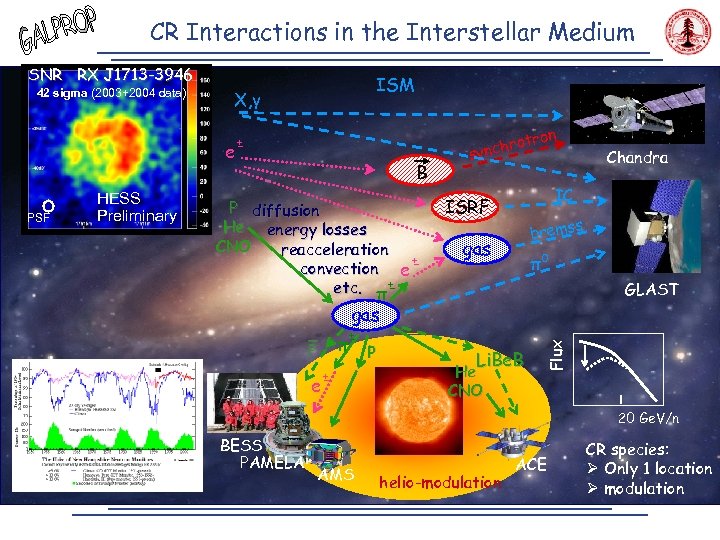 CR Interactions in the Interstellar Medium SNR RX J 1713 -3946 X, γ e PSF HESS Preliminary ISM tron + - B P diffusion He energy losses CNO reacceleration + convection e etc. π + ro synch Chandra IC ISRF s brems gas π0 GLAST gas _ P + π- p + e- Li. Be. B He CNO Flux 42 sigma (2003+2004 data) 20 Ge. V/n BESS PAMELA AMS helio-modulation ACE CR species: Ø Only 1 location Ø modulation
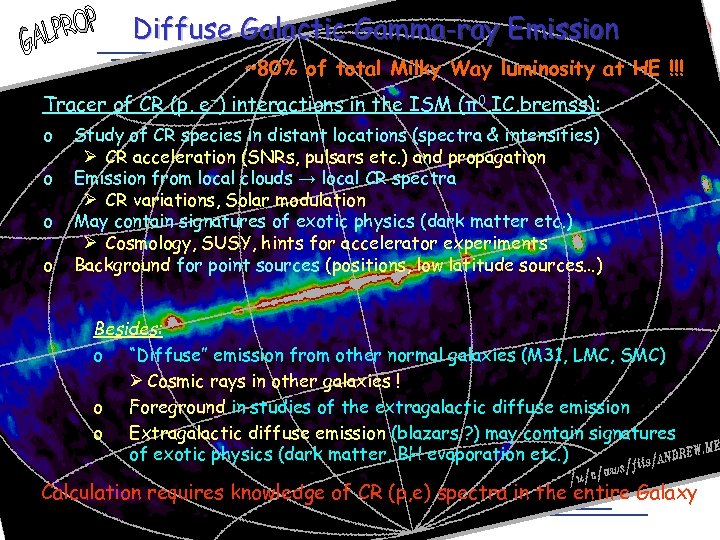 Diffuse Galactic Gamma-ray Emission ~80% of total Milky Way luminosity at HE !!! Tracer of CR (p, e−) interactions in the ISM (π0, IC, bremss): o o Study of CR species in distant locations (spectra & intensities) Ø CR acceleration (SNRs, pulsars etc. ) and propagation Emission from local clouds → local CR spectra Ø CR variations, Solar modulation May contain signatures of exotic physics (dark matter etc. ) Ø Cosmology, SUSY, hints for accelerator experiments Background for point sources (positions, low latitude sources…) Besides: o “Diffuse” emission from other normal galaxies (M 31, LMC, SMC) Ø Cosmic rays in other galaxies ! o Foreground in studies of the extragalactic diffuse emission o Extragalactic diffuse emission (blazars ? ) may contain signatures of exotic physics (dark matter, BH evaporation etc. ) Calculation requires knowledge of CR (p, e) spectra in the entire Galaxy
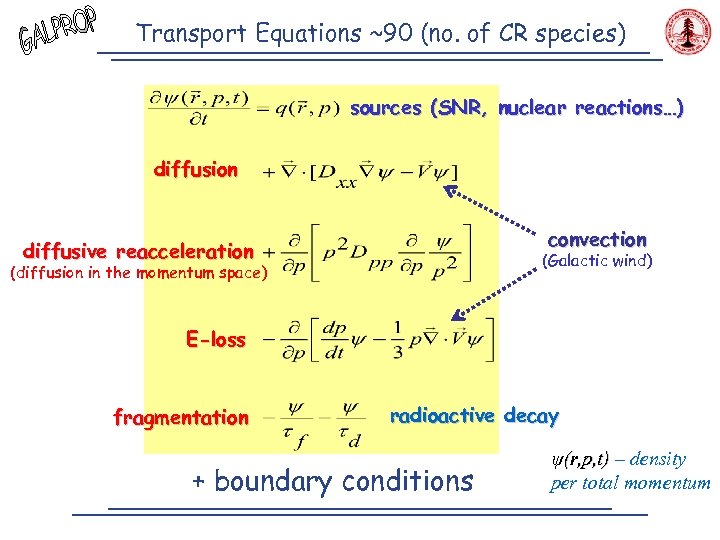 Transport Equations ~90 (no. of CR species) sources (SNR, nuclear reactions…) diffusion convection diffusive reacceleration (Galactic wind) (diffusion in the momentum space) E-loss fragmentation radioactive decay + boundary conditions ψ(r, p, t) – density per total momentum
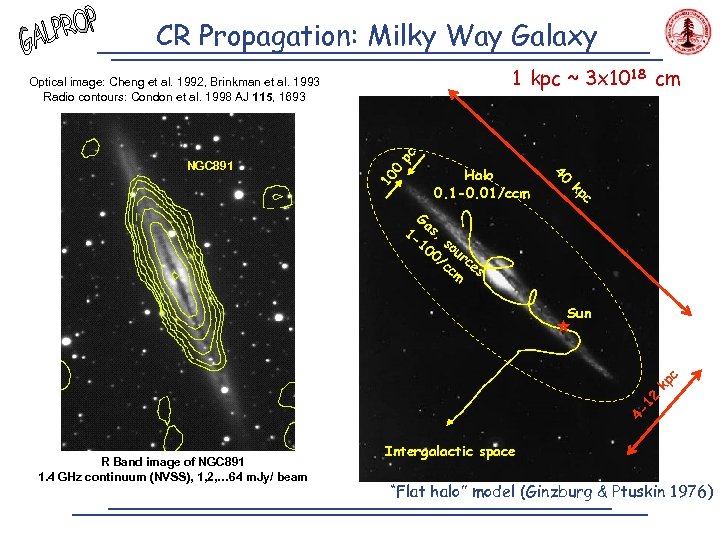 CR Propagation: Milky Way Galaxy 1 kpc ~ 3 x 1018 cm 0 10 NGC 891 pc Optical image: Cheng et al. 1992, Brinkman et al. 1993 Radio contours: Condon et al. 1998 AJ 115, 1693 Halo 0. 1 -0. 01/ccm 40 kp c Ga 1 - s, 10 so 0/ urc cc es m 4 - 12 kp c Sun R Band image of NGC 891 1. 4 GHz continuum (NVSS), 1, 2, … 64 m. Jy/ beam Intergalactic space “Flat halo” model (Ginzburg & Ptuskin 1976)
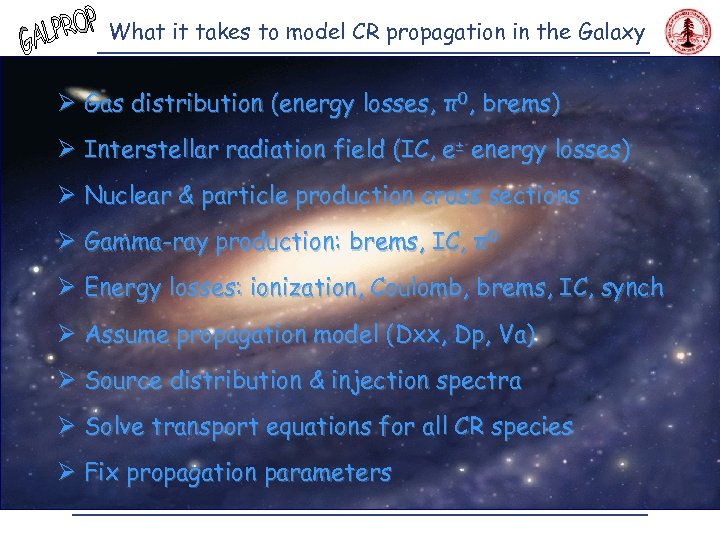 What it takes to model CR propagation in the Galaxy Ø Gas distribution (energy losses, π0, brems) Ø Interstellar radiation field (IC, e± energy losses) Ø Nuclear & particle production cross sections Ø Gamma-ray production: brems, IC, π0 Ø Energy losses: ionization, Coulomb, brems, IC, synch Ø Assume propagation model (Dxx, Dp, Va) Ø Source distribution & injection spectra Ø Solve transport equations for all CR species Ø Fix propagation parameters
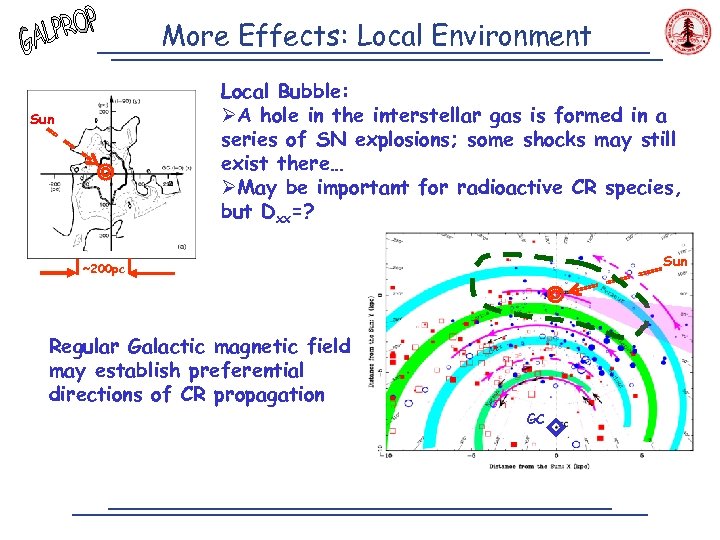 More Effects: Local Environment Local Bubble: ØA hole in the interstellar gas is formed in a series of SN explosions; some shocks may still exist there… ØMay be important for radioactive CR species, but Dxx=? Sun ~200 pc Regular Galactic magnetic field may establish preferential directions of CR propagation GC
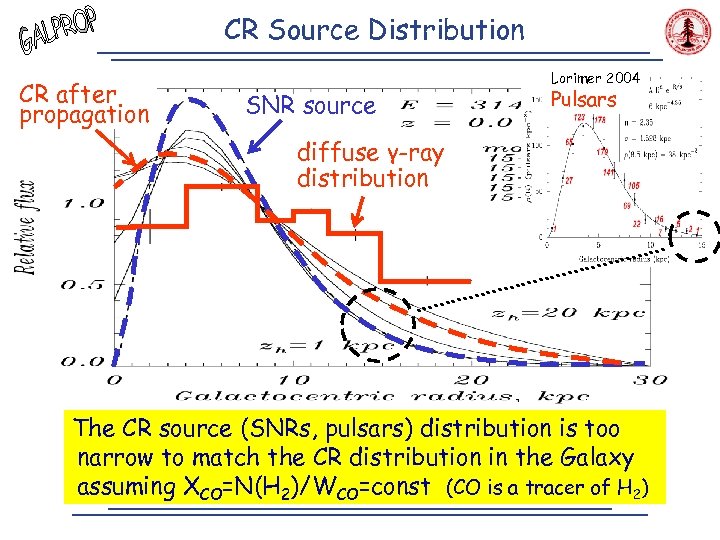 CR Source Distribution CR after propagation SNR source Lorimer 2004 Pulsars diffuse γ-ray distribution The CR source (SNRs, pulsars) distribution is too narrow to match the CR distribution in the Galaxy assuming XCO=N(H 2)/WCO=const (CO is a tracer of H 2)
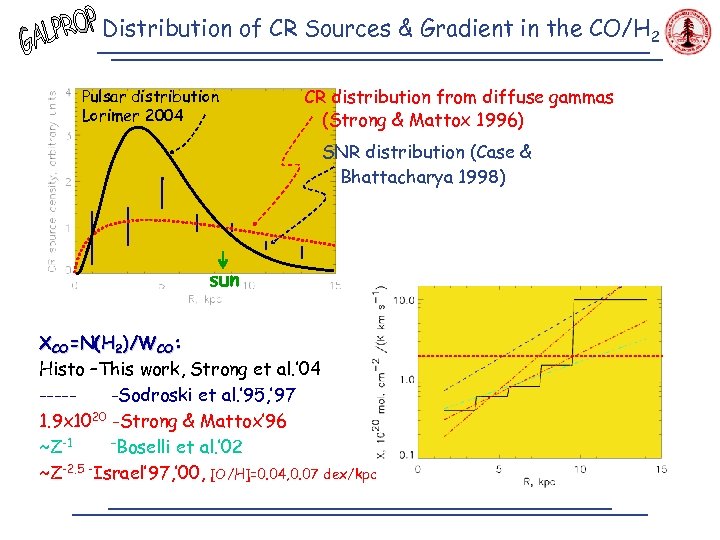 Distribution of CR Sources & Gradient in the CO/H 2 Pulsar distribution Lorimer 2004 CR distribution from diffuse gammas (Strong & Mattox 1996) SNR distribution (Case & Bhattacharya 1998) sun XCO=N(H 2)/WCO: Histo –This work, Strong et al. ’ 04 -----Sodroski et al. ’ 95, ’ 97 1. 9 x 10²⁰ -Strong & Mattox’ 96 –Boselli et al. ’ 02 ~Z-1 ~Z-2. 5 -Israel’ 97, ’ 00, [O/H]=0. 04, 0. 07 dex/kpc
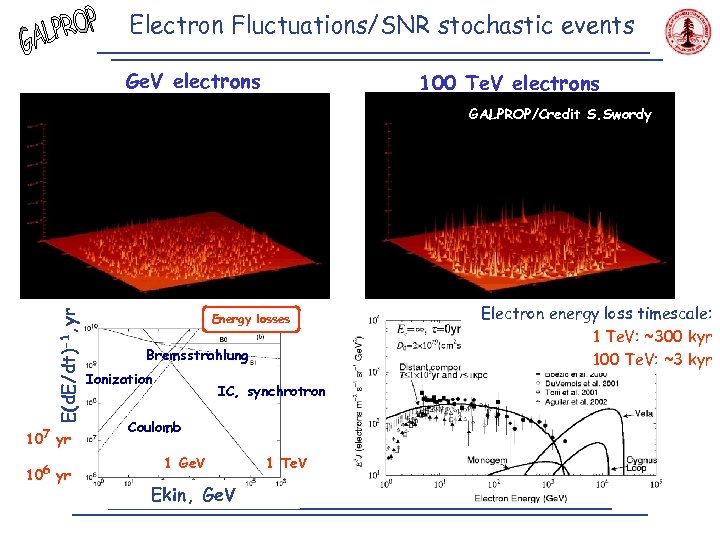 Electron Fluctuations/SNR stochastic events Ge. V electrons 100 Te. V electrons E(d. E/dt)-1, yr GALPROP/Credit S. Swordy 107 yr 106 yr Energy losses Bremsstrahlung Ionization IC, synchrotron Coulomb 1 Ge. V Ekin, Ge. V 1 Te. V Electron energy loss timescale: 1 Te. V: ~300 kyr 100 Te. V: ~3 kyr
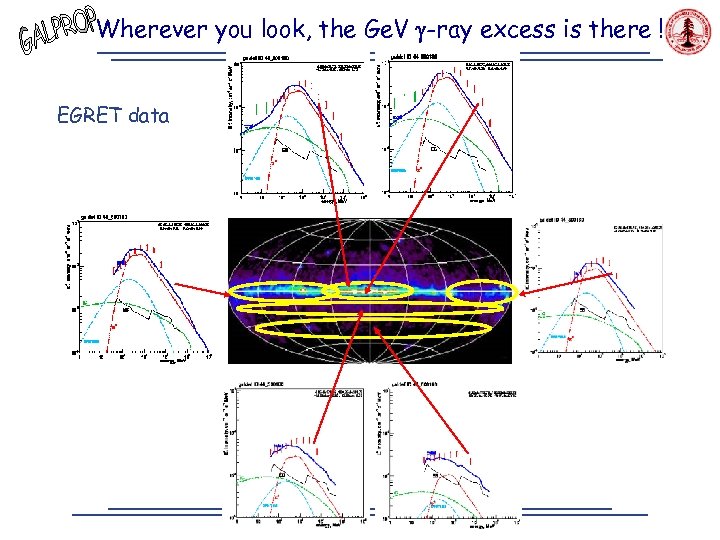 Wherever you look, the Ge. V -ray excess is there ! EGRET data 4 a-f
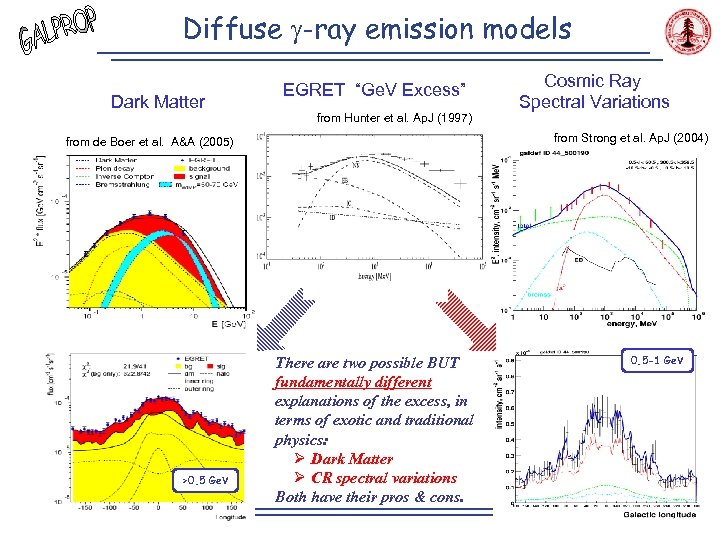 Diffuse g-ray emission models Dark Matter EGRET “Ge. V Excess” from Hunter et al. Ap. J (1997) from Strong et al. Ap. J (2004) from de Boer et al. A&A (2005) >0. 5 Ge. V Cosmic Ray Spectral Variations There are two possible BUT fundamentally different explanations of the excess, in terms of exotic and traditional physics: Ø Dark Matter Ø CR spectral variations Both have their pros & cons. 0. 5 -1 Ge. V
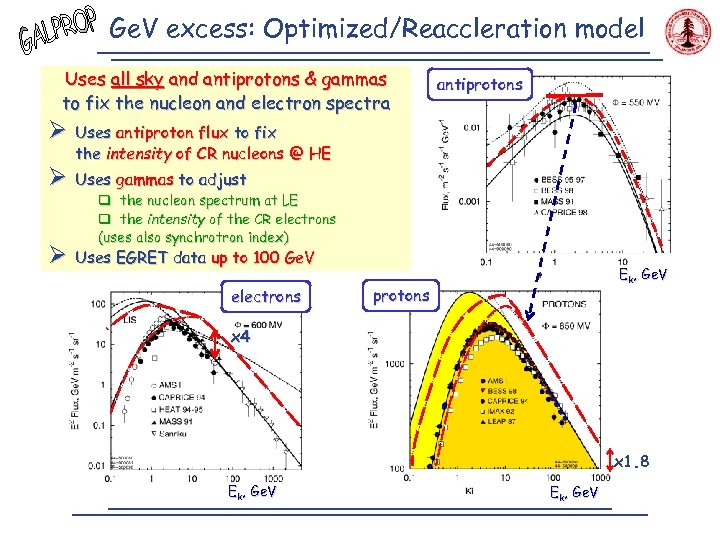 Ge. V excess: Optimized/Reaccleration model Uses all sky and antiprotons & gammas to fix the nucleon and electron spectra antiprotons Ø Uses antiproton flux to fix the intensity of CR nucleons @ HE Ø Uses gammas to adjust q the nucleon spectrum at LE q the intensity of the CR electrons (uses also synchrotron index) Ø Uses EGRET data up to 100 Ge. V electrons Ek, Ge. V protons x 4 x 1. 8 Ek, Ge. V
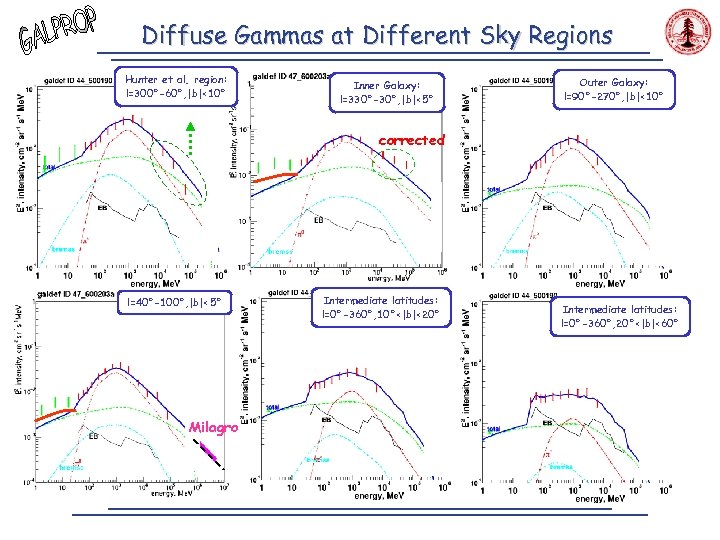 Diffuse Gammas at Different Sky Regions Hunter et al. region: l=300°-60°, |b|<10° Inner Galaxy: l=330°-30°, |b|<5° Outer Galaxy: l=90°-270°, |b|<10° corrected l=40°-100°, |b|<5° Milagro Intermediate latitudes: l=0°-360°, 10°<|b|<20° Intermediate latitudes: l=0°-360°, 20°<|b|<60°
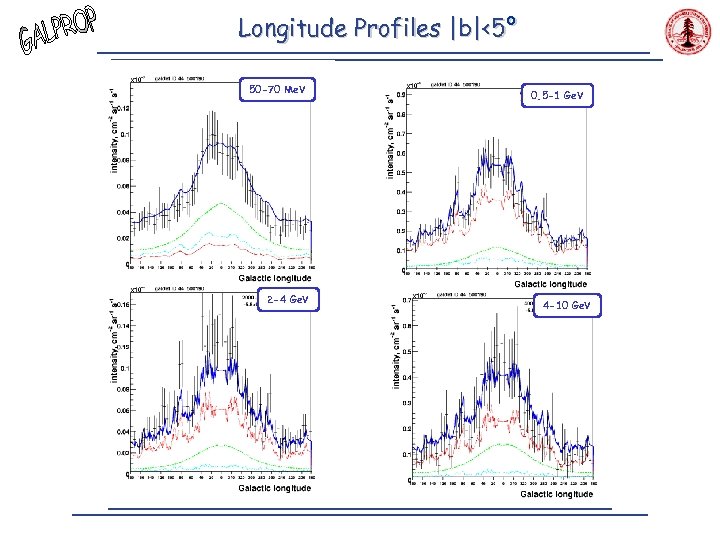 Longitude Profiles |b|<5° 50 -70 Me. V 2 -4 Ge. V 0. 5 -1 Ge. V 4 -10 Ge. V
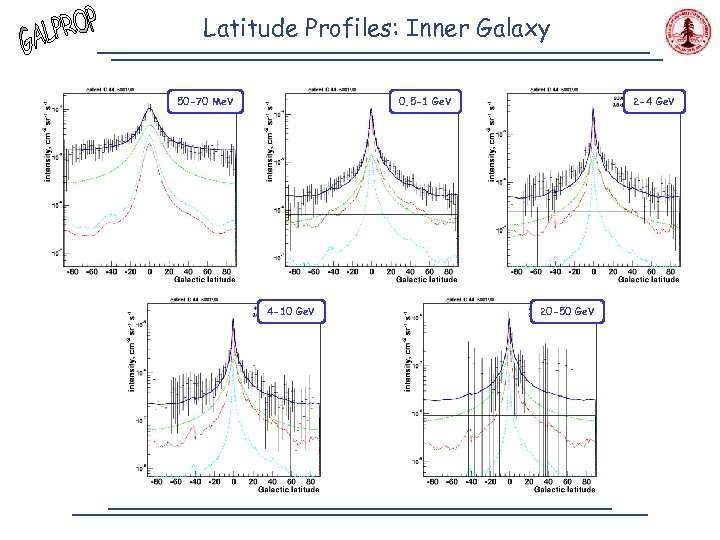 Latitude Profiles: Inner Galaxy 0. 5 -1 Ge. V 50 -70 Me. V 4 -10 Ge. V 2 -4 Ge. V 20 -50 Ge. V
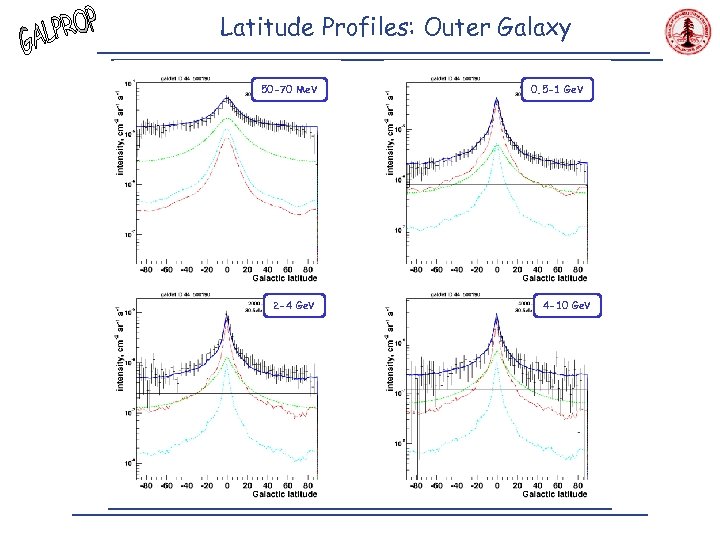 Latitude Profiles: Outer Galaxy 50 -70 Me. V 2 -4 Ge. V 0. 5 -1 Ge. V 4 -10 Ge. V
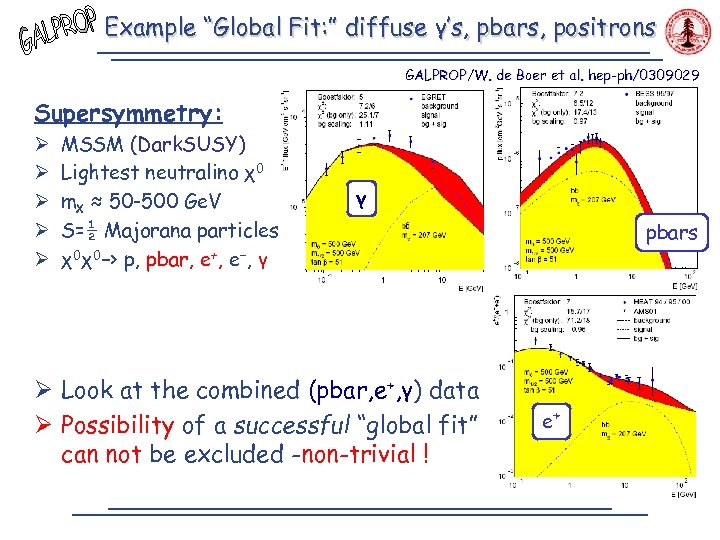 Example “Global Fit: ” diffuse γ’s, pbars, positrons GALPROP/W. de Boer et al. hep-ph/0309029 Supersymmetry: Ø Ø Ø MSSM (Dark. SUSY) Lightest neutralino χ0 mχ ≈ 50 -500 Ge. V S=½ Majorana particles χ0χ0−> p, pbar, e+, e−, γ γ Ø Look at the combined (pbar, e+, γ) data Ø Possibility of a successful “global fit” can not be excluded -non-trivial ! pbars e+
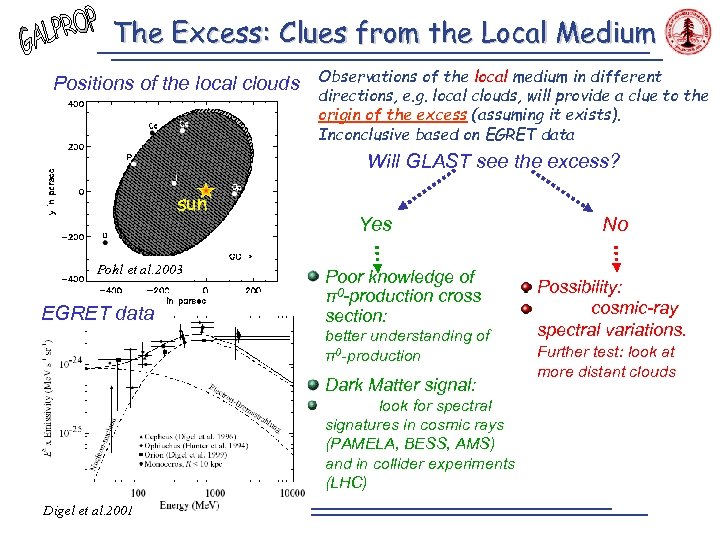 The Excess: Clues from the Local Medium Positions of the local clouds Observations of the local medium in different directions, e. g. local clouds, will provide a clue to the origin of the excess (assuming it exists). Inconclusive based on EGRET data Will GLAST see the excess? sun Pohl et al. 2003 EGRET data Yes Poor knowledge of π0 -production cross section: better understanding of π0 -production Dark Matter signal: look for spectral signatures in cosmic rays (PAMELA, BESS, AMS) and in collider experiments (LHC) Digel et al. 2001 No Possibility: cosmic-ray spectral variations. Further test: look at more distant clouds