


 Скачать презентацию GALEX Science Operations Center Mission Planning Karl Forster
d83548f45bb98094cfcdd35c78fe372c.ppt
- Количество слайдов: 27
 GALEX Science Operations Center Mission Planning Karl Forster June 29 th 2006 GALEX Operations Review Karl Forster
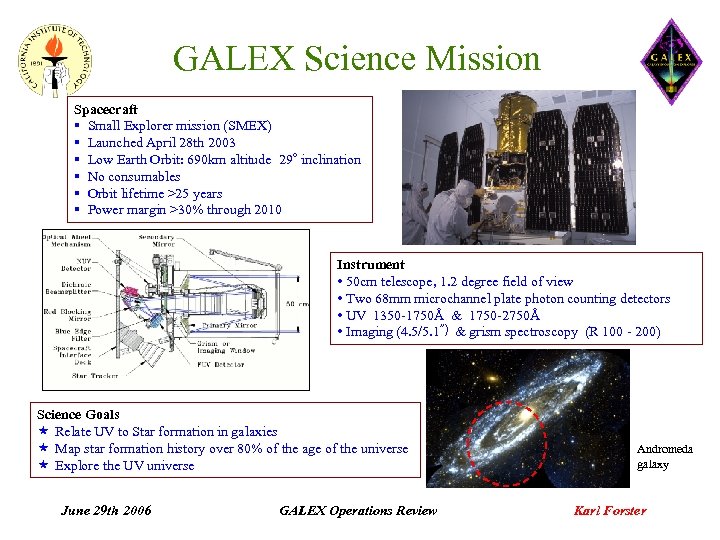 GALEX Science Mission Spacecraft § Small Explorer mission (SMEX) § Launched April 28 th 2003 § Low Earth Orbit: 690 km altitude 29 o inclination § No consumables § Orbit lifetime >25 years § Power margin >30% through 2010 Instrument • 50 cm telescope, 1. 2 degree field of view • Two 68 mm microchannel plate photon counting detectors • UV 1350 -1750Å & 1750 -2750Å • Imaging (4. 5/5. 1”) & grism spectroscopy (R 100 - 200) Science Goals Relate UV to Star formation in galaxies Map star formation history over 80% of the age of the universe Explore the UV universe June 29 th 2006 GALEX Operations Review Andromeda galaxy Karl Forster
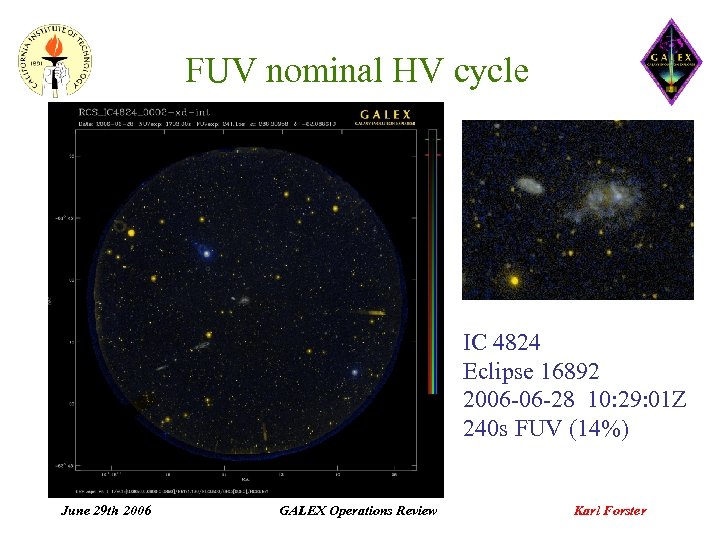 FUV nominal HV cycle IC 4824 Eclipse 16892 2006 -06 -28 10: 29: 01 Z 240 s FUV (14%) June 29 th 2006 GALEX Operations Review Karl Forster
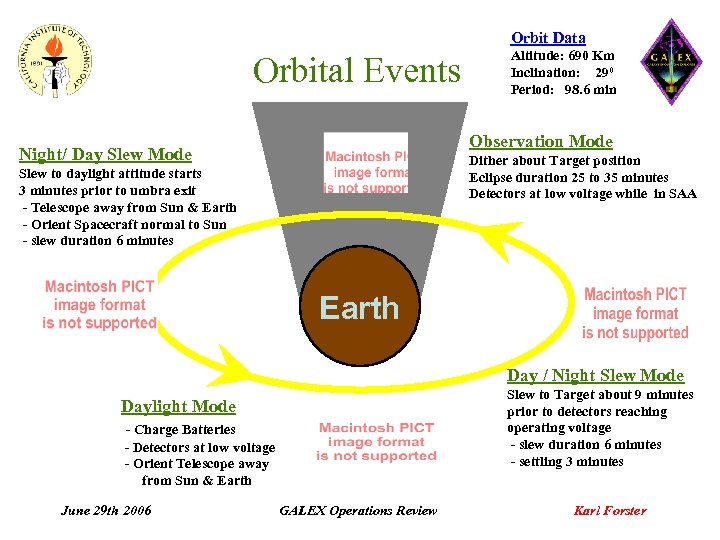 Orbit Data Orbital Events Altitude: 690 Km Inclination: 290 Period: 98. 6 min Observation Mode Night/ Day Slew Mode Dither about Target position Eclipse duration 25 to 35 minutes Detectors at low voltage while in SAA Slew to daylight attitude starts 3 minutes prior to umbra exit - Telescope away from Sun & Earth - Orient Spacecraft normal to Sun - slew duration 6 minutes Earth Day / Night Slew Mode Slew to Target about 9 minutes prior to detectors reaching operating voltage - slew duration 6 minutes - settling 3 minutes Daylight Mode - Charge Batteries - Detectors at low voltage - Orient Telescope away from Sun & Earth June 29 th 2006 GALEX Operations Review Karl Forster
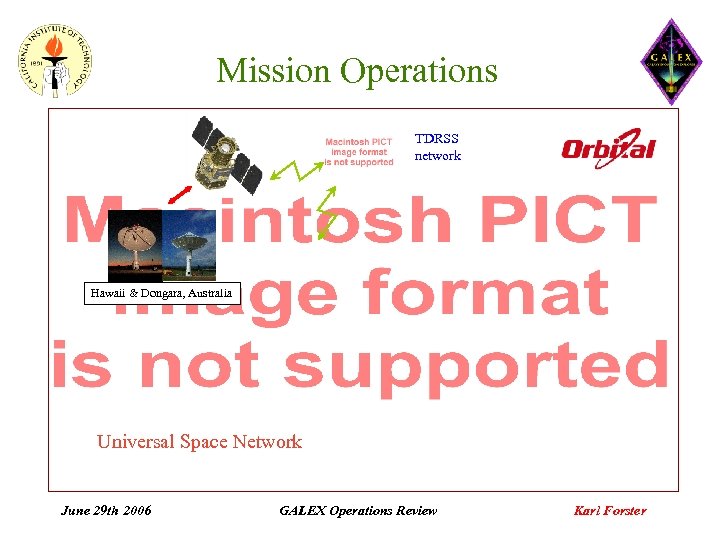 Mission Operations TDRSS network Hawaii & Dongara, Australia Universal Space Network June 29 th 2006 GALEX Operations Review Karl Forster
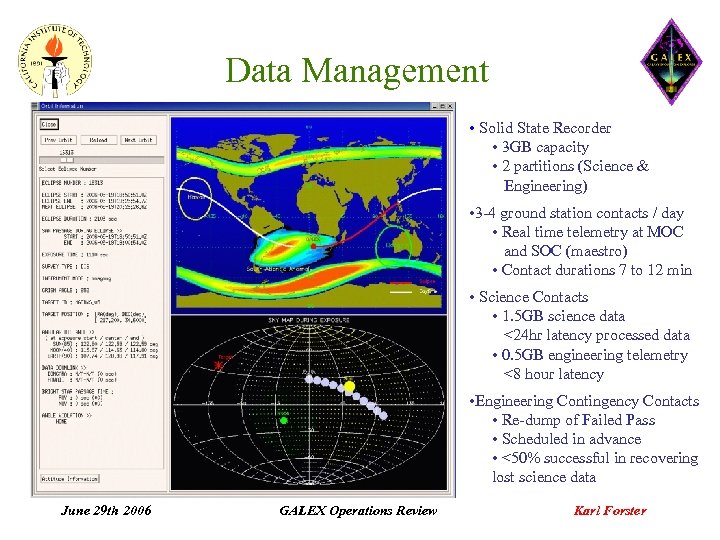 Data Management • Solid State Recorder • 3 GB capacity • 2 partitions (Science & Engineering) • 3 -4 ground station contacts / day • Real time telemetry at MOC and SOC (maestro) • Contact durations 7 to 12 min • Science Contacts • 1. 5 GB science data <24 hr latency processed data • 0. 5 GB engineering telemetry <8 hour latency • Engineering Contingency Contacts • Re-dump of Failed Pass • Scheduled in advance • <50% successful in recovering lost science data June 29 th 2006 GALEX Operations Review Karl Forster
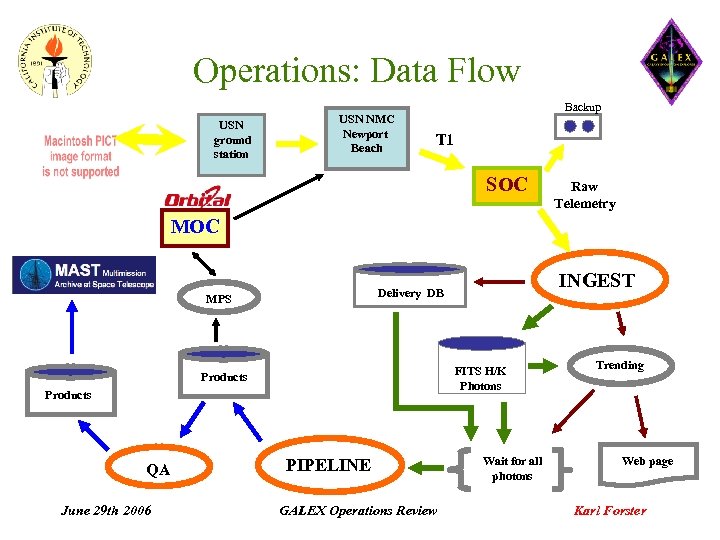 Operations: Data Flow USN ground station USN NMC Newport Beach Backup T 1 SOC Raw Telemetry MOC MPS FITS H/K Photons Products QA June 29 th 2006 INGEST Delivery DB PIPELINE GALEX Operations Review Wait for all photons Trending Web page Karl Forster
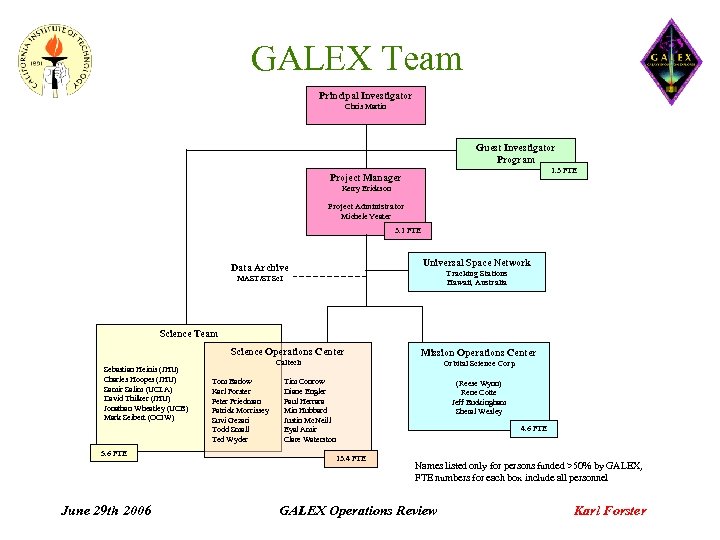 GALEX Team Principal Investigator Chris Martin Guest Investigator Program 1. 3 FTE Project Manager Kerry Erickson Project Administrator Michele Yeater 3. 1 FTE Universal Space Network Data Archive Tracking Stations Hawaii, Australia MAST/STSc. I Science Team Science Operations Center Sebastian Heinis (JHU) Charles Hoopes (JHU) Samir Salim (UCLA) David Thilker (JHU) Jonathan Wheatley (UCB) Mark Seibert (OCIW) 5. 6 FTE June 29 th 2006 Caltech Tom Barlow Karl Forster Peter Friedman Patrick Morrissey Suvi Gezari Todd Small Ted Wyder Mission Operations Center Orbital Science Corp Tim Conrow Diane Engler Paul Herrara Min Hubbard Justin Mc. Neill Eyal Amir Clare Waterston (Reese Wynn) Rene Cotte Jeff Buckingham Sheral Wesley 4. 6 FTE 13. 4 FTE Names listed only for persons funded >50% by GALEX, FTE numbers for each box include all personnel GALEX Operations Review Karl Forster
 MOC Mission Planning (RW) June 29 th 2006 GALEX Operations Review Karl Forster
 GALEX Science Operations Center • Caltech Campus, Pasadena, CA • Mission Planning Activities – – • • Target selection - KF (DS) Observe file generation - PH (KF, EA, JM) Safety checks - PH, KF (DS, KE) Raw telemetry backup - DE (KF, TC) Instrument health and safety - PM (FS + science team) Pipeline processing - TC, CW (TB) Telemetry Trending - KF QA - MH (CW + Science Team) June 29 th 2006 GALEX Operations Review Karl Forster
 SOC MPS • • • Command line driven (Linux OS) C++ IDL Perl (Postgre. SQL) Shell scripts call modular code elements Controlled by p arameter files Safety checks – At many points in observe file (obs) generation procedure – Absolute Time Sequence (ATS) file generated by MOC from obs – ATS approval meeting reviews remaining issues before upload • Planning cycle – Long Range - 60 days ~every week – Pre-planning, contact selection - 2 weeks – Short Range - weekly (as designed!) June 29 th 2006 GALEX Operations Review ~every week Karl Forster
 SOC MPS procedure (PH) June 29 th 2006 GALEX Operations Review Karl Forster
 Operations issues • • Long Range Planning SSR management / Contact selection (USN) MOC / SOC interface Contingency pass success? – VC 18 redump during contingency passes – More accurate SSR slice redump • • Planning cycle adjustments Relaxing instrument limits? Hardware & software upgrades Science mission efficiency June 29 th 2006 GALEX Operations Review Karl Forster
 Long Range (Target Planning) Issues • Update Bright Star catalog – Improve Estimated count rates (SDSS GALEX) – Include gain sag – GALEX measured countrates • Target Planning – Bright star exclusion from central 10 arcmin – Auto AIS allocation to SAA eclipses • Match exposure times used in long range planning to those created in short range planning (GNAT 143) more efficient eclipse allocation • Need major code upgrade for time domain survey planning June 29 th 2006 GALEX Operations Review Karl Forster
 SSR Management Issues • Inaccurate data volume (dvf photon rate) estimates – – – 110% NUV 75% FUV Inefficient SSR use and contact selection issues Historical fluxes Error warning when dvf total photons > count rate limit Duplicate star counting • Manual contact selection – Time consuming (longest process in observe file generation) • New SSR management and contact selection tool (Min H. ) – IDL widget code cf QATOOL (sap 2 dtf, reportssr, dtf 2 pcf, chkcon) – Visibility into target, eclipse, potential contacts, contact conflicts – To be efficient we will require regular standardized updates of the USHI/AUWA contact schedule from USN – Send. sap to USN? June 29 th 2006 GALEX Operations Review Karl Forster
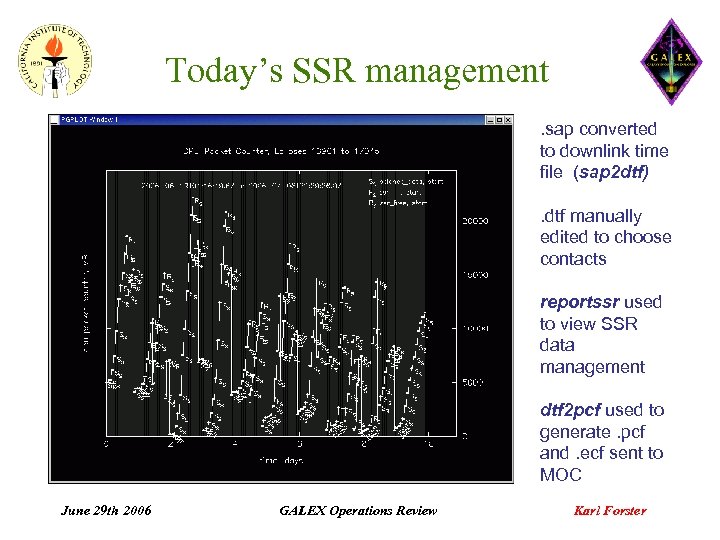 Today’s SSR management. sap converted to downlink time file (sap 2 dtf). dtf manually edited to choose contacts reportssr used to view SSR data management dtf 2 pcf used to generate. pcf and. ecf sent to MOC June 29 th 2006 GALEX Operations Review Karl Forster
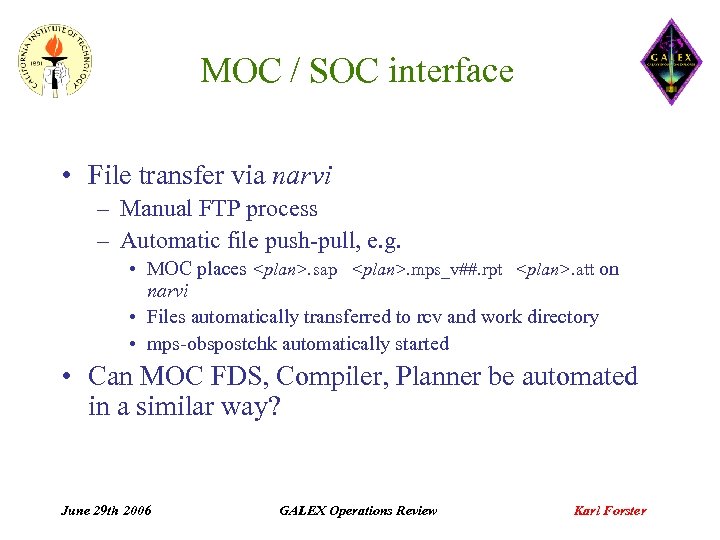 MOC / SOC interface • File transfer via narvi – Manual FTP process – Automatic file push-pull, e. g. • MOC places
 Planning Cycle adjustments • Whither obp? – Return to 2 week planning cycle – Improved USN information flow for 2 week contact selection – Do we need an obp? • Whence Long Range Plan? – Time domain survey may impose restrictions on target/eclipse assignment so LRP needs to become fixed for ## days – E. g. LSST can replan their entire survey in 6 hrs of cpu • Wherefore To. O? – Advertised response time is 10 days but To. O’s have been achieved within 5 days (SN 2005 ay) – Community interest in faster response – Minimum CPU time to generate obs file (inc. file push/pull)? – TDRSS for ATS and switch time load? June 29 th 2006 GALEX Operations Review Karl Forster
 Instrument limit adjustment • Moon avoidance angle (OECR 40) – Reduce from 40 o to ~20 o – Improved target visibility probably required for TDS – SAA, Earth limb avoidance reduction? • Detector countrate limits – FUV to 30 k/100 k NUV to 30 k/150 k? • Optical wheel motion within eclipse – Imaging/grism in single eclipse (FS, MOC, SOC, pipeline) • Dayside FUV operations – Galactic plane FUV slew survey (can we dither on dayside? ) June 29 th 2006 GALEX Operations Review Karl Forster
 Hardware Software upgrades • OS to Redhat Enterprise • Document server – Project documents are not collected in one place – CVS for documents? June 29 th 2006 GALEX Operations Review Karl Forster
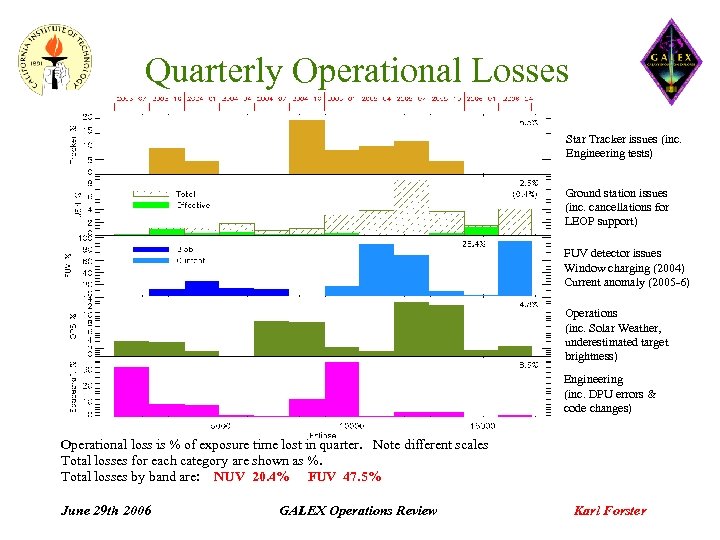 Quarterly Operational Losses Star Tracker issues (inc. Engineering tests) Ground station issues (inc. cancellations for LEOP support) FUV detector issues Window charging (2004) Current anomaly (2005 -6) Operations (inc. Solar Weather, underestimated target brightness) Engineering (inc. DPU errors & code changes) Operational loss is % of exposure time lost in quarter. Note different scales Total losses for each category are shown as %. Total losses by band are: NUV 20. 4% FUV 47. 5% June 29 th 2006 GALEX Operations Review Karl Forster
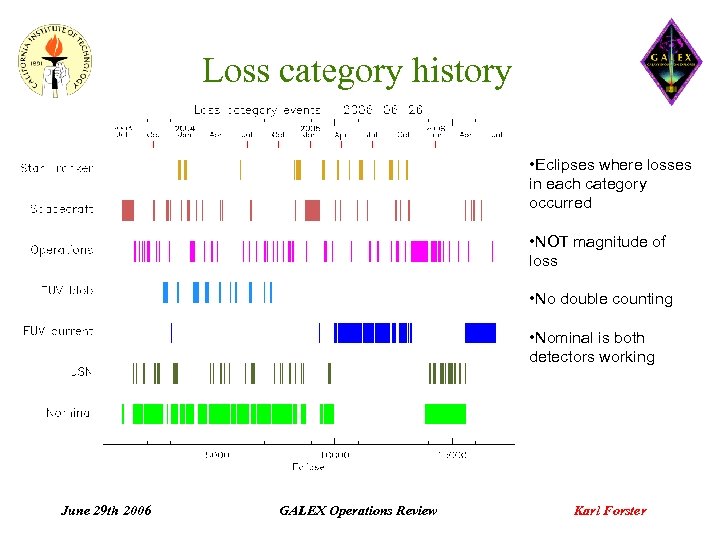 Loss category history • Eclipses where losses in each category occurred • NOT magnitude of loss • No double counting • Nominal is both detectors working June 29 th 2006 GALEX Operations Review Karl Forster
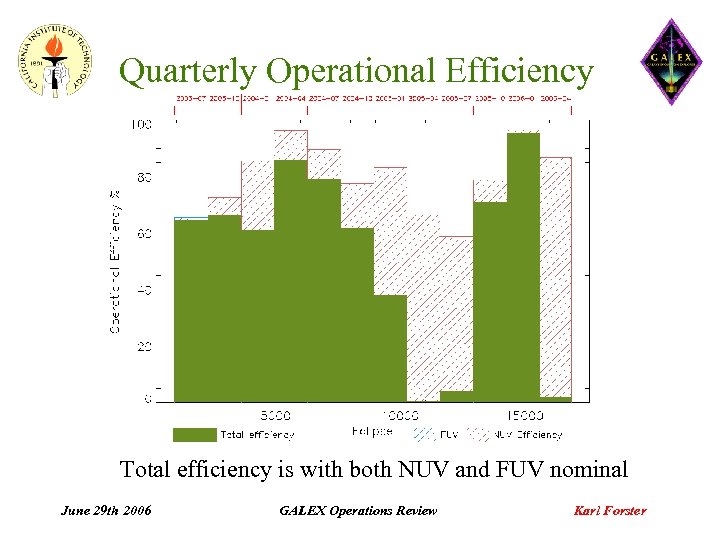 Quarterly Operational Efficiency Total efficiency is with both NUV and FUV nominal June 29 th 2006 GALEX Operations Review Karl Forster
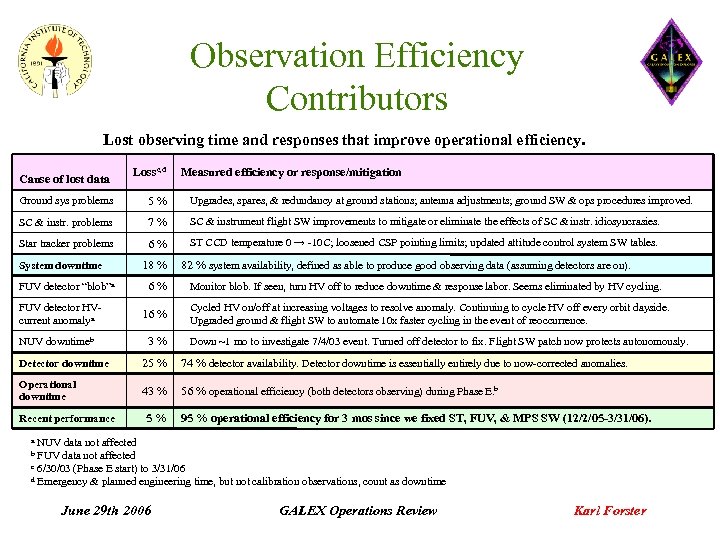 Observation Efficiency Contributors Lost observing time and responses that improve operational efficiency. Cause of lost data Lossc, d Measured efficiency or response/mitigation Ground sys problems 5% Upgrades, spares, & redundancy at ground stations; antenna adjustments; ground SW & ops procedures improved. SC & instr. problems 7% SC & instrument flight SW improvements to mitigate or eliminate the effects of SC & instr. idiosyncrasies. Star tracker problems 6% ST CCD temperature 0 → -10 C; loosened CSP pointing limits; updated attitude control system SW tables. System downtime FUV detector “blob”a FUV detector HVcurrent anomalya NUV downtimeb 18 % 6% 16 % 3% 82 % system availability, defined as able to produce good observing data (assuming detectors are on). Monitor blob. If seen, turn HV off to reduce downtime & response labor. Seems eliminated by HV cycling. Cycled HV on/off at increasing voltages to resolve anomaly. Continuing to cycle HV off every orbit dayside. Upgraded ground & flight SW to automate 10 x faster cycling in the event of reoccurrence. Down ~1 mo to investigate 7/4/03 event. Turned off detector to fix. Flight SW patch now protects autonomously. Detector downtime 25 % 74 % detector availability. Detector downtime is essentially entirely due to now-corrected anomalies. Operational downtime 43 % 56 % operational efficiency (both detectors observing) during Phase E. b Recent performance 5% 95 % operational efficiency for 3 mos since we fixed ST, FUV, & MPS SW (12/2/05 -3/31/06). NUV data not affected FUV data not affected c 6/30/03 (Phase E start) to 3/31/06 d Emergency & planned engineering time, but not calibration observations, count as downtime a b June 29 th 2006 GALEX Operations Review Karl Forster
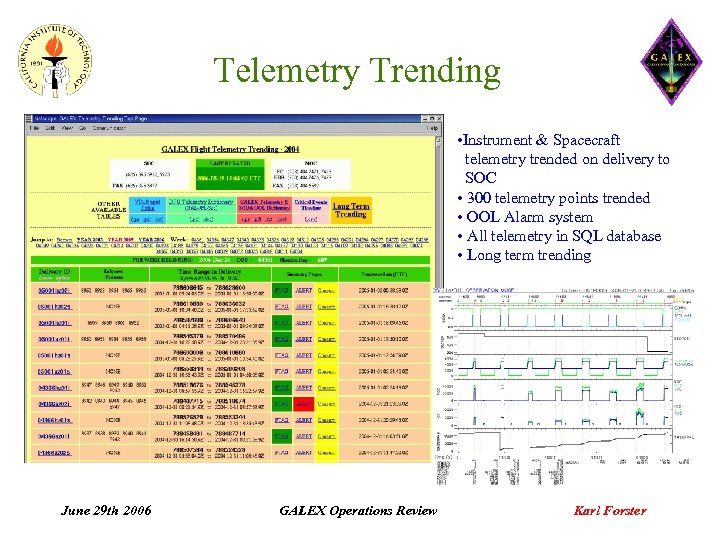 Telemetry Trending • Instrument & Spacecraft telemetry trended on delivery to SOC • 300 telemetry points trended • OOL Alarm system • All telemetry in SQL database • Long term trending June 29 th 2006 GALEX Operations Review Karl Forster
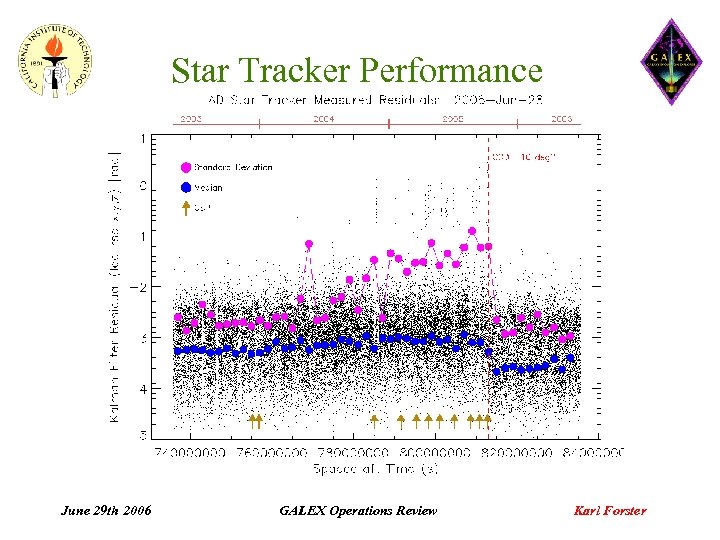 Star Tracker Performance June 29 th 2006 GALEX Operations Review Karl Forster
 Future • • • OECR 40 moon avoidance angle SOC GNATS closed Upgrades to SOC SSR/Contact management SOC MPS bi-weekly meetings Time domain survey need to be implemented by Oct 2007 • Task list with benefit in flexibility data efficiency, labor cost (automation), and risk document on Todds wiggy June 29 th 2006 GALEX Operations Review Karl Forster