Скачать презентацию Galaxies and AGNs — Four decades ago idea
0b27c1c1ac0fa00197150ea71e7f4e6a.ppt
- Количество слайдов: 18
 Galaxies and AGNs - Four decades ago, idea that accretion of matter onto a supermassive black hole (SMBH) >10^6 Msun powers luminous active galactic muclei (AGN), in particular quasi-stellar objects (QSO) - Dynamical evidence that SMBH pervade the centers of most massive galaxies -Challenge is now to understand the fueling and evolution of AGNs, and how they relate to host galaxies and their evolution - Why not all relatively massive galaxies show AGN activity, while they harbor SBMH? - What is role of internal galactic structure and environment?
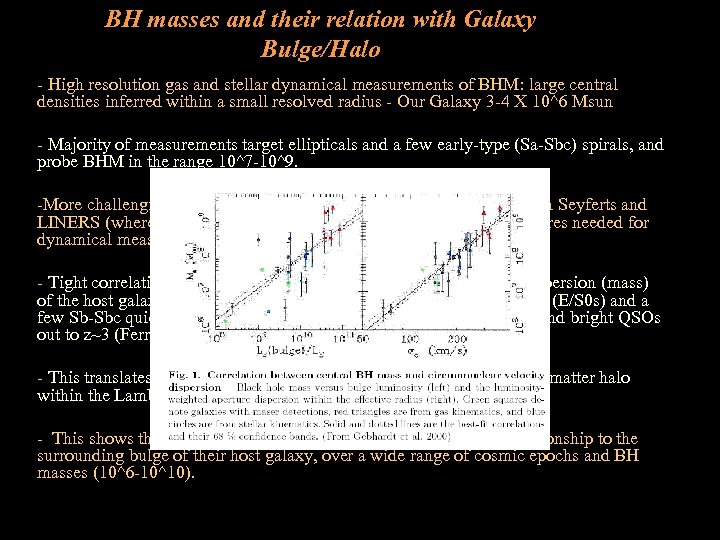 BH masses and their relation with Galaxy Bulge/Halo - High resolution gas and stellar dynamical measurements of BHM: large central densities inferred within a small resolved radius - Our Galaxy 3 -4 X 10^6 Msun - Majority of measurements target ellipticals and a few early-type (Sa-Sbc) spirals, and probe BHM in the range 10^7 -10^9. -More challenging measurements in late-type spirals and dwarfs, and in Seyferts and LINERS (where the bright active nucleus hides the spectroscopic features needed for dynamical measurements) - Tight correlation between mass of central BH and stellar velocity dispersion (mass) of the host galaxy’s bulge. This originally measured in local early-type (E/S 0 s) and a few Sb-Sbc quiescent galaxies, then found to hold also in AGN hosts and bright QSOs out to z~3 (Ferrarese et al. 2001, Shields et al. 2003). - This translates into a relation between BH mass and mass of the dark matter halo within the Lambda. CDM paradigm - This shows that both active and quiescent BHs bear a common relationship to the surrounding bulge of their host galaxy, over a wide range of cosmic epochs and BH masses (10^6 -10^10).
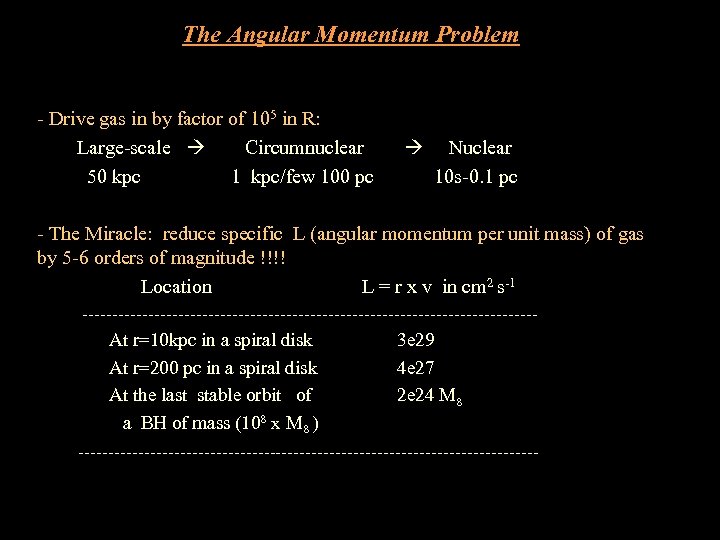 The Angular Momentum Problem - Drive gas in by factor of 105 in R: Large-scale Circumnuclear 50 kpc 1 kpc/few 100 pc Nuclear 10 s-0. 1 pc - The Miracle: reduce specific L (angular momentum per unit mass) of gas by 5 -6 orders of magnitude !!!! Location L = r x v in cm 2 s-1 -------------------------------------- At r=10 kpc in a spiral disk At r=200 pc in a spiral disk At the last stable orbit of a BH of mass (108 x M 8 ) 3 e 29 4 e 27 2 e 24 M 8 ---------------------------------------
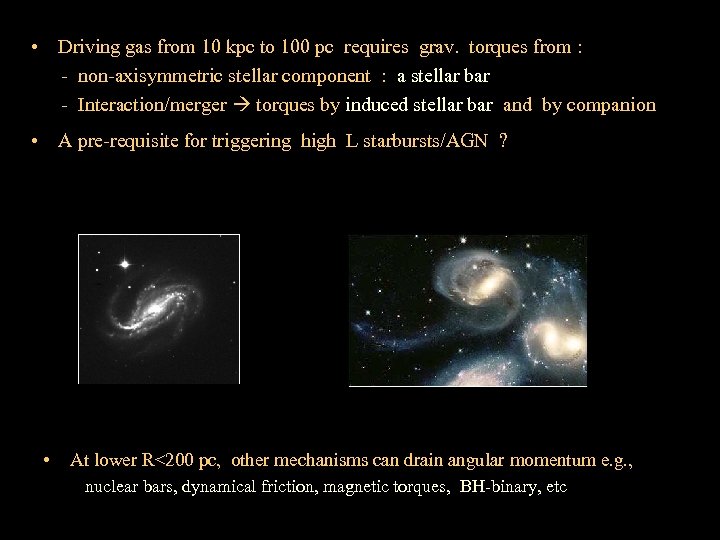 • Driving gas from 10 kpc to 100 pc requires grav. torques from : - non-axisymmetric stellar component : a stellar bar - Interaction/merger torques by induced stellar bar and by companion • A pre-requisite for triggering high L starbursts/AGN ? • At lower R<200 pc, other mechanisms can drain angular momentum e. g. , nuclear bars, dynamical friction, magnetic torques, BH-binary, etc
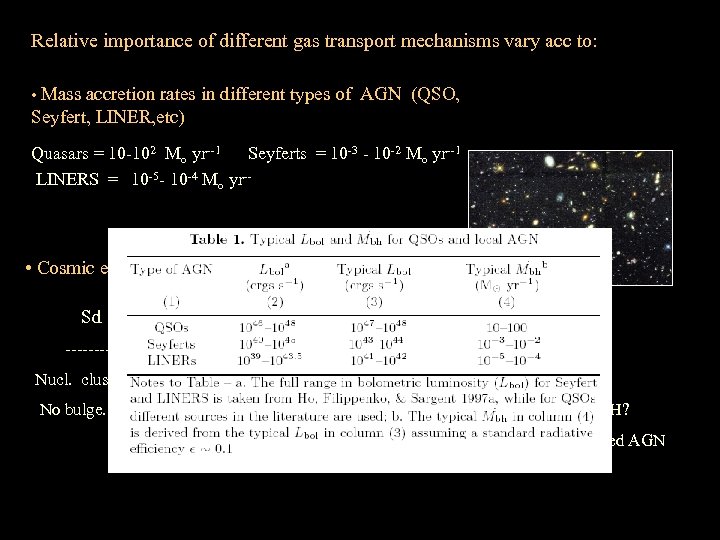 Relative importance of different gas transport mechanisms vary acc to: • Mass accretion rates in different types of AGN (QSO, Seyfert, LINER, etc) Quasars = 10 -102 Mo yr--1 Seyferts = 10 -3 - 10 -2 Mo yr--1 LINERS = 10 -5 - 10 -4 Mo yr-- • Cosmic epoch (z~0 vs z>>1) and Hubble type ? Sd ----- Scd Sc Sb ----------- > Sab Sa <-------------> Nucl. cluster - BH : if/when/how formed ? - SMBH—Bulge correlation No bulge. - Present-day secular evolution - z>>1: mergers build Bulges/BH? pseudo-bulges/compact disks? - z~0 : More ‘quiet’ drivers feed AGN
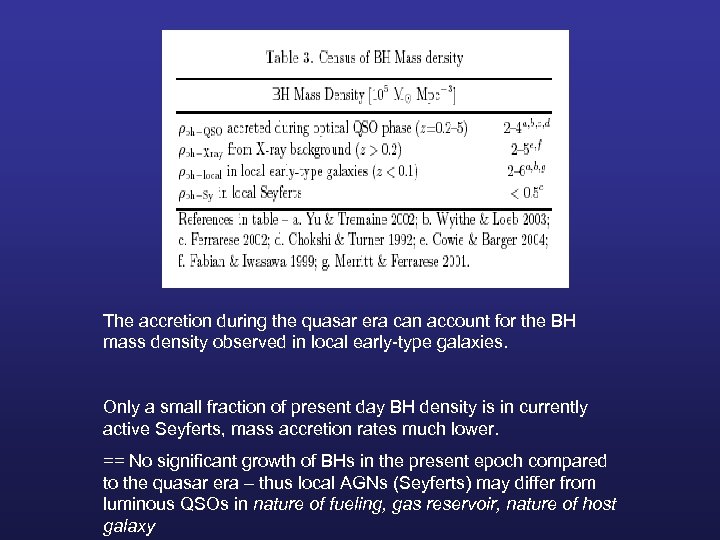 The accretion during the quasar era can account for the BH mass density observed in local early-type galaxies. Only a small fraction of present day BH density is in currently active Seyferts, mass accretion rates much lower. == No significant growth of BHs in the present epoch compared to the quasar era – thus local AGNs (Seyferts) may differ from luminous QSOs in nature of fueling, gas reservoir, nature of host galaxy
 AGN/Starbursts and Their Hosts
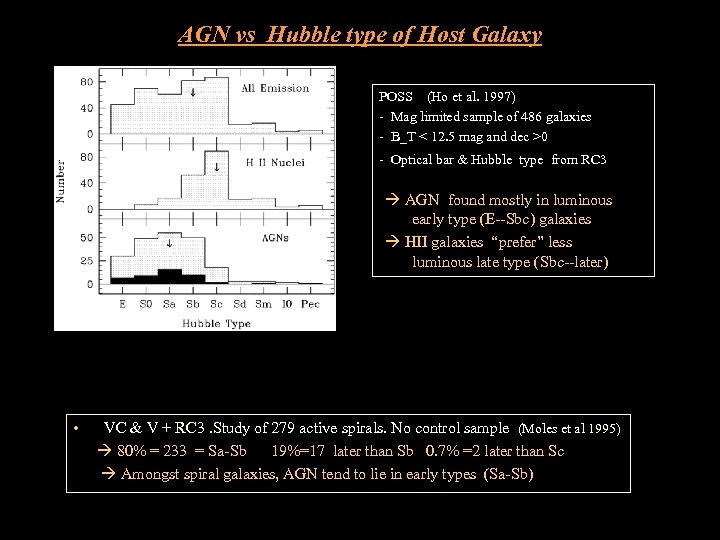 AGN vs Hubble type of Host Galaxy POSS (Ho et al. 1997) - Mag limited sample of 486 galaxies - B_T < 12. 5 mag and dec >0 - Optical bar & Hubble type from RC 3 AGN found mostly in luminous early type (E--Sbc) galaxies HII galaxies “prefer” less luminous late type (Sbc--later) • VC & V + RC 3. Study of 279 active spirals. No control sample (Moles et al 1995) 80% = 233 = Sa-Sb 19%=17 later than Sb 0. 7% =2 later than Sc Amongst spiral galaxies, AGN tend to lie in early types (Sa-Sb)
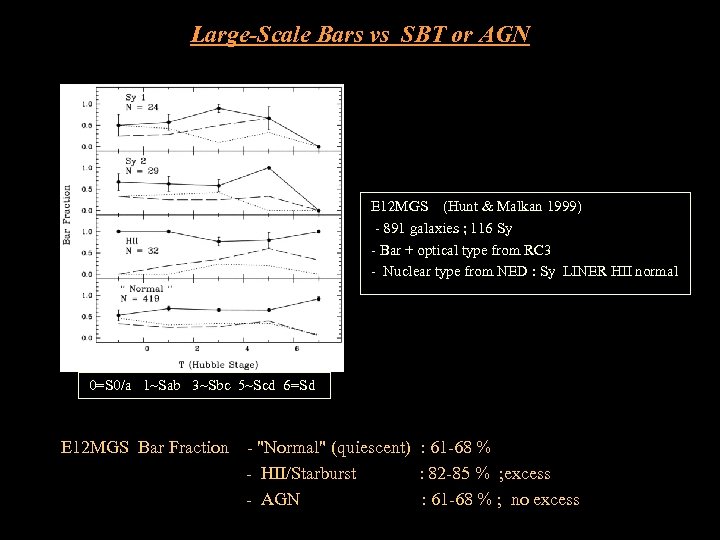 Large-Scale Bars vs SBT or AGN E 12 MGS (Hunt & Malkan 1999) - 891 galaxies ; 116 Sy - Bar + optical type from RC 3 - Nuclear type from NED : Sy LINER HII normal 0=S 0/a 1~Sab 3~Sbc 5~Scd 6=Sd E 12 MGS Bar Fraction - "Normal" (quiescent) : 61 -68 % - HII/Starburst : 82 -85 % ; excess - AGN : 61 -68 % ; no excess
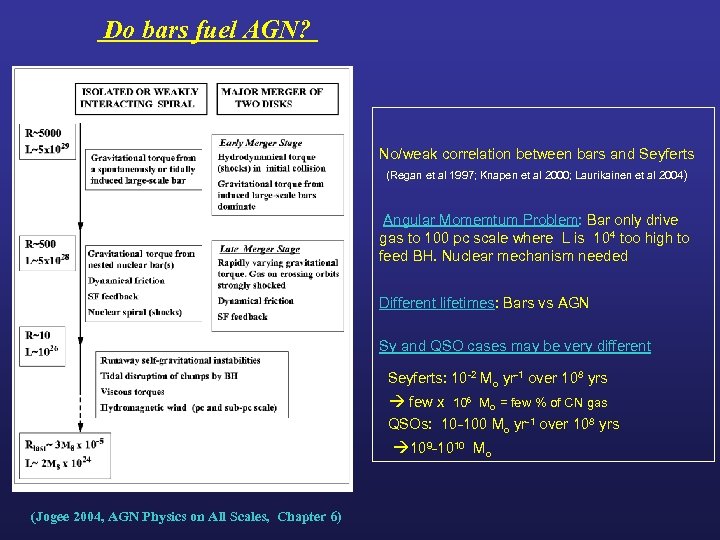 Do bars fuel AGN? No/weak correlation between bars and Seyferts (Regan et al 1997; Knapen et al 2000; Laurikainen et al 2004) Angular Momemtum Problem: Bar only drive gas to 100 pc scale where L is 104 too high to feed BH. Nuclear mechanism needed Different lifetimes: Bars vs AGN Sy and QSO cases may be very different Seyferts: 10 -2 Mo yr-1 over 108 yrs few x 106 Mo = few % of CN gas QSOs: 10 -100 Mo yr-1 over 108 yrs 109 -1010 Mo (Jogee 2004, AGN Physics on All Scales, Chapter 6)
 Summary : Host Galaxy vs AGN , Starbursts • AGN found mostly in luminous early type (E--Sbc) galaxies • Large-scale bar fraction in starbursts (at least relatively luminous ones) is higher wrt normal galaxies (Hunt & Malkan 1999; Hawarden et al. 1986; Mazzarella & Balzano 1986). Correlation less clear for lower luminosity starburst (e. g. , Ho et al. 1997) • Large-scale bar fraction in Seyferts is comparable to or slighlty higher than in normal galaxies (Mulchaey & Regan 1997; Hunt & Malkan 1999; Knapen et al 2000)
 Why no strong correlation: Primary Bars vs AGN? • Specific Angular Momentum Bars solve L problem half way : L down by 10 -100, R from 10 s kpc to 200 pc • Delay between bar-driven gas inflow on few 100 pc scale & onset of AGN e. g. , onset of nuclear gas transport mechanisms, dynamical evolution of dense cluster • Must have both (massive BH + gas) to show AGN. Favored in early type? • Can AGN fuelling destroy primary bar? - Freq of outer rings and of (inner +outer) rings is 3 -4 times higher in Sy (HM 99) - Slight deficiency of strong bars in Seyferts (Shlosman et al. 2000) BUT …………………. • Efficient ways other than bars to drive gas to 100 pc scale. e. g. , major mergers
 Starburst/AGN vs. Companions/Interactions/Mergers
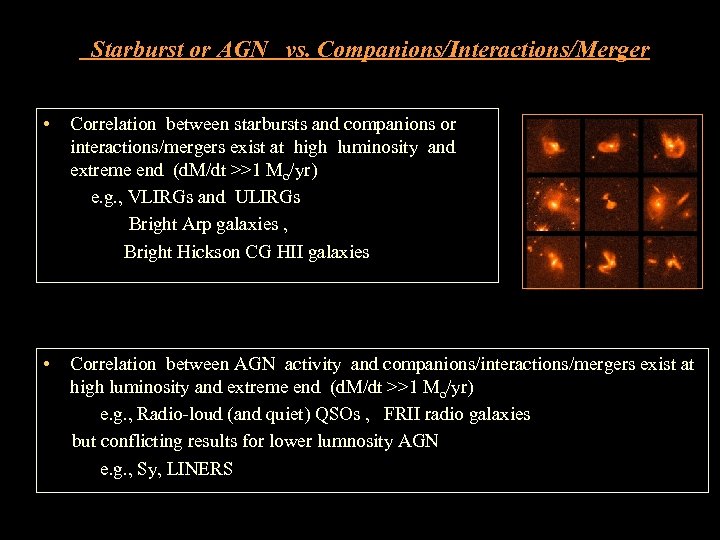 Starburst or AGN vs. Companions/Interactions/Merger • Correlation between starbursts and companions or interactions/mergers exist at high luminosity and extreme end (d. M/dt >>1 Mo/yr) e. g. , VLIRGs and ULIRGs Bright Arp galaxies , Bright Hickson CG HII galaxies • Correlation between AGN activity and companions/interactions/mergers exist at high luminosity and extreme end (d. M/dt >>1 Mo/yr) e. g. , Radio-loud (and quiet) QSOs , FRII radio galaxies but conflicting results for lower lumnosity AGN e. g. , Sy, LINERS
 Why correlation of (Interactions vs AGN or starbursts) only at high L end? • Not all speed, orientations, and impact parameters of interactions trigger strong gas inflows • Minor (1: 10), intermediate mass ratio (1: 4) interactions drive gas inflow by inducing large-scale bars. . same limitations as bars. reduce L by < 100 , and time delay between inflow and onset of AGN • Major mergers (Mihos & Hernquist 1996) Early stage : as above Final stage: Potential strongly varying. Gas on interseccting orbits shocks and dissipates strong inflow. ? ? Do final stages of major merger buy us the extra 10 3 loss in L? ? Via shocks + sb-driven outflows+AGN outflow ?
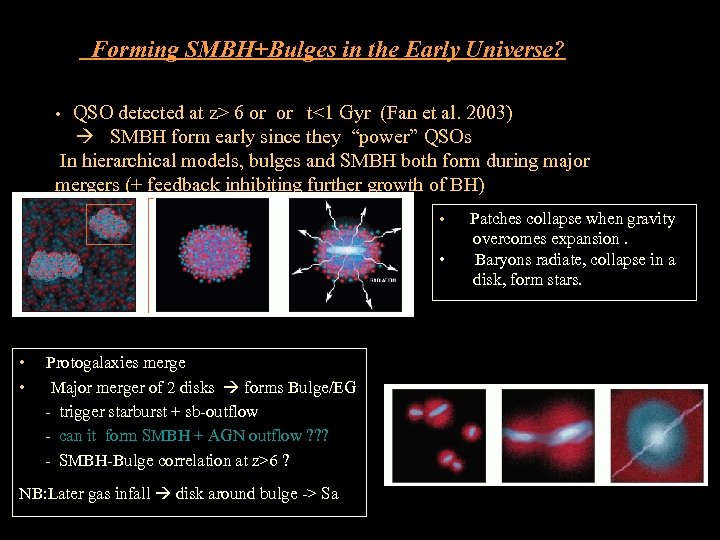 Forming SMBH+Bulges in the Early Universe? QSO detected at z> 6 or or t<1 Gyr (Fan et al. 2003) SMBH form early since they “power” QSOs In hierarchical models, bulges and SMBH both form during major mergers (+ feedback inhibiting further growth of BH) • • • Protogalaxies merge Major merger of 2 disks forms Bulge/EG - trigger starburst + sb-outflow - can it form SMBH + AGN outflow ? ? ? - SMBH-Bulge correlation at z>6 ? NB: Later gas infall disk around bulge -> Sa Patches collapse when gravity overcomes expansion. Baryons radiate, collapse in a disk, form stars.
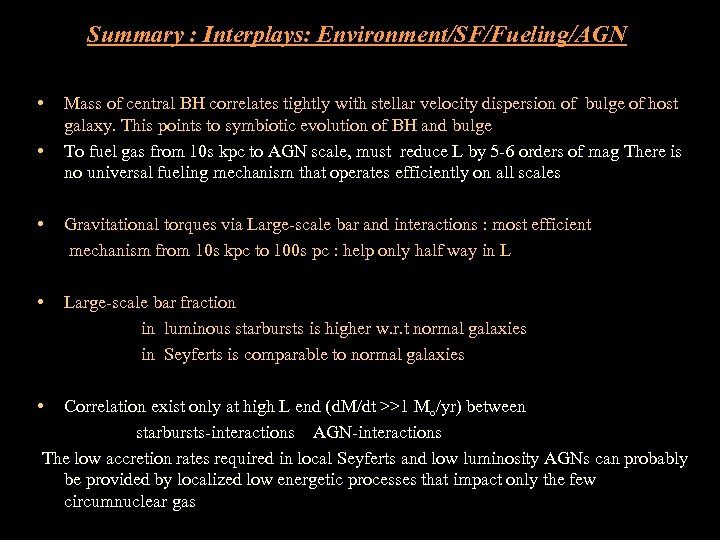 Summary : Interplays: Environment/SF/Fueling/AGN • • Mass of central BH correlates tightly with stellar velocity dispersion of bulge of host galaxy. This points to symbiotic evolution of BH and bulge To fuel gas from 10 s kpc to AGN scale, must reduce L by 5 -6 orders of mag There is no universal fueling mechanism that operates efficiently on all scales • Gravitational torques via Large-scale bar and interactions : most efficient mechanism from 10 s kpc to 100 s pc : help only half way in L • Large-scale bar fraction in luminous starbursts is higher w. r. t normal galaxies in Seyferts is comparable to normal galaxies • Correlation exist only at high L end (d. M/dt >>1 Mo/yr) between starbursts-interactions AGN-interactions The low accretion rates required in local Seyferts and low luminosity AGNs can probably be provided by localized low energetic processes that impact only the few circumnuclear gas