 Скачать презентацию Gaining New insights into Pharmaceutical Stability using High
8ccc64a456145a333ca236d184b0f7a6.ppt
- Количество слайдов: 1



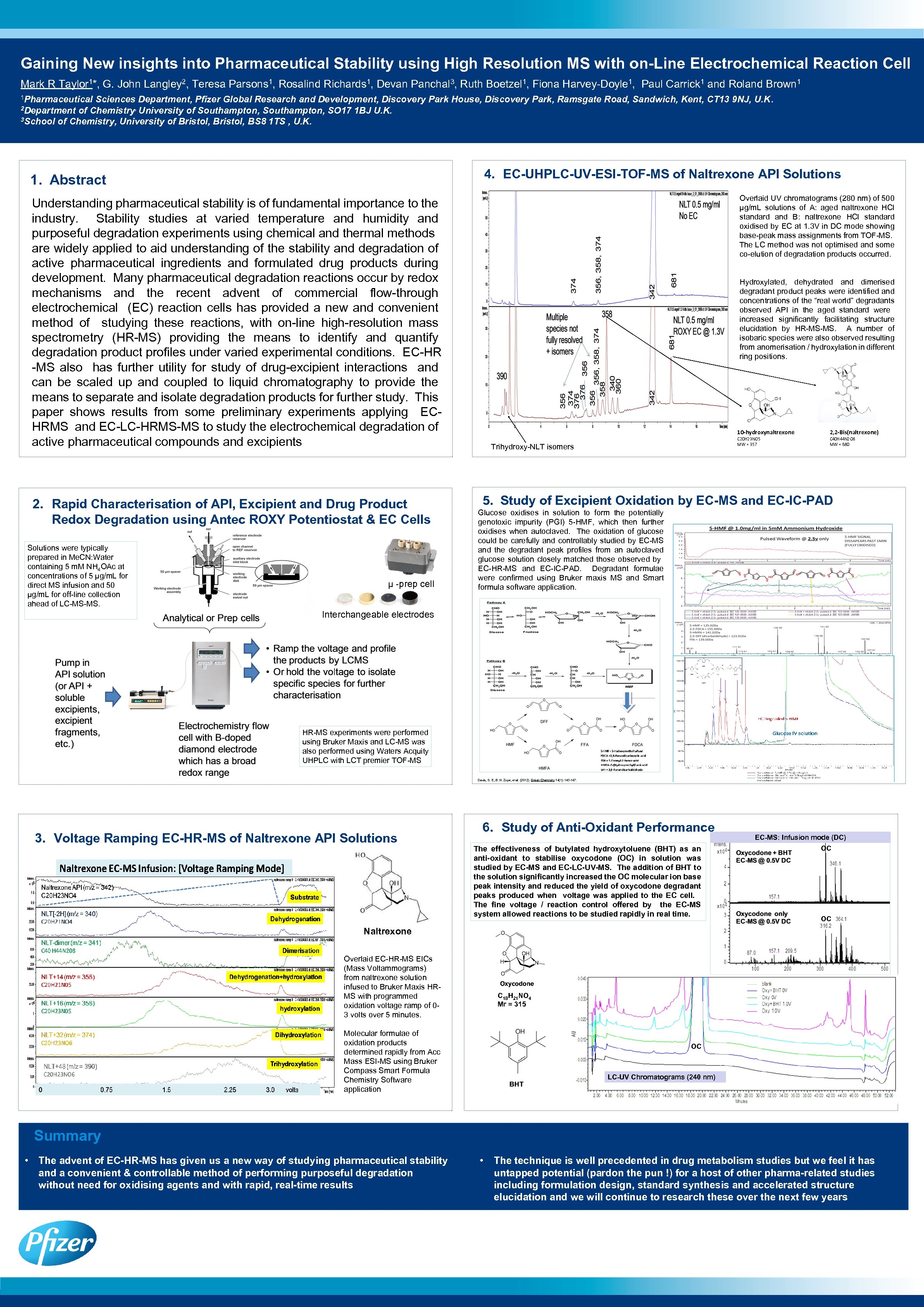
Gaining New insights into Pharmaceutical Stability using High Resolution MS with on-Line Electrochemical Reaction Cell Mark R Taylor 1*, G. John Langley 2, Teresa Parsons 1, Rosalind Richards 1, Devan Panchal 3, Ruth Boetzel 1, Fiona Harvey-Doyle 1, Paul Carrick 1 and Roland Brown 1 1 Pharmaceutical Sciences Department, Pfizer Global Research and Development, Discovery Park House, Discovery Park, Ramsgate Road, Sandwich, Kent, CT 13 9 NJ, U. K. 2 Department of Chemistry, University of Southampton, SO 17 1 BJ U. K. 3 School of Chemistry, University of Bristol, BS 8 1 TS , U. K. 4. EC-UHPLC-UV-ESI-TOF-MS of Naltrexone API Solutions 1. Abstract Understanding pharmaceutical stability is of fundamental importance to the industry. Stability studies at varied temperature and humidity and purposeful degradation experiments using chemical and thermal methods are widely applied to aid understanding of the stability and degradation of active pharmaceutical ingredients and formulated drug products during development. Many pharmaceutical degradation reactions occur by redox mechanisms and the recent advent of commercial flow-through electrochemical (EC) reaction cells has provided a new and convenient method of studying these reactions, with on-line high-resolution mass spectrometry (HR-MS) providing the means to identify and quantify degradation product profiles under varied experimental conditions. EC-HR -MS also has further utility for study of drug-excipient interactions and can be scaled up and coupled to liquid chromatography to provide the means to separate and isolate degradation products for further study. This paper shows results from some preliminary experiments applying ECHRMS and EC-LC-HRMS-MS to study the electrochemical degradation of active pharmaceutical compounds and excipients 2. Rapid Characterisation of API, Excipient and Drug Product Redox Degradation using Antec ROXY Potentiostat & EC Cells Solutions were typically prepared in Me. CN: Water containing 5 m. M NH 4 OAc at concentrations of 5 µg/m. L for direct MS infusion and 50 µg/m. L for off-line collection ahead of LC-MS-MS. µ -prep cell Overlaid UV chromatograms (280 nm) of 500 µg/m. L solutions of A: aged naltrexone HCl standard and B: naltrexone HCl standard oxidised by EC at 1. 3 V in DC mode showing base-peak mass assignments from TOF-MS. The LC method was not optimised and some co-elution of degradation products occurred. Hydroxylated, dehydrated and dimerised degradant product peaks were identified and concentrations of the “real world” degradants observed API in the aged standard were increased significantly facilitating structure elucidation by HR-MS-MS. A number of isobaric species were also observed resulting from anomerisation / hydroxylation in different ring positions. 10 -hydroxynaltrexone C 20 H 23 NO 5 MW = 357 Trihydroxy-NLT isomers 2, 2 -Bis(naltrexone) C 40 H 44 N 2 O 8 MW = 680 5. Study of Excipient Oxidation by EC-MS and EC-IC-PAD Glucose oxidises in solution to form the potentially genotoxic impurity (PGI) 5 -HMF, which then further oxidises when autoclaved. The oxidation of glucose could be carefully and controllably studied by EC-MS and the degradant peak profiles from an autoclaved glucose solution closely matched those observed by EC-HR-MS and EC-IC-PAD. Degradant formulae were confirmed using Bruker maxis MS and Smart formula software application. Interchangeable electrodes HR-MS experiments were performed using Bruker Maxis and LC-MS was also performed using Waters Acquity UHPLC with LCT premier TOF-MS Davis, S. E. , B. N. Zope, et al. (2012). Green Chemistry 14(1): 143 -147. 3. Voltage Ramping EC-HR-MS of Naltrexone API Solutions 6. Study of Anti-Oxidant Performance The effectiveness of butylated hydroxytoluene (BHT) as an anti-oxidant to stabilise oxycodone (OC) in solution was studied by EC-MS and EC-LC-UV-MS. The addition of BHT to the solution significantly increased the OC molecular ion base peak intensity and reduced the yield of oxycodone degradant peaks produced when voltage was applied to the EC cell. The fine voltage / reaction control offered by the EC-MS system allowed reactions to be studied rapidly in real time. EC-MS: Infusion mode (DC) OC OC Naltrexone Overlaid EC-HR-MS EICs (Mass Voltammograms) from naltrexone solution infused to Bruker Maxis HRMS with programmed oxidation voltage ramp of 03 volts over 5 minutes. Molecular formulae of oxidation products determined rapidly from Acc Mass ESI-MS using Bruker Compass Smart Formula Chemistry Software application C 18 H 21 NO 4 Mr = 315 OC LC-UV Chromatograms (240 nm) Summary • The advent of EC-HR-MS has given us a new way of studying pharmaceutical stability and a convenient & controllable method of performing purposeful degradation without need for oxidising agents and with rapid, real-time results • The technique is well precedented in drug metabolism studies but we feel it has untapped potential (pardon the pun !) for a host of other pharma-related studies including formulation design, standard synthesis and accelerated structure elucidation and we will continue to research these over the next few years
Скачать презентацию Gaining New insights into Pharmaceutical Stability using High
8ccc64a456145a333ca236d184b0f7a6.ppt