 Скачать презентацию Gaffer to Game Engine Cinematic Effects Kevin Bjorke
74e28df53f593bb7f302a3b040dc3afa.ppt
- Количество слайдов: 52



Gaffer to Game Engine: Cinematic Effects Kevin Bjorke Game Developer’s Conference, 2003
Cinematic Effects – Technical What makes movie rendering different? Heavy-duty software rendering, <0. 001 fps Zero tolerance for obvious errors BUT, we can paint-out the bad frames in an emergency – can’t do that in a game! Massive scale Complex Models, Complex Surfaces Complex Compositing – may have hundreds of passes per frame Motion blur, shadows used everywhere Basis in Live-Action Traditions Techniques now approachable in real time
Cinematic Effects – Artistic What makes movie making different? Tightly-controlled camera Movie photography is as much about lighting as it is about camerawork Controlled timing – animation, voice, music cues Passive Audience Viewer identification with characters and events comes through indirect means – not through experience in “being” or controlling the action Framing, staging, camera motion, lighting, and sound are all tuned to that very purpose – drawing the viewer into the scene
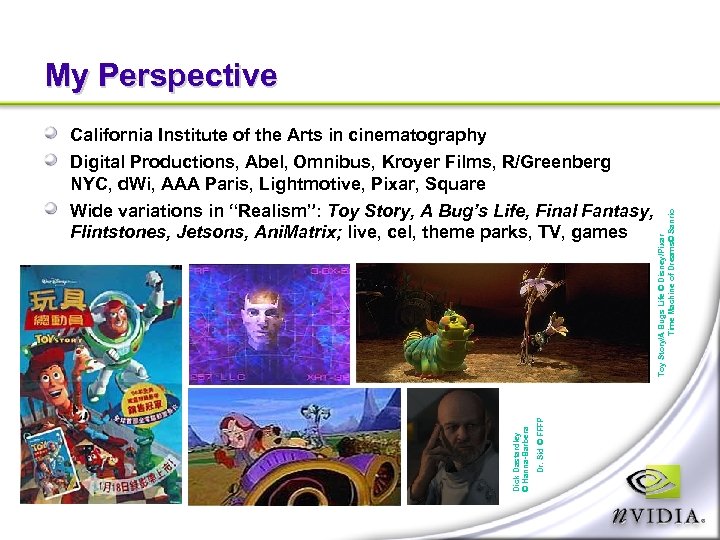
My Perspective California Institute of the Arts in cinematography Dr. Sid © FFFP Dick Dastardley © Hanna-Barbera Wide variations in “Realism”: Toy Story, A Bug’s Life, Final Fantasy, Flintstones, Jetsons, Ani. Matrix; live, cel, theme parks, TV, games Toy Story/A Bugs Life © Disney/Pixar Time Machine of Dreams© Sanrio Digital Productions, Abel, Omnibus, Kroyer Films, R/Greenberg NYC, d. Wi, AAA Paris, Lightmotive, Pixar, Square
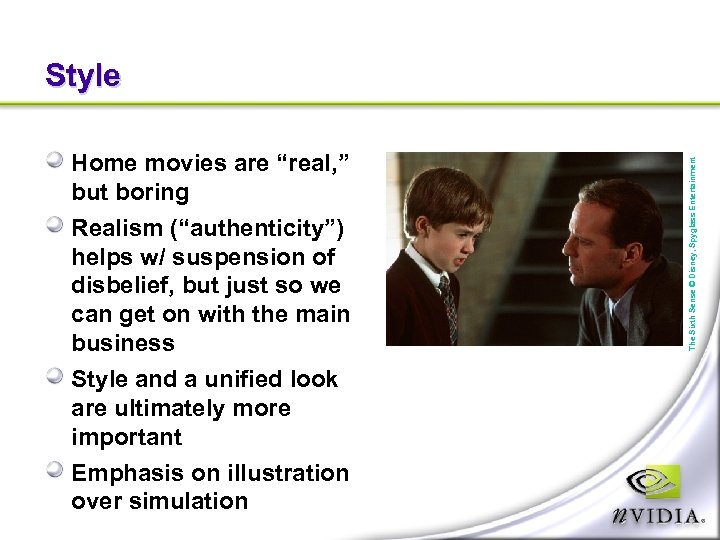
Home movies are “real, ” but boring Realism (“authenticity”) helps w/ suspension of disbelief, but just so we can get on with the main business Style and a unified look are ultimately more important Emphasis on illustration over simulation The Sixth Sense © Disney, Spyglass Entertainment Style
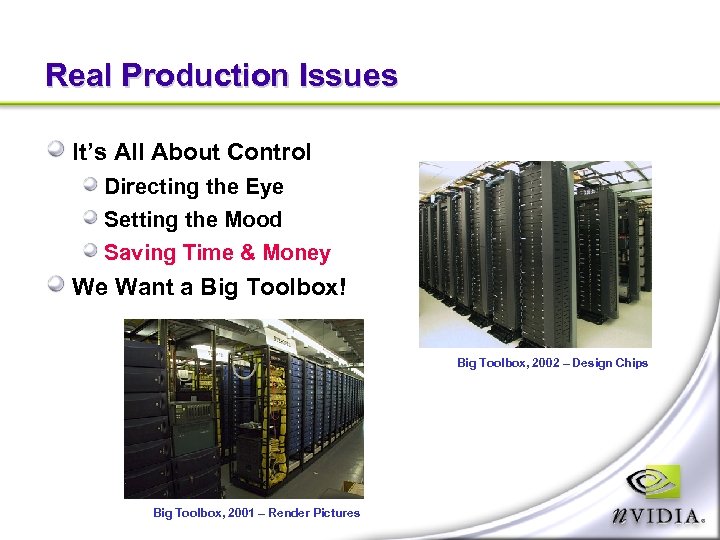
Real Production Issues It’s All About Control Directing the Eye Setting the Mood Saving Time & Money We Want a Big Toolbox! Big Toolbox, 2002 – Design Chips Big Toolbox, 2001 – Render Pictures
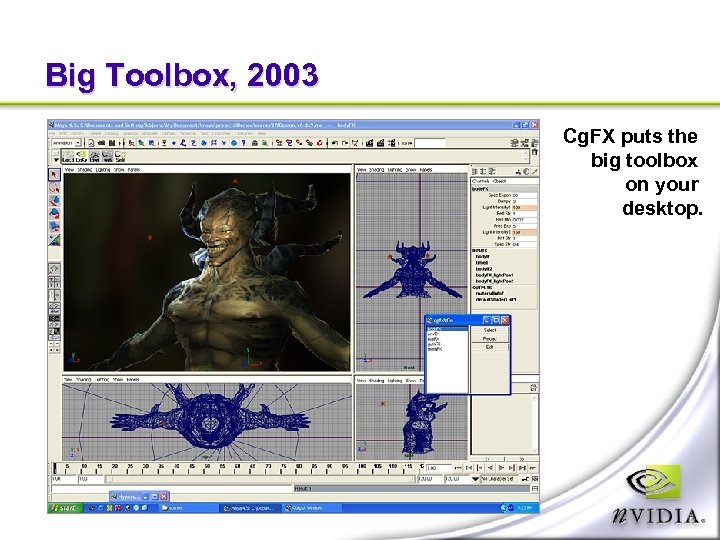
Big Toolbox, 2003 Cg. FX puts the big toolbox on your desktop.
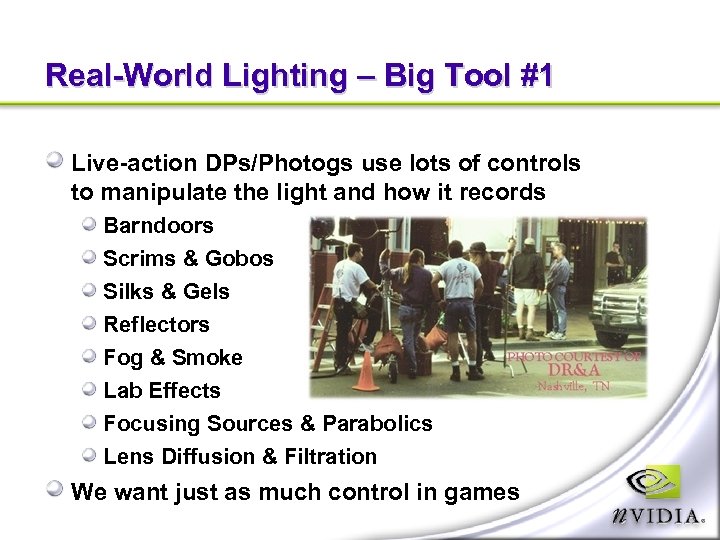
Real-World Lighting – Big Tool #1 Live-action DPs/Photogs use lots of controls to manipulate the light and how it records Barndoors Scrims & Gobos Silks & Gels Reflectors Fog & Smoke Lab Effects Focusing Sources & Parabolics Lens Diffusion & Filtration We want just as much control in games
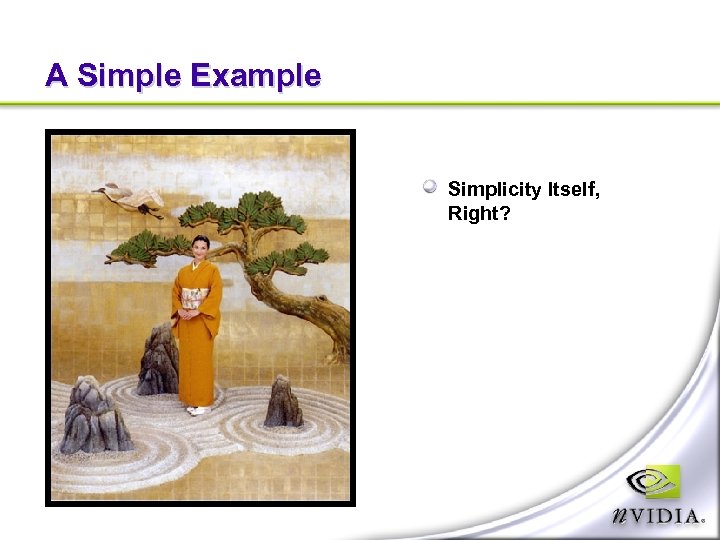
A Simple Example Simplicity Itself, Right?
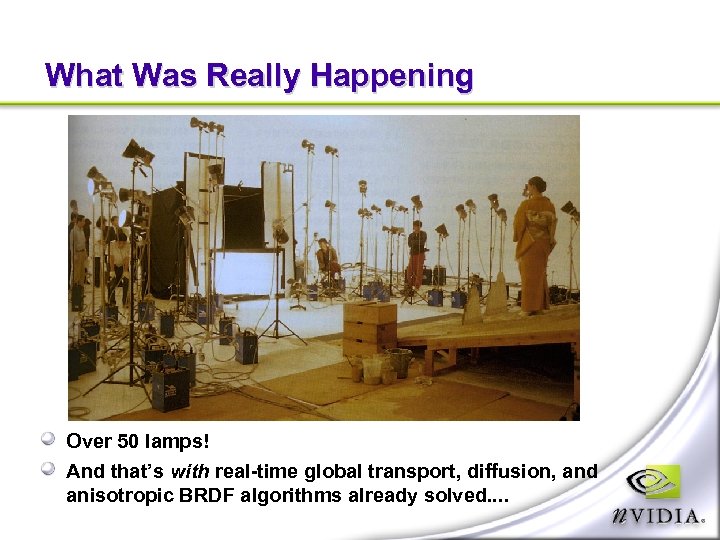
What Was Really Happening Over 50 lamps! And that’s with real-time global transport, diffusion, and anisotropic BRDF algorithms already solved. .
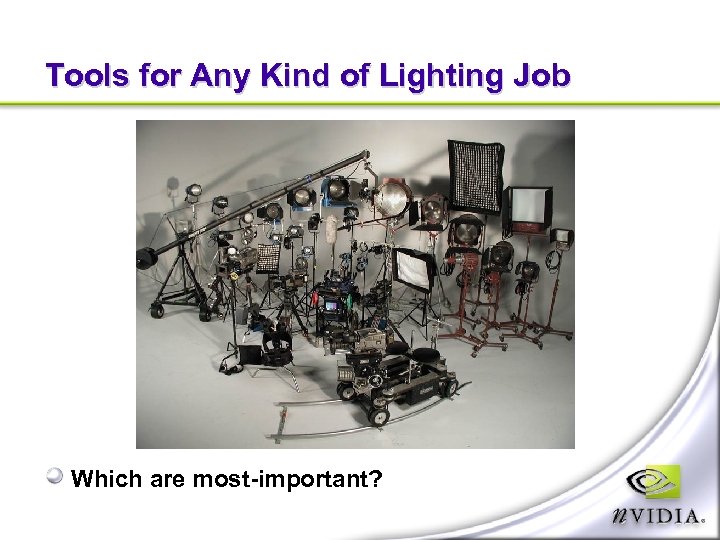
Tools for Any Kind of Lighting Job Which are most-important?
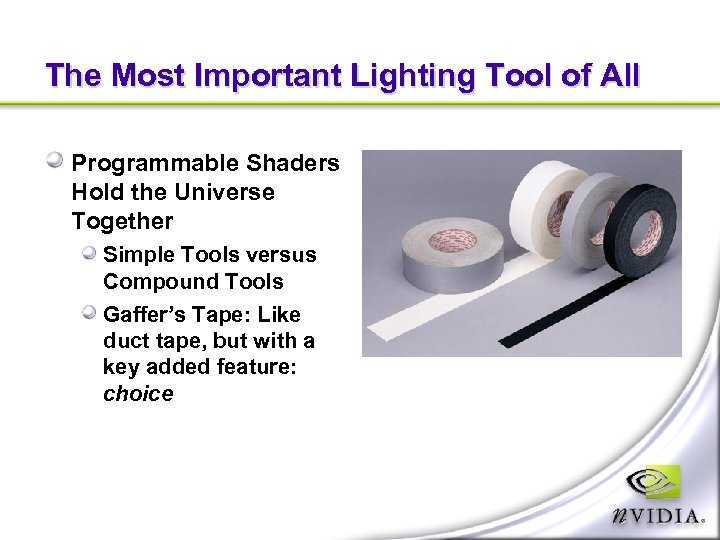
The Most Important Lighting Tool of All Programmable Shaders Hold the Universe Together Simple Tools versus Compound Tools Gaffer’s Tape: Like duct tape, but with a key added feature: choice
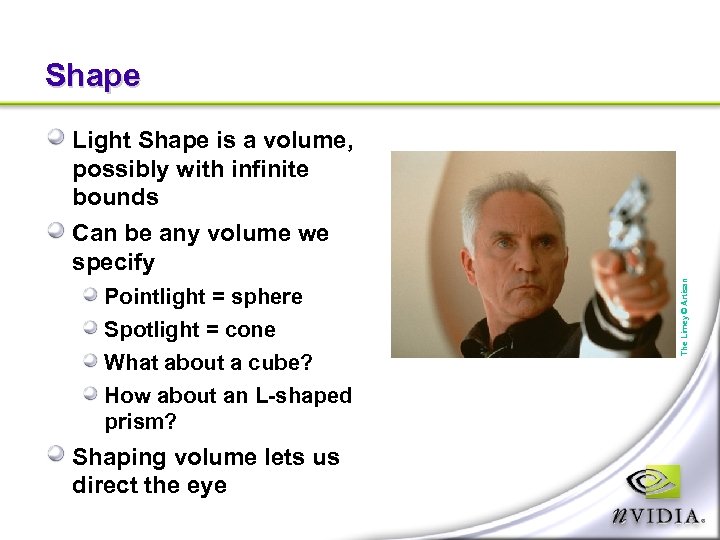
Shape Pointlight = sphere Spotlight = cone What about a cube? How about an L-shaped prism? Shaping volume lets us direct the eye The Limey © Artisan Light Shape is a volume, possibly with infinite bounds Can be any volume we specify
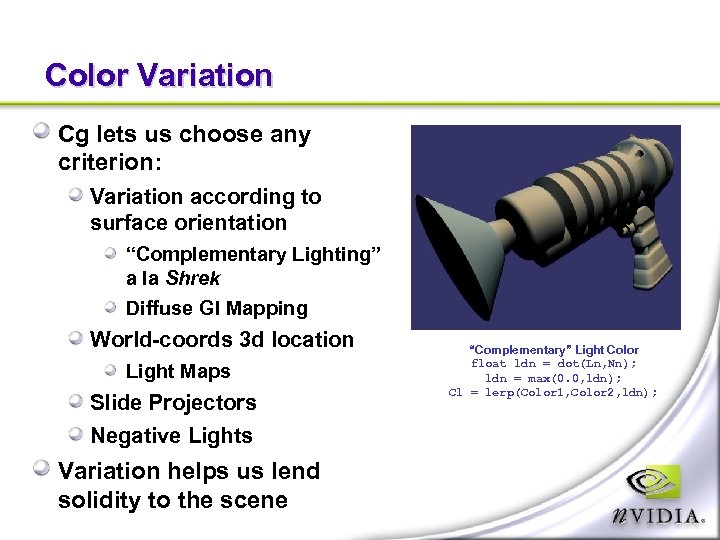
Color Variation Cg lets us choose any criterion: Variation according to surface orientation “Complementary Lighting” a la Shrek Diffuse GI Mapping World-coords 3 d location Light Maps Slide Projectors Negative Lights Variation helps us lend solidity to the scene “Complementary” Light Color float ldn = dot(Ln, Nn); ldn = max(0. 0, ldn); Cl = lerp(Color 1, Color 2, ldn);
Shadows also define a volume. We can mix volume functions in Cg – depth maps, polygonal stencil volumes, others Shadows don’t have to be black lerp(shadow. Color, light. Color, shadowfunc()); Shadows can be misdirected Light direction doesn’t always have to be shadow direction – the viewer’s eye will accept the shadow direction more than the light! Multiple sources can share the same shadow One source may have multiple shadows
Animatrix: Final Flight of the Osiris © 2003 Warner Bros http: //www. whatisthematrix. com/ Shadows Where They Don’t Belong? Shadow as a Graphic Element – Instantly Readable Jue’s contact shadow is posed for visual effect and to connect her firmly to the rooftop – it’s not driven by the lightsources themselves.
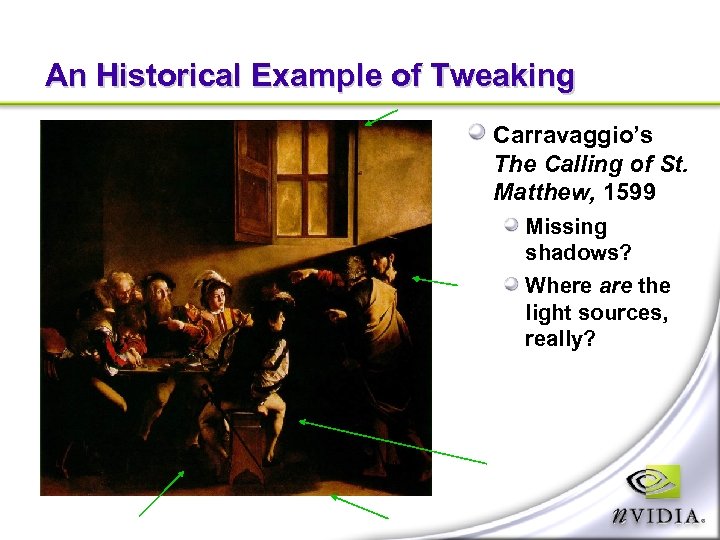
An Historical Example of Tweaking Carravaggio’s The Calling of St. Matthew, 1599 Missing shadows? Where are the light sources, really?
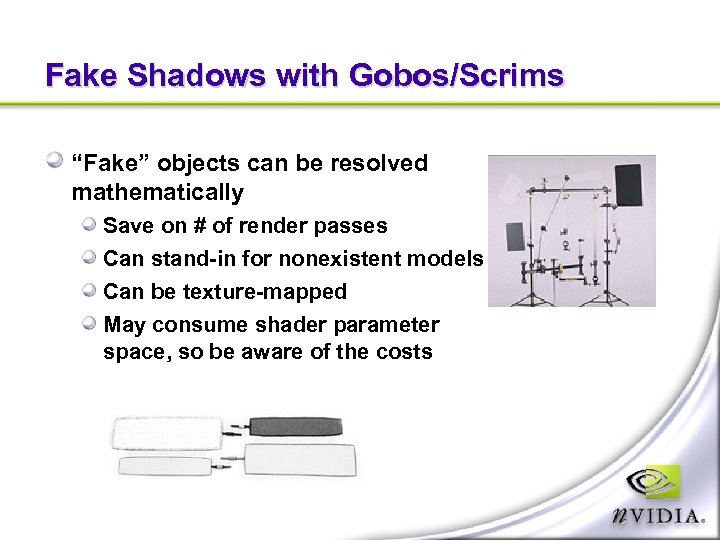
Fake Shadows with Gobos/Scrims “Fake” objects can be resolved mathematically Save on # of render passes Can stand-in for nonexistent models Can be texture-mapped May consume shader parameter space, so be aware of the costs
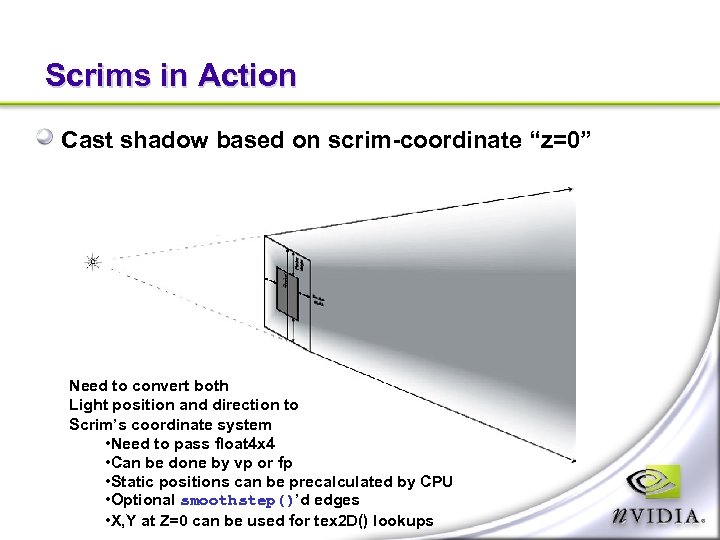
Scrims in Action Cast shadow based on scrim-coordinate “z=0” Need to convert both Light position and direction to Scrim’s coordinate system • Need to pass float 4 x 4 • Can be done by vp or fp • Static positions can be precalculated by CPU • Optional smoothstep()’d edges • X, Y at Z=0 can be used for tex 2 D() lookups
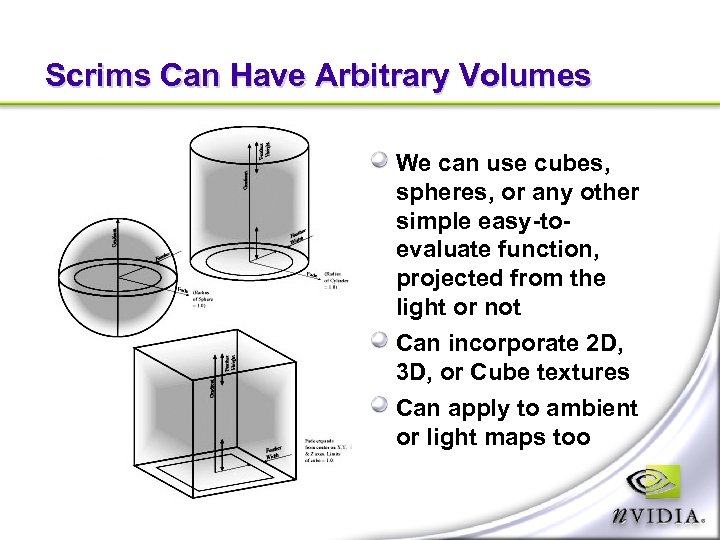
Scrims Can Have Arbitrary Volumes We can use cubes, spheres, or any other simple easy-toevaluate function, projected from the light or not Can incorporate 2 D, 3 D, or Cube textures Can apply to ambient or light maps too
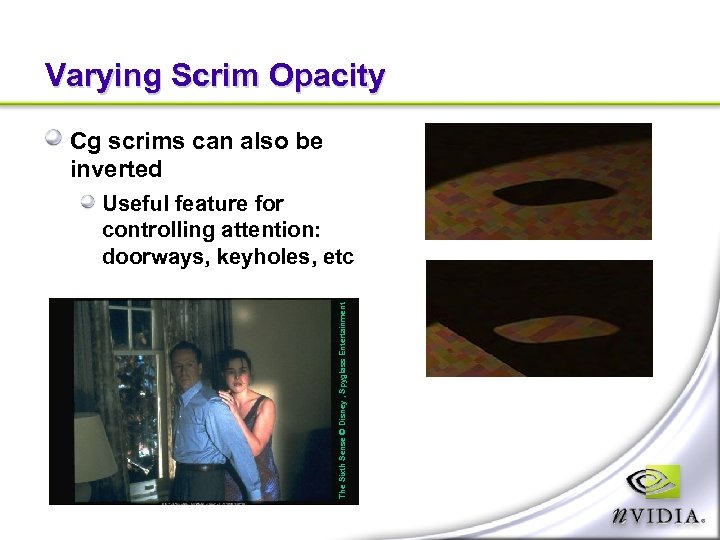
Varying Scrim Opacity Cg scrims can also be inverted The Sixth Sense © Disney , Spyglass Entertainment Useful feature for controlling attention: doorways, keyholes, etc
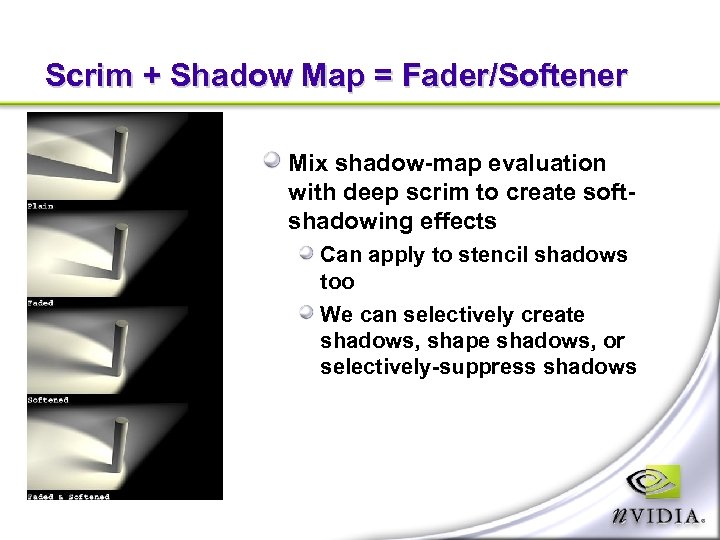
Scrim + Shadow Map = Fader/Softener Mix shadow-map evaluation with deep scrim to create softshadowing effects Can apply to stencil shadows too We can selectively create shadows, shape shadows, or selectively-suppress shadows
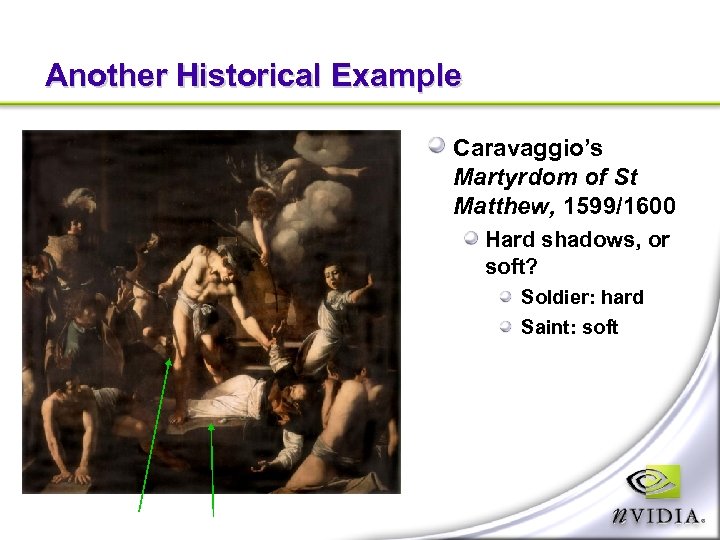
Another Historical Example Caravaggio’s Martyrdom of St Matthew, 1599/1600 Hard shadows, or soft? Soldier: hard Saint: soft
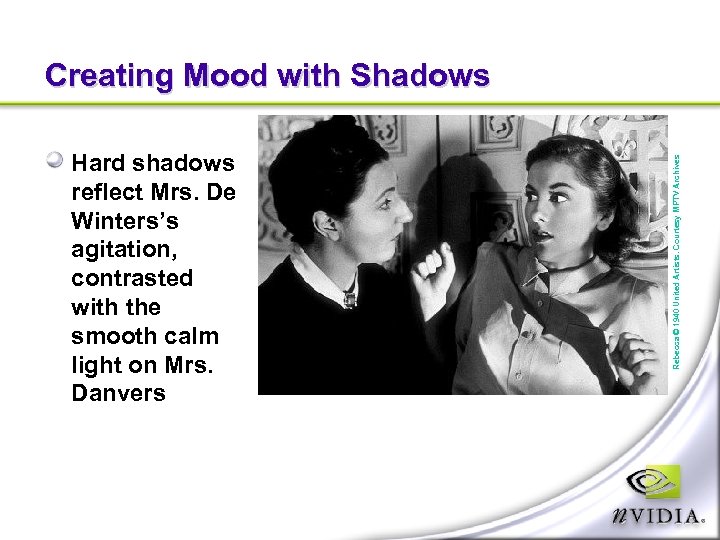
Hard shadows reflect Mrs. De Winters’s agitation, contrasted with the smooth calm light on Mrs. Danvers Rebecca © 1940 United Artists. Courtesy MPTV Archives Creating Mood with Shadows
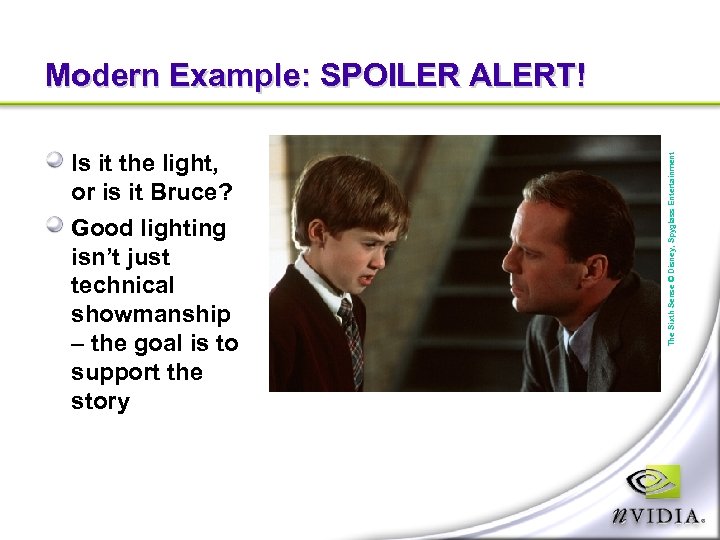
Is it the light, or is it Bruce? Good lighting isn’t just technical showmanship – the goal is to support the story The Sixth Sense © Disney, Spyglass Entertainment Modern Example: SPOILER ALERT!
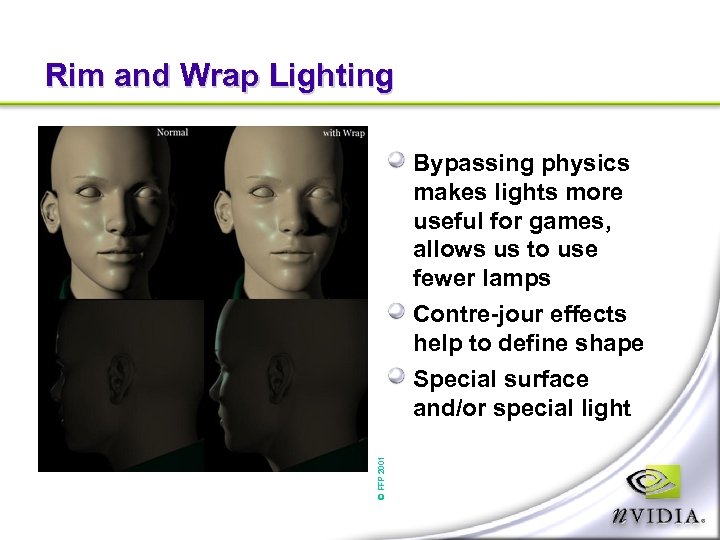
Rim and Wrap Lighting © FFP 2001 Bypassing physics makes lights more useful for games, allows us to use fewer lamps Contre-jour effects help to define shape Special surface and/or special light
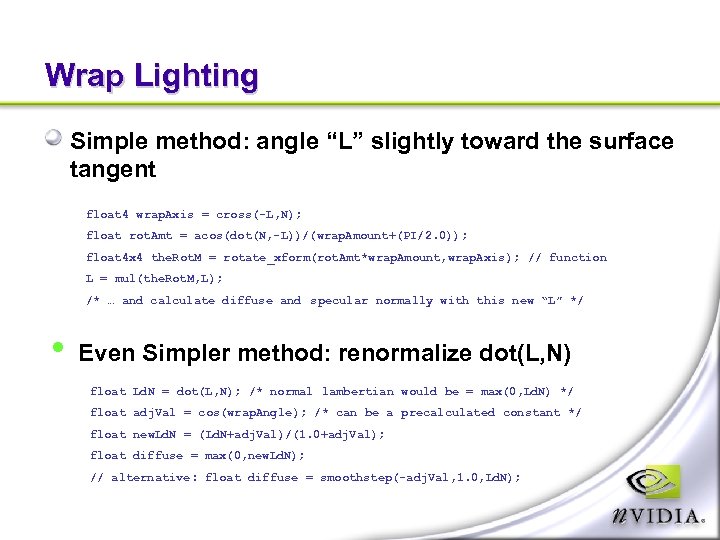
Wrap Lighting Simple method: angle “L” slightly toward the surface tangent float 4 wrap. Axis = cross(-L, N); float rot. Amt = acos(dot(N, -L))/(wrap. Amount+(PI/2. 0)); float 4 x 4 the. Rot. M = rotate_xform(rot. Amt*wrap. Amount, wrap. Axis); // function L = mul(the. Rot. M, L); /* … and calculate diffuse and specular normally with this new “L” */ • Even Simpler method: renormalize dot(L, N) float Ld. N = dot(L, N); /* normal lambertian would be = max(0, Ld. N) */ float adj. Val = cos(wrap. Angle); /* can be a precalculated constant */ float new. Ld. N = (Ld. N+adj. Val)/(1. 0+adj. Val); float diffuse = max(0, new. Ld. N); // alternative: float diffuse = smoothstep(-adj. Val, 1. 0, Ld. N);
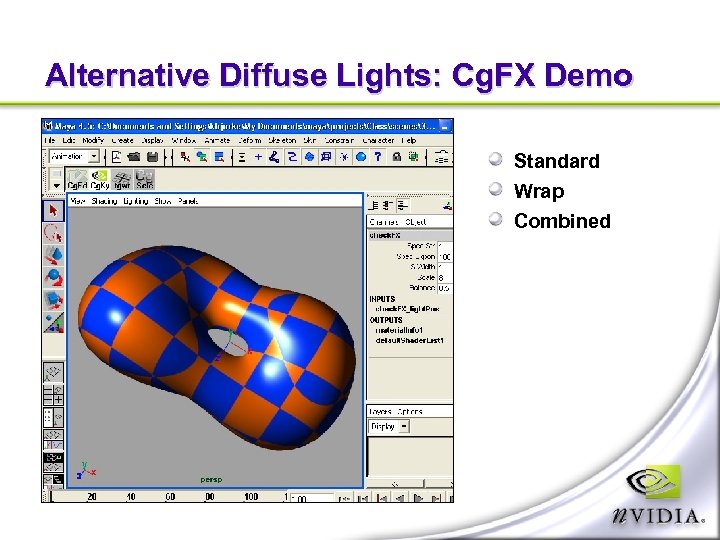
Alternative Diffuse Lights: Cg. FX Demo Standard Wrap Combined
Shadow-Inset Objects Use a slightly-smaller version of the geometry when making the shadow map/volume Can use the same geometry data and alter the vertex program to create a slightly-inset surface during the shadow-render pass float 4 inset. P = IN. Pos – inset*IN. Normal; OUT. HPosition = mul(World. View. Proj. Xf, inset. P); The technique can be used to solve a variety of shadowing and shadow-aliasing (“Z-fighting”) problems
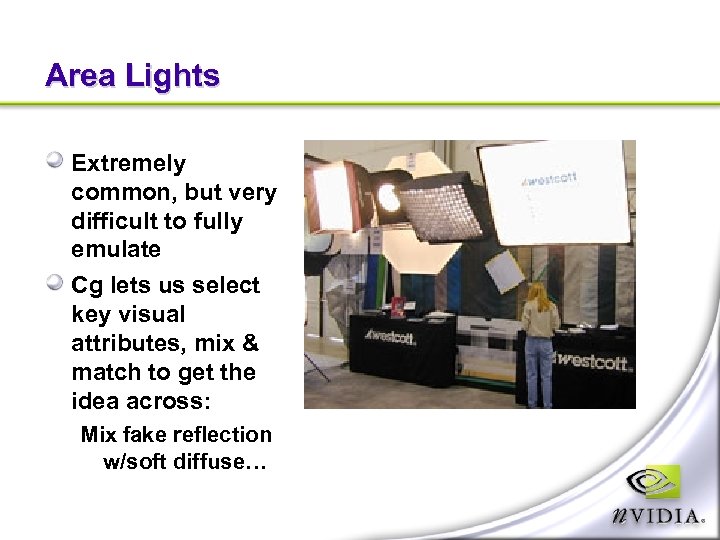
Area Lights Extremely common, but very difficult to fully emulate Cg lets us select key visual attributes, mix & match to get the idea across: Mix fake reflection w/soft diffuse…
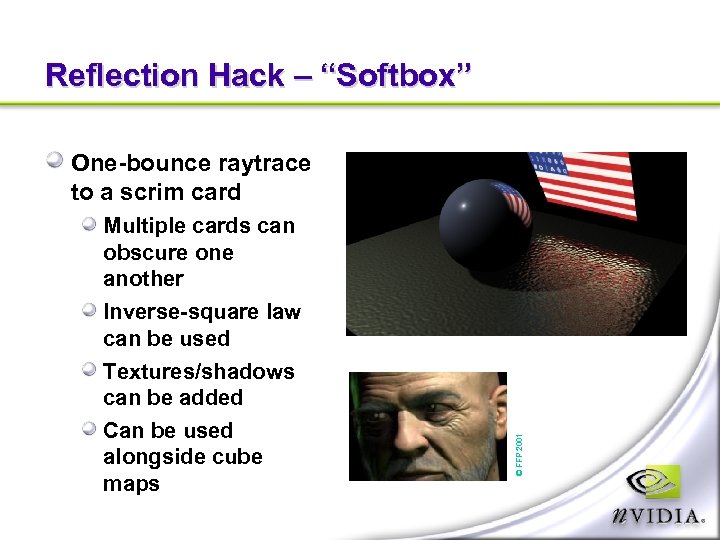
Reflection Hack – “Softbox” Multiple cards can obscure one another Inverse-square law can be used Textures/shadows can be added Can be used alongside cube maps © FFP 2001 One-bounce raytrace to a scrim card
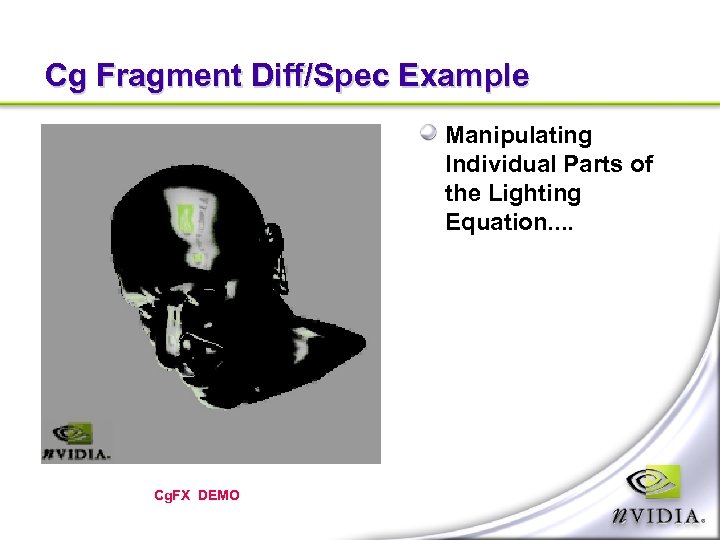
Cg Fragment Diff/Spec Example Manipulating Individual Parts of the Lighting Equation. . Cg. FX DEMO
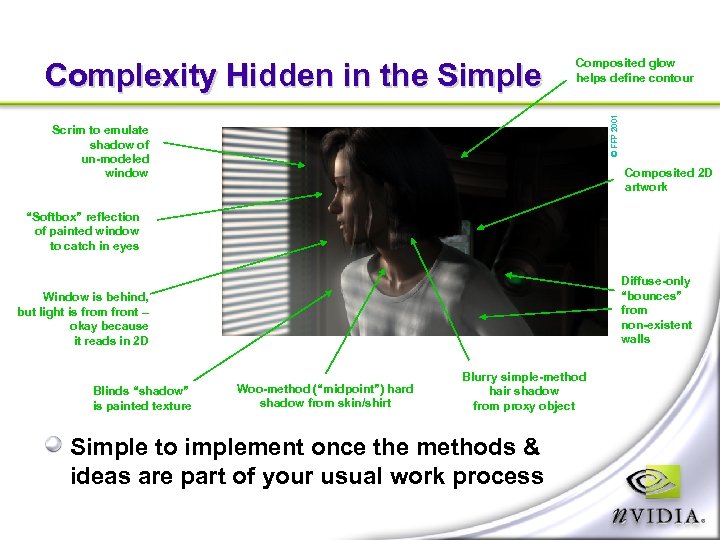
© FFP 2001 Complexity Hidden in the Simple Composited glow helps define contour Scrim to emulate shadow of un-modeled window Composited 2 D artwork “Softbox” reflection of painted window to catch in eyes Diffuse-only “bounces” from non-existent walls Window is behind, but light is from front – okay because it reads in 2 D Blinds “shadow” is painted texture Woo-method (“midpoint”) hard shadow from skin/shirt Blurry simple-method hair shadow from proxy object Simple to implement once the methods & ideas are part of your usual work process
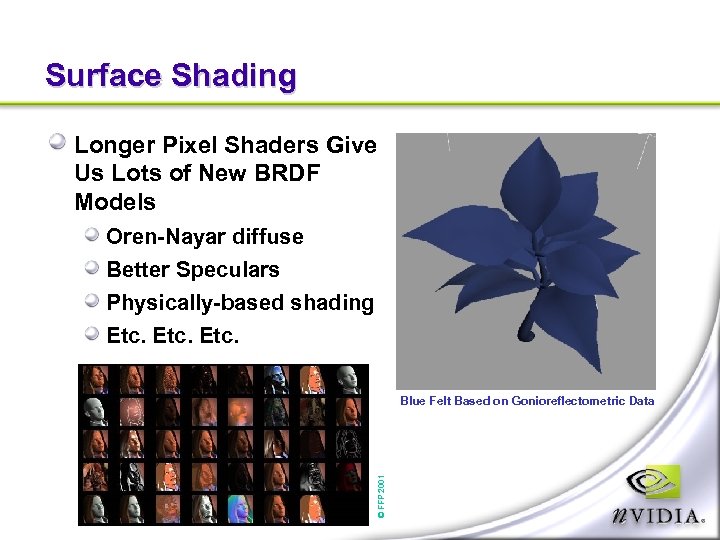
Surface Shading Longer Pixel Shaders Give Us Lots of New BRDF Models Oren-Nayar diffuse Better Speculars Physically-based shading Etc. © FFP 2001 Blue Felt Based on Gonioreflectometric Data
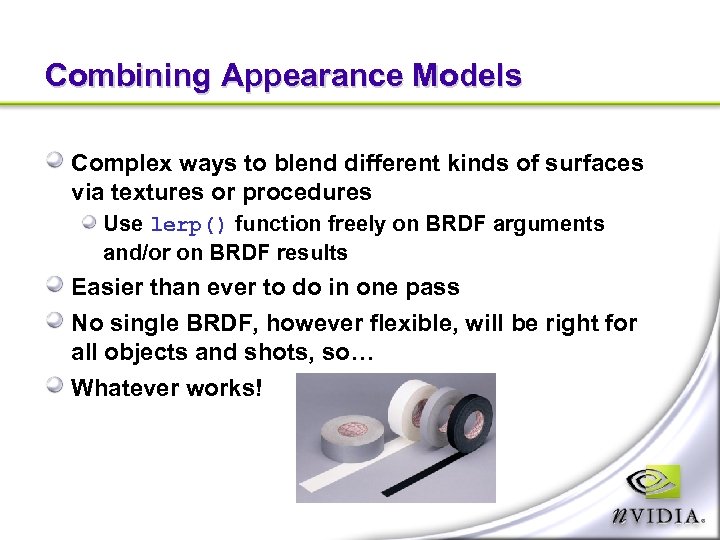
Combining Appearance Models Complex ways to blend different kinds of surfaces via textures or procedures Use lerp() function freely on BRDF arguments and/or on BRDF results Easier than ever to do in one pass No single BRDF, however flexible, will be right for all objects and shots, so… Whatever works!
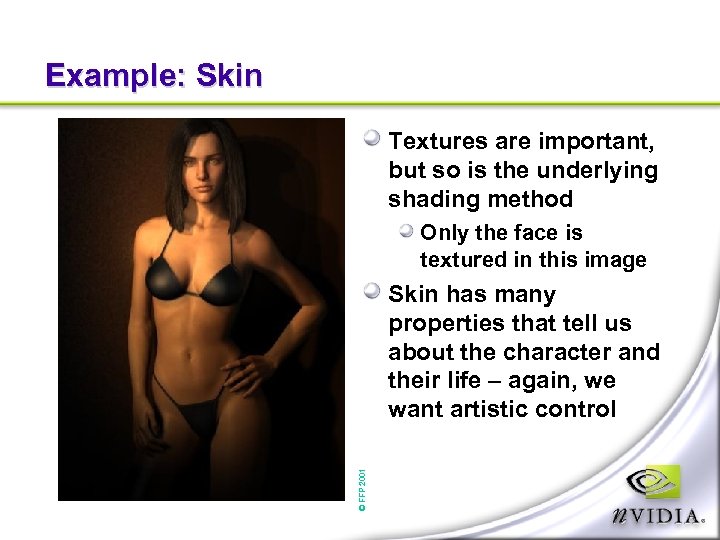
Example: Skin Textures are important, but so is the underlying shading method Only the face is textured in this image © FFP 2001 Skin has many properties that tell us about the character and their life – again, we want artistic control
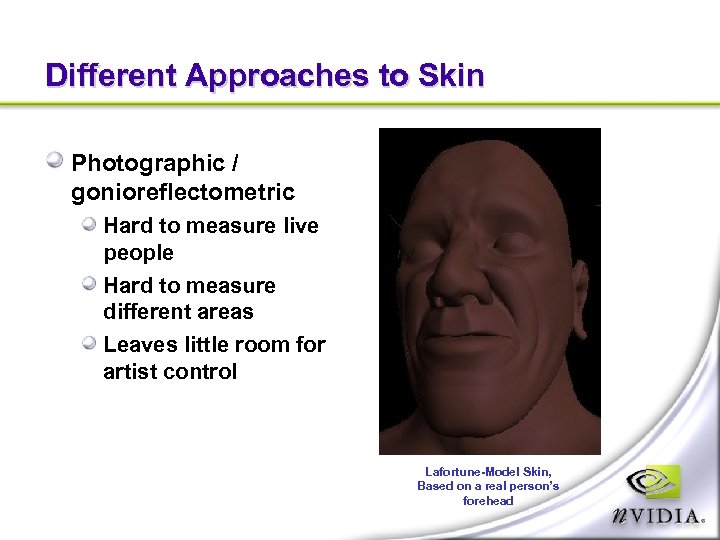
Different Approaches to Skin Photographic / gonioreflectometric Hard to measure live people Hard to measure different areas Leaves little room for artist control Lafortune-Model Skin, Based on a real person’s forehead
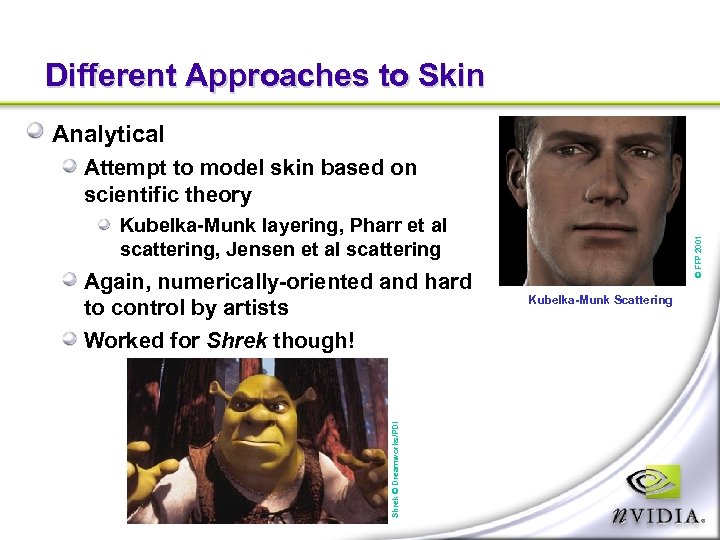
Different Approaches to Skin Analytical Attempt to model skin based on scientific theory Shrek © Dreamworks/PDI Again, numerically-oriented and hard to control by artists Worked for Shrek though! © FFP 2001 Kubelka-Munk layering, Pharr et al scattering, Jensen et al scattering Kubelka-Munk Scattering
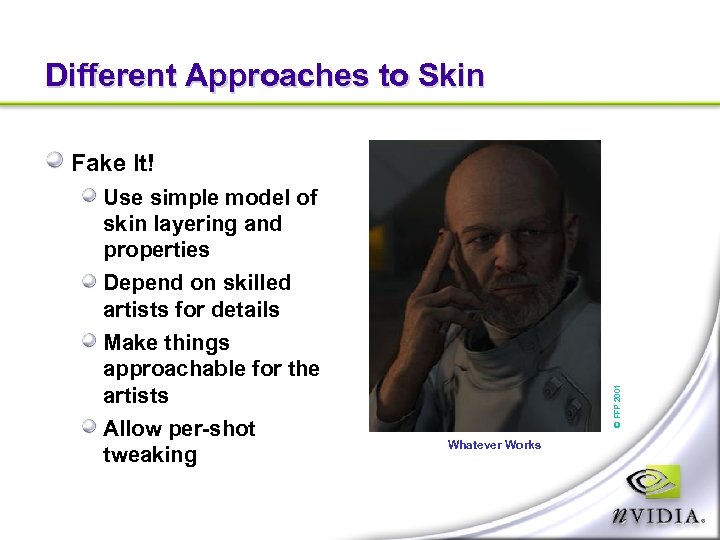
Different Approaches to Skin Fake It! Allow per-shot tweaking © FFP 2001 Use simple model of skin layering and properties Depend on skilled artists for details Make things approachable for the artists Whatever Works
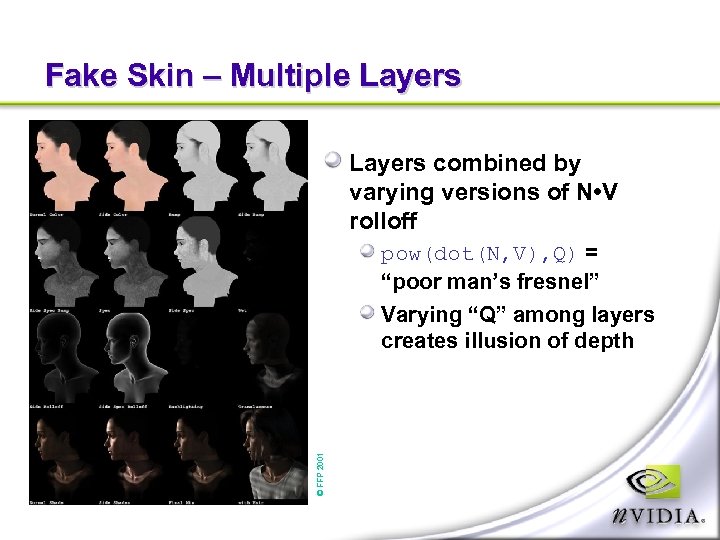
Fake Skin – Multiple Layers combined by varying versions of N • V rolloff © FFP 2001 pow(dot(N, V), Q) = “poor man’s fresnel” Varying “Q” among layers creates illusion of depth
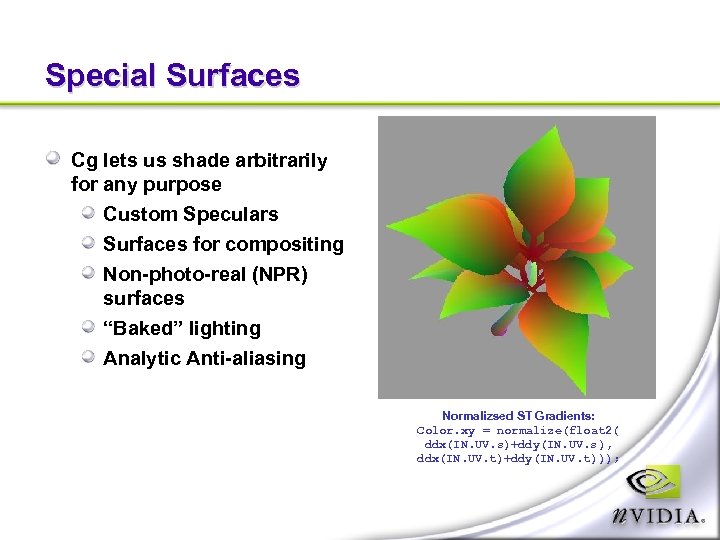
Special Surfaces Cg lets us shade arbitrarily for any purpose Custom Speculars Surfaces for compositing Non-photo-real (NPR) surfaces “Baked” lighting Analytic Anti-aliasing Normalizsed ST Gradients: Color. xy = normalize(float 2( ddx(IN. UV. s)+ddy(IN. UV. s ), ddx(IN. UV. t)+ddy(IN. UV. t )));
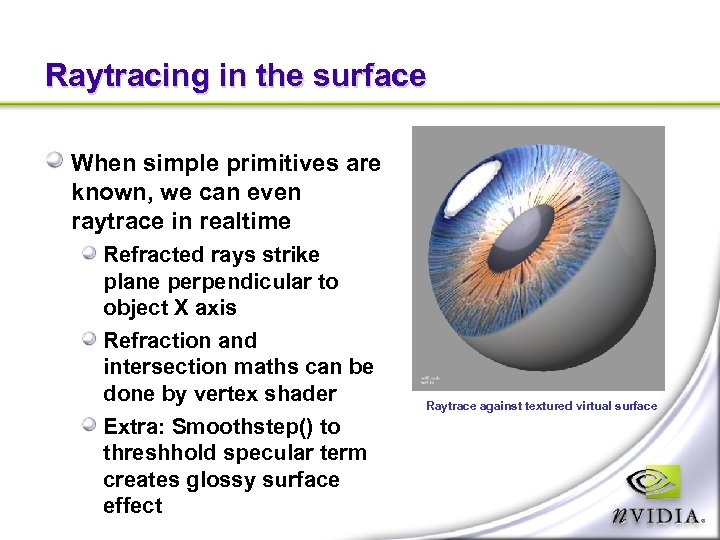
Raytracing in the surface When simple primitives are known, we can even raytrace in realtime Refracted rays strike plane perpendicular to object X axis Refraction and intersection maths can be done by vertex shader Extra: Smoothstep() to threshhold specular term creates glossy surface effect Raytrace against textured virtual surface
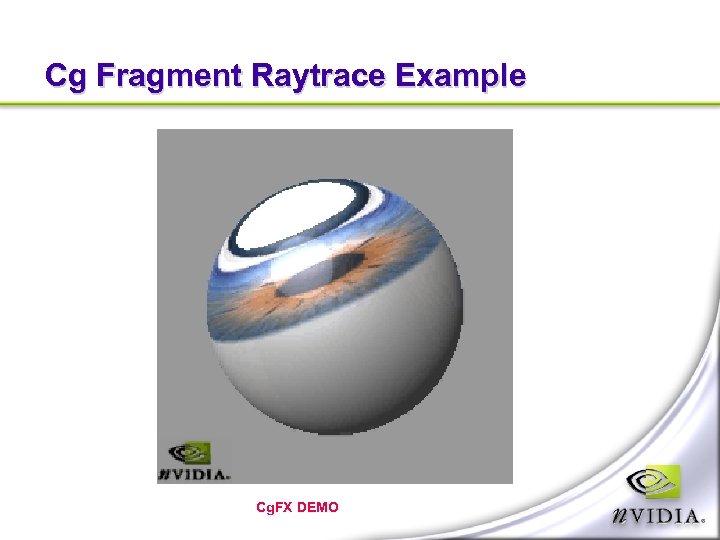
Cg Fragment Raytrace Example Cg. FX DEMO
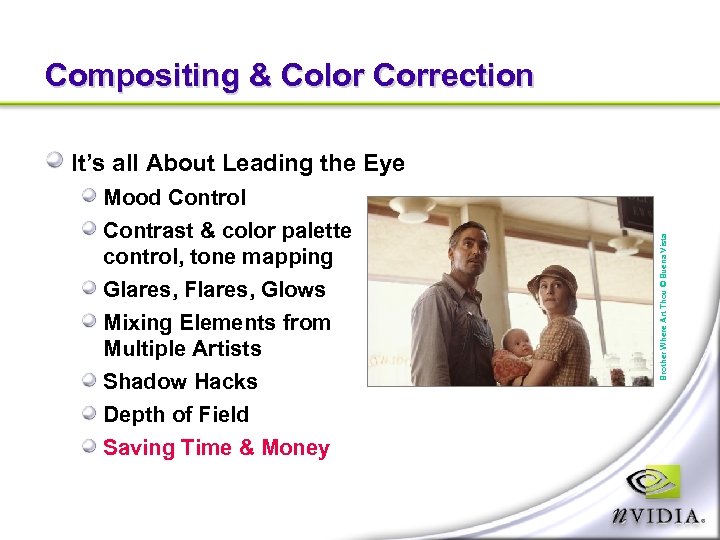
Compositing & Color Correction Mood Control Contrast & color palette control, tone mapping Glares, Flares, Glows Mixing Elements from Multiple Artists Shadow Hacks Depth of Field Saving Time & Money Brother Where Art Thou © Buena Vista It’s all About Leading the Eye
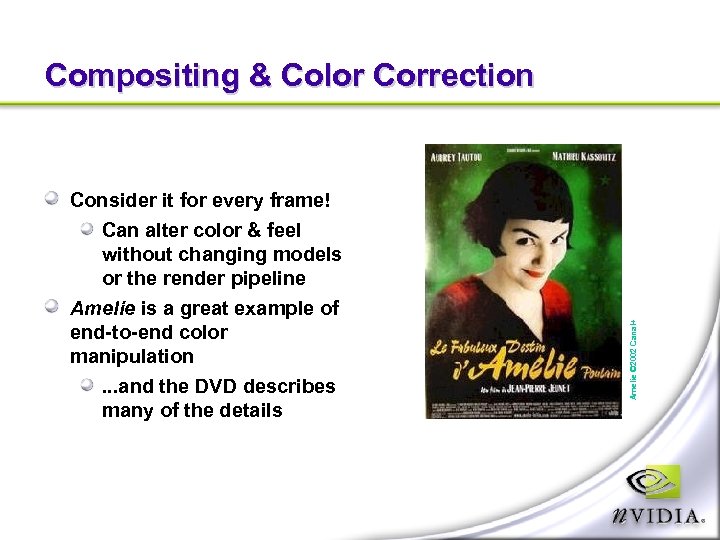
Consider it for every frame! Can alter color & feel without changing models or the render pipeline Amelie is a great example of end-to-end color manipulation. . . and the DVD describes many of the details Amelie © 2002 Canal+ Compositing & Color Correction
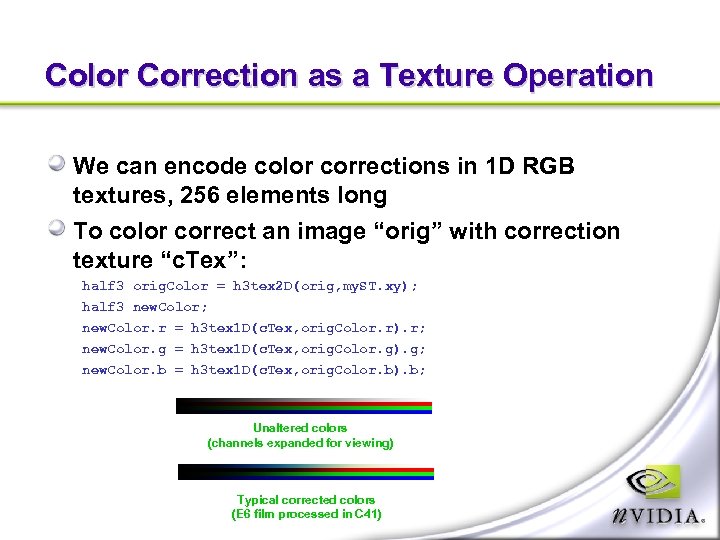
Color Correction as a Texture Operation We can encode color corrections in 1 D RGB textures, 256 elements long To color correct an image “orig” with correction texture “c. Tex”: half 3 orig. Color = h 3 tex 2 D(orig, my. ST. xy); half 3 new. Color; new. Color. r = h 3 tex 1 D(c. Tex, orig. Color. r). r; new. Color. g = h 3 tex 1 D(c. Tex, orig. Color. g). g; new. Color. b = h 3 tex 1 D(c. Tex, orig. Color. b). b; Unaltered colors (channels expanded for viewing) Typical corrected colors (E 6 film processed in C 41)
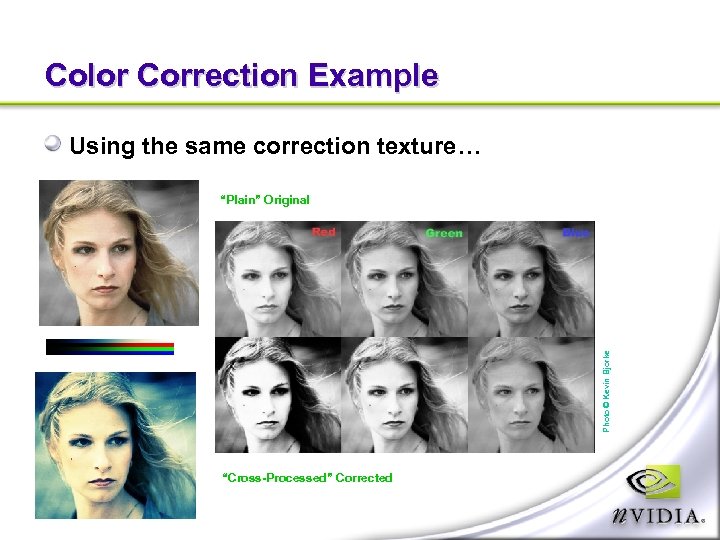
Color Correction Example Using the same correction texture… Photo © Kevin Bjorke “Plain” Original “Cross-Processed” Corrected
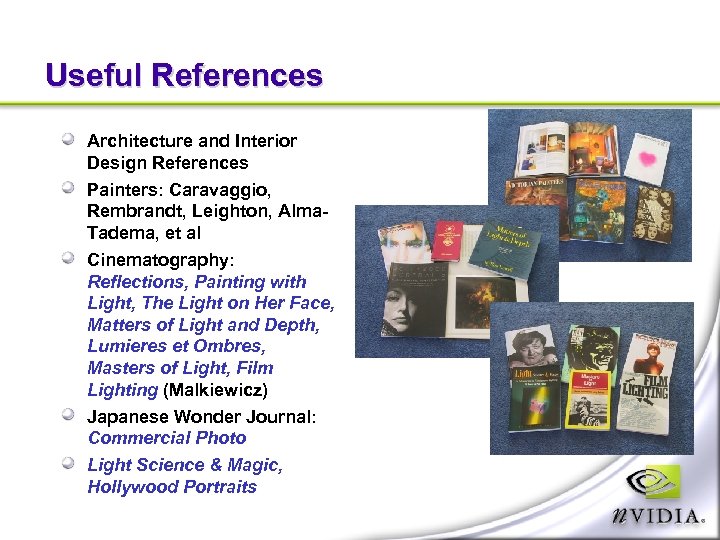
Useful References Architecture and Interior Design References Painters: Caravaggio, Rembrandt, Leighton, Alma. Tadema, et al Cinematography: Reflections, Painting with Light, The Light on Her Face, Matters of Light and Depth, Lumieres et Ombres, Masters of Light, Film Lighting (Malkiewicz) Japanese Wonder Journal: Commercial Photo Light Science & Magic, Hollywood Portraits
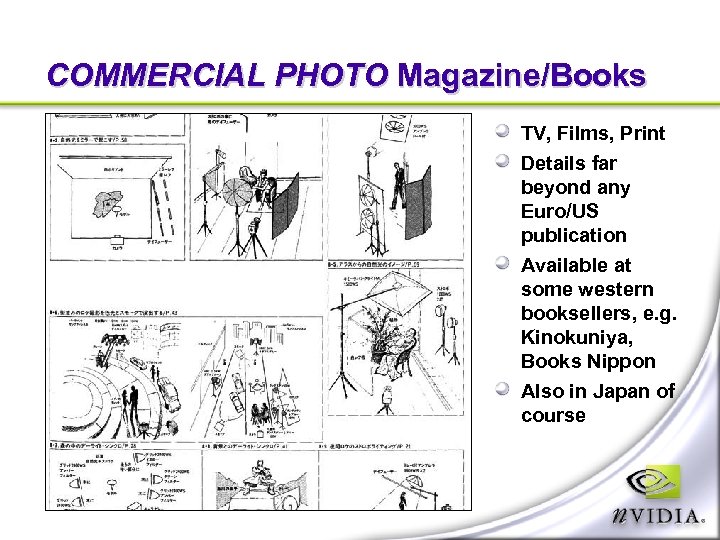
COMMERCIAL PHOTO Magazine/Books TV, Films, Print Details far beyond any Euro/US publication Available at some western booksellers, e. g. Kinokuniya, Books Nippon Also in Japan of course
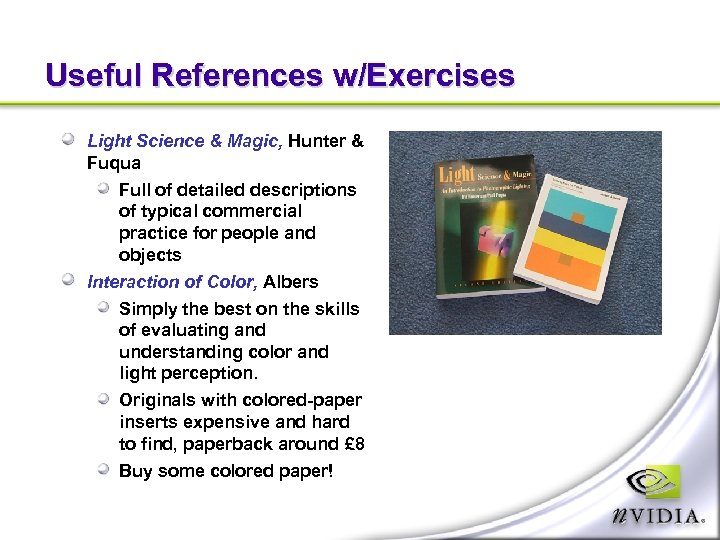
Useful References w/Exercises Light Science & Magic, Hunter & Fuqua Full of detailed descriptions of typical commercial practice for people and objects Interaction of Color, Albers Simply the best on the skills of evaluating and understanding color and light perception. Originals with colored-paper inserts expensive and hard to find, paperback around £ 8 Buy some colored paper!
Convergence Interactivity is changing movie production economics even as gaming rushes to supplant movies & TV Less Render Time == More Artistic Input Time Realtime will become important at the high-end, even if the technical gap never completely closes Artist time is more valuable than render time Programmable shading lets you tape-together almost any desired effect That’s Show Biz!

Thanks! kbjorke@nvidia. com
Скачать презентацию Gaffer to Game Engine Cinematic Effects Kevin Bjorke
74e28df53f593bb7f302a3b040dc3afa.ppt