 Скачать презентацию G-REMi T An Algorithm for Building Energy Efficient
65c6a5cbdfb2c0bbd87abbf4f3b3b058.ppt
- Количество слайдов: 25



G-REMi. T: An Algorithm for Building Energy Efficient Multicast Trees in Wireless Ad Hoc Networks Bin Wang and Sandeep K. S. Gupta Computer Science and Engineering Department Arizona State University Tempe, AZ, USA {Bin. Wang, Sandeep. Gupta}@asu. edu 1
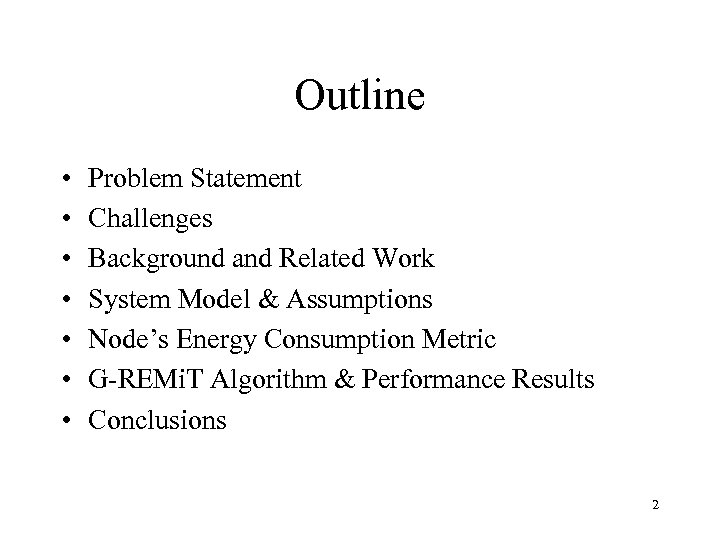
Outline • • Problem Statement Challenges Background and Related Work System Model & Assumptions Node’s Energy Consumption Metric G-REMi. T Algorithm & Performance Results Conclusions 2
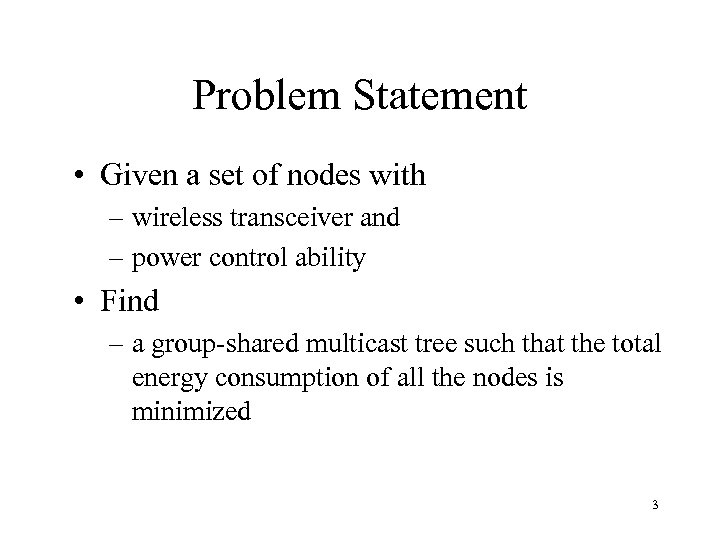
Problem Statement • Given a set of nodes with – wireless transceiver and – power control ability • Find – a group-shared multicast tree such that the total energy consumption of all the nodes is minimized 3
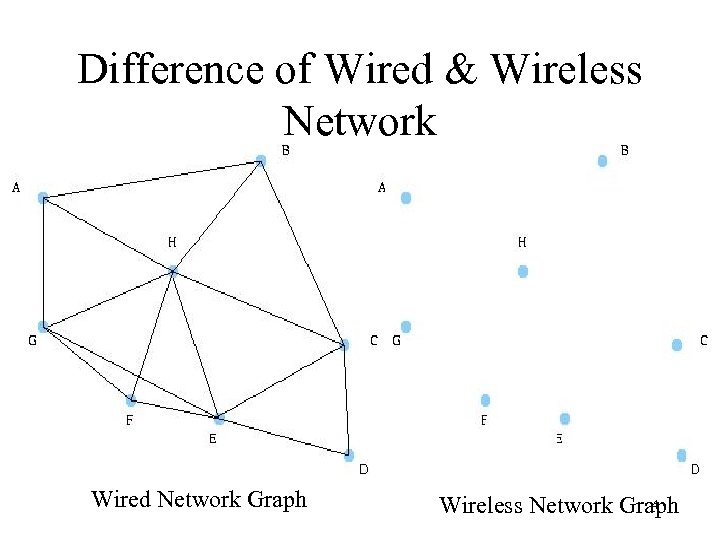
Difference of Wired & Wireless Network Wired Network Graph 4 Wireless Network Graph
Challenges • Transmission Power determines – The total amount of energy consumed on the link – Feasible of the link – Network topology 5

Background and Current State of Art • Multicasting – What is? • Allow one entity to communicate efficiently with multiple entities residing in a subset of the nodes in the network – Why multi-destination delivery in a single message? • Transparency; Efficiency; Concurrency – Applications (e. g, distributed database, distributed games, teleconferencing) 6
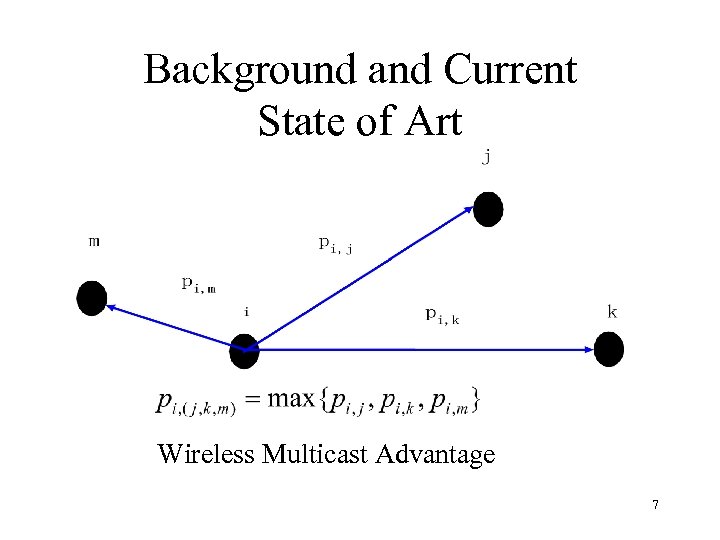
Background and Current State of Art Wireless Multicast Advantage 7
Background and Current State of Art • Building energy-efficient broadcast/ multicast tree – Optimal solution is NP-hard problem [Li LCN 2001], heuristic algorithm is needed – Distributed Solution vs. Centralized Solution • High overhead to obtain global knowledge • Dynamic of wireless link and data traffic 8
Background and Current State of Art • Current heuristic algorithms for building energy efficient broadcast/multicast tree – Minimize cost metric increment for adding a node in the source-based tree. • Using cost metric with energy cost (BIP/MIP, BLU/MLU, BLi. MST/MLi. MST [Wieselthier Infocom 2000]); Dist-BIP-A, Dist. BIP-G [Wieselthier Milcom 2002] – Refine a minimum spanning tree (MST) by cover as more downstream node as possible in source-based tree • EWMA, Dist-EWMA [Cagalj Mobicom 2002] 9
System Model & Assumptions • Static Wireless Ad hoc Network • Each node knows the distance between itself and its neighbor nodes • Every node knows the number of nodes in the multicast group • Group message generation rate (in term of bit/s) at every node follow Poisson distribution. And all of these message generation rates are independent random variables 10
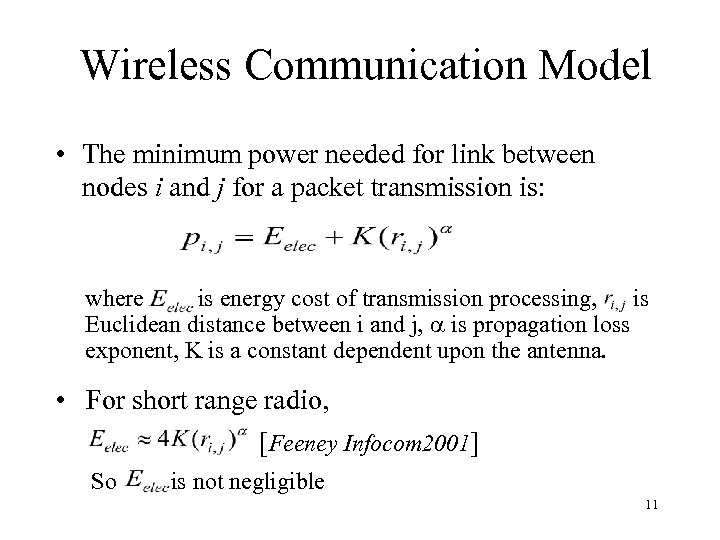
Wireless Communication Model • The minimum power needed for link between nodes i and j for a packet transmission is: where is energy cost of transmission processing, is Euclidean distance between i and j, is propagation loss exponent, K is a constant dependent upon the antenna. • For short range radio, [Feeney Infocom 2001] So is not negligible 11
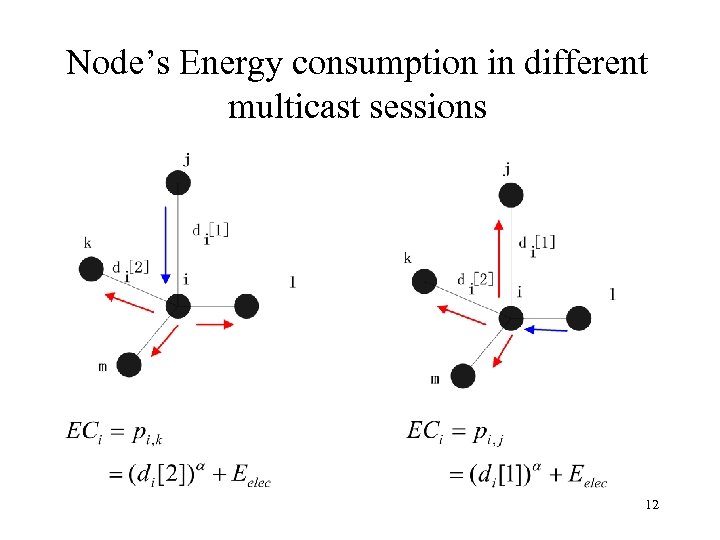
Node’s Energy consumption in different multicast sessions 12
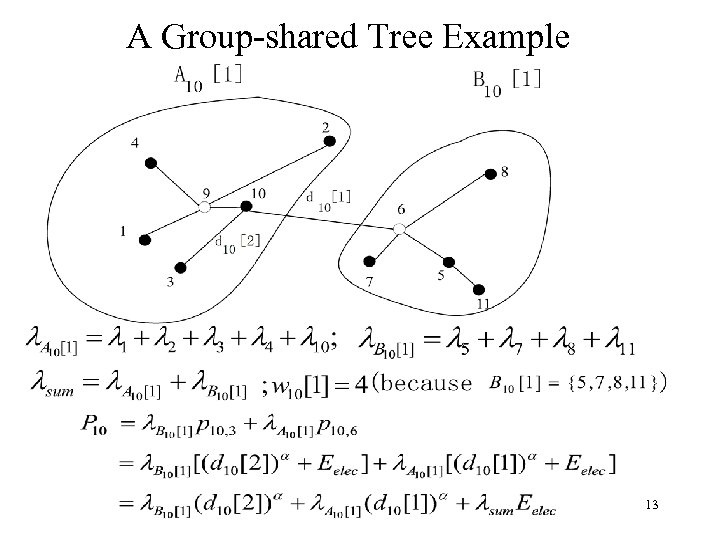
A Group-shared Tree Example 13
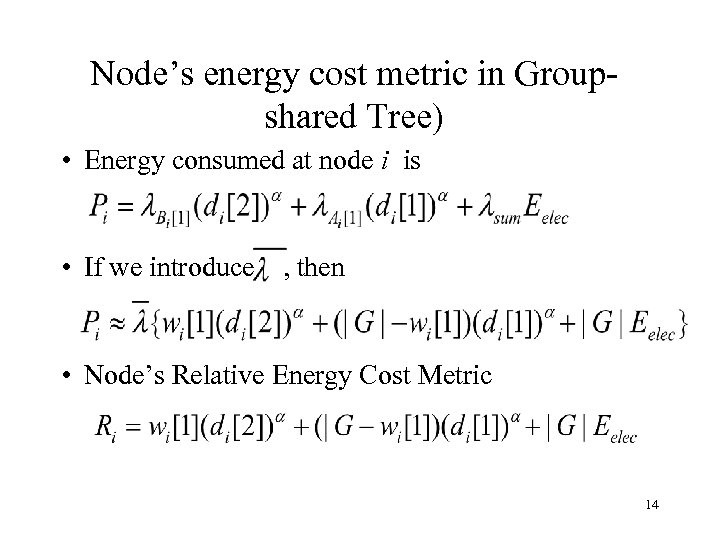
Node’s energy cost metric in Groupshared Tree) • Energy consumed at node i is • If we introduce , then • Node’s Relative Energy Cost Metric 14
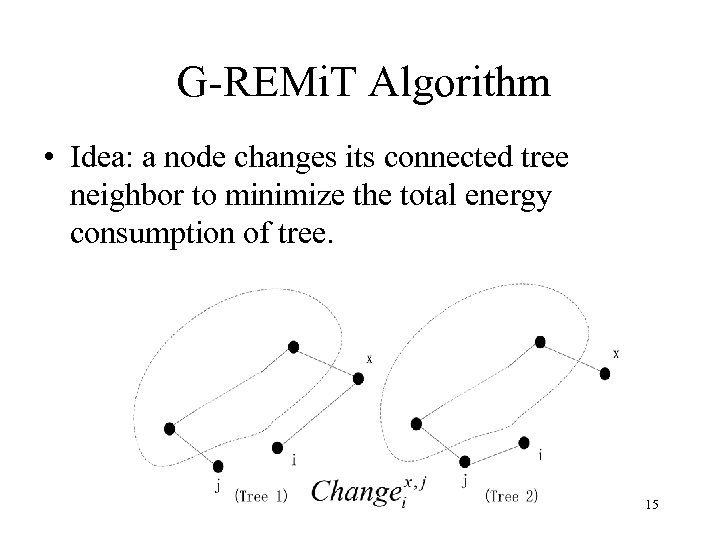
G-REMi. T Algorithm • Idea: a node changes its connected tree neighbor to minimize the total energy consumption of tree. 15
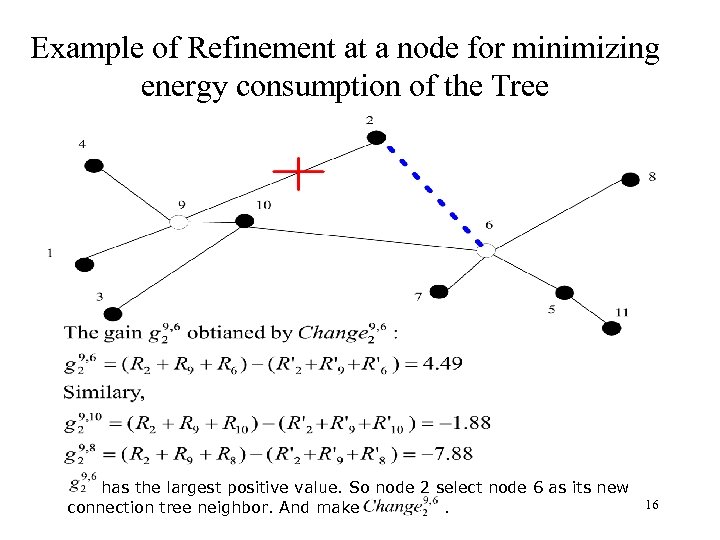
Example of Refinement at a node for minimizing energy consumption of the Tree has the largest positive value. So node 2 select node 6 as its new connection tree neighbor. And make . 16
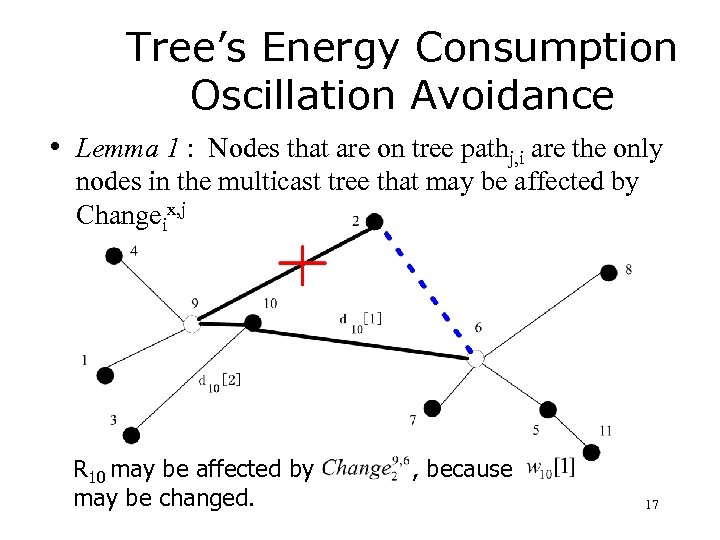
Tree’s Energy Consumption Oscillation Avoidance • Lemma 1 : Nodes that are on tree pathj, i are the only nodes in the multicast tree that may be affected by Changeix, j R 10 may be affected by may be changed. , because 17
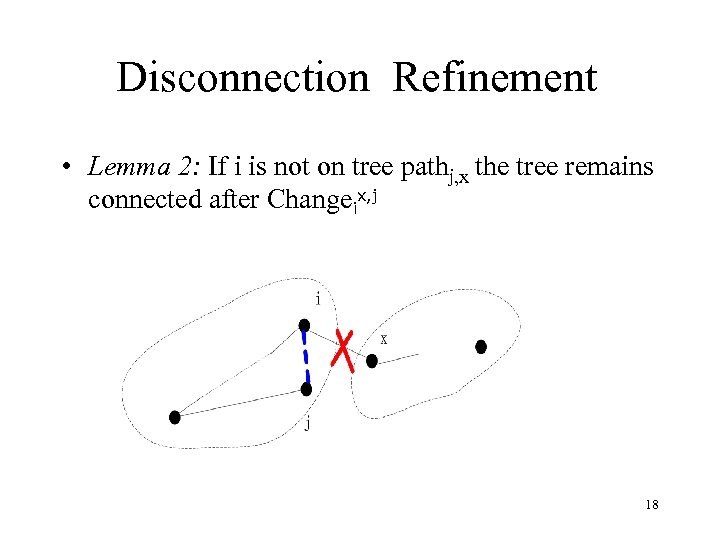
Disconnection Refinement • Lemma 2: If i is not on tree pathj, x the tree remains connected after Changeix, j 18
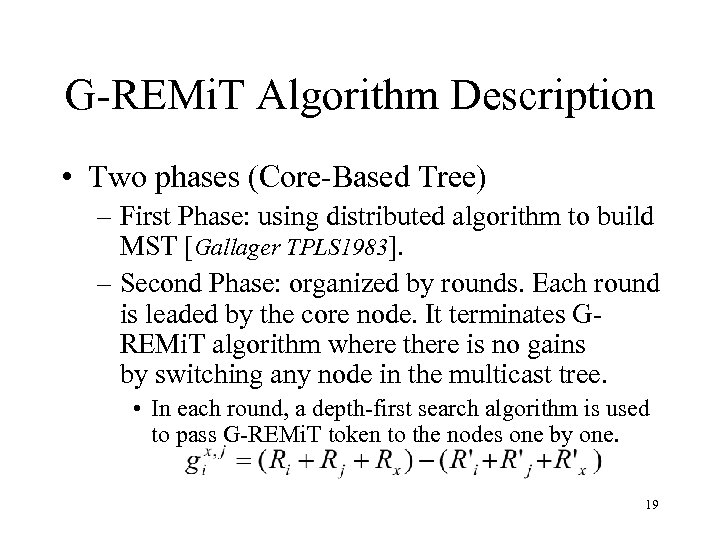
G-REMi. T Algorithm Description • Two phases (Core-Based Tree) – First Phase: using distributed algorithm to build MST [Gallager TPLS 1983]. – Second Phase: organized by rounds. Each round is leaded by the core node. It terminates GREMi. T algorithm where there is no gains by switching any node in the multicast tree. • In each round, a depth-first search algorithm is used to pass G-REMi. T token to the nodes one by one. 19
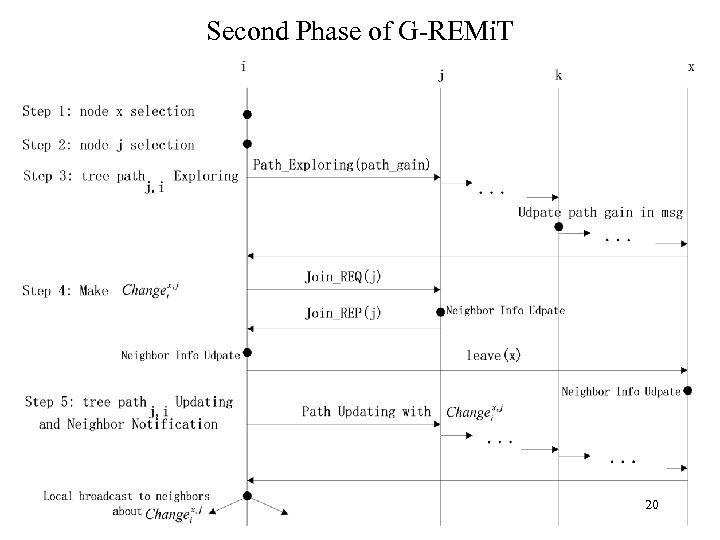
Second Phase of G-REMi. T 20
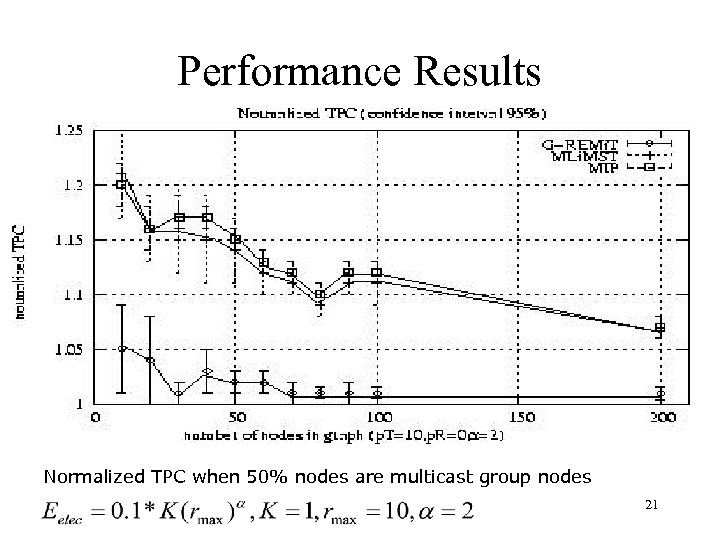
Performance Results Normalized TPC when 50% nodes are multicast group nodes 21
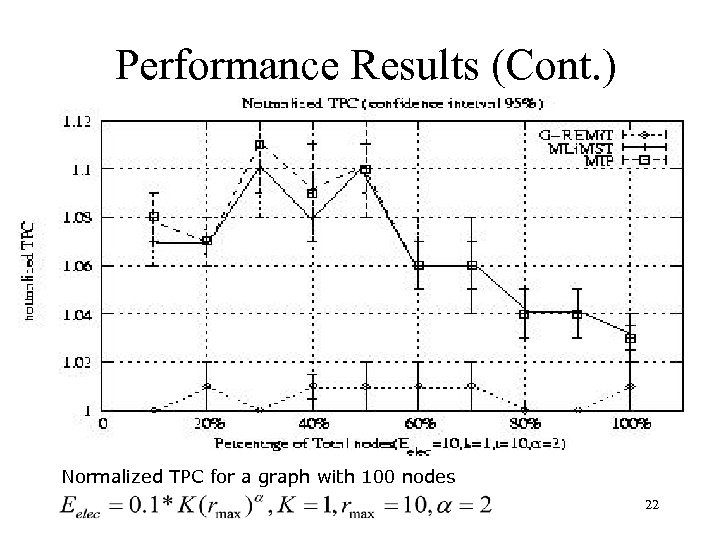
Performance Results (Cont. ) Normalized TPC for a graph with 100 nodes 22
Conclusions • Energy consumption metric for evaluating energyefficiency of multicast protocol in WANET • G-REMi. T is a distributed algorithm to construct an energy-efficient multicast tree. • G-REMi. T Perform better than BIP/MIP Dist-BIPG, and Dist-BIP-A algorithms for long range radios. • All of the algorithms have similar performance for short range radios. 23
Future Work • Energy efficient multicast in mobile ad hoc network • Multicast tree lifetime extension • Other schemes for energy efficient multicast of short range radios – Directional antenna – Scheduling sleep mode among the nodes 24
![Reference [1] J. E. Wieselthier, G. D. Nguyen, and A. Ephremides. On the construction](https://present5.com/presentation/65c6a5cbdfb2c0bbd87abbf4f3b3b058/image-25.jpg "Reference [1] J. E. Wieselthier, G. D. Nguyen, and A. Ephremides. On the construction")
Reference [1] J. E. Wieselthier, G. D. Nguyen, and A. Ephremides. On the construction of energy-efficient broadcast and multicast tree in wireless networks. In Proceedings of the IEEE INFOCOM 2000, pages 585– 594, Tel Aviv, ISRAEL, March 2000. [2] J. E. Wieselthier, G. D. Nguyen, and A. Ephremides, Distributed algorithms for energyefficient broadcasting in ad hoc networks, Proceedings of Mil. Com, Anaheim, CA, Oct. 2002. [3] M. Cagalj, J. P. Hubaux, and C. Enz. Minimum-energy broadcast in All-wireless networks: NP-completeness and distribution issues. In Proceedings of ACM Mobi. Com 2002, pages 172 – 182, Atlanta, Georgia, September 2002. [4] F. Li and I. Nikolaidis. On minimum-energy broadcasting in all-wireless networks. In Proceedings of the 26 th Annual IEEE Conference on Local Computer Networks (LCN 2001), pages 193– 202, Tampa, Florida, November 2001. [5] R. G. Gallager, P. A. Humblet, and P. M. Spira. A distributed algorithm for minimum weight spanning trees. ACM Transactions on Programming Languages and Systems, 5(1): 66– 77, January 1983. [6] L. M. Feeney and M. Nilsson. Investigating the energy consumption of a wireless network interface in an ad hoc networking environment. In Proceedings of IEEE INFOCOM, Anchorage, pages 1548 – 1557, AK, April 2001. 25
Скачать презентацию G-REMi T An Algorithm for Building Energy Efficient
65c6a5cbdfb2c0bbd87abbf4f3b3b058.ppt