


 Скачать презентацию G-Commerce A Study of Market Economies For the
07c42dac775847a55b39c16d7880fdd7.ppt
- Количество слайдов: 19
 G-Commerce: A Study of Market Economies For the Grid Rich Wolski James Plank John Brevik Todd Bryan University of Tennessee
 Resource Allocation under Gr. ADS • Applications (through their schedulers) “contract” with resources for service – Performance contracts ® Application resource specification ® Execution monitoring and control • Resource specification contract – Current Sca. LAPACK demo • Violations may cause the scheduler to acquire and release resources – Cactus migration • What if there are many schedulers and contracts at work simultaneously? – Performance Economy
 Performance Economic Questions • Will Grid resource allocations be stable? – We are building a system that enables dynamic allocation and release under program control. – Resource reservations may make the problem worse, not better. • What is the overall efficiency of the Grid? – We don’t really have a way to evaluate how well the Grid is working in the aggregate. • What resource allocation protocols ensure the best overall performance? – Our current set of performance-only allocation rules work well if the Grid is over-supplied. – In an over-demand case, the results may be different.
 Approach • Start with theory and simulation – Build an experimental framework for Grid market economies based on Gr. ADS Prototypes – Identify and test different economic formulations • Then build the infrastructure necessary to transact business – Leverage Gr. ADSoft tools – Use Macro. Grid and Micro. Grid to verify the results
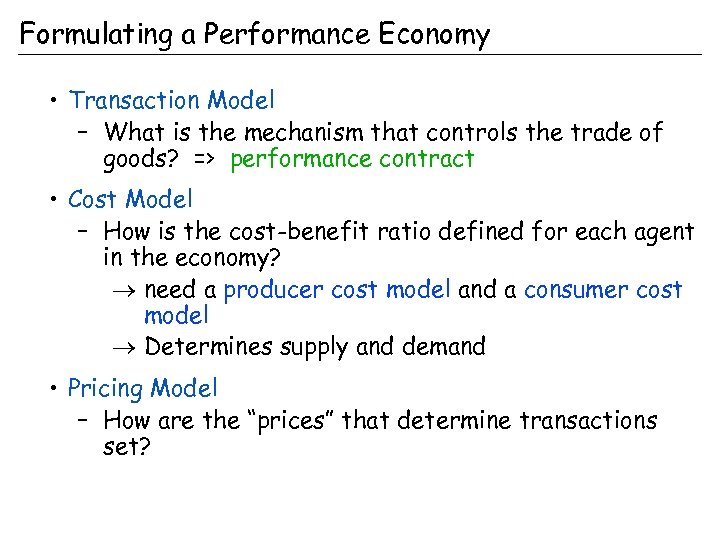 Formulating a Performance Economy • Transaction Model – What is the mechanism that controls the trade of goods? => performance contract • Cost Model – How is the cost-benefit ratio defined for each agent in the economy? ® need a producer cost model and a consumer cost model ® Determines supply and demand • Pricing Model – How are the “prices” that determine transactions set?
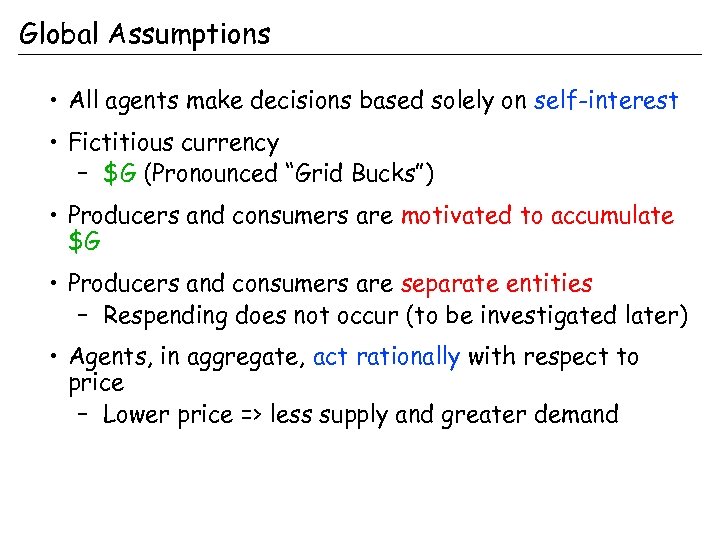 Global Assumptions • All agents make decisions based solely on self-interest • Fictitious currency – $G (Pronounced “Grid Bucks”) • Producers and consumers are motivated to accumulate $G • Producers and consumers are separate entities – Respending does not occur (to be investigated later) • Agents, in aggregate, act rationally with respect to price – Lower price => less supply and greater demand
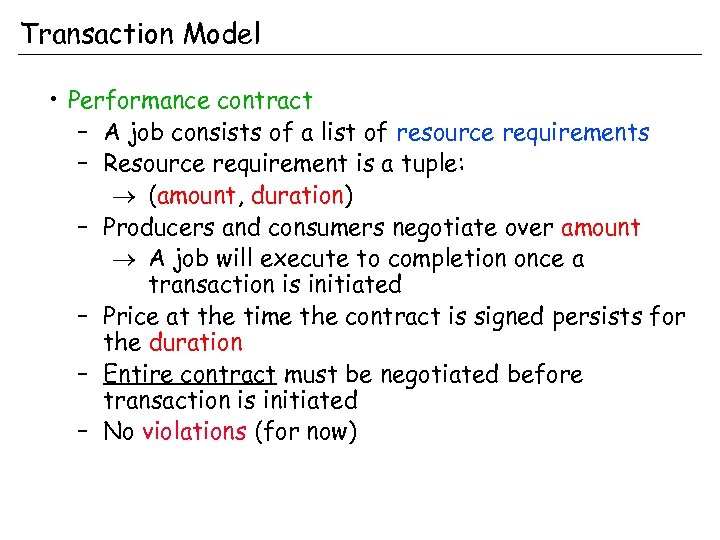 Transaction Model • Performance contract – A job consists of a list of resource requirements – Resource requirement is a tuple: ® (amount, duration) – Producers and consumers negotiate over amount ® A job will execute to completion once a transaction is initiated – Price at the time the contract is signed persists for the duration – Entire contract must be negotiated before transaction is initiated – No violations (for now)
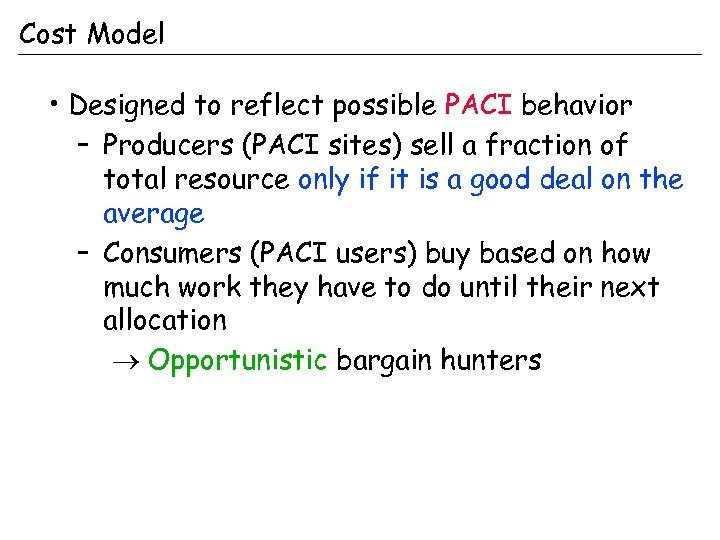 Cost Model • Designed to reflect possible PACI behavior – Producers (PACI sites) sell a fraction of total resource only if it is a good deal on the average – Consumers (PACI users) buy based on how much work they have to do until their next allocation ® Opportunistic bargain hunters
 Pricing Model • Two alternatives: auctions and markets • Auctions – Easy to implement – No need for global information (maybe) – No provable stability or equilibrium properties – Generally favor the seller • Markets (dynamic pricing) – Provable stability and equilibrium characteristics – Accurately (fairly) reflect value – Requires global state information – More difficult to understand implement than auctions
 First Study: Markets versus Auctions • Transaction Model: performance contracts • Cost Model: PACI-inspired producers and consumers – Diurnal job cycle – Opportunistic consumers – Producers use historical profit • Compare – Resource allocation stability – Equilibrium (value accuracy) – Resource efficiency for a hypothetical Grid
 Markets • Theory – Equilibrium Price: a price that equalizes supply and demand – Smale (1976) provides a constructive method for determining the equilibrium price based on Newton. Raphson – First Bank of G: implementable Smale • Practice – Nothing is continuous => optimality is impossible – Simulation is generally the final arbiter
 G-Bay • Theory – Uniform Second-price Auction (Vickery, 1961) ® Sealed-bid ® Highest bidder pays second-highest bid price – Reduces seller favoritism – Determines a prices that is “closer” to market consensus • Practice – Auctions work well when object that is for sale is unique ® If not, buyer must participate in multiple auctions => centralized auction clearing house
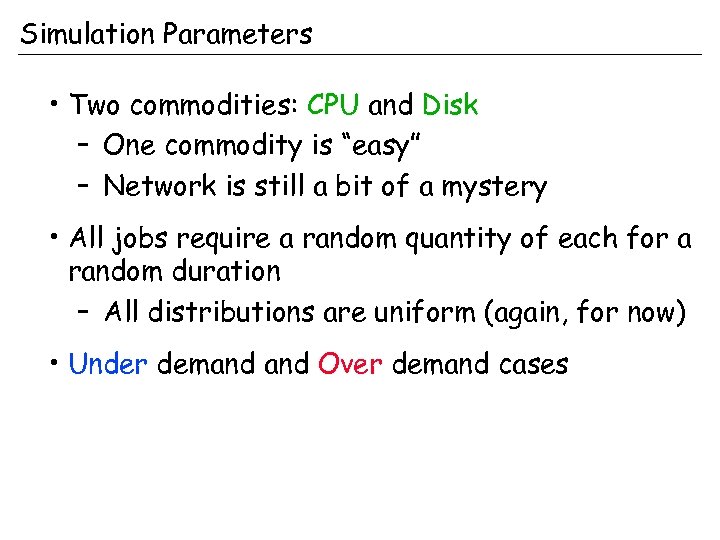 Simulation Parameters • Two commodities: CPU and Disk – One commodity is “easy” – Network is still a bit of a mystery • All jobs require a random quantity of each for a random duration – All distributions are uniform (again, for now) • Under demand Over demand cases
 Price Stability – Under Demand
 Market and Auction Equilibrium – Under Demand
 Resource Utilization
 Conclusions • For G-Commerce, Commodities Markets look better than Auctions (IPDPS-01, JSA) – More stable prices – Equilibrium – No more centralized than Auctions – Theoretically tractable • What we Learned: Anecdotes from the Trading Pits – It is really easy to build an oscillating economy ® Panics happen ® Performance contracts are a good first step – Self-interest is easy to model, but realistic selfinterest is hard to model
 What’s Next? • Sca. LAPACK – Currently simulating Sca. LAPACK Demo – Build a running Economy of Sca. LAPACK consumers ® Macro. Grid and Micro. Grid • Stability Theory – Dynamical systems approach • Information consistency – Extend equilibrium results to account for imperfect information => decentralization • Build The First Bank of G for Gr. ADS
 People and Leverage • People – James Plank (UTK faculty, not a Gr. ADS participant) – John Brevik (postdoc) – Todd Bryan (grad. student) – Performance contracts team and Sca. LAPACK demo team (many, many discussions) • Leverage – NGS Loci (supply and demand information management) – NSF Career Award