


 Скачать презентацию G 22 3250 -001 Farsite A Serverless File
6afb5cf729235e1c8b0c2256c85441e2.ppt
- Количество слайдов: 20
 G 22. 3250 -001 Farsite: A Serverless File System Robert Grimm New York University
 Altogether Now: The Three Questions § What is the problem? § What is new or different or notable? § What are the contributions and limitations?
 Distributed File Systems Take Two (late 90 s and 00 s) § Goal: Provide uniform file system access across several workstations § Single, possibly large organization § Computers connected by local network (not Internet) § General strategy: Serverless file systems § Server-based FS’s are well administered, have higher quality, more redundancy, and greater physical security § But they also are expensive! § Equipment, physical plant, personnel § Alternative: Use already existing workstations § Need to reconcile security, reliability, and performance
 Farsite Design Assumptions § High-bandwidth, low-latency network § Topology can be ignored § Majority of machines up and running a majority of the time § Generally uncorrelated downtimes § Small fraction of users malicious § Try to destroy or corrupt data or metadata § Large fraction of users opportunistic § Try to read unauthorized data or metadata
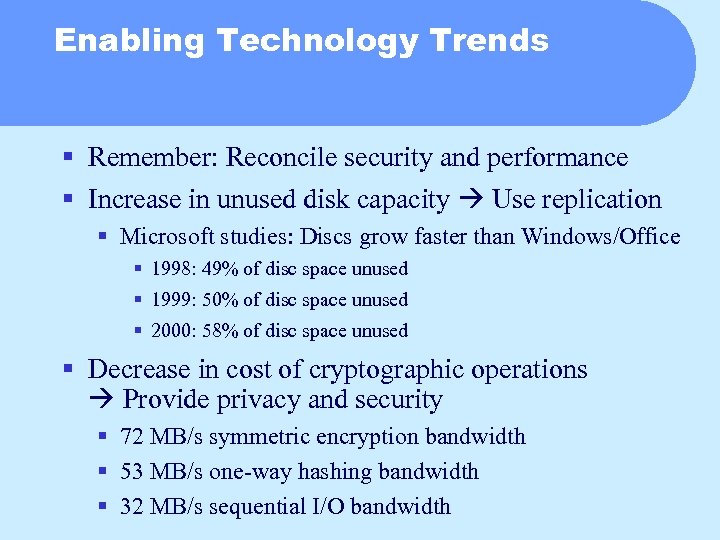 Enabling Technology Trends § Remember: Reconcile security and performance § Increase in unused disk capacity Use replication § Microsoft studies: Discs grow faster than Windows/Office § 1998: 49% of disc space unused § 1999: 50% of disc space unused § 2000: 58% of disc space unused § Decrease in cost of cryptographic operations Provide privacy and security § 72 MB/s symmetric encryption bandwidth § 53 MB/s one-way hashing bandwidth § 32 MB/s sequential I/O bandwidth
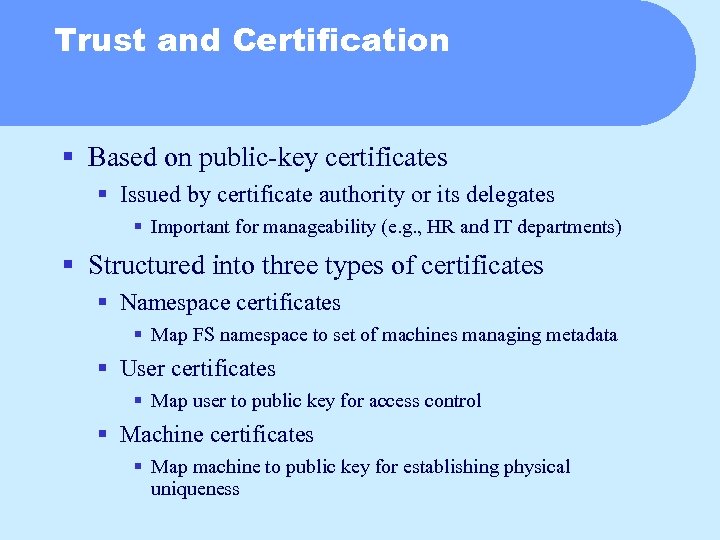 Trust and Certification § Based on public-key certificates § Issued by certificate authority or its delegates § Important for manageability (e. g. , HR and IT departments) § Structured into three types of certificates § Namespace certificates § Map FS namespace to set of machines managing metadata § User certificates § Map user to public key for access control § Machine certificates § Map machine to public key for establishing physical uniqueness
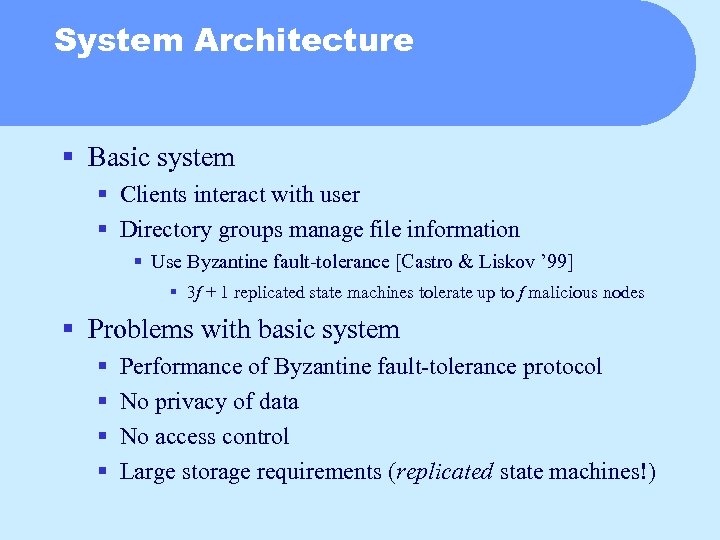 System Architecture § Basic system § Clients interact with user § Directory groups manage file information § Use Byzantine fault-tolerance [Castro & Liskov ’ 99] § 3 f + 1 replicated state machines tolerate up to f malicious nodes § Problems with basic system § § Performance of Byzantine fault-tolerance protocol No privacy of data No access control Large storage requirements (replicated state machines!)
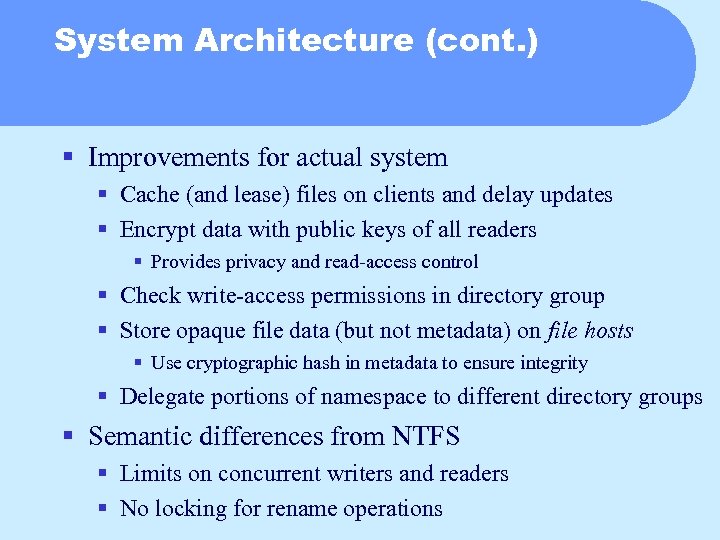 System Architecture (cont. ) § Improvements for actual system § Cache (and lease) files on clients and delay updates § Encrypt data with public keys of all readers § Provides privacy and read-access control § Check write-access permissions in directory group § Store opaque file data (but not metadata) on file hosts § Use cryptographic hash in metadata to ensure integrity § Delegate portions of namespace to different directory groups § Semantic differences from NTFS § Limits on concurrent writers and readers § No locking for rename operations
 Diggin’ Deeper § § § § Reliability and availability Security Durability Consistency Scalability Efficiency Manageability
 Reliability and Availability § Main mechanism: Replication § Byzantine for metadata, regular for file data § Challenge: Migrate replicas in face of failures § Aggressive directory migration § After all, need to access metadata to even get to file data § Random selection of new group members after short downtime § Bias towards high-availability machines § Balanced file host migration § Swap locations of high-availability files with low-availability files § Simulations show 1% of replicas swapped per day
 Security § Access control § Based on public keys of all authorized file writers § Performed by directory group § Privacy § Based on block-level, convergent encryption (why? ) § One-way hash serves as key for encrypting block § One-way hash encrypted with symmetric file key § File key encrypted with public keys of all file readers § Integrity § Ensured by hash tree over file data blocks § Tree stored with file, root hash stored with metadata
 Durability § Updates to metadata collected in client-side log § Batched to directory group § What to do after a crash? § Obvious solutions are problematic § Private key signing of all log entries too expensive § Holding private key on machine opens security hole § Better solution: Symmetric authenticator key § Split into shares and distributed amongst directory group § Log entries signed using message authentication code § On crash recovery, log pushed to directory group § Members reconstruct authenticator key, validate entries
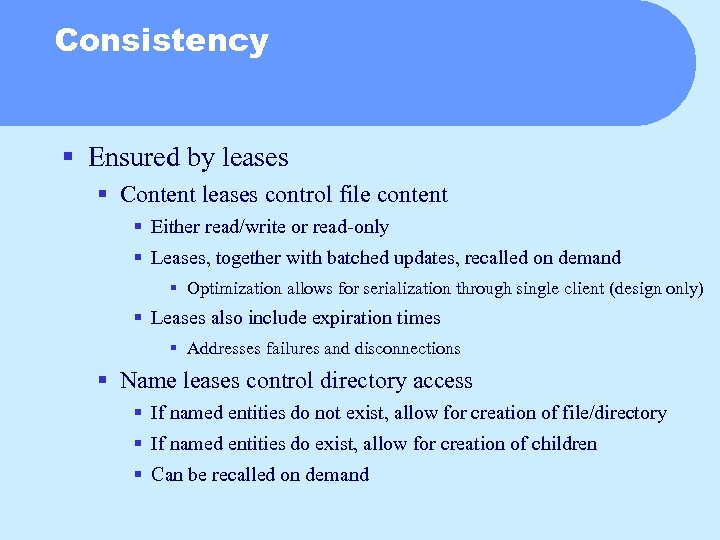 Consistency § Ensured by leases § Content leases control file content § Either read/write or read-only § Leases, together with batched updates, recalled on demand § Optimization allows for serialization through single client (design only) § Leases also include expiration times § Addresses failures and disconnections § Name leases control directory access § If named entities do not exist, allow for creation of file/directory § If named entities do exist, allow for creation of children § Can be recalled on demand
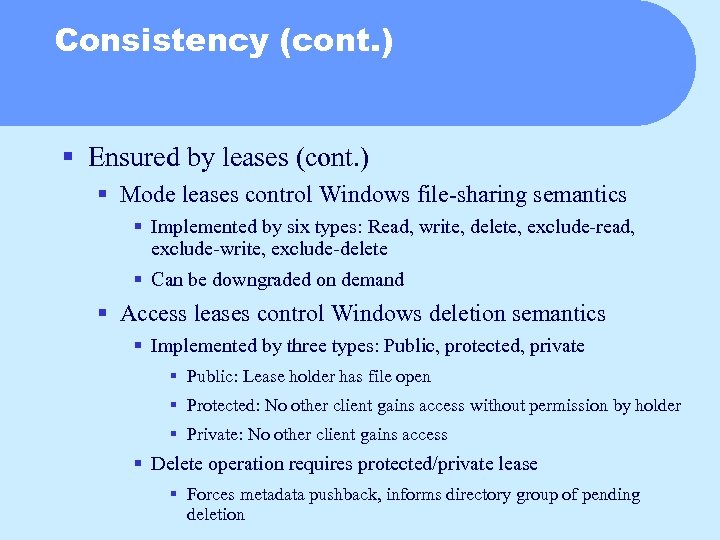 Consistency (cont. ) § Ensured by leases (cont. ) § Mode leases control Windows file-sharing semantics § Implemented by six types: Read, write, delete, exclude-read, exclude-write, exclude-delete § Can be downgraded on demand § Access leases control Windows deletion semantics § Implemented by three types: Public, protected, private § Public: Lease holder has file open § Protected: No other client gains access without permission by holder § Private: No other client gains access § Delete operation requires protected/private lease § Forces metadata pushback, informs directory group of pending deletion
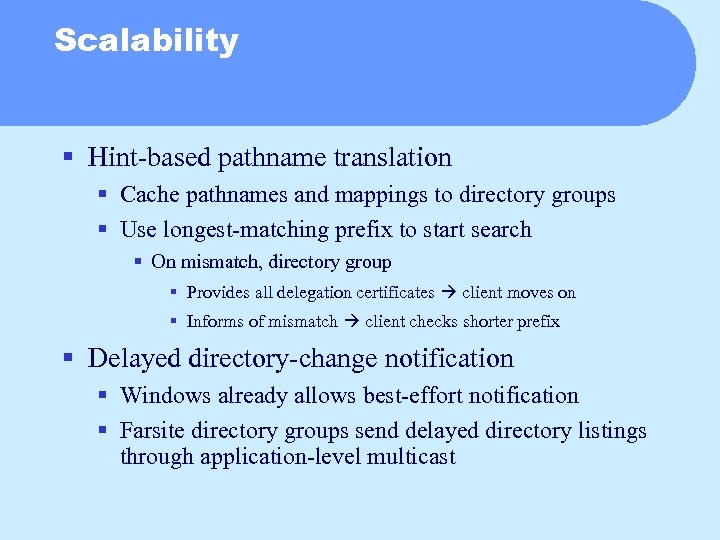 Scalability § Hint-based pathname translation § Cache pathnames and mappings to directory groups § Use longest-matching prefix to start search § On mismatch, directory group § Provides all delegation certificates client moves on § Informs of mismatch client checks shorter prefix § Delayed directory-change notification § Windows already allows best-effort notification § Farsite directory groups send delayed directory listings through application-level multicast
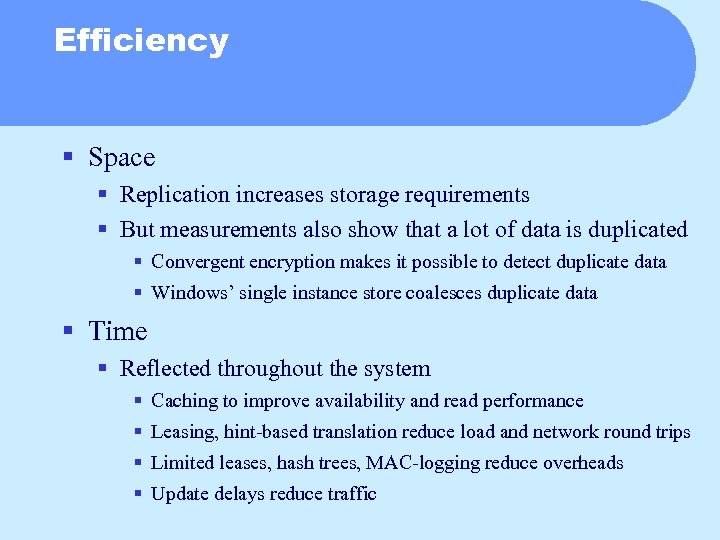 Efficiency § Space § Replication increases storage requirements § But measurements also show that a lot of data is duplicated § Convergent encryption makes it possible to detect duplicate data § Windows’ single instance store coalesces duplicate data § Time § Reflected throughout the system § Caching to improve availability and read performance § Leasing, hint-based translation reduce load and network round trips § Limited leases, hash trees, MAC-logging reduce overheads § Update delays reduce traffic
 Manageability § Local machine administration § Preemptive migration to improve reliability § Backwards-compatible versions to simplify upgrades § Potential backup utilities to improve performance and avoid loss of privacy § Autonomic system operation § Timed Byzantine operations § Group member initiates time update which causes timed operations to be performed § Byzantine outcalls § Revert standard model of Byzantine fault tolerance § Members prod clients into performing a Byzantine operation
 Phhh, That’s a Lot of Details § But how well does it work? § Windows-based implementation § Kernel-level driver & user-level daemon § NTFS for local storage § CIFS for remote data transfer § Encrypted TCP for control channel § Analysis for 105 machines § Certification: 2 x 10⁵ certificates per month, less than one CPU hour § Direct load on directory groups § Limited by leases per file, directory-change notifications § Indirect load on directory groups § 1 year lifetime 300 new machines/day trivial load on root group
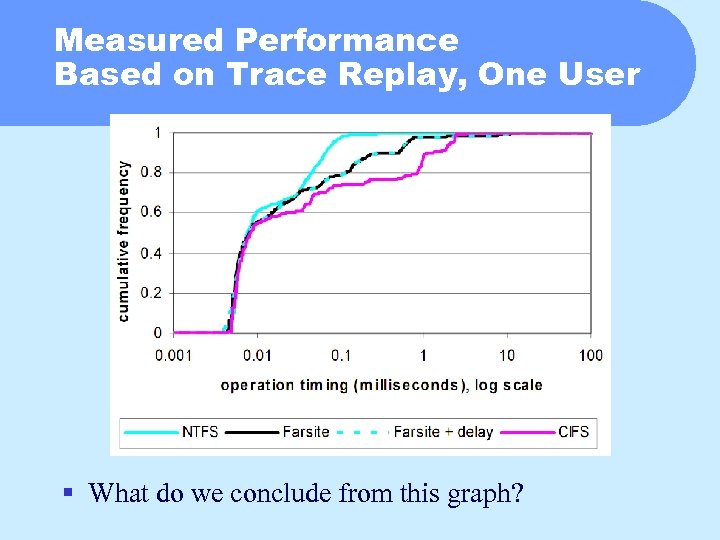 Measured Performance Based on Trace Replay, One User § What do we conclude from this graph?
 What Do You Think?