 Скачать презентацию G 0 MDK 1 RADAR Chuck Hobson BA
44b5871f6ab7076b357d4825a34b6c57.ppt
- Количество слайдов: 45



G 0 MDK 1 RADAR Chuck Hobson BA BSc (hons)
G 0 MDK INTRODUCTION 2 This presentation starts with the early beginnings of Radar in the United States and Great Britain. It moves on from there to describe various military and civilian radars, how they work and what they look like. In keeping with this, I shall first kick off with my own early beginnings and how I fit into the picture. I was born and raised in Pittsburgh Pennsylvania, which is located at the heart of the US steel and coal mining industries. My early years were spent there during the Great Depression. I graduated from High School at the age of 17 in 1944. Like most young men in similar circumstances at that time, I contemplated my future, which included the military draft and a life time working in Steel Mills. With such a future to look forward to, I became very depressed indeed. Then one morning while walking in down town Pittsburgh I spotted a US Navy recruitment poster in a Post Office window. My spirits soared. “US Navy wants young men in Radar!” I rushed into the Post Office where I suddenly found myself confronted by a very intimidating US Navy Chief Petty Officer. ”So you want to join the Navy”, he asked? I mentioned the Radar poster and he said I would have to pass a written test on mathematics and physics to get into the Navy’s Radar school. I was really elated as those were my favourite high school subjects. I said I would like to take the test please. The Chief said It was called “The Captain Eddy Test”, which consisted of 80 questions, and that very few ever passed it. He then handed me the test paper and told me I had two hours to complete it.
G 0 MDK INTRODUCTION 3 (continued) I completed the test in an hour and 10 minutes and handed it back to the Chief. He asked me, “What’s the matter, can’t you answer the questions? ” I told him I finished the test. He marked it and graded it a pass. The chief then handed me an official looking US Navy form and told me to give it to the doctor in an adjoining room. The physical exam took about 5 hours, It was truly an ordeal. Having passed that I found myself on my way to Boot Camp the following week with a Seaman First Class rating (S 1/c). After surviving four weeks of accelerated boot training, I went on to attend a suite of US Navy technical schools. The first was called “Pre-Radio School. ” It was a gruelling four weeks of mathematics. I managed that (30% survival rate). From there I went on to the next level, “Primary Radio School” for 3 months. It included electronic theory, some higher math, and building elementary receivers. After finishing and passing that, I went on to the final level, “Secondary Radio School. ” That lasted six months. This school included a lot of electronic theory, which was taught in the mornings. The afternoons were taken up with extensive hands on experience: Radar and Sonar sets, Communication gear, and Navigation equipment. I graduated in the top 10% of the class and was awarded a second class petty officer rating. (RT 2/c) It was not because I had a super brain, but because I was adicted to electronics and completely immersed in my studies. (The Nerd mode)
G 0 MDK INTRODUCTION 4 (continued) During the next 6 years I served aboard various Naval ships and on shore stations repairing any and all kinds of Naval Electronic Equipment. If it contained vacuum tubes (valves) magnetrons and klystrons, I had a go at it: Fire Control, Air and Surface Search Radars, HF/VHF/UHF Transmitters and Receivers, Loran etc. That experience along with the Navy’s education/training in Radar set me up for life in the field of Electronics. In the process I became quite familiar with many kinds of Radars, which is what this Radar presentation is all about. The next slide shows a picture of the USN Recruitment Poster I saw in Pittsburgh, a photo of me taken in Boot Camp and another of an early US Navy Destroyer Escort. From there the presentation goes strictly into Radar.
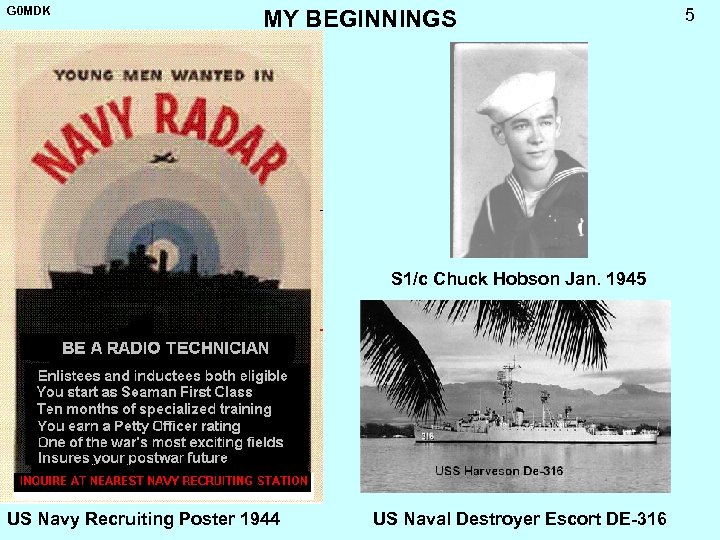
G 0 MDK MY BEGINNINGS S 1/c Chuck Hobson Jan. 1945 US Navy Recruiting Poster 1944 US Naval Destroyer Escort DE-316 5
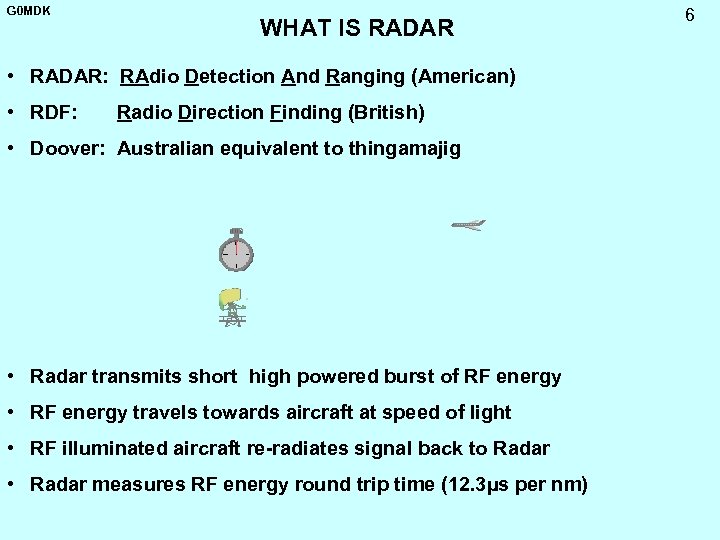
G 0 MDK WHAT IS RADAR • RADAR: RAdio Detection And Ranging (American) • RDF: Radio Direction Finding (British) • Doover: Australian equivalent to thingamajig • Radar transmits short high powered burst of RF energy • RF energy travels towards aircraft at speed of light • RF illuminated aircraft re-radiates signal back to Radar • Radar measures RF energy round trip time (12. 3µs per nm) 6
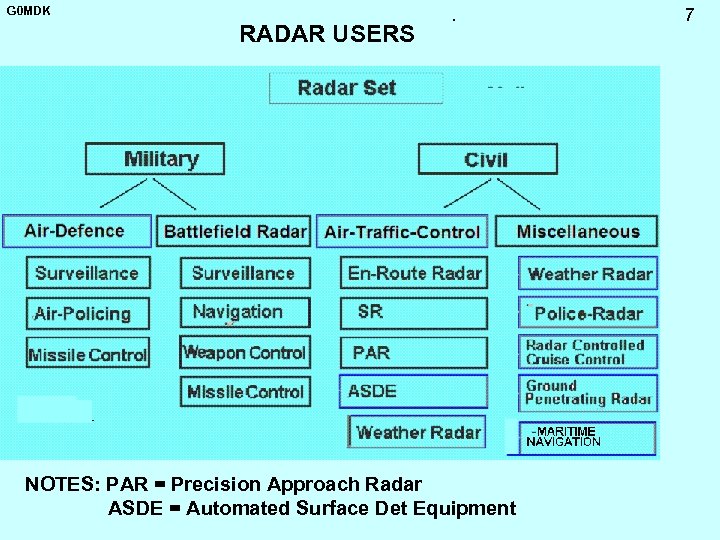
G 0 MDK RADAR USERS . NOTES: PAR = Precision Approach Radar ASDE = Automated Surface Det Equipment 7
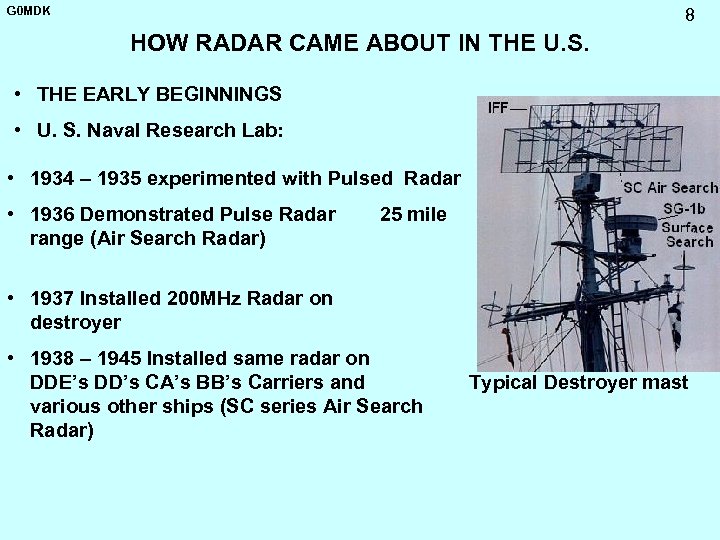
G 0 MDK 8 HOW RADAR CAME ABOUT IN THE U. S. • THE EARLY BEGINNINGS • U. S. Naval Research Lab: • 1934 – 1935 experimented with Pulsed Radar • 1936 Demonstrated Pulse Radar 25 mile range (Air Search Radar) • 1937 Installed 200 MHz Radar on destroyer • 1938 – 1945 Installed same radar on DDE’s DD’s CA’s BB’s Carriers and various other ships (SC series Air Search Radar) Typical Destroyer mast
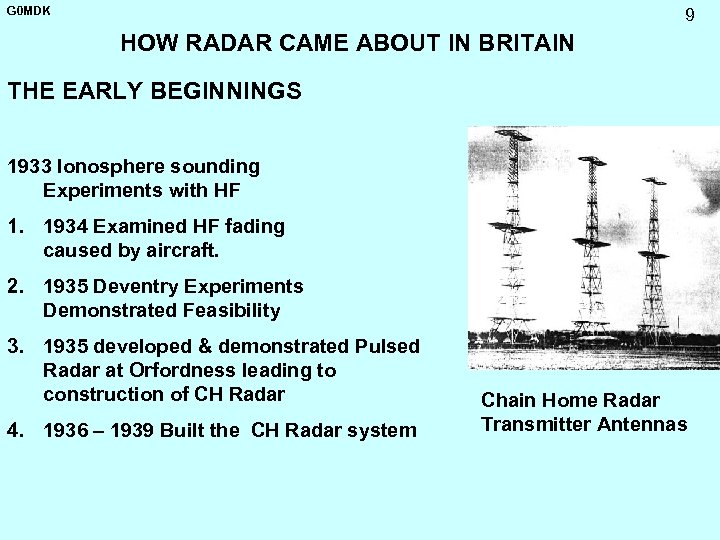
G 0 MDK 9 HOW RADAR CAME ABOUT IN BRITAIN THE EARLY BEGINNINGS 1933 Ionosphere sounding Experiments with HF 1. 1934 Examined HF fading caused by aircraft. 2. 1935 Deventry Experiments Demonstrated Feasibility 3. 1935 developed & demonstrated Pulsed Radar at Orfordness leading to construction of CH Radar 4. 1936 – 1939 Built the CH Radar system Chain Home Radar Transmitter Antennas
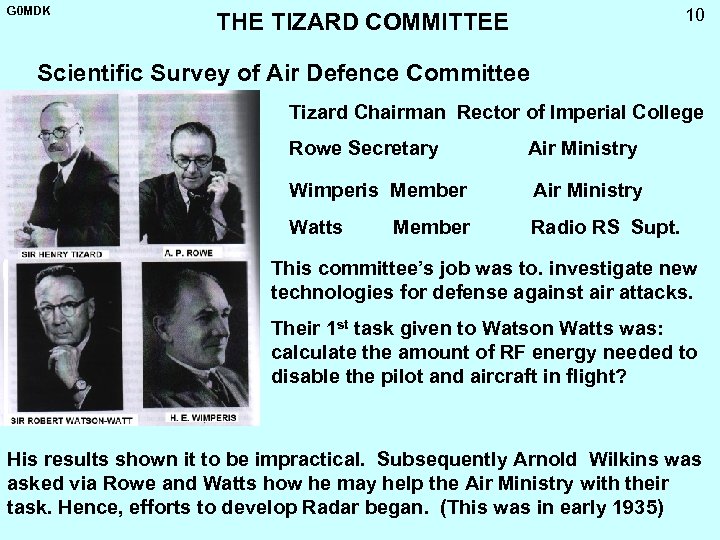
G 0 MDK THE TIZARD COMMITTEE 10 Scientific Survey of Air Defence Committee Tizard Chairman Rector of Imperial College Rowe Secretary Air Ministry Wimperis Member Air Ministry Watts Member Radio RS Supt. This committee’s job was to. investigate new technologies for defense against air attacks. Their 1 st task given to Watson Watts was: calculate the amount of RF energy needed to disable the pilot and aircraft in flight? His results shown it to be impractical. Subsequently Arnold Wilkins was asked via Rowe and Watts how he may help the Air Ministry with their task. Hence, efforts to develop Radar began. (This was in early 1935)
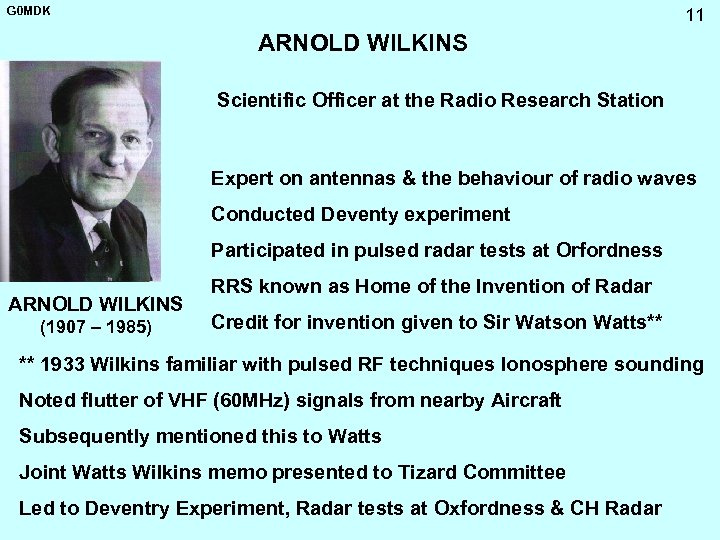
G 0 MDK 11 ARNOLD WILKINS Scientific Officer at the Radio Research Station Expert on antennas & the behaviour of radio waves Conducted Deventy experiment Participated in pulsed radar tests at Orfordness ARNOLD WILKINS (1907 – 1985) RRS known as Home of the Invention of Radar Credit for invention given to Sir Watson Watts** ** 1933 Wilkins familiar with pulsed RF techniques Ionosphere sounding Noted flutter of VHF (60 MHz) signals from nearby Aircraft Subsequently mentioned this to Watts Joint Watts Wilkins memo presented to Tizard Committee Led to Deventry Experiment, Radar tests at Oxfordness & CH Radar
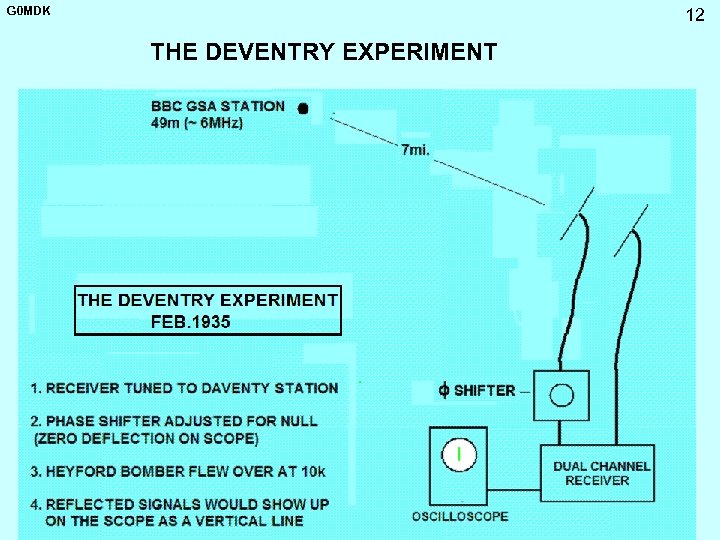
G 0 MDK 12 THE DEVENTRY EXPERIMENT
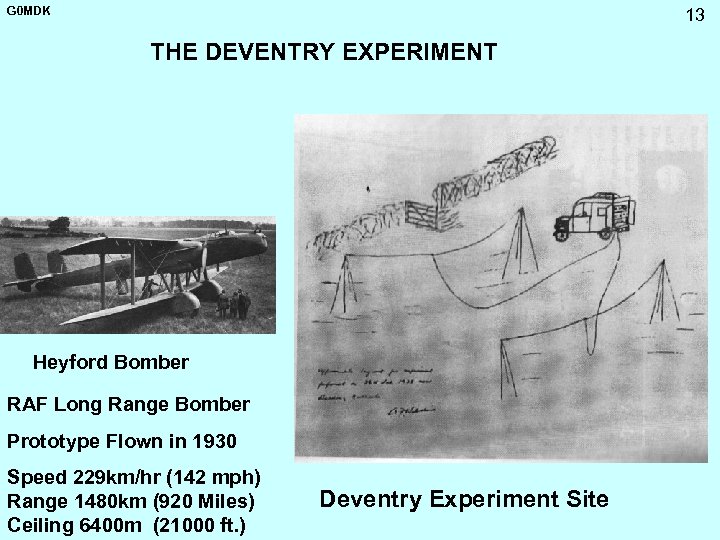
G 0 MDK 13 THE DEVENTRY EXPERIMENT Heyford Bomber RAF Long Range Bomber Prototype Flown in 1930 Speed 229 km/hr (142 mph) Range 1480 km (920 Miles) Deventry Experiment Site Ceiling 6400 m (21000 ft. )
G 0 MDK 14 ORFORDNESS 1. Radar proposal by Watts and Wilkins accepted and go ahead given 2. Highly secret work started Apr. 1935 at Orfordness an isolated place 3. A very austere operation 4. Test equipment 2 HF wave meters, 2 Avometers, & misc. VM & AM’s 5. Tech book Radio Amateur Handbook: Wilkins & other 2 were “Hams” 6. Erected two 75’ wooden towers for Xmtr and 4 others for Receivers 7. Transmitter problems: Flash over and pulse width Corona on ant. 8. Committee appeared on site expecting results (June 1935) 9. 50 metre freq. Used. Atmospheric noise problems. 10. Echo from Valencia A/C observed at 27 km 11. Committee gave glowing report to Air Ministry 12. Shifted to 22 MHz (14 m) atmospheric problem went away. 13. Pulse width down from 50µs to 10µs
G 0 MDK 15 CHAIN HOME (CH) RADAR • Following Orfordness development work, a system of 20 CH radars were strung up along the south and east coasts of England just before World War Two. • These radars gave the RAF a distinct advantage over the German Luftwaffe. • These radars were able to detect incoming enemy bombers and provide the RAF with their range, direction and altitude (position) • With this information the RAF could choose when and where, or simply not to engage the enemy bombers (A distinct tactical advantage)
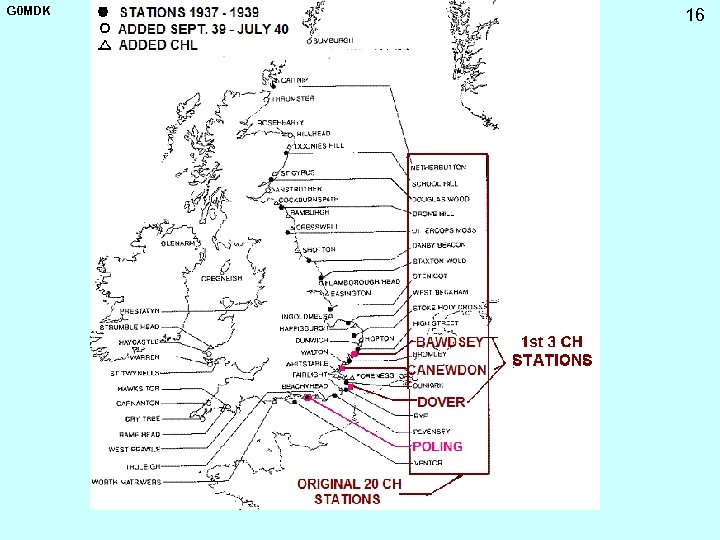
G 0 MDK 16 Map of Chain Home Radars
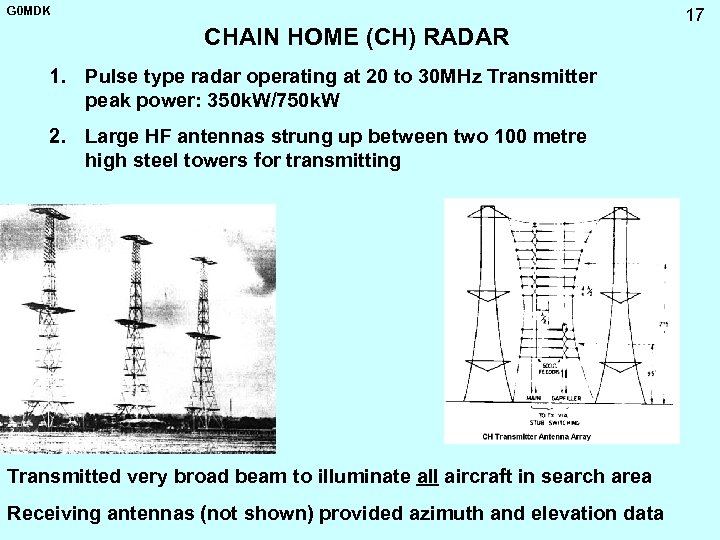
G 0 MDK CHAIN HOME (CH) RADAR 1. Pulse type radar operating at 20 to 30 MHz Transmitter peak power: 350 k. W/750 k. W 2. Large HF antennas strung up between two 100 metre high steel towers for transmitting Transmitted very broad beam to illuminate all aircraft in search area Receiving antennas (not shown) provided azimuth and elevation data 17
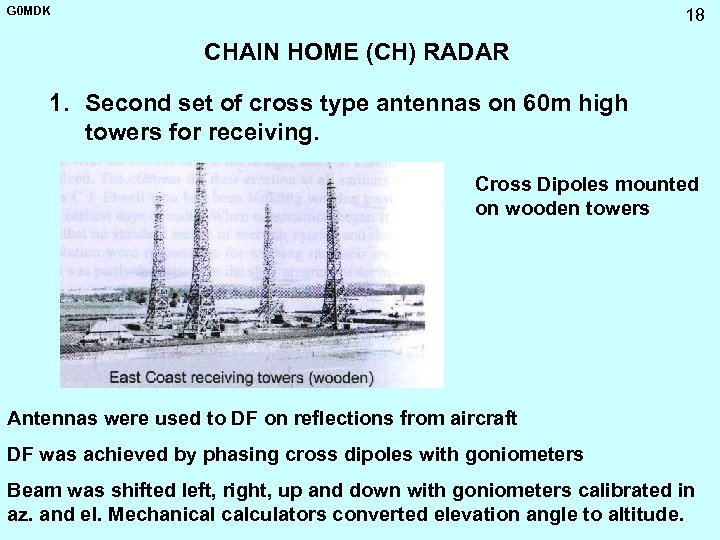
G 0 MDK 18 CHAIN HOME (CH) RADAR 1. Second set of cross type antennas on 60 m high towers for receiving. Cross Dipoles mounted on wooden towers Antennas were used to DF on reflections from aircraft DF was achieved by phasing cross dipoles with goniometers Beam was shifted left, right, up and down with goniometers calibrated in az. and el. Mechanical calculators converted elevation angle to altitude.
G 0 MDK 19 LUFTWAFFE FLYING BELOW CH RADAR BEAM 1. Chain Home Low (CHL) Radars added (1939 - 1940 2. Picked up Luftwaffe flying below CH radar beams 3. Operated at 180 – 210 MHz 4. Antenna broadside 32 dipole array 5. Horizontal Beam width 200 6. Antenna steered on pedal crank by WAAF 7. “A” Scope display. PPI introduced in 1940 8. Antenna rotated at ~ 1 to 2 rpm
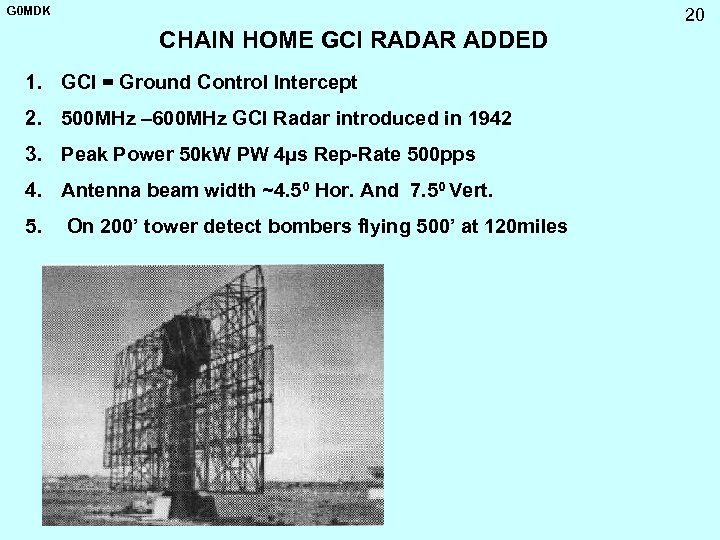
G 0 MDK 20 CHAIN HOME GCI RADAR ADDED 1. GCI = Ground Control Intercept 2. 500 MHz – 600 MHz GCI Radar introduced in 1942 3. Peak Power 50 k. W PW 4µs Rep-Rate 500 pps 4. Antenna beam width ~4. 50 Hor. And 7. 50 Vert. 5. On 200’ tower detect bombers flying 500’ at 120 miles
G 0 MDK IDENTIFICATION FRIEND OF FOE IFF (Secondary Radar) • PASSIVE REFLECTOR • MARK I • MARK I I • MARK I I I • MARK X THIS SLIDE IN WORK 21
G 0 MDK 22 BASIC RADAR TYPES CW DOPPLER RADAR PULSED RADAR PULSE DOPPLER RADAR
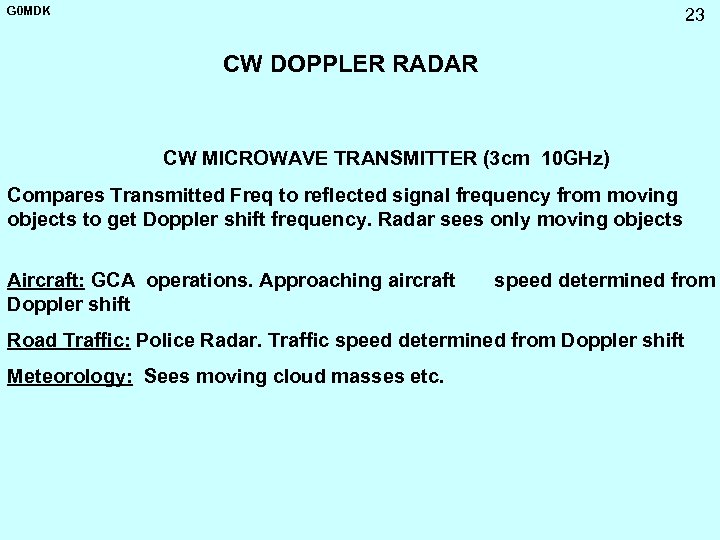
G 0 MDK 23 CW DOPPLER RADAR CW MICROWAVE TRANSMITTER (3 cm 10 GHz) Compares Transmitted Freq to reflected signal frequency from moving objects to get Doppler shift frequency. Radar sees only moving objects Aircraft: GCA operations. Approaching aircraft speed determined from Doppler shift Road Traffic: Police Radar. Traffic speed determined from Doppler shift Meteorology: Sees moving cloud masses etc.
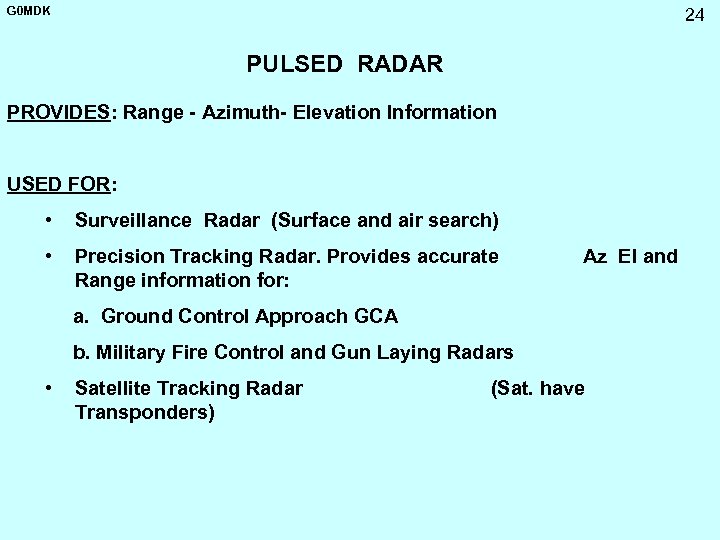
G 0 MDK 24 PULSED RADAR PROVIDES: Range - Azimuth- Elevation Information USED FOR: • Surveillance Radar (Surface and air search) • Precision Tracking Radar. Provides accurate Az El and Range information for: a. Ground Control Approach GCA b. Military Fire Control and Gun Laying Radars • Satellite Tracking Radar (Sat. have Transponders)
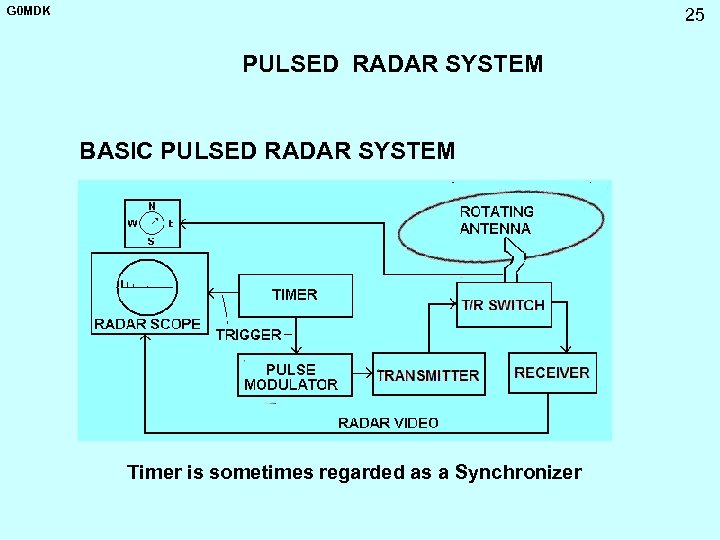
G 0 MDK 25 PULSED RADAR SYSTEM BASIC PULSED RADAR SYSTEM Timer is sometimes regarded as a Synchronizer
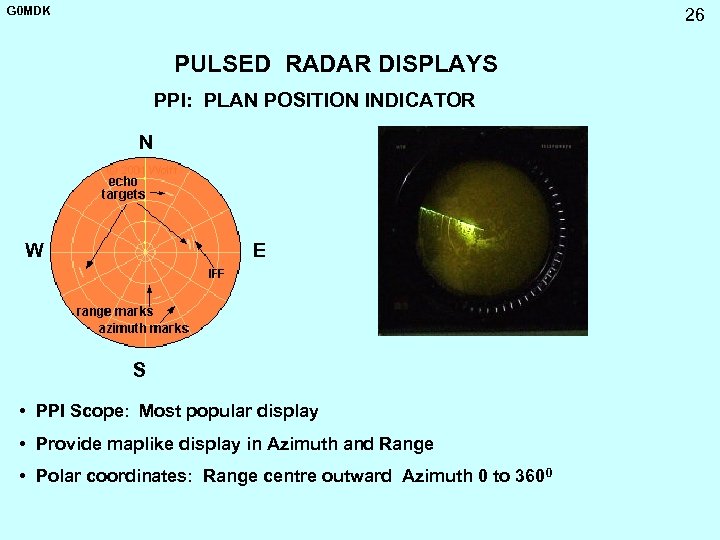
G 0 MDK 26 PULSED RADAR DISPLAYS PPI: PLAN POSITION INDICATOR N W E S • PPI Scope: Most popular display • Provide maplike display in Azimuth and Range • Polar coordinates: Range centre outward Azimuth 0 to 3600
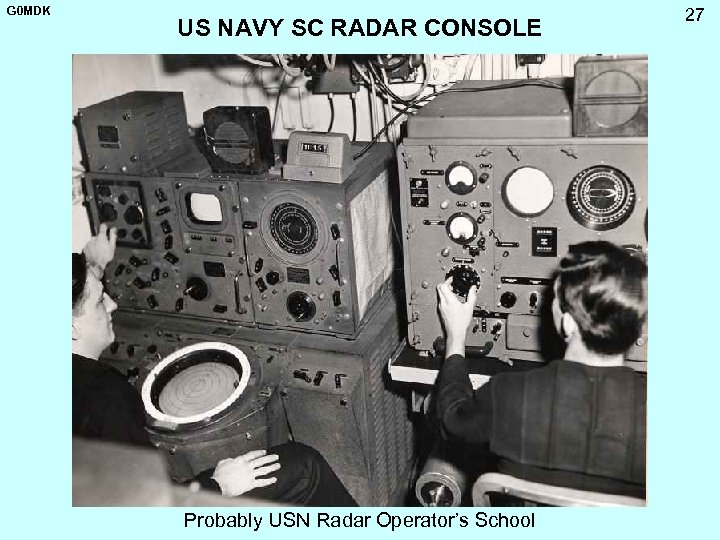
G 0 MDK US NAVY SC RADAR CONSOLE Probably USN Radar Operator’s School 27
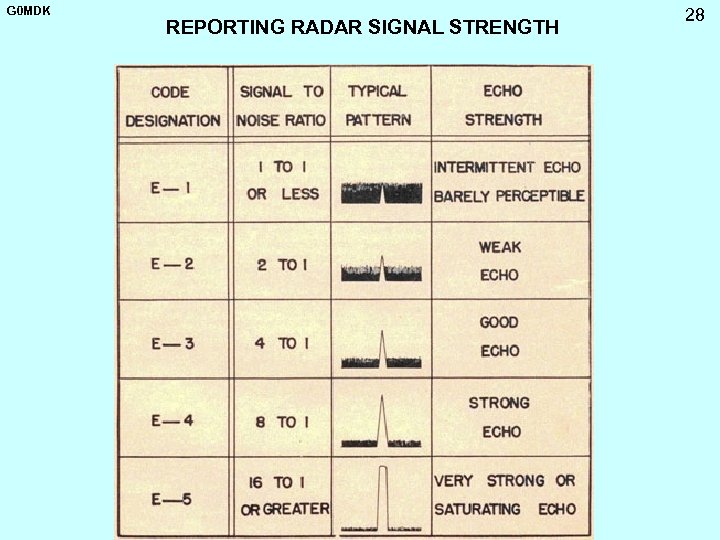
G 0 MDK REPORTING RADAR SIGNAL STRENGTH 28
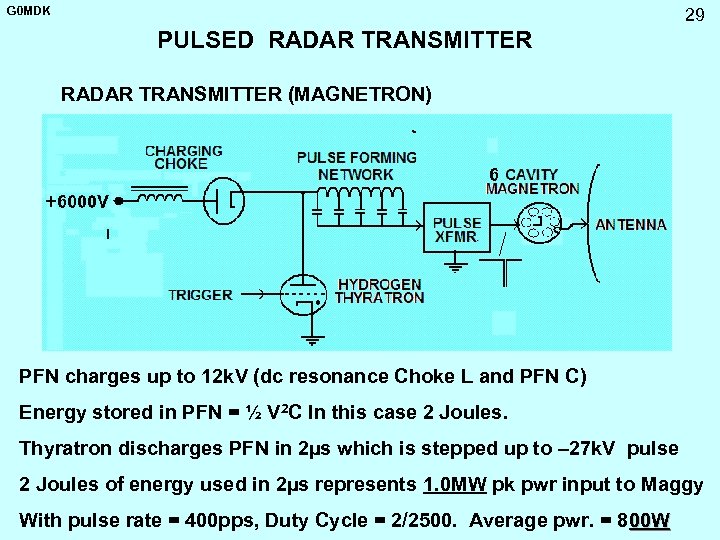
G 0 MDK 29 PULSED RADAR TRANSMITTER (MAGNETRON) PFN charges up to 12 k. V (dc resonance Choke L and PFN C) Energy stored in PFN = ½ V 2 C In this case 2 Joules. Thyratron discharges PFN in 2µs which is stepped up to – 27 k. V pulse 2 Joules of energy used in 2µs represents 1. 0 MW pk pwr input to Maggy With pulse rate = 400 pps, Duty Cycle = 2/2500. Average pwr. = 8 00 W
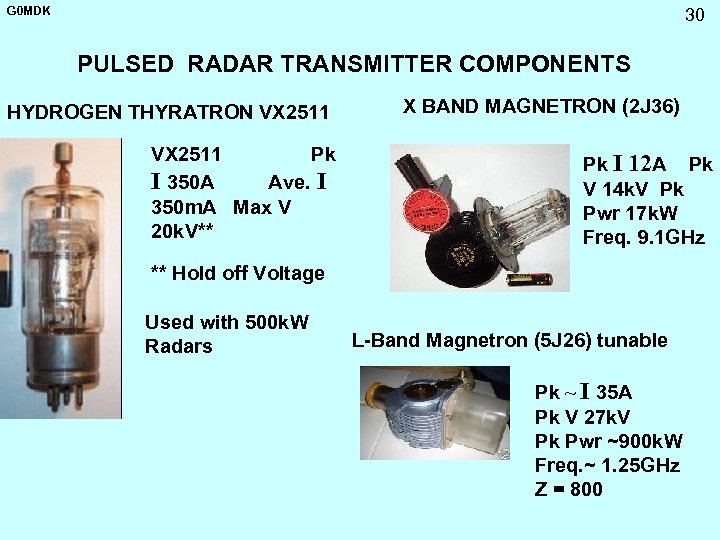
G 0 MDK 30 PULSED RADAR TRANSMITTER COMPONENTS HYDROGEN THYRATRON VX 2511 Pk I 350 A Ave. I 350 m. A Max V 20 k. V** X BAND MAGNETRON (2 J 36) Pk I 12 A Pk V 14 k. V Pk Pwr 17 k. W Freq. 9. 1 GHz ** Hold off Voltage Used with 500 k. W Radars • L-Band Magnetron (5 J 26) tunable Pk ~ I 35 A Pk V 27 k. V Pk Pwr ~900 k. W Freq. ~ 1. 25 GHz Z = 800
G 0 MDK 31 PULSE DOPPLER RADARS DISTINGUISHES BETWEEN FIXED & MOVING TARGETS Surveillance Radars (Surface and air search) Precision Tracking Radars Relies heavily on digital signal processing (dsp)
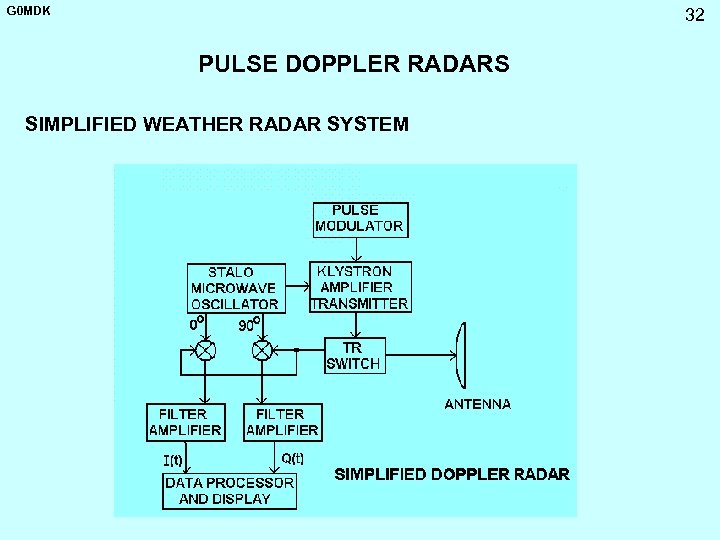
G 0 MDK 32 PULSE DOPPLER RADARS SIMPLIFIED WEATHER RADAR SYSTEM
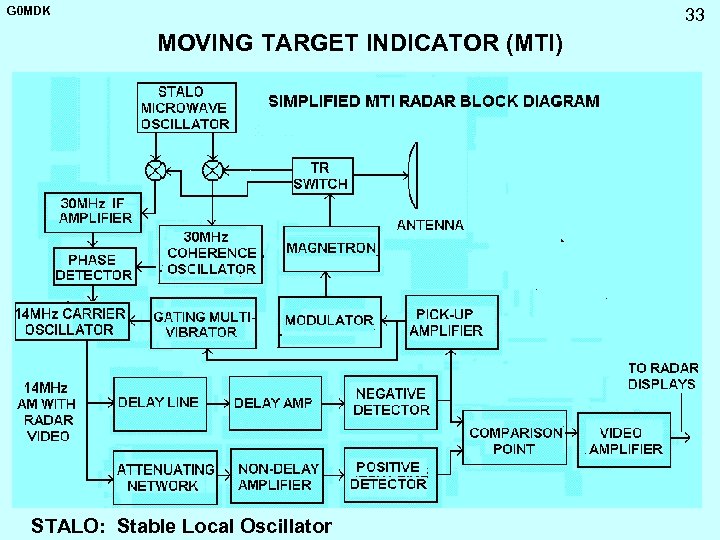
G 0 MDK 33 MOVING TARGET INDICATOR (MTI) STALO: Stable Local Oscillator
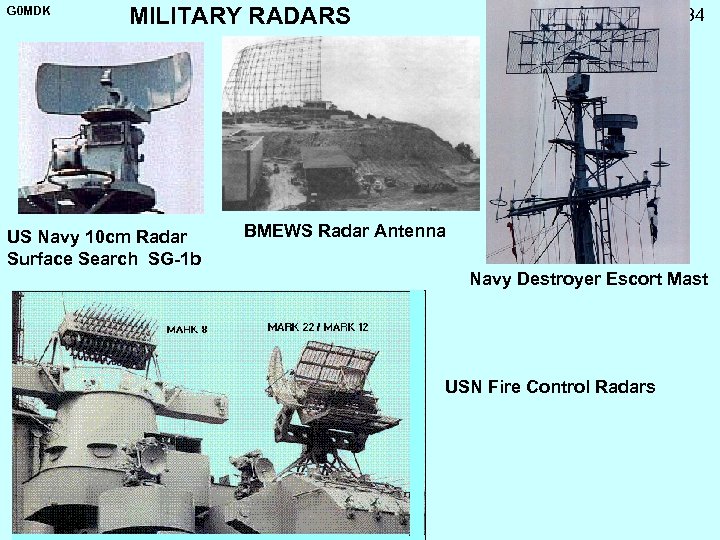
G 0 MDK MILITARY RADARS 34 US Navy 10 cm Radar BMEWS Radar Antenna Surface Search SG-1 b Navy Destroyer Escort Mast USN Fire Control Radars
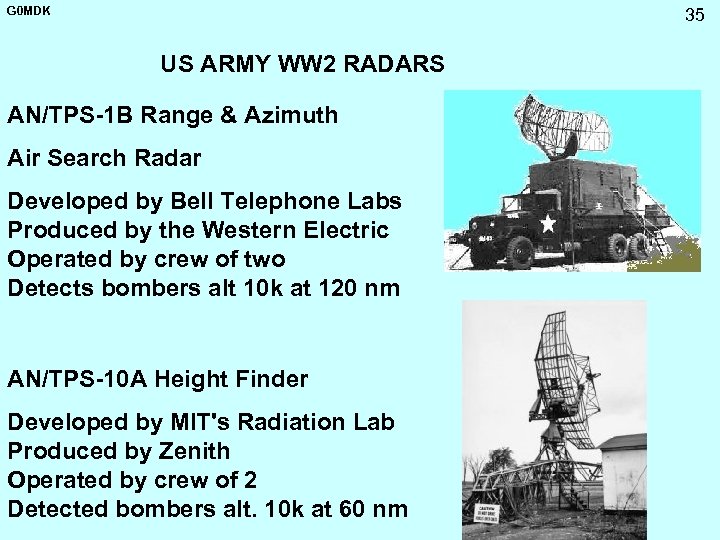
G 0 MDK 35 US ARMY WW 2 RADARS AN/TPS-1 B Range & Azimuth Air Search Radar Developed by Bell Telephone Labs Produced by the Western Electric Operated by crew of two Detects bombers alt 10 k at 120 nm AN/TPS-10 A Height Finder Developed by MIT's Radiation Lab Produced by Zenith Operated by crew of 2 Detected bombers alt. 10 k at 60 nm
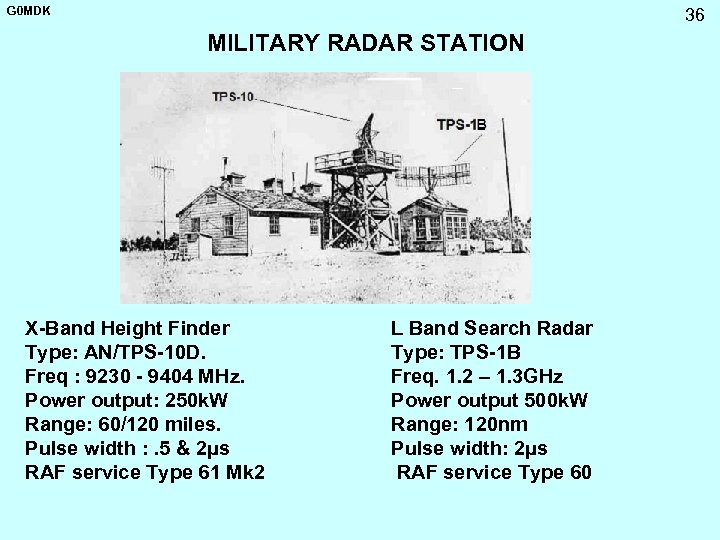
G 0 MDK 36 MILITARY RADAR STATION X-Band Height Finder Type: AN/TPS-10 D. Freq : 9230 - 9404 MHz. Power output: 250 k. W Range: 60/120 miles. Pulse width : . 5 & 2µs RAF service Type 61 Mk 2 L Band Search Radar Type: TPS-1 B Freq. 1. 2 – 1. 3 GHz Power output 500 k. W Range: 120 nm Pulse width: 2µs RAF service Type 60
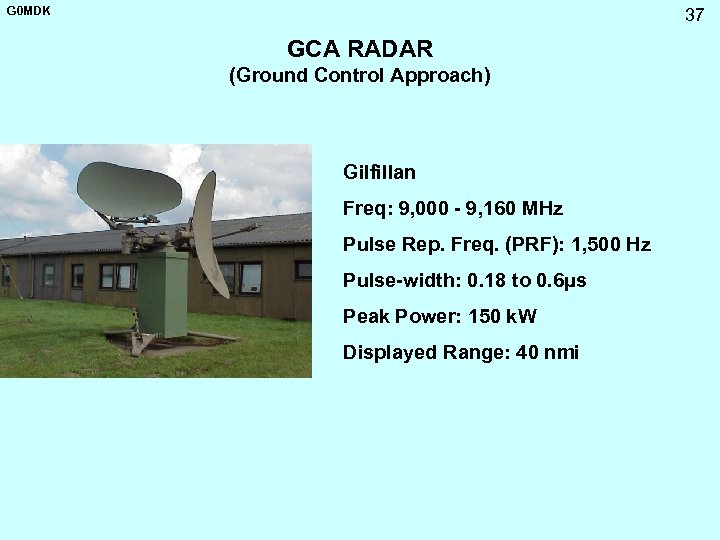
G 0 MDK 37 GCA RADAR (Ground Control Approach) Gilfillan Freq: 9, 000 - 9, 160 MHz Pulse Rep. Freq. (PRF): 1, 500 Hz Pulse-width: 0. 18 to 0. 6µs Peak Power: 150 k. W Displayed Range: 40 nmi
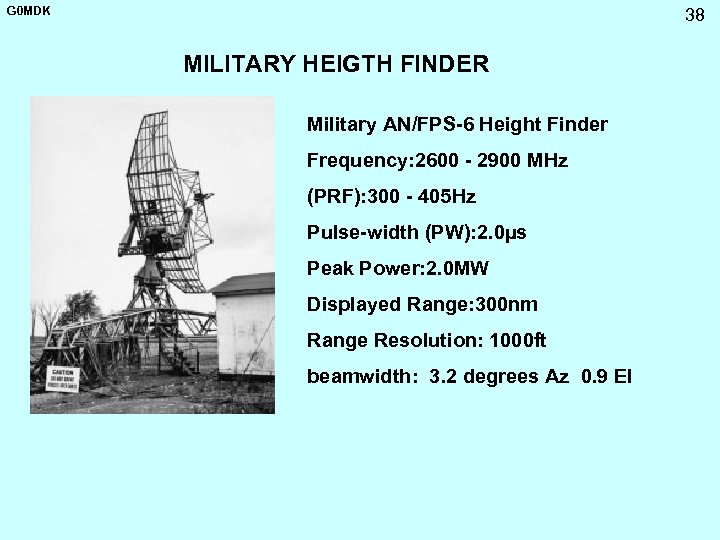
G 0 MDK 38 MILITARY HEIGTH FINDER Military AN/FPS-6 Height Finder Frequency: 2600 - 2900 MHz (PRF): 300 - 405 Hz Pulse-width (PW): 2. 0µs Peak Power: 2. 0 MW Displayed Range: 300 nm Range Resolution: 1000 ft beamwidth: 3. 2 degrees Az 0. 9 El
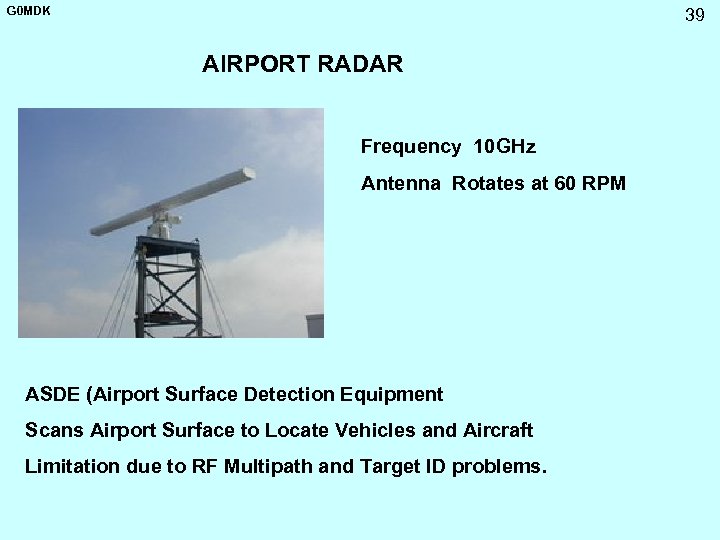
G 0 MDK 39 AIRPORT RADAR Frequency 10 GHz Antenna Rotates at 60 RPM ASDE (Airport Surface Detection Equipment Scans Airport Surface to Locate Vehicles and Aircraft Limitation due to RF Multipath and Target ID problems.
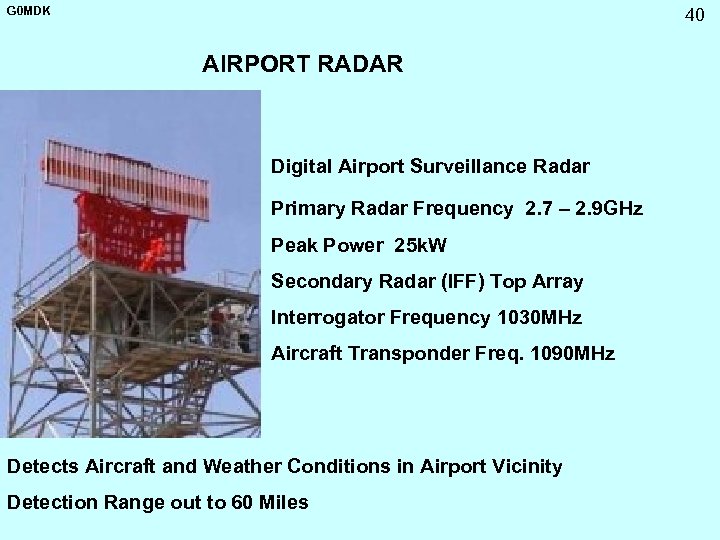
G 0 MDK 40 AIRPORT RADAR Digital Airport Surveillance Radar Primary Radar Frequency 2. 7 – 2. 9 GHz Peak Power 25 k. W Secondary Radar (IFF) Top Array Interrogator Frequency 1030 MHz Aircraft Transponder Freq. 1090 MHz Detects Aircraft and Weather Conditions in Airport Vicinity Detection Range out to 60 Miles
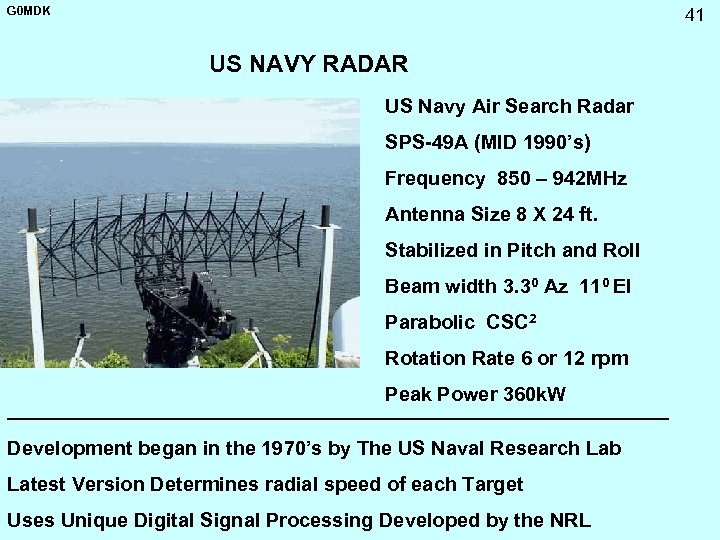
G 0 MDK 41 US NAVY RADAR US Navy Air Search Radar SPS-49 A (MID 1990’s) Frequency 850 – 942 MHz Antenna Size 8 X 24 ft. Stabilized in Pitch and Roll Beam width 3. 30 Az 110 El Parabolic CSC 2 Rotation Rate 6 or 12 rpm Peak Power 360 k. W ================================================= Development began in the 1970’s by The US Naval Research Lab Latest Version Determines radial speed of each Target Uses Unique Digital Signal Processing Developed by the NRL
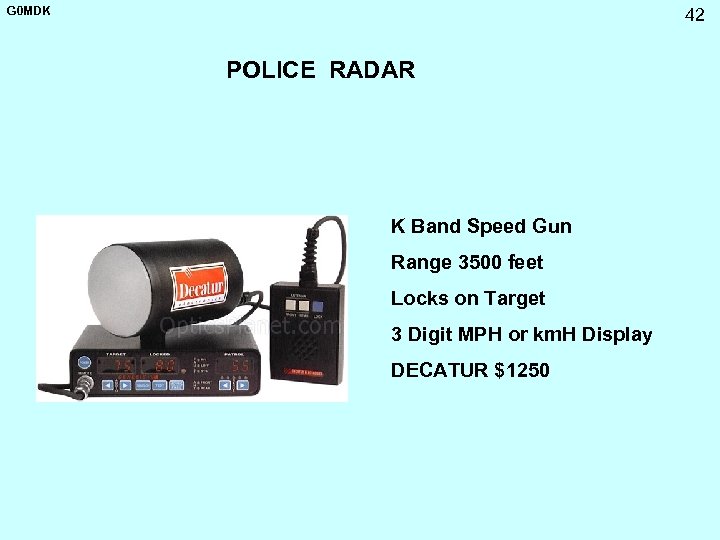
G 0 MDK 42 POLICE RADAR K Band Speed Gun Range 3500 feet Locks on Target 3 Digit MPH or km. H Display DECATUR $1250
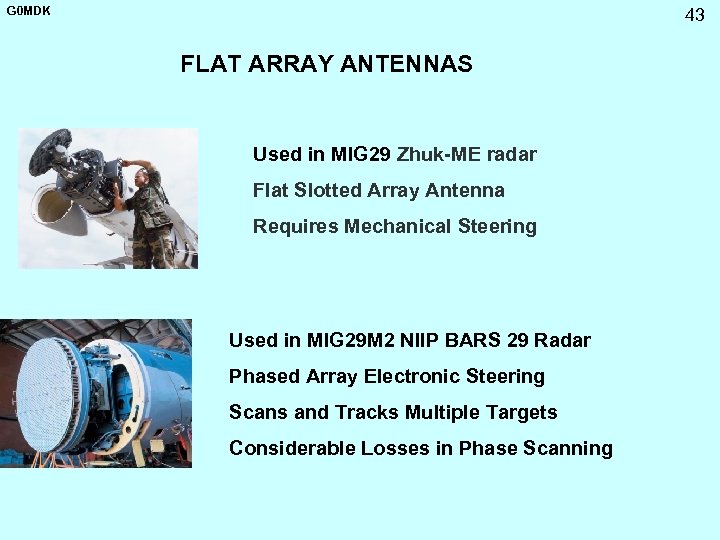
G 0 MDK 43 FLAT ARRAY ANTENNAS Used in MIG 29 Zhuk-ME radar Flat Slotted Array Antenna Requires Mechanical Steering Used in MIG 29 M 2 NIIP BARS 29 Radar Phased Array Electronic Steering Scans and Tracks Multiple Targets Considerable Losses in Phase Scanning
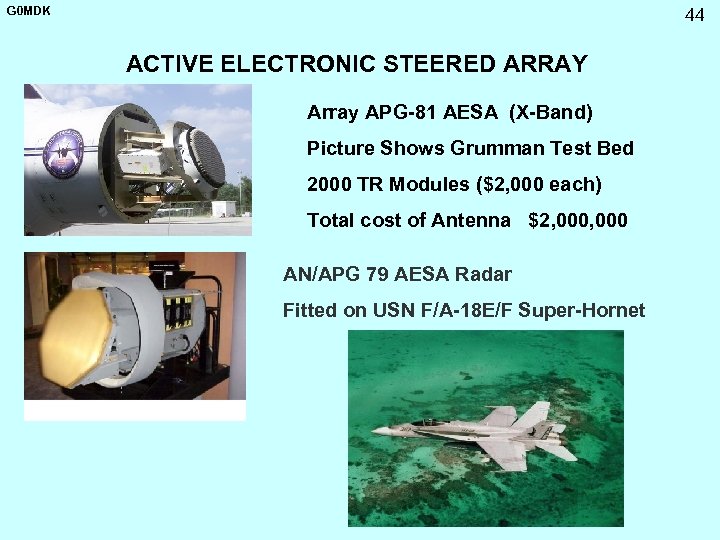
G 0 MDK 44 ACTIVE ELECTRONIC STEERED ARRAY Array APG-81 AESA (X-Band) Picture Shows Grumman Test Bed 2000 TR Modules ($2, 000 each) Total cost of Antenna $2, 000 AN/APG 79 AESA Radar Fitted on USN F/A-18 E/F Super-Hornet
G 0 MDK 45 Thank you for viewing my Radar Presentation I hope you found it informative and enjoyable Chuck Hobson G 0 MDK . Comments
Скачать презентацию G 0 MDK 1 RADAR Chuck Hobson BA
44b5871f6ab7076b357d4825a34b6c57.ppt