 Скачать презентацию FY 15 SHERM Metrics-Based Performance Summary Key Performance
d9f60449f627ebc0aabc85b47212d8f2.ppt
- Количество слайдов: 34



FY 15 SHERM Metrics-Based Performance Summary Key Performance Indicators for Safety, Health, Environment & Risk Management (SHERM): Losses, Compliance, Finances, and Client Satisfaction
UTHealth Institutional Missions and SHERM’s Role, Contributions • UTHealth institutional missions: – Teaching – Research – Service • Service to the Institution: SHERM’s Primary Role – 4 Key Performance Indicators (KPI) of safety services provided – Service to the Community • SHERM also contributes to the other key institutional missions as well
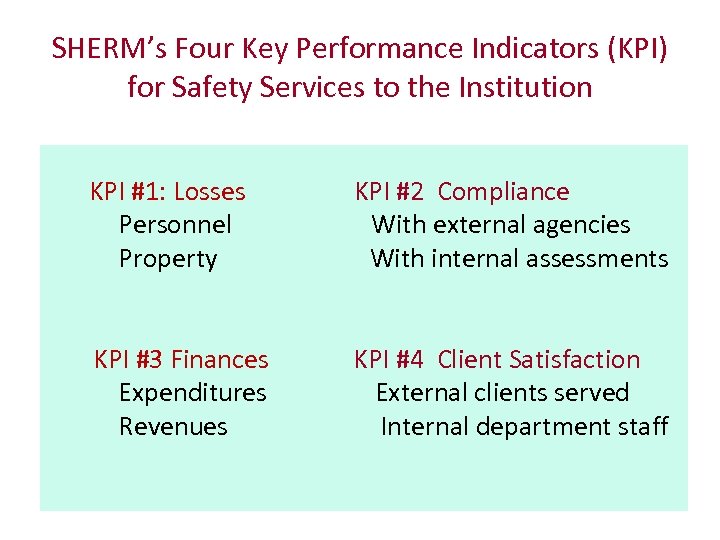
SHERM’s Four Key Performance Indicators (KPI) for Safety Services to the Institution KPI #1: Losses KPI #2 Compliance Personnel With external agencies Property With internal assessments KPI #3 Finances KPI #4 Client Satisfaction Expenditures External clients served Revenues Internal department staff
KPI #1: Losses • Personnel – Numbers of first reports of injury submitted by employees, residents, students – Employee injury and Illness rate – Workers’ Compensation Insurance experience modifier • Property – Losses incurred and covered by UTS Comprehensive Property Protection Program – Losses incurred but covered by outside party – Losses retained by UTHealth
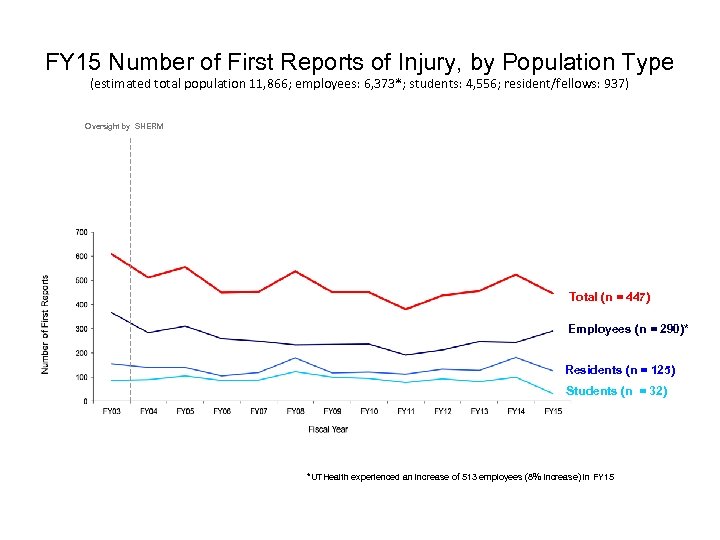
FY 15 Number of First Reports of Injury, by Population Type (estimated total population 11, 866; employees: 6, 373*; students: 4, 556; resident/fellows: 937) Oversight by SHERM Total (n = 447) Employees (n = 290)* Residents (n = 125) Students (n = 32) *UTHealth experienced an increase of 513 employees (8% increase) in FY 15
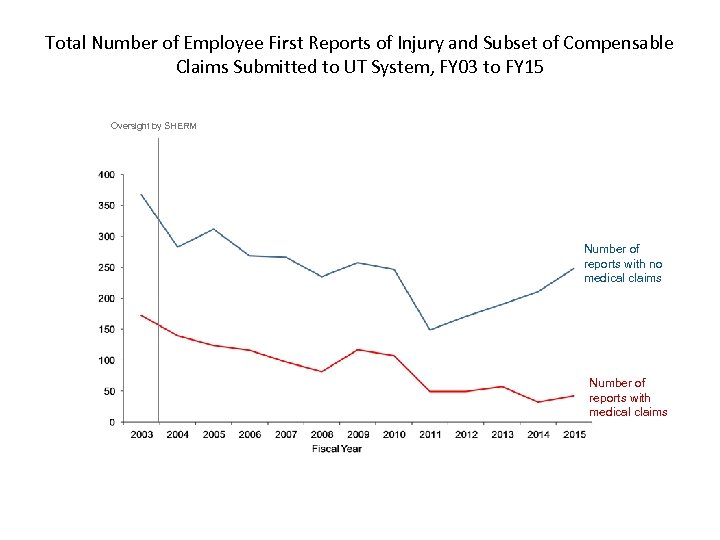
Total Number of Employee First Reports of Injury and Subset of Compensable Claims Submitted to UT System, FY 03 to FY 15 Oversight by SHERM Number of reports with no medical claims Number of reports with medical claims
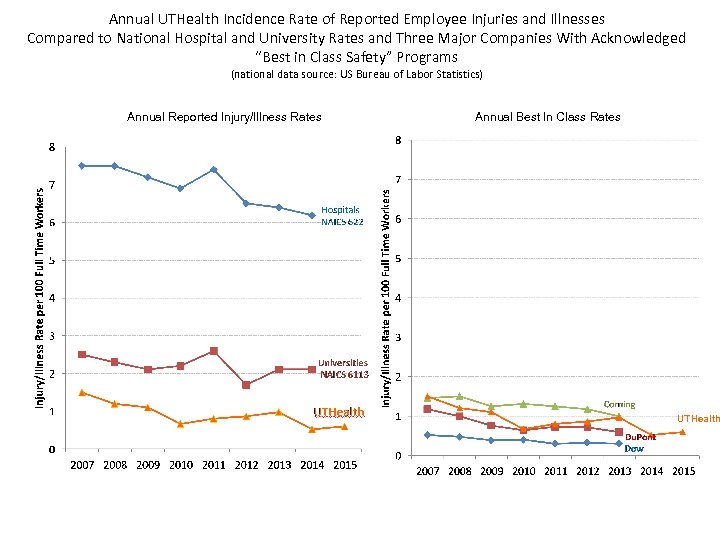
Annual UTHealth Incidence Rate of Reported Employee Injuries and Illnesses Compared to National Hospital and University Rates and Three Major Companies With Acknowledged “Best in Class Safety” Programs (national data source: US Bureau of Labor Statistics) Annual Reported Injury/Illness Rates Annual Best In Class Rates UTHealth
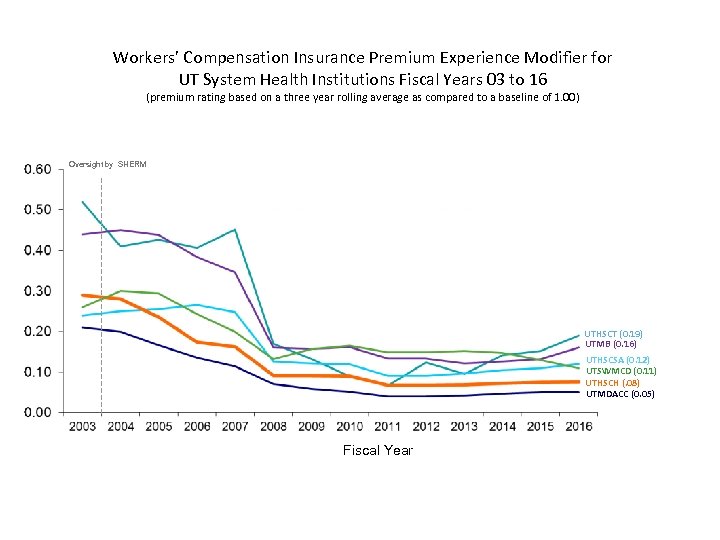
Workers’ Compensation Insurance Premium Experience Modifier for UT System Health Institutions Fiscal Years 03 to 16 (premium rating based on a three year rolling average as compared to a baseline of 1. 00) Oversight by SHERM UTHSCT (0. 19) UTMB (0. 16) UTHSCSA (0. 12) UTSWMCD (0. 11) UTHSCH (. 08) UTMDACC (0. 05) Fiscal Year
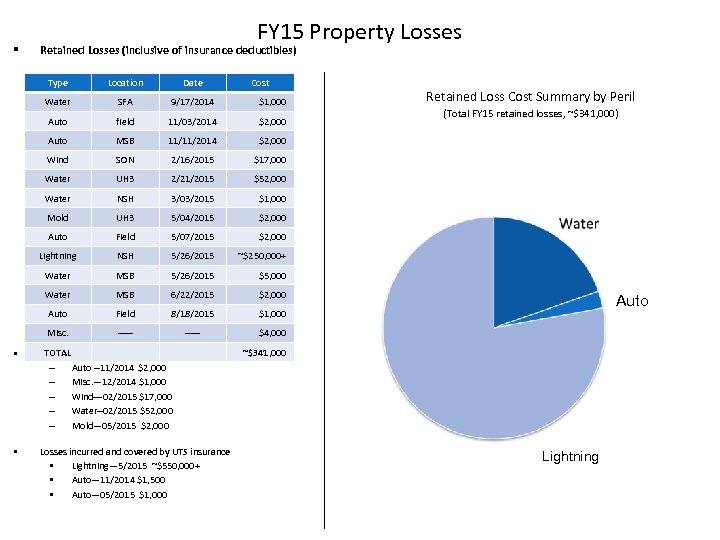
§ FY 15 Property Losses Retained Losses (inclusive of insurance deductibles) Type Location Date Water SFA 9/17/2014 $1, 000 Auto field 11/03/2014 $2, 000 Auto MSB 11/11/2014 $2, 000 Wind SON 2/16/2015 $17, 000 Water UH 3 2/21/2015 $52, 000 Water NSH 3/03/2015 $1, 000 Mold UH 3 5/04/2015 $2, 000 Auto Field 5/07/2015 $2, 000 Lightning NSH 5/26/2015 ~$250, 000+ Water MSB 5/26/2015 $5, 000 Water MSB 6/22/2015 $2, 000 Auto Field 8/18/2015 $1, 000 Misc. ----- $4, 000 § TOTAL Losses incurred and covered by third party – Auto --11/2014 $2, 000 – Misc. — 12/2014 $1, 000 – Wind---02/2015 $17, 000 – Water--02/2015 $52, 000 – Mold— 05/2015 $2, 000 § Losses incurred and covered by UTS insurance § Lightning— 5/2015 ~$550, 000+ § Auto— 11/2014 $1, 500 § Auto— 05/2015 $1, 000 Cost Retained Loss Cost Summary by Peril (Total FY 15 retained losses, ~$341, 000) Auto ~$341, 000 Lightning
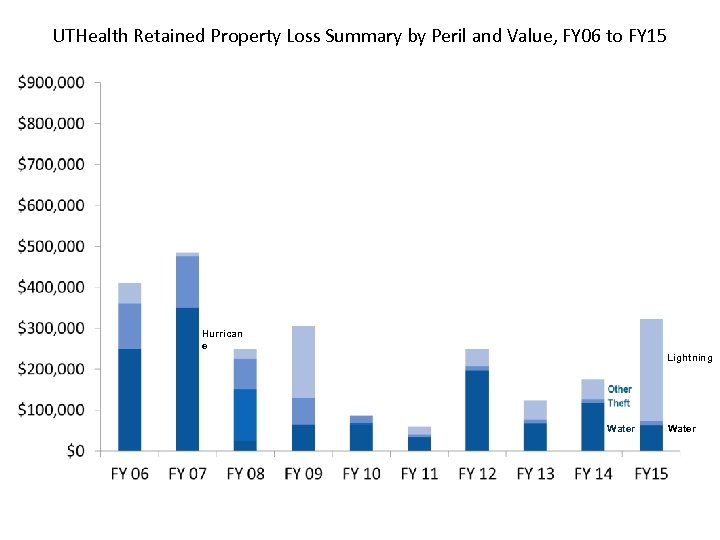
UTHealth Retained Property Loss Summary by Peril and Value, FY 06 to FY 15 Hurrican e Lightning Water
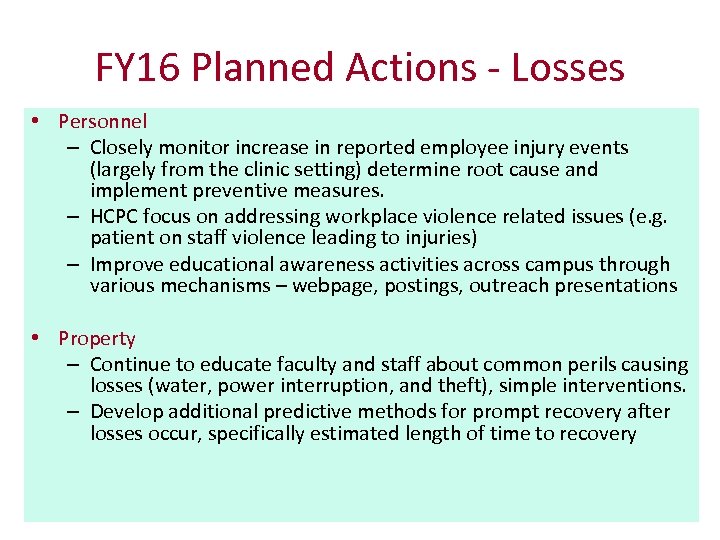
FY 16 Planned Actions - Losses • Personnel – Closely monitor increase in reported employee injury events (largely from the clinic setting) determine root cause and implement preventive measures. – HCPC focus on addressing workplace violence related issues (e. g. patient on staff violence leading to injuries) – Improve educational awareness activities across campus through various mechanisms – webpage, postings, outreach presentations • Property – Continue to educate faculty and staff about common perils causing losses (water, power interruption, and theft), simple interventions. – Develop additional predictive methods for prompt recovery after losses occur, specifically estimated length of time to recovery
KPI #2: Compliance • With external agencies – Regulatory inspections; other compliance related inspections by outside entities • With internal assessments – Results of EH&S routine safety surveillance activities
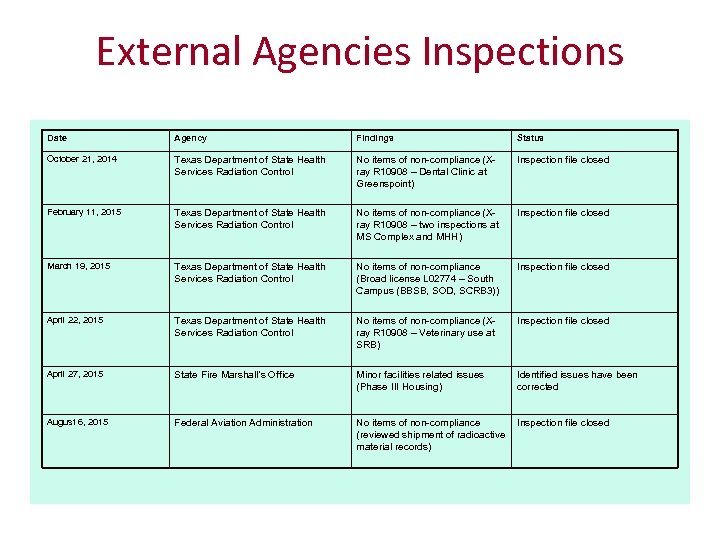
External Agencies Inspections Date Agency Findings Status October 21, 2014 Texas Department of State Health Services Radiation Control No items of non-compliance (Xray R 10908 – Dental Clinic at Greenspoint) Inspection file closed February 11, 2015 Texas Department of State Health Services Radiation Control No items of non-compliance (Xray R 10908 – two inspections at MS Complex and MHH) Inspection file closed March 19, 2015 Texas Department of State Health Services Radiation Control No items of non-compliance (Broad license L 02774 – South Campus (BBSB, SOD, SCRB 3)) Inspection file closed April 22, 2015 Texas Department of State Health Services Radiation Control No items of non-compliance (Xray R 10908 – Veterinary use at SRB) Inspection file closed April 27, 2015 State Fire Marshall’s Office Minor facilities related issues (Phase III Housing) Identified issues have been corrected August 6, 2015 Federal Aviation Administration No items of non-compliance (reviewed shipment of radioactive material records) Inspection file closed
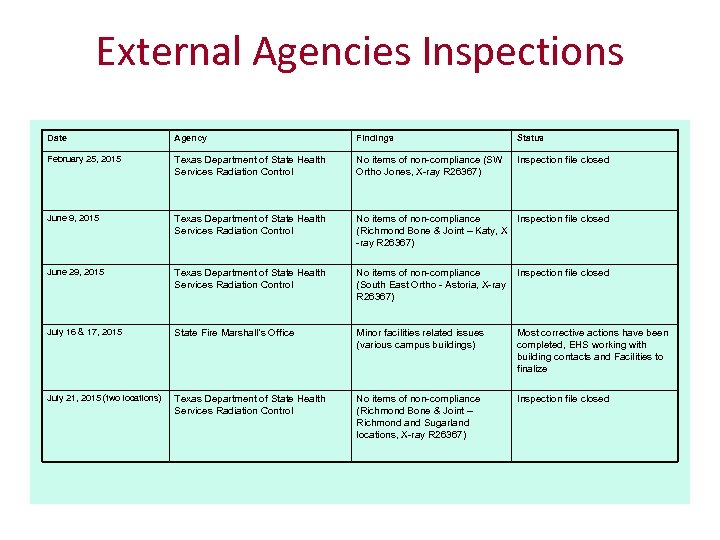
External Agencies Inspections Date Agency Findings Status February 25, 2015 Texas Department of State Health Services Radiation Control No items of non-compliance (SW Ortho Jones, X-ray R 26367) Inspection file closed June 9, 2015 Texas Department of State Health Services Radiation Control No items of non-compliance Inspection file closed (Richmond Bone & Joint – Katy, X -ray R 26367) June 29, 2015 Texas Department of State Health Services Radiation Control No items of non-compliance (South East Ortho - Astoria, X-ray R 26367) Inspection file closed July 16 & 17, 2015 State Fire Marshall’s Office Minor facilities related issues (various campus buildings) Most corrective actions have been completed, EHS working with building contacts and Facilities to finalize July 21, 2015 (two locations) Texas Department of State Health Services Radiation Control No items of non-compliance (Richmond Bone & Joint – Richmond and Sugarland locations, X-ray R 26367) Inspection file closed
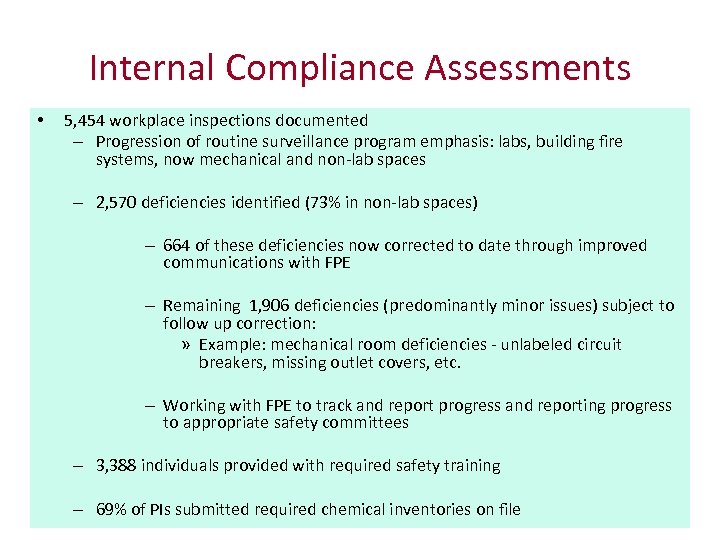
Internal Compliance Assessments • 5, 454 workplace inspections documented – Progression of routine surveillance program emphasis: labs, building fire systems, now mechanical and non-lab spaces – 2, 570 deficiencies identified (73% in non-lab spaces) – 664 of these deficiencies now corrected to date through improved communications with FPE – Remaining 1, 906 deficiencies (predominantly minor issues) subject to follow up correction: » Example: mechanical room deficiencies - unlabeled circuit breakers, missing outlet covers, etc. – Working with FPE to track and report progress and reporting progress to appropriate safety committees – 3, 388 individuals provided with required safety training – 69% of PIs submitted required chemical inventories on file
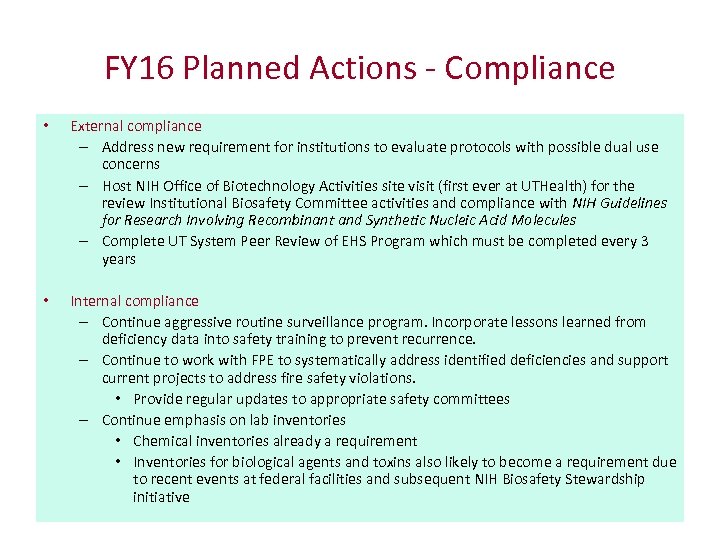
FY 16 Planned Actions - Compliance • External compliance – Address new requirement for institutions to evaluate protocols with possible dual use concerns – Host NIH Office of Biotechnology Activities site visit (first ever at UTHealth) for the review Institutional Biosafety Committee activities and compliance with NIH Guidelines for Research Involving Recombinant and Synthetic Nucleic Acid Molecules – Complete UT System Peer Review of EHS Program which must be completed every 3 years • Internal compliance – Continue aggressive routine surveillance program. Incorporate lessons learned from deficiency data into safety training to prevent recurrence. – Continue to work with FPE to systematically address identified deficiencies and support current projects to address fire safety violations. • Provide regular updates to appropriate safety committees – Continue emphasis on lab inventories • Chemical inventories already a requirement • Inventories for biological agents and toxins also likely to become a requirement due to recent events at federal facilities and subsequent NIH Biosafety Stewardship initiative
KPI #3: Finances • Expenditures – Program cost, cost drivers • Revenues – Sources of revenue, amounts
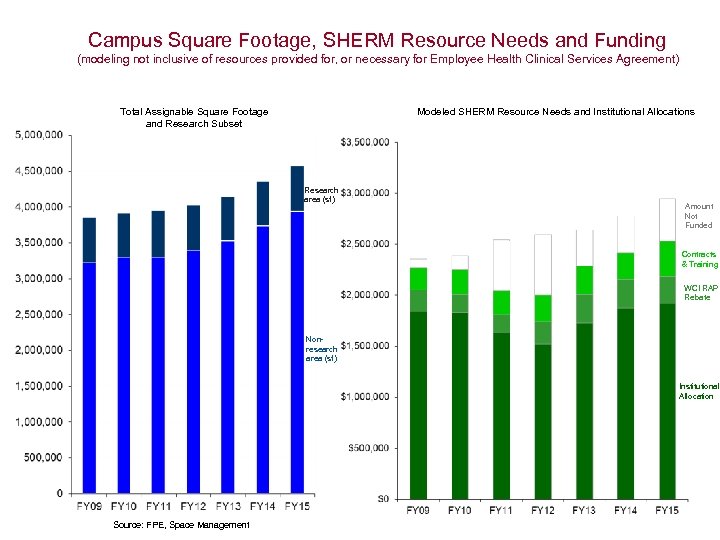
Campus Square Footage, SHERM Resource Needs and Funding (modeling not inclusive of resources provided for, or necessary for Employee Health Clinical Services Agreement) Total Assignable Square Footage and Research Subset Modeled SHERM Resource Needs and Institutional Allocations Research area (sf) Amount Not Funded Contracts & Training WCI RAP Rebate Nonresearch area (sf) Institutional Allocation Source: FPE, Space Management
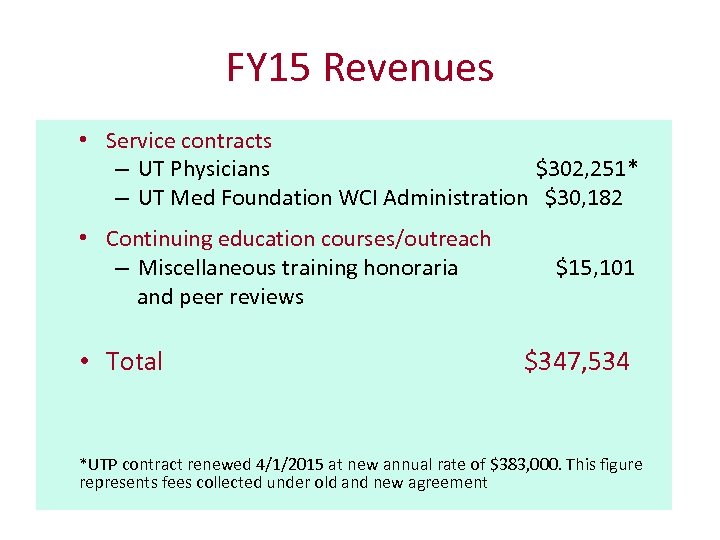
FY 15 Revenues • Service contracts – UT Physicians $302, 251* – UT Med Foundation WCI Administration $30, 182 • Continuing education courses/outreach – Miscellaneous training honoraria $15, 101 and peer reviews • Total $347, 534 *UTP contract renewed 4/1/2015 at new annual rate of $383, 000. This figure represents fees collected under old and new agreement
UT Physicians Service Agreement • • • Professional Services Agreement: – Agreement includes services such as training, radiation safety permitting & surveys, general clinic surveys, fire & life safety surveillance, waste management, emergency preparedness & response, IAQ evaluations, asbestos/mold monitoring, accident/incident investigations, CAP/CLIA quality control monitoring, etc. – Contract renewed in April 2015 at new annual rate of $383, 000 – New FTE position dedicated to clinical safety created in Sept 2015 – Development of Risk Assessment program jointly between SHERM and UTPD to assess new clinic spaces Challenges – Continued growth and rapid expansion of clinical locations and services – Dramatic increase in manpower requirements for CAP/CLIA oversight and compliance, waste collection, occupational health services, training, etc. Opportunities – Continued focus on possible parallel expansion of EHS services to include patient safety, infection prevention/control
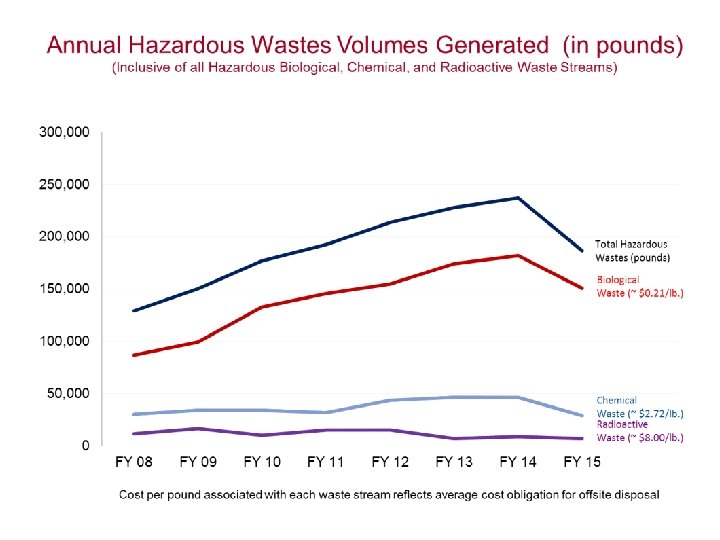
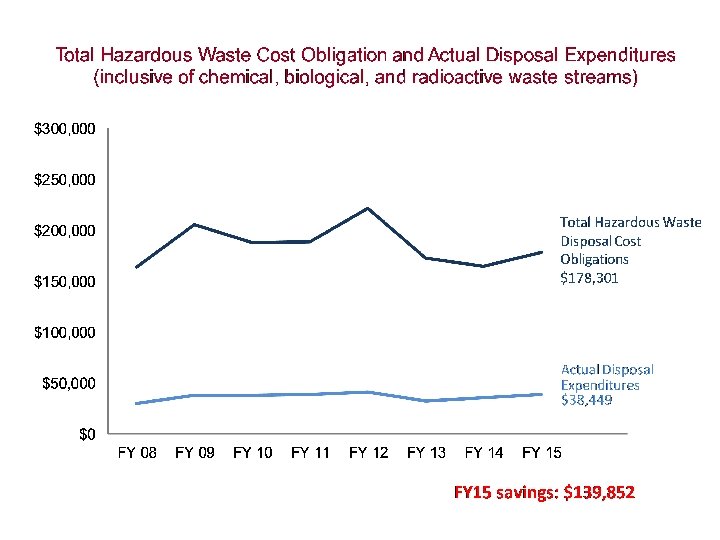
FY 16 Planned Actions - Financial • Expenditures – Continue aggressive hazardous waste minimization program to contain hazardous waste disposal costs – Continue to lobby for dedicated funding for Occupational Health Clinical Services Agreement because of impending discontinuance of UTS WCI RAP – Address additional FTE needs identified for OSFP program due to forthcoming significant construction renovation projects at MSB, UCT, and SPH • Revenues – Continue with service contracts and community outreach activities that provide financial support to supplement institutional funding (FY 15 revenues equated to about 14% of total budget) – NOTE: WCI RAP fund allocations to end after FY 2016!
KPI #4: Client Satisfaction • External clients served – Results of Client Satisfaction Survey for OSFP program distributed to key personnel who regularly utilize services from this program (e. g. Facilities, Auxiliary Enterprises, Building Space Coordinators, etc. ) • Internal department staff – Summary of ongoing staff professional development activities
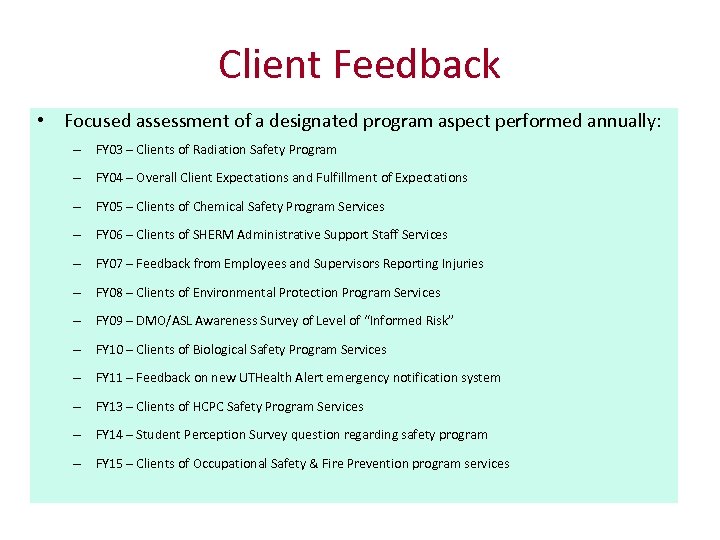
Client Feedback • Focused assessment of a designated program aspect performed annually: – FY 03 – Clients of Radiation Safety Program – FY 04 – Overall Client Expectations and Fulfillment of Expectations – FY 05 – Clients of Chemical Safety Program Services – FY 06 – Clients of SHERM Administrative Support Staff Services – FY 07 – Feedback from Employees and Supervisors Reporting Injuries – FY 08 – Clients of Environmental Protection Program Services – FY 09 – DMO/ASL Awareness Survey of Level of “Informed Risk” – FY 10 – Clients of Biological Safety Program Services – FY 11 – Feedback on new UTHealth Alert emergency notification system – FY 13 – Clients of HCPC Safety Program Services – FY 14 – Student Perception Survey question regarding safety program – FY 15 – Clients of Occupational Safety & Fire Prevention program services
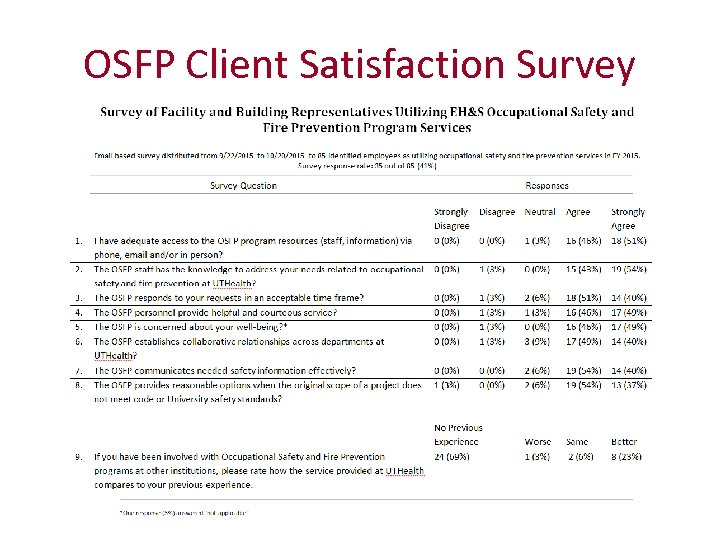
OSFP Client Satisfaction Survey
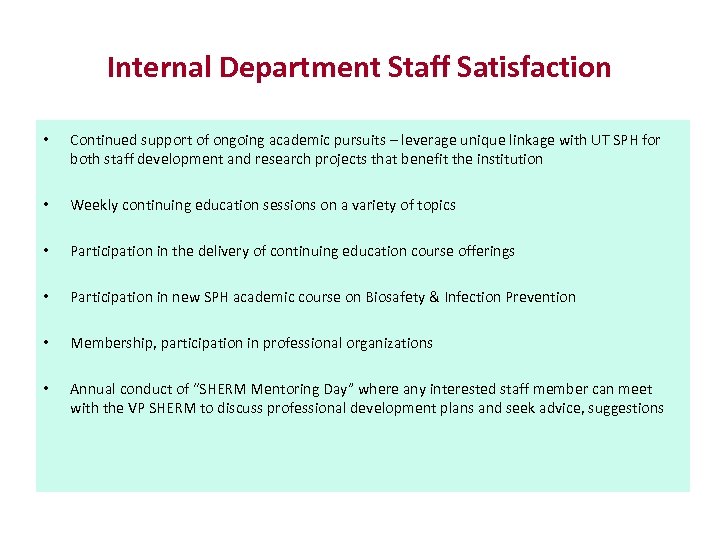
Internal Department Staff Satisfaction • Continued support of ongoing academic pursuits – leverage unique linkage with UT SPH for both staff development and research projects that benefit the institution • Weekly continuing education sessions on a variety of topics • Participation in the delivery of continuing education course offerings • Participation in new SPH academic course on Biosafety & Infection Prevention • Membership, participation in professional organizations • Annual conduct of “SHERM Mentoring Day” where any interested staff member can meet with the VP SHERM to discuss professional development plans and seek advice, suggestions
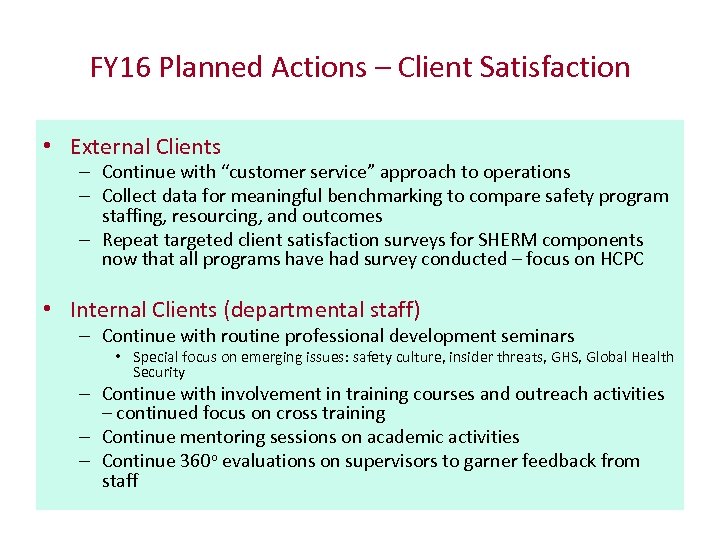
FY 16 Planned Actions – Client Satisfaction • External Clients – Continue with “customer service” approach to operations – Collect data for meaningful benchmarking to compare safety program staffing, resourcing, and outcomes – Repeat targeted client satisfaction surveys for SHERM components now that all programs have had survey conducted – focus on HCPC • Internal Clients (departmental staff) – Continue with routine professional development seminars • Special focus on emerging issues: safety culture, insider threats, GHS, Global Health Security – Continue with involvement in training courses and outreach activities – continued focus on cross training – Continue mentoring sessions on academic activities – Continue 360 o evaluations on supervisors to garner feedback from staff
Institutional Safety Service KPI Caveats • Important to remember what isn’t effectively captured by these metrics: • Increasing complexity of research protocols • Increased collaborations and associated challenges • Increased complexity of regulatory environment • Impacts of construction – both navigation and reviews • The pain, suffering, apprehension associated with any injury – every dot on the graph is a person • The things that didn’t happen
SHERM Contribution to Community Service Institutional Mission • Safety support to UT Physicians clinical operations • Staff membership on area university Institutional Biosafety Committees (e. g. Rice University, BCM) • Delivery of continuing education courses through UT SPH SWCOEH • Participation in the management of the Southern Biosafety Association (local affiliate of ABSA International) by SHERM staff members • Outreach education through invited lectures provided to local and national professional organizations • Provision of subject matter expert interviews on safety-related topics to local and national media • Invited university safety program peer reviews – 2015: Seattle University, UConn, UT Southwestern, Temple University
SHERM Contribution to Teaching Institutional Mission • UT SPH academic instruction, student advising • Guest lectures at other UTHealth schools (UT MS and GSBS) and other area institutions (TAMU, TWU, TSU, UHCL, UHD) • Host student internships, practica. Advising for UT MS Scholarly Concentration students • Continuing education courses through UT SPH SWCOEH • Outreach education through courses with professional organizations (HPS, ABSA, CSHEMA)
SHERM Contribution to Research Institutional Mission • NIEHS training grant and Ebola supplement (Year 5 $282, 209 + $110, 000 supplement) • Participation in other funded grants (NIOSH ERC SWCOEH, TSU Health Physics Program) • Advising and hosting students for research projects and associated publications: – Vellani, KH, Emery, RJ, Reingle-Gonzalez, JM. A data-driven model for estimating industry average numbers of hospital security staff. J Healthcare Protection Management, 31: 1 51 -63; 2015. – Lim H*, Agopian AJ, Whitehead LW, Beasley CW, Langlois PH, Emery RJ, Waller DK. Maternal occupational exposure to ionizing radiation and major structural birth defects. Birth Defects Research Part A: Clinical and Molecular Teratology, 103: 4 243 -254; 2015. DOI: 10. 1002/bdra. 23340. – Patlovich SJ*; Emery RJ; Whitehead LW; Brown EL; Flores R. Assessing the biological safety profession’s evaluation and control of risks associated with the field collection of potentially infectious specimens. Appl Biosaf. 20: 1 27 -40; 2015. – Brown BJ*, Emery RJ, Delclos G, Pompeii L. An empirical model for estimating environmental health and safety program resourcing for colleges and universities. Prof Saf submitted April 2015.
Summary • Various measures and metrics indicate that SHERM continues to meet its objective of maintaining a safe and healthy working and learning environment in a cost effective manner that doesn’t interfere with operations, while also making active contributions to the institutional missions: – Injury rates continue to be among the lowest within the UT System – Despite continued growth in the research enterprise, hazardous waste costs aggressively contained – Client satisfaction continues to be measurably high – And while providing these services, SHERM also actively contributes to the teaching, research, and community service missions of the institution • The major area of current institutional growth is in the clinical setting, so SHERM will need to adjust accordingly to support this enterprises • The discontinuance of the UTS WCI Rebate program represents a challenge, especially for the Occupational Health program • A successful safety program is largely “people powered” – the services most valued by clients cannot be automated! • SHERM resource needs will continue to be driven primarily by the square footage to which services are provided (total, lab and clinic square footage)
 Скачать презентацию FY 15 SHERM Metrics-Based Performance Summary Key Performance
d9f60449f627ebc0aabc85b47212d8f2.ppt