 Скачать презентацию Fuzzy Classification -An Overview Presented By Jignesh Panchal
299ab124ac94f15870fcb11a49799bb0.ppt
- Количество слайдов: 28



Fuzzy Classification -An Overview Presented By, Jignesh Panchal ECE 8990: Automated Target Recognition Fuzzy Classification-An Overview Jignesh Panchal
Introduction Ø Fuzzy Logic was initiated in 1965, by Dr. Lotfi A. Zadeh, professor for computer science at the university of California in Berkley. Ø Basically, Fuzzy Logic is a multivalued logic, that allows intermediate values to be defined between conventional evaluations like true/false, yes/no, high/low, etc. Ø Fuzzy Logic starts with and builds on a set of user–supplied human language rules. Ø Fuzzy Systems convert these rules to their mathematical equivalents. Ø This simplifies the job of the system designer and the computer, and results in much more accurate representations of the way system behaves in real world. Ø Fuzzy Logic provides a simple way to arrive at a definite conclusion based upon vague, ambiguous, imprecise, noisy, or missing input information. ECE 8990: Automated Target Recognition Fuzzy Classification-An Overview Jignesh Panchal
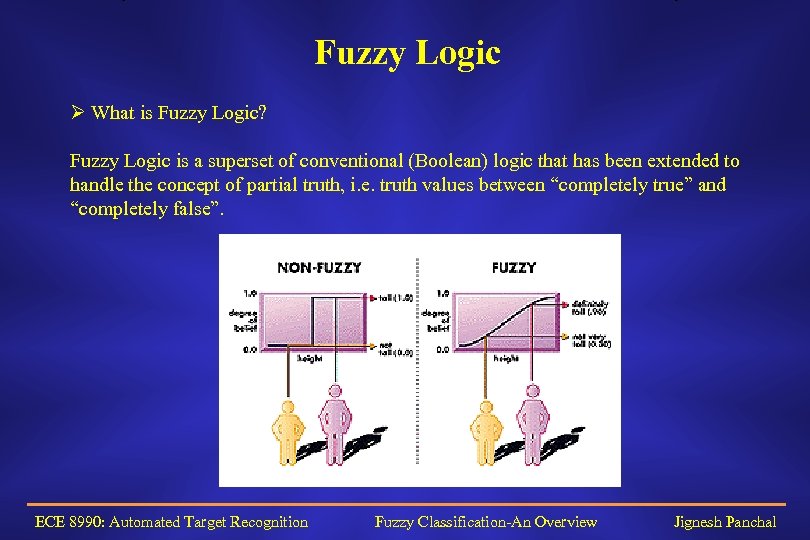
Fuzzy Logic Ø What is Fuzzy Logic? Fuzzy Logic is a superset of conventional (Boolean) logic that has been extended to handle the concept of partial truth, i. e. truth values between “completely true” and “completely false”. ECE 8990: Automated Target Recognition Fuzzy Classification-An Overview Jignesh Panchal
Definitions Ø Universe of Discourse: The Universe of Discourse is the range of all possible values for an input to a fuzzy system. Ø Fuzzy Set: A Fuzzy Set is any set that allows its members to have different grades of membership (membership function) in the interval [0, 1]. Ø Support: The Support of a fuzzy set F is the crisp set of all points in the Universe of Discourse U such that the membership function of F is non-zero. Ø Crossover point: The Crossover point of a fuzzy set is the element in U at which its membership function is 0. 5. Ø Fuzzy Singleton: A Fuzzy singleton is a fuzzy set whose support is a single point in U with a membership function of one. ECE 8990: Automated Target Recognition Fuzzy Classification-An Overview Jignesh Panchal
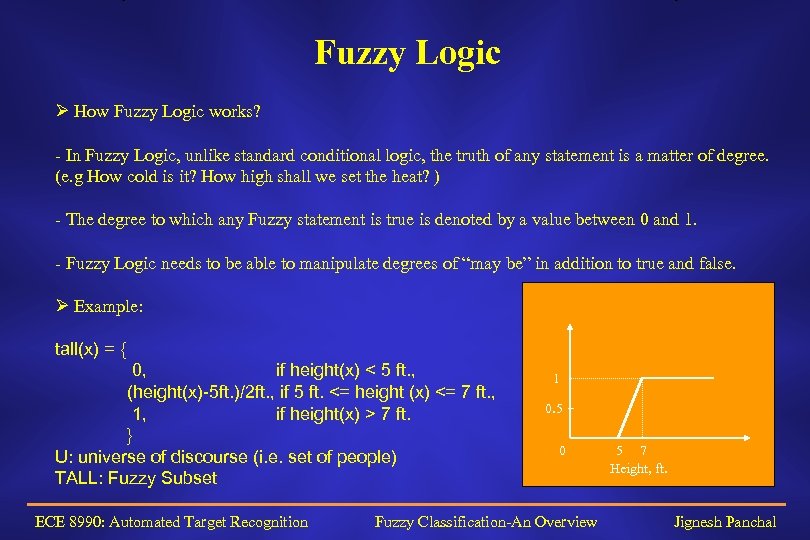
Fuzzy Logic Ø How Fuzzy Logic works? - In Fuzzy Logic, unlike standard conditional logic, the truth of any statement is a matter of degree. (e. g How cold is it? How high shall we set the heat? ) - The degree to which any Fuzzy statement is true is denoted by a value between 0 and 1. - Fuzzy Logic needs to be able to manipulate degrees of “may be” in addition to true and false. Ø Example: tall(x) = { 0, if height(x) < 5 ft. , (height(x)-5 ft. )/2 ft. , if 5 ft. <= height (x) <= 7 ft. , 1, if height(x) > 7 ft. } U: universe of discourse (i. e. set of people) TALL: Fuzzy Subset ECE 8990: Automated Target Recognition 1 0. 5 0 Fuzzy Classification-An Overview 5 7 Height, ft. Jignesh Panchal
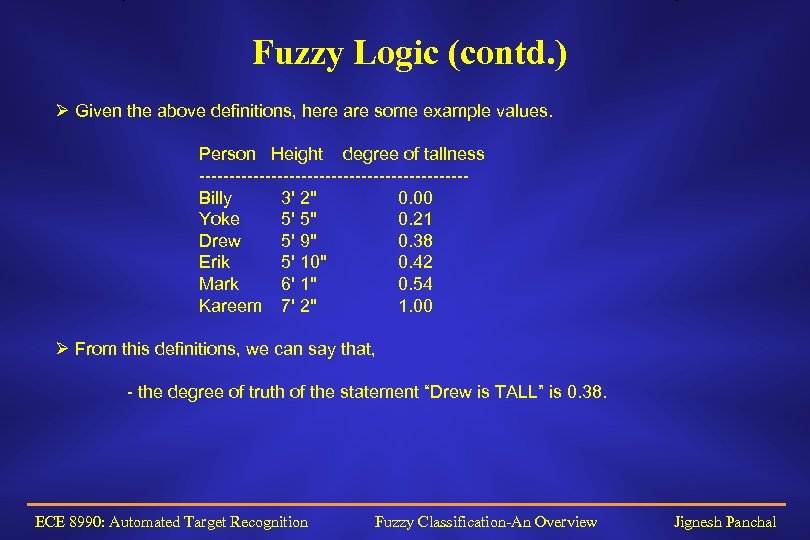
Fuzzy Logic (contd. ) Ø Given the above definitions, here are some example values. Person Height degree of tallness ----------------------Billy 3' 2" 0. 00 Yoke 5' 5" 0. 21 Drew 5' 9" 0. 38 Erik 5' 10" 0. 42 Mark 6' 1" 0. 54 Kareem 7' 2" 1. 00 Ø From this definitions, we can say that, - the degree of truth of the statement “Drew is TALL” is 0. 38. ECE 8990: Automated Target Recognition Fuzzy Classification-An Overview Jignesh Panchal
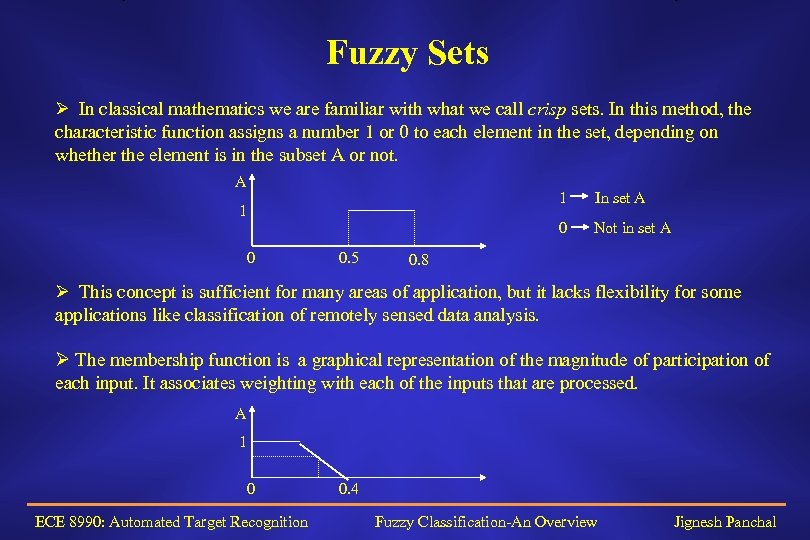
Fuzzy Sets Ø In classical mathematics we are familiar with what we call crisp sets. In this method, the characteristic function assigns a number 1 or 0 to each element in the set, depending on whether the element is in the subset A or not. A 1 0 0. 5 In set A 0 1 Not in set A 0. 8 Ø This concept is sufficient for many areas of application, but it lacks flexibility for some applications like classification of remotely sensed data analysis. Ø The membership function is a graphical representation of the magnitude of participation of each input. It associates weighting with each of the inputs that are processed. A 1 0 ECE 8990: Automated Target Recognition 0. 4 Fuzzy Classification-An Overview Jignesh Panchal
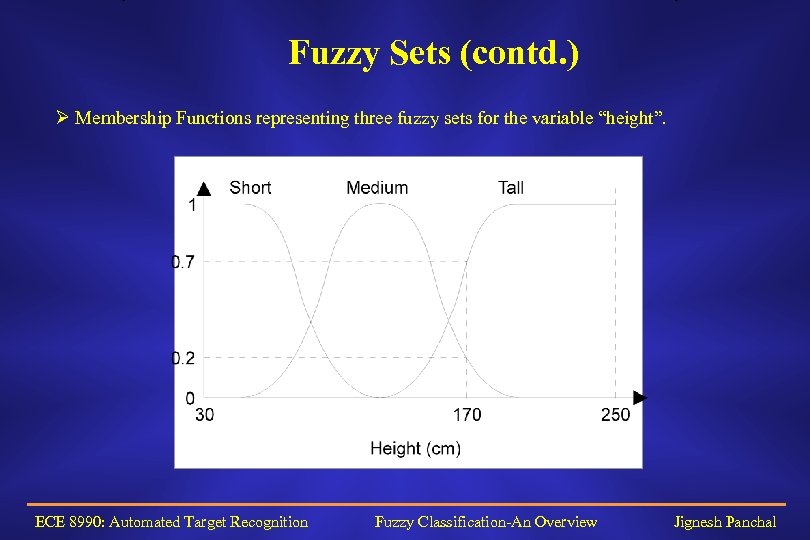
Fuzzy Sets (contd. ) Ø Membership Functions representing three fuzzy sets for the variable “height”. ECE 8990: Automated Target Recognition Fuzzy Classification-An Overview Jignesh Panchal
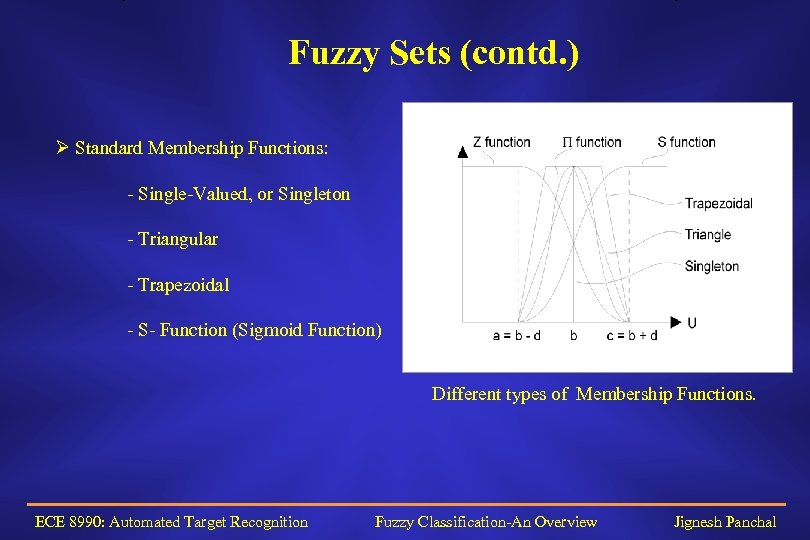
Fuzzy Sets (contd. ) Ø Standard Membership Functions: - Single-Valued, or Singleton - Triangular - Trapezoidal - S- Function (Sigmoid Function) Different types of Membership Functions. ECE 8990: Automated Target Recognition Fuzzy Classification-An Overview Jignesh Panchal
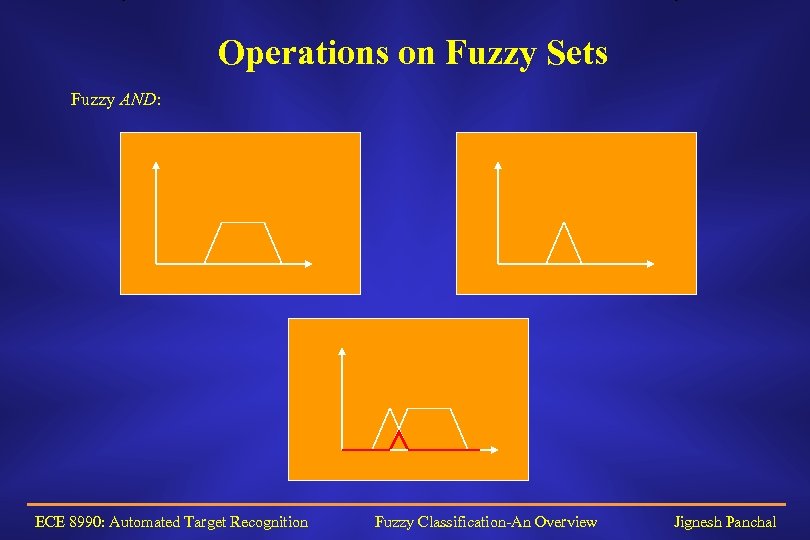
Operations on Fuzzy Sets Fuzzy AND: ECE 8990: Automated Target Recognition Fuzzy Classification-An Overview Jignesh Panchal
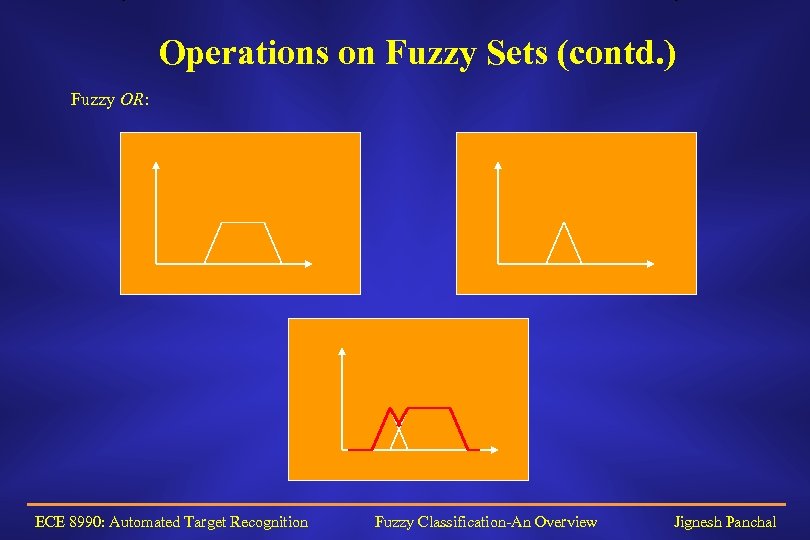
Operations on Fuzzy Sets (contd. ) Fuzzy OR: ECE 8990: Automated Target Recognition Fuzzy Classification-An Overview Jignesh Panchal
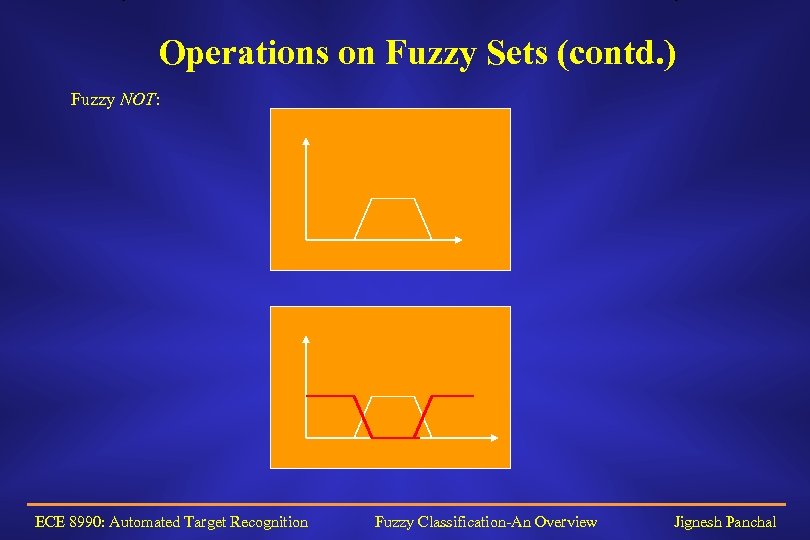
Operations on Fuzzy Sets (contd. ) Fuzzy NOT: ECE 8990: Automated Target Recognition Fuzzy Classification-An Overview Jignesh Panchal
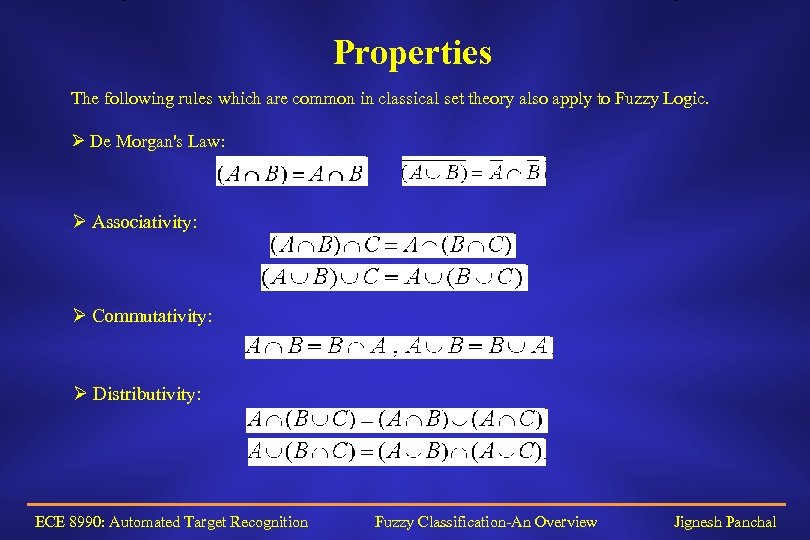
Properties The following rules which are common in classical set theory also apply to Fuzzy Logic. Ø De Morgan's Law: Ø Associativity: Ø Commutativity: Ø Distributivity: ECE 8990: Automated Target Recognition Fuzzy Classification-An Overview Jignesh Panchal
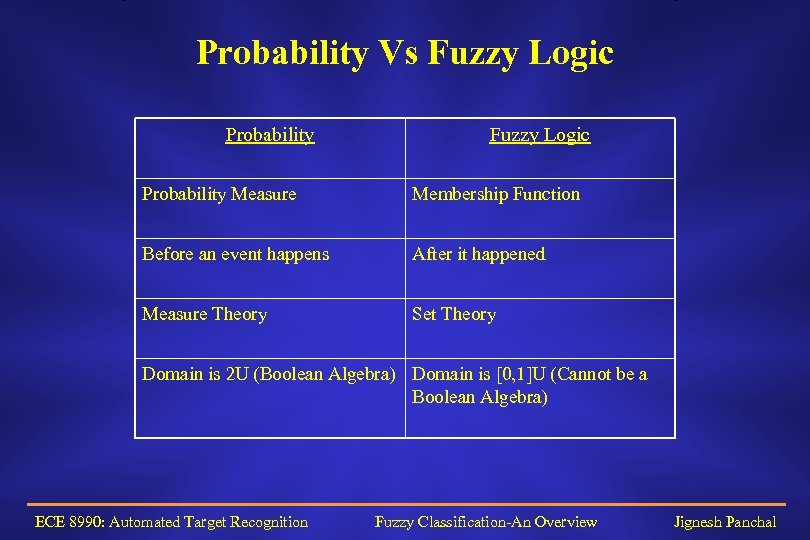
Probability Vs Fuzzy Logic Probability Measure Membership Function Before an event happens After it happened Measure Theory Set Theory Domain is 2 U (Boolean Algebra) Domain is [0, 1]U (Cannot be a Boolean Algebra) ECE 8990: Automated Target Recognition Fuzzy Classification-An Overview Jignesh Panchal
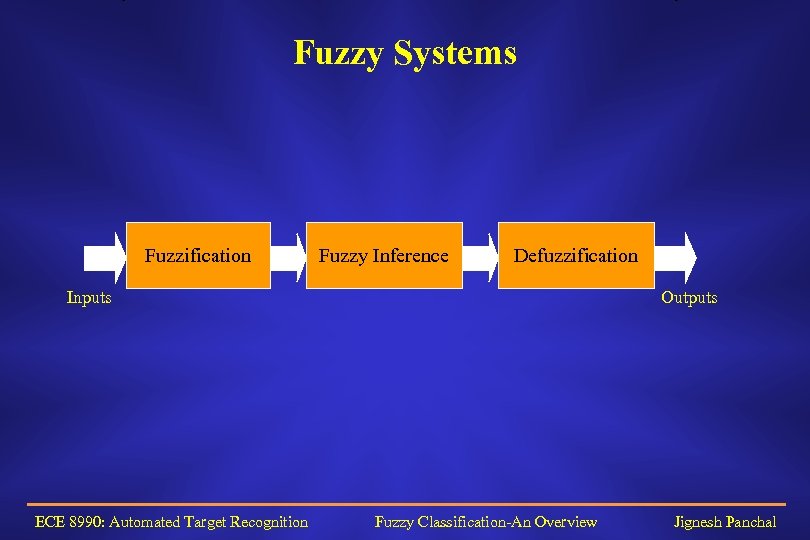
Fuzzy Systems Fuzzification Fuzzy Inference Defuzzification Inputs ECE 8990: Automated Target Recognition Outputs Fuzzy Classification-An Overview Jignesh Panchal
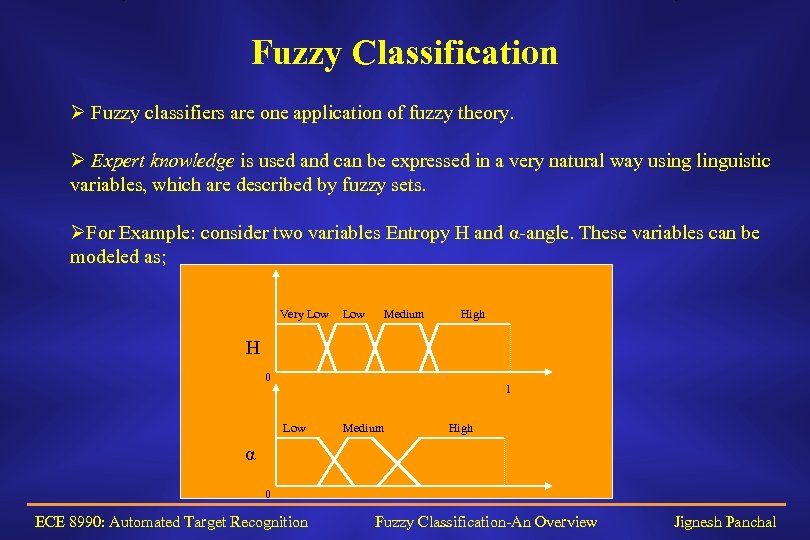
Fuzzy Classification Ø Fuzzy classifiers are one application of fuzzy theory. Ø Expert knowledge is used and can be expressed in a very natural way using linguistic variables, which are described by fuzzy sets. ØFor Example: consider two variables Entropy H and α-angle. These variables can be modeled as; Very Low Medium High H 0 1 Low Medium High α 0 ECE 8990: Automated Target Recognition Fuzzy Classification-An Overview Jignesh Panchal
Fuzzy Classification (contd. ) Ø In fuzzy classification, a sample can have membership in many different classes to different degrees. Typically, the membership values are constrained so that all of the membership values for a particular sample sum to 1. Ø Now the expert knowledge for this variable can be formulated as a rule like IF Entropy high AND α high THEN Class = class 4 Ø The rules can be combined in a table, called as rule base. ECE 8990: Automated Target Recognition Fuzzy Classification-An Overview Jignesh Panchal
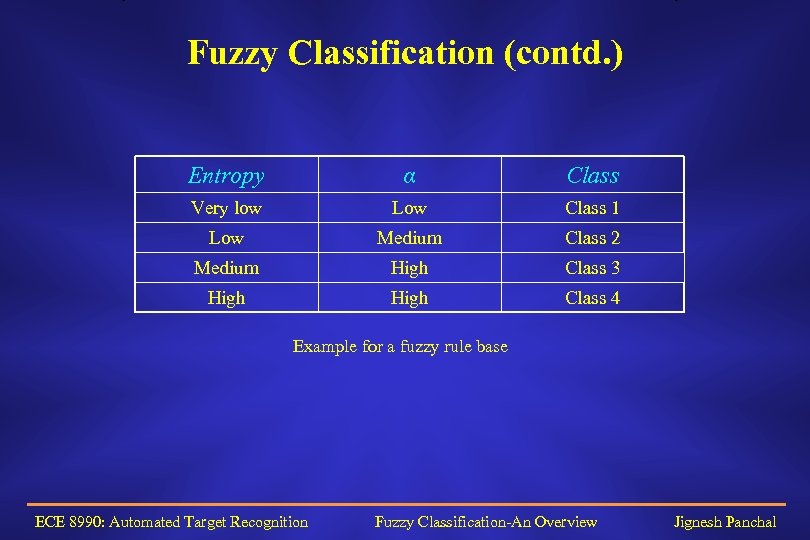
Fuzzy Classification (contd. ) Entropy α Class Very low Low Class 1 Low Medium Class 2 Medium High Class 3 High Class 4 Example for a fuzzy rule base ECE 8990: Automated Target Recognition Fuzzy Classification-An Overview Jignesh Panchal
Fuzzy Classification (contd. ) Ø Linguistic rules describing the control system consist of two parts; an antecedent block (between the IF and THEN) and a consequent block (following THEN). Ø Depending on the system, it may not be necessary to evaluate every possible input combination, since some may rarely or never occur. Ø Optimum evaluation is usually done by experienced operators. Ø The inputs are combined logically using the AND operator to produce output response values for all expected inputs. The active conclusions are then combined to logical sum for each membership function. Ø Finally, all that remains is combined in defuzzyfication process to produce the crisp output. ECE 8990: Automated Target Recognition Fuzzy Classification-An Overview Jignesh Panchal
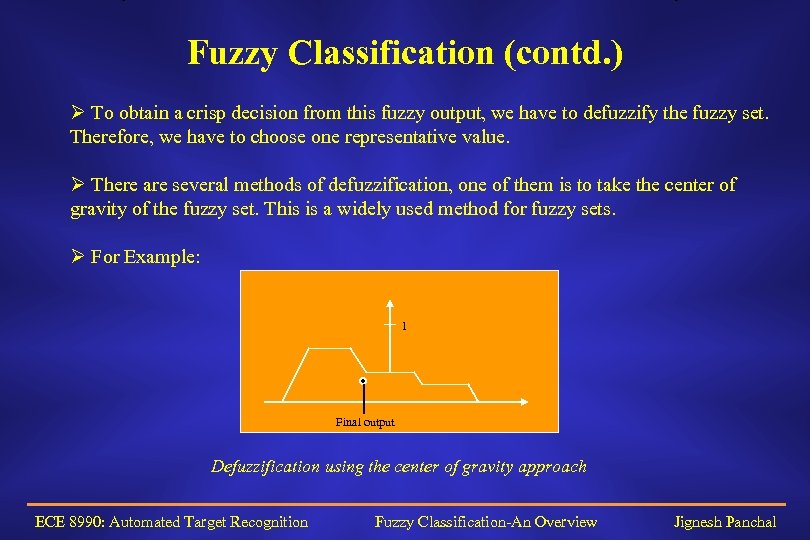
Fuzzy Classification (contd. ) Ø To obtain a crisp decision from this fuzzy output, we have to defuzzify the fuzzy set. Therefore, we have to choose one representative value. Ø There are several methods of defuzzification, one of them is to take the center of gravity of the fuzzy set. This is a widely used method for fuzzy sets. Ø For Example: 1 Final output Defuzzification using the center of gravity approach ECE 8990: Automated Target Recognition Fuzzy Classification-An Overview Jignesh Panchal
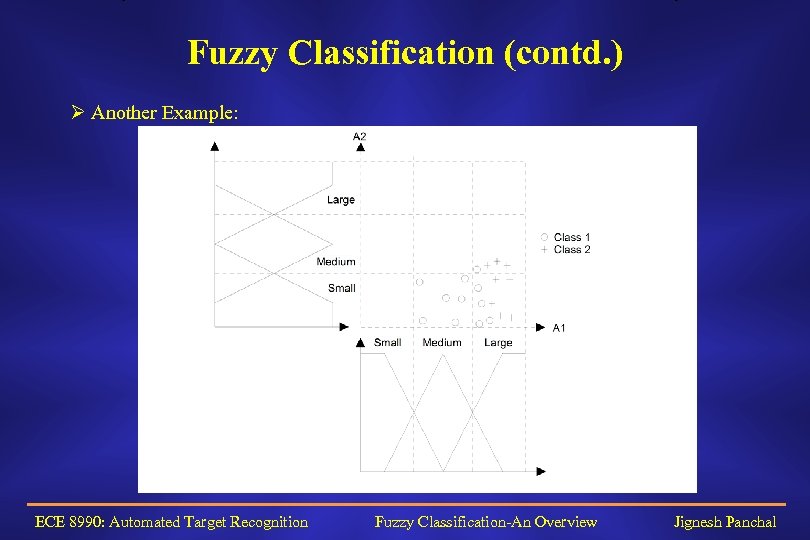
Fuzzy Classification (contd. ) Ø Another Example: ECE 8990: Automated Target Recognition Fuzzy Classification-An Overview Jignesh Panchal
Conclusions Ø Fuzzy Logic provides a different way to approach a control or classification problem. This method focuses on what the system should do rather than trying to model how it works. Ø Fuzzy approach requires a sufficient expert knowledge for the formulation of the rule base, the combination of the sets and the defuzzification. Ø Fuzzy Logic might be helpful, for very complex processes, when there is no simple mathematical model. ECE 8990: Automated Target Recognition Fuzzy Classification-An Overview Jignesh Panchal
Pros & Cons Ø Advantages: - Helpful for very complex or highly nonlinear processes. - Allows use of “fuzzy” concepts like medium, low, etc. - Biggest impact is for control problems. - Help avoid discontinuities in behavior. Ø Disadvantages: - Sometimes results are unexpected and hard to debug. - Computationally complicated. - According to literature, Fuzzy Logic is not recommendable, if conventional approach yields a satisfying result. ECE 8990: Automated Target Recognition Fuzzy Classification-An Overview Jignesh Panchal
Fuzzy System Applications Ø Pattern Recognition and Classification Ø Fuzzy Clustering Ø Image and Speech Processing ØFuzzy Systems for Predictions Ø Fuzzy Control Ø Monitoring Ø Diagnosis Ø Optimization and Decision Making Ø Group Decision Making ECE 8990: Automated Target Recognition Fuzzy Classification-An Overview Jignesh Panchal
References Ø http: //www. doc. ic. ac. uk/~nd/surprise_96/journal/vol 2/jp 6/article 2. html Ø http: //www. seattlerobotics. org/encoder/mar 98/fuz/fl_part 2. html Ø http: //www. terraseer. com/bsr/help/Fuzzy_classification/About_fuzzy_classification. htm Ø “Fuzzy Logic Introduction” – by Martin Hellmann, March 2001 ECE 8990: Automated Target Recognition Fuzzy Classification-An Overview Jignesh Panchal
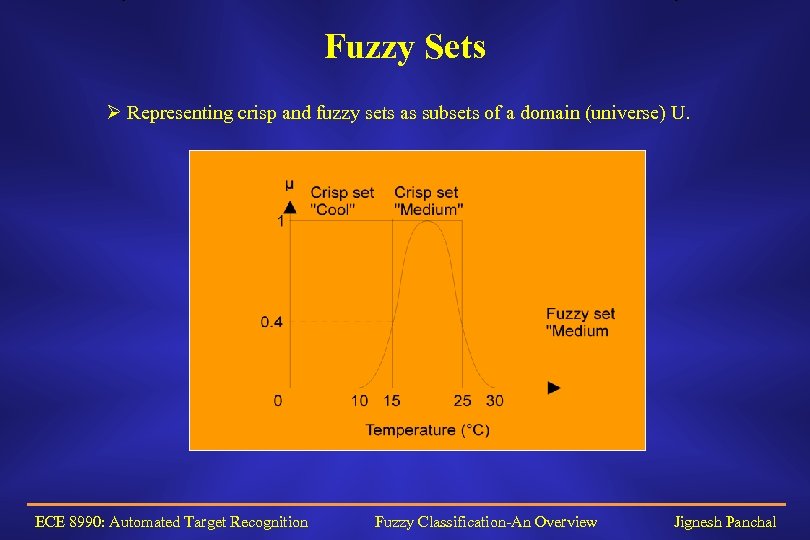
Fuzzy Sets Ø Representing crisp and fuzzy sets as subsets of a domain (universe) U. ECE 8990: Automated Target Recognition Fuzzy Classification-An Overview Jignesh Panchal
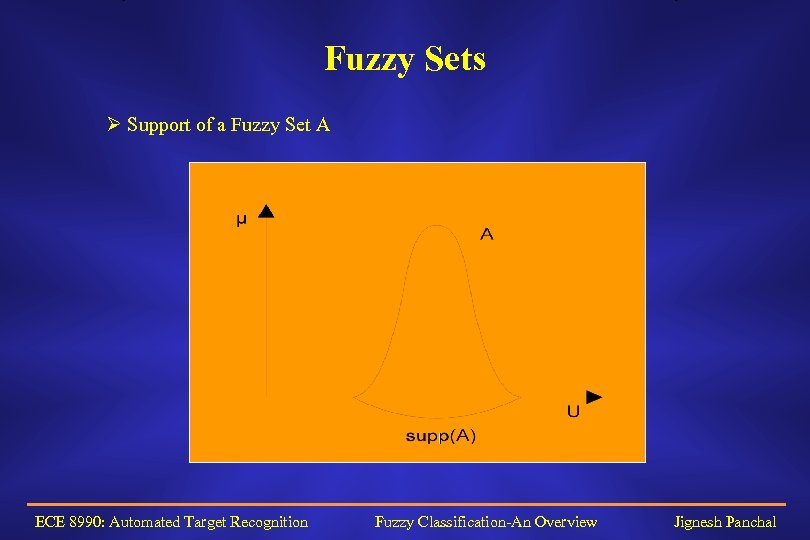
Fuzzy Sets Ø Support of a Fuzzy Set A ECE 8990: Automated Target Recognition Fuzzy Classification-An Overview Jignesh Panchal
Fuzzy k-Means Clustering Ø In classical k-means procedure, each data point is assumed to be in exactly one cluster. Ø In fuzzy k-means clustering, we can relax this condition and assume that each sample xj has some graded or “fuzzy” membership in a cluster. ECE 8990: Automated Target Recognition Fuzzy Classification-An Overview Jignesh Panchal
Скачать презентацию Fuzzy Classification -An Overview Presented By Jignesh Panchal
299ab124ac94f15870fcb11a49799bb0.ppt