


 Скачать презентацию Future Wireless Standards and the Emergence of Wi
68ed85e5b6e3b24daa4f27c5f13e8695.ppt
- Количество слайдов: 82
 Future Wireless Standards and the Emergence of Wi. MAX October 3 -4, 2007 Jeff Reed reedjh@vt. edu reedjh@crtwireless. com (540) 231 -2972 James Neel james. neel@crtwireless. com (540) 230 -6012 www. crtwireless. com 1/82
 Jeffrey H. Reed • • Director, Wireless @ Virginia Tech Willis G. Worcester Professor, Deputy Director, Mobile and Portable Radio Research Group (MPRG) Authored book, Software Radio: A Modern Approach to Radio Engineering IEEE Fellow for Software Radio, Communications Signal Processing and Education Industry Achievement Award from the SDR Forum Highly published. Co-authored – 2 books, edited – 7 books. Previous and Ongoing CR projects from – ETRI, ONR, ARO, Tektronix • Email: reedjh@vt. edu 2/82
 James Neel • President, Cognitive Radio Technologies, LLC • Ph. D, Virginia Tech 2006 • Textbook chapters on: – Cognitive Network Analysis in – Data Converters in Software Radio: A Modern Approach to Radio Engineering – SDR Case Studies in Software Radio: A Modern Approach to Radio Engineering – UWB Simulation Methodologies in An Introduction to Ultra Wideband Communication Systems • SDR Forum Paper Awards for 2002, 2004 papers on analyzing/designing cognitive radio networks • Email: james. neel@crtwireless. com 3/82
 About Virginia Tech • Virginia Tech has approximately 26, 000 students • The College of Engineering grants the 7 th largest number BS degrees in the US, and is ranked 14 th by US News and others • The Bradley Department of Electrical & Computer Engineering is one of the nation’s largest ECE departments, with broad resources: – 72 tenure-track faculty and 12 research faculty members – 1, 100 undergraduate and 570 graduate students • Wireless Telecommunications is a principal focus area – 25 ECE faculty are involved in various aspects of wireless communications research and teaching. – Large number of the ECE graduate students are majoring in wireless telecommunications field. 4/82
 Wireless @ Virginia Tech • New Wireless Umbrella Group – MPRG, CWT, VTVT, WML, Antenna Group, Time Domain Lab, DSPRL • Officially rolled-out June 2006 • Currently 32 tenure-track faculty and more than 111 students • Backlog in research growing • University providing initial financial support • Cognitive Networks targeted as strategic technical growth effort 5/82
 What is Wireless @ Virginia Tech? A comprehensive organization focused on wireless research to support our educational mission. 6/82
 Research Areas • • • • Algorithm Development Antennas RF Circuit Design MEMS UWB Position Location RF Systems Cognitive Radio/Networks Collaborative Radio Software Radio Smart Antennas and Diversity Schemes Radio Resource Management Network protocol design Cross layer optimization • • • • 7/82 Game Theory Analysis Hybrid wireless/fiber optic/powerline systems Land Mobile Radio MIMO Interference Cancellation Channel Measurements Channel Modeling Simulation Tools VLSI Implementation Reconfigurable Computing RF material-characterization Security Networking Sensor networking Satellite Systems Wearable computing and communications
 Current and Recent Research Sponsors • • • • Applied EM Army Research Office Aero. Astron Wireless Technologies Ausgar Technologies, Inc Bradley Fellowship Program Catalyst Communications Technologies Cisco Systems, Inc. Comteh DRS Technologies ETRI L-3 Laboratory for Telecommunication Science Luna Motorola • • • • 8/82 Nanosonics National Institute of Justice National Polar-Orbiting Earth Sensing Satellite Program National Science Foundation RFMD M/A-COM Office of Naval Research Rosettex Technology & Ventures Group SAIC SPAWAR Systems Center Tektronix Texas Instruments U. S. Army U. S. Naval Research Laboratory
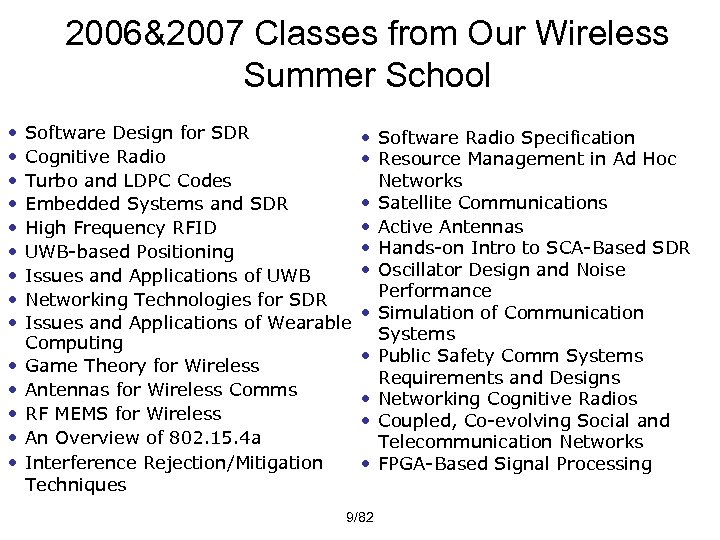 2006&2007 Classes from Our Wireless Summer School • • • • Software Design for SDR Cognitive Radio Turbo and LDPC Codes Embedded Systems and SDR High Frequency RFID UWB-based Positioning Issues and Applications of UWB Networking Technologies for SDR Issues and Applications of Wearable Computing Game Theory for Wireless Antennas for Wireless Comms RF MEMS for Wireless An Overview of 802. 15. 4 a Interference Rejection/Mitigation Techniques • Software Radio Specification • Resource Management in Ad Hoc Networks • Satellite Communications • Active Antennas • Hands-on Intro to SCA-Based SDR • Oscillator Design and Noise Performance • Simulation of Communication Systems • Public Safety Comm Systems Requirements and Designs • Networking Cognitive Radios • Coupled, Co-evolving Social and Telecommunication Networks • FPGA-Based Signal Processing 9/82
 Cognitive Radio Technologies Small business incorporated in Feb 2007 to commercialize VT cognitive radio research Provide traditional wireless engineering services and develop critical cognitive radio technologies Email: james. neel@crtwireless. com reedjh@crtwireless. com bin. le@crtwireless. com Website: crtwireless. com Tel: 540 -230 -6012 Mailing Address: Cognitive Radio Technologies 147 Mill Ridge Rd, Suite 119 Lynchburg, VA 24502 10/82
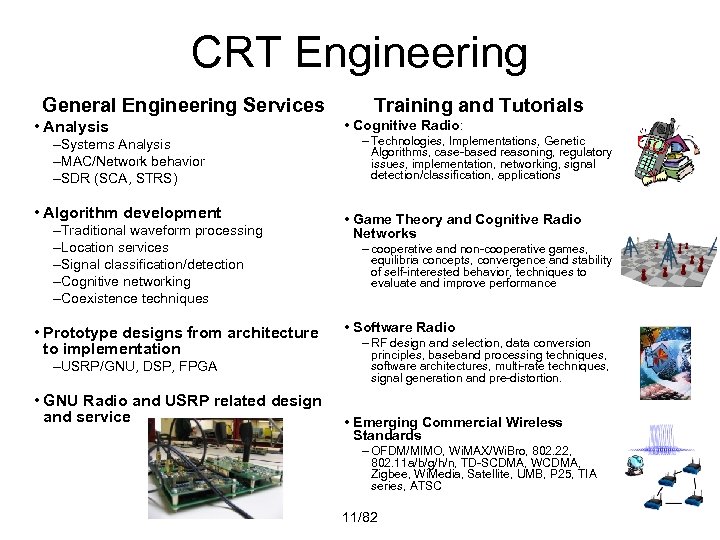 CRT Engineering General Engineering Services • Analysis –Systems Analysis –MAC/Network behavior –SDR (SCA, STRS) • Algorithm development –Traditional waveform processing –Location services –Signal classification/detection –Cognitive networking –Coexistence techniques • Prototype designs from architecture to implementation –USRP/GNU, DSP, FPGA • GNU Radio and USRP related design and service Training and Tutorials • Cognitive Radio: – Technologies, Implementations, Genetic Algorithms, case-based reasoning, regulatory issues, implementation, networking, signal detection/classification, applications • Game Theory and Cognitive Radio Networks – cooperative and non-cooperative games, equilibria concepts, convergence and stability of self-interested behavior, techniques to evaluate and improve performance • Software Radio – RF design and selection, data conversion principles, baseband processing techniques, software architectures, multi-rate techniques, signal generation and pre-distortion. • Emerging Commercial Wireless Standards – OFDM/MIMO, Wi. MAX/Wi. Bro, 802. 22, 802. 11 a/b/g/h/n, TD-SCDMA, WCDMA, Zigbee, Wi. Media, Satellite, UMB, P 25, TIA series, ATSC 11/82
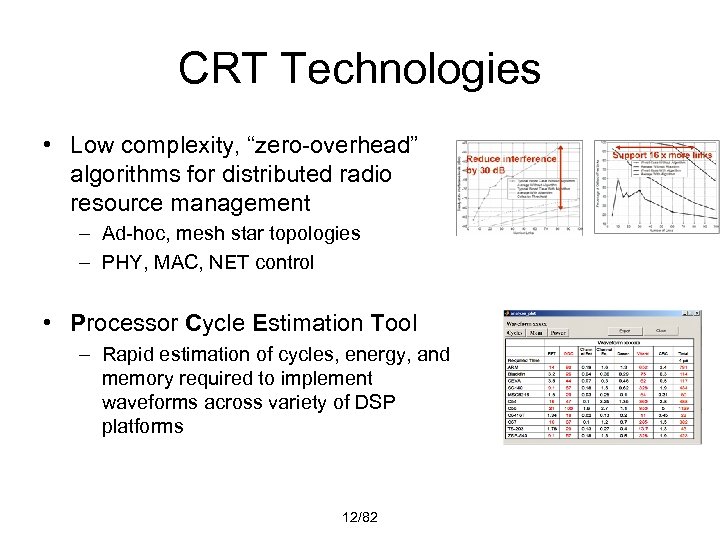 CRT Technologies • Low complexity, “zero-overhead” algorithms for distributed radio resource management – Ad-hoc, mesh star topologies – PHY, MAC, NET control • Processor Cycle Estimation Tool – Rapid estimation of cycles, energy, and memory required to implement waveforms across variety of DSP platforms 12/82
 Tutorial Objectives • Understand state of the wireless world • Understand how some key standards work and the tradeoffs available to implementations of those standards • Understand the basic principles and deployment options of Wi. MAX 13/82
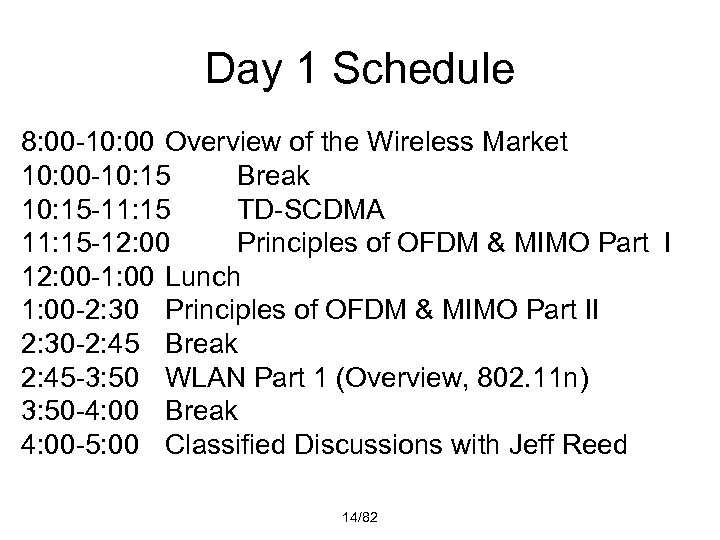 Day 1 Schedule 8: 00 -10: 00 Overview of the Wireless Market 10: 00 -10: 15 Break 10: 15 -11: 15 TD-SCDMA 11: 15 -12: 00 Principles of OFDM & MIMO Part I 12: 00 -1: 00 Lunch 1: 00 -2: 30 Principles of OFDM & MIMO Part II 2: 30 -2: 45 Break 2: 45 -3: 50 WLAN Part 1 (Overview, 802. 11 n) 3: 50 -4: 00 Break 4: 00 -5: 00 Classified Discussions with Jeff Reed 14/82
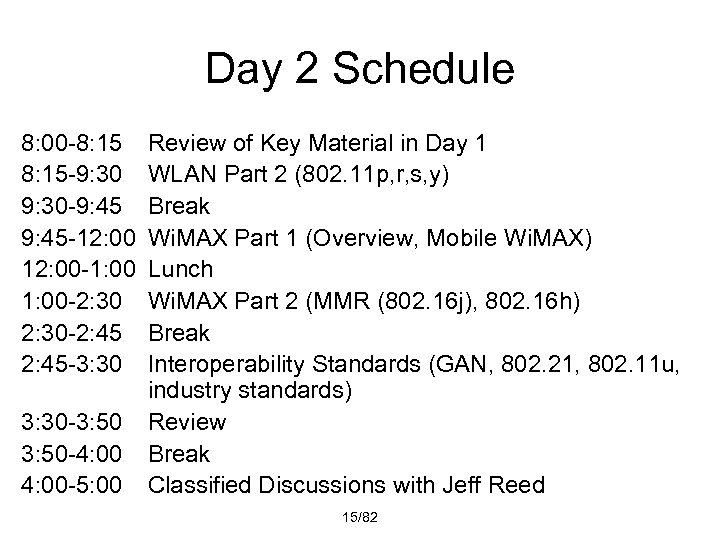 Day 2 Schedule 8: 00 -8: 15 Review of Key Material in Day 1 8: 15 -9: 30 WLAN Part 2 (802. 11 p, r, s, y) 9: 30 -9: 45 Break 9: 45 -12: 00 Wi. MAX Part 1 (Overview, Mobile Wi. MAX) 12: 00 -1: 00 Lunch 1: 00 -2: 30 Wi. MAX Part 2 (MMR (802. 16 j), 802. 16 h) 2: 30 -2: 45 Break 2: 45 -3: 30 Interoperability Standards (GAN, 802. 21, 802. 11 u, industry standards) 3: 30 -3: 50 Review 3: 50 -4: 00 Break 4: 00 -5: 00 Classified Discussions with Jeff Reed 15/82
 Wireless Minutes Shamelessly modified from cover art to Michael Todd’s soundtrack to “Around the World in 80 Days”, see 16/82 http: //www. phys. uu. nl/~gdevries/objects/80 days_todd. html for original context
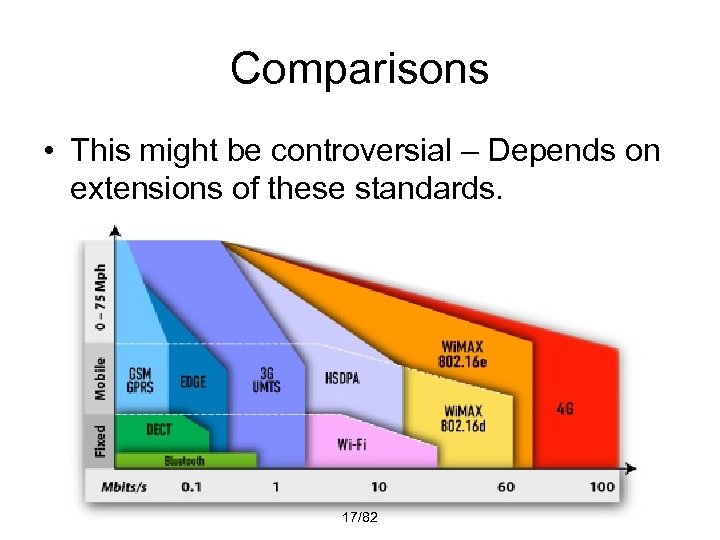 Comparisons • This might be controversial – Depends on extensions of these standards. 17/82
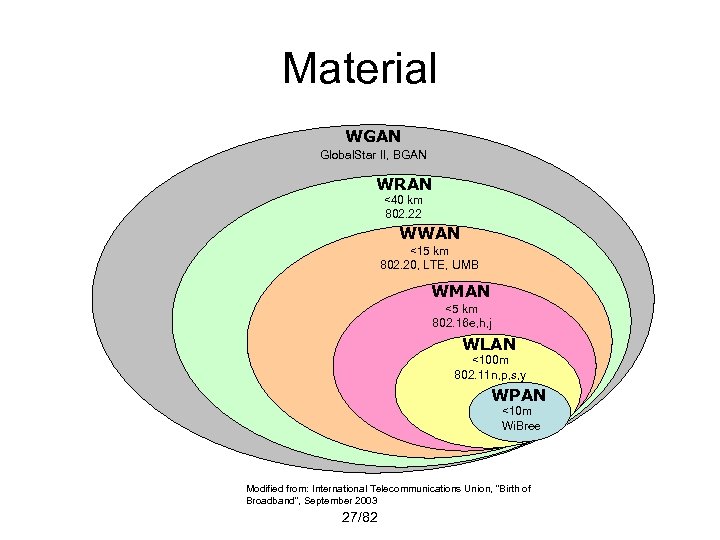
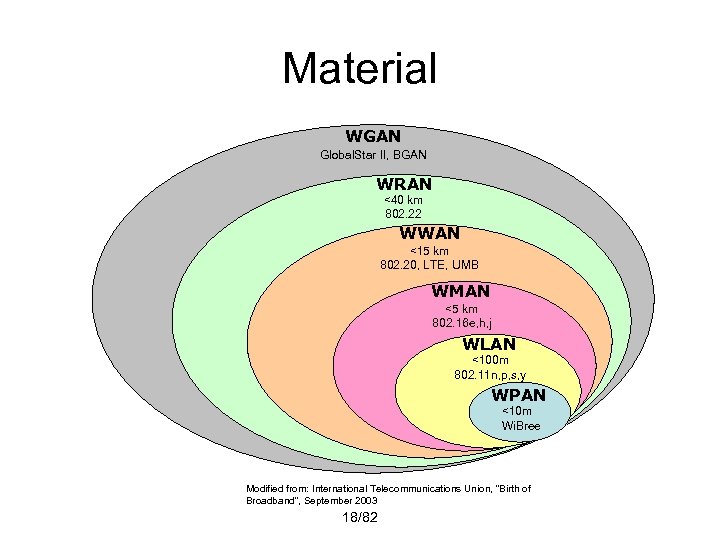 Material WGAN Global. Star II, BGAN WRAN <40 km 802. 22 WWAN <15 km 802. 20, LTE, UMB WMAN <5 km 802. 16 e, h, j WLAN <100 m 802. 11 n, p, s, y WPAN <10 m Wi. Bree Modified from: International Telecommunications Union, “Birth of Broadband”, September 2003 18/82
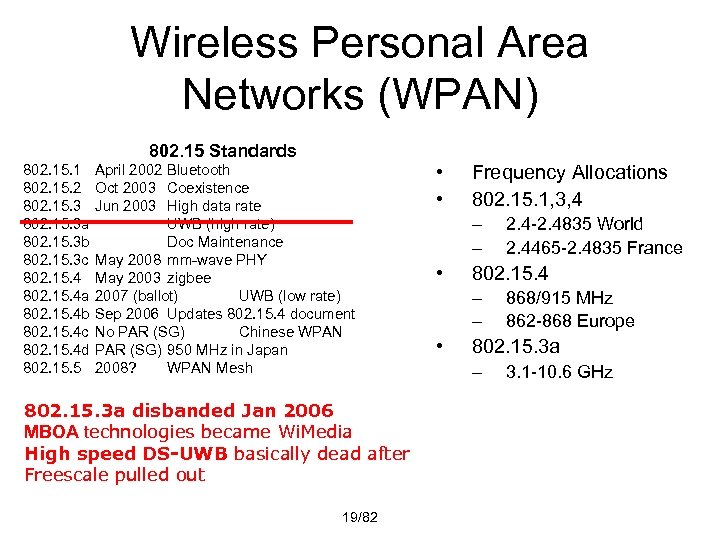 Wireless Personal Area Networks (WPAN) 802. 15 Standards 802. 15. 1 April 2002 Bluetooth 802. 15. 2 Oct 2003 Coexistence 802. 15. 3 Jun 2003 High data rate 802. 15. 3 a UWB (high rate) 802. 15. 3 b Doc Maintenance 802. 15. 3 c May 2008 mm-wave PHY 802. 15. 4 May 2003 zigbee 802. 15. 4 a 2007 (ballot) UWB (low rate) 802. 15. 4 b Sep 2006 Updates 802. 15. 4 document 802. 15. 4 c No PAR (SG) Chinese WPAN 802. 15. 4 d PAR (SG) 950 MHz in Japan 802. 15. 5 2008? WPAN Mesh 802. 15. 3 a disbanded Jan 2006 MBOA technologies became Wi. Media High speed DS-UWB basically dead after Freescale pulled out 19/82 • • Frequency Allocations 802. 15. 1, 3, 4 – – • 802. 15. 4 – – • 2. 4 -2. 4835 World 2. 4465 -2. 4835 France 868/915 MHz 862 -868 Europe 802. 15. 3 a – 3. 1 -10. 6 GHz
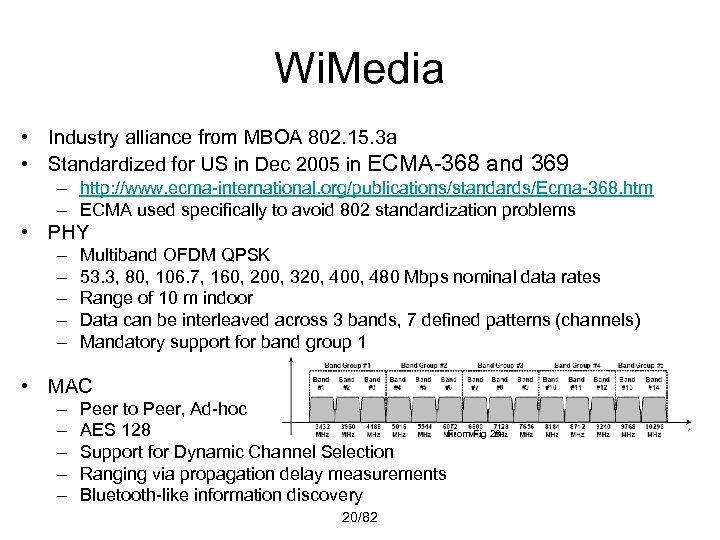 Wi. Media • Industry alliance from MBOA 802. 15. 3 a • Standardized for US in Dec 2005 in ECMA-368 and 369 – http: //www. ecma-international. org/publications/standards/Ecma-368. htm – ECMA used specifically to avoid 802 standardization problems • PHY – – – Multiband OFDM QPSK 53. 3, 80, 106. 7, 160, 200, 320, 400, 480 Mbps nominal data rates Range of 10 m indoor Data can be interleaved across 3 bands, 7 defined patterns (channels) Mandatory support for band group 1 • MAC – – – Peer to Peer, Ad-hoc AES 128 From Fig 28: Support for Dynamic Channel Selection Ranging via propagation delay measurements Bluetooth-like information discovery 20/82
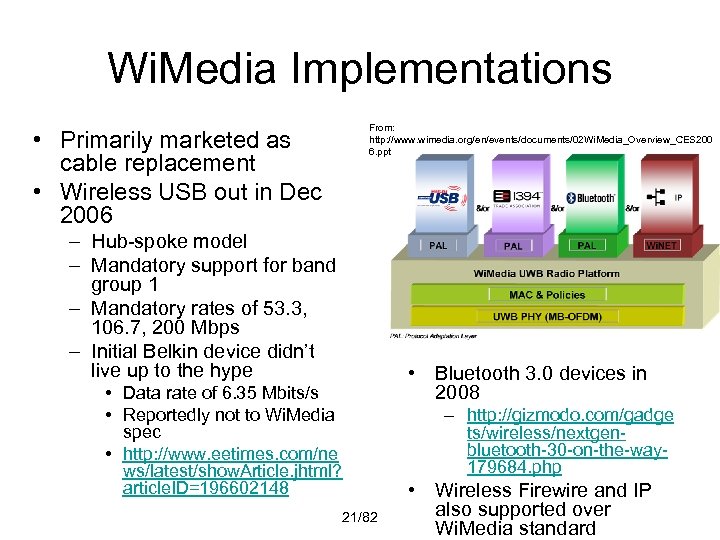 Wi. Media Implementations • Primarily marketed as cable replacement • Wireless USB out in Dec 2006 From: http: //www. wimedia. org/en/events/documents/02 Wi. Media_Overview_CES 200 6. ppt – Hub-spoke model – Mandatory support for band group 1 – Mandatory rates of 53. 3, 106. 7, 200 Mbps – Initial Belkin device didn’t live up to the hype • Bluetooth 3. 0 devices in 2008 • Data rate of 6. 35 Mbits/s • Reportedly not to Wi. Media spec • http: //www. eetimes. com/ne ws/latest/show. Article. jhtml? article. ID=196602148 – http: //gizmodo. com/gadge ts/wireless/nextgenbluetooth-30 -on-the-way 179684. php 21/82 • Wireless Firewire and IP also supported over Wi. Media standard
 • Status – Nokia sponsored initiative announced Oct 2006 – Specification work is currently being evaluated, targeted for availability second quarter 2007 – Trial chips probably available late 2007 • Public data: (from wibree. com and http: //www. theregister. co. uk/2006/10/06/wibree_analysis/) – – – 2. 4 GHz ISM band Range 10 meters 1 Mbps data rate Likely to be integrated into Bluetooth products Targets low power/low cost market • Many reports mentioned Wi. Bree as a competitor to Bluetooth – Being brought into Bluetooth fold • http: //www. internetnews. com/dev-news/article. php/3682961 • More likely a competitor to Zigbee and Z-wave 22/82
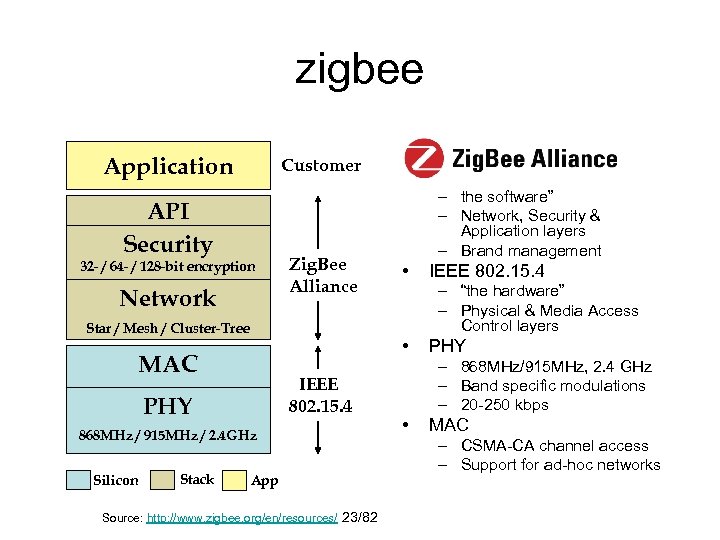 zigbee Application Customer API Security 32 - / 64 - / 128 -bit encryption Network Zig. Bee Alliance Star / Mesh / Cluster-Tree IEEE 802. 15. 4 PHY 868 MHz / 915 MHz / 2. 4 GHz Stack • App Source: http: //www. zigbee. org/en/resources/ 23/82 IEEE 802. 15. 4 – “the hardware” – Physical & Media Access Control layers • MAC Silicon – the software” – Network, Security & Application layers – Brand management PHY – 868 MHz/915 MHz, 2. 4 GHz – Band specific modulations – 20 -250 kbps • MAC – CSMA-CA channel access – Support for ad-hoc networks
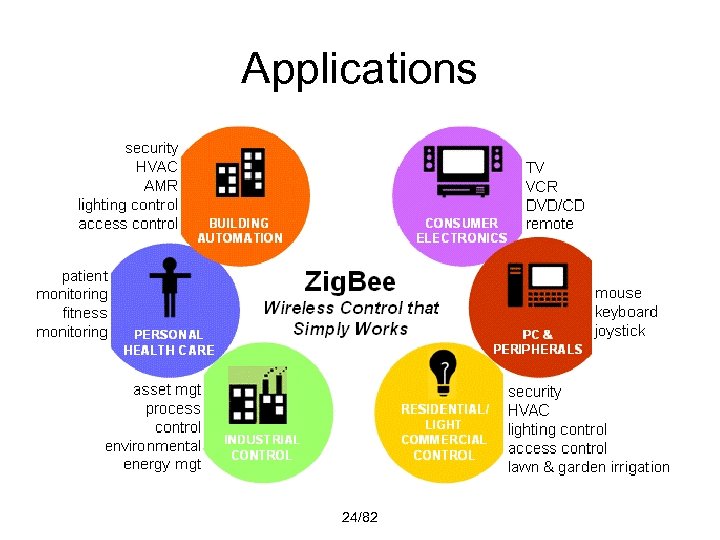 Applications 24/82
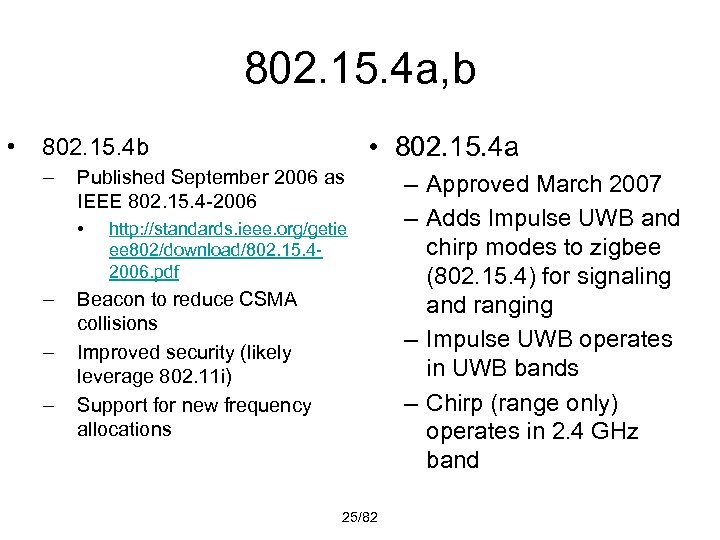 802. 15. 4 a, b • • 802. 15. 4 a 802. 15. 4 b – Published September 2006 as IEEE 802. 15. 4 -2006 • – – – http: //standards. ieee. org/getie ee 802/download/802. 15. 42006. pdf Beacon to reduce CSMA collisions Improved security (likely leverage 802. 11 i) Support for new frequency allocations 25/82 – Approved March 2007 – Adds Impulse UWB and chirp modes to zigbee (802. 15. 4) for signaling and ranging – Impulse UWB operates in UWB bands – Chirp (range only) operates in 2. 4 GHz band
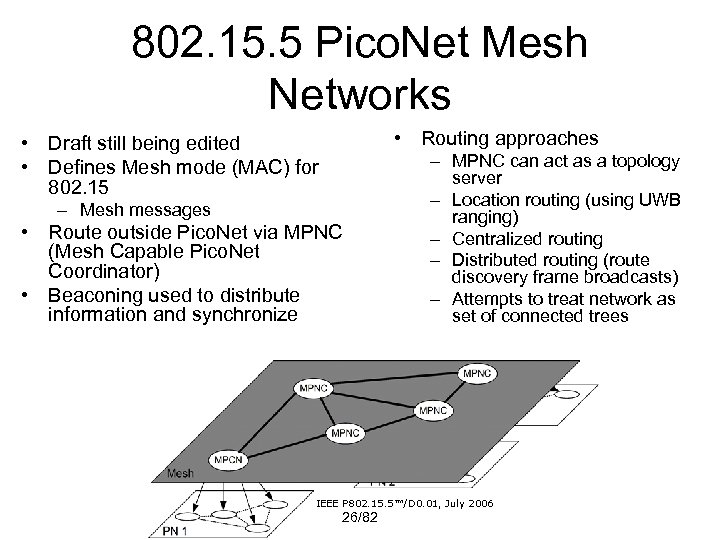 802. 15. 5 Pico. Net Mesh Networks • Routing approaches • Draft still being edited • Defines Mesh mode (MAC) for 802. 15 – Mesh messages • Route outside Pico. Net via MPNC (Mesh Capable Pico. Net Coordinator) • Beaconing used to distribute information and synchronize – MPNC can act as a topology server – Location routing (using UWB ranging) – Centralized routing – Distributed routing (route discovery frame broadcasts) – Attempts to treat network as set of connected trees IEEE P 802. 15. 5™/D 0. 01, July 2006 26/82
 Material WGAN Global. Star II, BGAN WRAN <40 km 802. 22 WWAN <15 km 802. 20, LTE, UMB WMAN <5 km 802. 16 e, h, j WLAN <100 m 802. 11 n, p, s, y WPAN <10 m Wi. Bree Modified from: International Telecommunications Union, “Birth of Broadband”, September 2003 27/82
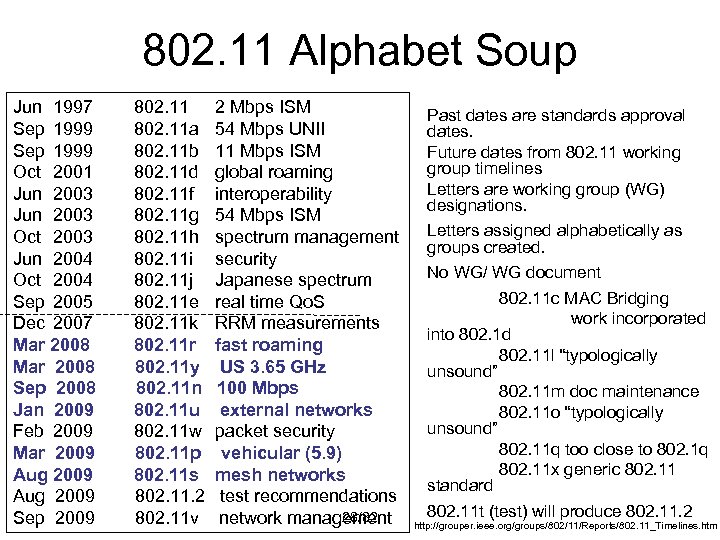 802. 11 Alphabet Soup Jun 1997 802. 11 2 Mbps ISM Sep 1999 802. 11 a 54 Mbps UNII Sep 1999 802. 11 b 11 Mbps ISM Oct 2001 802. 11 d global roaming Jun 2003 802. 11 f interoperability Jun 2003 802. 11 g 54 Mbps ISM Oct 2003 802. 11 h spectrum management Jun 2004 802. 11 i security Oct 2004 802. 11 j Japanese spectrum Sep 2005 802. 11 e real time Qo. S Dec 2007 802. 11 k RRM measurements Mar 2008 802. 11 r fast roaming Mar 2008 802. 11 y US 3. 65 GHz Sep 2008 802. 11 n 100 Mbps Jan 2009 802. 11 u external networks Feb 2009 802. 11 w packet security Mar 2009 802. 11 p vehicular (5. 9) Aug 2009 802. 11 s mesh networks Aug 2009 802. 11. 2 test recommendations 28/82 Sep 2009 802. 11 v network management Past dates are standards approval dates. Future dates from 802. 11 working group timelines Letters are working group (WG) designations. Letters assigned alphabetically as groups created. No WG/ WG document 802. 11 c MAC Bridging work incorporated into 802. 1 d 802. 11 l “typologically unsound” 802. 11 m doc maintenance 802. 11 o “typologically unsound” 802. 11 q too close to 802. 1 q 802. 11 x generic 802. 11 standard 802. 11 t (test) will produce 802. 11. 2 http: //grouper. ieee. org/groups/802/11/Reports/802. 11_Timelines. htm
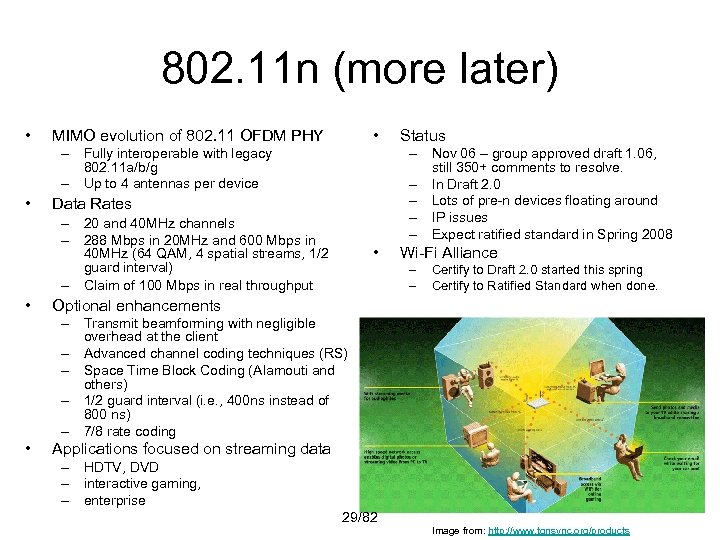 802. 11 n (more later) • MIMO evolution of 802. 11 OFDM PHY • – Fully interoperable with legacy 802. 11 a/b/g – Up to 4 antennas per device • – Nov 06 – group approved draft 1. 06, still 350+ comments to resolve. – In Draft 2. 0 – Lots of pre-n devices floating around – IP issues – Expect ratified standard in Spring 2008 Data Rates – 20 and 40 MHz channels – 288 Mbps in 20 MHz and 600 Mbps in 40 MHz (64 QAM, 4 spatial streams, 1/2 guard interval) – Claim of 100 Mbps in real throughput • Status • Wi-Fi Alliance – – Certify to Draft 2. 0 started this spring Certify to Ratified Standard when done. Optional enhancements – Transmit beamforming with negligible overhead at the client – Advanced channel coding techniques (RS) – Space Time Block Coding (Alamouti and others) – 1/2 guard interval (i. e. , 400 ns instead of 800 ns) – 7/8 rate coding • Applications focused on streaming data – HDTV, DVD – interactive gaming, – enterprise 29/82 Image from: http: //www. tgnsync. org/products
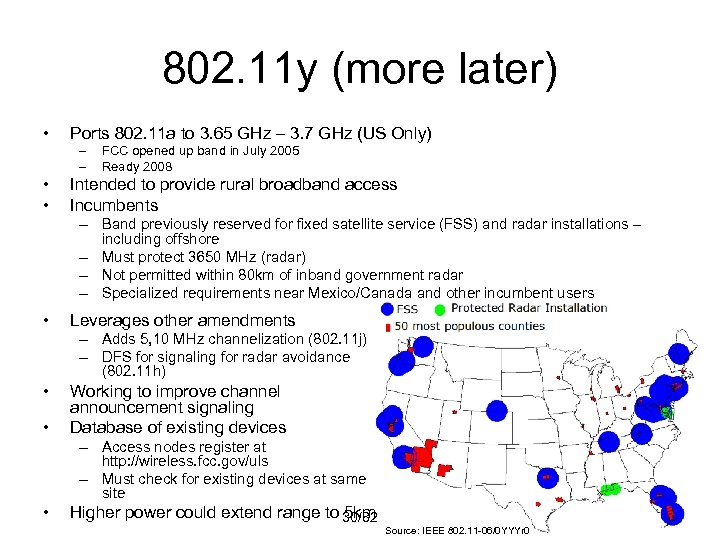 802. 11 y (more later) • Ports 802. 11 a to 3. 65 GHz – 3. 7 GHz (US Only) – – • • FCC opened up band in July 2005 Ready 2008 Intended to provide rural broadband access Incumbents – Band previously reserved for fixed satellite service (FSS) and radar installations – including offshore – Must protect 3650 MHz (radar) – Not permitted within 80 km of inband government radar – Specialized requirements near Mexico/Canada and other incumbent users • Leverages other amendments – Adds 5, 10 MHz channelization (802. 11 j) – DFS for signaling for radar avoidance (802. 11 h) • • Working to improve channel announcement signaling Database of existing devices – Access nodes register at http: //wireless. fcc. gov/uls – Must check for existing devices at same site • Higher power could extend range to 5 km 30/82 Source: IEEE 802. 11 -06/0 YYYr 0
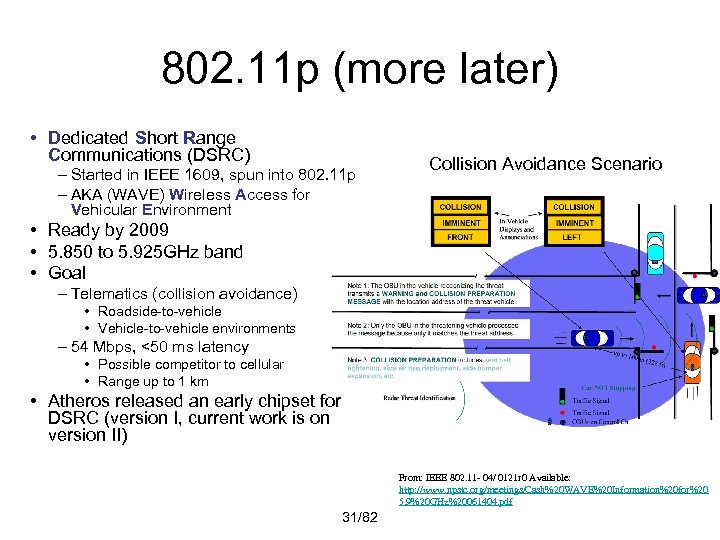 802. 11 p (more later) • Dedicated Short Range Communications (DSRC) – Started in IEEE 1609, spun into 802. 11 p – AKA (WAVE) Wireless Access for Vehicular Environment Collision Avoidance Scenario • Ready by 2009 • 5. 850 to 5. 925 GHz band • Goal – Telematics (collision avoidance) • Roadside-to-vehicle • Vehicle-to-vehicle environments – 54 Mbps, <50 ms latency • Possible competitor to cellular • Range up to 1 km • Atheros released an early chipset for DSRC (version I, current work is on version II) From: IEEE 802. 11 - 04/ 0121 r 0 Available: http: //www. npstc. org/meetings/Cash%20 WAVE%20 Information%20 for%20 5. 9%20 GHz%20061404. pdf 31/82
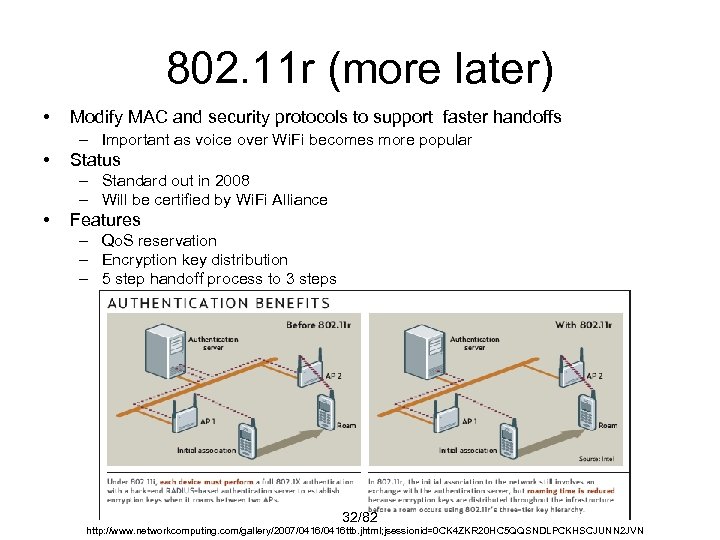 802. 11 r (more later) • Modify MAC and security protocols to support faster handoffs – Important as voice over Wi. Fi becomes more popular • Status – Standard out in 2008 – Will be certified by Wi. Fi Alliance • Features – Qo. S reservation – Encryption key distribution – 5 step handoff process to 3 steps 32/82 http: //www. networkcomputing. com/gallery/2007/0416 ttb. jhtml; jsessionid=0 CK 4 ZKR 20 HC 5 QQSNDLPCKHSCJUNN 2 JVN
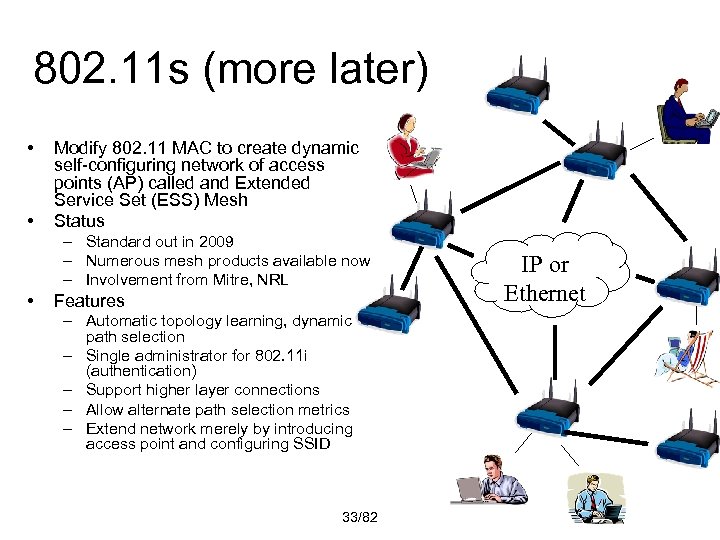 802. 11 s (more later) • • Modify 802. 11 MAC to create dynamic self-configuring network of access points (AP) called and Extended Service Set (ESS) Mesh Status – Standard out in 2009 – Numerous mesh products available now – Involvement from Mitre, NRL • Features – Automatic topology learning, dynamic path selection – Single administrator for 802. 11 i (authentication) – Support higher layer connections – Allow alternate path selection metrics – Extend network merely by introducing access point and configuring SSID 33/82 IP or Ethernet
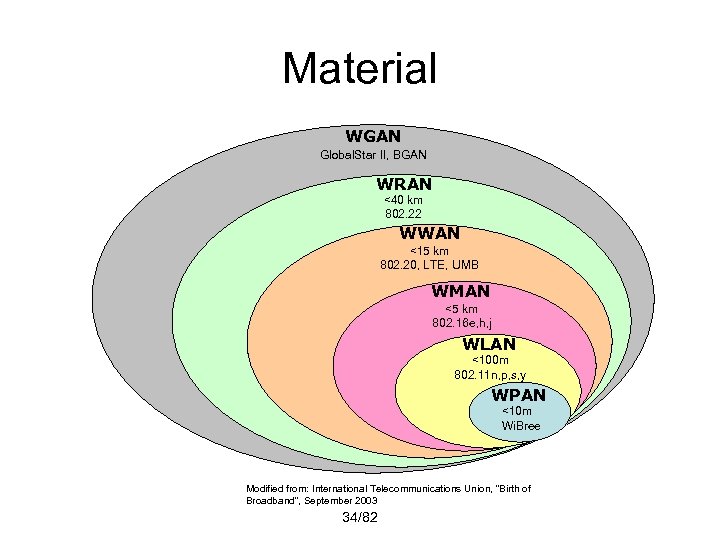 Material WGAN Global. Star II, BGAN WRAN <40 km 802. 22 WWAN <15 km 802. 20, LTE, UMB WMAN <5 km 802. 16 e, h, j WLAN <100 m 802. 11 n, p, s, y WPAN <10 m Wi. Bree Modified from: International Telecommunications Union, “Birth of Broadband”, September 2003 34/82
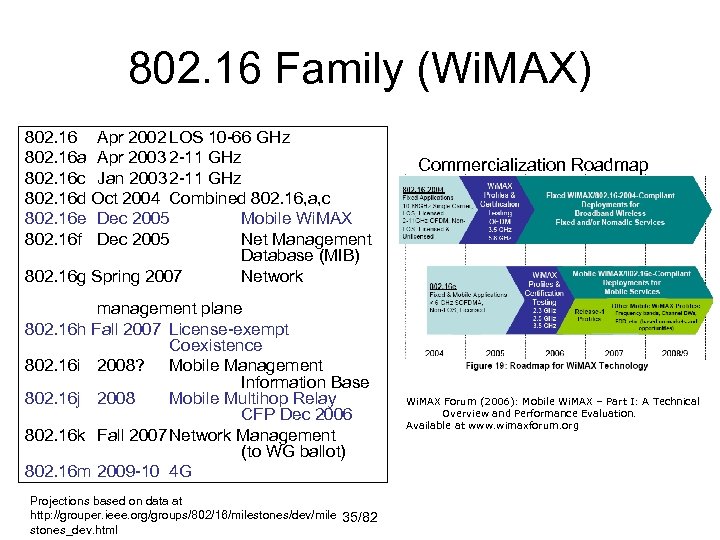 802. 16 Family (Wi. MAX) 802. 16 Apr 2002 LOS 10 -66 GHz 802. 16 a Apr 2003 2 -11 GHz 802. 16 c Jan 2003 2 -11 GHz 802. 16 d Oct 2004 Combined 802. 16, a, c 802. 16 e Dec 2005 Mobile Wi. MAX 802. 16 f Dec 2005 Net Management Database (MIB) 802. 16 g Spring 2007 Network management plane 802. 16 h Fall 2007 License-exempt Coexistence 802. 16 i 2008? Mobile Management Information Base 802. 16 j 2008 Mobile Multihop Relay CFP Dec 2006 802. 16 k Fall 2007 Network Management (to WG ballot) 802. 16 m 2009 -10 4 G Projections based on data at http: //grouper. ieee. org/groups/802/16/milestones/dev/mile 35/82 stones_dev. html Commercialization Roadmap Wi. MAX Forum (2006): Mobile Wi. MAX – Part I: A Technical Overview and Performance Evaluation. Available at www. wimaxforum. org
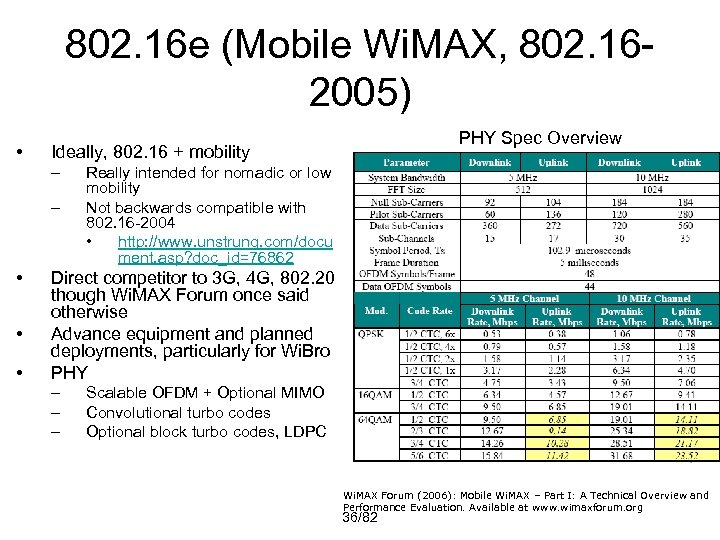 802. 16 e (Mobile Wi. MAX, 802. 162005) • Ideally, 802. 16 + mobility – – • • • PHY Spec Overview Really intended for nomadic or low mobility Not backwards compatible with 802. 16 -2004 • http: //www. unstrung. com/docu ment. asp? doc_id=76862 Direct competitor to 3 G, 4 G, 802. 20 though Wi. MAX Forum once said otherwise Advance equipment and planned deployments, particularly for Wi. Bro PHY – – – Scalable OFDM + Optional MIMO Convolutional turbo codes Optional block turbo codes, LDPC Wi. MAX Forum (2006): Mobile Wi. MAX – Part I: A Technical Overview and Performance Evaluation. Available at www. wimaxforum. org 36/82
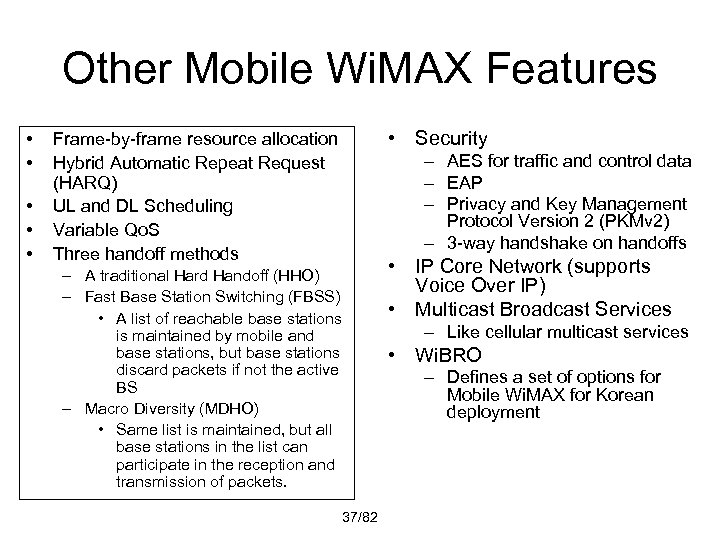 Other Mobile Wi. MAX Features • • • Security Frame-by-frame resource allocation Hybrid Automatic Repeat Request (HARQ) UL and DL Scheduling Variable Qo. S Three handoff methods – AES for traffic and control data – EAP – Privacy and Key Management Protocol Version 2 (PKMv 2) – 3 -way handshake on handoffs – A traditional Hard Handoff (HHO) – Fast Base Station Switching (FBSS) • A list of reachable base stations is maintained by mobile and base stations, but base stations discard packets if not the active BS – Macro Diversity (MDHO) • Same list is maintained, but all base stations in the list can participate in the reception and transmission of packets. 37/82 • IP Core Network (supports Voice Over IP) • Multicast Broadcast Services – Like cellular multicast services • Wi. BRO – Defines a set of options for Mobile Wi. MAX for Korean deployment
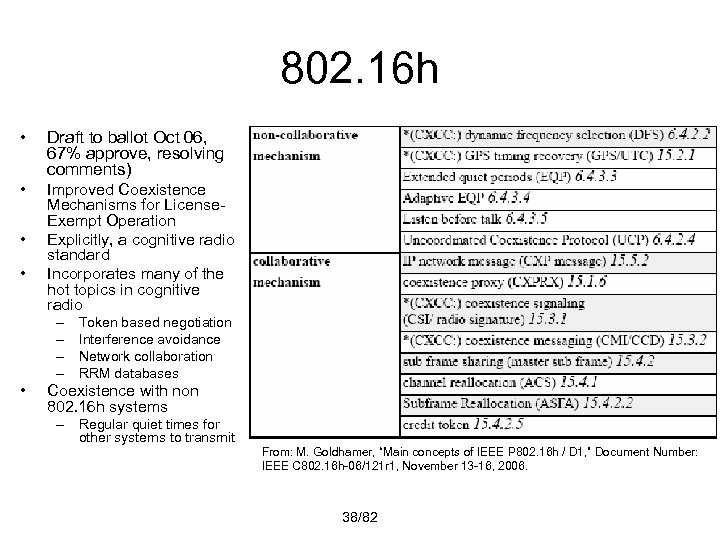 802. 16 h • Draft to ballot Oct 06, 67% approve, resolving comments) • Improved Coexistence Mechanisms for License. Exempt Operation Explicitly, a cognitive radio standard Incorporates many of the hot topics in cognitive radio • • – – • Token based negotiation Interference avoidance Network collaboration RRM databases Coexistence with non 802. 16 h systems – Regular quiet times for other systems to transmit From: M. Goldhamer, “Main concepts of IEEE P 802. 16 h / D 1, ” Document Number: IEEE C 802. 16 h-06/121 r 1, November 13 -16, 2006. 38/82
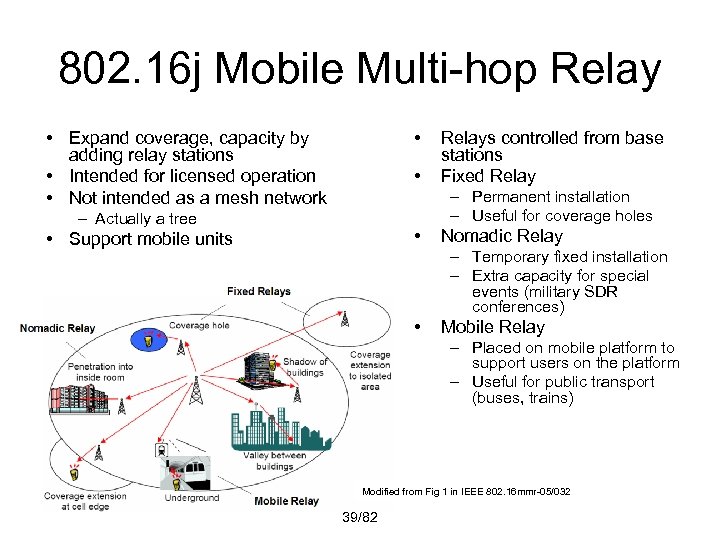 802. 16 j Mobile Multi-hop Relay • Expand coverage, capacity by adding relay stations • Intended for licensed operation • Not intended as a mesh network • • Relays controlled from base stations Fixed Relay – Permanent installation – Useful for coverage holes – Actually a tree • • Support mobile units Nomadic Relay – Temporary fixed installation – Extra capacity for special events (military SDR conferences) • Mobile Relay – Placed on mobile platform to support users on the platform – Useful for public transport (buses, trains) Modified from Fig 1 in IEEE 802. 16 mmr-05/032 39/82
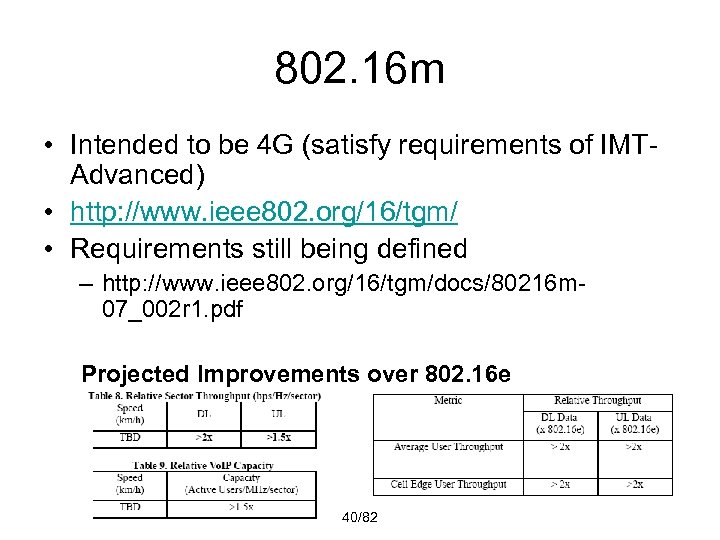 802. 16 m • Intended to be 4 G (satisfy requirements of IMTAdvanced) • http: //www. ieee 802. org/16/tgm/ • Requirements still being defined – http: //www. ieee 802. org/16/tgm/docs/80216 m 07_002 r 1. pdf Projected Improvements over 802. 16 e 40/82
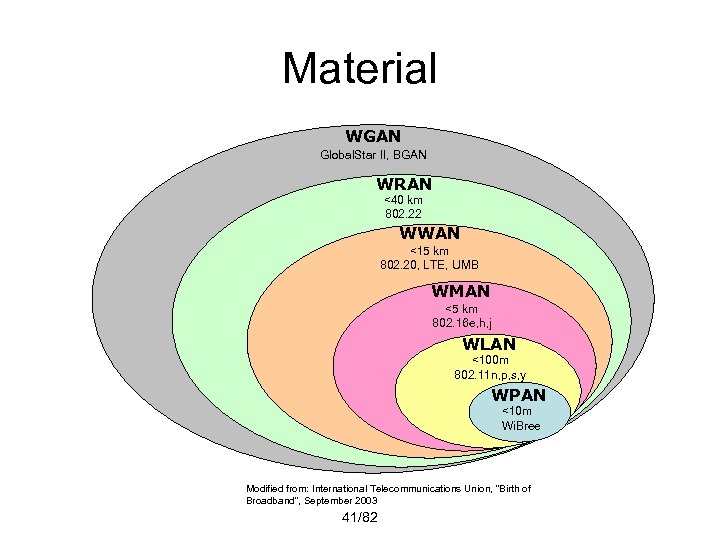 Material WGAN Global. Star II, BGAN WRAN <40 km 802. 22 WWAN <15 km 802. 20, LTE, UMB WMAN <5 km 802. 16 e, h, j WLAN <100 m 802. 11 n, p, s, y WPAN <10 m Wi. Bree Modified from: International Telecommunications Union, “Birth of Broadband”, September 2003 41/82
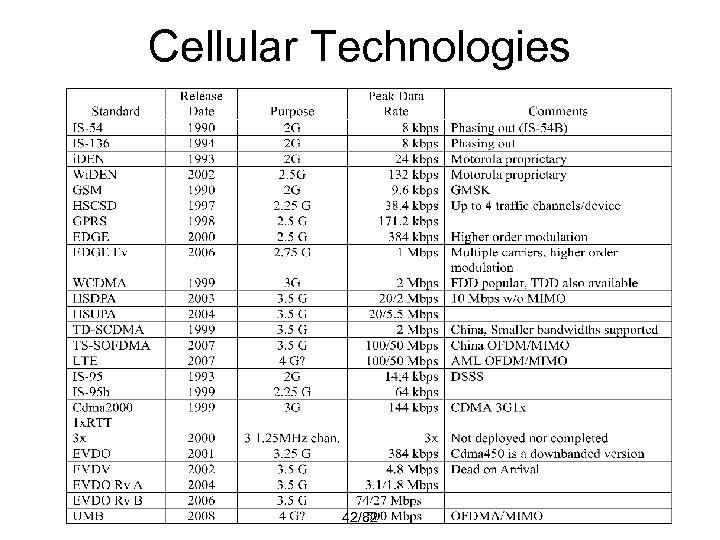 Cellular Technologies 42/82
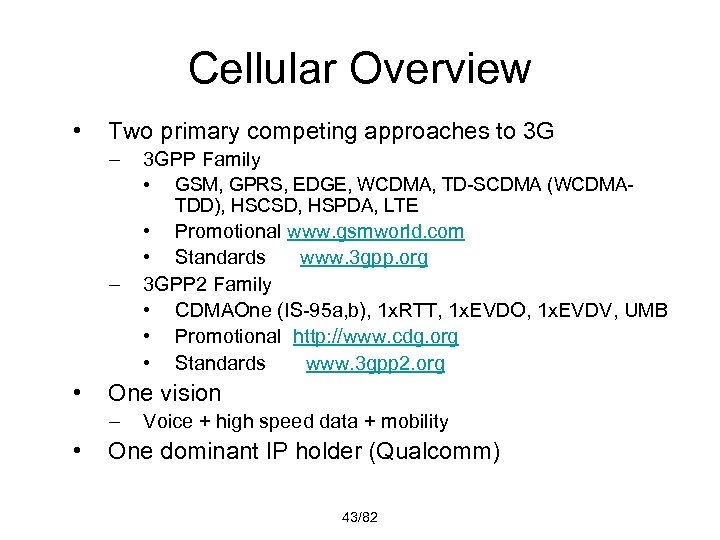 Cellular Overview • Two primary competing approaches to 3 G – 3 GPP Family • GSM, GPRS, EDGE, WCDMA, TD-SCDMA (WCDMATDD), HSCSD, HSPDA, LTE – • One vision – • • Promotional www. gsmworld. com • Standards www. 3 gpp. org 3 GPP 2 Family • CDMAOne (IS-95 a, b), 1 x. RTT, 1 x. EVDO, 1 x. EVDV, UMB • Promotional http: //www. cdg. org • Standards www. 3 gpp 2. org Voice + high speed data + mobility One dominant IP holder (Qualcomm) 43/82
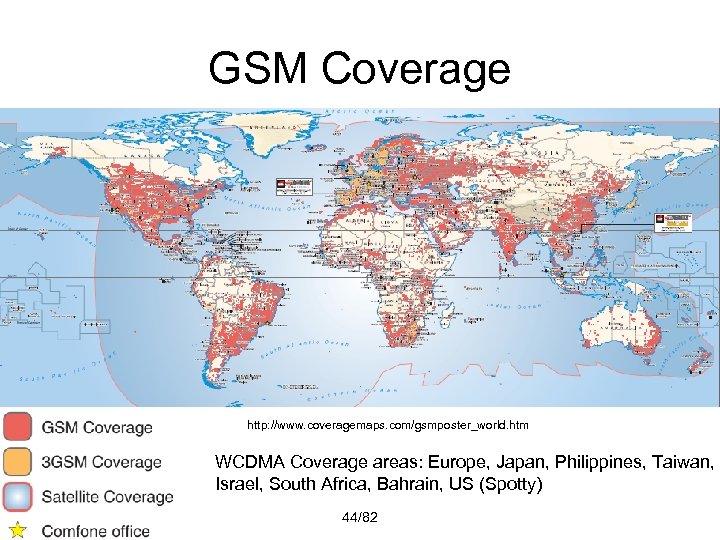 GSM Coverage http: //www. coveragemaps. com/gsmposter_world. htm WCDMA Coverage areas: Europe, Japan, Philippines, Taiwan, Israel, South Africa, Bahrain, US (Spotty) 44/82
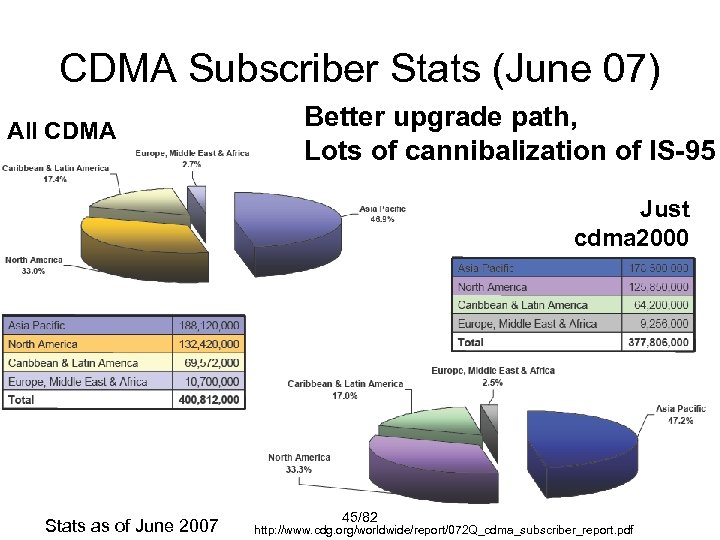 CDMA Subscriber Stats (June 07) All CDMA Better upgrade path, Lots of cannibalization of IS-95 Just cdma 2000 Stats as of June 2007 45/82 http: //www. cdg. org/worldwide/report/072 Q_cdma_subscriber_report. pdf
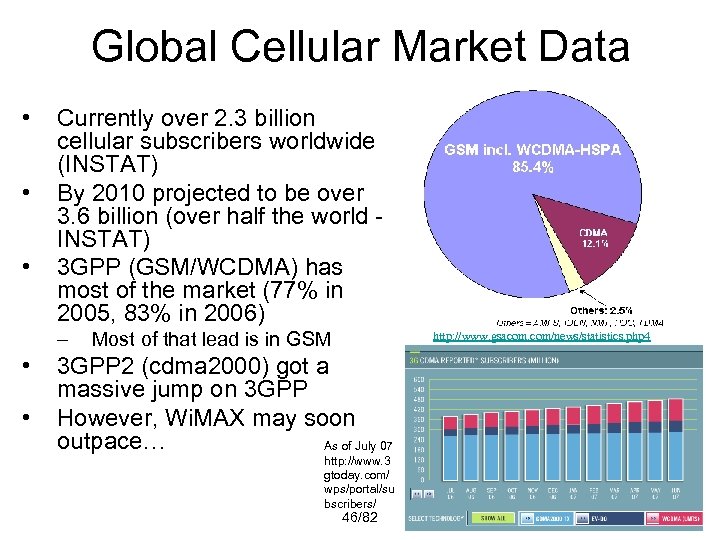 Global Cellular Market Data • • • Currently over 2. 3 billion cellular subscribers worldwide (INSTAT) By 2010 projected to be over 3. 6 billion (over half the world - INSTAT) 3 GPP (GSM/WCDMA) has most of the market (77% in 2005, 83% in 2006) – • • Most of that lead is in GSM http: //www. gsacom. com/news/statistics. php 4 3 GPP 2 (cdma 2000) got a massive jump on 3 GPP However, Wi. MAX may soon outpace… As of July 07 http: //www. 3 gtoday. com/ wps/portal/su bscribers/ 46/82
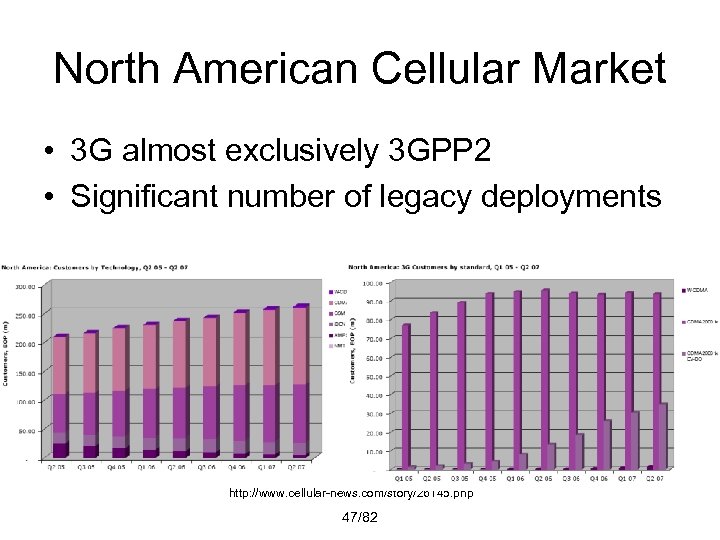 North American Cellular Market • 3 G almost exclusively 3 GPP 2 • Significant number of legacy deployments http: //www. cellular-news. com/story/26145. php 47/82
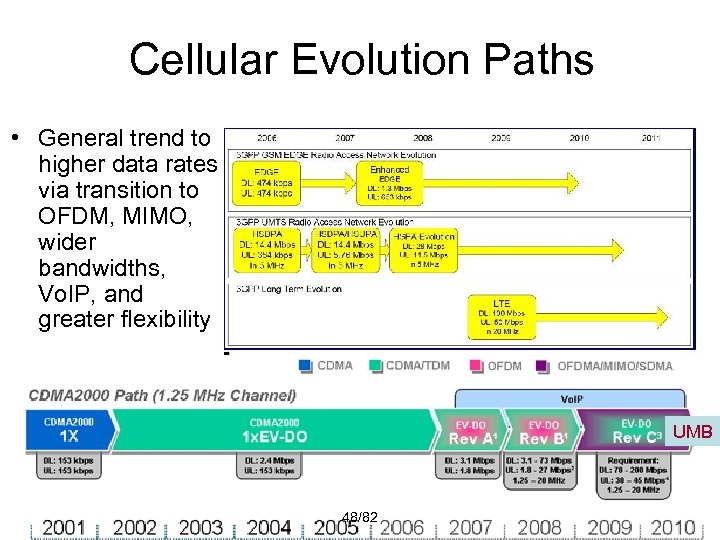 Cellular Evolution Paths • General trend to higher data rates via transition to OFDM, MIMO, wider bandwidths, Vo. IP, and greater flexibility UMB 48/82
 GPRS • General Packet Radio Service • Packet-based protocol layered over GSM or IS-136 networks – Transfer rates up to 171. 2 kbps – Supports X. 25 and IP (Internet Protocol) – Packet-switched link • Makes possible data transfer without circuit connection • Uses up to 8 channels simultaneously • Widespread deployment 49/82
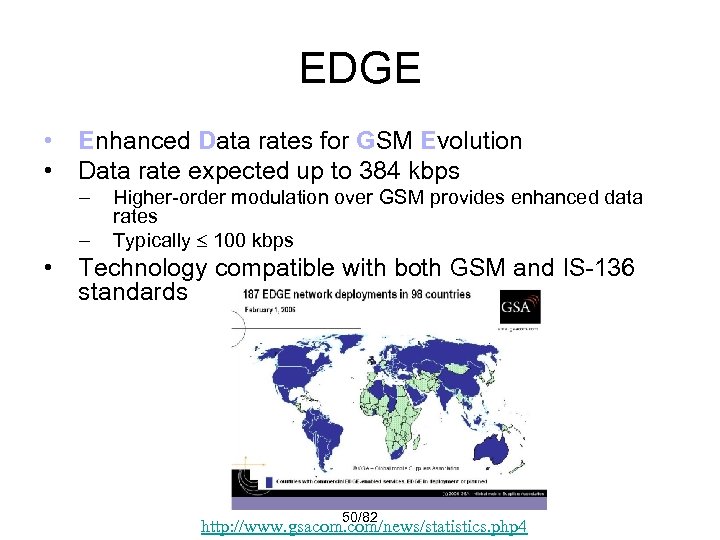 EDGE • • Enhanced Data rates for GSM Evolution Data rate expected up to 384 kbps – – • Higher-order modulation over GSM provides enhanced data rates Typically 100 kbps Technology compatible with both GSM and IS-136 standards 50/82 http: //www. gsacom. com/news/statistics. php 4
 3 G Standards • cdma 2000 – 1. 25 MHz bandwidth – 1 x - Voice and basic data service (up to 307. 2 Kbps) – 1 x. EV-DO – enhanced data service only (up to 2. 5 Mbps) – 1 x. EV-DV – voice and enhanced data service (up to 5 Mbps) – CDMA 450 • 3 GSM (WCDMA) – 3. 84 MHz bandwidth – WCDMA (UMTS) – Voice and basic data (up to 384 Kbps) – HSDPA – Voice and enhanced data service (up to 10 Mbps) – TD-SCDMA – Chinese variant on WCDMA 51/82
 General 3 GPP Technologies • Generic Access Network – Supports handoffs between GSM networks and 802. 11 or Bluetooth networks • Packet Switched Handoffs – Enables easier handoffs between different 3 GPP networks • Multimedia Broadcast/Multicast Services – Simultaneous broadcast of data streams to multiple recipients 52/82
 WCDMA • Wideband CDMA UMTS (Universal Mobile Telecommunications System) – Also known as 3 GSM • • Different from CDMA 2000 Standard controlled by 3 GPP Uses new spectrum Can be complemented by EDGE in less dense areas 53/82
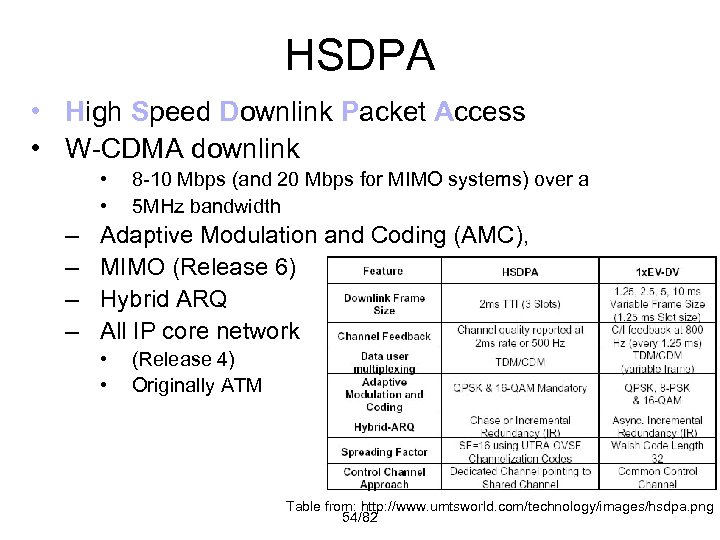 HSDPA • High Speed Downlink Packet Access • W-CDMA downlink • • – – 8 -10 Mbps (and 20 Mbps for MIMO systems) over a 5 MHz bandwidth Adaptive Modulation and Coding (AMC), MIMO (Release 6) Hybrid ARQ All IP core network • • (Release 4) Originally ATM Table from: http: //www. umtsworld. com/technology/images/hsdpa. png 54/82
 HSUPA (EUL) • High Speed Uplink Packet Access (Enhanced Up. Link) • Similar technologies to HSDPA • Demo by Ericsson May 2005 – Handsets 2007 – http: //www. mobic. com/news/publisher/view. do? id=31 96 • T-Mobile planning deployment in Austria in 2007 – http: //www. mobilecommstechnology. com/projects/hsupa/ 55/82
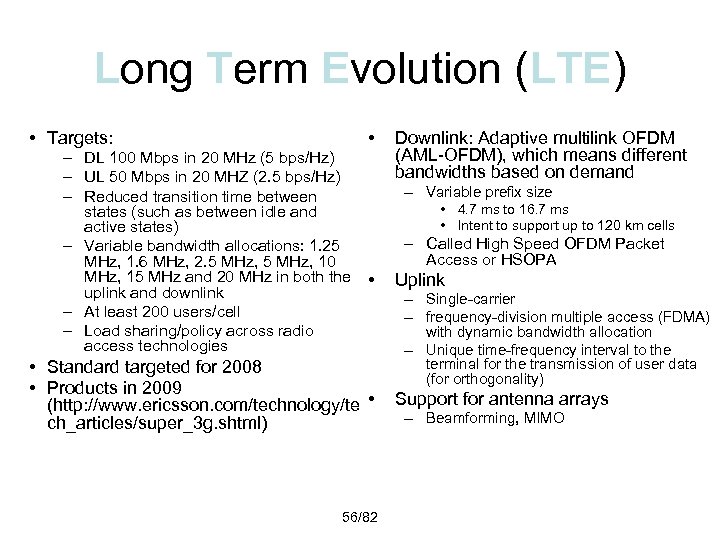 Long Term Evolution (LTE) • Targets: • – DL 100 Mbps in 20 MHz (5 bps/Hz) – UL 50 Mbps in 20 MHZ (2. 5 bps/Hz) – Reduced transition time between states (such as between idle and active states) – Variable bandwidth allocations: 1. 25 MHz, 1. 6 MHz, 2. 5 MHz, 10 MHz, 15 MHz and 20 MHz in both the • uplink and downlink – At least 200 users/cell – Load sharing/policy across radio access technologies • Standard targeted for 2008 • Products in 2009 (http: //www. ericsson. com/technology/te • ch_articles/super_3 g. shtml) 56/82 Downlink: Adaptive multilink OFDM (AML-OFDM), which means different bandwidths based on demand – Variable prefix size • 4. 7 ms to 16. 7 ms • Intent to support up to 120 km cells – Called High Speed OFDM Packet Access or HSOPA Uplink – Single-carrier – frequency-division multiple access (FDMA) with dynamic bandwidth allocation – Unique time-frequency interval to the terminal for the transmission of user data (for orthogonality) Support for antenna arrays – Beamforming, MIMO
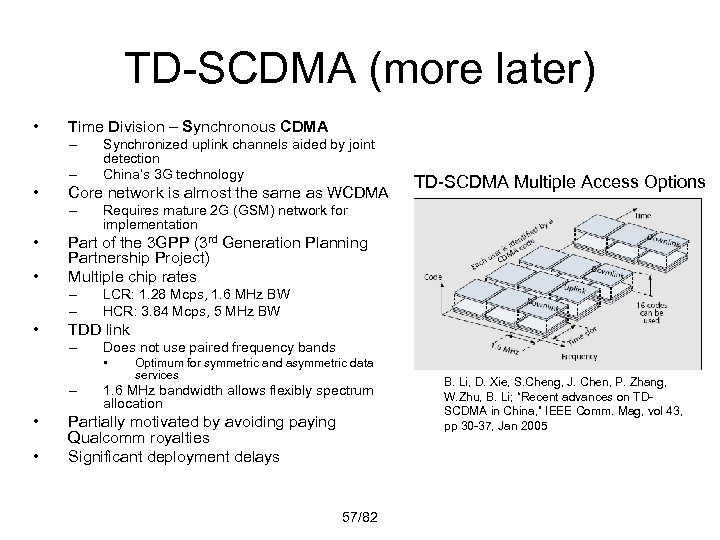 TD-SCDMA (more later) • Time Division – Synchronous CDMA – – • Core network is almost the same as WCDMA – • • Requires mature 2 G (GSM) network for implementation LCR: 1. 28 Mcps, 1. 6 MHz BW HCR: 3. 84 Mcps, 5 MHz BW TDD link – Does not use paired frequency bands • – • • TD-SCDMA Multiple Access Options Part of the 3 GPP (3 rd Generation Planning Partnership Project) Multiple chip rates – – • Synchronized uplink channels aided by joint detection China’s 3 G technology Optimum for symmetric and asymmetric data services 1. 6 MHz bandwidth allows flexibly spectrum allocation Partially motivated by avoiding paying Qualcomm royalties Significant deployment delays 57/82 B. Li, D. Xie, S. Cheng, J. Chen, P. Zhang, W. Zhu, B. Li; “Recent advances on TDSCDMA in China, ” IEEE Comm. Mag, vol 43, pp 30 -37, Jan 2005
 cdma 2000 1 x. RTT • 1 x Radio Transmission Technology • Also known as: – CDMA 1 x – CDMA 3 G 1 x • Packet-switched (always on) • Maximum of 144 kbps – Typical 40 -60 kbps • Deployments – South Korea, US, Canada, Australia, Brazil, Japan, Taiwan, Malaysia, Vietnam, Uganda, Ukraine, Thailand, Russia, Pakistan, Indonesia, India, China, Chile, Angola 58/82
 cdma 2000 1 x EV-DO • CDMA EVolution Data Only – Designed to support only data applications • – Also known as: • • • CDMA 1 x EV-DO CDMA EV-DO Can offer data rates of 384 kbps - 2. 4 Mbps – • VOIP Does not mix voice traffic with data traffic Deployments: – – – South Korea: 01/25/02 (SK Telecom), 05/01/02 (KTF) United States: 10/29/02 (Monet) Australia (Hutchison) Bermuda (Bermuda Digital) Guatelmala (Movistar Guatelmala) 59/82
 cdma 2000 1 x EV-DV • CDMA 2000 EVolution Data and Voice • Intended to blend both voice and data traffic – Can use existing EV-DO or 1 x infrastructure as a starting point • Data rates up to 4. 8 Mbps • Dead on arrival – http: //telephonyonline. com/mag/telecom_evdv_dead/ index. html – Qualcomm halted work on the standard in 2005 • http: //news. com/Cell+phone+makers+to+adopt+I nternet+calling/2100 -7352_3 -5618191. html 60/82
 EVDO Rev B • Adds Multiple carriers – 2 x. EVDO, 3 x. EVDO, … – Up to 15 1. 25 MHz carriers within 20 MHz • Adds support for 64 -QAM modulation • DL 73. 5 Mbps • UL 27 Mbps • Dynamic non-contiguous carrier allocation • Support for single carrier and multiple carrier subscribers • Standardized 2006 • Trial mid-2007 • Commercial deployments mid-2008 61/82
 EVDO Rev C (UMB) • Spec published Sep 24, 2007 – http: //www. cdg. org/news/press/2007/Sep 24_07. asp – 3 GPP 2 (UMB) beats 3 GPP to market again – Commercially available 1 H 2009 • Data rates, mobile with 20 MHz bandwidth – DL: 288 Mbps – UL: 75 Mbps • Key technologies – – OFDMA, MIMO, beamforming Flexible spectrum allocation Enhanced Qo. S Support for multiple access technologies • Reduced latency 62/82
 Other Cellular Efforts • • • i. DEN CDMA 450 OFDM-FLO (Qualcomm) DVB-H (GSM/ETSI) IEEE 802. 20 63/82
 i. DEN • Motorola created Nextel popularized cellular technology • TDMA 6 channels on 25 MHz • PTT, voice, data • May expand to 100 MHz (Wi. DEN) for 96 kbps • Other countries implementing i. DEN networks: – South Korea, Japan, Israel, Jordan, Saudi Arabia, Philippines, Singapore 64/82
 cdma 450 • cdma 2000 in 450 MHz band • Permits migration of Nordic Mobile Telephone System • Deployments in Asia, Europe, South America 65/82
 Media-FLO • • • http: //www. qualcomm. com/mediaflo/index. shtml Not 4 G itself, but possibly indicative of Qualcomm’s direction (they also own spectrum) Mobile Video Broadcast (Digital TV, Digital Video Broadcast-Handheld) OFDM based system 11. 2 Mbps at 6 MHz Run-time optimization of power, frequency, time Chipsets available Nov 2004 Possible use in UHF bands (high power) Standard released – • http: //telephonyonline. com/home/news/flo_forum_multim edia_112805/ Verizon to offer service in 2006 – http: //telephonyonline. com/wireless/news/verizon_media flo_qualcomm_120105/ 66/82
 Digital Video Broadcasting. Handheld • ETSI digital video broadcasting standard – Based on DVB-T • • • Forum http: //www. dvb-h-online. org/ Backed by GSM networks Also OFDM based Crown. Castle testing in Pennsylvania Numerous trials in Europe 67/82
 IEEE 802. 20 • • • Fill performance gap between “high data-rate, low mobility 802 standards” and “high mobility cellular networks” 802. 20 Shenanigans Allegations of process abuse brought to a screeching halt when standard suspended in September Project Launched 2004 Looked to be dead in the water – – • • • http: //www. dailywireless. org/modules. ph p? name=News&file=article&sid=4532 Went to proposal downselection process – – – QTDD/QFDD Proposal OFDMA data channel CDMA control channel Bandwidths – • – – • • Qualcomm (Flarion) TDD, FDD ETRI BEST-WINE (Kyocera) Reapproved in Dec 06 First meeting Jan 2007 68/82 Single, multiple code word Pseudo- Eigen beamforming Space Division Multiple Access Separate mode from MIMO Data Rate 260 Mbps – • • • 5 MHz – 20 MHz MIMO – Turned around when Qualcomm bought Flarion (Aug 05) – • Flarion leading proposal Qualcomm leading vote holder • • MIMO, 20 MHz Turbo coding Time-frequency hopping Supposed to support inter Radio Access Technology handoffs
 Cellular Takeaways • Two major approaches to 3 G – • Legacies continue to be deployed – • Cheaper than upgrading for voice Multi User Detection (MUD) and MIMO techniques that could dramatically increase capacity GSM and TDMA systems may extend lifetime of legacy systems. – • >10 standards in those two families http: //www. iee. org/oncomms/pn/antennas/mimo/chenu_tournier y. pdf Voice remains killer ap for cellular, data likely to be supported by other networks – Convergence of devices supporting cellular and Wi. Fi 69/82
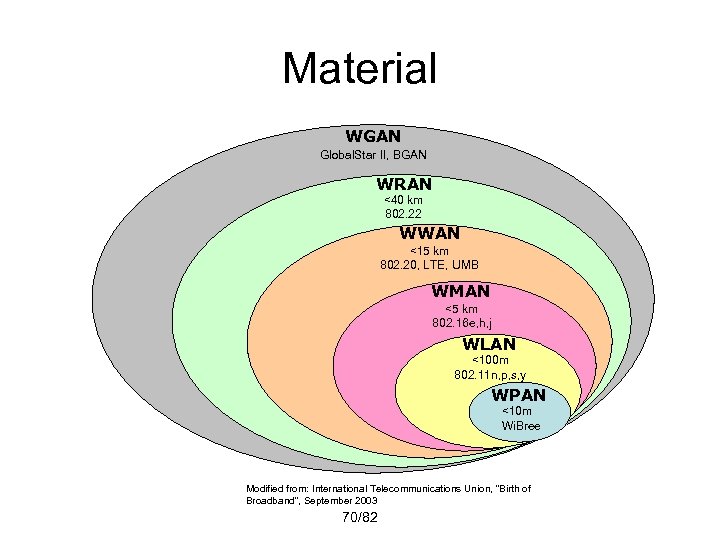 Material WGAN Global. Star II, BGAN WRAN <40 km 802. 22 WWAN <15 km 802. 20, LTE, UMB WMAN <5 km 802. 16 e, h, j WLAN <100 m 802. 11 n, p, s, y WPAN <10 m Wi. Bree Modified from: International Telecommunications Union, “Birth of Broadband”, September 2003 70/82
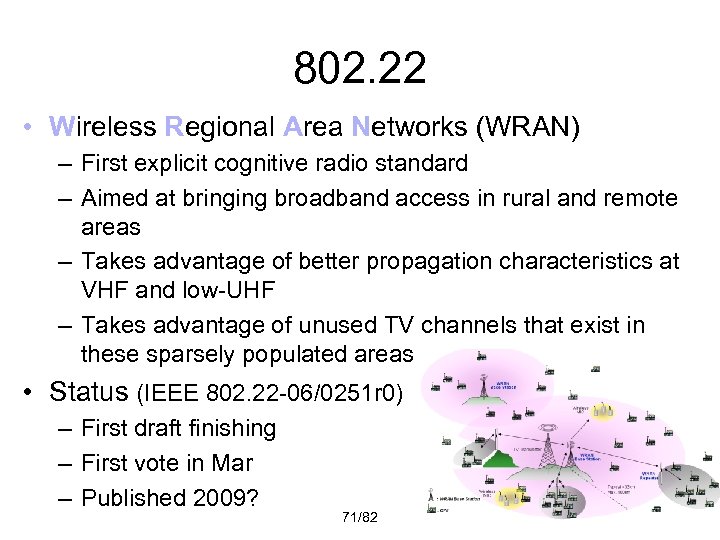 802. 22 • Wireless Regional Area Networks (WRAN) – First explicit cognitive radio standard – Aimed at bringing broadband access in rural and remote areas – Takes advantage of better propagation characteristics at VHF and low-UHF – Takes advantage of unused TV channels that exist in these sparsely populated areas • Status (IEEE 802. 22 -06/0251 r 0) – First draft finishing – First vote in Mar – Published 2009? 71/82
 Features of 802. 22 • • Data Rates 5 Mbps – 70 Mbps Point-to-multipoint TDD/FDD DFS, TPC Adaptive Modulation • – Multiple channel support – Coexistence • Incumbents • BS synchronization • Dynamic resource sharing – QPSK, 16, 64 -QAM, Spread QPSK • OFDMA on uplink and downlink • Use multiple contiguous TV channels when available • Fractional channels (adapting around microphones) • Space Time Block Codes • Beam Forming – No feedback for TDD (assumes channel reciprocity) • 802. 16 -like ranging 72/82 802. 16 MAC plus the following – Clustering support – Signal detection/classification routines • • • Security based on 802. 16 e security Collaborative sensing Techniques in 802. 22 will be extended to other standards and to other bands around the world
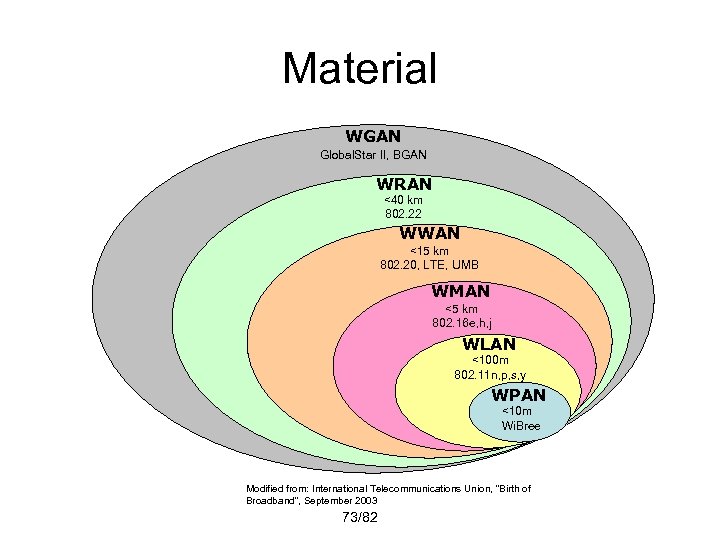 Material WGAN Global. Star II, BGAN WRAN <40 km 802. 22 WWAN <15 km 802. 20, LTE, UMB WMAN <5 km 802. 16 e, h, j WLAN <100 m 802. 11 n, p, s, y WPAN <10 m Wi. Bree Modified from: International Telecommunications Union, “Birth of Broadband”, September 2003 73/82
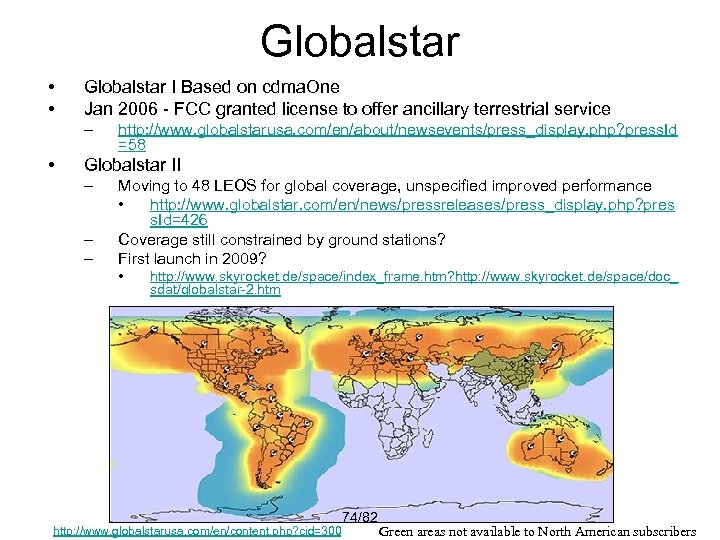 Globalstar • • Globalstar I Based on cdma. One Jan 2006 - FCC granted license to offer ancillary terrestrial service – • http: //www. globalstarusa. com/en/about/newsevents/press_display. php? press. Id =58 Globalstar II – – – Moving to 48 LEOS for global coverage, unspecified improved performance • http: //www. globalstar. com/en/news/pressreleases/press_display. php? pres s. Id=426 Coverage still constrained by ground stations? First launch in 2009? • http: //www. skyrocket. de/space/index_frame. htm? http: //www. skyrocket. de/space/doc_ sdat/globalstar-2. htm 74/82 http: //www. globalstarusa. com/en/content. php? cid=300 Green areas not available to North American subscribers
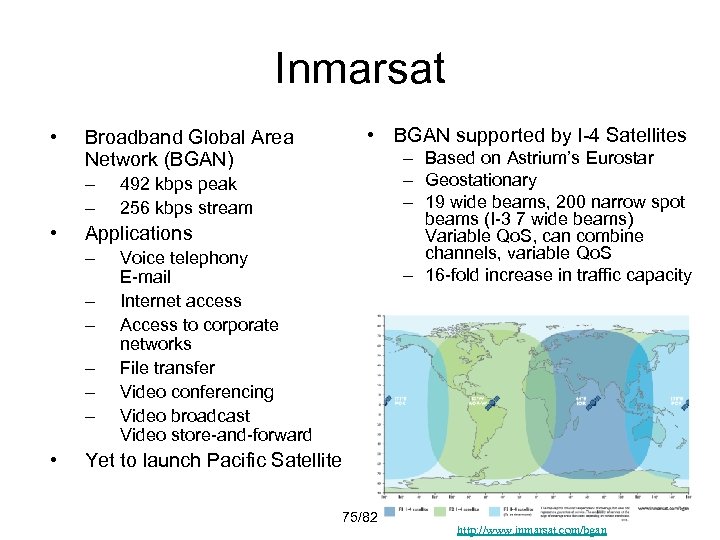 Inmarsat • – – • – Based on Astrium’s Eurostar – Geostationary – 19 wide beams, 200 narrow spot beams (I-3 7 wide beams) Variable Qo. S, can combine channels, variable Qo. S – 16 -fold increase in traffic capacity 492 kbps peak 256 kbps stream Applications – – – • • BGAN supported by I-4 Satellites Broadband Global Area Network (BGAN) Voice telephony E-mail Internet access Access to corporate networks File transfer Video conferencing Video broadcast Video store-and-forward Yet to launch Pacific Satellite 75/82 http: //www. inmarsat. com/bgan
 Summary and Future Trends Relevant Data and a Discussion on 4 G 76/82
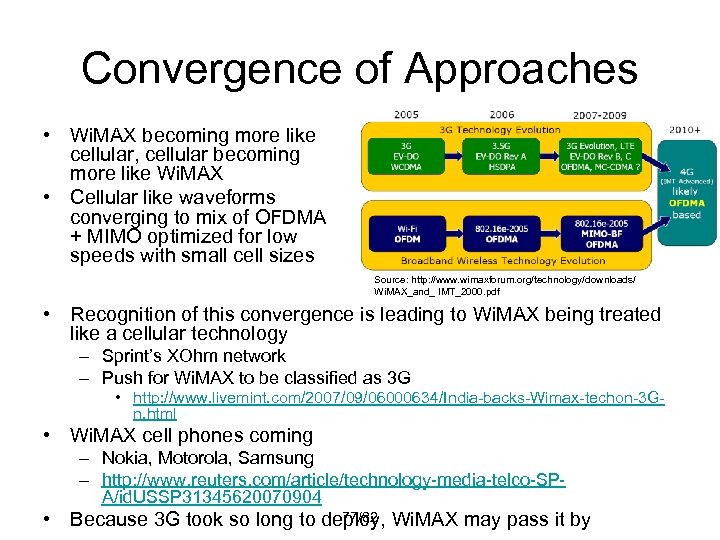 Convergence of Approaches • Wi. MAX becoming more like cellular, cellular becoming more like Wi. MAX • Cellular like waveforms converging to mix of OFDMA + MIMO optimized for low speeds with small cell sizes Source: http: //www. wimaxforum. org/technology/downloads/ Wi. MAX_and_ IMT_2000. pdf • Recognition of this convergence is leading to Wi. MAX being treated like a cellular technology – Sprint’s XOhm network – Push for Wi. MAX to be classified as 3 G • http: //www. livemint. com/2007/09/06000634/India-backs-Wimax-techon-3 Gn. html • Wi. MAX cell phones coming – Nokia, Motorola, Samsung – http: //www. reuters. com/article/technology-media-telco-SPA/id. USSP 31345620070904 77/82 • Because 3 G took so long to deploy, Wi. MAX may pass it by
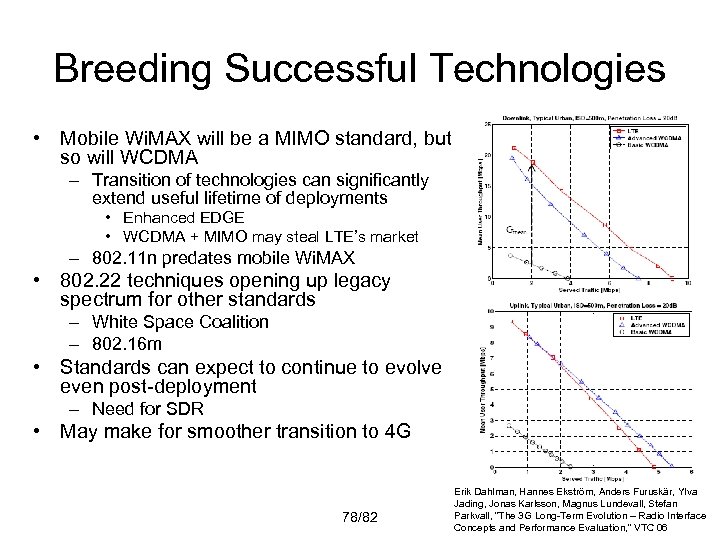 Breeding Successful Technologies • Mobile Wi. MAX will be a MIMO standard, but so will WCDMA – Transition of technologies can significantly extend useful lifetime of deployments • Enhanced EDGE • WCDMA + MIMO may steal LTE’s market – 802. 11 n predates mobile Wi. MAX • 802. 22 techniques opening up legacy spectrum for other standards – White Space Coalition – 802. 16 m • Standards can expect to continue to evolve even post-deployment – Need for SDR • May make for smoother transition to 4 G 78/82 Erik Dahlman, Hannes Ekström, Anders Furuskär, Ylva Jading, Jonas Karlsson, Magnus Lundevall, Stefan Parkvall, “The 3 G Long-Term Evolution – Radio Interface Concepts and Performance Evaluation, ” VTC 06
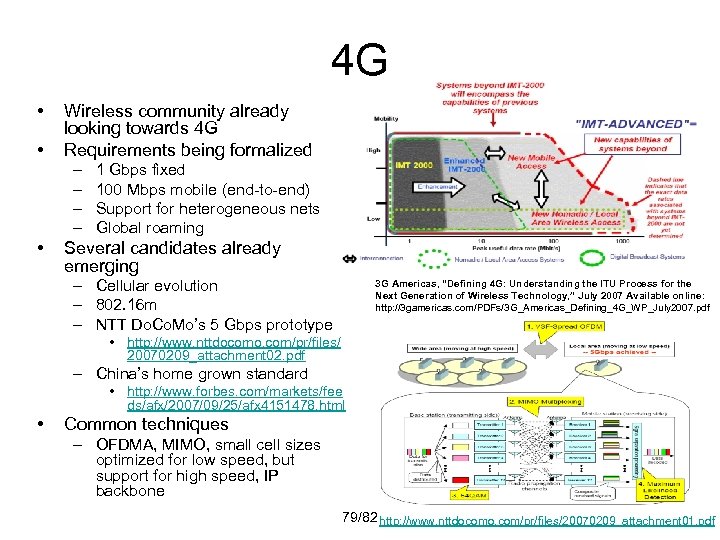 4 G • • Wireless community already looking towards 4 G Requirements being formalized – – • 1 Gbps fixed 100 Mbps mobile (end-to-end) Support for heterogeneous nets Global roaming Several candidates already emerging – Cellular evolution – 802. 16 m – NTT Do. Co. Mo’s 5 Gbps prototype 3 G Americas, “Defining 4 G: Understanding the ITU Process for the Next Generation of Wireless Technology, ” July 2007 Available online: http: //3 gamericas. com/PDFs/3 G_Americas_Defining_4 G_WP_July 2007. pdf • http: //www. nttdocomo. com/pr/files/ 20070209_attachment 02. pdf – China’s home grown standard • http: //www. forbes. com/markets/fee ds/afx/2007/09/25/afx 4151478. html • Common techniques – OFDMA, MIMO, small cell sizes optimized for low speed, but support for high speed, IP backbone 79/82 http: //www. nttdocomo. com/pr/files/20070209_attachment 01. pdf
 Overview Take-Always 1/2 • High data rate systems migrating to OFDM + MIMO PHY – OFDM – Wi. Media, 802. 11 a, g, 802. 16, 802. 20, 802. 22, UMB, LTE – OFDM + MIMO – 802. 11 n, 802. 16 e, 802. 20, UMB, LTE • More responsive/adaptive resource management (early cognitive radio) – Multiple Qo. S levels – 802. 11 e; 802. 16 e; 802. 20; UMB, LTE, EVDO, – Dynamic channel selection – Wi. Media; 802. 11 h, y; 802. 16 h; 802. 22 – Distributed sensing – 802. 22 • Coexistence given increasing interest – Vertical handoffs – 802. 21, 802. 11 u – Legacy systems – 802. 22, 802. 11 h, y, 802. 16 h • New bands opening up for old techs – 802. 15. 4 d, 802. 11 j, p, y 80/82
 Overview Take-Always 2/2 • Some spectral harmonization – 5 GHz for Wi. MAX • China pushing own standards – 802. 15. 4 c, TD-SCDMA, TD-SOFDMA • Emergence of Advanced Networking – 802. 11 s, 802. 15. 5, 802. 16 j • Increasing # of technologies – Legacy systems not quickly fading and large # of new ones • Convergence on AES for security – 802. 11 i, Wi. Media, Mobile Wi. MAX • All IP Backbone – Mobile Wi. MAX, UMB, LTE 81/82
 Useful Websites (News, Promotional, Forums, Standards) WLAN 3 GPP Family www. gsmworld. com www. umtsworld. com www. gsacom. com www. 3 gpp. org http: //www. tdscdma-forum. org/ www. wi-fi. org www. wi-fiplanet. com/ http: //grouper. ieee. org/groups/802/11/ 802. 15 www. bluetooth. com https: //www. bluetooth. org/ www. wimedia. org http: //www. zigbee. org/en/ http: //www. uwbforum. org/ www. wibree. org http: //www. multibandofdm. org/ http: //grouper. ieee. org/groups/802/15/ 802. 16 www. wimaxforum. org http: //wimaxxed. com http: //wimax. com http: //grouper. ieee. org/groups/802/16/ 3 GPP 2 Family www. cdg. org www. 3 gpp 2. org 802. 20 http: //grouper. ieee. org/groups/802/20/ 802. 21 http: //www. ieee 802. org/21/ www. umatechnology. org 802. 22 http: //grouper. ieee. org/groups/802/22/ E 2 R “Requirements and scenario definition, ” Available online: http: //e 2 r. motlabs. com/Deliverables/E 2 R_WP 4_D 4. 1_040725. pdf 82/82