


 Скачать презентацию Future of OASIS II Conference ISO RTO Activities and
8e579fb795dcfb79ac8a25ff84aed61d.ppt
- Количество слайдов: 13
 Future of OASIS II Conference ISO/RTO Activities and Initiatives Presented by Karl Tammar – NYISO For the ISO/RTO Council March 29, 2005
 OASIS II Issues and Goals: w Many Transactions Crossing RTO Boundaries w Numerous Customers doing business with multiple RTOs w Remove barriers to the ability to trade w Standardizing Electronic Communication in Electric Industry w Develop effective processes and tools
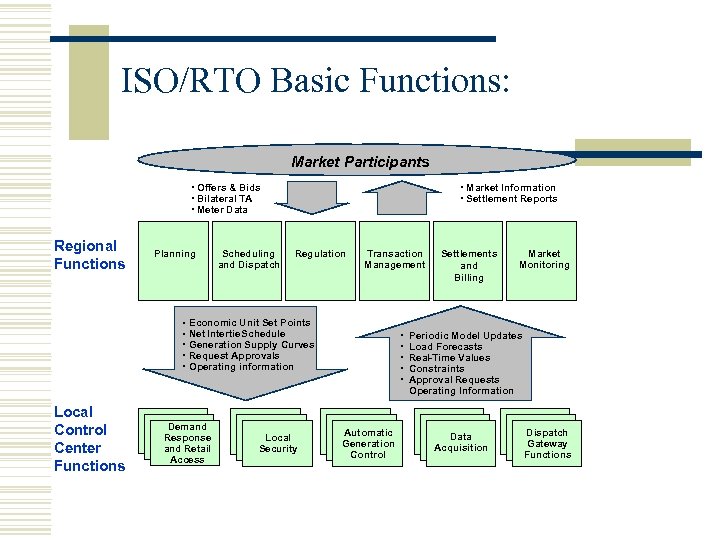 ISO/RTO Basic Functions: Market Participants • Offers & Bids • Bilateral TA • Meter Data Regional Functions Planning • • • Local Control Center Functions Scheduling and Dispatch • Market Information • Settlement Reports Regulation Transaction Management Economic Unit Set Points Net Intertie Schedule Generation Supply Curves Request Approvals Operating information Demand Response and Retail Access Local Security • • • Automatic Generation Control Settlements and Billing Market Monitoring Periodic Model Updates Load Forecasts Real-Time Values Constraints Approval Requests Operating Information Data Acquisition Dispatch Gateway Functions
 Seams Issues w barriers and inefficiencies n n equipment limitations differences in market rules and designs operating and scheduling protocols, other control area practices w inhibit or preclude the ability to transact capacity and energy across control area boundaries.
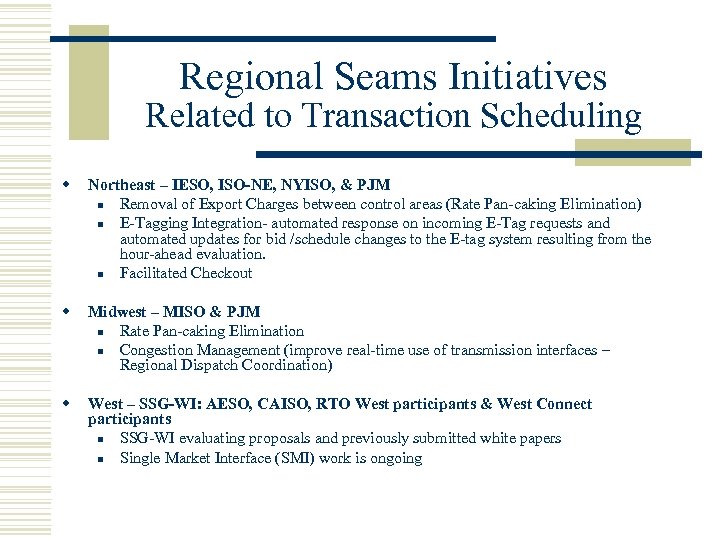 Regional Seams Initiatives Related to Transaction Scheduling w Northeast – IESO, ISO-NE, NYISO, & PJM n Removal of Export Charges between control areas (Rate Pan-caking Elimination) n E-Tagging Integration- automated response on incoming E-Tag requests and automated updates for bid /schedule changes to the E-tag system resulting from the hour-ahead evaluation. n Facilitated Checkout w Midwest – MISO & PJM n Rate Pan-caking Elimination n Congestion Management (improve real-time use of transmission interfaces – Regional Dispatch Coordination) w West – SSG-WI: AESO, CAISO, RTO West participants & West Connect participants n SSG-WI evaluating proposals and previously submitted white papers n Single Market Interface (SMI) work is ongoing
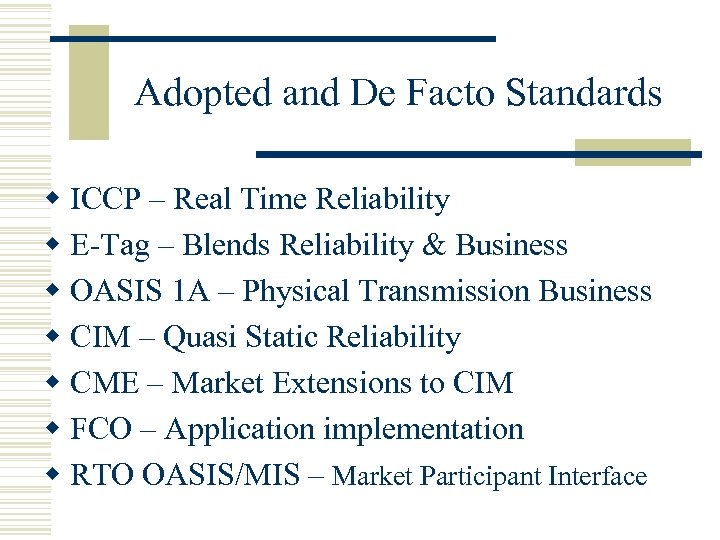 Adopted and De Facto Standards w ICCP – Real Time Reliability w E-Tag – Blends Reliability & Business w OASIS 1 A – Physical Transmission Business w CIM – Quasi Static Reliability w CME – Market Extensions to CIM w FCO – Application implementation w RTO OASIS/MIS – Market Participant Interface
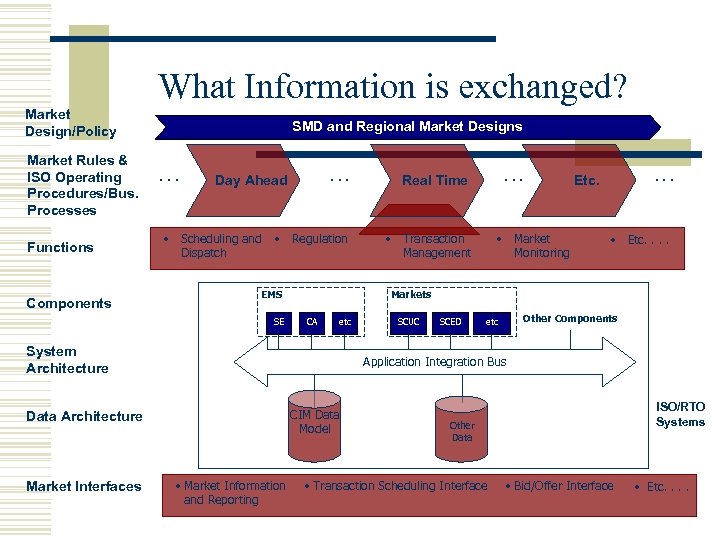 What Information is exchanged? Market Design/Policy Market Rules & ISO Operating Procedures/Bus. Processes Functions Components SMD and Regional Market Designs. . . Real Time • Regulation • Transaction Management Day Ahead • Scheduling and Dispatch EMS SE • Market Monitoring . . . Etc. • Etc. . Markets CA etc System Architecture SCUC SCED Other Components etc Application Integration Bus CIM Data Model Data Architecture Market Interfaces . . . • Market Information and Reporting ISO/RTO Systems Other Data • Transaction Scheduling Interface • Bid/Offer Interface • Etc. .
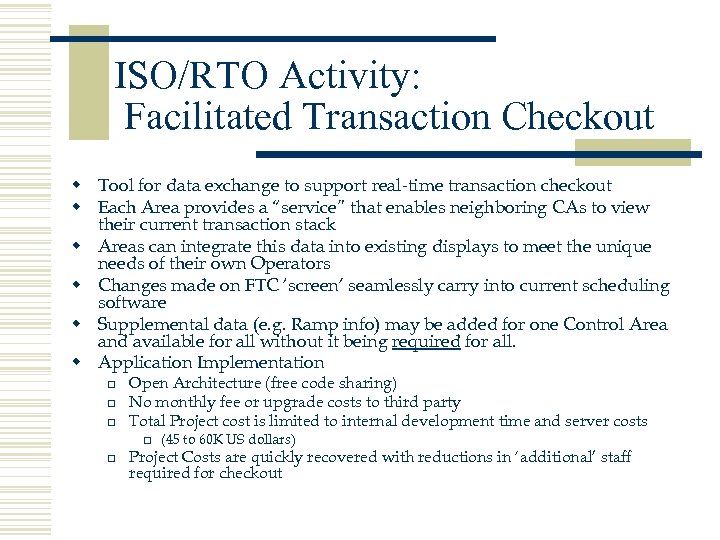 ISO/RTO Activity: Facilitated Transaction Checkout w Tool for data exchange to support real-time transaction checkout w Each Area provides a “service” that enables neighboring CAs to view their current transaction stack w Areas can integrate this data into existing displays to meet the unique needs of their own Operators w Changes made on FTC ‘screen’ seamlessly carry into current scheduling software w Supplemental data (e. g. Ramp info) may be added for one Control Area and available for all without it being required for all. w Application Implementation o o o Open Architecture (free code sharing) No monthly fee or upgrade costs to third party Total Project cost is limited to internal development time and server costs o o (45 to 60 K US dollars) Project Costs are quickly recovered with reductions in ‘additional’ staff required for checkout
 Goals of CIM for Market Extensions (CME) Project w Extend the CIM architecture to support SMD and facilitate markets w Focus on the Day-Ahead and Real-Time Market Processes to define extensions needed for the CIM data model to support these processes w Standardize information format and application interfaces to make the North American wholesale electricity market run efficiently, reduce seams issues and save substantial costs in the development of applications for each RTO l Will allow RTOs to buy best-of-breed applications and communicate with Transmission operating Organizations and/or other ISOs/RTOs in a standard information format l Will allow marketers, Load Serving Entities (LSE), and Generator Serving Entities (GSE) to access information and bid in the RTO’s preferred format
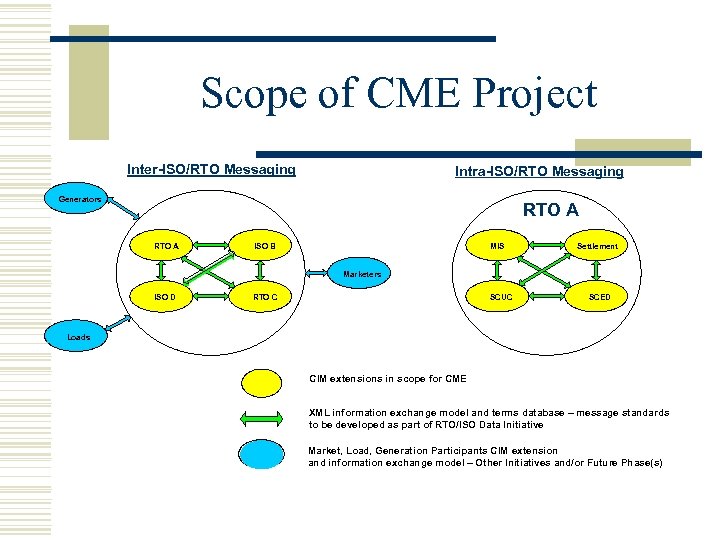 Scope of CME Project Inter-ISO/RTO Messaging Intra-ISO/RTO Messaging Generators RTO A MIS ISO B Settlement Marketers ISO D SCUC RTO C SCED Loads CIM extensions in scope for CME XML information exchange model and terms database – message standards to be developed as part of RTO/ISO Data Initiative Market, Load, Generation Participants CIM extension and information exchange model – Other Initiatives and/or Future Phase(s)
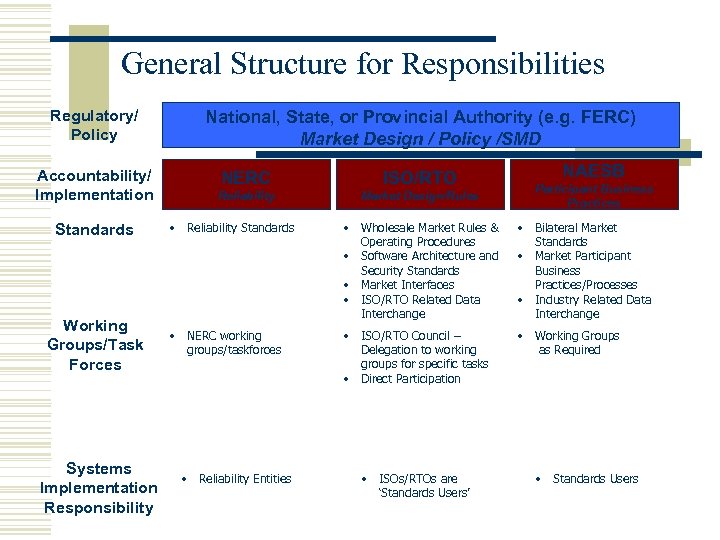 General Structure for Responsibilities Regulatory/ Policy Accountability/ Implementation Standards Working Groups/Task Forces Systems Implementation Responsibility National, State, or Provincial Authority (e. g. FERC) Market Design / Policy /SMD NERC ISO/RTO Reliability Market Design/Rules NAESB Participant Business Practices • Reliability Standards • Wholesale Market Rules & Operating Procedures • Software Architecture and Security Standards • Market Interfaces • ISO/RTO Related Data Interchange • Bilateral Market Standards • Market Participant Business Practices/Processes • Industry Related Data Interchange • NERC working groups/taskforces • ISO/RTO Council – Delegation to working groups for specific tasks • Direct Participation • Working Groups as Required • Reliability Entities • ISOs/RTOs are ‘Standards Users’ • Standards Users
 Challenges for OASIS II w SMD Closure w Rate Pancaking w Data Confidentiality w Protecting Existing Investments w Determining Business Case
 Questions