 Скачать презентацию Future of my speciallty Государственное Образовательное Учреждение Среднего
максу.ppt
- Количество слайдов: 11



Future of my speciallty. Государственное Образовательное Учреждение Среднего Профессионального Образования Колледжа связи № 54. Подготовил: Шандурин Максим, учащийся ССК 9 -2. Москва 2012 г.
1. Ways to build networks. Network connection between the two users. Communication networks of three or more users. 2. Telephone networks and their classification. Telephone network. 3. Building a subscriber networks. Analog networks and digital networks. 4. Management system in the CSK. Classification of control systems. Ways of interacting N References.
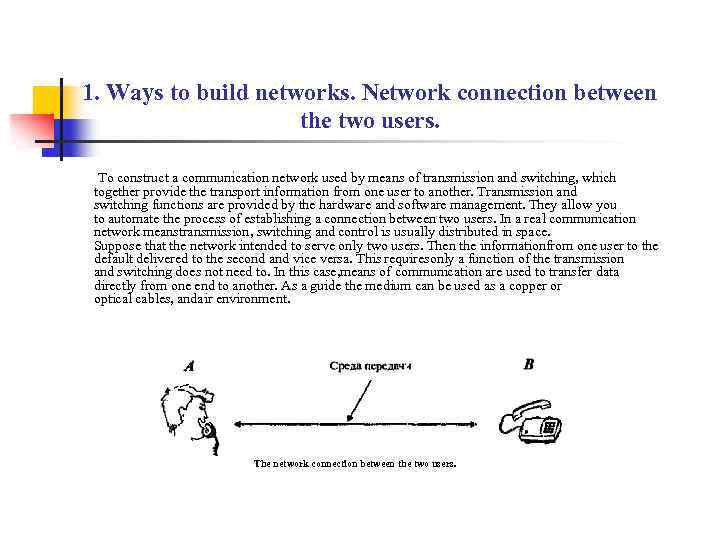
1. Ways to build networks. Network connection between the two users. To construct a communication network used by means of transmission and switching, which together provide the transport information from one user to another. Transmission and switching functions are provided by the hardware and software management. They allow you to automate the process of establishing a connection between two users. In a real communication network meanstransmission, switching and control is usually distributed in space. Suppose that the network intended to serve only two users. Then the informationfrom one user to the default delivered to the second and vice versa. This requiresonly a function of the transmission and switching does not need to. In this case, means of communication are used to transfer data directly from one end to another. As a guide the medium can be used as a copper or optical cables, andair environment. The network connection between the two users.
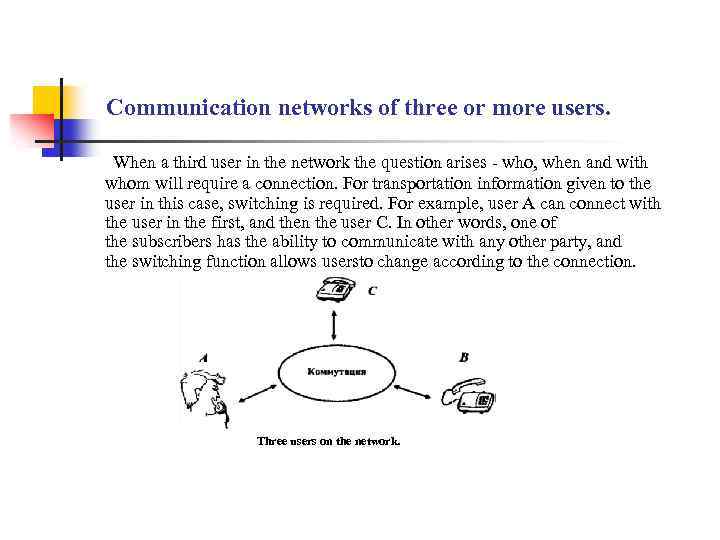
Communication networks of three or more users. When a third user in the network the question arises - who, when and with whom will require a connection. For transportation information given to the user in this case, switching is required. For example, user A can connect with the user in the first, and then the user C. In other words, one of the subscribers has the ability to communicate with any other party, and the switching function allows usersto change according to the connection. Three users on the network.
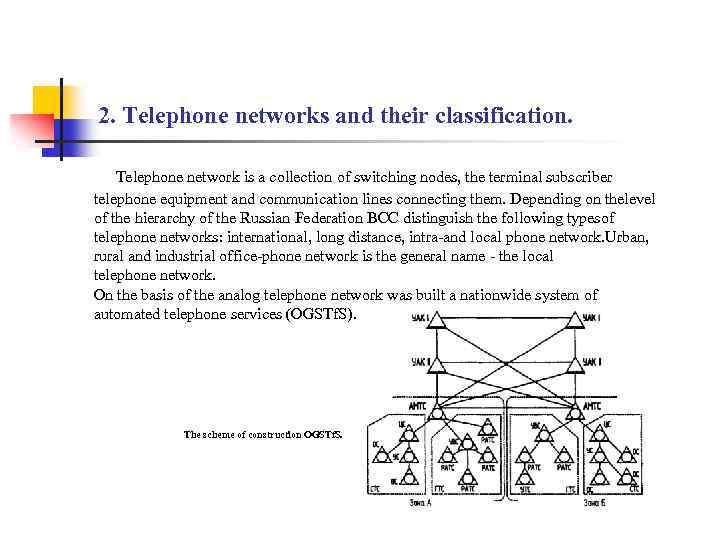
2. Telephone networks and their classification. Telephone network is a collection of switching nodes, the terminal subscriber telephone equipment and communication lines connecting them. Depending on thelevel of the hierarchy of the Russian Federation BCC distinguish the following typesof telephone networks: international, long distance, intra-and local phone network. Urban, rural and industrial office-phone network is the general name - the local telephone network. On the basis of the analog telephone network was built a nationwide system of automated telephone services (OGSTf. S). The scheme of construction OGSTf. S.
Telephone network. Long-distance telephone switching equipment network nodes can be classified as auto-switching (VAR) and automatic toll mill (AMTS). Alongside the guidance documents previously provided for the use of a two-stage VAR network, which designated the feces VAR I and VAR P. Recent studies have shown the feasibility of using only one stage of VAR. All VARs are interconnected in a full mesh scheme, serve certain territorial areas and are the center of a radial-node network construction. All telephone stations located in the zonal network, end stations are long-distance network, and VAR - transit. Under a heavy load between the AMTS is a direct link is established. Production office-telephone network (UPTS) provide domestic telephone companies, institutions and organizations. Such networks can be either completely independent or have access to the PSTN. Local telephone network (GTS) provides telephone communications in the city and its suburbs. Rural telephone network (SRT provides telephone svyaz in areas of rural administrative districts. They cover a wider area than the city, but the density of telephones is much smaller. Consequently, the capacity of rural telephone exchanges is much less than in urban. Intra-phone network (VZTS) - a collection of devices and structures that are intended to establish connections between users of different local telephone networks in the territory of a single telephone area, and their access to long distance and international network. The sign area is the presence of a single seven-digit numbering intra-local networks of subscriber lines in this zone. Long-distance telephone system (MTS) - a single set of devices and structures that are intended to establish connections between subscribers of local telephone networks in the territories of different zones of the telephone numbering.
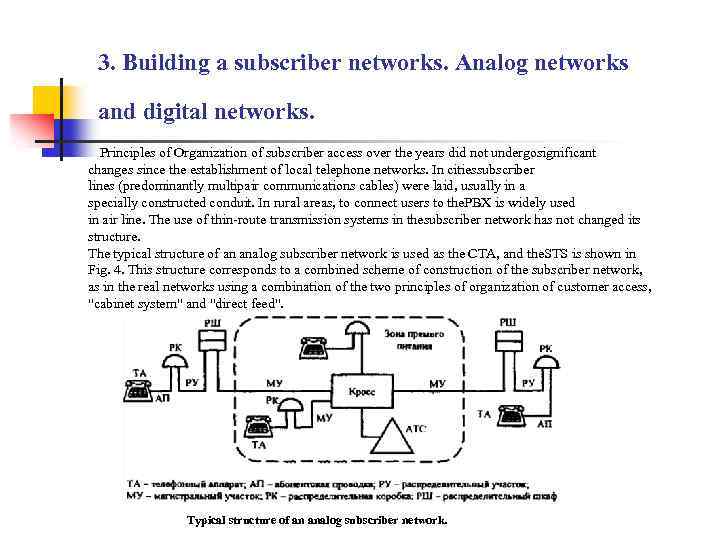
3. Building a subscriber networks. Analog networks and digital networks. Principles of Organization of subscriber access over the years did not undergosignificant changes since the establishment of local telephone networks. In citiessubscriber lines (predominantly multipair communications cables) were laid, usually in a specially constructed conduit. In rural areas, to connect users to the. PBX is widely used in air line. The use of thin-route transmission systems in thesubscriber network has not changed its structure. The typical structure of an analog subscriber network is used as the CTA, and the. STS is shown in Fig. 4. This structure corresponds to a combined scheme of construction of the subscriber network, as in the real networks using a combination of the two principles of organization of customer access, "cabinet system" and "direct feed". Typical structure of an analog subscriber network.
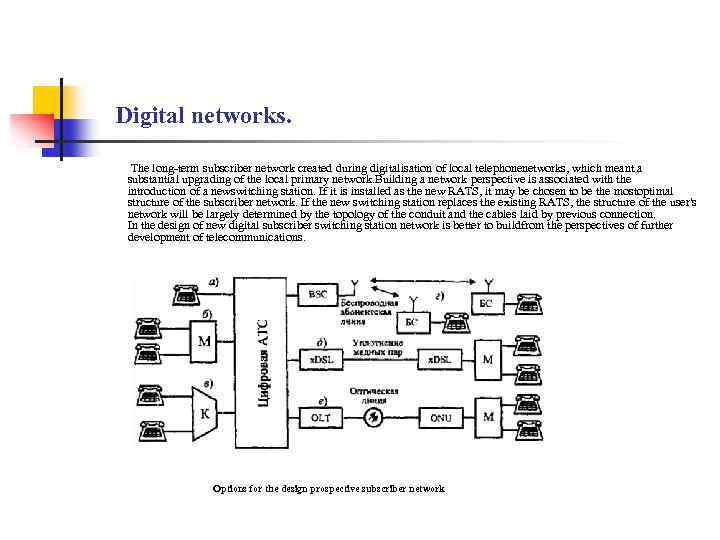
Digital networks. The long-term subscriber network created during digitalisation of local telephonenetworks, which meant a substantial upgrading of the local primary network. Building a network perspective is associated with the introduction of a newswitching station. If it is installed as the new RATS, it may be chosen to be the mostoptimal structure of the subscriber network. If the new switching station replaces the existing RATS, the structure of the user's network will be largely determined by the topology of the conduit and the cables laid by previous connection. In the design of new digital subscriber switching station network is better to buildfrom the perspectives of further development of telecommunications. Options for the design prospective subscriber network
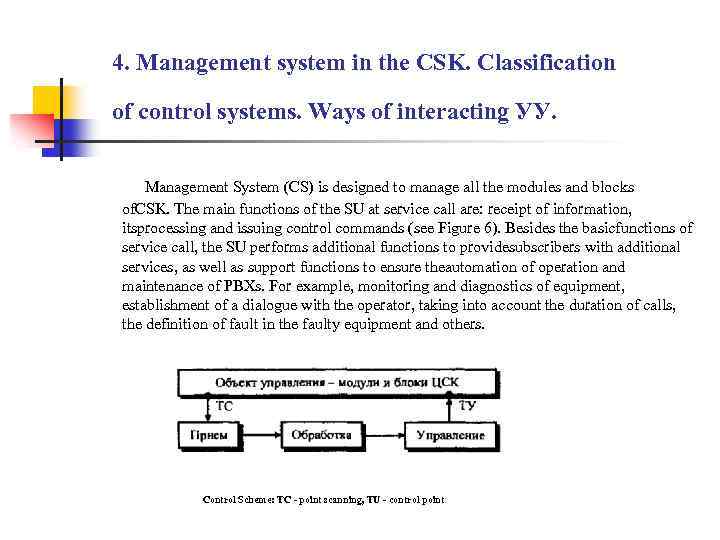
4. Management system in the CSK. Classification of control systems. Ways of interacting УУ. Management System (CS) is designed to manage all the modules and blocks of. CSK. The main functions of the SU at service call are: receipt of information, itsprocessing and issuing control commands (see Figure 6). Besides the basicfunctions of service call, the SU performs additional functions to providesubscribers with additional services, as well as support functions to ensure theautomation of operation and maintenance of PBXs. For example, monitoring and diagnostics of equipment, establishment of a dialogue with the operator, taking into account the duration of calls, the definition of fault in the faulty equipment and others. Control Scheme: TC - point scanning, TU - control point
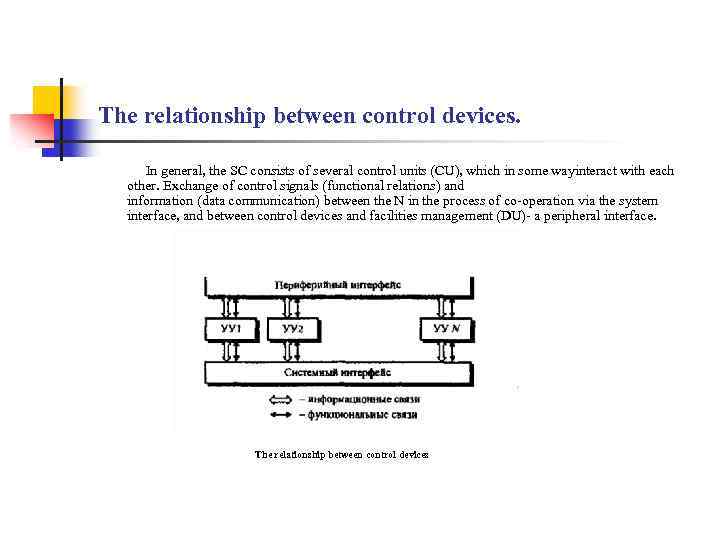
The relationship between control devices. In general, the SC consists of several control units (CU), which in some wayinteract with each other. Exchange of control signals (functional relations) and information (data communication) between the N in the process of co-operation via the system interface, and between control devices and facilities management (DU)- a peripheral interface. The relationship between control devices

My attitude I think that this profession for me. I want to then proceed to study in this specialty, because it is progressive. I like it!
Скачать презентацию Future of my speciallty Государственное Образовательное Учреждение Среднего
максу.ppt