


 Скачать презентацию Future graphics in games Cevat Yerli Crytek CEO
66cdbe67501aa6394cfffb02b73e7c3b.ppt
- Количество слайдов: 48
 Future graphics in games Cevat Yerli Crytek CEO Anton Kaplanyan Lead researcher
 Agenda • The history: Crytek Gmb. H • Current graphics technologies • Stereoscopic rendering • Current graphics challenges • Graphics of the future • Graphics technologies of the future • Server-side rendering • Hardware challenges • Perception-driven graphics
 The Past - Part 1 • March 2001 till March 2004 • Development of Far Cry • Development of Cry. Engine 1 • Approach: A naïve, but successful push for contrasts, by insisting on opposites to industry. size, quality, detail, brightness • First right investment into tools - WYSIWYPlay
 Past - Part 1: Cry. Engine 1 • Polybump (2001) • Normal. Map extraction from High-Res Geometry • First „Per Pixel Shading“ & HDR Engine • For Lights, Shadows & Materials • High Dynamic Range • Long view distances & detailed vistas • Terrain featured unique base-texturing • High quality close ranges • High fidelity physics & AI • It took 3 years, avg 20 R&D Engineers
 Cry. ENGINE 2
 The Past – Part 2 – Cry. ENGINE 2 • April 2004 till November 2007 • Development of Crysis • Development of Cry. Engine 2 • Approach: Photorealism meets interactivity! • Typically mutual exclusive directions • Realtime productivity with WYSIWYPlay • Extremely challenging, but successful
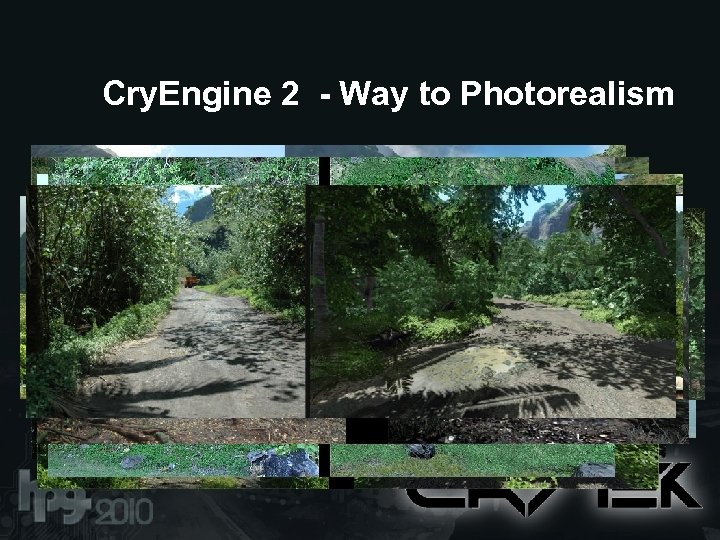 Cry. Engine 2 - Way to Photorealism
 The Past - Part 2: Cry. Engine 2 • CGI Quality Lighting & Shading • Life-like characters • Scaleable architecture in • Both content and pipeline • Technologies and assets allow various configurations to be maxed out! • Crysis shipped Nov 2007, works on PCs of 2004 till today and for future. . .
 The Present - Cry. Engine 3 • Cry. Engine 3 is build with next-gen in mind • Scales through many-core support • Performs on PC, Xbox 360, PS 3, DX 11 • Built by avg. 25 people over 3 years
 Cry. ENGINE 3 architecture • Cry. ENGINE 2 successor, but now we do • Deferred lighting (aka Light Prepass) • Lighting in linear space • Indirect lighting • Coordinated dynamic and precomputed lighting • Advanced color correction (artists-driven color charts) • Streaming rendering assets (geometry, textures, animation) • Run on both consoles (Xbox 360 and Playstation 3) • Compressed and minimized bandwidth and memory requirements
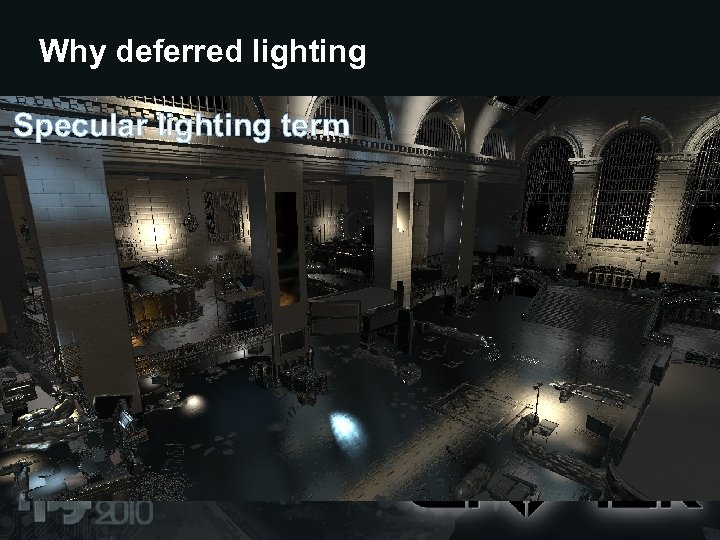 Why deferred lighting Scene in lighting term Diffuse lighting term Specular the Crysis 2 level
 Deferred lighting • Good decomposition of lighting • No lighting-geometry interdependency • Cons: • Limited material variations • Higher memory and bandwidth requirements • Shading problems • 2 x 2 tiles for mip computation fail for any kind of deferred texturing (projective light textures, decals etc. )
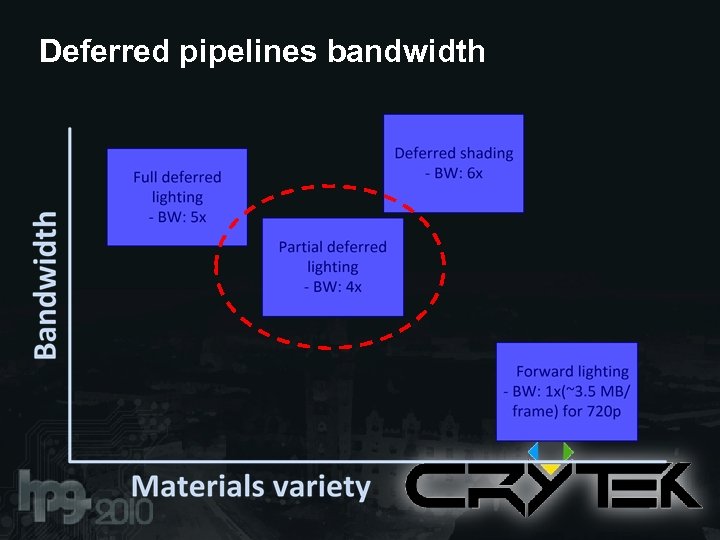 Deferred pipelines bandwidth
 Feature
 How to design for the future? • Facts • Fixed Resolution for Gaming till 2012 • HD 1920 x 1080 @ 60 fps • Stereoscopic 3 D experience: 30 fps per eye • Limited by current consoles hardware • Risk of „Uncanny Valley“ for content • Perception-driven approaches! • Till 2012 majority of games must use artistic style, physics and AI to differentiate! • What‘s the current artistic style? Desaturate colors?
 Graphics architecture • Breakthroughs in rendering architecture are not easy • Proved multiple times by hardware vendors • Especially multiple recent tries with software renderer • Trails along with a huge infrastructure • • Outcome of a many-years development experience Graphics architecture will be much more divergent • Do we really want to write our own software renderer? • Coming back to old good techniques like voxels, micropolygons etc.
 How to design for the future? • Alternatives that will brand some games in future: • Point Based Rendering • Ray Tracing • Rasterization, as usual • Micropolygons • Data representations: • Sparse Voxel Octrees (data structure) • Sparse Surfel Octrees
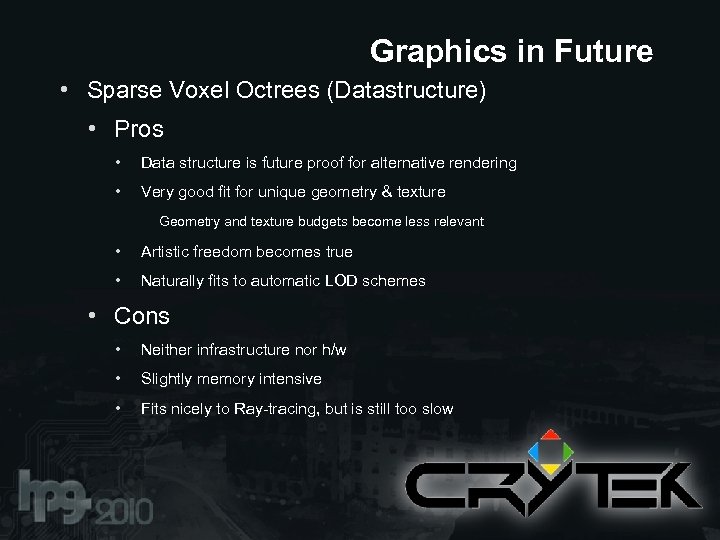 Graphics in Future • Sparse Voxel Octrees (Datastructure) • Pros • Data structure is future proof for alternative rendering • Very good fit for unique geometry & texture Geometry and texture budgets become less relevant • Artistic freedom becomes true • Naturally fits to automatic LOD schemes • Cons • Neither infrastructure nor h/w • Slightly memory intensive • Fits nicely to Ray-tracing, but is still too slow
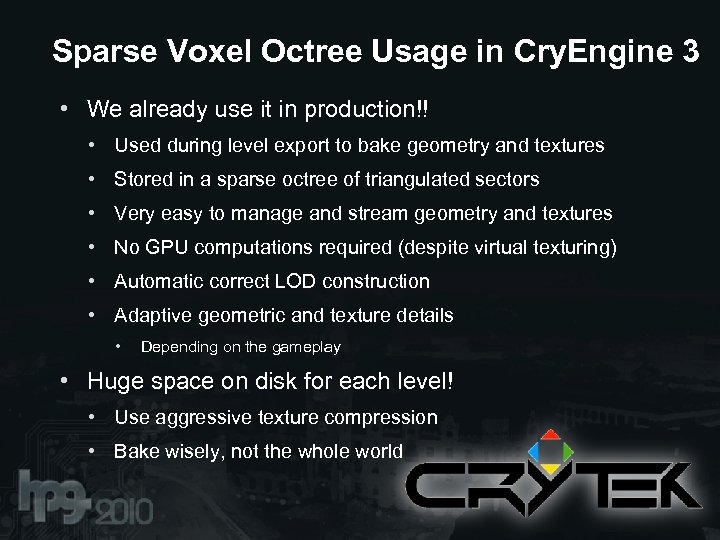 Sparse Voxel Octree Usage in Cry. Engine 3 • We already use it in production!! • Used during level export to bake geometry and textures • Stored in a sparse octree of triangulated sectors • Very easy to manage and stream geometry and textures • No GPU computations required (despite virtual texturing) • Automatic correct LOD construction • Adaptive geometric and texture details • Depending on the gameplay • Huge space on disk for each level! • Use aggressive texture compression • Bake wisely, not the whole world
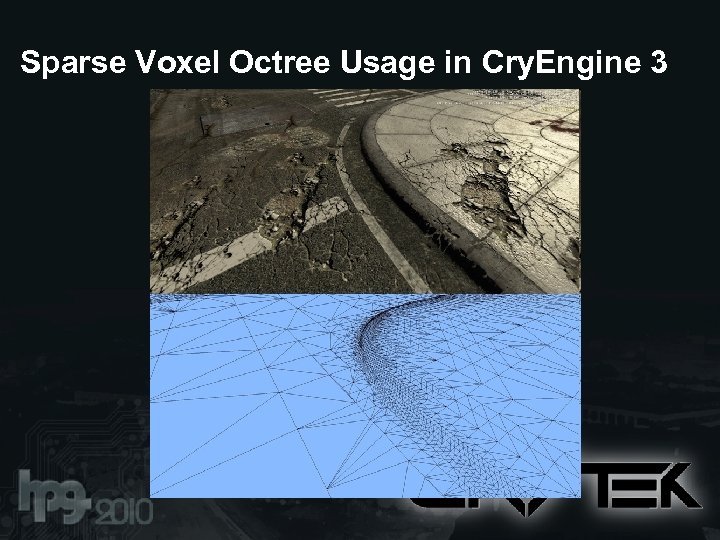 Sparse Voxel Octree Usage in Cry. Engine 3
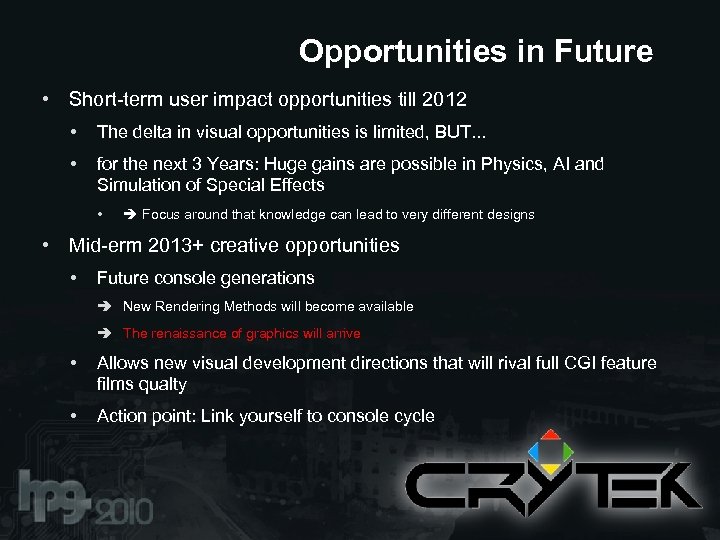 Opportunities in Future • Short-term user impact opportunities till 2012 • The delta in visual opportunities is limited, BUT. . . • for the next 3 Years: Huge gains are possible in Physics, AI and Simulation of Special Effects • Focus around that knowledge can lead to very different designs • Mid-erm 2013+ creative opportunities • Future console generations New Rendering Methods will become available The renaissance of graphics will arrive • Allows new visual development directions that will rival full CGI feature films qualty • Action point: Link yourself to console cycle
 PERCEPTION-DRIVEN GRAPHICS
 Perception-driven graphics • PCF-based soft shadows • Stochastic OIT • Image-based reflections • Ambient Occlusion (SSAO, prebaked etc. ) • Most posteffect (Do. F, motion blur approximations) • Light propagation volumes • Many stochastic algorithms • most of assumptions in real-time graphics • All that works because of the limited human perception
 Real-time graphics is perception-driven • Human‘s eye has some specialities • ~350 Mpixel spatial resolution • Quite hard to trick it in this area • ~24 Hz temporal resolution • Very low, a room for techniques • We don‘t notice the flickering @ > 40 Hz • We don‘t create an image for another machine, our target customer is a human
 Under-sampling / super-sampling • Spatial • Undersampling • Inferred shading • Depth of field • Decoupled sampling • Temporal anti-aliasing • Motion blur • Mixed • Spatio-temporal anti-aliasing
 Hybrid rendering • There is no panacea rendering pipeline • Even REYES is not used in its original form for movies • Hybrid pipeline is possible on the current gen GPUs • Will be even more topical for new generation of consoles • Usually combines everything that matches and helps • Ray-tracing for reflections and shadows • Could be triangles / point sets / voxel structures / etc. • Voxels for better scene representation (partially) • Screen-space contact effects (e. g. reflections) • Much more (a lot of ideas)
 Recent trend STEREOSCOPIC RENDERING
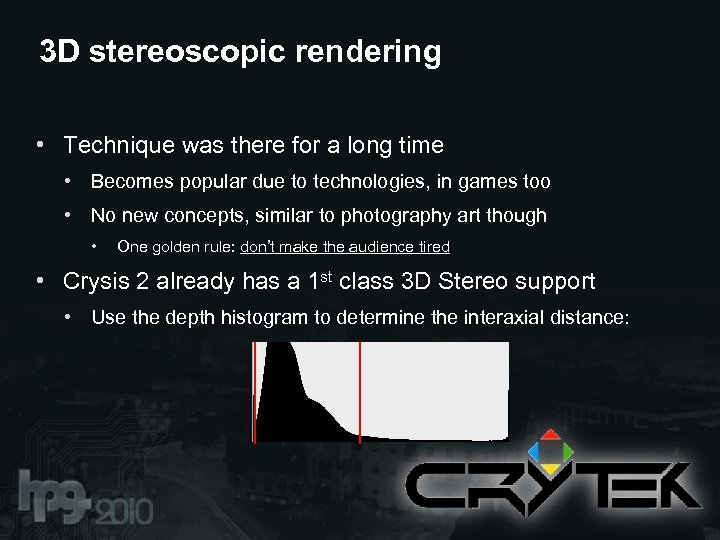 3 D stereoscopic rendering • Technique was there for a long time • Becomes popular due to technologies, in games too • No new concepts, similar to photography art though • One golden rule: don’t make the audience tired • Crysis 2 already has a 1 st class 3 D Stereo support • Use the depth histogram to determine the interaxial distance:
 Supported stereo modes in Cry. ENGINE 3 • Stereo rendering modes • Brute-force stereo rendering • Central eye frame with reprojection • Experimental stochastic rendering from one of eyes • Stereo output modes • Anaglyph (color separation) • Interlaced • Horizontal joint images • Vertical joint images • Two monitors
 Stereo video
 SERVER-SIDE RENDERING
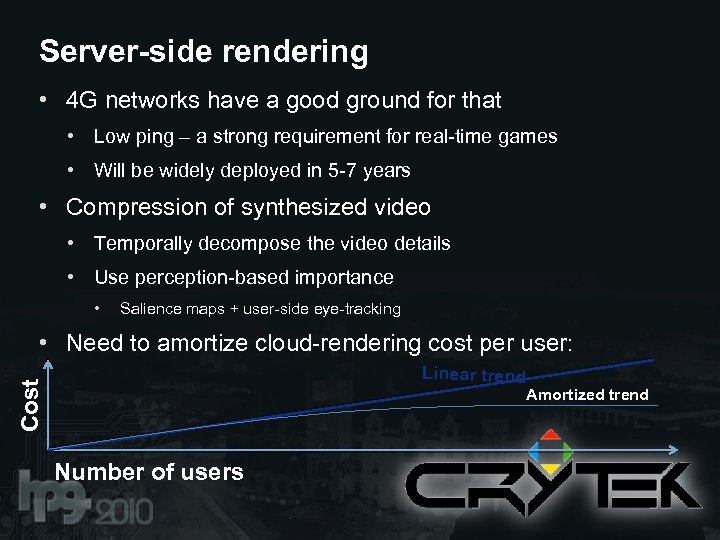 Server-side rendering • 4 G networks have a good ground for that • Low ping – a strong requirement for real-time games • Will be widely deployed in 5 -7 years • Compression of synthesized video • Temporally decompose the video details • Use perception-based importance • Salience maps + user-side eye-tracking • Need to amortize cloud-rendering cost per user: Cost Linear trend Number of users Amortized trend
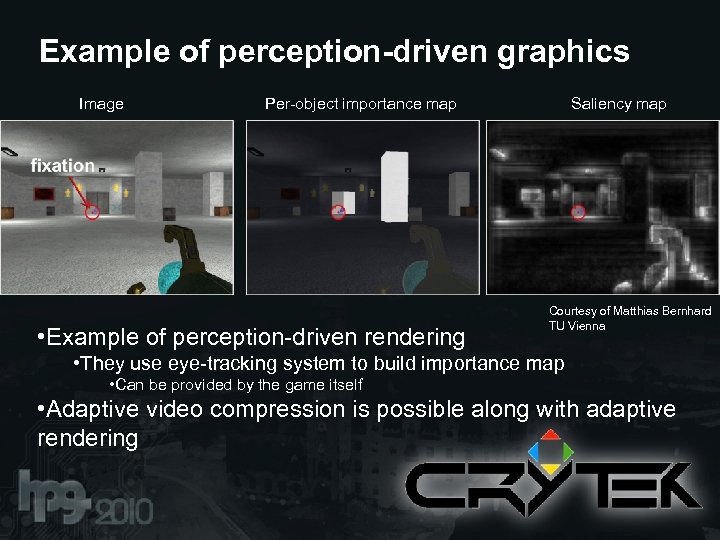 Example of perception-driven graphics Image Per-object importance map • Example of perception-driven rendering Saliency map Courtesy of Matthias Bernhard TU Vienna • They use eye-tracking system to build importance map • Can be provided by the game itself • Adaptive video compression is possible along with adaptive rendering
 CURRENT PROBLEMS OF HARDWARE ARCHITECTURE
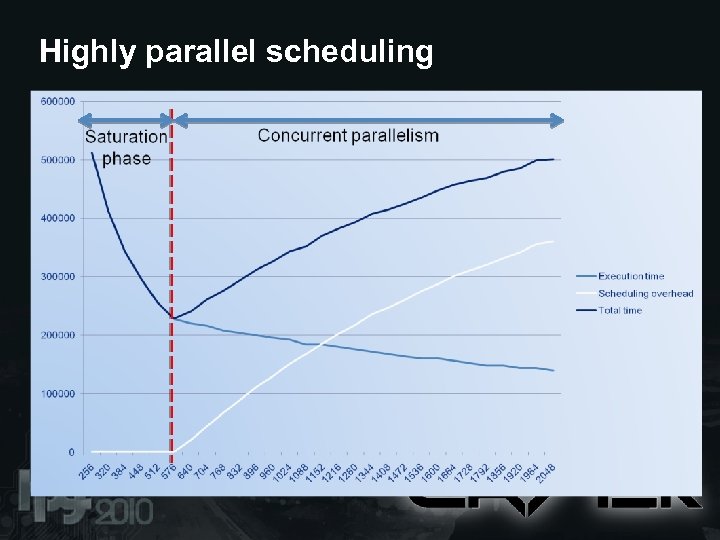
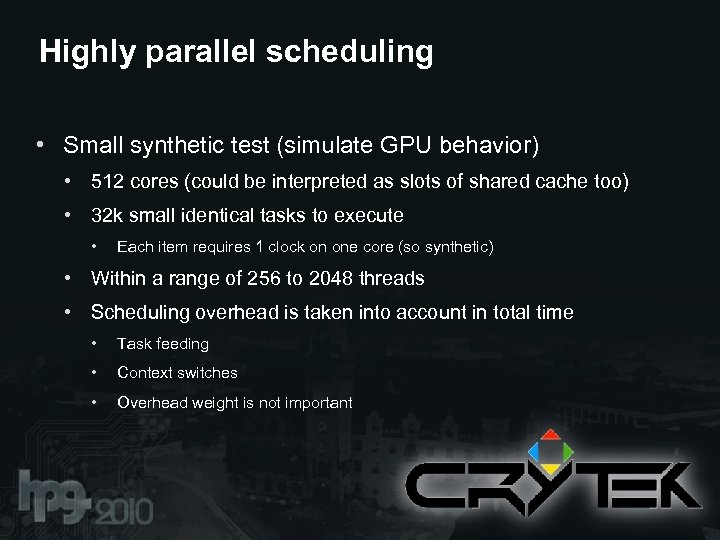 Highly parallel scheduling • Small synthetic test (simulate GPU behavior) • 512 cores (could be interpreted as slots of shared cache too) • 32 k small identical tasks to execute • Each item requires 1 clock on one core (so synthetic) • Within a range of 256 to 2048 threads • Scheduling overhead is taken into account in total time • Task feeding • Context switches • Overhead weight is not important
 Highly parallel scheduling
 Highly parallel scheduling • Another test • Real GPU! • Screen-space effect (SSAO) • Bandwidth-intensive pixel shader • Each item requires 1 clock on one core (so synthetic) • Within a range of 5 to 40 threads • Cache pollution causes a peak right after the saturation state • The time reaches the saturation performance with more threads asymptotically
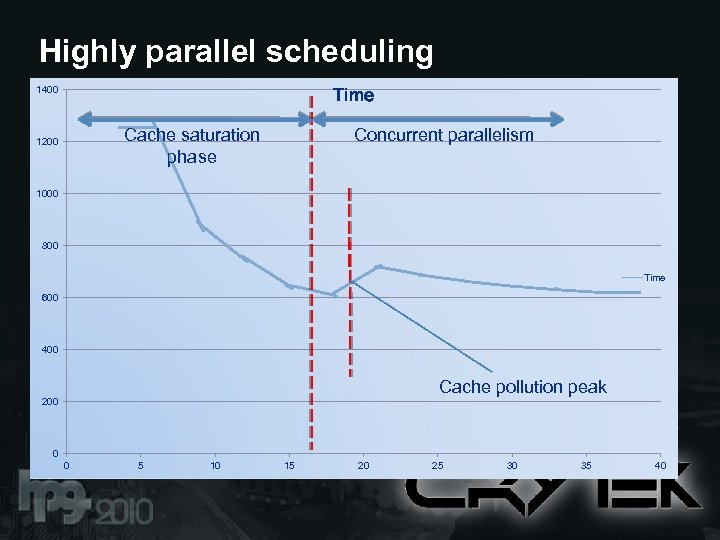 Highly parallel scheduling 1400 Time Cache saturation phase 1200 Concurrent parallelism 1000 800 Time 600 400 Cache pollution peak 200 0 0 5 10 15 20 25 30 35 40
 Highly parallel scheduling • Scheduling overhead can be a problem • Parallel scalability • With homogenous tasks it comes to maximum at saturation • What about heterogeneous workload? • The existence of the minimum depends on the performance impact of scheduling • We need to reduce it • Configurable hardware scheduler! • GRAMPS-like architectures are possible with it • Ray tracing becomes much faster and So. L with bandwidth bottleneck
 Atomics • Atomics came from CPU hardware • Used to build synchronization primitives in Oses • Works only on integers • Provides result of operation • We need absolutely different atomics!!! • We use it mostly for gather/scatter operations • MUST work on floating point numbers instead! • In most cases no result needed • Improve atomics w/o read-back (fire-and-forget concept) • Operation should be done on memory controller / smart memory side • We need order of magnitude faster performance for graphics atomics
 Future performance • PS 3 and Xbox 360 are in-order • “by optimizing for consoles we also speed up PC” • not really, we invest only into current consoles • What’s the next generation of consoles? • Larrabee 2 and Fermi ARE in-order • Should we rewrite the architecture again? • Death of Out-of-Order architecture? • No way! Game platform will remain heterogeneous • Related to different game subsystems (game code vs rendering) • Many new parallel languages and paradigms • Open. CL, GRAMPS, C++0 x, Open. MP, TBB, Conc. RT, Ct • Backwards scalability is a challenge
 Future performance • Mostly graphics, as it’s scalable without pain • Doesn’t affect game-play • Assets processing • Texture compression becomes an issue as well • Both decompression AND compression complexity should be respected • Shaders development • Compilation is too slow and not flexible • Still not solved by DX 11 DSL • Getting worse with Compute. Shaders • Debugging / profiling is still not there for compute shaders • Developing a huge system might become a hell
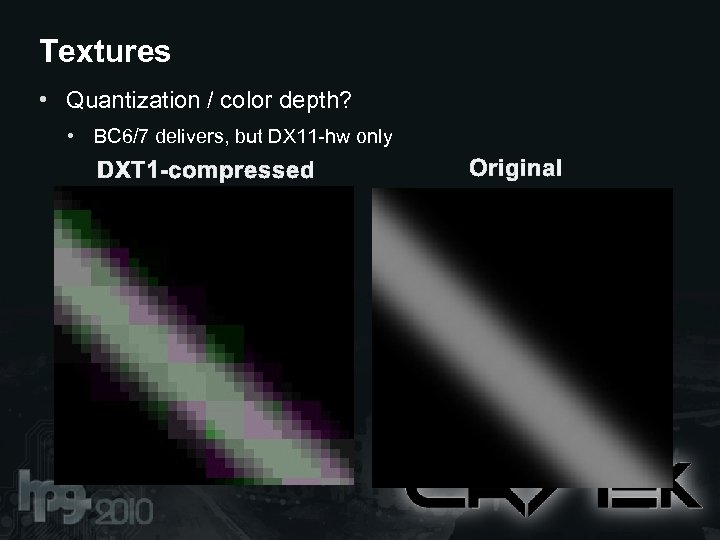 Textures • Quantization / color depth? • BC 6/7 delivers, but DX 11 -hw only DXT 1 -compressed Original
 Challenges of Future • Technology challenges • Switching to a scaleable codebase • Think of parallelism & async jobs • Multithreading, scheduling • Larger codebases, multiple platforms & APIs • Production challenges • Cost of assets increase by ~50% annually • Content, besides quality increases, gets more & more „interactive“ • Think to improve Tools, Pipelines & Bottlenecks to counter-effect , automate Source Back-Ends Resource Compilers • The better the tools, the cheaper and/or the better your output
 Efficiency • We spend too much of computational power per frame! • Precision is mostly redundant • No need to compute colors in 32 -bits floating points • Even h/w rasterizers was 12 -bits of fixed precision in good old times • Humans do notice the most of the picture in real-time graphics • It is a gameplay video rather than a still image • Neither we watch it like a movie, games are usually challenging • The importance of a particular technology is perception-driven How important are the fully accurate rather very glossy reflections • Graphics hardware should challenge incoherent workloads • What about profit / development cost ratio? • Seems like we already fall into uncanny valley in graphics technologies
 Scopes • Content costs will increase • If nothing changes Tools must adapt • Smarter & automated pipelines & tools will provide better, faster & valid content data • Think procedural content creation • 5 y. . . gaming graphics will change, • but insignificantly in the next 3 years • Today‘s technologies will drive the next 3 years in visual development. The look is still about creativity and using the given resource powers of today • 5 y. . . realtime gaming graphics will approach to current CGI offline rendering
 Conclusion • Real-time rendering pipeline renovation is around the corner • Hardware improvements are required • Evolution of current techniques for production real-time rendering • Prepare to new representations and rendering pipelines • Better infrastructure for parallel development • Tools and authoring pipelines needs modernization • Consider server-side rendering: could change the direction drastically • Perception-driven real-time graphics is a technology driver • Avoid uncanny valley in graphics technologies
 Questions? Cevat@Crytek. de Anton. K@Crytek. de