 Скачать презентацию Future 802 16 Networks Challenges and Possibilities IEEE
77c5150ed02a6cc79140901e61011d0d.ppt
- Количество слайдов: 81



Future 802. 16 Networks: Challenges and Possibilities IEEE 802. 16 Presentation Submission Template (Rev. 9) Document Number: IEEE C 802. 16 -16 r 1/0009 Date Submitted: 2010 -03 -15 Source(s): See list on slides 2 -3 Venue: Orlando, FL, USA Base Contribution: None Purpose: Call For Interest Tutorial Notice: This document does not represent the agreed views of the IEEE 802. 16 Working Group or any of its subgroups. It represents only the views of the participants listed in the “Source(s)” field above. It is offered as a basis for discussion. It is not binding on the contributor(s), who reserve(s) the right to add, amend or withdraw material contained herein. Release: The contributor grants a free, irrevocable license to the IEEE to incorporate material contained in this contribution, and any modifications thereof, in the creation of an IEEE Standards publication; to copyright in the IEEE’s name any IEEE Standards publication even though it may include portions of this contribution; and at the IEEE’s sole discretion to permit others to reproduce in whole or in part the resulting IEEE Standards publication. The contributor also acknowledges and accepts that this contribution may be made public by IEEE 802. 16. Patent Policy: The contributor is familiar with the IEEE-SA Patent Policy and Procedures: <http: //standards. ieee. org/guides/bylaws/sect 6 -7. html#6> and <http: //standards. ieee. org/guides/opman/sect 6. html#6. 3>. Further information is located at <http: //standards. ieee. org/board/pat-material. html> and <http: //standards. ieee. org/board/pat >. 3/17/2018 1
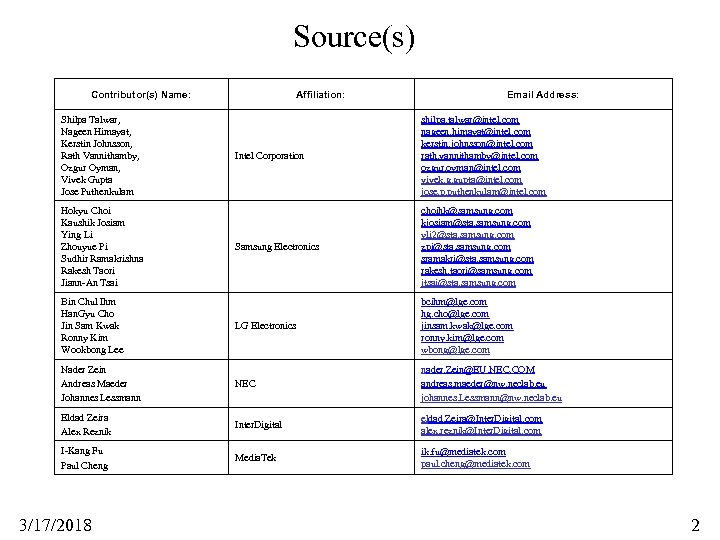
Source(s) Contributor(s) Name: Shilpa Talwar, Nageen Himayat, Kerstin Johnsson, Rath Vannithamby, Ozgur Oyman, Vivek Gupta Jose Puthenkulam Affiliation: Email Address: Intel Corporation shilpa. talwar@intel. com nageen. himayat@intel. com kerstin. johnsson@intel. com rath. vannithamby@intel. com ozgur. oyman@intel. com vivek. g. gupta@intel. com jose. p. puthenkulam@intel. com Samsung Electronics choihk@samsung. com kjosiam@sta. samsung. com yli 2@sta. samsung. com zpi@sta. samsung. com sramakri@sta. samsung. com rakesh. taori@samsung. com jtsai@sta. samsung. com Bin Chul Ihm Han. Gyu Cho Jin Sam Kwak Ronny Kim Wookbong Lee LG Electronics bcihm@lge. com hg. cho@lge. com jinsam. kwak@lge. com ronny. kim@lge. com wbong@lge. com Nader Zein Andreas Maeder Johannes Lessmann NEC nader. Zein@EU. NEC. COM andreas. maeder@nw. neclab. eu johannes. Lessmann@nw. neclab. eu Eldad Zeira Alex Reznik Inter. Digital eldad. Zeira@Inter. Digital. com alex. reznik@Inter. Digital. com I-Kang Fu Paul Cheng Media. Tek ik. fu@mediatek. com paul. cheng@mediatek. com Hokyu Choi Kaushik Josiam Ying Li Zhouyue Pi Sudhir Ramakrishna Rakesh Taori Jiann-An Tsai 3/17/2018 2
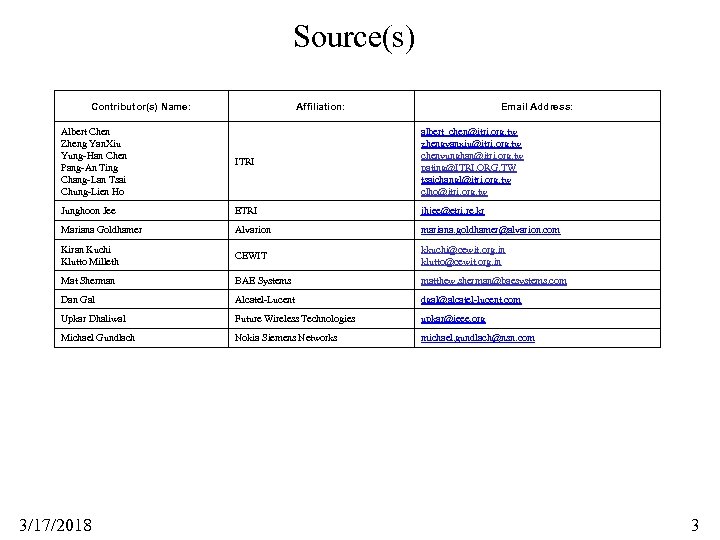
Source(s) Contributor(s) Name: Affiliation: Email Address: Albert Chen Zheng Yan. Xiu Yung-Han Chen Pang-An Ting Chang-Lan Tsai Chung-Lien Ho ITRI albert_chen@itri. org. tw zhengyanxiu@itri. org. tw chenyunghan@itri. org. tw pating@ITRI. ORG. TW tsaichangl@itri. org. tw clho@itri. org. tw Junghoon Jee ETRI jhjee@etri. re. kr Mariana Goldhamer Alvarion mariana. goldhamer@alvarion. com Kiran Kuchi Klutto Milleth CEWIT kkuchi@cewit. org. in klutto@cewit. org. in Mat Sherman BAE Systems matthew. sherman@baesystems. com Dan Gal Alcatel-Lucent dgal@alcatel-lucent. com Upkar Dhaliwal Future Wireless Technologies upkar@ieee. org Michael Gundlach Nokia Siemens Networks michael. gundlach@nsn. com 3/17/2018 3
Future 802. 16 Networks: Challenges and Possibilities 3/17/2018 4
Agenda • • • Motivation Objectives and Potential Requirements Advanced Access Networks Advanced Services Summary 3/17/2018 5
Motivation Drivers for future 802. 16 Networks • Market trends • New usages 3/17/2018 6
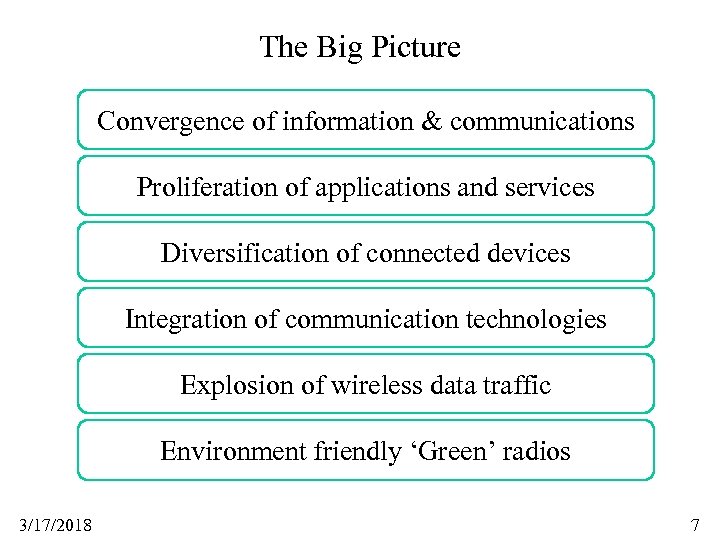
The Big Picture Convergence of information & communications Proliferation of applications and services Diversification of connected devices Integration of communication technologies Explosion of wireless data traffic Environment friendly ‘Green’ radios 3/17/2018 7
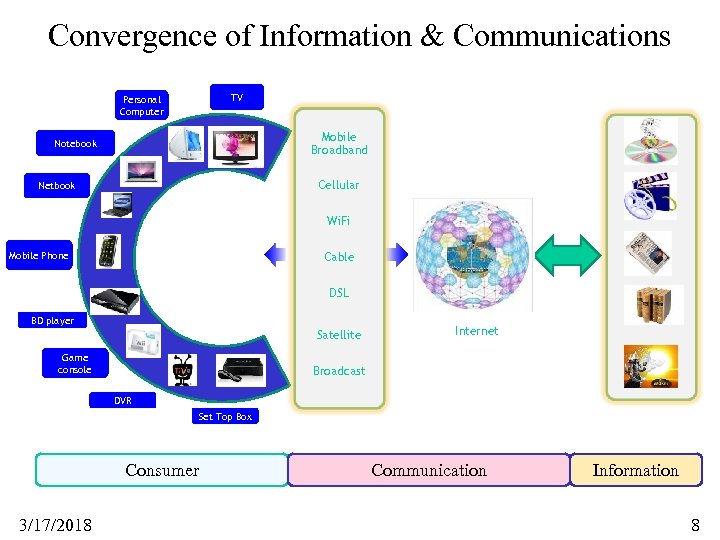
Convergence of Information & Communications TV Personal Computer Mobile Broadband Notebook Cellular Netbook Wi. Fi Mobile Phone Cable DSL BD player Satellite Game console Internet Broadcast DVR Set Top Box Consumer 3/17/2018 Communication Information 8
Proliferation of Mobile Internet Apps & Services +Logos and trademarks belong to the other entities ++ These are examples of applications & services 3/17/2018 9
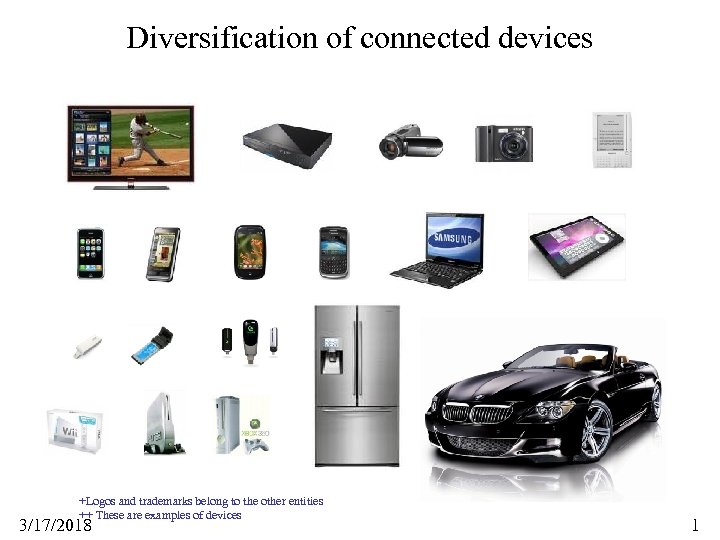
Diversification of connected devices +Logos and trademarks belong to the other entities ++ These are examples of devices 3/17/2018 1
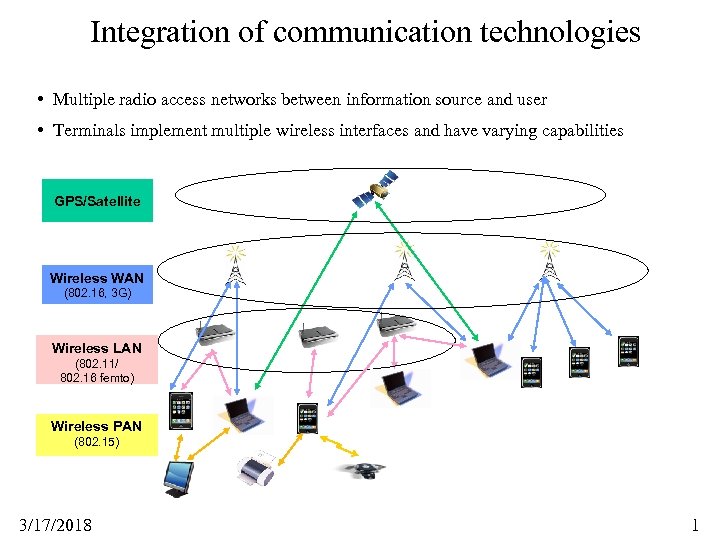
Integration of communication technologies • Multiple radio access networks between information source and user • Terminals implement multiple wireless interfaces and have varying capabilities GPS/Satellite Wireless WAN (802. 16, 3 G) Wireless LAN (802. 11/ 802. 16 femto) Wireless PAN (802. 15) 3/17/2018 1
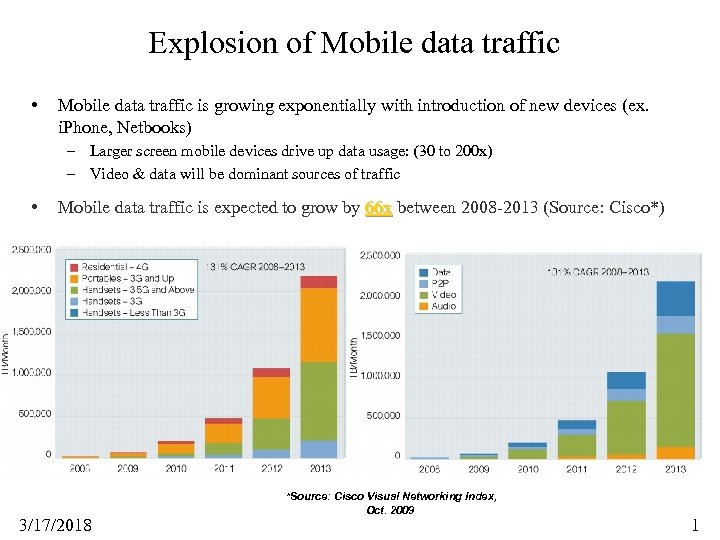
Explosion of Mobile data traffic • Mobile data traffic is growing exponentially with introduction of new devices (ex. i. Phone, Netbooks) – Larger screen mobile devices drive up data usage: (30 to 200 x) – Video & data will be dominant sources of traffic • Mobile data traffic is expected to grow by 66 x between 2008 -2013 (Source: Cisco*) *Source: Cisco Visual Networking Index, 3/17/2018 Oct. 2009 1
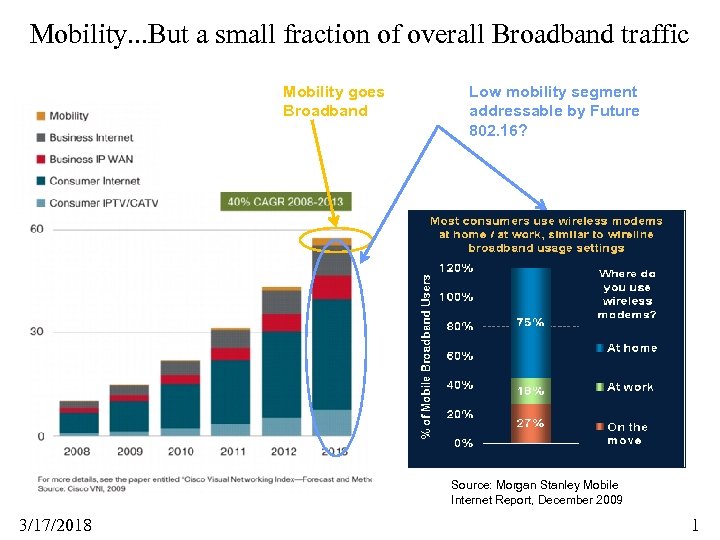
Mobility. . . But a small fraction of overall Broadband traffic Mobility goes Broadband Low mobility segment addressable by Future 802. 16? Source: Morgan Stanley Mobile Internet Report, December 2009 3/17/2018 1
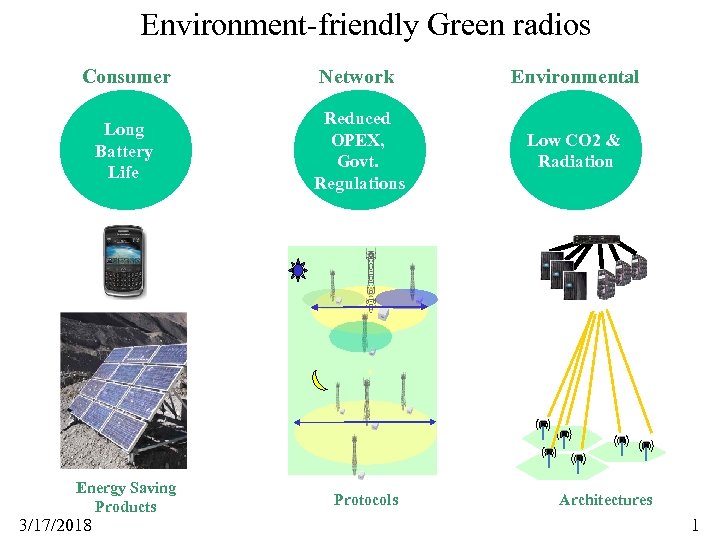
Environment-friendly Green radios Consumer Network Environmental Long Battery Life Reduced OPEX, Govt. Regulations Low CO 2 & Radiation Energy Saving Products 3/17/2018 Protocols Architectures 1
Objectives and Potential Requirements • Objectives – Enable Advanced Networks & Services • Potential Requirements (and Technology possibilities) – Peak rate – System metrics – New metrics 3/17/2018 1
Market developments present new Objectives • Future networks should support explosive mobile data traffic growth driven by – Large screen devices – Multimedia applications – More connected users & devices • Future networks should be optimized for mobile broadband traffic – Efficiently support low-mobility traffic – Efficiently support large number of mobile video users – Provide enhanced quality of experience for mobile internet applications • Future networks should reduce operator costs – Low power consumption at BS (green) – Network deployments should require minimal planning and maintenance • Future networks should interwork efficiently with other radio technologies – Converged multi-access networks – Multi-radio terminals 3/17/2018 1
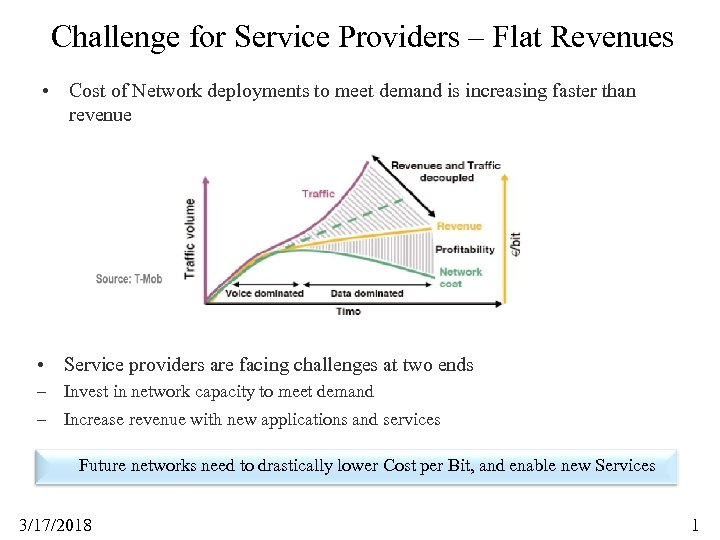
Challenge for Service Providers – Flat Revenues • Cost of Network deployments to meet demand is increasing faster than revenue • Service providers are facing challenges at two ends – Invest in network capacity to meet demand – Increase revenue with new applications and services Future networks need to drastically lower Cost per Bit, and enable new Services 3/17/2018 1
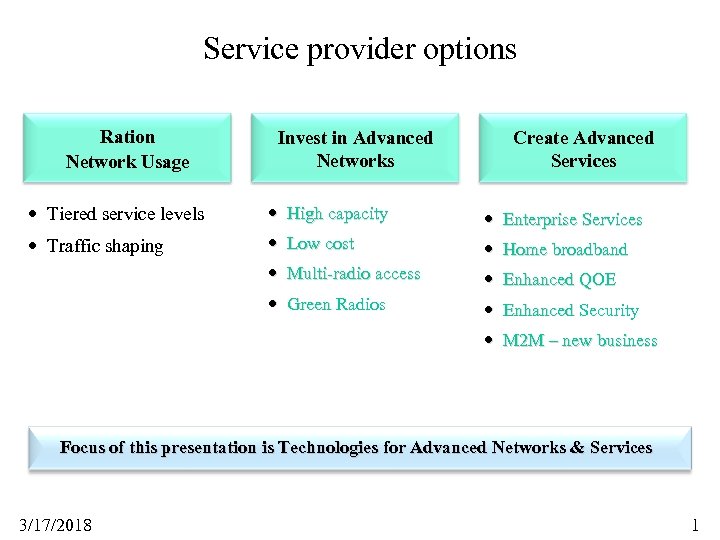
Service provider options Ration Network Usage Invest in Advanced Networks Create Advanced Services • Tiered service levels • High capacity • Enterprise Services • Traffic shaping • Low cost • Home broadband • Multi-radio access • Enhanced QOE • Green Radios • Enhanced Security • M 2 M – new business Focus of this presentation is Technologies for Advanced Networks & Services 3/17/2018 1
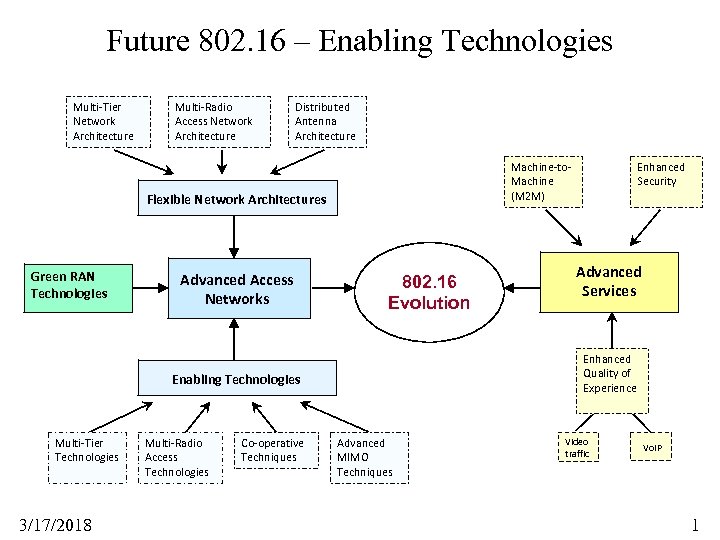
Future 802. 16 – Enabling Technologies Multi-Tier Network Architecture Multi-Radio Access Network Architecture Distributed Antenna Architecture Machine-to. Machine (M 2 M) Flexible Network Architectures Green RAN Technologies Advanced Access Networks 802. 16 Evolution 3/17/2018 Multi-Radio Access Technologies Co-operative Techniques Advanced Services Enhanced Quality of Experience Enabling Technologies Multi-Tier Technologies Enhanced Security Advanced MIMO Techniques Video traffic Vo. IP 1
Objectives and Potential Requirements • Objectives – Enable Advanced Networks & Services • Potential Requirements (and Technology possibilities) – Peak rate – System metrics – New metrics 3/17/2018 2
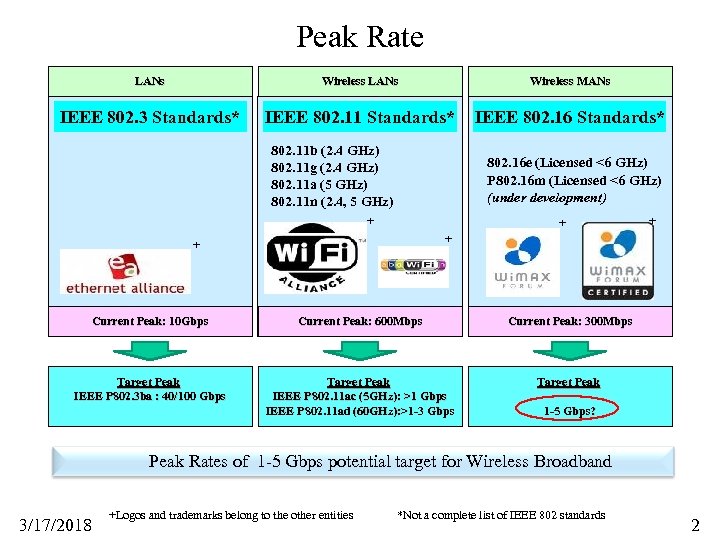
Peak Rate LANs Wireless MANs IEEE 802. 3 Standards* IEEE 802. 11 Standards* IEEE 802. 16 Standards* 802. 11 b (2. 4 GHz) 802. 11 g (2. 4 GHz) 802. 11 a (5 GHz) 802. 11 n (2. 4, 5 GHz) 802. 16 e (Licensed <6 GHz) P 802. 16 m (Licensed <6 GHz) (under development) + + + Current Peak: 10 Gbps Current Peak: 600 Mbps Current Peak: 300 Mbps Target Peak IEEE P 802. 3 ba : 40/100 Gbps Target Peak IEEE P 802. 11 ac (5 GHz): >1 Gbps IEEE P 802. 11 ad (60 GHz): >1 -3 Gbps Target Peak 1 -5 Gbps? Peak Rates of 1 -5 Gbps potential target for Wireless Broadband 3/17/2018 +Logos and trademarks belong to the other entities *Not a complete list of IEEE 802 standards 2
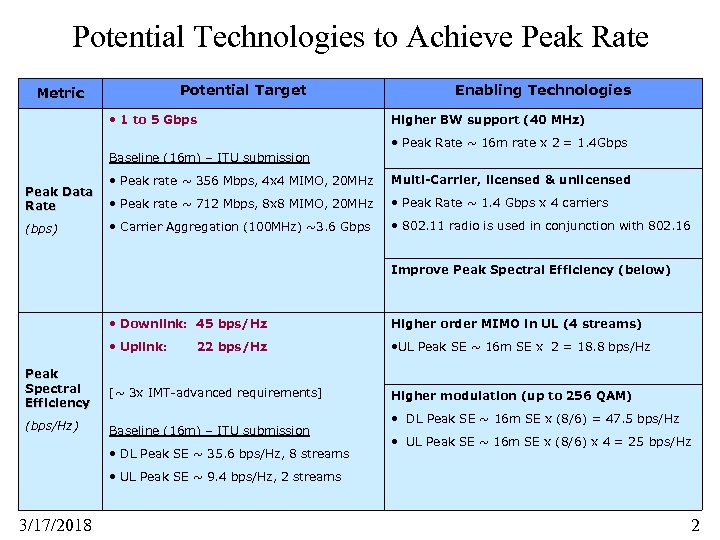
Potential Technologies to Achieve Peak Rate Potential Target Metric • 1 to 5 Gbps Enabling Technologies Higher BW support (40 MHz) • Peak Rate ~ 16 m rate x 2 = 1. 4 Gbps Baseline (16 m) – ITU submission Peak Data Rate (bps) • Peak rate ~ 356 Mbps, 4 x 4 MIMO, 20 MHz Multi-Carrier, licensed & unlicensed • Peak rate ~ 712 Mbps, 8 x 8 MIMO, 20 MHz • Peak Rate ~ 1. 4 Gbps x 4 carriers • Carrier Aggregation (100 MHz) ~3. 6 Gbps • 802. 11 radio is used in conjunction with 802. 16 Improve Peak Spectral Efficiency (below) • Downlink: 45 bps/Hz Higher order MIMO in UL (4 streams) • Uplink: • UL Peak SE ~ 16 m SE x 2 = 18. 8 bps/Hz 22 bps/Hz Peak Spectral Efficiency [~ 3 x IMT-advanced requirements] (bps/Hz) Baseline (16 m) – ITU submission • DL Peak SE ~ 35. 6 bps/Hz, 8 streams Higher modulation (up to 256 QAM) • DL Peak SE ~ 16 m SE x (8/6) = 47. 5 bps/Hz • UL Peak SE ~ 16 m SE x (8/6) x 4 = 25 bps/Hz • UL Peak SE ~ 9. 4 bps/Hz, 2 streams 3/17/2018 2
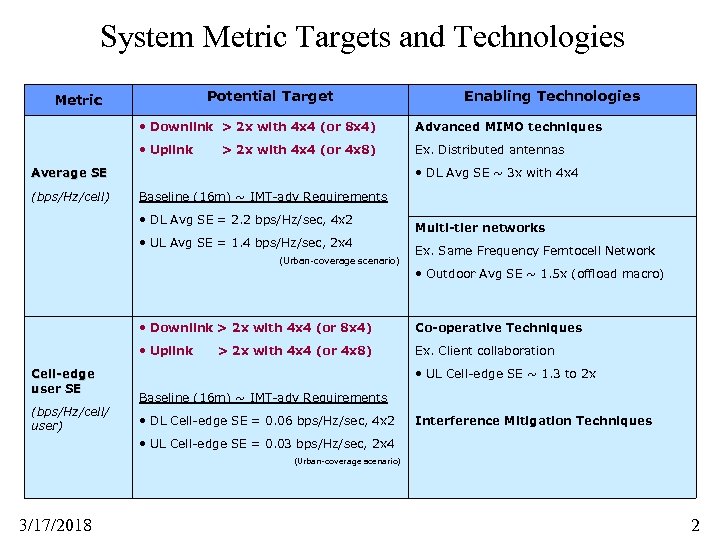
System Metric Targets and Technologies Potential Target Metric Enabling Technologies • Downlink > 2 x with 4 x 4 (or 8 x 4) Advanced MIMO techniques • Uplink Ex. Distributed antennas > 2 x with 4 x 4 (or 4 x 8) • DL Avg SE ~ 3 x with 4 x 4 Average SE (bps/Hz/cell) Baseline (16 m) ~ IMT-adv Requirements • DL Avg SE = 2. 2 bps/Hz/sec, 4 x 2 • UL Avg SE = 1. 4 bps/Hz/sec, 2 x 4 (Urban-coverage scenario) Multi-tier networks Ex. Same Frequency Femtocell Network • Outdoor Avg SE ~ 1. 5 x (offload macro) • Downlink > 2 x with 4 x 4 (or 8 x 4) • Uplink Cell-edge user SE (bps/Hz/cell/ user) Co-operative Techniques Ex. Client collaboration > 2 x with 4 x 4 (or 4 x 8) • UL Cell-edge SE ~ 1. 3 to 2 x Baseline (16 m) ~ IMT-adv Requirements • DL Cell-edge SE = 0. 06 bps/Hz/sec, 4 x 2 Interference Mitigation Techniques • UL Cell-edge SE = 0. 03 bps/Hz/sec, 2 x 4 (Urban-coverage scenario) 3/17/2018 2
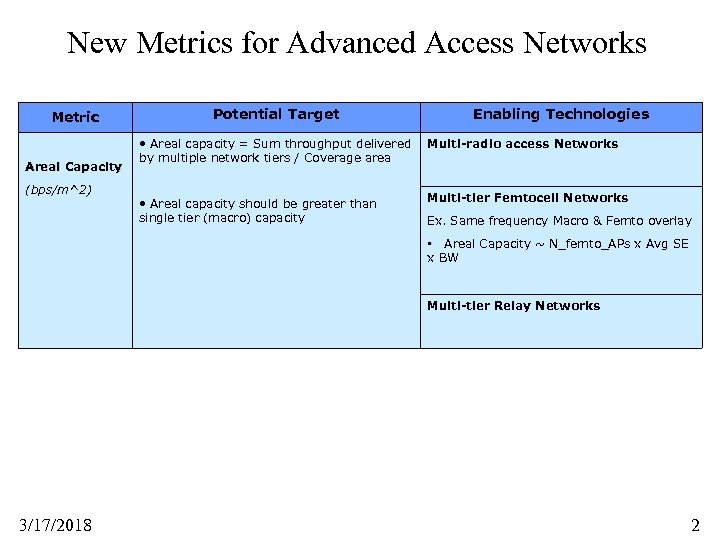
New Metrics for Advanced Access Networks Metric Areal Capacity (bps/m^2) Potential Target Enabling Technologies • Areal capacity = Sum throughput delivered by multiple network tiers / Coverage area Multi-radio access Networks • Areal capacity should be greater than single tier (macro) capacity Multi-tier Femtocell Networks Ex. Same frequency Macro & Femto overlay • Areal Capacity ~ N_femto_APs x Avg SE x BW Multi-tier Relay Networks 3/17/2018 2
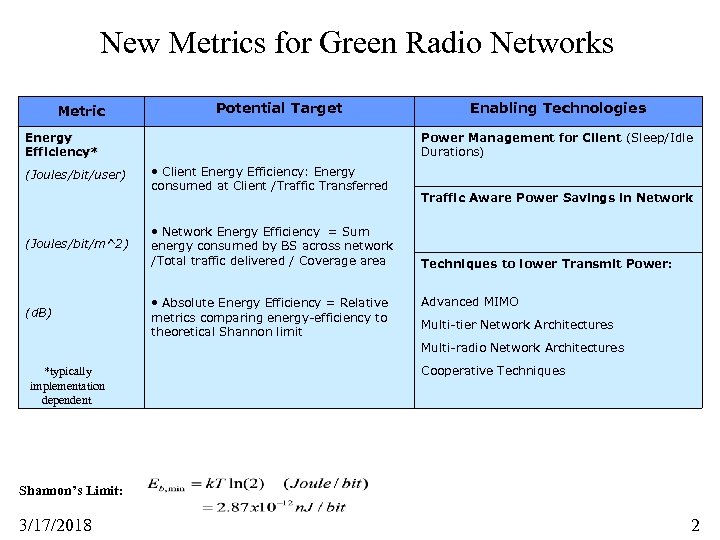
New Metrics for Green Radio Networks Metric Potential Target Energy Efficiency* (Joules/bit/user) (Joules/bit/m^2) (d. B) Enabling Technologies Power Management for Client (Sleep/Idle Durations) • Client Energy Efficiency: Energy consumed at Client /Traffic Transferred • Network Energy Efficiency = Sum energy consumed by BS across network /Total traffic delivered / Coverage area • Absolute Energy Efficiency = Relative metrics comparing energy-efficiency to theoretical Shannon limit Traffic Aware Power Savings in Network Techniques to lower Transmit Power: Advanced MIMO Multi-tier Network Architectures Multi-radio Network Architectures *typically implementation dependent Cooperative Techniques Shannon’s Limit: 3/17/2018 2
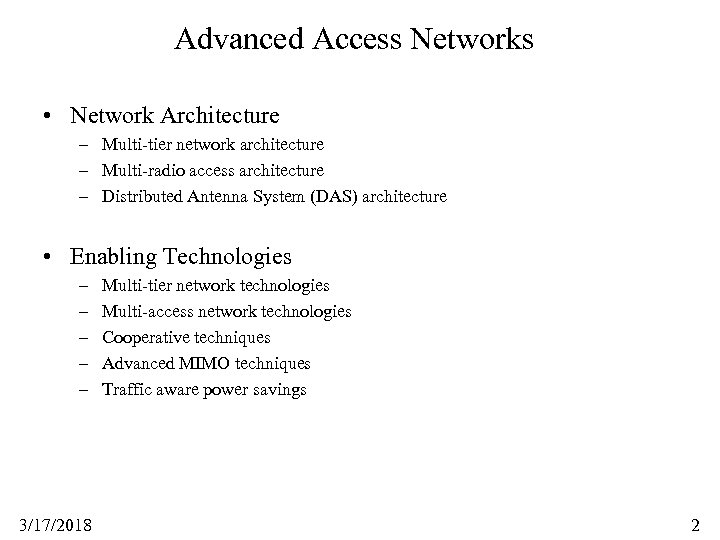
Advanced Access Networks • Network Architecture – Multi-tier network architecture – Multi-radio access architecture – Distributed Antenna System (DAS) architecture • Enabling Technologies – – – 3/17/2018 Multi-tier network technologies Multi-access network technologies Cooperative techniques Advanced MIMO techniques Traffic aware power savings 2
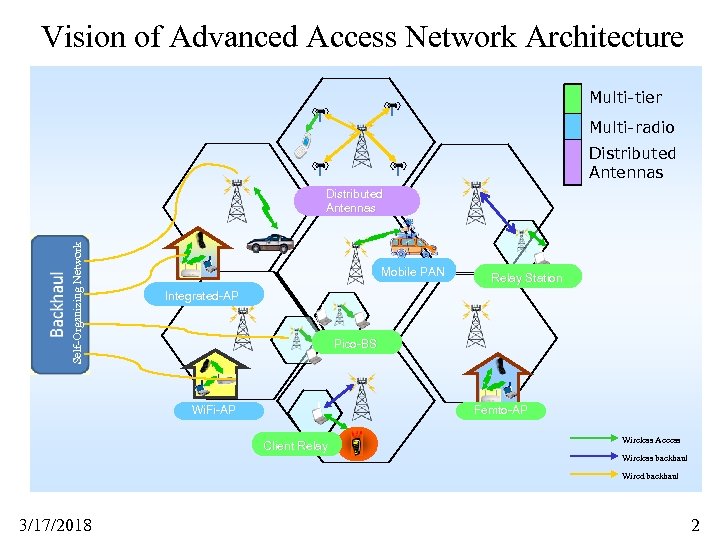
Vision of Advanced Access Network Architecture Multi-tier Multi-radio Distributed Antennas Self-Organizing Network Distributed Antennas Mobile PAN Relay Station Integrated-AP Pico-BS Wi. Fi-AP Femto-AP Client Relay Wireless Access Wireless backhaul Wired backhaul 3/17/2018 2
Enabling technologies for Multi-tier networks 3/17/2018 2
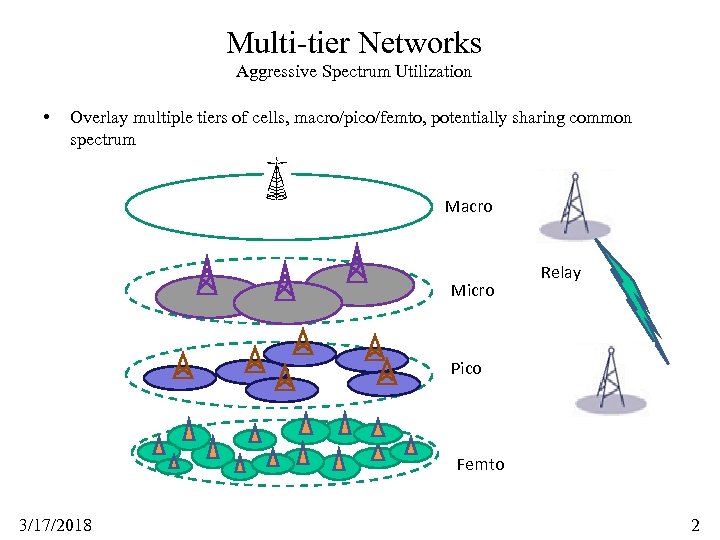
Multi-tier Networks Aggressive Spectrum Utilization • Overlay multiple tiers of cells, macro/pico/femto, potentially sharing common spectrum Macro Micro Relay Pico Femto 3/17/2018 2
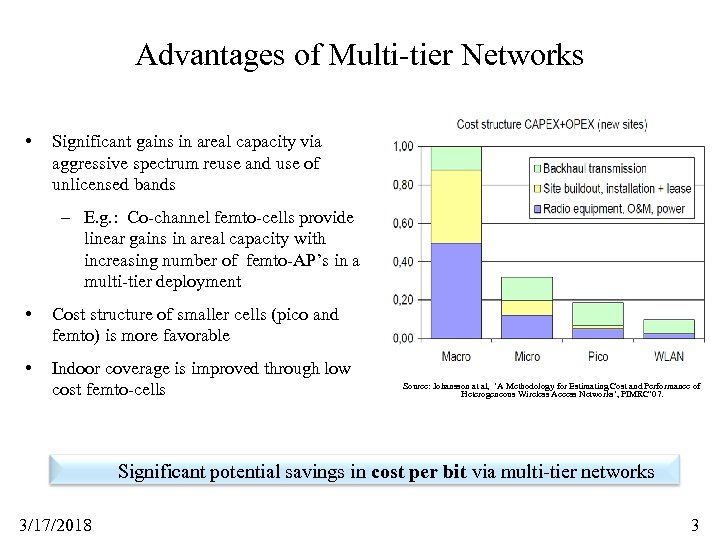
Advantages of Multi-tier Networks • Significant gains in areal capacity via aggressive spectrum reuse and use of unlicensed bands – E. g. : Co-channel femto-cells provide linear gains in areal capacity with increasing number of femto-AP’s in a multi-tier deployment • Cost structure of smaller cells (pico and femto) is more favorable • Indoor coverage is improved through low cost femto-cells Source: Johansson at al, ‘A Methodology for Estimating Cost and Performance of Heterogeneous Wireless Access Networks’, PIMRC’ 07. Significant potential savings in cost per bit via multi-tier networks 3/17/2018 3
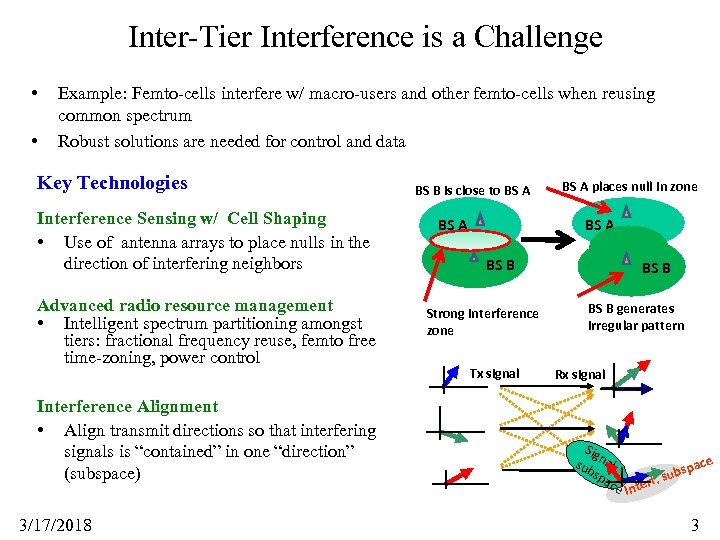
Inter-Tier Interference is a Challenge • • Example: Femto-cells interfere w/ macro-users and other femto-cells when reusing common spectrum Robust solutions are needed for control and data Key Technologies Interference Sensing w/ Cell Shaping • Use of antenna arrays to place nulls in the direction of interfering neighbors Advanced radio resource management • Intelligent spectrum partitioning amongst tiers: fractional frequency reuse, femto free time-zoning, power control Interference Alignment • Align transmit directions so that interfering signals is “contained” in one “direction” (subspace) 3/17/2018 BS B is close to BS A places null in zone BS A BS B Strong interference zone Tx signal BS B generates irregular pattern Rx signal Sig sub nal pace spa ubs ce nterf. s I 3
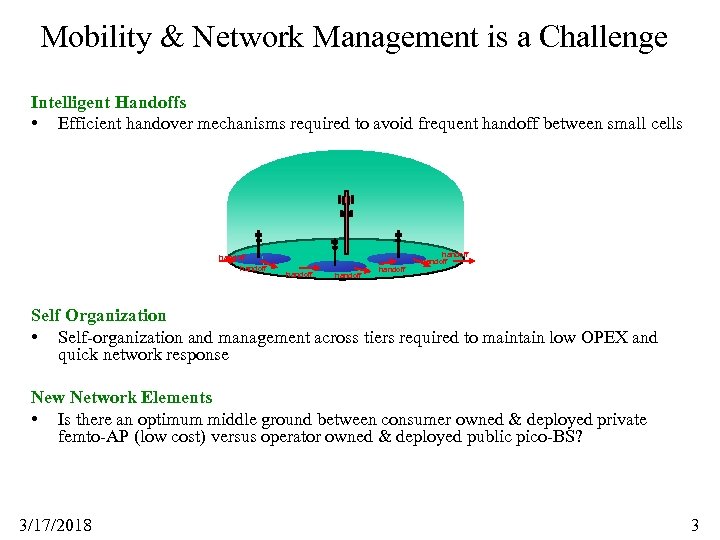
Mobility & Network Management is a Challenge Intelligent Handoffs • Efficient handover mechanisms required to avoid frequent handoff between small cells handoff handoff Self Organization • Self-organization and management across tiers required to maintain low OPEX and quick network response New Network Elements • Is there an optimum middle ground between consumer owned & deployed private femto-AP (low cost) versus operator owned & deployed public pico-BS? 3/17/2018 3
Enabling technologies for Multi-radio access networks 3/17/2018 3
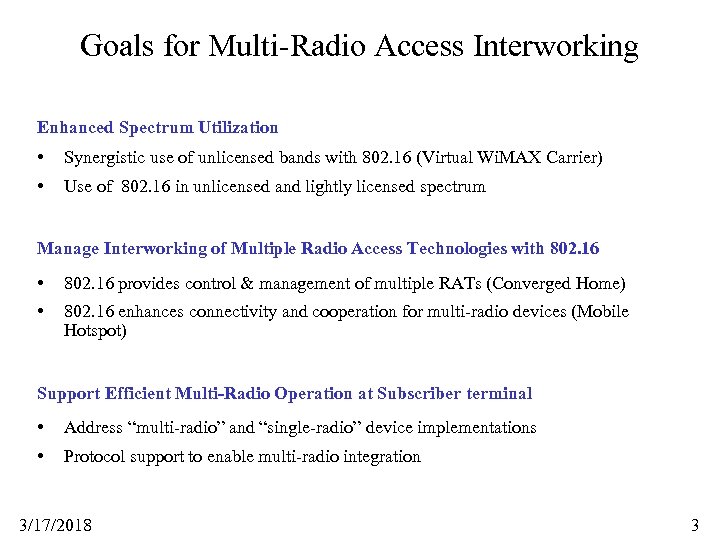
Goals for Multi-Radio Access Interworking Enhanced Spectrum Utilization • Synergistic use of unlicensed bands with 802. 16 (Virtual Wi. MAX Carrier) • Use of 802. 16 in unlicensed and lightly licensed spectrum Manage Interworking of Multiple Radio Access Technologies with 802. 16 • 802. 16 provides control & management of multiple RATs (Converged Home) • 802. 16 enhances connectivity and cooperation for multi-radio devices (Mobile Hotspot) Support Efficient Multi-Radio Operation at Subscriber terminal • Address “multi-radio” and “single-radio” device implementations • Protocol support to enable multi-radio integration 3/17/2018 3
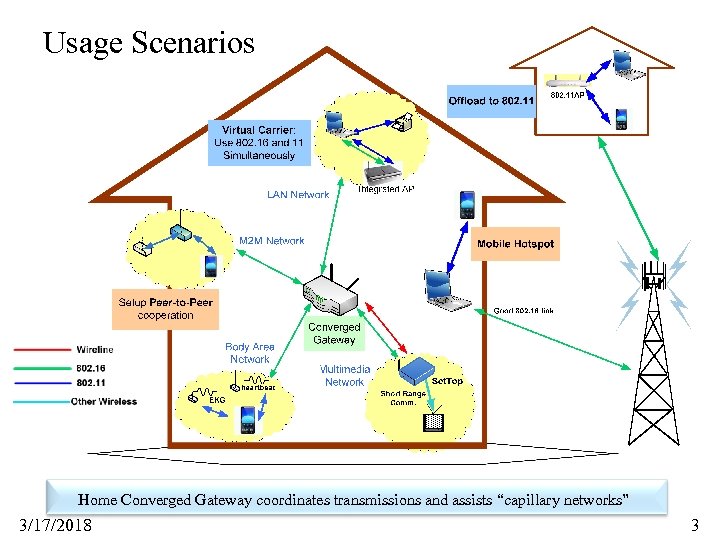
Usage Scenarios Home Converged Gateway coordinates transmissions and assists “capillary networks” 3/17/2018 3
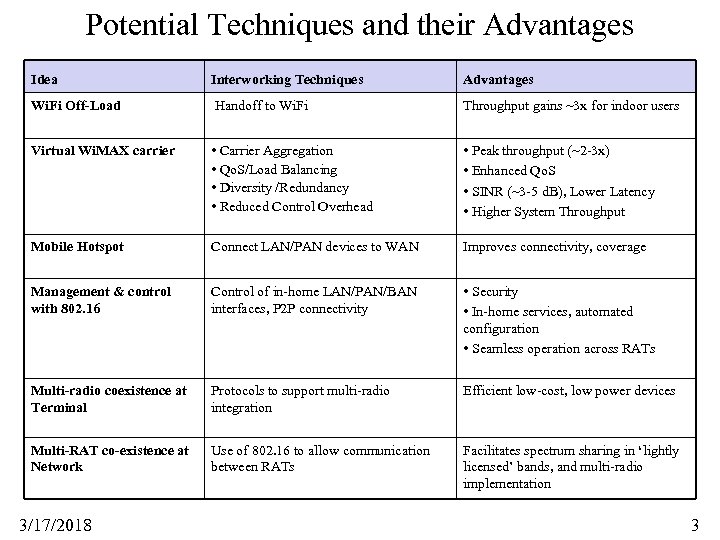
Potential Techniques and their Advantages Idea Interworking Techniques Advantages Wi. Fi Off-Load Handoff to Wi. Fi Throughput gains ~3 x for indoor users Virtual Wi. MAX carrier • Carrier Aggregation • Qo. S/Load Balancing • Diversity /Redundancy • Reduced Control Overhead • Peak throughput (~2 -3 x) • Enhanced Qo. S • SINR (~3 -5 d. B), Lower Latency • Higher System Throughput Mobile Hotspot Connect LAN/PAN devices to WAN Improves connectivity, coverage Management & control with 802. 16 Control of in-home LAN/PAN/BAN interfaces, P 2 P connectivity • Security • In-home services, automated configuration • Seamless operation across RATs Multi-radio coexistence at Terminal Protocols to support multi-radio integration Efficient low-cost, low power devices Multi-RAT co-existence at Network Use of 802. 16 to allow communication between RATs Facilitates spectrum sharing in ‘lightly licensed’ bands, and multi-radio implementation 3/17/2018 3
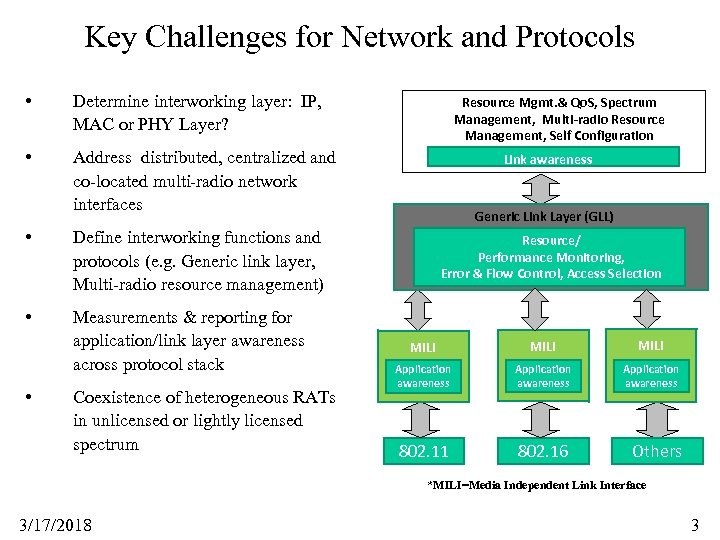
Key Challenges for Network and Protocols • Determine interworking layer: IP, MAC or PHY Layer? • Address distributed, centralized and co-located multi-radio network interfaces • Measurements & reporting for application/link layer awareness across protocol stack Link awareness Link Generic Link Layer (GLL) awareness Define interworking functions and protocols (e. g. Generic link layer, Multi-radio resource management) • Resource Mgmt. & Qo. S, Spectrum Management, Multi-radio Resource Management, Self Configuration • Coexistence of heterogeneous RATs in unlicensed or lightly licensed spectrum Resource/ Performance Monitoring, Error & Flow Control, Access Selection MILI Application awareness 802. 11 802. 16 Others *MILI=Media Independent Link Interface 3/17/2018 3
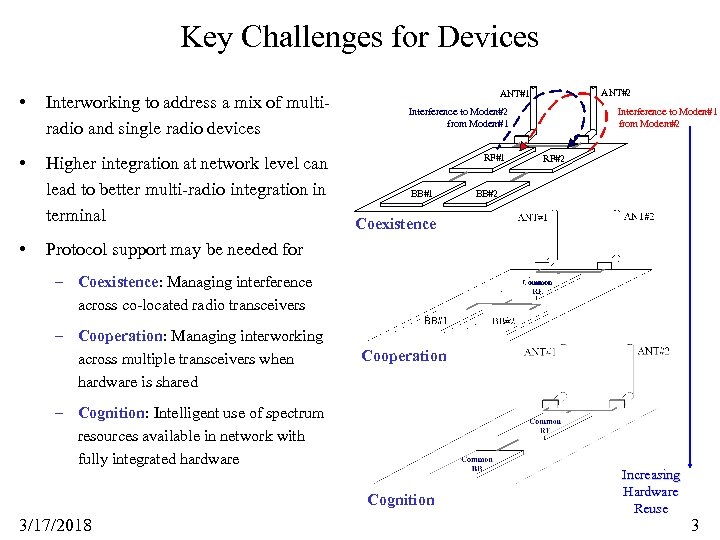
Key Challenges for Devices • Interworking to address a mix of multiradio and single radio devices • Higher integration at network level can lead to better multi-radio integration in terminal • ANT#2 ANT#1 Interference to Modem #2 from Modem #1 RF#1 BB#1 Interference to Modem #1 from Modem#2 RF#2 BB#2 Coexistence Protocol support may be needed for – Coexistence: Managing interference across co-located radio transceivers – Cooperation: Managing interworking across multiple transceivers when hardware is shared Cooperation – Cognition: Intelligent use of spectrum resources available in network with fully integrated hardware Cognition 3/17/2018 Increasing Hardware Reuse 3

Cooperative techniques 3/17/2018 3
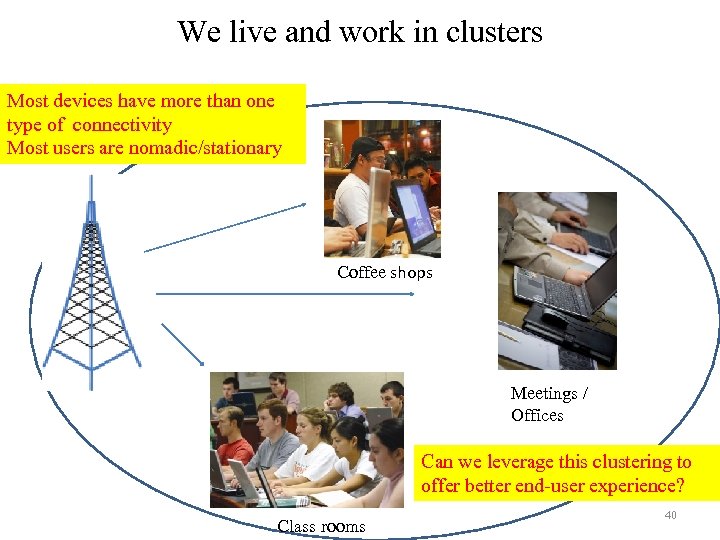
We live and work in clusters Most devices have more than one type of connectivity Most users are nomadic/stationary Coffee shops Meetings / Offices Can we leverage this clustering to offer better end-user experience? Class rooms 40
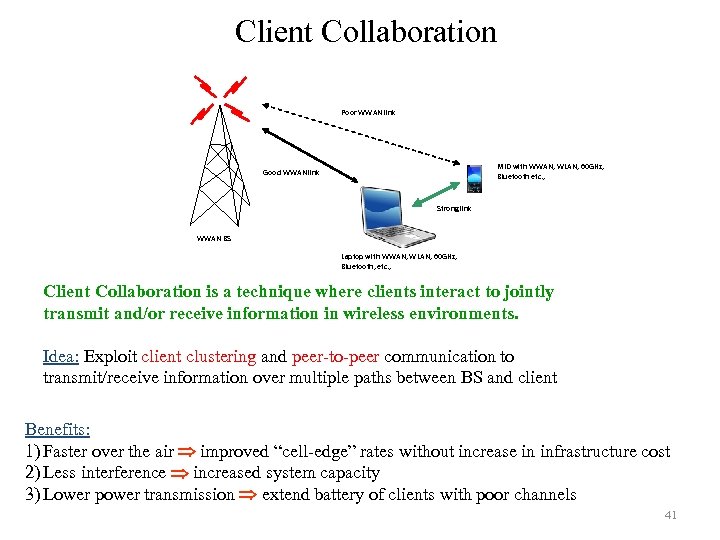
Client Collaboration Poor WWAN link MID with WWAN, WLAN, 60 GHz, Bluetooth etc. , Good WWAN link Strong link WWAN BS Laptop with WWAN, WLAN, 60 GHz, Bluetooth, etc. , Client Collaboration is a technique where clients interact to jointly transmit and/or receive information in wireless environments. Idea: Exploit client clustering and peer-to-peer communication to transmit/receive information over multiple paths between BS and client Benefits: 1) Faster over the air improved “cell-edge” rates without increase in infrastructure cost 2) Less interference increased system capacity 3) Lower power transmission extend battery of clients with poor channels 41
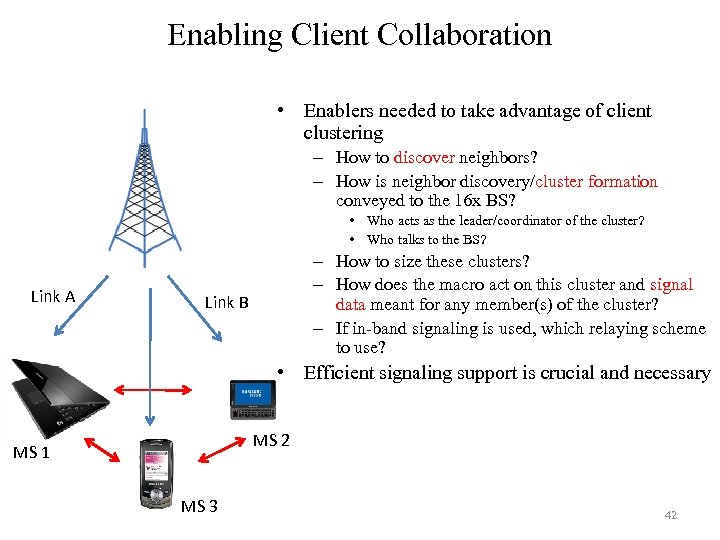
Enabling Client Collaboration • Enablers needed to take advantage of client clustering – How to discover neighbors? – How is neighbor discovery/cluster formation conveyed to the 16 x BS? • Who acts as the leader/coordinator of the cluster? • Who talks to the BS? Link A – How to size these clusters? – How does the macro act on this cluster and signal data meant for any member(s) of the cluster? – If in-band signaling is used, which relaying scheme to use? Link B • Efficient signaling support is crucial and necessary MS 2 MS 1 MS 3 42
Advanced MIMO techniques 43
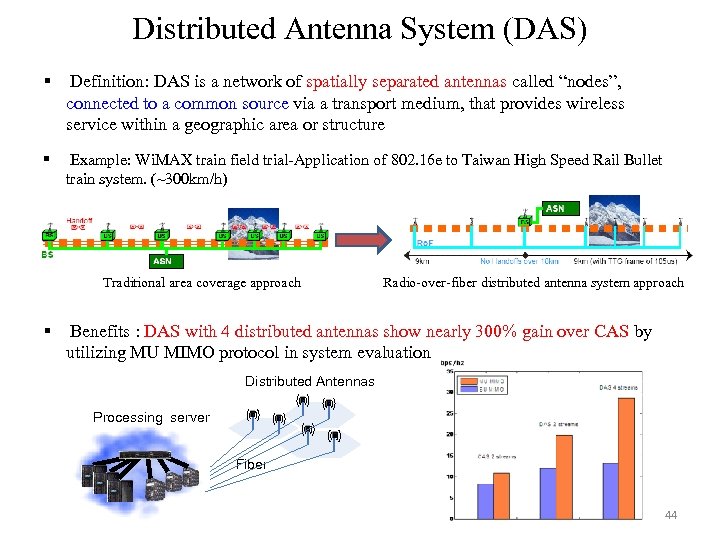
Distributed Antenna System (DAS) § Definition: DAS is a network of spatially separated antennas called “nodes”, connected to a common source via a transport medium, that provides wireless service within a geographic area or structure § Example: Wi. MAX train field trial-Application of 802. 16 e to Taiwan High Speed Rail Bullet train system. (~300 km/h) Traditional area coverage approach § Radio-over-fiber distributed antenna system approach Benefits : DAS with 4 distributed antennas show nearly 300% gain over CAS by utilizing MU MIMO protocol in system evaluation Distributed Antennas Processing server Fiber 44
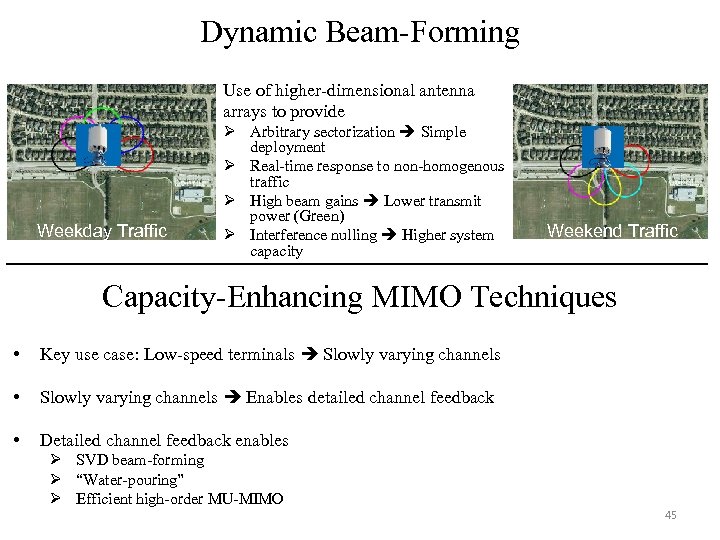
Dynamic Beam-Forming Use of higher-dimensional antenna arrays to provide Weekday Traffic Ø Arbitrary sectorization Simple deployment Ø Real-time response to non-homogenous traffic Ø High beam gains Lower transmit power (Green) Ø Interference nulling Higher system capacity Weekend Traffic Weekday Traffic Capacity-Enhancing MIMO Techniques • Key use case: Low-speed terminals Slowly varying channels • Slowly varying channels Enables detailed channel feedback • Detailed channel feedback enables Ø SVD beam-forming Ø “Water-pouring” Weekend Traffic Ø Efficient high-order MU-MIMO 45
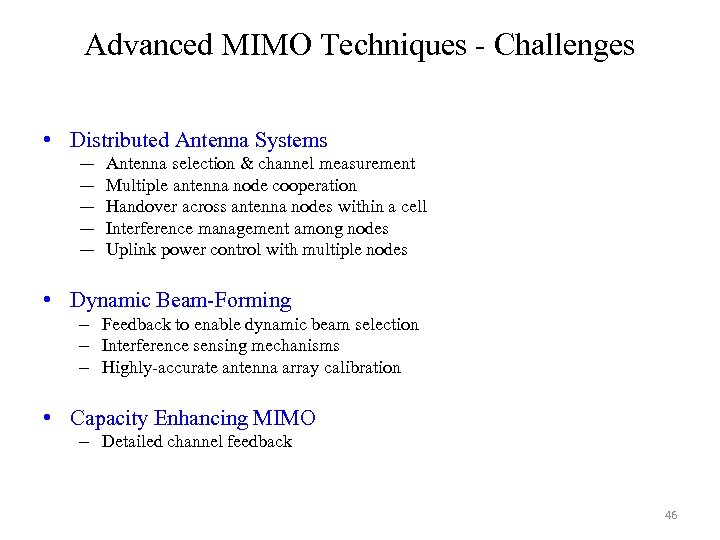
Advanced MIMO Techniques - Challenges • Distributed Antenna Systems — — — Antenna selection & channel measurement Multiple antenna node cooperation Handover across antenna nodes within a cell Interference management among nodes Uplink power control with multiple nodes • Dynamic Beam-Forming – Feedback to enable dynamic beam selection – Interference sensing mechanisms – Highly-accurate antenna array calibration • Capacity Enhancing MIMO – Detailed channel feedback 46

Traffic aware power savings 3/17/2018 4
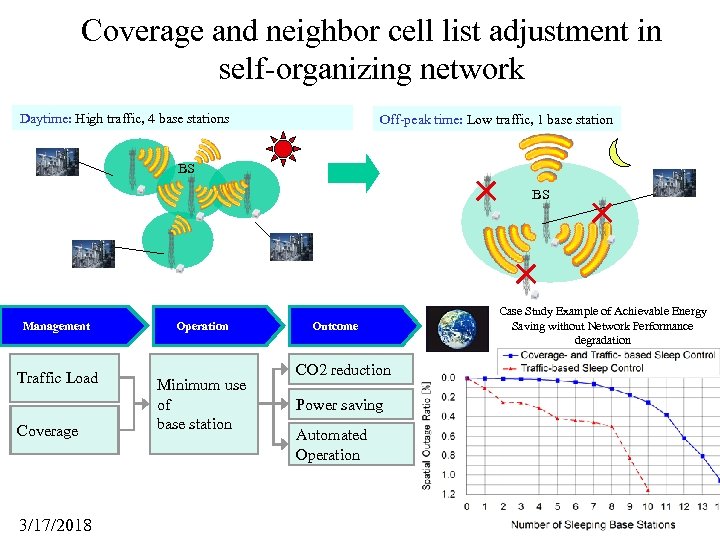
Coverage and neighbor cell list adjustment in self-organizing network Daytime: High traffic, 4 base stations Off-peak time: Low traffic, 1 base station BS × × Management Traffic Load Coverage 3/17/2018 Operation Minimum use of base station Outcome Case Study Example of Achievable Energy Saving without Network Performance degradation CO 2 reduction Power saving Automated Operation 4
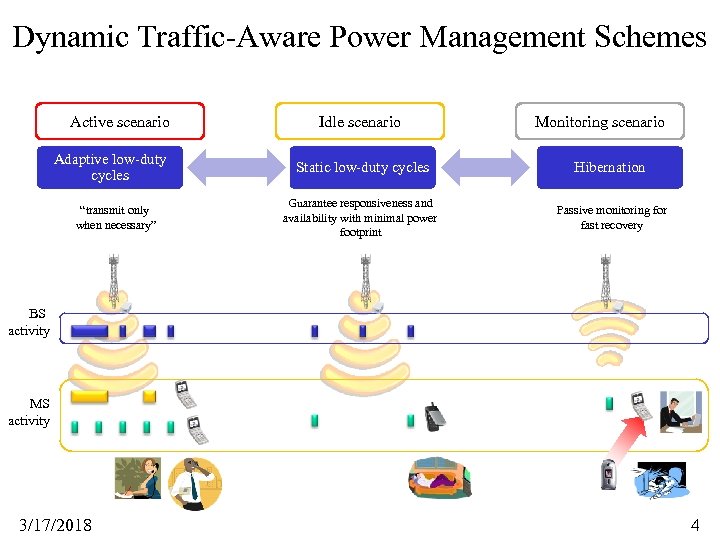
Dynamic Traffic-Aware Power Management Schemes Active scenario Adaptive low-duty cycles “transmit only when necessary” Idle scenario Monitoring scenario Static low-duty cycles Hibernation Guarantee responsiveness and availability with minimal power footprint Passive monitoring for fast recovery BS activity MS activity 3/17/2018 4
Advanced Services • Machine-to-Machine communications • Enhanced Quality of Experience for voice & video • Enhancements for Security 3/17/2018 5
Machine-to-Machine communications (M 2 M) 3/17/2018 5
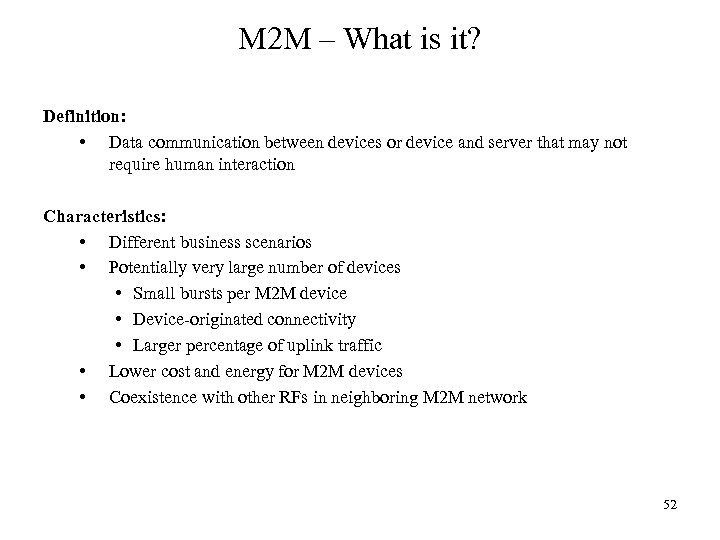
M 2 M – What is it? Definition: • Data communication between devices or device and server that may not require human interaction Characteristics: • Different business scenarios • Potentially very large number of devices • Small bursts per M 2 M device • Device-originated connectivity • Larger percentage of uplink traffic • Lower cost and energy for M 2 M devices • Coexistence with other RFs in neighboring M 2 M network 52
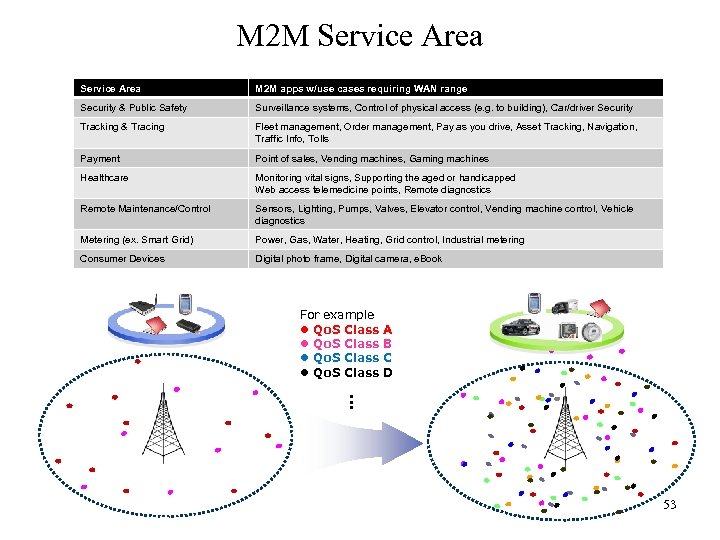
M 2 M Service Area M 2 M apps w/use cases requiring WAN range Security & Public Safety Surveillance systems, Control of physical access (e. g. to building), Car/driver Security Tracking & Tracing Fleet management, Order management, Pay as you drive, Asset Tracking, Navigation, Traffic Info, Tolls Payment Point of sales, Vending machines, Gaming machines Healthcare Monitoring vital signs, Supporting the aged or handicapped Web access telemedicine points, Remote diagnostics Remote Maintenance/Control Sensors, Lighting, Pumps, Valves, Elevator control, Vending machine control, Vehicle diagnostics Metering (ex. Smart Grid) Power, Gas, Water, Heating, Grid control, Industrial metering Consumer Devices Digital photo frame, Digital camera, e. Book For example l Qo. S Class A B C D … 53
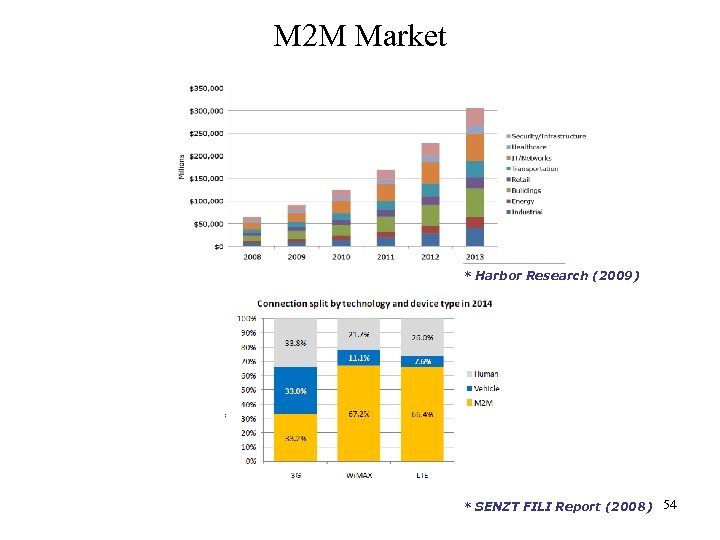
M 2 M Market * Harbor Research (2009) * SENZT FILI Report (2008) 54
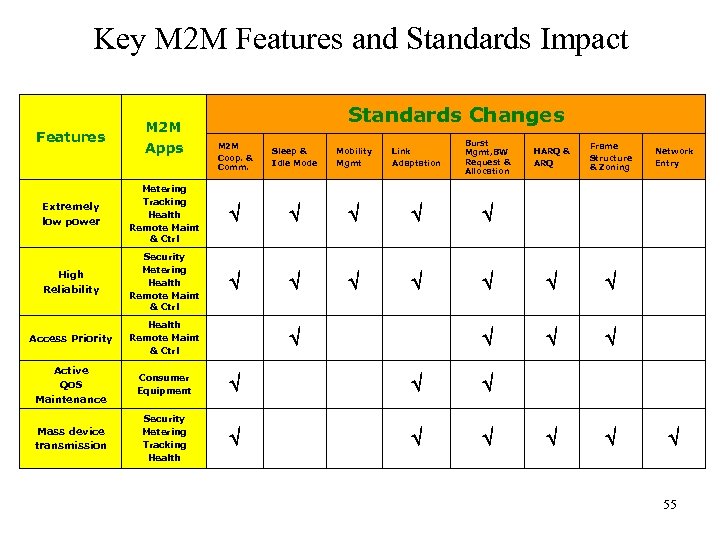
Key M 2 M Features and Standards Impact Features M 2 M Apps Standards Changes M 2 M Coop. & Comm. Sleep & Idle Mode Mobility Mgmt Link Adaptation Burst Mgmt, BW Request & Allocation Extremely low power Metering Tracking Health Remote Maint & Ctrl High Reliability Security Metering Health Remote Maint & Ctrl Access Priority Health Remote Maint & Ctrl Active Qo. S Maintenance Consumer Equipment Mass device transmission Security Metering Tracking Health Frame Structure & Zoning HARQ & ARQ Network Entry 55
Enhanced Quality of Experience (QOE) for voice & video 3/17/2018 5
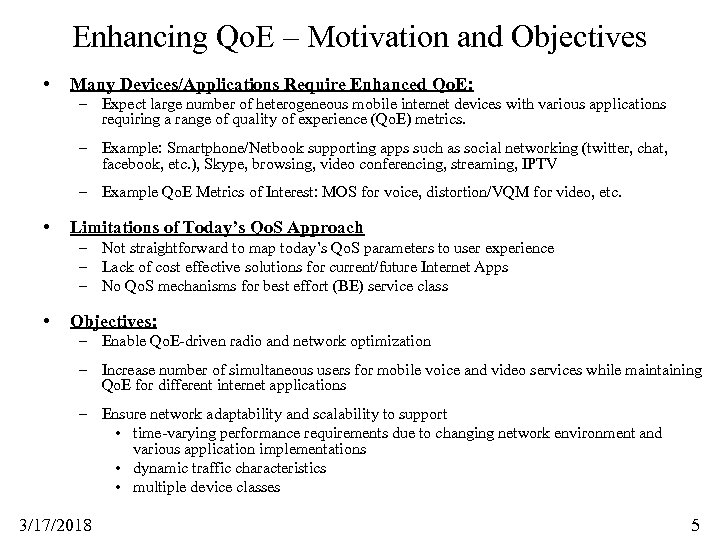
Enhancing Qo. E – Motivation and Objectives • Many Devices/Applications Require Enhanced Qo. E: – Expect large number of heterogeneous mobile internet devices with various applications requiring a range of quality of experience (Qo. E) metrics. – Example: Smartphone/Netbook supporting apps such as social networking (twitter, chat, facebook, etc. ), Skype, browsing, video conferencing, streaming, IPTV – Example Qo. E Metrics of Interest: MOS for voice, distortion/VQM for video, etc. • Limitations of Today’s Qo. S Approach – Not straightforward to map today’s Qo. S parameters to user experience – Lack of cost effective solutions for current/future Internet Apps – No Qo. S mechanisms for best effort (BE) service class • Objectives: – Enable Qo. E-driven radio and network optimization – Increase number of simultaneous users for mobile voice and video services while maintaining Qo. E for different internet applications – Ensure network adaptability and scalability to support • time-varying performance requirements due to changing network environment and various application implementations • dynamic traffic characteristics • multiple device classes 3/17/2018 5
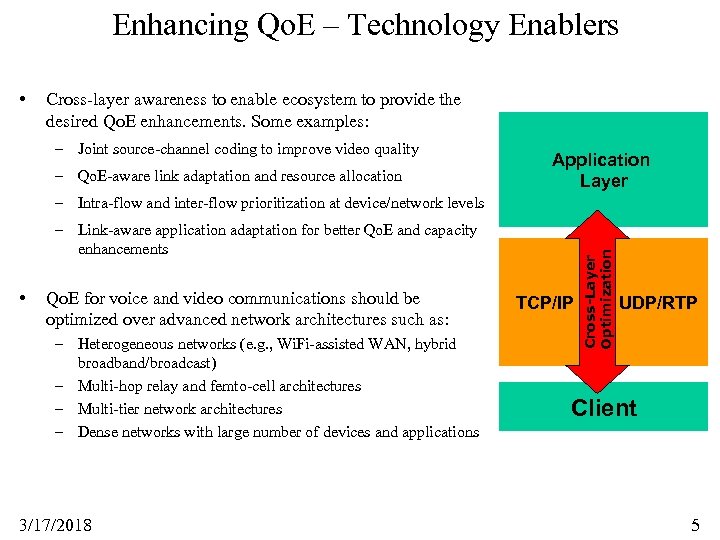
Enhancing Qo. E – Technology Enablers • Cross-layer awareness to enable ecosystem to provide the desired Qo. E enhancements. Some examples: – Joint source-channel coding to improve video quality – Qo. E-aware link adaptation and resource allocation Application Layer – Link-aware application adaptation for better Qo. E and capacity enhancements • Qo. E for voice and video communications should be optimized over advanced network architectures such as: – Heterogeneous networks (e. g. , Wi. Fi-assisted WAN, hybrid broadband/broadcast) – Multi-hop relay and femto-cell architectures – Multi-tier network architectures – Dense networks with large number of devices and applications 3/17/2018 TCP/IP Cross-Layer Optimization – Intra-flow and inter-flow prioritization at device/network levels UDP/RTP Client 5
Enhancing Qo. E - Recommendations – Define new system requirements for Mobile Internet - voice and video services, e. g. , minimum number of video users, etc. – Develop new air-interface specifications to meet target requirements for user Qo. E. The standard hooks are needed • To exchange application level information for better radio/network adaptation and resource management • To exchange radio/network level information for better application adaptation • To enable standard mechanisms to support Qo. E-aware adaptation and resource management for multiple flows 3/17/2018 5

Enhancements for Security 3/17/2018 6
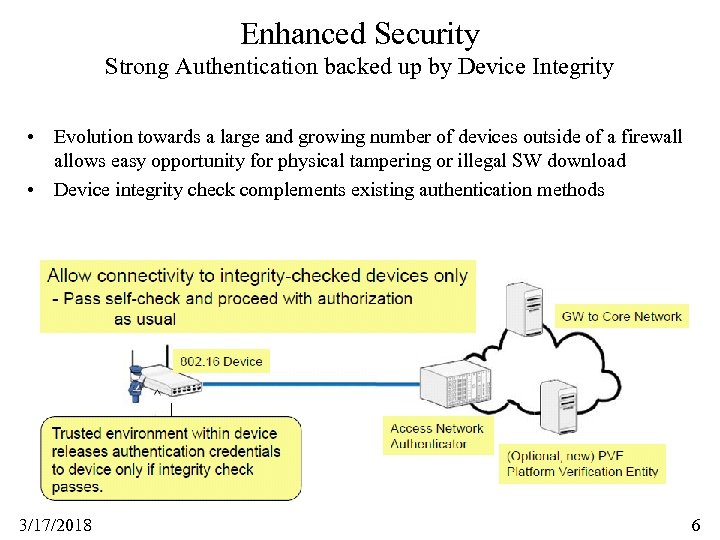
Enhanced Security Strong Authentication backed up by Device Integrity • Evolution towards a large and growing number of devices outside of a firewall allows easy opportunity for physical tampering or illegal SW download • Device integrity check complements existing authentication methods 3/17/2018 6

Summary and Recommendations 3/17/2018 6
In Summary - Key Technical Features • Very high Peak throughput (> 1 Gbps) – Support for bandwidths greater than 20 MHz • Advanced Access Networks – New flexible network architectures – Low cost deployments – Enabling technologies providing • Higher Spectral Efficiency (> 2 x) • High Areal Capacity • Improved Energy Efficiency • Advanced Services – Enhancements for video, voice & security – Support for new M 2 M service 3/17/2018 6
Call for Interest Summary • Plan to initiate study for the following topics in 802. 16 Working Group – – Advanced Access Networks: Architectures (ex. Multi-Tier, Multi-radio Access, Distributed Antennas), and Enabling Technologies (ex. Multi-tier network technologies, Multi-access network technologies, Cooperative techniques, Advanced MIMO techniques, Traffic aware power savings) Advanced Services: M 2 M, Improved Qo. E, Security • Plan to initiate collaboration on studying some of these topics with other 802 Working Groups – – 802. 11 – Wi. Fi offload, unlicensed spectrum utilization, interworking 802. 21 – Flexible protocols for interworking of multi-radio interfaces 802. 15 – Interworking in converged home scenario 802 Emergency Services ECSG • Plan to conduct study of these topics together towards identifying near term and long term projects in 802. 16 • Plan to initiate one or more PARs for some of these topics in 2010 • We hope interested individuals will join this effort to help define the evolution of IEEE 802. 16 standards based networks 3/17/2018 6

Backup 3/17/2018 6
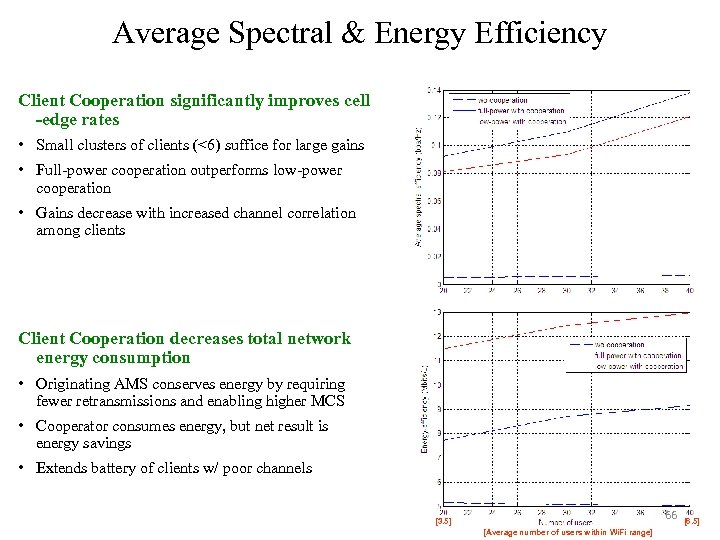
Average Spectral & Energy Efficiency Client Cooperation significantly improves cell -edge rates • Small clusters of clients (<6) suffice for large gains • Full-power cooperation outperforms low-power cooperation • Gains decrease with increased channel correlation among clients Client Cooperation decreases total network energy consumption • Originating AMS conserves energy by requiring fewer retransmissions and enabling higher MCS • Cooperator consumes energy, but net result is energy savings • Extends battery of clients w/ poor channels 66 [3. 5] [Average number of users within Wi. Fi range] [6. 5]
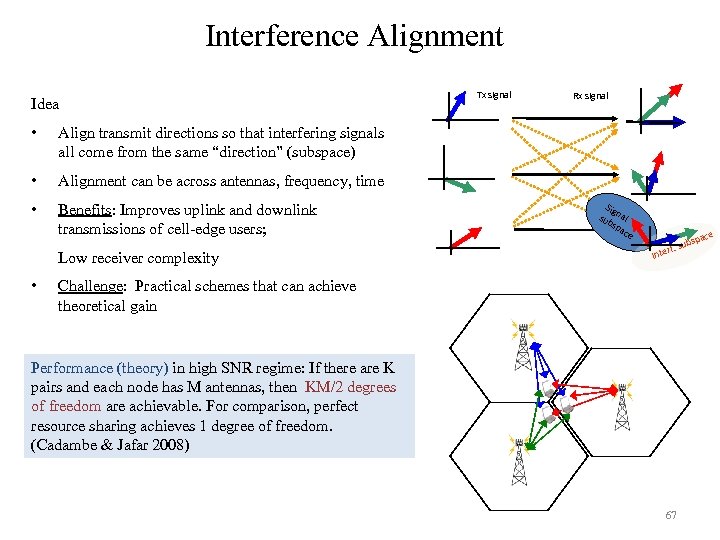
Interference Alignment Idea • Alignment can be across antennas, frequency, time • Benefits: Improves uplink and downlink transmissions of cell-edge users; Rx signal Align transmit directions so that interfering signals all come from the same “direction” (subspace) • Tx signal Low receiver complexity • Sig sub nal spa ce e spac sub erf. Int Challenge: Practical schemes that can achieve theoretical gain Performance (theory) in high SNR regime: If there are K pairs and each node has M antennas, then KM/2 degrees of freedom are achievable. For comparison, perfect resource sharing achieves 1 degree of freedom. (Cadambe & Jafar 2008) 67
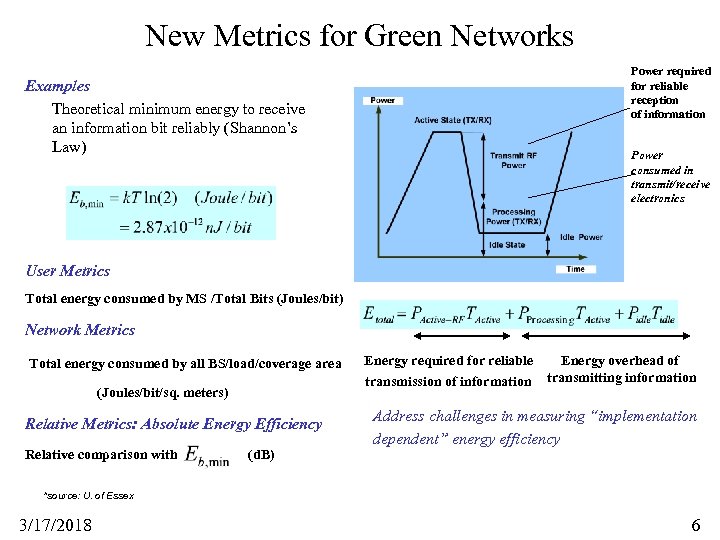
New Metrics for Green Networks Examples Theoretical minimum energy to receive an information bit reliably (Shannon’s Law) Power required for reliable reception of information Power consumed in transmit/receive electronics User Metrics Total energy consumed by MS /Total Bits (Joules/bit) Network Metrics Total energy consumed by all BS/load/coverage area (Joules/bit/sq. meters) Relative Metrics: Absolute Energy Efficiency Relative comparison with (d. B) Energy required for reliable Energy overhead of transmission of information transmitting information Address challenges in measuring “implementation dependent” energy efficiency *source: U. of Essex 3/17/2018 6

Smart Grids/GRIDMAN 3/17/2018 6
Selected utility MAN-based applications* Not exhaustive –to illustrate a range of requirements taken from C 80216 gman-10/0007 • Advanced Metering Infrastructure (AMI) • Distributed Energy Resources (DER) Integration • SCADA and Distribution Automation (DA) • Advanced DA (“Self-Healing Circuits”) • Wide-Area Situational Awareness (WASA) * - The Greater Reliability in Disrupted Metropolitan Area Network (GRIDMAN) study group was formed in Nov 2009 to study synergies between the applications previously studied in the Network Robustness and Reliability (NRR) Ad Hoc and Smart Grid applications. They have developed a draft PAR which partially addresses the needs of the application above: IEEE 802. 16 -10/0013 3/17/2018 7

Self-healing Networks 3/17/2018 7
Self-healing Networks Preface • “To have a self-healing network, you cannot rely on a single point of failure, as you would with Wi. Max or cellular technology” http: //www. greentechmedia. com/articles/read/smart-grid-networks-now-vs-the-future / 72
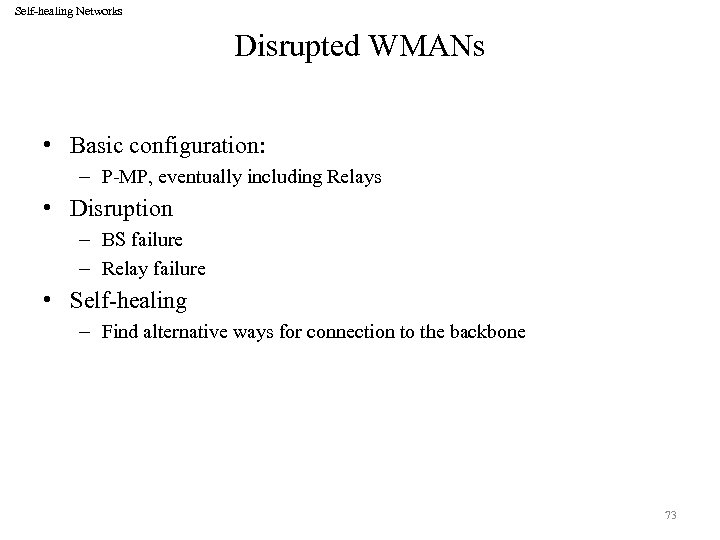
Self-healing Networks Disrupted WMANs • Basic configuration: – P-MP, eventually including Relays • Disruption – BS failure – Relay failure • Self-healing – Find alternative ways for connection to the backbone 73
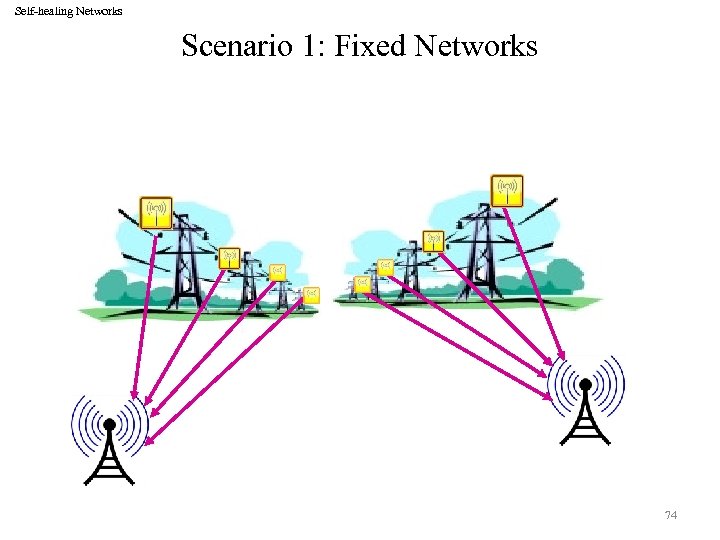
Self-healing Networks Scenario 1: Fixed Networks 74
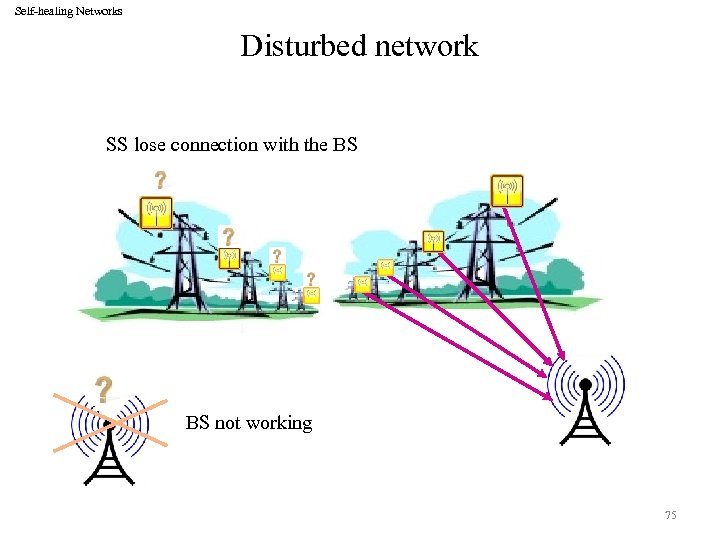
Self-healing Networks Disturbed network SS lose connection with the BS BS not working 75
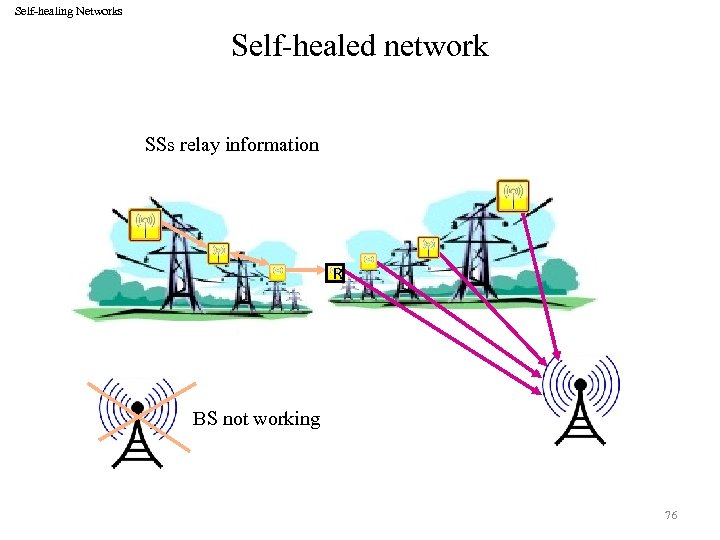
Self-healing Networks Self-healed network SSs relay information R BS not working 76
Self-healing Networks Healing solutions and topics • SS to SS communication – Multi-hop relaying function included • PHY changes to SS • Ability to connect through a neighbor network – May belong or not to the same operator • Access rights? • Security? – May use or not the same frequency • Hand-over between different frequency bands • Hand-over between licensed and un-licensed – May have or not enough available capacity • New traffic classes and real-time spread of the traffic across multiple frequency allocations 77
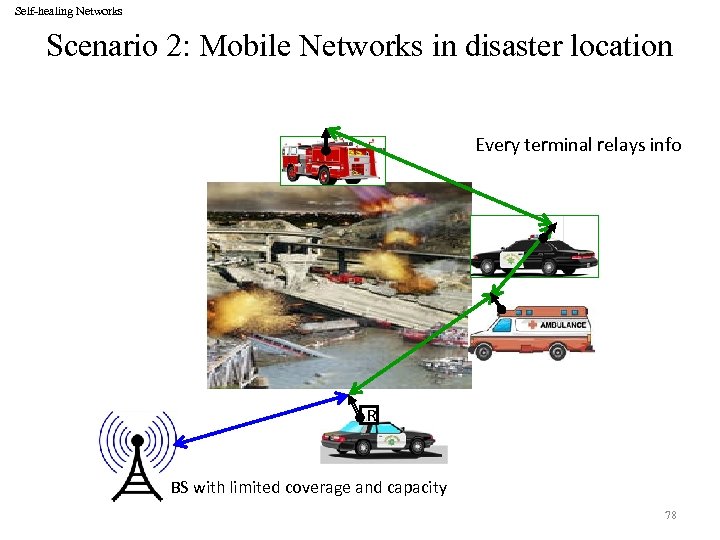
Self-healing Networks Scenario 2: Mobile Networks in disaster location Every terminal relays info R BS with limited coverage and capacity 78
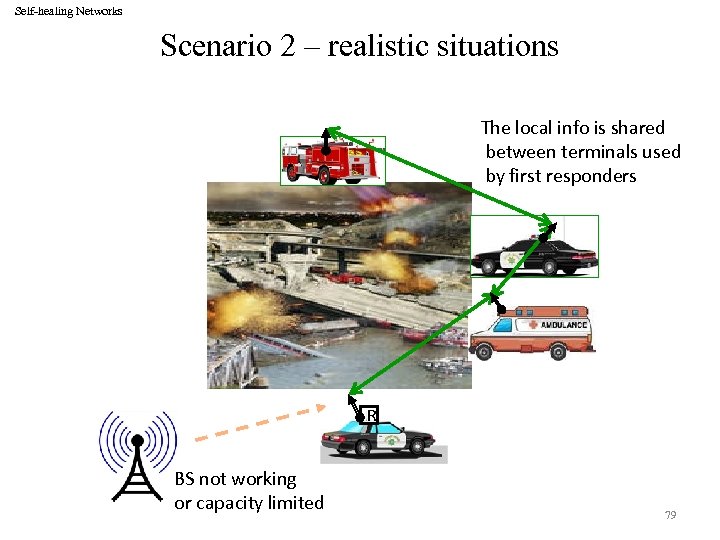
Self-healing Networks Scenario 2 – realistic situations The local info is shared between terminals used by first responders R BS not working or capacity limited 79
Self-healing Networks Topics • MS to MS communication – Multi-hop relaying function included • PHY changes to SS • Ability to connect through a neighbor network – First responders: different entities involved (police, fire brigade, health, etc. ) • Access rights? • Security? • Spectrum – May have or not enough available capacity in licensed spectrum • New traffic classes and real-time spread of the traffic across multiple frequency allocations 80
Self-healing Networks Conclusion • MS-2 -MS or SS-2 -SS direct communication is requested for smart grids and public safety applications – Specific issues should be addressed • PHY, MAC, Networking • Simultaneous usage of multiple frequency bands 81
Скачать презентацию Future 802 16 Networks Challenges and Possibilities IEEE
77c5150ed02a6cc79140901e61011d0d.ppt