


 Скачать презентацию Fusion Simulation Project FSP Workshop Report and Status
616088eed1279c939320d2edceac135f.ppt
- Количество слайдов: 47
 Fusion Simulation Project (FSP) Workshop Report and Status Presented by Glenn Bateman Lehigh University on behalf of the FSP Committee and Panels ITPA Meeting October 1 -3, 2007 Slide ITPA Naka, Japan October 2, 2007
 Fusion Simulation Project (FSP) • FSP mission: Develop a predictive capability for integrated modeling of magnetically confined burning plasmas – Create high-performance software to carry out comprehensive predictive integrated modeling simulations, with high physics fidelity • For ITER, future demonstration fusion reactors, and other tokamaks – Petascale computers are necessary to achieve this mission • FSP goal: Predict reliably the behavior of plasma discharges in toroidal magnetic fusion devices on all relevant time and space scales – FSP must bring together into one framework a large number of codes and models that presently constitute separate disciplines within plasma science • FSP integrated modeling capability will embody theoretical and experimental understanding of confined thermonuclear plasmas – Theoretical models will be implemented and used in the context of self-consistent simulations that can be compared with experimental data – Experimental data will be analyzed and organized in a way that can be compared with simulation results Slide ITPA Naka, Japan October 2, 2007
 Fusion Simulation Project • During February 2007 DOE appointed a Committee to organize a workshop to address issues related to FSP objectives and priorities • Committee established 4 Panels Composed of Physicists, Applied Mathematicians, and Computer Scientists – 45 scientists from 22 institutions (labs, universities and companies) • Committee and panels planned a workshop that was held May 16 -18 • In June a charge was sent to the Fusion Energy Sciences Advisory Committee (FESAC) by U. S. Under Secretary for Science asking: – That a review of the FSP Workshop report be carried out in order to “evaluate the prospects for the proposed FSP to produce a world-leading realistic predictive capability” • Report describing the conclusions reached at the FSP Workshop was prepared by the end of June and was submitted to FESAC – Report is available at http: //www. lehigh. edu/~infusion/FSP_report. pdf • FESAC has appointed a sub-panel to review the report and recommend a course of action for DOE – FESAC sub-panel report will be presented October 23, 2007 Slide ITPA Naka, Japan October 2, 2007
 FSP Background • Previous Fusion Simulation Project (FSP) to address questions outlined in charge letter, February 22, 2002 – Develop 5 -6 year initiative the goal of which is develop an improved capacity for Integrated Simulation and Optimization of Fusion Systems • FESAC appointed committee to develop a roadmap – Final FESAC Report December 2002 • http: //www. isofs. info/ FSP_Final_Report. pdf http: //www. isofs. info/FSP_Appendix. pdf – Fusion Simulation Project (FSP) envisioned as a 15 year, $25 M/year multi-institutional project • Develop a comprehensive simulation capability for magnetic fusion experiments with a focus on ITER – Recommended an approach through Focused Integration Initiatives • Coupling pairs of components before moving to whole device modeling • OFES formed an FSP Steering Committee in 2003 – Develop project vision, governance concept, and roadmap for the FSP – Recommends that the FSP consist of three elements: • Production component, a research and integration component, and a software infrastructure component – Final report in Journal of Fusion Energy, Vol. 23, No. 1, March 2004 Slide ITPA Naka, Japan October 2, 2007
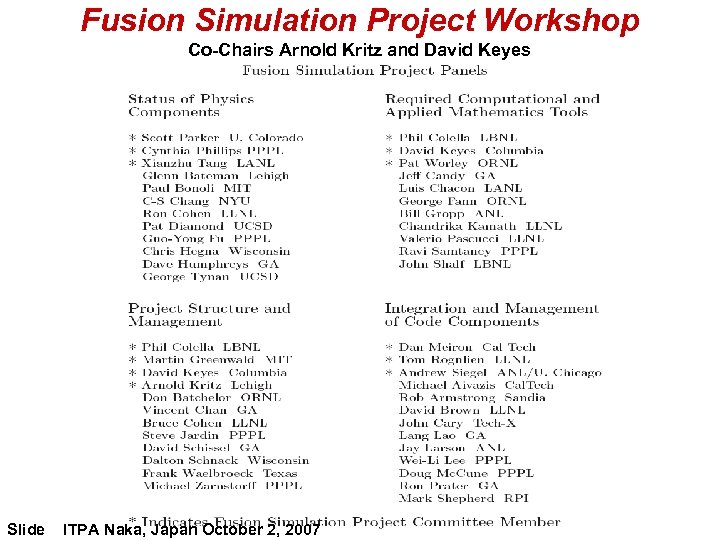 Fusion Simulation Project Workshop Co-Chairs Arnold Kritz and David Keyes Slide ITPA Naka, Japan October 2, 2007
 ITER Integrated Modeling Needs From presentation by W. A. Houlberg on behalf of D. Campbell and the ITER International Organization • The ultimate success of ITER will rely heavily on programs such as FSP – Need to know basic interactions among the physics processes, diagnostics and auxiliary systems in order to define the details of ITER control systems – ITER IO will rely heavily on the resources of the domestic agencies • Domestic funded programs will be coordinated on an international level • Times identified when ITER would like to have initial modeling capabilities are aggressive – Performance predictions will have to adapt to evolution in the design – Work on the plasma control system is starting now and we need to evaluate and define key areas such as kinetic control – Planning for ITER operation requires intense involvement with the FSP – Operational program, with detailed scenario development including sequences of pulses, will need to begin around 2012 • Comprehensive modeling tools needed for self-consistent scenarios – Requires significant advances in modeling and computing capabilities – Development of integrated modeling is one of the most critical things that needs to begin now Slide ITPA Naka, Japan October 2, 2007
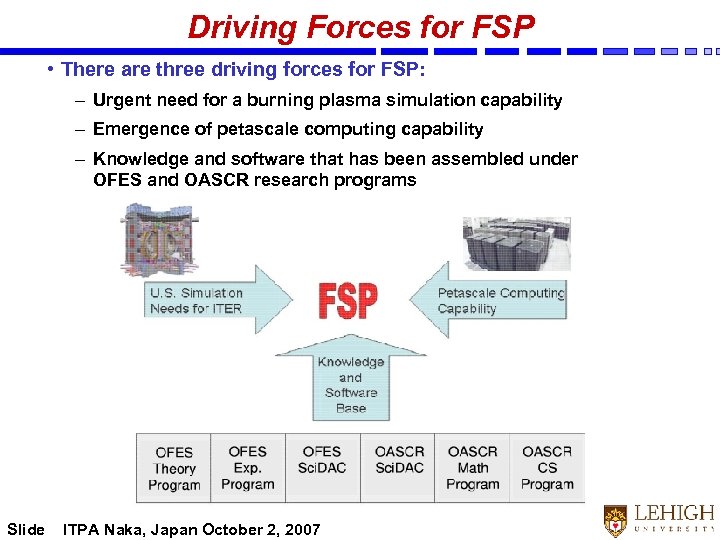 Driving Forces for FSP • There are three driving forces for FSP: – Urgent need for a burning plasma simulation capability – Emergence of petascale computing capability – Knowledge and software that has been assembled under OFES and OASCR research programs Slide ITPA Naka, Japan October 2, 2007
 Report Resulting from FSP Workshop • The FSP workshop report: – Identifies key scientific issues that can be addressed by integrated modeling that takes advantage of the physics, computer science, and applied mathematics knowledge base – Identifies the critical technical challenges for which predictive integrated simulation has a unique potential for providing answers in a timely fashion • In a way that traditional theory or experiment by themselves cannot – Establishes a plan to improve the fidelity of the physics modules required for predictive tokamak whole device modeling • Well supported theory and experimental fusion programs are essential – Identifies the critical areas of computational science and infrastructure in which investments would likely produce the tools required for the FSP to achieve its goals – Addresses issues associated with project structure and management of the proposed FSP • The FSP panels concluded that it is essential to produce, in a timely way, advanced whole plasma simulation capability using high performance computers to: – Provide key scientific deliverables – Make accurate predictions for burning plasma experiments Slide ITPA Naka, Japan October 2, 2007
 Questions Addressed at FSP Workshop • To initiate an expanded FSP, it was determined at the workshop that answers to the following questions are required: – What are the critical compelling scientific and technical issues that the fusion program faces for which computation is required? • What substantial contribution can computer simulation make that traditional theory or experiment, by themselves, cannot? – For each critical issue, what is the current state of the art and what is missing from the current capability? • What are the underlying models and algorithms that are used in computer simulations relating to the critical issues? – Modules that are required are often scattered among a variety of codes and are not consistent in level of sophistication – For each critical issue, what new capabilities are needed in order to produce simulations that will aid in addressing critical issues? • What investments in fusion science as well as computational science and infrastructure must be made to obtain solutions for the critical issue? • At the workshop it was recognized that there are many critical issues for which the solution requires advanced simulation capability • Five critical issues were selected for more detailed consideration Slide ITPA Naka, Japan October 2, 2007
 Critical Issues for Burning Plasma Experiments to be Addressed by FSP - 1 • Disruption effects and mitigation – ITER can sustain only a limited number of full-current disruptions – Important to predict the onset of a disruption and to take actions that minimize damage when a disruption occurs • Pedestal formation and transient heat loads on the divertor – Pedestal height controls confinement • Simulation of onset and growth of pedestal needed to predict confinement – Large ELM crashes can damage the divertor • Require prediction of frequency and size of ELMs as well as the effect of stabilization techniques • Tritium migration and impurity transport – Since tritium can migrate through the edge plasma to locations where it is hard to remove, we must predict the transport of tritium – Since impurities can dilute the deuterium-tritium fuel and degrade fusion power production, we must predict impurity influx and transport Slide ITPA Naka, Japan October 2, 2007
 Critical Issues for Burning Plasma Experiments to be Addressed by FSP - 2 • Performance optimization and scenario modeling – Performance includes sustaining maximum fusion power production • Since each ITER discharge will cost about $1 M, it is important to plan each discharge and to evaluate the results of each discharge carefully – Scenario modeling is used to plan new experiments • Since multiple experimental teams will be competing for ITER running time, teams with best scenario modeling capability may obtain more running time – Scenario modeling is used in data analysis • Validated simulations provide a way to embody our knowledge of fusion plasmas • Plasma feedback control – Burning plasma regime is fundamentally new, with stronger self-coupling and weaker external control than ever before • Burning plasma experiments are designed to operate near parameter limits but must avoid damaging disruptions – Real-time feedback control essential to avoid disruptions and to optimize the performance of burning plasma experiments • Instability control includes the use of modulated heating and current drive, as well as the application of non-axisymmetric fields Slide ITPA Naka, Japan October 2, 2007
 Physics Components Essential for Integrated Burning Plasma Simulations • Many physics components are important in addressing critical issues in the integrated modeling of burning plasma experiments • In order to optimize burning plasma performance, many of these components require substantial physics and computational advances • To illustrate the advances required, four components required in an integrated simulation of a burning plasma were identified at the FSP Workshop • Required advances were discussed for components to compute: – Core and edge turbulence and transport – Large-scale instabilities – Sources and sinks of heat, momentum, current and particles – Energetic particle effects • It is recognized that other components might have been chosen to illustrate the advances required – For example, edge physics, equilibrium, wall material physics, atomic physics … Slide ITPA Naka, Japan October 2, 2007
 Physics is Interactive • Many physical processes in tokamaks interact strongly as illustrated in Table 2. 1 in the Workshop report – Whole device integrated modeling codes are needed to simulate strongly interacting physical processes observed in experiments • Examples of interacting processes: – Large scale instabilities can interact and can strongly modify plasma profiles which in turn can affect the driving mechanisms producing instabilities • Sawtooth oscillations (internal kink/tearing modes) redistribute current density, thermal particles and fast particle species and seed neoclassical tearing modes • Neoclassical tearing modes (NTMs) are very sensitive to current and pressure profiles and produce flat spots in those profiles • Energetic alpha particles (fusion products) can excite global instabilities that can redistribute or remove these particles before they deposit their energy – Boundary conditions strongly affect core plasma profiles • H-mode pedestal height, normally limited by ELM crashes, controls core temperature profiles since anomalous transport is “stiff” • Wall conditioning has a strong effect on discharge performance – Distortion of velocity distribution due to slowing down of fast ions from NBI, RF and fusion reactions need to be included in gyrokinetic turbulence codes • Fast ions are redistributed by large scale instabilities and slowing down time is affected by plasma profile changes caused by sawtooth crashes Slide ITPA Naka, Japan October 2, 2007
 Integration of Code Components • Required advances in component architecture are critical – To facilitate large number of people working simultaneously on a large code – FSP will require a variety of levels of integration across time scales, spatial regions, different physical phenomena • Investments are needed for software design, repository management, release management, regression suites and documentation – There is trade-off between rapid development and code stability – Software tools will help manage code development and maintenance • Software tools are also needed to enhance connection between simulations and experiments Slide ITPA Naka, Japan October 2, 2007
 FSP and OASCR Vision • FSP agenda for applied mathematics and computer science is at the top of the OASCR ten-year vision statement “Simulation and Modeling at the Exascale for Energy, Ecological Sustainability and Global Security” – Integration focusing on whole-system behavior, going beyond traditional reductionism focused on detailed understanding of components – Interdisciplinary simulations incorporating all relevant expertise – Validated simulations capitalizing on the ability to manage, visualize, and analyze ultra-large datasets • FSP programmatic themes support the OASCR vision – Engagement of top scientists and engineers to develop the science of complex systems and drive computer architectures and algorithms – Investment in pioneering science to contribute to advancing energy, ecology, and global security – Development of scalable algorithms, visualization, and analysis systems to integrate ultra-scale data with ultra-scale simulation – Build-out the required computing facilities and an integrated network computing environment Slide ITPA Naka, Japan October 2, 2007
 Mathematical and Computational Enabling Technologies • Research topics and techniques, important to the success of FSP are identified in the areas of • Applied mathematics, data management, analysis, visualization, and performance engineering • Investment in these critical areas is required for FSP to achieve its goals • Efficient implementation of mathematical and computational methods on petascale and exascale resources requires applied mathematics progress on – Improved spatial and temporal discretizations for improved accuracy – Scalable solver methods for efficient utilization of computing resources – Inverse problem capabilities – Mathematical optimization and control techniques • FSP will produce massive amounts of data that must be managed, mined, visualized and will benefit from advances in – Efficient storage techniques – Scientific data mining – Advanced visualization techniques – Scientific workflow technology Slide ITPA Naka, Japan October 2, 2007
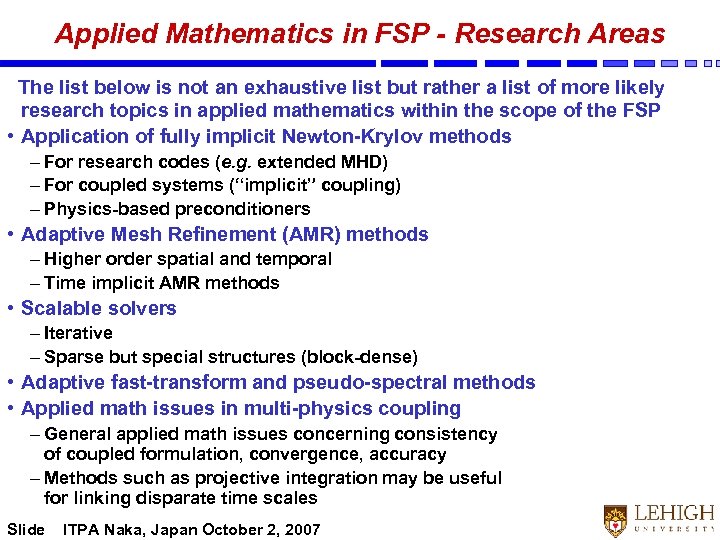 Applied Mathematics in FSP - Research Areas The list below is not an exhaustive list but rather a list of more likely research topics in applied mathematics within the scope of the FSP • Application of fully implicit Newton-Krylov methods For research codes (e. g. extended MHD) For coupled systems (“implicit” coupling) Physics-based preconditioners • Adaptive Mesh Refinement (AMR) methods Higher order spatial and temporal Time implicit AMR methods • Scalable solvers Iterative Sparse but special structures (block-dense) • Adaptive fast-transform and pseudo-spectral methods • Applied math issues in multi-physics coupling General applied math issues concerning consistency of coupled formulation, convergence, accuracy Methods such as projective integration may be useful for linking disparate time scales Slide ITPA Naka, Japan October 2, 2007
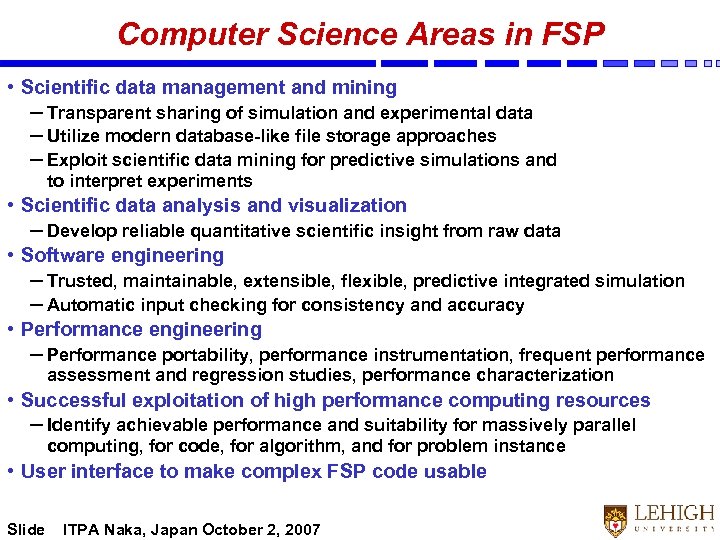 Computer Science Areas in FSP • Scientific data management and mining ─ Transparent sharing of simulation and experimental data ─ Utilize modern database-like file storage approaches ─ Exploit scientific data mining for predictive simulations and to interpret experiments • Scientific data analysis and visualization ─ Develop reliable quantitative scientific insight from raw data • Software engineering ─ Trusted, maintainable, extensible, flexible, predictive integrated simulation ─ Automatic input checking for consistency and accuracy • Performance engineering ─ Performance portability, performance instrumentation, frequent performance assessment and regression studies, performance characterization • Successful exploitation of high performance computing resources ─ Identify achievable performance and suitability for massively parallel computing, for code, for algorithm, and for problem instance • User interface to make complex FSP code usable Slide ITPA Naka, Japan October 2, 2007
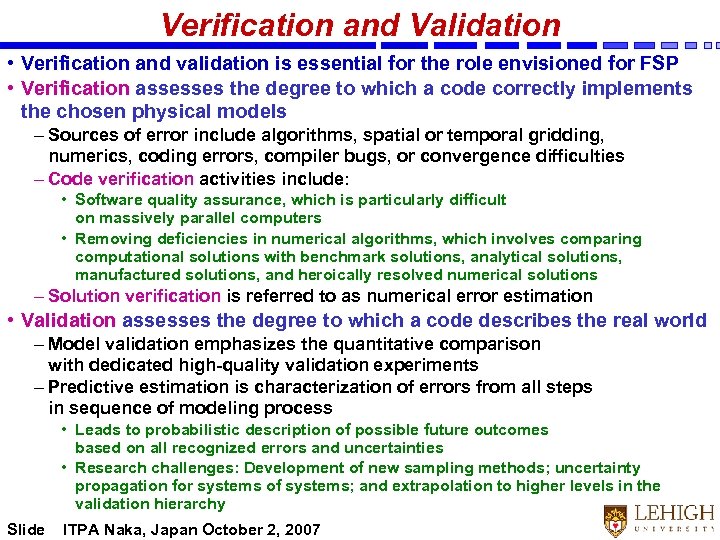 Verification and Validation • Verification and validation is essential for the role envisioned for FSP • Verification assesses the degree to which a code correctly implements the chosen physical models – Sources of error include algorithms, spatial or temporal gridding, numerics, coding errors, compiler bugs, or convergence difficulties – Code verification activities include: • Software quality assurance, which is particularly difficult on massively parallel computers • Removing deficiencies in numerical algorithms, which involves comparing computational solutions with benchmark solutions, analytical solutions, manufactured solutions, and heroically resolved numerical solutions – Solution verification is referred to as numerical error estimation • Validation assesses the degree to which a code describes the real world – Model validation emphasizes the quantitative comparison with dedicated high-quality validation experiments – Predictive estimation is characterization of errors from all steps in sequence of modeling process • Leads to probabilistic description of possible future outcomes based on all recognized errors and uncertainties • Research challenges: Development of new sampling methods; uncertainty propagation for systems of systems; and extrapolation to higher levels in the validation hierarchy Slide ITPA Naka, Japan October 2, 2007
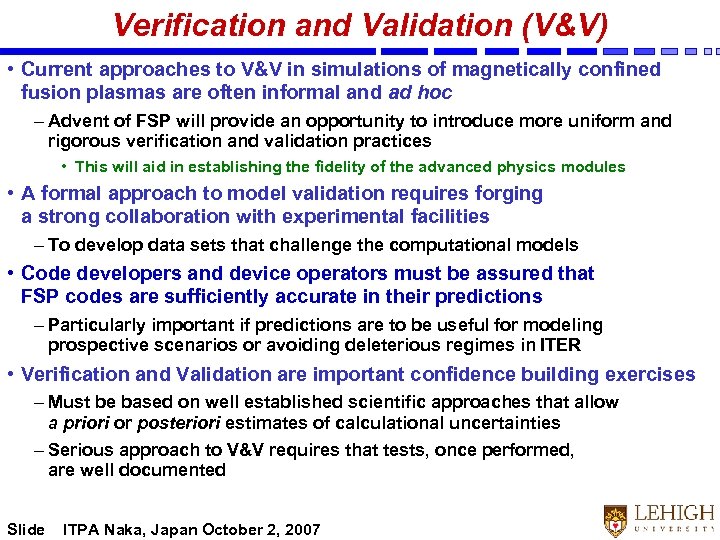 Verification and Validation (V&V) • Current approaches to V&V in simulations of magnetically confined fusion plasmas are often informal and ad hoc – Advent of FSP will provide an opportunity to introduce more uniform and rigorous verification and validation practices • This will aid in establishing the fidelity of the advanced physics modules • A formal approach to model validation requires forging a strong collaboration with experimental facilities – To develop data sets that challenge the computational models • Code developers and device operators must be assured that FSP codes are sufficiently accurate in their predictions – Particularly important if predictions are to be useful for modeling prospective scenarios or avoiding deleterious regimes in ITER • Verification and Validation are important confidence building exercises – Must be based on well established scientific approaches that allow a priori or posteriori estimates of calculational uncertainties – Serious approach to V&V requires that tests, once performed, are well documented Slide ITPA Naka, Japan October 2, 2007
 FSP Project Management • FSP - a scientific development and focused research effort of unprecedented size and scope in U. S. fusion theory and supporting computational science and applied mathematics research programs – Requires geographically distributed collaboration because expertise is currently distributed – Legacy and recently written codes will play a role in early stages of FSP • FSP should make use of the expertise embodied in existing codes • FSP must satisfy the large user base of currently used codes • A strong and well-coordinated management structure is required – OFES and OASCR will specify the requirements in the request for proposals – Submitted proposals will provide detail on how the project will be structured and managed to achieve its goals – Effective management is required to ensure that deliverables and goals are achieved • Thirteen issues that management will have to address are identified – Management tasks associated with each of these issues are described – Management approach for these issues will be specified in the proposals that are submitted Slide ITPA Naka, Japan October 2, 2007
 Management Issues • Accountability – Make clear who is ultimately responsible for project deliverables as a whole as well as for the individual parts of the project • Utility – Mechanisms to evaluate the usefulness of the project, in whole and in parts • Delivery – Ensure that release schedules and required capability are achieved • Expertise, advice, and evaluation – Identify mechanisms, such as advisory committees and/or panels, by which required expertise is brought into the project • Communication – Disseminate project requirements, schedules, progress and issues to the multi-institutional, geographically distributed workforce • Best practices and interdisciplinary integration – Project structure should ensure that tasks are executed by teams that have embraced the expertise needed from all appropriate fields • Motivation and evaluation – Establish mechanisms to ensure accomplishments are appropriately rewarded Slide ITPA Naka, Japan October 2, 2007
 Management Issues • Technical decision making – Project structure should allow for technical decisions to be made in a manner in which all participants are confident that they are heard • Conflict resolution – Management structure must be able to identify the person and/or mechanism by which conflicts will be resolved • Delivery and Quality – Identify the mechanisms to insure deliverables are provided on time and that all quality standards are enforced • Staffing and resource management – Dynamically assign resources and staff and establish a mechanism for reassignment of tasks, in partnership with the Department of Energy • Risk assessment and mitigation – Quantify risk for each part of the software project and have appropriate backup solutions and/or have recovery methods in place • Mentoring and education – Ensure that mechanisms exist for bringing into the project scientifically capable personal and establish liaisons with educational institutions Slide ITPA Naka, Japan October 2, 2007
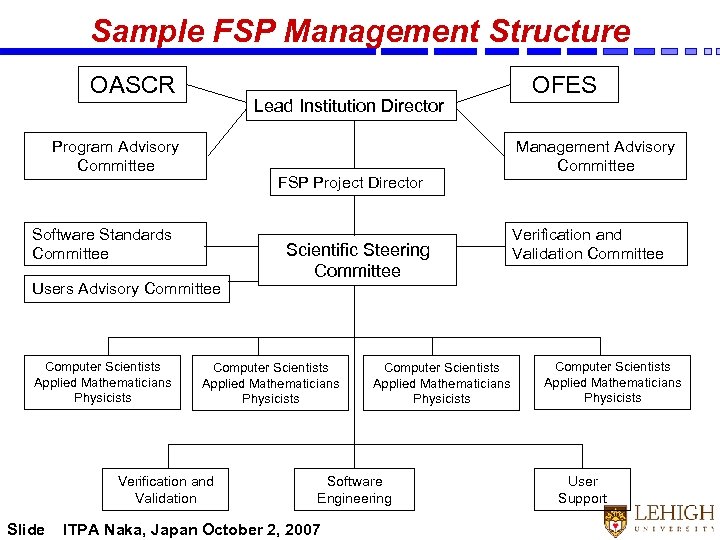 Sample FSP Management Structure OASCR Lead Institution Director Program Advisory Committee Management Advisory Committee FSP Project Director Software Standards Committee Users Advisory Committee Computer Scientists Applied Mathematicians Physicists OFES Scientific Steering Committee Computer Scientists Applied Mathematicians Physicists Verification and Validation Computer Scientists Applied Mathematicians Physicists Software Engineering Slide ITPA Naka, Japan October 2, 2007 Verification and Validation Committee Computer Scientists Applied Mathematicians Physicists User Support
 5 Year Goals for FSP • Assemble a new powerful integrated whole device modeling framework that uses high performance computing resources for the simulation of tokamak plasmas – Simulation framework will allow inter-operability of state-of-the-art physics components running on most powerful available computers – Together with flexibility to incorporate less-demanding models so that computational scale can be tailored appropriate to particular study • Fidelity of the models will be verified using first-principles simulations on leadership class computers • FSP will develop an infrastructure for user interface, visualization, synthetic diagnostics, data access, data storage, data mining, and validation capabilities – FSP infrastructure will allow FSP resources to be configured to perform all of the required fusion simulation tasks such as: • Time-slice analysis, interpretive experimental analysis, predictive plasma modeling, advancement of fundamental theoretical understanding, and operational control Slide ITPA Naka, Japan October 2, 2007
 Simulator Capabilities at End of 5 Years • Capabilities will be in place to perform the calculations needed to support ITER diagnostics, plasma control and auxiliary systems design, and review decisions – Simulator capable of performing entire-discharge modeling • Simulator will include modules for: – Classical and anomalous transport coefficients – All heating, particle, current drive, and momentum sources – Large-scale instability events such as sawtooth oscillations, magnetic island growth, and edge localized modes – Energetic particle effects • Simulator will be capable of basic control system modeling involving coil currents, density control, and burn control – Computational synthetic diagnostics will allow the simulation codes to be used for diagnostic development Slide ITPA Naka, Japan October 2, 2007
 First-Principles Capabilities at End of 5 Years • In addition to the whole-device simulator, there will be a number of stateof-the-art codes, designed to solve more first-principles equations, that will be used for time-slice analysis – These fundamental codes will be employed to better understand the underlying physical processes • In doing so, to refine the modules in the simulator • Fundamental codes will also be used for such ITER-directed tasks as – Developing mitigation methods for edge localized modes and disruptions – Predicting the effects of energetic particle modes • Focus on a limited number of problems for which advanced simulation capability can provide exciting scientific deliverables that substantially impact realistic predictive capabilities Slide ITPA Naka, Japan October 2, 2007
 Data Capabilities at End of 5 Years • FSP will foster the development of leading-edge scientific data management, data mining, and data visualization capabilities – Significance of these capabilities extends beyond the ability to manipulate the results of simulation data at the petascale – Automated data mining tools to detect the onset of instabilities in their incipient stages in order to apply mitigation strategies will complement simulation-based control strategies – Advanced software tools for understanding and managing large experimental datasets are integral to the validation goals of the FSP • Data assimilation resulting from reduction in uncertainty in simulations by penalizing the departure of functionals of the simulation from experimental observables • High-end scientific computational facility will provide an environment to host experimental data – To facilitate the interaction of the modeler and experimenter by enabling comparisons of the respective data products Slide ITPA Naka, Japan October 2, 2007
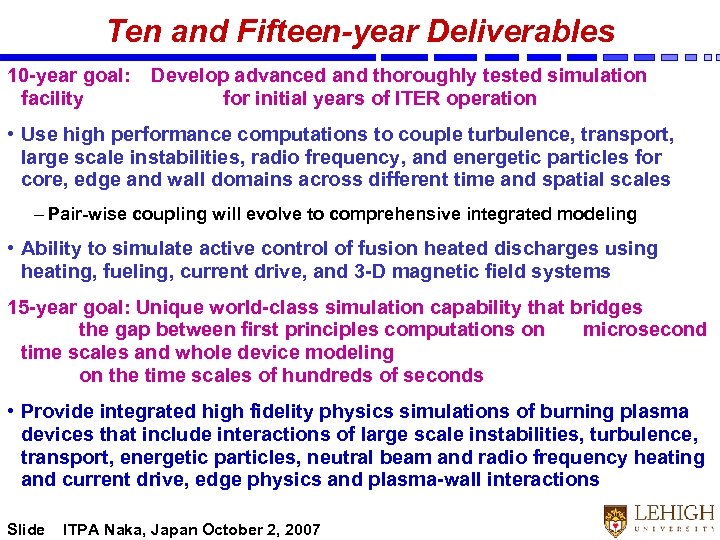 Ten and Fifteen-year Deliverables 10 -year goal: Develop advanced and thoroughly tested simulation facility for initial years of ITER operation • Use high performance computations to couple turbulence, transport, large scale instabilities, radio frequency, and energetic particles for core, edge and wall domains across different time and spatial scales – Pair-wise coupling will evolve to comprehensive integrated modeling • Ability to simulate active control of fusion heated discharges using heating, fueling, current drive, and 3 -D magnetic field systems 15 -year goal: Unique world-class simulation capability that bridges the gap between first principles computations on microsecond time scales and whole device modeling on the time scales of hundreds of seconds • Provide integrated high fidelity physics simulations of burning plasma devices that include interactions of large scale instabilities, turbulence, transport, energetic particles, neutral beam and radio frequency heating and current drive, edge physics and plasma-wall interactions Slide ITPA Naka, Japan October 2, 2007
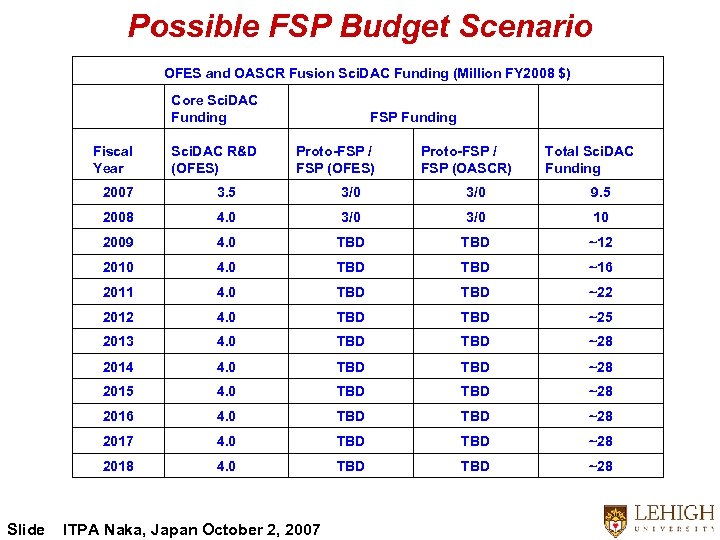 Possible FSP Budget Scenario OFES and OASCR Fusion Sci. DAC Funding (Million FY 2008 $) Core Sci. DAC Funding FSP Funding Fiscal Year Sci. DAC R&D (OFES) Proto-FSP / FSP (OASCR) Total Sci. DAC Funding 2007 3. 5 3/0 9. 5 2008 4. 0 3/0 10 2009 4. 0 TBD ~12 2010 4. 0 TBD ~16 2011 4. 0 TBD ~22 2012 4. 0 TBD ~25 2013 4. 0 TBD ~28 2014 4. 0 TBD ~28 2015 4. 0 TBD ~28 2016 4. 0 TBD ~28 2017 4. 0 TBD ~28 2018 4. 0 TBD ~28 Slide ITPA Naka, Japan October 2, 2007
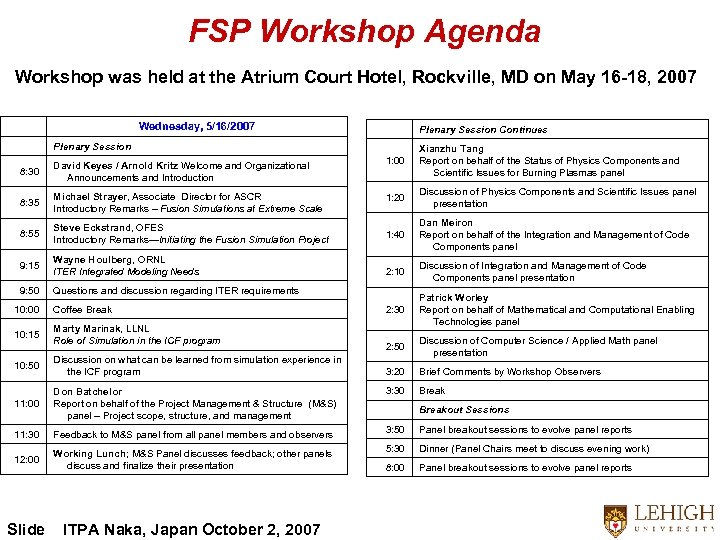 FSP Workshop Agenda Workshop was held at the Atrium Court Hotel, Rockville, MD on May 16 -18, 2007 Wednesday, 5/16/2007 Plenary Session 8: 30 David Keyes / Arnold Kritz Welcome and Organizational Announcements and Introduction 8: 35 Michael Strayer, Associate Director for ASCR Introductory Remarks – Fusion Simulations at Extreme Scale 8: 55 Steve Eckstrand, OFES Introductory Remarks—Initiating the Fusion Simulation Project 9: 15 Wayne Houlberg, ORNL ITER Integrated Modeling Needs 9: 50 1: 00 Xianzhu Tang Report on behalf of the Status of Physics Components and Scientific Issues for Burning Plasmas panel 1: 20 Discussion of Physics Components and Scientific Issues panel presentation 1: 40 Dan Meiron Report on behalf of the Integration and Management of Code Components panel 2: 10 Discussion of Integration and Management of Code Components panel presentation 2: 30 Patrick Worley Report on behalf of Mathematical and Computational Enabling Technologies panel 2: 50 Discussion of Computer Science / Applied Math panel presentation 3: 20 Brief Comments by Workshop Observers 3: 30 Break Questions and discussion regarding ITER requirements 10: 00 Coffee Break 10: 15 Marty Marinak, LLNL Role of Simulation in the ICF program 10: 50 Discussion on what can be learned from simulation experience in the ICF program 11: 00 Don Batchelor Report on behalf of the Project Management & Structure (M&S) panel – Project scope, structure, and management 11: 30 Feedback to M&S panel from all panel members and observers 12: 00 Working Lunch; M&S Panel discusses feedback; other panels discuss and finalize their presentation Slide ITPA Naka, Japan October 2, 2007 Plenary Session Continues Breakout Sessions 3: 50 Panel breakout sessions to evolve panel reports 5: 30 Dinner (Panel Chairs meet to discuss evening work) 8: 00 Panel breakout sessions to evolve panel reports
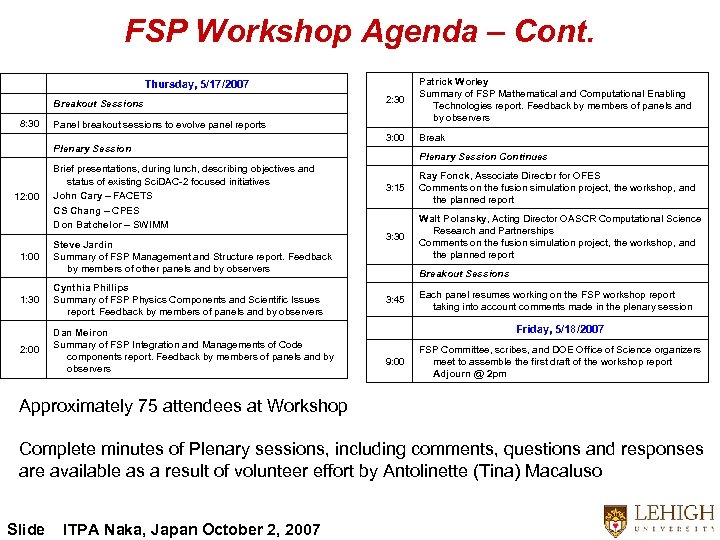 FSP Workshop Agenda – Cont. 8: 30 12: 00 2: 30 Patrick Worley Summary of FSP Mathematical and Computational Enabling Technologies report. Feedback by members of panels and by observers 3: 00 Break Thursday, 5/17/2007 Breakout Sessions Panel breakout sessions to evolve panel reports Plenary Session Brief presentations, during lunch, describing objectives and status of existing Sci. DAC-2 focused initiatives John Cary – FACETS CS Chang – CPES Don Batchelor – SWIMM 1: 00 Steve Jardin Summary of FSP Management and Structure report. Feedback by members of other panels and by observers 1: 30 Cynthia Phillips Summary of FSP Physics Components and Scientific Issues report. Feedback by members of panels and by observers 2: 00 Dan Meiron Summary of FSP Integration and Managements of Code components report. Feedback by members of panels and by observers Plenary Session Continues 3: 15 Ray Fonck, Associate Director for OFES Comments on the fusion simulation project, the workshop, and the planned report 3: 30 Walt Polansky, Acting Director OASCR Computational Science Research and Partnerships Comments on the fusion simulation project, the workshop, and the planned report Breakout Sessions 3: 45 Each panel resumes working on the FSP workshop report taking into account comments made in the plenary session Friday, 5/18/2007 9: 00 FSP Committee, scribes, and DOE Office of Science organizers meet to assemble the first draft of the workshop report Adjourn @ 2 pm Approximately 75 attendees at Workshop Complete minutes of Plenary sessions, including comments, questions and responses are available as a result of volunteer effort by Antolinette (Tina) Macaluso Slide ITPA Naka, Japan October 2, 2007
 Core and Edge Turbulence and Transport • Current research issues for core and edge gyrokinetic codes: – Electron thermal transport (resolving electron and ion dynamics together) – Effects of zonal flows and magnetic shear – Electromagnetic (finite beta) effects • There is a debate in the field concerning the relative advantages of particle-in-cell vs continuum approaches to gyrokinetic simulations – Special gyrokinetic codes have been developed for the edge, with its steep gradients, geometrical complexity, impurity and neutral-particle dynamics • FSP needs to bridge gap between turbulence and transport time scales – One approach is to develop comprehensive reduced transport models from advanced gyrokinetic simulation results • Time-slice gyrokinetic simulations can recalibrate reduced models as needed – It is particularly challenging to simulate transport barriers • Gyrokinetic codes must be developed to investigate turbulence in: – 3 D plasma equilibria, such as regions with helical magnetic islands – Open flux surface regions in the scrape-off-layer at the edge of the plasma • Core and edge turbulence simulations must be coupled Slide ITPA Naka, Japan October 2, 2007
 Large-Scale Instabilities • Includes neoclassical tearing modes, edge localized modes, sawtooth oscillations, resistive wall modes, and Alfven eigenmodes • Nearly all of the forefront research in macroscopic instability modeling involves nonlinear mode evolution using extended MHD models – Extended MHD includes physics relevant to long mean free path plasmas, effects of energetic particles, two-fluid effects, and magnetic reconnection • Modules are needed for computing mode stabilization such as – Localized current drive used for stabilization of neoclassical tearing modes – Rotation used to stabilize resistive wall modes • Extended MHD models need rigorous closure on higher order moments for long mean free path fusion plasmas – Framework needed that yields concurrent solutions for • Fluid-moment-based extended MHD equations • Drift kinetic equation for long mean free path moment closure, and • Gyro-kinetic equation for effect of micro-turbulence on instabilities • Improved numerical algorithms needed, particularly scalable solvers for implicit time advancement of strongly hyperbolic partial differential equations such as the extended MHD – Aggressive grid adaptation scheme needed that concentrates grid resolution near the location of the dynamically moving narrow layers Slide ITPA Naka, Japan October 2, 2007
 Sources and Sinks of Heat, Momentum, Current and Particles • Includes radio frequency, neutral beam, fusion reactions, edge neutrals • RF codes include: – Sheath physics near antennas – Full-wave electromagnetic field solvers – Bounce averaged Fokker-Planck codes for slowing down of fast particles • Monte Carlo technique is most widely used to model slowing down of energetic particles from neutral beam injection and fusion reactions – Includes effects of large scale instabilities, magnetic ripple, banana orbits and finite gyro radius, charge exchange losses and the recapture of fast ions • Improvements needed for RF codes: – Improved simulations need terascale and petascale computing platforms – Nonlinear formation of near and far-field RF sheaths implementing metal wall boundary conditions for the sheaths in ICRF full-wave solvers – Self-consistent coupling of Monte Carlo orbit codes to ICRF full-wave solvers – Inclusion of magnetic islands, scrape-off-layer, and more complete collision operator for slower ions needed in Monte Carlo codes Slide ITPA Naka, Japan October 2, 2007
 Energetic Particle Effects • Expected to significantly affect behavior of burning plasmas – Can drive instabilities, which can eject energetic particles – Possibility of driving plasma rotation in ITER is an open issue – Energetic particle-driven Alfven instabilities can induce zonal flow which may suppress core plasma turbulence – Fusion alpha particles can stabilize the internal kink mode leading to monster sawteeth and can also stabilize resistive wall modes • Codes currently simulate one cycle of growth, saturation, and decay of energetic particle-driven Alfven modes for moderate mode numbers – Codes are limited in physics and numerical efficiency for self-consistent high-resolution simulations of high-n modes in burning plasmas. • Self-consistent nonlinear simulations of energetic particle-driven modes are needed on transport timescales – Need to investigate fast ion transport, driven by interactions of the energetic particles with Alfven instabilities with high mode number – Factor of ten higher resolution (in each dimension) and a factor of ten longer physical time period needed for alpha particle-driven Alfven instabilities Slide ITPA Naka, Japan October 2, 2007
 10 Year Goals for FSP • To develop a simulation facility that is required to meet the national scientific and engineering objectives for ITER throughout the remainder of its operational lifetime – The system will allow for self-consistent complex interactions that involve coupling of physical processes on multiple time and space scales using high performance software on leadership class computers – Experience gained from FSP pilot projects and advances in the FSP research programs will result in a comprehensive simulation framework • Framework will include: – Coupling of extended magnetohydrodynamics, core and edge turbulence, long time-scale transport evolution, source models, energetic particles and coupling of core and edge physics at the state-of-the-art level • Advanced component models will reflect advances in theory and algorithms, as well as verification and validation • Validated simulations will cover all critical tokamak phenomena – Disruptions, energetic particle stability and confinement, turbulent transport, macro-stability, and micro-stability • Validation effort will switch from primarily pre-ITER experiments to ITER itself Slide ITPA Naka, Japan October 2, 2007
 Computational Capabilities at End of 10 Years • The system will be optimized for the most powerful computer platforms using the most efficient computational frameworks – To accommodate increased demands of multiscale, multiphysics coupling, new computer architectures, and experience gained with user needs • FSP codes will be capable of comprehensive integrated time-slice analysis • FSP codes will also be used to develop sophisticated control systems that are actuated by heating, fueling, and current drive systems as well as external 3 -D magnetic coils – Control systems include use of: • Radio frequency current drive to control monster sawteeth and to prevent magnetic island growth • External 3 D magnetic fields or rapid pellet injection to control edge localized modes • It is expected that FSP simulation codes will lead to significant increases in the understanding of many complex processes – including formation of edge pedestal and plasma disruption mechanisms Slide ITPA Naka, Japan October 2, 2007
 15 Year Goals for FSP • To develop a simulation facility that will be sufficiently well-validated to extrapolate with confidence to a DEMO reactor based on the tokamak concept or other more advanced magnetic confinement concepts – FSP will have developed a world-class simulation capability that will be used in many ways to get maximum benefit from ITER • The simulation capability will be used to identify optimal operation modes for burning plasma experiments – To combine good confinement, high fusion gain, freedom from disruptions • FSP capability will be used extensively in: – Experimental discharge design for ITER – Analyzing experimental data – Comparing experimental data with predicted simulation data – Tuning the many control systems in ITER • It is expected that the sophisticated and well validated simulation tool that is developed by this project will play an indispensable role in the design of next-generation fusion devices such as DEMO and beyond Slide ITPA Naka, Japan October 2, 2007
 Relation to the OFES Base Program • FSP requires well supported theory and experimental fusion programs • Base theory program, in particular, is needed to provide improvements to the physics models, the algorithms and the computer science that are at the foundation of FSP components – Improved models are essential for physics fidelity of FSP simulations • Improved diagnostics in experimental program are needed to provide accurate experimental data for validation of FSP simulation results • It is expected that FSP personnel will work closely with plasma physics theoreticians and experimentalists at each stage in the development of the project • New contributions and scientific discovery can result from significant advances in physics models, algorithms, software, computer hardware • A dramatic increase in funding is required for FSP to reach its goals while maintaining a strong base research program Slide ITPA Naka, Japan October 2, 2007
 Fusion Simulation Project Structure Sample FSP Structure – Lead institution for FSP that is chosen by an open, competitive process • Responsible to DOE for meeting the project goals and milestones – High-level Program Advisory Committee (PAC) • Report to the top management of the lead institution • Composed of scientists external to the project – Management Advisory Committee • Project Director and additional members chosen from institutions participating in the project • Represent the broad community and institutional interests – FSP Project director (at lead institution) • Assemble management team that will coordinate and insure the success of the elements of the project – Scientific Steering Committee • Addresses all activities of the project including research, production computing, and software design – Software Standards Committee, – Verification and Validation Committee, – User Advisory Committee Slide ITPA Naka, Japan October 2, 2007
 Disruption Effects and Mitigation • Disruptions are initiated by large-scale instabilities – Conditions for disruptive instabilities determined by evolution of plasma profiles, which are a consequence of sources and sinks and transport • Disruption simulation capability is scattered across many codes that are not seamlessly integrated together into a coherent framework – Complete nonlinear evolution disruptions extremely difficult to compute • For comprehensive analysis of disruption onset and effects, as well as accurate prediction and design of mitigation approaches, required new and integrated physics elements include: – Plasma-wall interaction, impurity transport, atomic radiation physics – Equilibrium and kinetic profile evolution – Nonlinear evolution of large scale instabilities – Runaway electron production – Effects of axisymmetric control actuators such as poloidal field coils – Effects of non-axisymmetric control actuators such as resonant magnetic field perturbation coils Slide ITPA Naka, Japan October 2, 2007
 Pedestal Formation and Transient Divertor Heat Loads • First-principles gyrokinetic simulations of the pedestal and scrape-off-layer are being developed by: – Center for Plasma Edge Simulation and the Edge Simulation Laboratory • Gyrokinetic codes used to simulate pedestal formation and growth – Spatially axisymmetric gyrokinetic codes simulate neoclassical effects – Full 5 -D turbulence simulation codes are nearing completion • Need to develop fully electromagnetic edge gyrokinetic simulations • Two-fluid codes have been applied to modeling of the pedestal on transport and turbulence timescales • Monte Carlo and fluid formulations used to model neutral transport • Linear and nonlinear extended MHD codes used to model ELM triggering and ELM crash evolution – Kinetic effects on ELMs may well play a significant role • Require multi-scale integration between plasma phenomena operating on turbulence, neoclassical, large-scale MHD, various atomic physics, and transport timescales, as well as coupling to core plasma Slide ITPA Naka, Japan October 2, 2007
 Tritium Migration • Modeling of deuterium and tritium recycling involves wall material simulations, presently performed by simple 1 D diffusion codes – Present experimental results indicate D/T penetrates much deeper into the material than simple models indicate – Impact of energy pulses from ELMs is believed important • Plasma tritium transport modeled by 3 D Monte Carlo ion/neutral codes – Rates for the large number of molecular and surface processes often have a large number of adjustable coefficients to fit complex experimental results • Adjusted to values substantially larger than expected from simple theory • Time-dependent diffusion simulations of tritium retention within first few microns of wall materials must be coupled to edge transport codes – Multi-species, 2 D, two-velocity kinetic ion transport codes need to evaluate collisional, neoclassical impurity transport in edge region, coupled to core • Inter-atomic potentials need to be developed for ITER mixed materials – For use in 3 D molecular dynamics simulations of sputtering • Molecular dynamics results need to be supplemented by 2 D kinetic Monte Carlo simulations of slower wall surface chemistry processes that also generate hydrocarbons Slide ITPA Naka, Japan October 2, 2007
 Impurity Production and Transport • Impurities produced by plasma-wall interactions and fusion products – Physical and chemical sputtering and evaporative release contribute • Impurity influx complicated by the presence of various wall materials, such as beryllium, carbon, tungsten, in different locations of the wall • Further complicated by impact of heat fluctuations during ELM cycles – Sufficiently high impurity influx can rapidly degrade fusion performance • Chemical sputtering is not well understood, particularly for carbon wall – Empirically parameterized models, which utilize experimental data on material composition, surface conditions, wall temperature, incident plasma flux, and sometimes long-time exposure history – Extensions of the molecular dynamic sputtering database, mixed material simulation, and kinetic Monte Carlo simulations are needed • Impurity transport simulations in scrape-off-layer need improvements: – Need to include 3 D turbulence impact on multi-species impurities and coupling to kinetic transport – Gyrokinetic simulations of core, pedestal and scrape-off-layer are needed to predict impurity concentration and resulting effects on fusion performance Slide ITPA Naka, Japan October 2, 2007
 Performance Optimization and Scenario Modeling • Full-featured integrated modeling codes such as TRANSP or ONETWO are large codes that were started 30 years ago – They consist of a patchwork of contributions from a large number of people who were often working on isolated tasks under time pressure – The required models are often scattered among a variety of codes and are not consistent in their level of sophistication – Most of the codes are not modular, they do not use modern software engineering methods, and the programming practices do not always conform to accepted standards for reliability, efficiency, and documentation – As a result, these codes are difficult to learn, to run correctly, and to maintain • A new comprehensive whole device integrated modeling code framework is needed for scenario modeling – In addition to a comprehensive collection of physics modules, the framework should include synthetic diagnostics and the tools needed to make quantitative comparisons between simulation results and experimental data – Tight coupling is needed for strongly interacting physical processes – Integrated framework should have options for first-principles computations – Simulations can make a substantial contribution in a way that traditional theory and experiment, by themselves, cannot Slide ITPA Naka, Japan October 2, 2007
 Plasma Feedback Control • Owing to its role as first burning plasma experiment, its nuclear mission, and its stringent licensing requirements, at time of its commissioning, ITER will be the most control-demanding tokamak ever built – Feedback control used to avoid disruptions and optimize performance – The need to certify high confidence control performance will place extreme demands on the physics simulation community • Will require an unprecedented amount of integration between frontier physics understanding and mission-critical control solutions • Currently, 1 -1/2 D simulation codes include feedback actuator modules – Connection between these simulations and real-time control platforms has been demonstrate and used routinely on some devices – However, currently, there is minimal integration with other physical effects – Varying levels of accuracy, completeness, and validation, which are often insufficient for ITER requirements • Needed for ITER Control Data Access and Communications system: – Control design models derivable from more detailed physics models – Full or partial shot integrated control scenario simulation capability – Modular infrastructure for flexibly using these products Slide ITPA Naka, Japan October 2, 2007