 Скачать презентацию Further ESCO Case Studies Rebecca Gunning IT Power
cb163739175cb43a876a9e4ca689afc0.ppt
- Количество слайдов: 90



Further ESCO Case Studies Rebecca Gunning, IT Power, Dr Alex Westlake, Independent Consultant to the REEEP, Dai Cunfeng, CREIA Industrial Case Studies Courtesy of the World Bank EMC Project
Agenda • International ESCO Case Studies – Public buildings • Hospital • Prison service – Industry • • Boilers Steam Line Upgrades End Users Electrical Equipment Power Distribution Upgrades Industrial Kilns Industrial Hammers Waste Energy Recovery Building Energy Conservation
Public Buildings • • Hospitals and medical centres Schools and colleges Government buildings Case studies: – Hemel Hempstead Hospital, UK – Michigan Prison Service, USA
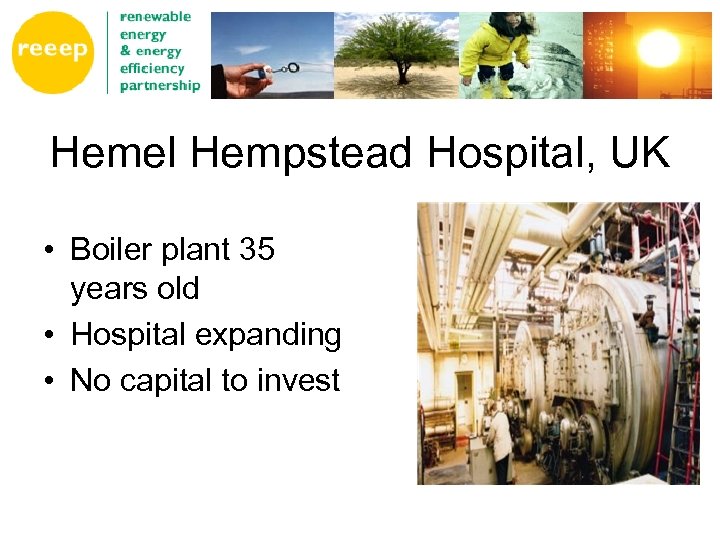
Hemel Hempstead Hospital, UK • Boiler plant 35 years old • Hospital expanding • No capital to invest
Benefits of ESCO to hospital • Government policy states that hospitals should contract out non-core activities. • Reduces the demands on management and transferred risk to the ESCO. • Provides better value for money than the option of purchasing the plant. The cost was less than 90% of the capital purchase equivalent. • Does not use the Hospital's existing capital funding. • The obligations of the ESCO are expressed in terms of the service provided rather than specific tasks – a performance contract.
Contract details • Install two new central steam boilers • Operate plant for 10 years • Equipment owned by ESCO • • • Boilers generate 25% more steam than old boilers. Energy costs remained the same Energy costs per square metre fell by 12% ESCO sells steam to hospital Price structure designed to ensure incentive for energy efficiency – fixed cost plus marginal costs
Output specification • A continuous supply of steam will be supplied at a pressure of 5. 4 bar up to a maximum flow rate of 7700 kg/hour, providing that demand for steam does not vary by more than 15% from its level at the time the contract was signed. • Steam shall be delivered at not less than 0. 85 dryness fraction for not less than 80% of the time. The steam will have no contaminants. • As the Hospital is responsible for the steam distribution network, there is an obligation to ensure that the returned condensate will be free from contamination and that the mass flow shall not be less than 90% of delivered steam.
Risk Transfer The risks transferred to the ESCO were: • construction cost overrun – through the use of a fixed price contract • construction programme overrun – if the work had not been completed on time the contract would have been terminated and all equipment would belong to the hospital • design risks – if what was proposed did not operate as efficiently as expected, ESCO would bear any additional costs • the risks associated with loss of service, ESCO pays penalties if the service fails for more than two hours • plant repairs and maintenance will now be the responsibility of ESCO • legislation – the risks of any changes in environmental legislation • insurance The risk of a fall in demand is borne by the hospital through the payment of a standing charge which covers fixed costs.
Michigan prison service • Two prisons – 16 buildings and 34 buildings • 42, 600 m 2 • Inefficient equipment and lighting
Energy efficiency measures • • • Upgrade from incandescent to fluorescent lighting Upgrade from mercury vapor to metal halide lighting Conversion to energy efficient electronic ballasts Reflectors for lighting systems Energy management system Programmable thermostats Variable speed motor drives Zone control for heating, ventilating and cooling Attic insulation Motorized dampers Blowdown heat recovery for boilers
Costs and contract • Total cost: USD 454, 000 • Annual savings: USD 130, 700 • Simple payback: 3. 71 years • 7 year performance contract • ESCO assumed the performance risk • Energy and operating savings guaranteed by ESCO were then used to pay off the contract. • In the case of a savings shortfall during the term of the contract, ESCO agreed to pay the difference. • Savings used for further projects
Agenda • International ESCO Case Studies – Public buildings – Industry • • Boilers Steam Line Upgrades End Users Electrical Equipment Power Distribution Upgrades Industrial Kilns Industrial Hammers Waste Energy Recovery Building Energy Conservation
1. Industrial Boiler Energy Conservation Upgrade • Boilers with capacity below 65 t/h provide heating for industrial production and for buildings. There are 520, 000 units nationwide, 1. 2 million (steam) tons. 70% are steam boilers and the rest are hot water boilers. Yearly coal consumption amounts to 400 million tons of standard coal, with an energy conservation potential of 40 -60 million tons of standard coal (10 -15%). • Major technical upgrade measures are as follows:
1. 1 Coal Feeding Device Upgrade • Feed coal by layer: For a co-rotation fire-grate chaingrate boiler, the previous bucket coal feeding device is changed to layered coal feeding. Through gravitation filtering, coal blocks and powder are placed on fire grate loosely from bottom to top. This will facilitate air passage, improve combustion and reduce the slag’s carbon content. • Saving energy by 5 -20%.
1. 2 Combustion System Upgrade • (1) For co-rotation fire-grate chain-grate boilers, an appropriate amount of pulverized coal is sent into hearth from an appropriate position in front of the boiler, allowing suspension combustion in addition to the previous layer combustion, saving energy by approx 10%. • (2) For oil-fire boilers, gas-fired boilers and pulverizedcoal boilers, new-model energy-saving burners replace the obsolete burners, saving energy by 5 -10%.
Fly Ash Return System of Coal-fired Boiler • • Case: Jinlin Chemical Company, Power Plant Project: Introduce Germen VE Company technology to be used on 35~2000 t/h cyclone furnace and wet bottom furnace. Dry fly ash collected from ash bucket of dust collector is sent to hearth’s high-temperature part to be burned for the second time. Fly ash is melted to become liquid slag, which is quenched with water to become 3 -5 mm solid vitreous body. Result: recovery of residue carbon caloricity, and recycling of ash and slag. — Used by cement mill as mixture material to produce cement together with clinker. — Produce hollow masonry blocks and cement square bricks — Water granulated slag is mixed with calcium and magnesium to produce silicon-calcium-magnesium composite chemical fertilizer — Replace gravel to produce quality asphalt concrete.
Airtight Calcium Carbide Furnace Gas Recovery through Direct Firing • Case: Hangzhou Electrochemical Group Company • Project: airtight calcium carbide furnace produces 400 Nm 3 gas per ton of calcium carbide, containing 90% combustible gas, with CO accounting for approx 80%. It has high dust concentration, and also contains cyanide. Furnace gas at 500℃ is directly sent to boiler for combustion. Then, dedusting is carried out through cyclone separation and cloth bag processes for exhaust discharge after meeting standard. • Energy saving: 1 t calcium carbide produces 1. 5 t of steam at 0. 85 MPa; 35000 t calcium carbide produces over 50000 t of steam; total investment is 3 million RMB; payback period is less than 1 year.
1. 3 Furnace Arch Upgrade • Furnace arch of chain-grate boiler is designed for specific type of coal. It is not very suitable to different types of coal, causing bad combustion condition and lowering boiler’s thermal efficiency. • Appropriately modifying furnace arch’s shape and position according to the coal to be used can improve combustion conditions and raise combustion efficiency, with an energy saving of approx 10%. • (1) Chain-grate boiler’s combustion has four stages: preheating, dry distillation, combustion and burning-to-ash. Upgrade of anterior arch can enhance coal preheating and dry distillation so as to ignite earlier and to lengthen the time of combustion. • (2) Upgrade of rear arch can enhance burning-to-ash process and lower carbon content in slag.
Furnace Arch Upgrade • Application of double-A-shaped boiler furnace arch technique that saves energy and is suitable to multiple types of coal. • Client: Hudong Dockyard • Project: 2 x 10 t/h chain-grate boilers. After upgrade with that technique, boilers can suit more types of coal and produce bigger output, and slag contains less carbon. • Energy Saving: Payback period is 6 months. • Suitable to: chain-grate boilers below 35 t/h, in areas where coal types vary greatly.
1. 4 Boiler Auxiliaries’ Energy Conservation Upgrade • Use speed control technique to regulate air quantity of blower fans and induced draft fans according to boiler load, allowing boiler to operate under the best operating condition. This can save boiler fuel as well as fans’ power consumption, with obvious energy conservation effect.
Boiler Auxiliaries’ Energy Conservation Upgrade • Case: Frequency speed control device’s application on fans and pumps • Client: Lido Hotel’s Power Center • Project: 3 x 20 t/h boilers, 3 x 75 k. W induced draft fans, 3 x 55 k. W blower fans, and 1 water feed pump, with a total capacity of 442 k. W. All of them have frequency speed control devices. • Investment: 667, 000 RMB • Energy saving: yearly saving of 610 MWh; profit of 350, 000 RMB; payback period being 1. 88 years.
1. 5 Circulating Fluidized-bed Boiler Replaces Gratefiring Boiler • Circulating fluidized-bed boiler has a thermal efficiency 15 -20% higher than gratefiring boiler, can use inferior coal, and can use limestone powder to do desulfurization in furnace so as to reduce SO 2 emission. Ash and slag can be used directly to produce building materials.
Circulating Fluidized-bed Boiler • Application of circulating fluidized-bed boiler technology • Client: Qinhuangdao Beishan Power Plant • Project: 130 t/h circulating fluidized-bed boiler replaces pulverized-coal boiler that uses high-quality coal and pollutes heavily. Tsinghua University’s patent technology. Manufactured by Sichuan Boiler Works. • Investment: 1. 9 million RMB • Yearly energy saving profit: 1. 73 million RMB. Payback period: 1. 1 years.
Slag-tapping Vertical Cyclone Furnace Technique • Client: Heilongjiang Suibao Thermal Power Ltd. • Project: use 4 x 75 t/h slag-tapping vertical cyclone furnaces as power boilers. – stable operation, easy to handle, easy to control; – ash and slag recycling (raw materials for cement mills and building materials plants); – good energy saving result; saving ignition oil by 70 -75% when being started up; – High dedusting efficiency (slag collection rate being 70%), reducing pollution. • Total investment: 2. 8 million RMB • Energy saving: yearly coal saving of 8594 t. Payback period (assuming coal cost of 180 RMB/t): 1. 8 years.
Fluidized-bed Furnace – Recycling of Slag • Case: Hunan Dachengzi Nitrogen Group Ltd. • Project: Synthetic ammonia system consumes 360, 000 t of anthracite block coal per year, and generates 80, 000 t of slag, which contains 20% carbon, with calorific value of 8000 k. J/kg. Build 1 x 35 t/h fluidized-bed furnace that uses the slag as fuel, and also build a brick factory that produces 3. 5 million pieces of burning-free slag bricks per year. • Energy saving: short payback period, obvious energy saving, reducing pollution and improving environment; boilers’ secondary slag can be used to produce cement and new-type masonry blocks. • Mainly suitable to fertilizer makers with coal as raw materials.
1. 6 Control System Upgrade • (1) Automatically regulate coal feed, water feed, air intake and induced draft according to boiler’s load, allowing it to be often in best operation condition. For boilers with big and frequent load changes, the energy saving result is approx 10%. • (2) For heating boilers, regulate their heat output at appropriate time according to outdoor temperature changes, able to save 20% of energy.
Control System Upgrade • Application of boiler fuzzy control and digital flame control system • Client: Kaiyuan Thermal Power Plant Ltd. • Project: 75 t/h mesothermal and medium-pressure pulverized-coal boilers; adoption of technology developed by Tsinghua University’s National Key Lab on Thermodynamic System Control • Investment: 970, 000 RMB • Energy saving result: safe and stable operation of boilers; yearly saving of 2629 t standard coal; profit of 840, 000 RMB. Payback period: 1. 15 years.
2. Steam Pipeline Energy Conservation Upgrade • China’s steam pipeline energy conservation has a potential of over 20 million tons of standard coal. There are mainly three measures for energy conservation upgrade: (1)condensation water recovery; (2)high-efficiency drain valves (3)steam pipeline heat insulation.
2. 1 Condensation Water Recovery • China has developed technology and equipment that eliminates cavitation of pumps. They can recover condensation water below 200℃ together with secondary steam under sealed condition to be sent to boilers or deaerators. • Condensation water recovery technique and equipment without using water pumps are also in use in China.
Condensation Water Recovery • • Application of sealed recovery of condensation water Implemented by: Dalian Huineng Technology Service Ltd. Client: Yunnan Qujing Redrying Plant Project: previously, some steam and large amount of flash steam are discharged to the atmosphere, with pump cavitation damages. • Investment: 880, 000 RMB • Energy saving result: yearly standard coal saving of 3540 t, power saving of 190, 000 kwh, and water saving of 140, 000 t, with a profit of 630, 000 RMB. Payback period: 1. 5 years.
2. 2 High Efficiency Drain Valves • Eliminate drain valves’ steam leakage loss, able to reduce steam consumption by 10 -30%.
2. 3 Steam Pipeline Heat Insulation • Use quality heating insulation materials; improve steam pipeline heat insulation; eliminate leakage loss; save energy by 5 -10%. • The energy saved should be divided by boiler’s running thermal efficiency. The actual energy saved is even more obvious.
2. 4 Pipeline Insulation to maintain cold medium • Many firms use large quantity of cold medium in their production process. Such cold medium is generated by ammonia compressors, which consume large amount of power. • If pipeline insulation to maintain cold medium is done well, the power saved and energy conservation profit will be more obvious than heat insulation.
Energy Conservation Upgrade for Urban Heating Pipelines • Implemented by: Shandong EMCo • Client: Shandong Dongying City Administration of Public Utilities • Project: Install layered-coal-feeding devices on 3 x 20 t/h boilers, and induced draft fans and air blowers of 7 x 20 t/h boilers are equipped with frequency speed control, allowing automatic heating load regulation according to heating demand environment temperature. • Investment: 4. 36 million RMB • Energy saving result: yearly energy saving of 6585 tce, and a yearly profit of 2. 5 million RMB.
Heating System • Case: Heat accumulator’s application in steam system • Client: Shanghai Steam Turbine Ltd. • Project: previously 3 x 20 t/h boilers and 2 x 4 t/h boilers, with big variation of load. Newly install one 130 m 3 variable-pressure steam heat accumulator, and 2 x 4 t/h boilers were stopped. • Total investment: 1. 01 million RMB. • Energy saving: yearly coal saving of 653 t, power saving of 100 MWh, water saving of 5560 m 3, with a profit of 610, 000 RMB. Payback period: 1. 8 years.
3. Terminal Power-consuming Equipment • In 2003, China generated electricity of 1908000 GWh, of which thermal power constituted 82. 8%, hydro 14. 8%, and nuclear 2. 2%. • In 2003, China had an installed capacity of 384500 MW, of which thermal power constituted 74. 3% (285. 64 M), hydro 24% (92. 17 M), and nuclear 1. 6% (6. 19 M).
3. Terminal Power-consuming Equipment • Power demand forecast for the next 20 years • 2005 will reach 2000000~2300000 GWh • 2010 will reach 2800000~3200000 GWh • 2020 will reach 5000000 GWh source: Economic Daily
3. Terminal Power-consuming Equipment • Terminal power-consuming equipment has a yearly power conservation potential of 180000 GWh. – Motors consume 60% of the national power consumption, with a yearly power conservation potential of 30000 GWh. – Blow fans and pumps yearly consume power of 300000 GWh, with a yearly power conservation potential of 30000 GWh. – Distribution transformers have a yearly power conservation potential of 25000 GWh. – Electric furnaces consume 6% of the power, with a yearly power conservation potential of 9000 GWh.
3. Terminal Power-consuming Equipment • Continued… – Electric locomotives have a yearly power conservation potential of 2000 GWh. – Power for lighting constitute 11%, with a yearly power conservation potential of 15000 GWh. – There are 3 million electric welding machines, consuming 1% of the power, with a yearly power conservation potential of 1500 GWh. – Electrolysis and electroplating have a yearly power conservation potential of 4000 GWh.
3. Terminal Power-consuming Equipment Continued… – Efficiency of trolleybus and mine locomotives can be increased by 25%, with a yearly energy conservation potential of 2500 GWh. – Rolling mills, mine hoists and tumbling mills employ electronic current and frequency speed control technology, with an energy conservation potential of 8000 GWh. – Household appliances: air-conditioners consume approx 37000 GWh (in 2000, the country’s air-conditioner peak load was 45000 MW), and refrigerators consume approx 41000 GWh, with a yearly power conservation potential of approx 15000 GWh.
3. 1 Frequency Speed Control • Frequency speed control technology (high/low voltage) can be used on varyingload blow fans and pumps. • Wide range of speed regulation; high accuracy of speed regulation; soft startup available. • Obvious power saving.
Speed Control (Hydraulic Coupling) • Case: Application of speed-control hydraulic coupling on blower fans • Client: Anshan Steel Group Company, No. 3 Steel Plant • Project: 3 top-bottom-blowing converters; smelting fume exhaust is cyclic; blower fans run with high load when delivering oxygen and can stop when not delivering oxygen. This technique allows speed control in conformity with the requirement of operating conditions. • Payback period: less than 1 month
4. Distribution System Energy Conservation Upgrade 4. 1 Electric network capacity does not match load • With economic growth and raise of living standard, power consumption has been increasing rapidly. Existing electric network’s equipment do not match power consumption load. Overload operation will endanger the power supply safety and increase wear and tear of distribution system. • Upgrade method: replace lines and equipment
4. 2 Service Voltage not Appropriate • Service voltage of some large power consuming enterprises is too low (e. g. , incoming voltage should be 6 k. V according to regulations), and multiple voltage stepdowns will be made. This requires large amount of investment and the system consumes large amount of power. • Increase service voltage to a proper degree, and reduce the previous 2 or 3 voltage step-downs to 1. This can reduce power consumption by power supply system equipment and lines, and can increase power supply quality.
4. 3 Reactive Power Compensation • Because of increase of inductive load in power supply and distribution system, distribution transformers and electric motors are in low load condition that is not economical. This causes great increase of reactive power in power supply and distribution system. If compensation is not made timely, power supply quality will deteriorate, causing increase of system loss or even accident. • Direct compensation (install compensation capacitor at power supplying side). Power supply company will be the one to have direct benefit. • On-site compensation (install compensation capacitor at power consuming side). Power user will be the one to have direct benefit, mainly through reduced line loss.
Reactive Power Compensation • Case: Reactive power compensation devices’ application in power supply/consumption companies • Client: Wuhan City Power Bureau’s 110 k. V transformer station • Investment: 750, 000 RMB. • Yearly power conservation: 800 MWh. Profit: 400, 000 RMB. Payback period: 1. 9 years.
4. 4 Distribution Transformer • China’s distribution transformers have a yearly power conservation potential of 25000 GWh. • (1) transformers’ economical operation • (2) employ high-efficiency power-saving transformers
5. Industrial Kilns’ Power Conservation Upgrade • China has approx 60000 units of industrial kilns in operation (120000 units according other sources), with a yearly fuel consumption of over 100 million standard coal; fuel used include coal, oil, gas and electricity, but mainly coal (including coal gas). • Main sectors: steel, nonferrous metal, chemical industry, petrochemical, building materials, light industries, food, military industry, machine building.
5. 1 Heat Source Upgrade • Heat source upgrade will depend on the type of kilns • (1) Kilns with electricity as heat source: According to product specifications, some replace power-frequency power source with low-frequency power source; some replace AC power supply with DC power supply; some upgrade electrodes with automatic control; and some upgrade current delivery network for energy conservation. • (2) Replace fuel oil with various recovered combustible gases.
Heat Source Upgrade • Case: Upgrade of metallurgical arc furnace network • Implemented by: Liaoning EMCo • Client: Dalian Steel Group Ltd. • Project: 2 x 20 t and 1 x 30 t electric arc steel furnaces • Investment: 2. 4 million RMB • Energy conservation: yearly saving of 2852 tce, and yearly profit of 3. 22 million RMB
5. 2 Combustion System Upgrade • Oil-fired and gas-fired kilns mainly use new-model burners. Some use flue gas heat to preheat combustion-supporting air. • For coal-fired kilns, previous layered combustion is changed to powdered coal suspension combustion to increase combustion efficiency.
Heat-storage High-temperature Air Combustion Technique • Implemented by: Beijing Shenwu Thermal Energy Technology Ltd. • Project: increase combustion efficiency; and increase thermal utilization efficiency. • Preheat combustion-supporting air or fuel gas by recovering sensible heat from flue gas of industrial kilns or boilers, so as to realize lean-oxygen combustion (with oxygen concentration of 215%) of 900℃+ high-temperature air (or fuel gas), saving energy by 30 -70% and reducing CO 2 emission by 30 -70%, with nitrogen oxides emission less than 100 ppm.
W-3 Heavy Fuel Oil Combustion Additive • Implemented by: Zhejiang Jiangnan Industry and Trade Group • Client: Sinopec Liaoyang Petrochemical Company’s Refinery • Project: Process 5 million tons of crude oil; have 17 units of devices and furnaces for hydrocracking, atmospheric and vacuum distillation, hydrorefining, hydrogen production and delayed coking, with yearly fuel oil (consumption) of 60000 tons. Add 0. 3% W-3 heavy fuel oil combustion additive into 200# fuel oil. • Payback period: 6 months (assuming 980 RMB/T for heavy oil)
5. 3 Kiln Heat Insulation • Most industrial kilns operate at temperature over 1000 ℃. Kiln heat insulation is directly related to its energy consumption. Using new-model heat insulation materials can reduce fuel consumption and improve working environment.
5. 4 Control System Upgrade • Replace manual or semi-automatic control with automatic control, and regulate feed rate, fuel charge, air intake, induced draft and finished product quantity in a coordinated way according product technique requirement, so as to keep kilns in good operation conditions, producing obvious energy savings.
Control System Upgrade • Application of fuzzy control technique in large roll steel furnace of steelworks • Client: Chongqing Iron&Steel Group Company’s Profile Steel Mill • Project: After implementation of this technique on large furnaces, they can perform stably and reliably, and are easy to operate, with clear interface, and furnace temperature variation is limited within 5 ℃. • Total investment: 710, 000 RMB • Energy saving result: saving natural gas and electricity, with a yearly profit of 690, 000 RMB. Payback period: 1. 1 years.
Class Kiln Energy Conservation Upgrade • Implemented by: Shandong EMCo • Client: Shandong Shenghua Class Ltd. • Project: Install 1 unit of heat-storage horseshoe-flame glass kiln (producer gas) and automatic control system, to replace 3 units of high-energy-consuming old kilns. • Investment: 5. 86 million RMB • Energy saving result: yearly energy saving of 11150 tce, and yearly profit of 6. 21 million RMB.
6. Steam (Air) Forge Hammer Energy Conservation Upgrade • Forge hammers driven by steam (compressed air) have very low energy efficiency, generally less than 10%. • Replace steam (compressed air) power equipment with electro-hydraulic gears to make electrohydraulic hammers, which are energy efficient. • The whole country has approx 2500 units of steam (air) forge hammers in operation, of which at least 2000 units need to be upgraded.
Steam (Air) Forge Hammer Energy Conservation Upgrade • Case: Upgrade steam and air forge hammers with electrohydraulic hammer technology • Implemented by: Shandong EMCo • Client: Yanzhou Alloy Steel Ltd. • Project: upgrade steam free forge hammers (2 units of 3 -ton, 1 unit of 2 -ton and 1 unit of 1 -ton) to electrohydraulic hammers of the same tonnage. • Investment: 1. 95 million RMB • Energy saving result: yearly energy saving of 10587 tce, and yearly profit of 2. 21 million RMB.
7. Industrial Waste Energy Recovery • Industrial waste energy recovery covers many areas, including sectors of steel, nonferrous metal, building materials, power generation, chemical industry, oil, petrochemical, light industry and coal industry. These industries discharge waste energy everywhere, a fairly large amount of which have recovery value.
7. 1 Recovery of Discharged Combustible Gas • (1) Flare gas of petrochemical firms can be changed to liquefied petroleum gas through processes of drainage, storage, purification, compression and transport. Some are burned and used on site in gaseous state. • (2) Combustible gas discharged from blast furnace and converters of steelworks can be recovered as fuel for roll steel furnaces to replace fuel currently used. • (3) Combustible gas discharged from calcium carbide furnaces has low heat value, and can be used in place of conventional energy • (4) Combustible gas generated from carbon black production. • (5) Blast furnace gas from production of lead and nickel.
Recovery of Discharged Gas • Implemented by: Shandong EMCo • Client: Laiwu Iron & Steel Group Ltd. • Project: Recovery of discharged blast furnace gas and coke oven gas, and replace heavy oil with mixed gas as fuel for roll steel furnace • Investment: 8. 3 million RMB • Energy saving result: yearly energy saving of 41820 tce, and yearly profit of 7. 89 million RMB.
Stop Flare, and Recover Flare Gas • Client: Sinopec Gaoqiao Petrochemical Compay’s Refinery • Project: Improve recovery equipment and system (including compressor, gas tank, burner, pipeline, etc. ); develop automatic flare ignition technology; and safe and reliable automatic control instruments. • Petrochemical industry invests 500 million RMB, with yearly profit of 4519 billion RMB. Average payback period: 1. 29 years. If environment benefit is included, the period is generally 0. 5 -1 year.
Pressure-swing-adsorption (PSA) Gas Separation Technique • Case: Wuhan Steelworks • Implemented by: Southwest Chemical Design Institute • Project: PSA is an advanced technology of low power consumption and high efficiency. It uses exhaust gas discharged by oil, chemical and metallurgical industries as raw materials to make purified gas as industrial raw materials. • Wuhan Steel used to electrolyze water to product hydrogen, with a capacity of 1000 m 3/h, and 1 m 3 hydrogen consumes 7 k. Wh of power. After adopting PSA, 1 m 3 hydrogen consumes 0. 5 k. Wh of power. • Energy saving result: this unit of equipment saves power by 46000 MWh per year.
7. 2 Recovery of High-grade Waste Heat • Refers to various high-temperature flue gases over 500℃. (1) high-temperature flue gas generated from cooling of coking, sintering, cement clinker and calcium carbide; (2) high-temperature flue gas from cement kilns and other kilns; (3) high-temperature flue gas discharged in sulfuric acid production. • Recovery is mainly achieved by using waste heat boilers which turn waste heat into steam and electricity for production.
Dry Coke Quenching Technique • Client: Jinan Iron&Steel Group Company • Project: Recover coking waste heat to generate steam for power generation, raise coke quality and improve environment. • Total investment: 93. 99 million RMB. Payback period: 2. 7 years. • Energy saving result: recovery of 450, 000 tons of steam, additional recovery of 9138 tons of fine coke (1%), and CO 2 emission reduction of 31197 tons.
Recovery of High-grade Waste Heat • Case 1: Shandong EMCo recovered, for Qilu Petrochemical Group Ltd. , acrylonitrile production waste water and 900 ℃ hightemperature flue gas from incinerators to generate steam for the company. • Case 2: Shandong EMCo recovered, for Shandong Guoda Cold Company, 900 ℃ high-temperature flue gas from chemical reaction heat generated in sulfuric acid production to generate steam and electricity. Recovery of waste heat from sulfuric acid production is not only enough for self use, but also has extra amount for sale. • Case 3: Use chemical reaction heat from phthalic anhydride production to produce steam for electricity generation, not only enough for self use, but also having extra amount for sale.
Waste Heat Recovery from 100, 000 t/a Hydrochloric Acid Furnace • Case: Shanghai Tianyuan (Group) Ltd. , Electrochemical Plant • Project: use waste heat from hydrochloric acid production process to generate steam for production; steam generation rate is 700 kg/t HCl (100%); highly automatic, safe and reliable. • Energy saving: total investment of 10. 21 million RMB; saving money by 24. 54 million RMB per year.
7. 3 Mesothermal Waste Heat Recovery • Mesothermal waste heat of 100 -400℃ generated in production of sulfuric acid and synthetic ammonia and mesothermal flue gas from some industrial kilns are valuable energy resources. We can benefit from their recovery in terms of both energy conservation and environment protection.
Process Energy Optimization • Client: Sinopec Shanghai Gaoqiao Branch’s Refinery • Project: Improve energy recovery process through technique optimization, and increase thermal energy utilization equipment, realizing low-temperature heat recovery and reducing steam consumption; saving energy, protecting environment and increasing profit. • Total investment: 11. 84 million RMB. Dynamic payback period: 16 months. • Energy saving: Saving 5638 tons of oil per year, and reducing CO 2 emission by 20977 tons.
Steam Self-sustaining Technique for Synthetic Ammonia Production • Company: Shandong Shouguang Chemical Plant • Project: Upgrade synthesis, conversion and copper wash sections, and set up waste heat recovery network. Upgrade steam generation section. (Abandon steam coal classification, and coal for steam and coal as raw materials are incorporated as one class) • Energy saving result: Energy consumption for each ton of ammonia reduces to 10. 19 million Kcal, approaching the level of imported 300, 000 -ton large plant, and saving energy of 462 kgce per ton of ammonia. • Included in Eighth Five Year Plan’s 314 upgrading enterprises and Ninth Five Year Plan’s 200 upgrading enterprises
7. 4 Low-grade Waste Heat Recovery • Technology advancement provides conditions for low-grade waste heat recovery. In recently years, technologies have been successfully developed to recover the waste heat of cooling water and geothermal water below 40℃ to be used as living or heating water. It is also economically feasible.
Low-grade Waste Heat Recovery • Shandong Shengli Oil Field uses the lowgrade waste heat of underground water obtained from oil extraction. Its temperature is raised to 55℃ by heat pumps for heating in winter, saving large amount of primary energy sources.
8. Energy Conservation Upgrade for Buildings • In 2000, China’s energy consumption for buildings reached 180 million tons of standard coal, accounting for approx 14% of the country’s total energy consumption (or 27% according another source). • Energy consumption for buildings’ air-conditioning (heating and refrigeration) accounts for approx 60%. Energy conservation potential will mainly come from heating and refrigeration. • In 2003, the whole country has a floor area of 40 billion m 2. The whole country’s air-conditioning peak loan is as high as 45000 MWh, equivalent to 3 Three-gorge Power Stations.
8. Energy Conservation Upgrade for Buildings • China’s building heating energy consumption per unit of area is approx 3 times that of developed countries of similar climate. It has an energy conservation potential of 30 million tce. • Currently, 80% of China’s walls are made of bricks, equivalent to 600 billion pieces of standard bricks, consuming land of 80, 000 hectares per year and 60 million tce.
8. 1 Improve Structure of Outer Enclosure of Buildings • Outer enclosures of buildings consume large amount of energy. Exterior walls in China consume energy 4 -5 times that of developed countries; roofs consume energy 2. 5 -5. 5 times of such; outer windows consume energy 1. 5 -2. 2 times of such; and air leakage of doors and windows is 3 -6 times of that of developed countries. • Main measures: Exterior wall is covered with thermal insulation materials. Roof is covered with thermal insulation materials of an appropriate thickness. Outer windows of steel frame and single glass are changed to plastic steel, aluminum plastic and double glass windows. Saving energy by 30%.

Application of TDL Exterior Wall Thermal Insulation Technology • Client: Beijing Enji Estate • Project: Adopted TDL exterior wall thermal insulation technology; enclose the buildings with EPS polystyrene boards that have very low thermal conductivity; eliminate thermal bridge’s thermal transmission effect; and reduce heat and cold impact. Energy consumption indexes for heating and thermal transmission coefficient of various enclosure structures are in conformity with national energy conservation standards. • Total investment: 700, 000 RMB. Payback period: 1. 9 years.
8. 2 Replace Welfare Heating with Individual Household Measurement and Payment • For a long time, Chinese employees have been enjoying free heating as a welfare. Heating areas in China should charge fee to individual household, with the precondition that heating can be regulated according to need and can be measured individually. • EMCos can install bypass pipes on radiators of the incoming single-pipe series system on the top floor, can install temperature control valves before radiators, and can install calorimeters. • Saving energy approx 20%

Application of Integrated User Calorimeter in Centralized Heating System • Client: Shandong Qingdao Thermal Power Group Ltd. • Project: The residence quarter has a floor area of 21600 m 2. All households are equipped with Tsinghua Tongfang’s RH-HIM integrated user calorimeters. • Payback period: 2. 3 years.
8. 3 Energy Conservation Upgrade of Heat Source for Heating • Centralized heat supply in urban area: regional (unit) heat exchange stations can increase heat exchange efficiency. Adopt automatic control system that regulates heat supply on real time basis according load changes.
Shock Wave Heater’s Application in Steam Boiler’s Heat Exchange System • Implemented by: Tsinghua University, and Beijing Hongjinlong Hi-tech Development Ltd. • Client: PLA General Hospital • Project: Steam-water heat exchange system for heating purpose. Replace the previous plate heat exchangers with shock wave heaters. • Total investment: 850, 000 RMB • Energy saving result: yearly energy cost saving of 1. 58 million RMB. Payback period: 6. 5 months.
3 e-STS Supersonic Energy Conservation Equipment • Client: Yanshan Petrochemical’s Xiangyang Residence Quarter • Implemented by: Meisheng Energy Conservation Technology (Zhuhai) Ltd. • Project: Adopt Meisheng 3 e-STS patent technology, which raises China’s energy efficiency of steam in centralized heating system and steam-heating water supply system. • Xiangyang Residence Quarter used to use heat exchangers. 3 e. STS, which replaces steam-water heat exchanger, fully make use of heat balance and power balance between steam and water, saving electricity, water and heat.
Energy Conservation Upgrade of Heat Source for Heating Heat-storage electric heating: There are three types of central, household and room. According to power load status, it operates more in lowload period and less in high-load period. It also saves construction investment for users. It saves energy and reduces heating expense. EMCo can implement replacement of coal-fired boilers and oil-fired boilers by heat-storage electric boilers.
Modular Gas-Fired Hot Water Boiler • Client: Dongcheng District Government, Beijing • Project: floor area of 26000 m 2; abandon coal-fired boilers; use 4 x JC-3000 modular boilers made by Utica of USA; easy to operate; safe and reliable; and high thermal efficiency. • Payback period: approx three heating periods
8. 4 Energy Conservation Upgrade of Airconditioning Cold Source • Refrigeration equipment: new-model lithium bromide refrigerating unit has a heat consumption 10 -20% lower than the old unit, and can use low-grade waste heat, with more obvious energy conservation effect. • Examples: Shuangliang in Jiangsu, Yuanda in Changsha
Large-temperature-difference Water-coldaccumulation Air-conditioning System • • • It accumulates cold by combining sensible heat of water with the power grid’s excessive electricity during low-load periods in the night, and provides cold for air-conditioning during high-load period in the day by using the accumulated low-temperature refrigerated water. Water cold accumulation design and operation control technologies are already quite mature. At the end of the 20 th Century, large power companies in Japan increased the temperature difference of water cold accumulation trench to increase cold accumulation, reduce the size of water cold accumulation trench and raise air-conditioning system’s efficiency. In China, with people gradually getting to know about water cold accumulation technology and with the widening of difference between electricity prices of low- and high-load periods year by year, the economical benefit of water cold accumulation air-conditioning is becoming more and more obvious.
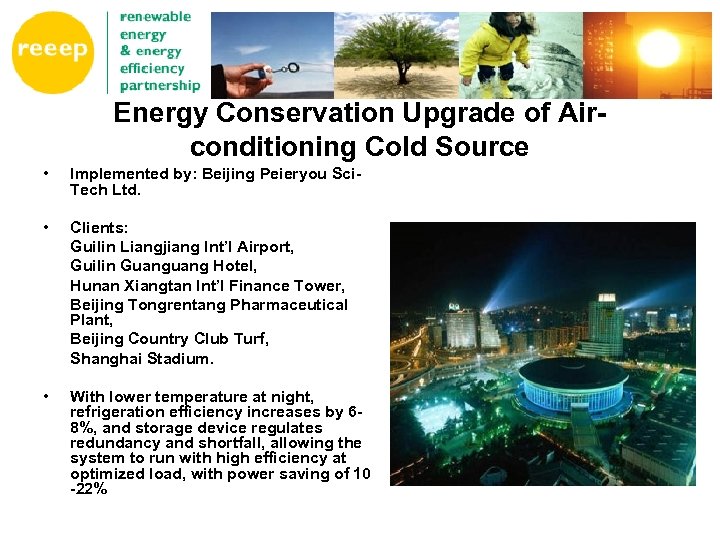
Energy Conservation Upgrade of Airconditioning Cold Source • Implemented by: Beijing Peieryou Sci. Tech Ltd. • Clients: Guilin Liangjiang Int’l Airport, Guilin Guang Hotel, Hunan Xiangtan Int’l Finance Tower, Beijing Tongrentang Pharmaceutical Plant, Beijing Country Club Turf, Shanghai Stadium. • With lower temperature at night, refrigeration efficiency increases by 68%, and storage device regulates redundancy and shortfall, allowing the system to run with high efficiency at optimized load, with power saving of 10 -22%
8. 5 New Heat Source for Air-conditioning • Land-source heat pump air-conditioning system: This system can provide both heating and refrigeration. The heat/coldness source is not fuels but land thermal energy. Heat pump replaces boiler (or refrigeration unit) as conversion equipment. • Land is a huge constant temperature energy storage bank. Temperatures at different strata of a specific area are constant all the year round. We can benefit greatly by using this resources. • Currently, there are mainly two types of heat pumps, i. e. , water-source heat pump and land-source heat pump.
Land Thermal Centralized Airconditioning Technology • Client: Beijing Friendship Hospital • Implemented by: Fuerda (Beijing) Hi-tech Ltd. • Project: The hospital previously used coal-fired boilers for heating. After adopting land thermal centralized air-conditioning technology, the system provides heating in winter and refrigeration in summer. • Energy Saving: According to measurement by Shandong Energy Conservation Technical Service Center, winter has heating for 150 days with an average cost of 20. 34 RMB/m 2, and summer has refrigeration for 120 days with an average cost of 16. 30 RMB/m 2. • Payback Period: 2. 3 years
Summary • A wealth of positive ESCO experience exists now globally • Key sectors are public buildings, industry commercial and residential • Ideally EE is tackled by better upfront standards and design, but as technology advances and installations age there always opportunities for ESCOs to take advantage
Скачать презентацию Further ESCO Case Studies Rebecca Gunning IT Power
cb163739175cb43a876a9e4ca689afc0.ppt