


 Скачать презентацию Funding the Movement of Freight Towards Financial
2ca56e06ef5671fe371ee130e0d37b67.ppt
- Количество слайдов: 30
 Funding the Movement of Freight Towards Financial & Environmental Rewards December 4, 2007 Canadian Association of Movers Annual Conference Toronto, ON Lynda Harvey - Fleet. Smart 1
 Today’s presentation: ü eco. ACTION ü eco. ENERGY for Fleets ü Results 2
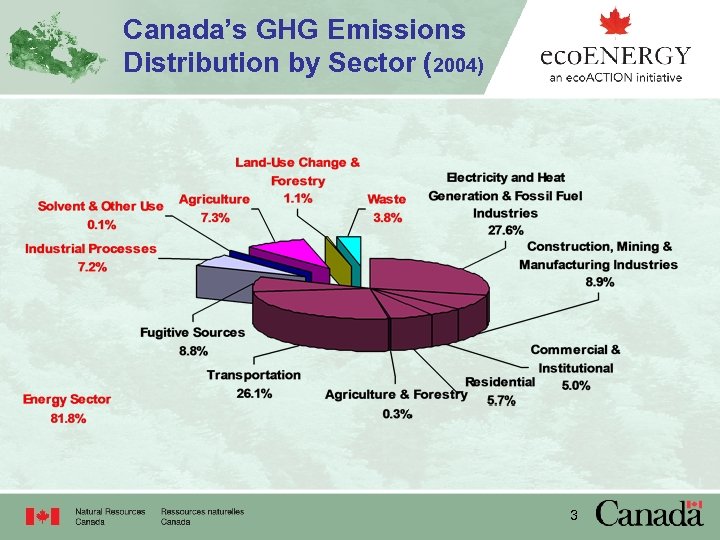 Canada’s GHG Emissions Distribution by Sector (2004) 3
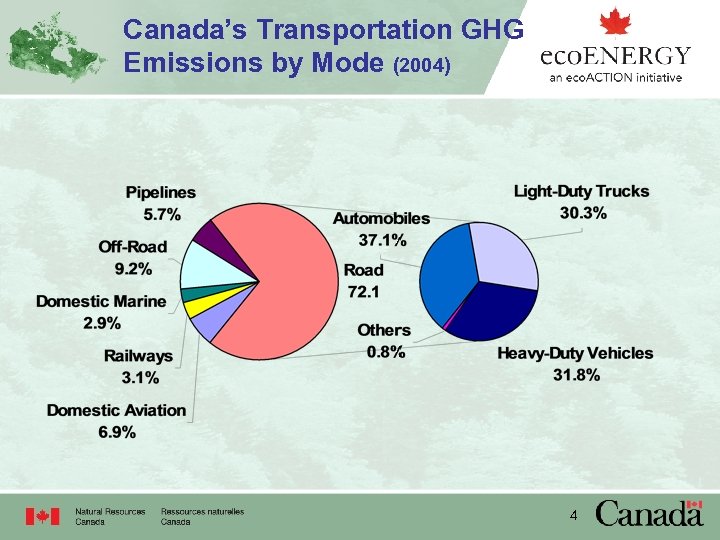 Canada’s Transportation GHG Emissions by Mode (2004) 4
 Chicken or Egg? Government concerns for – C Oil supplies C Carbon emissions C Global Climate Change 5
 Chicken or Egg? General Public / Consumer concerns demonstrating – • Emerging consumer preferences for locally produced products • Consumer choices in purchasing decision 6
 Voluntary Programs Little opportunity for gains from changes in structure / modal shifts, most obvious gains will come from logistics, training & technology • Utilization of trucks, truck size & capacity to cargo load • Optimizing locations where goods are produced & loaded / unloaded • Driver training • Proven vehicle technologies • Fuels 7
 eco. TRANSPORT eco. FREIGHT - Joint $61 m initiative with NRCan & Transport Canada Consists of six components: 1. National Harmonization Initiative for the Trucking Industry (TC) 2. Freight Technology Demonstration Fund (TC) 3. Freight Technology Incentives (TC) 4. eco. FREIGHT Partnerships (TC) 5. Marine Shore Power (TC) 6. eco. ENERGY for Fleets (NRCan) 8
 eco. FREIGHT funding envelopes ■ Freight Technology Demonstration Fund ($10 m) Reduce GHG and air pollutant emissions by funding the demonstrating of new technologies in real world conditions ■ Freight Technology Incentives ($10 m) Reduce GHG and air pollutant emissions by funding the purchase & installation of proven technologies Ø Funding Terms: Max $500 k per project, up to 50% of eligible costs limit of 50% federal funding per project – all four modes Ø Timeline: April 1, 2007 – March 31, 2011 Expected first round of funding Nov 1, 2007 9
 Federal Strategy & Programs for Fuels Four key elements to Canada’s biofuels strategy 1. Regulation to establish demand 2. Incentive to encourage domestic production (eco. Energy for Biofuels) 3. Support for deployment of next-generation technologies (Next. Gen Biofuels Fund. TM) 4. Support for agricultural producer participation in the production of biofuels 10
 What is Fleet. Smart ? (eco. ENERGY for fleets) A program at Natural Resources Canada to help commercial & institutional fleets reduce fuel consumption & emissions through improved energy efficient practices. Programs for on-road vehicles > Trucks – highway, forestry, urban > Bus – highway coach, transit, school buses > Urban – municipalities, utilities, light-duty fleets (ie. taxi, courier) 11
 eco. ENERGY for fleets Fleet. Smart - $22 m Ø Ø Fuel Management Plans (FM 101) Smart. Driver Technology & Information Workshops Truck Stop Idle-free Quiet Zone Campaign Ø U. S. Government partner - EPA - Smart. Way Transport Partnership 12
 Fuel Management Ø Fuel prices are volatile Ø New emissions standards are changing the engines and the fuel Ø The environmental impact of transportation is a concern 13
 Fuel Management Plan 1. 2. 3. 4. 5. 6. How do I start tracking fuel use? What information do I need to know? Where can I get that information? How do I analyze it? How do I cost my options? How do I decide which option is best? 14
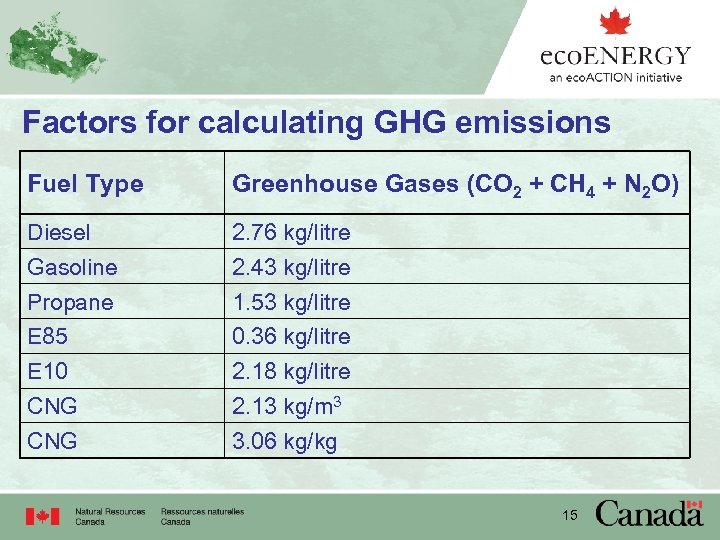 Factors for calculating GHG emissions Fuel Type Greenhouse Gases (CO 2 + CH 4 + N 2 O) Diesel 2. 76 kg/litre Gasoline 2. 43 kg/litre Propane 1. 53 kg/litre E 85 0. 36 kg/litre E 10 2. 18 kg/litre CNG 2. 13 kg/m 3 CNG 3. 06 kg/kg 15
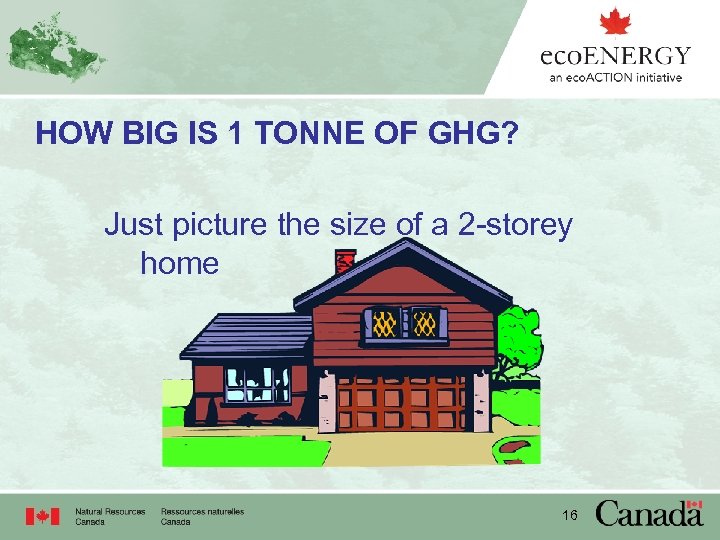 HOW BIG IS 1 TONNE OF GHG? Just picture the size of a 2 -storey home 16
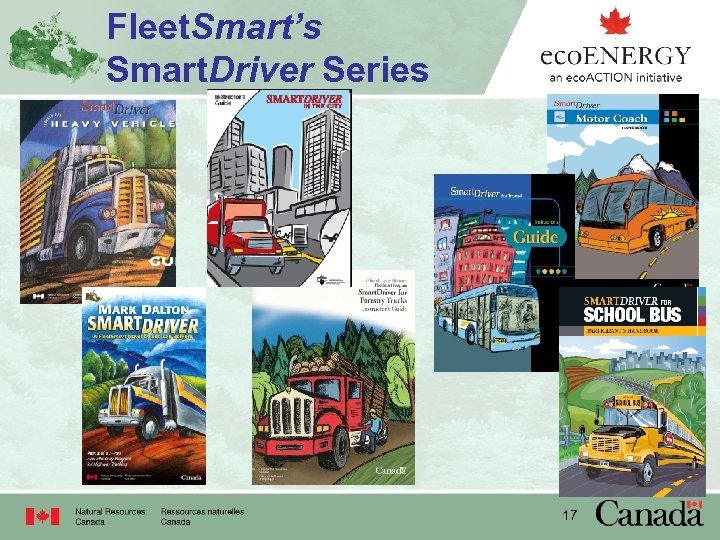 Fleet. Smart’s Smart. Driver Series 17
 Fleet. Smart con’t Maximizing on–board technologies THE DRIVER The investment in fuelefficient technology will not pay off if the driver is not trained to drive efficiently 18
 What is Smart. Way Transport? • Voluntary partnership between EPA and the freight industry: (Mix of shippers, carriers, logistics companies) – Designed to create a demand for cleaner, more fuel efficient freight transportation Ø Add environmental performance to the list of criteria used to contract business – Developed jointly by EPA and 15 Charter Partners – EPA interests: Reduced emissions (CO 2, NOx, PM) and interests improved energy security – Freight industry interests: Reduced fuel consumption, public interests recognition, improved public image, driver retention – No fees to participate – Open to companies of all sizes 19
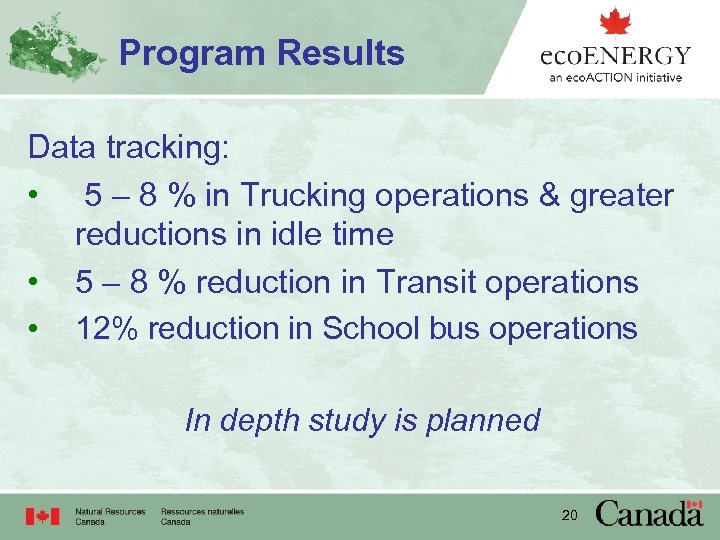 Program Results Data tracking: • 5 – 8 % in Trucking operations & greater reductions in idle time • 5 – 8 % reduction in Transit operations • 12% reduction in School bus operations In depth study is planned 20
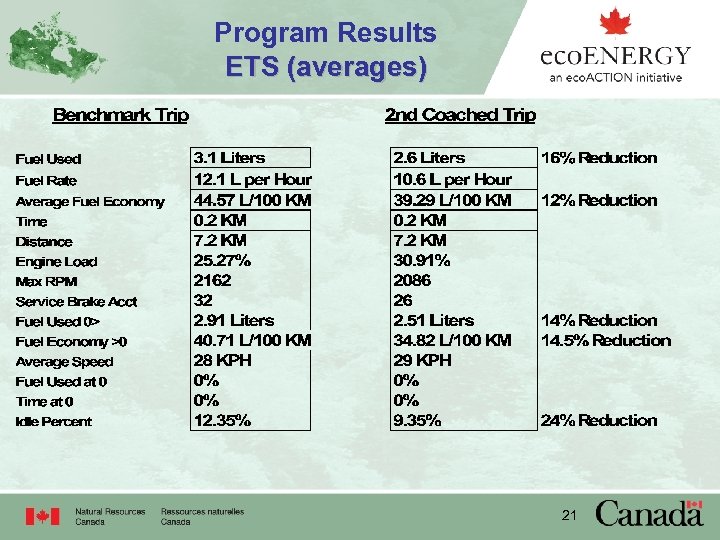 Program Results ETS (averages) 21
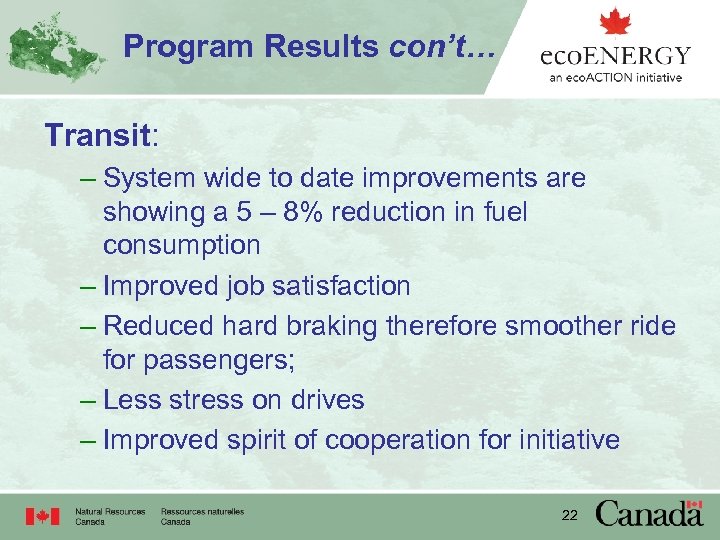 Program Results con’t… Transit: – System wide to date improvements are showing a 5 – 8% reduction in fuel consumption – Improved job satisfaction – Reduced hard braking therefore smoother ride for passengers; – Less stress on drives – Improved spirit of cooperation for initiative 22
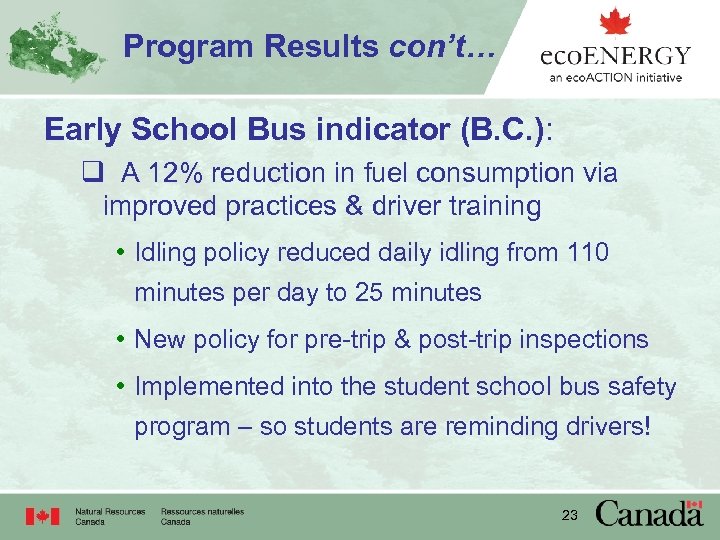 Program Results con’t… Early School Bus indicator (B. C. ): q A 12% reduction in fuel consumption via improved practices & driver training • Idling policy reduced daily idling from 110 minutes per day to 25 minutes • New policy for pre-trip & post-trip inspections • Implemented into the student school bus safety program – so students are reminding drivers! 23
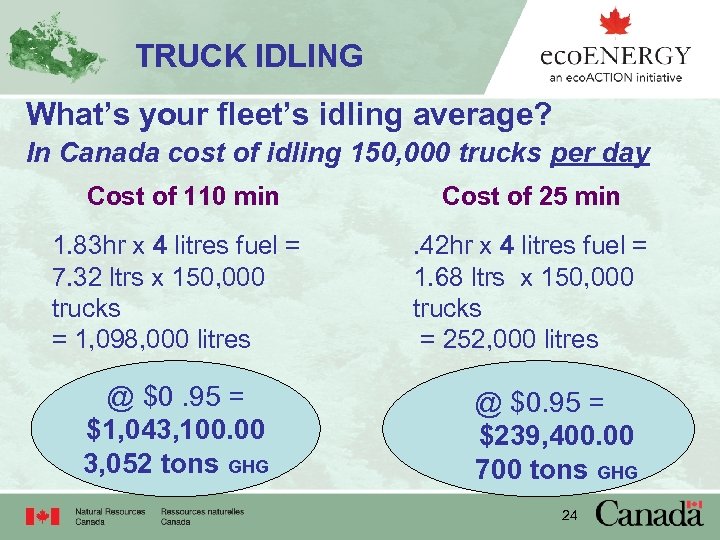 TRUCK IDLING What’s your fleet’s idling average? In Canada cost of idling 150, 000 trucks per day Cost of 110 min Cost of 25 min 1. 83 hr x 4 litres fuel = 7. 32 ltrs x 150, 000 trucks = 1, 098, 000 litres . 42 hr x 4 litres fuel = 1. 68 ltrs x 150, 000 trucks = 252, 000 litres @ $0. 95 = $1, 043, 100. 00 3, 052 tons GHG @ $0. 95 = $239, 400. 00 700 tons GHG 24
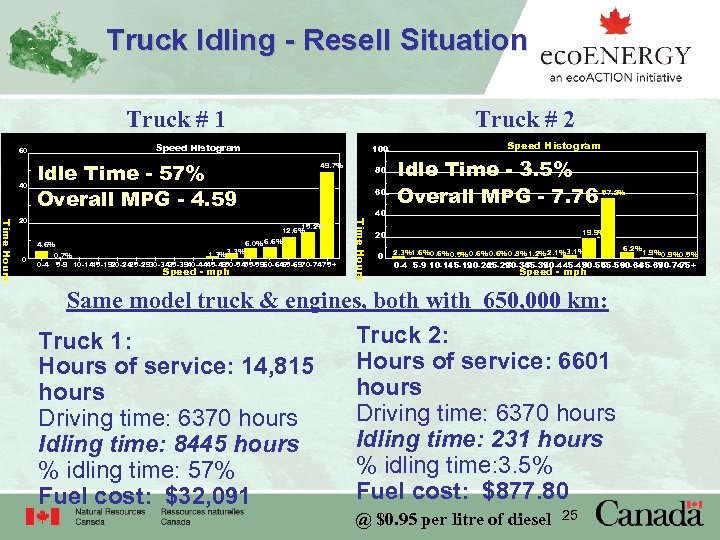 Truck Idling - Resell Situation Truck # 1 Speed Histogram 60 40 Idle Time - 57% Overall MPG - 4. 59 100 49. 7% 60 15. 2% 12. 6% 6. 0% 6. 6% 3. 3% 1. 3% 0. 7% 0 -4 5 -9 10 -14 15 -19 20 -24 25 -29 30 -34 35 -39 40 -44 45 -49 50 -54 55 -59 60 -64 65 -69 70 -7475+ 4. 6% Speed - mph 80 Time Hours 20 0 Truck # 2 40 Speed Histogram Idle Time - 3. 5% Overall MPG - 7. 76 19. 9% 20 0 57. 2% 2. 3%1. 6% 0. 5% 0. 6% 0. 8%1. 2% 2. 1% 3. 1% 6. 2% 1. 9% 0. 9%0. 5% 0 -4 5 -9 10 -14 5 -19 0 -24 5 -29 0 -34 5 -39 0 -44 5 -49 0 -54 5 -590 -64 5 -69 0 -74 1 2 2 3 3 4 4 5 5 6 6 7 75+ Speed - mph Same model truck & engines, both with 650, 000 km: Truck 2: Truck 1: Hours of service: 6601 Hours of service: 14, 815 hours Driving time: 6370 hours Idling time: 231 hours Idling time: 8445 hours % idling time: 3. 5% % idling time: 57% Fuel cost: $877. 80 Fuel cost: $32, 091 @ $0. 95 per litre of diesel 25
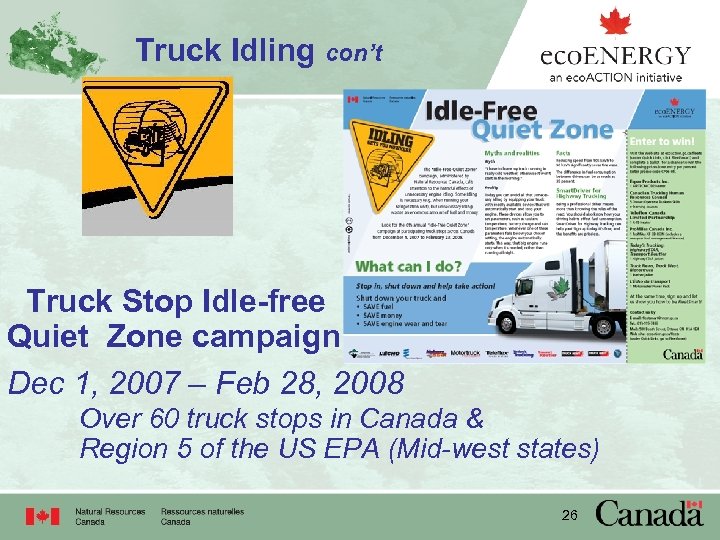 Truck Idling con’t Truck Stop Idle-free Quiet Zone campaign Dec 1, 2007 – Feb 28, 2008 Over 60 truck stops in Canada & Region 5 of the US EPA (Mid-west states) 26
 CO-BENEFITS Corporate: > Employee Retention Programs > Creates funds for reinvestment via § reduced fuel & maintenance costs § extending purchase cycle Social: > Corporate Social Responsibility trends > Reduction in emissions 27
 BUY- IN Ø Misinformation & myths are prevalent & an impediment to the industry Ø Informed drivers, technicians, dispatchers, managers are more likely to change their behaviour & share with family & community 28
 What do FLEETSmart Fleets have in common? ü ü ü Management commitment & Action Plan Staff education & training Use of technology Monitoring performance Coaching to improve weak performers Incentives / recognition program 29
 Natural Resources Canada - Fleet. Smart Thank You Lynda Harvey lharvey@nrcan. gc. ca 613 -947 -4291 30