 Скачать презентацию Fundamentals of Legal Research for Paralegals Presented by
205f48794114b4fe9573d711f9a380e9.ppt
- Количество слайдов: 65



Fundamentals of Legal Research for Paralegals Presented by: Jessica Salow Assistant Librarian Joan Dalton AGO Library Director
Seminar Content 1. 2. 3. 4. 5. What do I need to bring to the table in order to conduct legal research? How do I begin researching? Understanding legal research sources. Understanding the goal of researching. Where do I begin researching?
Seminar Content (cont. ) Researching a topic that you know something about. 6. • • 7. 8. 9. Anatomy of a judicial decision. Using key numbers to find other decisions. Researching when you don’t know much about the topic. Research Sources Checklist sharepoint Law Library Page
1. What do I need to bring to the table in order to conduct legal research? n n n Understanding of American legal principles (e. g. , stare decisis (legal precedent), separation of powers, etc. ). Understanding of American government (esp. , form and function of the three branches of government and “separation of powers” legal principle). Understanding of the American court system (i. e. , stages of litigation).
2. Q: How do I begin researching? A: Get Organized n n n First, you need to become familiar with the basic law as it exists in your practice area. At a minimum, you need to know where to find the applicable statutes, administrative code, court rules, etc. that pertain to your practice area. Optimal: Create a research notebook that outlines the statutes and administrative code in your practice area. [And keep it updated!]
Example: Outlining Garnishment Statutes A. R. S. 12 -1570: Definitions Definition of: deliver, exempt monies or property, good faith, judgment creditor, judgment debtor, monies, nonexempt monies or property, personal property, receipt. A. R. S. 12 -1571: Issuance of writ (A) Clerk of court or justice of peace must issue writs of garnishment (wog) to be returned to their courts upon filing of application and bond. (B) City and town magistrates may issue wog, returnable to their courts, for nonpayment of monies payable to the court. Includes but is not limited to bonds, fines, fees, sanctions, penalties, surcharges, assessments and restitution upon filing of appropriate application and bond. A political subdivision or court is considered a judgment creditor for purposes of garnishment. (C) writ may issue to the judgment creditor as garnishee for property of the judgment debtor in possession of the judgment creditor or a third party. A. R. S. 12 -1572: Application for writ of garnishment for monies or property.
Get Organized: Why outlining helps n n n The act of outlining acquaints you with the law in your practice area. When researching, you will usually first want to check applicable statutes and/or agency rules in your practice area for an answer. An outline assists with skimming through these materials. The more familiar you become with the law in your practice area the better you become at your job.
3. Understand: Legal Research Sources Primary vs. Secondary Authority n Primary Authority: law that a court must follow in deciding a case. Sources of primary authority are: 1) written laws passed by legislative bodies, 2) prior judicial decisions aka “case law” (stare decisis), 3) government administrative regulations, and 4) court rules. Courts are obliged to decide cases by following the dictates of primary authority, and lawyers must make arguments based on the primary authority that is applicable to the case.
Understand: Legal Research Sources Primary vs. Secondary Authority n Secondary Authority: Sources of information that describe or interpret the law, such as legal treatises, law review articles, and other scholarly legal writings. Secondary authority is cited by lawyers to “persuade” a court to reach a particular decision in a case; however, the court is not obligated to follow it. Thus secondary authority is inferior to primary authority.
n n Understand: Primary Authority 3 Branches Interplay “Separation of Powers Doctrine” The governments of states and the United States are divided into three departments or branches: Legislative Branch, Executive Branch, and Judicial Branch. One branch may not encroach on the domain of another branch = Separation of Powers Doctrine.
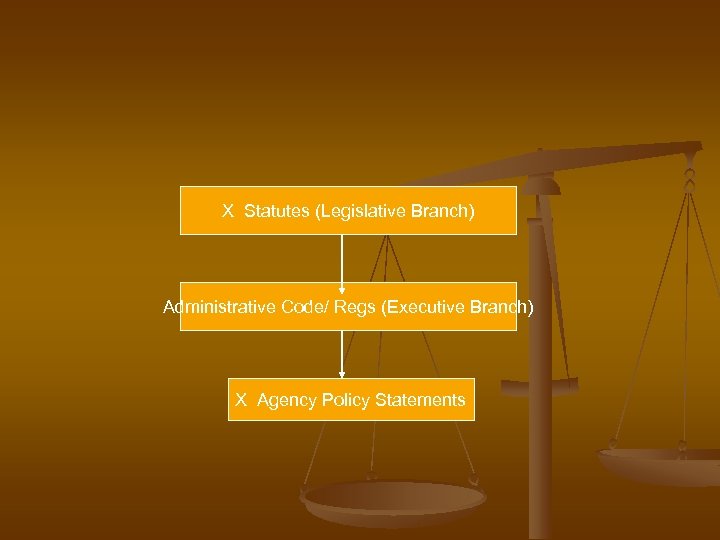
Primary Authority: Three Branches Interplay n n n Legislative Branch– has plenary power to create laws [statutes]; however, can delegate certain administrative functions/gaps in legislation to the Executive Branch– State agencies that implement laws created by the Legislative Branch. Responsible for creation of administrative regs (or code), which serve to “fill in the gaps” of laws created by the Legislative Branch. Judicial Branch– determines the validity of laws created by the Legislative Branch and implemented by the Executive Branch. Adjudicates disputes under the law.
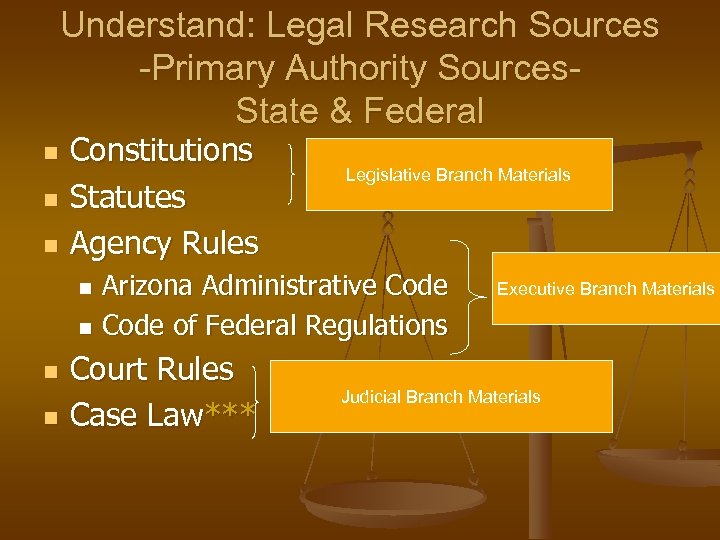
Understand: Legal Research Sources -Primary Authority Sources. State & Federal n n n Constitutions Statutes Agency Rules Legislative Branch Materials Arizona Administrative Code n Code of Federal Regulations n n n Court Rules Case Law*** Executive Branch Materials Judicial Branch Materials
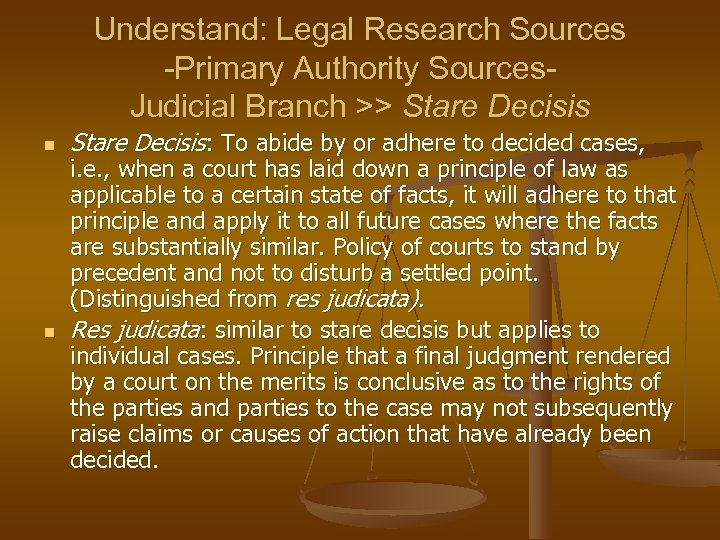
Understand: Legal Research Sources -Primary Authority Sources. Judicial Branch >> Stare Decisis n n Stare Decisis: To abide by or adhere to decided cases, i. e. , when a court has laid down a principle of law as applicable to a certain state of facts, it will adhere to that principle and apply it to all future cases where the facts are substantially similar. Policy of courts to stand by precedent and not to disturb a settled point. (Distinguished from res judicata). Res judicata: similar to stare decisis but applies to individual cases. Principle that a final judgment rendered by a court on the merits is conclusive as to the rights of the parties and parties to the case may not subsequently raise claims or causes of action that have already been decided.
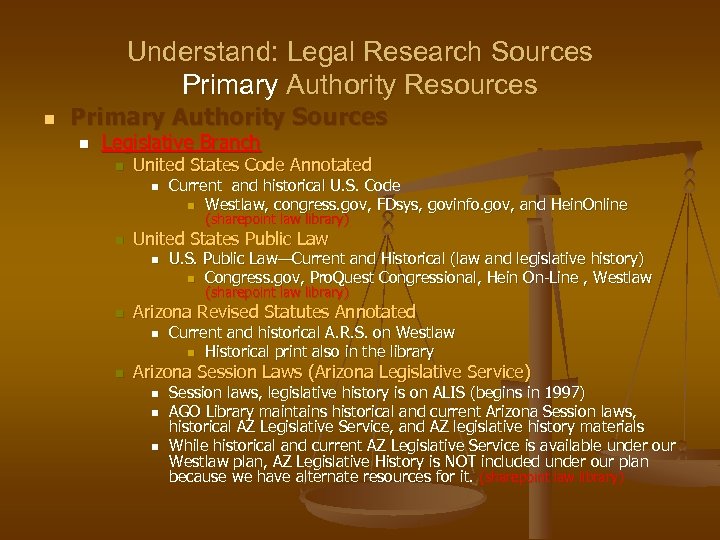
Understand: Legal Research Sources Primary Authority Resources n Primary Authority Sources n Legislative Branch n United States Code Annotated n Current and historical U. S. Code n Westlaw, congress. gov, FDsys, govinfo. gov, and Hein. Online (sharepoint law library) n United States Public Law n U. S. Public Law—Current and Historical (law and legislative history) n Congress. gov, Pro. Quest Congressional, Hein On-Line , Westlaw (sharepoint law library) n Arizona Revised Statutes Annotated n n Current and historical A. R. S. on Westlaw n Historical print also in the library Arizona Session Laws (Arizona Legislative Service) n n n Session laws, legislative history is on ALIS (begins in 1997) AGO Library maintains historical and current Arizona Session laws, historical AZ Legislative Service, and AZ legislative history materials While historical and current AZ Legislative Service is available under our Westlaw plan, AZ Legislative History is NOT included under our plan because we have alternate resources for it. (sharepoint law library)
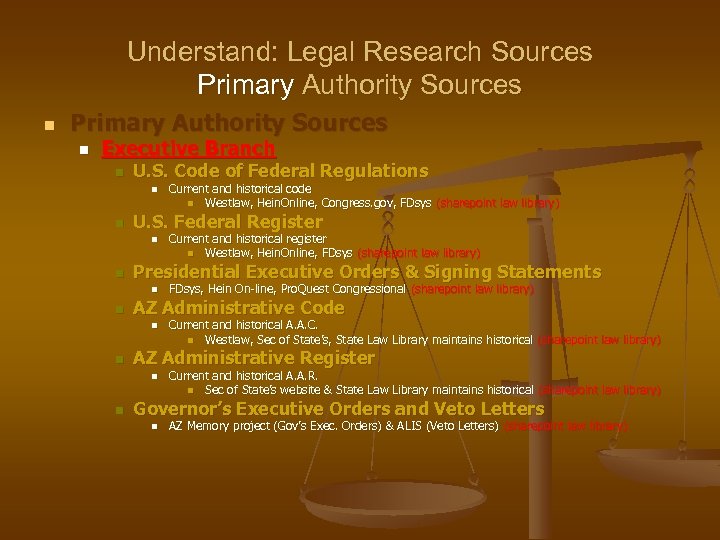
Understand: Legal Research Sources Primary Authority Sources n Executive Branch n U. S. Code of Federal Regulations n n U. S. Federal Register n n Current and historical A. A. C. n Westlaw, Sec of State’s, State Law Library maintains historical (sharepoint law library) AZ Administrative Register n n FDsys, Hein On-line, Pro. Quest Congressional (sharepoint law library) AZ Administrative Code n n Current and historical register n Westlaw, Hein. Online, FDsys (sharepoint law library) Presidential Executive Orders & Signing Statements n n Current and historical code n Westlaw, Hein. Online, Congress. gov, FDsys (sharepoint law library ) Current and historical A. A. R. n Sec of State’s website & State Law Library maintains historical (sharepoint law library) Governor’s Executive Orders and Veto Letters n AZ Memory project (Gov’s Exec. Orders) & ALIS (Veto Letters) (sharepoint law library)
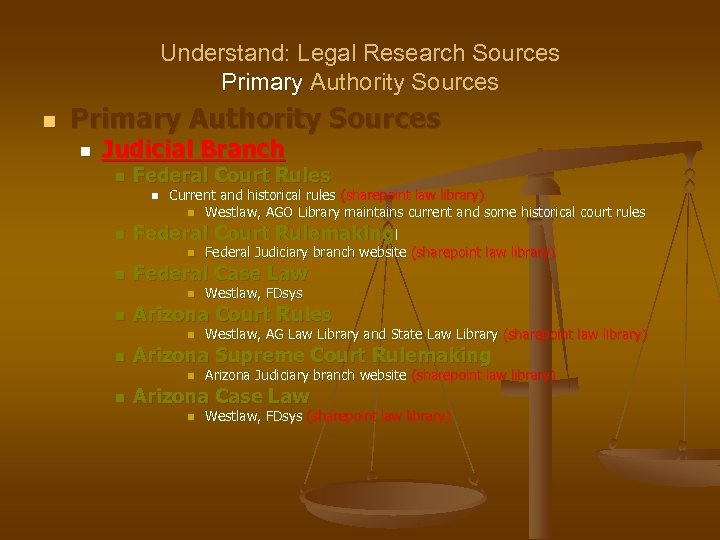
Understand: Legal Research Sources Primary Authority Sources n Judicial Branch n Federal Court Rules n n Current and historical rules (sharepoint law library) n Westlaw, AGO Library maintains current and some historical court rules Federal Court Rulemakingl n n Federal Case Law n n Westlaw, AG Law Library and State Law Library (sharepoint law library) Arizona Supreme Court Rulemaking n n Westlaw, FDsys Arizona Court Rules n n Federal Judiciary branch website (sharepoint law library) Arizona Case Law n Westlaw, FDsys (sharepoint law library)
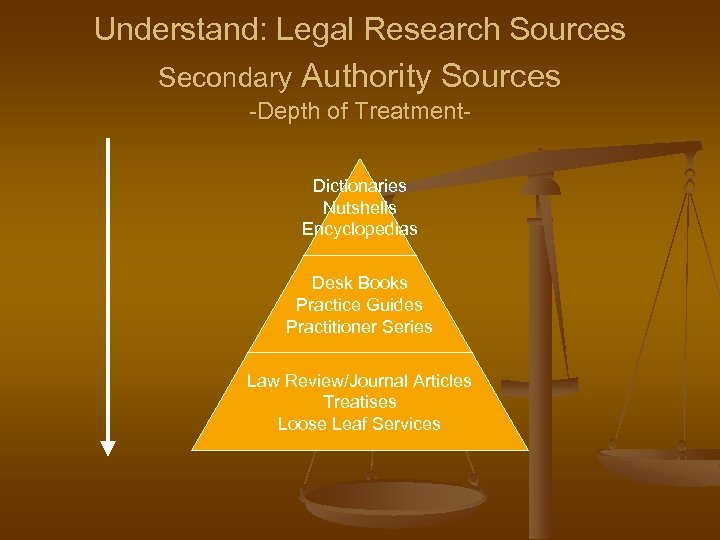
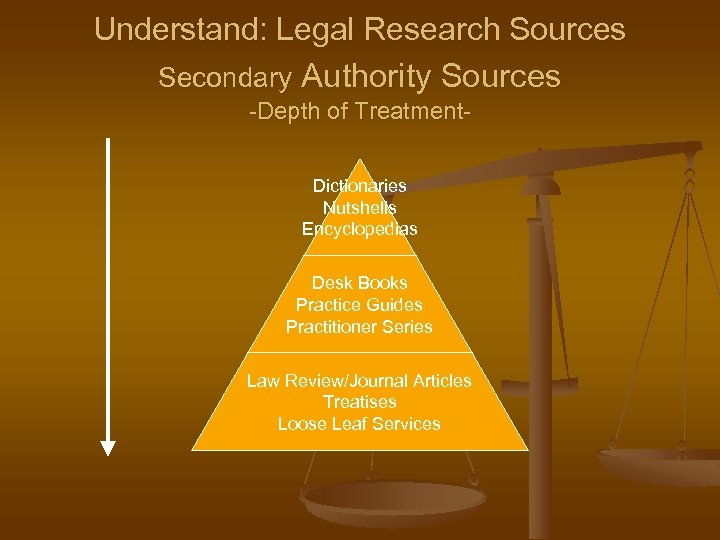
Understand: Legal Research Sources Secondary Authority Sources -Depth of Treatment. Dictionaries Nutshells Encyclopedias Desk Books Practice Guides Practitioner Series Law Review/Journal Articles Treatises Loose Leaf Services
Secondary Authority Sources n Hornbook: A primer; a book explaining the basics, fundamentals, or rudiments of any science or branch of knowledge. The phrase hornbook law is a colloquial designation of the rudiments or general principles of law. E. g. , “Nutshell” series: Search and Seizure in a Nutshell, etc. n Treatise: A scholarly legal publication containing all the law relating to a particular area, such as criminal law or land-use control. Lawyers commonly use treatises in order to review the law and update their knowledge of pertinent case decisions and statutes. E. g. , Wright & Miller: Federal Practice & Procedure
4. Understand: Goal of Researching n Find primary resource as authority for legal proposition; BUT: Keep in mind that you are striving to find. . .
#1. . . Primary authority that supports your legal proposition and is in a similar context to your fact pattern (fact pattern = circumstances raising legal issue) and procedural history (procedural history = stage of litigation).
#2. . . Primary authority that supports your legal proposition and is still good law. n Statute or case law has not been found unconstitutional or overturned.
#3. . . Primary authority that supports your legal proposition and that is also in an appropriate jurisdiction. n State vs. Federal n The higher the court the better
When you have found all of these elements you have found a case that is exactly “on point. ”
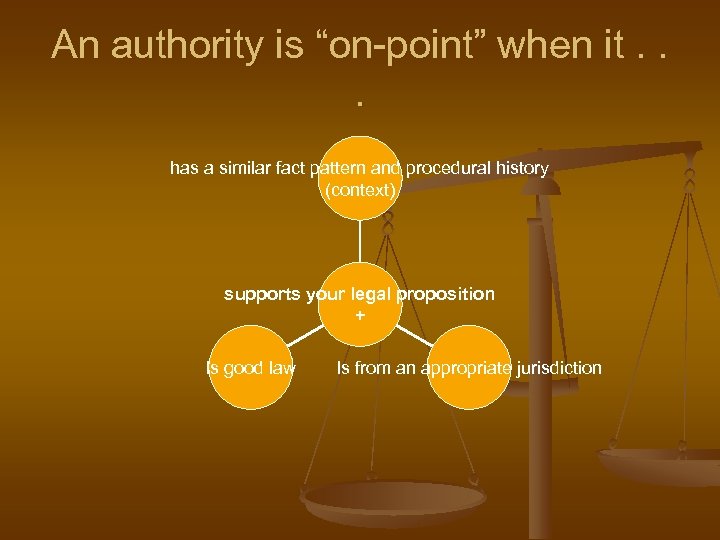
An authority is “on-point” when it. . . has a similar fact pattern and procedural history (context) supports your legal proposition + Is good law Is from an appropriate jurisdiction
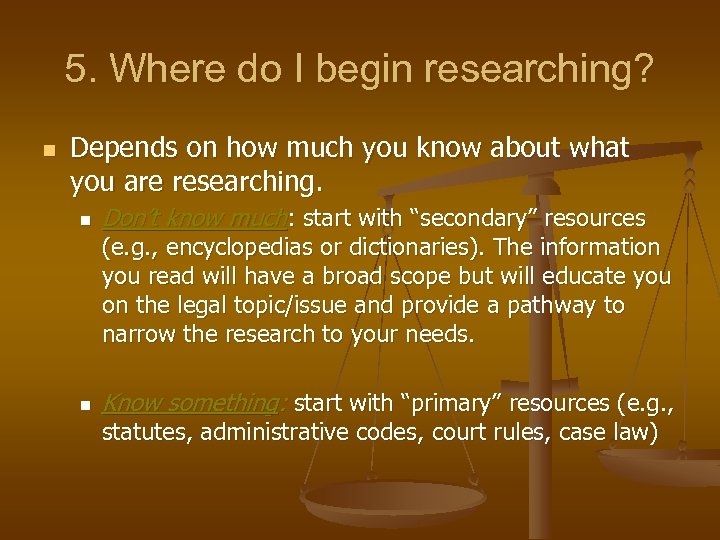
5. Where do I begin researching? n Depends on how much you know about what you are researching. n Don’t know much: start with “secondary” resources (e. g. , encyclopedias or dictionaries). The information you read will have a broad scope but will educate you on the legal topic/issue and provide a pathway to narrow the research to your needs. n Know something: start with “primary” resources (e. g. , statutes, administrative codes, court rules, case law)
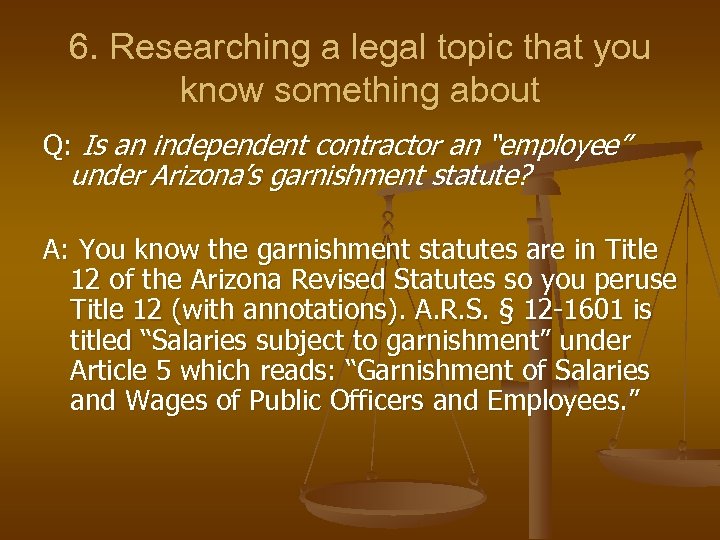
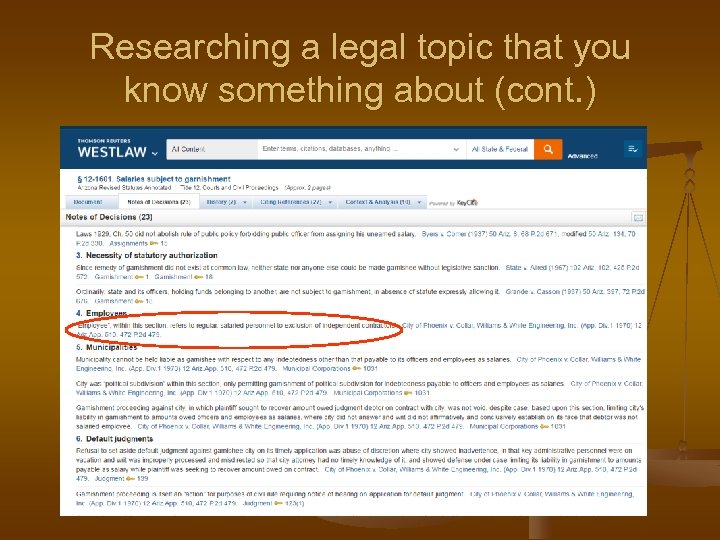
6. Researching a legal topic that you know something about Q: Is an independent contractor an “employee” under Arizona’s garnishment statute? A: You know the garnishment statutes are in Title 12 of the Arizona Revised Statutes so you peruse Title 12 (with annotations). A. R. S. § 12 -1601 is titled “Salaries subject to garnishment” under Article 5 which reads: “Garnishment of Salaries and Wages of Public Officers and Employees. ”
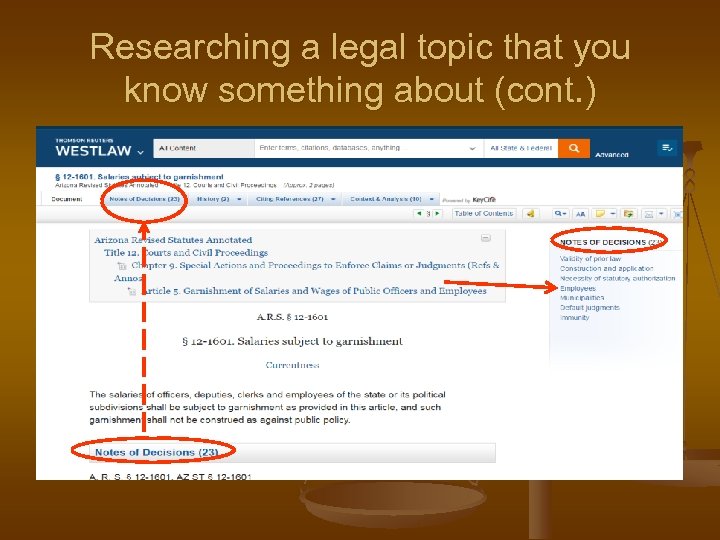
Researching a legal topic that you know something about (cont. )
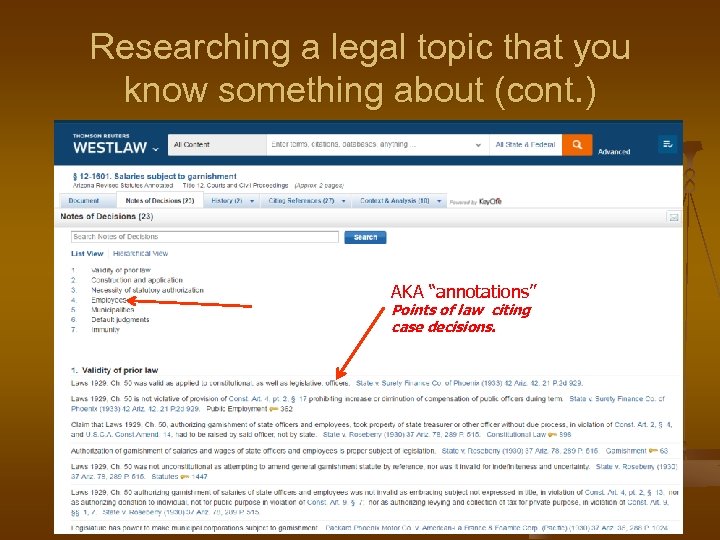
Researching a legal topic that you know something about (cont. ) AKA “annotations” Points of law citing case decisions.
Researching a legal topic that you know something about (cont. )
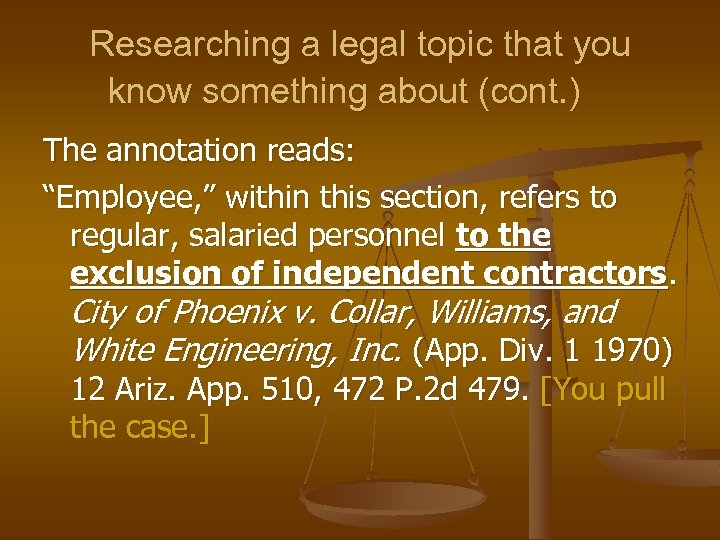
Researching a legal topic that you know something about (cont. ) The annotation reads: “Employee, ” within this section, refers to regular, salaried personnel to the exclusion of independent contractors. City of Phoenix v. Collar, Williams, and White Engineering, Inc. (App. Div. 1 1970) 12 Ariz. App. 510, 472 P. 2 d 479. [You pull the case. ]
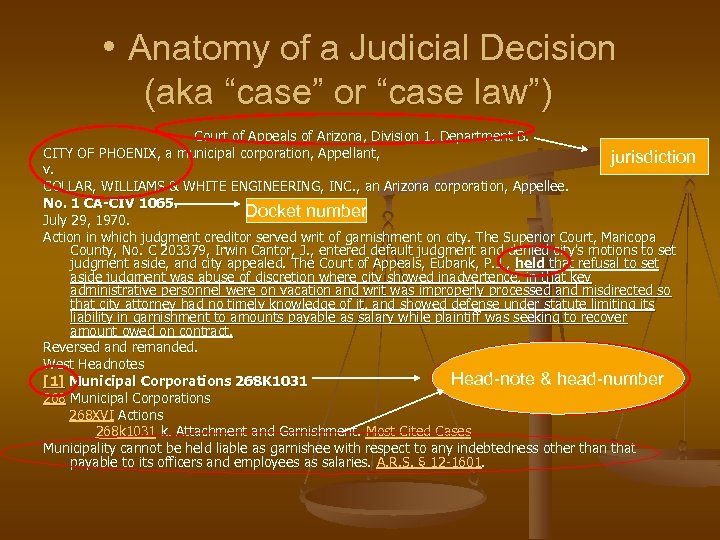
• Anatomy of a Judicial Decision (aka “case” or “case law”) Court of Appeals of Arizona, Division 1, Department B. CITY OF PHOENIX, a municipal corporation, Appellant, jurisdiction v. COLLAR, WILLIAMS & WHITE ENGINEERING, INC. , an Arizona corporation, Appellee. No. 1 CA-CIV 1065. Docket number July 29, 1970. Action in which judgment creditor served writ of garnishment on city. The Superior Court, Maricopa County, No. C 203379, Irwin Cantor, J. , entered default judgment and denied city's motions to set judgment aside, and city appealed. The Court of Appeals, Eubank, P. J. , held that refusal to set aside judgment was abuse of discretion where city showed inadvertence, in that key administrative personnel were on vacation and writ was improperly processed and misdirected so that city attorney had no timely knowledge of it, and showed defense under statute limiting its liability in garnishment to amounts payable as salary while plaintiff was seeking to recover amount owed on contract. Reversed and remanded. West Headnotes Head-note & head-number [1] Municipal Corporations 268 K 1031 268 Municipal Corporations 268 XVI Actions 268 k 1031 k. Attachment and Garnishment. Most Cited Cases Municipality cannot be held liable as garnishee with respect to any indebtedness other than that payable to its officers and employees as salaries. A. R. S. § 12 -1601.
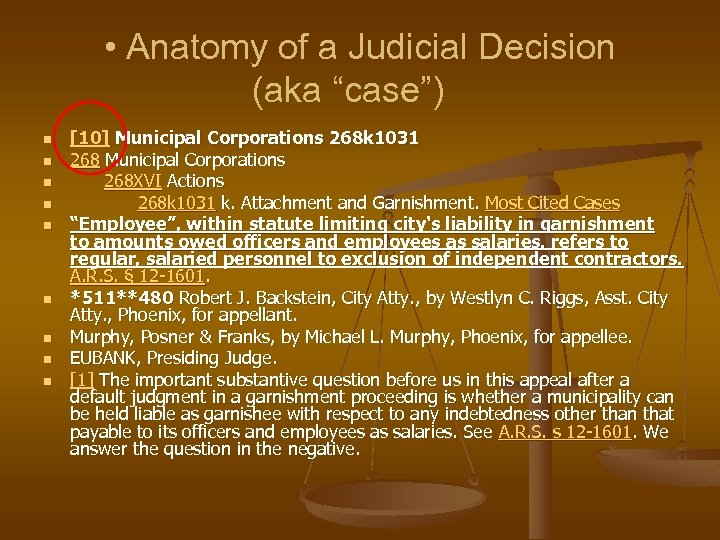
• Anatomy of a Judicial Decision (aka “case”) n n n n n [10] Municipal Corporations 268 k 1031 268 Municipal Corporations 268 XVI Actions 268 k 1031 k. Attachment and Garnishment. Most Cited Cases “Employee”, within statute limiting city's liability in garnishment to amounts owed officers and employees as salaries, refers to regular, salaried personnel to exclusion of independent contractors. A. R. S. § 12 -1601. *511**480 Robert J. Backstein, City Atty. , by Westlyn C. Riggs, Asst. City Atty. , Phoenix, for appellant. Murphy, Posner & Franks, by Michael L. Murphy, Phoenix, for appellee. EUBANK, Presiding Judge. [1] The important substantive question before us in this appeal after a default judgment in a garnishment proceeding is whether a municipality can be held liable as garnishee with respect to any indebtedness other than that payable to its officers and employees as salaries. See A. R. S. s 12 -1601. We answer the question in the negative.
![• Anatomy of a Judicial Decision (aka “case”) n n n n [10]](https://present5.com/presentation/205f48794114b4fe9573d711f9a380e9/image-33.jpg "• Anatomy of a Judicial Decision (aka “case”) n n n n [10]")
• Anatomy of a Judicial Decision (aka “case”) n n n n [10] Should the matter come into controversy, we do not think that the legislature intended the term ‘employees' as used in A. R. S. s 12 -1601 to be a term of broad significance which might include an independent contractor performing specified tasks on a job or contract basis. We think that term, which follows the terms ‘officers, deputies, clerks' is clearly intended to refer only to regular, salaried personnel of the public entity. We disagree with the contrary dicta in Wheeler v. Walter J. Bryson Co. , 162 Tenn. 163, 35 S. W. 2 d 391 (1931), on this subject. Reversed and remanded for further proceedings not inconsistent herewith. HAIRE and JACOBSEN, JJ. , concur. Ariz. App. 1970. City of Phoenix v. Collar, Williams & White Engineering, Inc. 12 Ariz. App. 510, 472 P. 2 d 479 END OF DOCUMENT
![• Finding Other Cases/Materials– Using Key Numbers [10] Municipal Corporations 268(KEY)1031 268 Municipal](https://present5.com/presentation/205f48794114b4fe9573d711f9a380e9/image-34.jpg "• Finding Other Cases/Materials– Using Key Numbers [10] Municipal Corporations 268(KEY)1031 268 Municipal")
• Finding Other Cases/Materials– Using Key Numbers [10] Municipal Corporations 268(KEY)1031 268 Municipal Corporations 268 XVI Actions 268 k 1031 k. Attachment and Garnishment. Most Cited Cases “Employee”, within statute limiting city's liability in garnishment to amounts owed officers and employees as salaries, refers to regular, salaried personnel to exclusion of independent contractors. A. R. S. § 12 -1601. *511**480 Robert J. Backstein, City Atty. , by Westlyn C. Riggs, Asst. City Atty. , Phoenix, for appellant. Murphy, Posner & Franks, by Michael L. Murphy, Phoenix, for appellee. EUBANK, Presiding Judge.
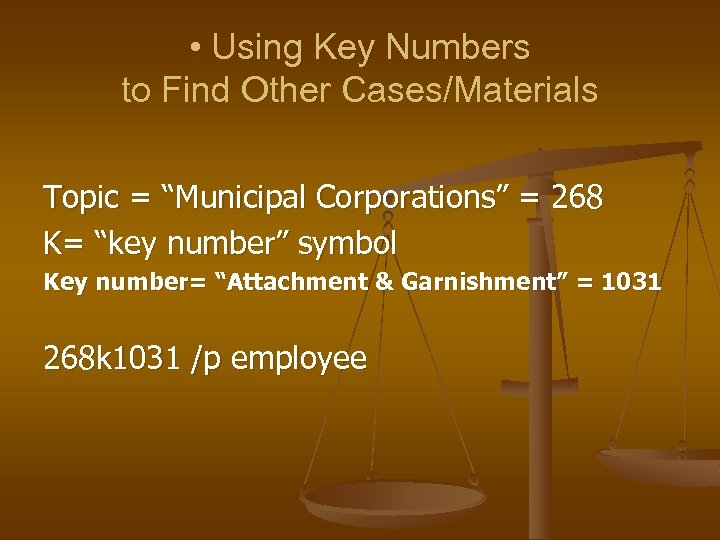
• Using Key Numbers to Find Other Cases/Materials Topic = “Municipal Corporations” = 268 K= “key number” symbol Key number= “Attachment & Garnishment” = 1031 268 k 1031 /p employee
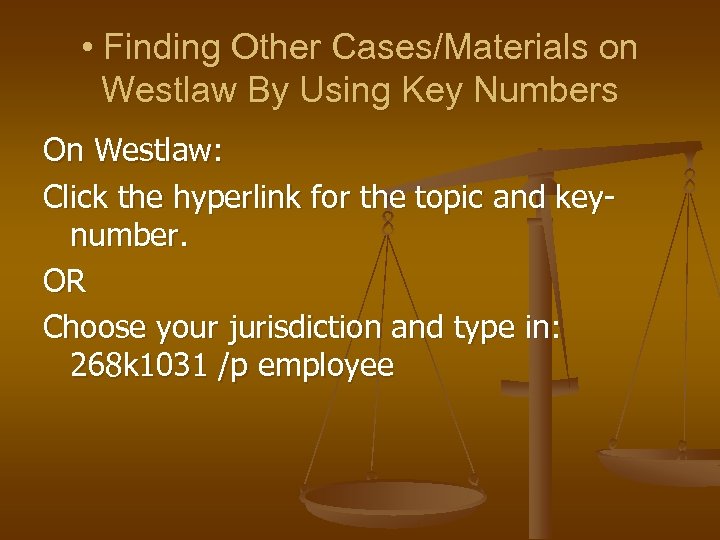
• Finding Other Cases/Materials on Westlaw By Using Key Numbers On Westlaw: Click the hyperlink for the topic and keynumber. OR Choose your jurisdiction and type in: 268 k 1031 /p employee
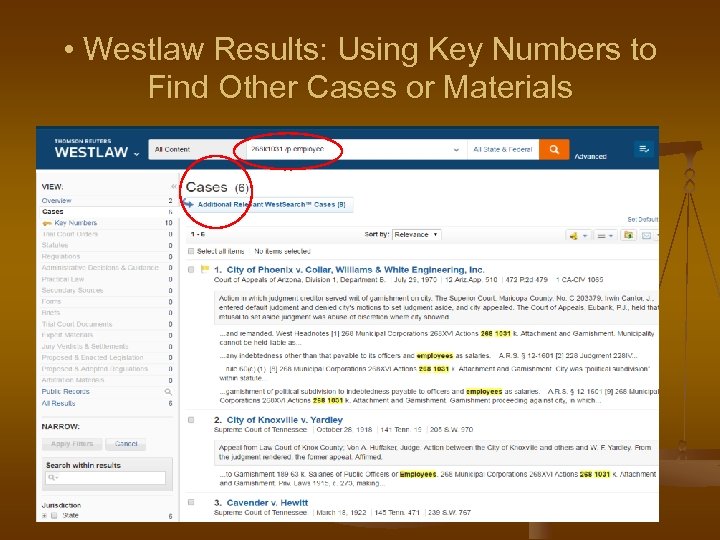
• Westlaw Results: Using Key Numbers to Find Other Cases or Materials
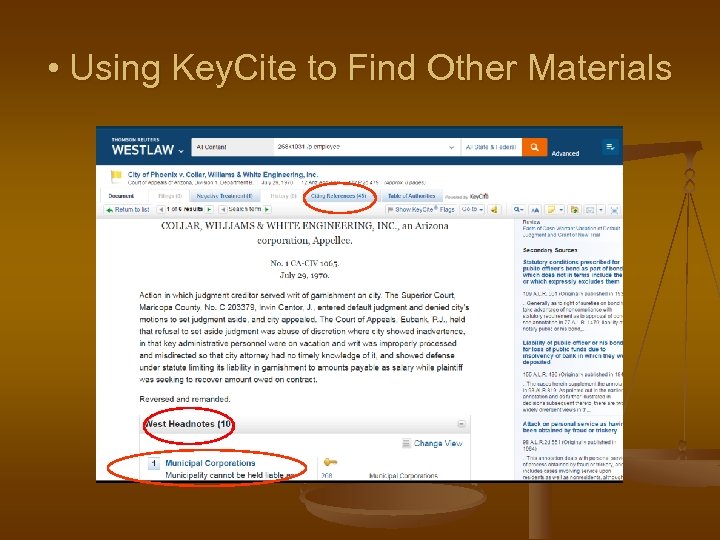
• Using Key. Cite to Find Other Materials
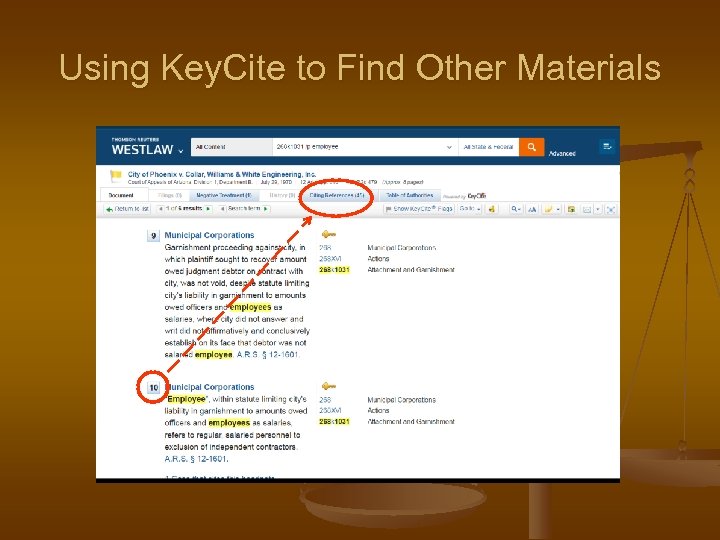
Using Key. Cite to Find Other Materials
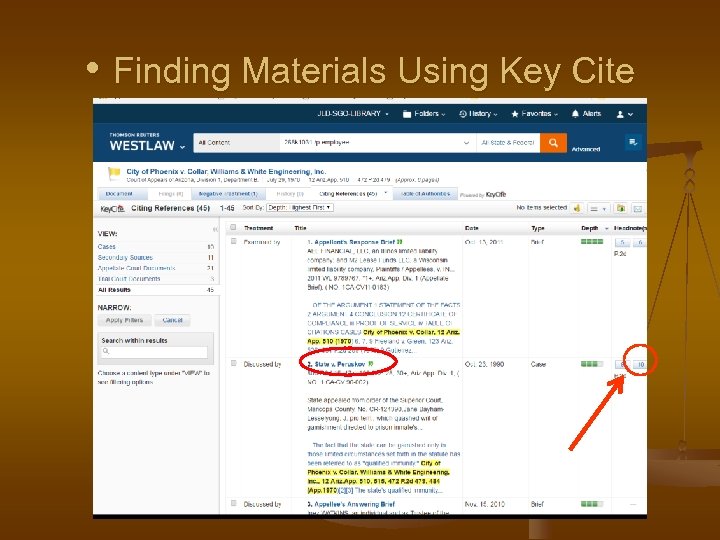
• Finding Materials Using Key Cite
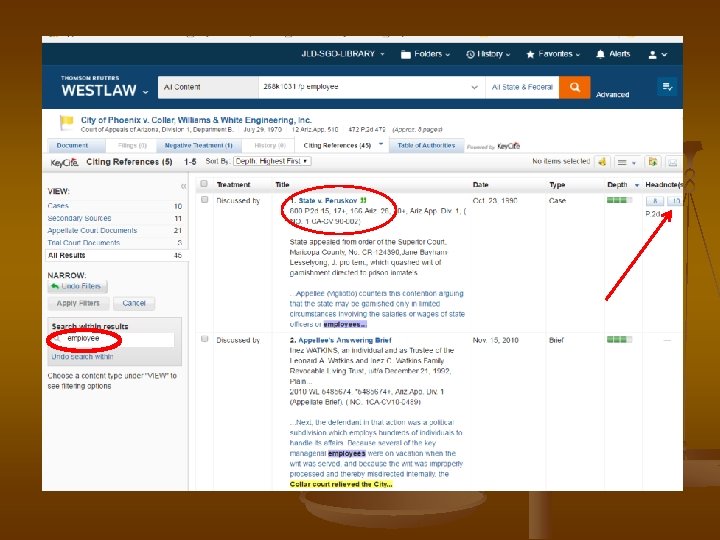
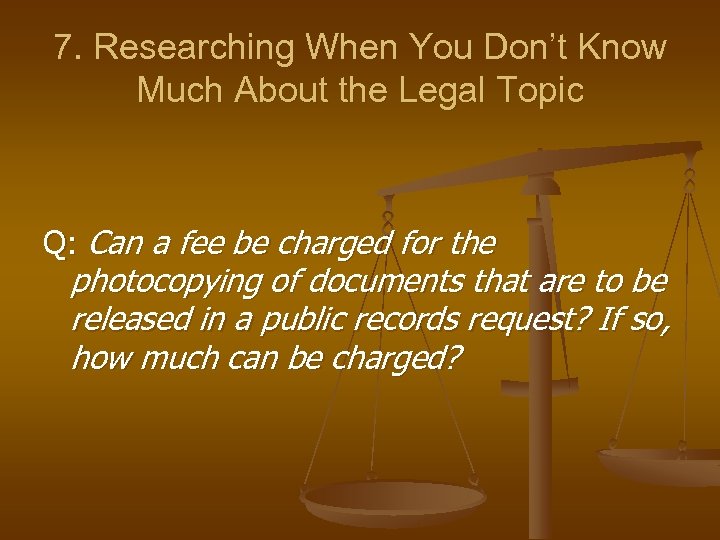
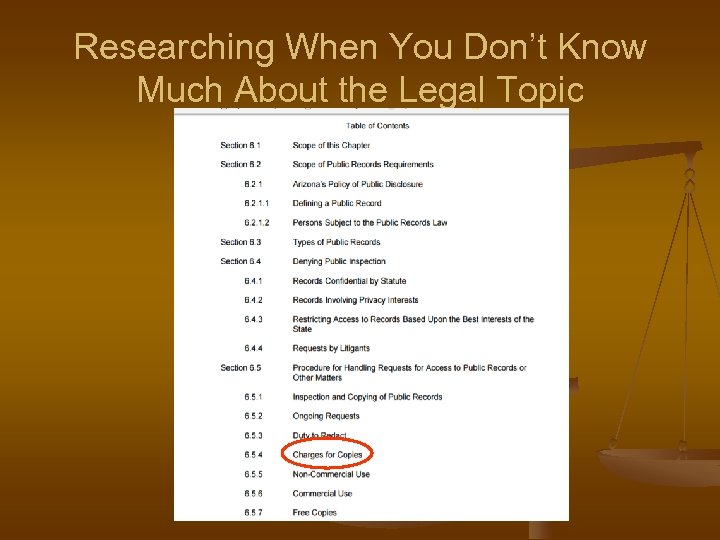
7. Researching When You Don’t Know Much About the Legal Topic Q: Can a fee be charged for the photocopying of documents that are to be released in a public records request? If so, how much can be charged?
Understand: Legal Research Sources Secondary Authority Sources -Depth of Treatment. Dictionaries Nutshells Encyclopedias Desk Books Practice Guides Practitioner Series Law Review/Journal Articles Treatises Loose Leaf Services
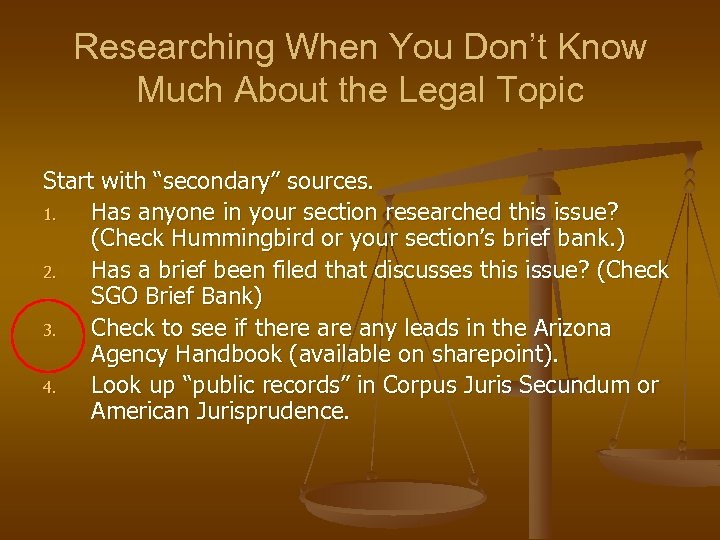
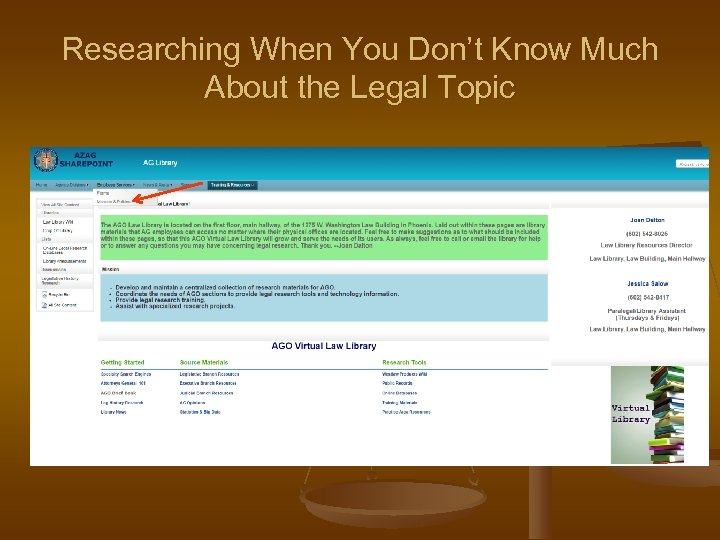
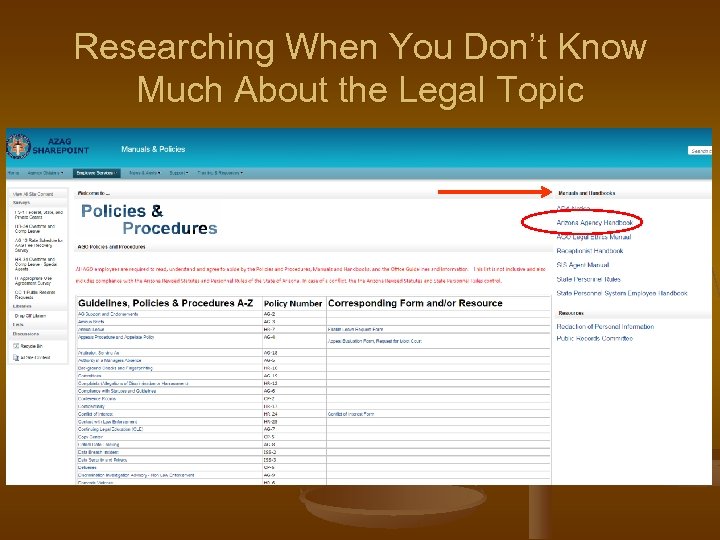
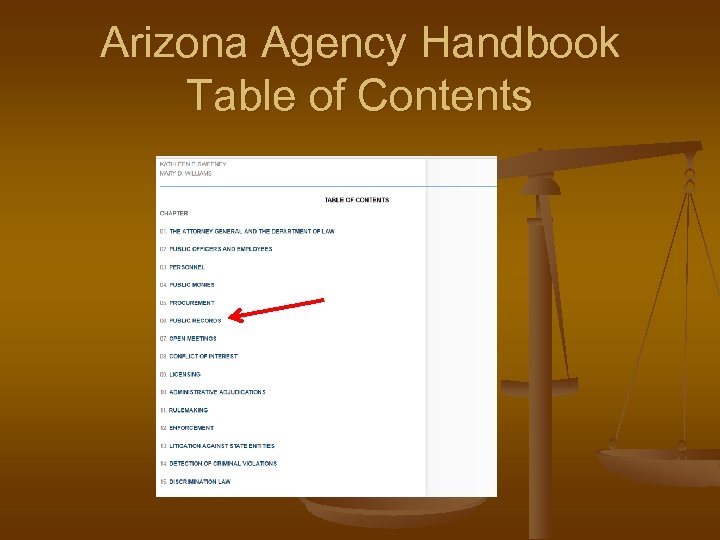
Researching When You Don’t Know Much About the Legal Topic Start with “secondary” sources. 1. Has anyone in your section researched this issue? (Check Hummingbird or your section’s brief bank. ) 2. Has a brief been filed that discusses this issue? (Check SGO Brief Bank) 3. Check to see if there any leads in the Arizona Agency Handbook (available on sharepoint). 4. Look up “public records” in Corpus Juris Secundum or American Jurisprudence.
Researching When You Don’t Know Much About the Legal Topic
Researching When You Don’t Know Much About the Legal Topic
Researching When You Don’t Know Much About the Legal Topic
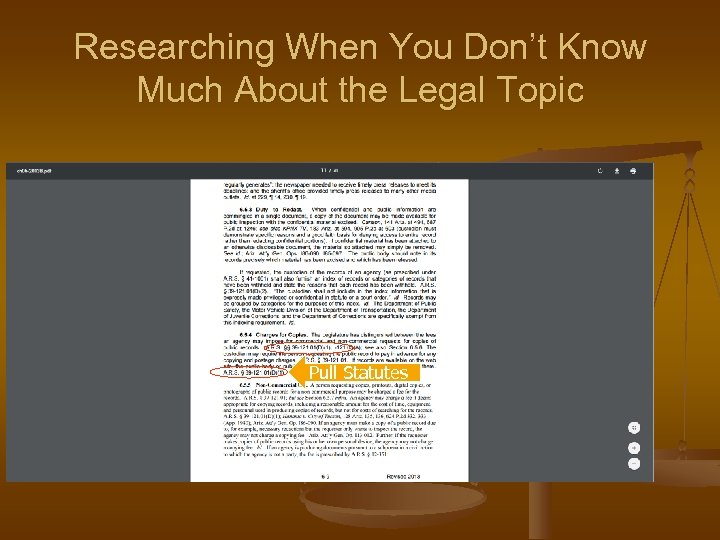
Researching When You Don’t Know Much About the Legal Topic Pull Statutes
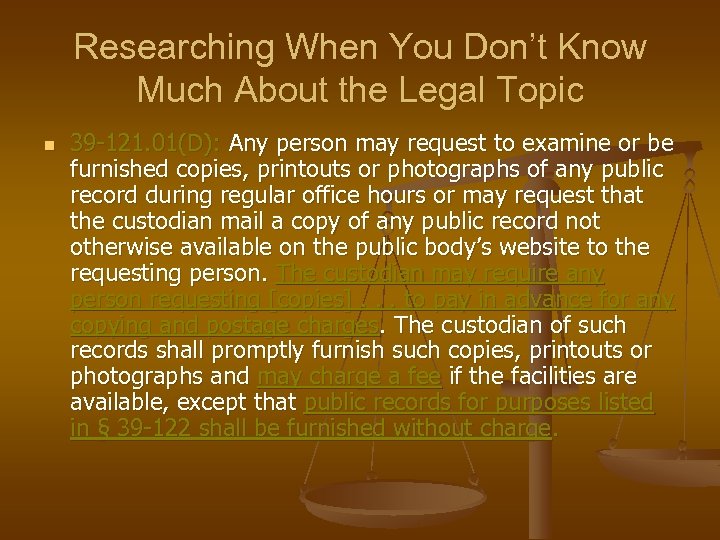
Researching When You Don’t Know Much About the Legal Topic n 39 -121. 01(D): Any person may request to examine or be furnished copies, printouts or photographs of any public record during regular office hours or may request that the custodian mail a copy of any public record not otherwise available on the public body’s website to the requesting person. The custodian may require any person requesting [copies]. . . to pay in advance for any copying and postage charges. The custodian of such records shall promptly furnish such copies, printouts or photographs and may charge a fee if the facilities are available, except that public records for purposes listed in § 39 -122 shall be furnished without charge.
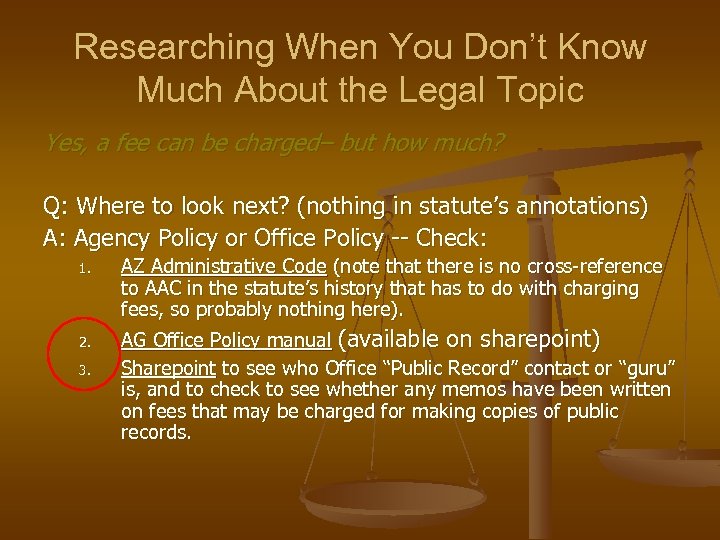
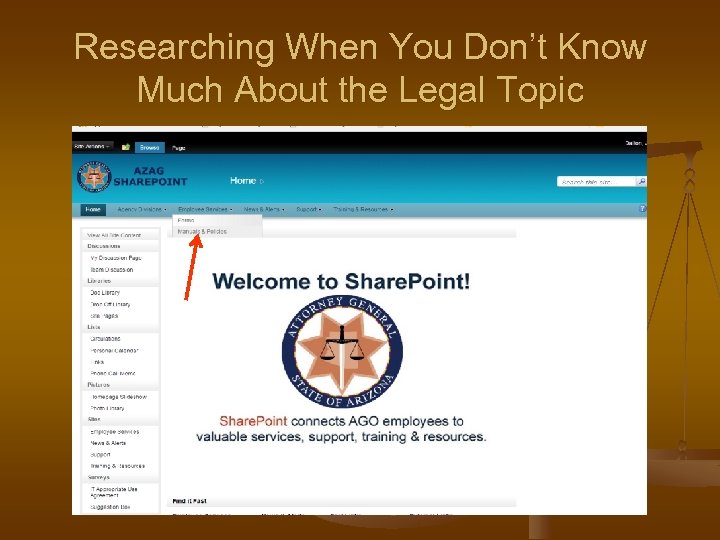
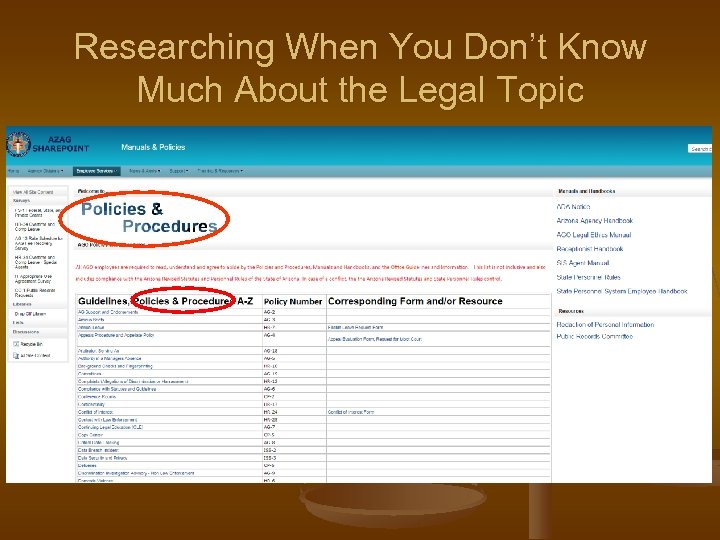
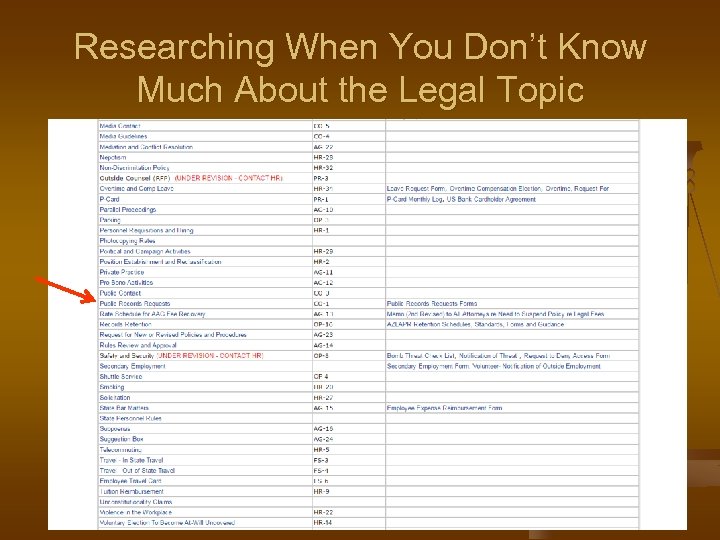
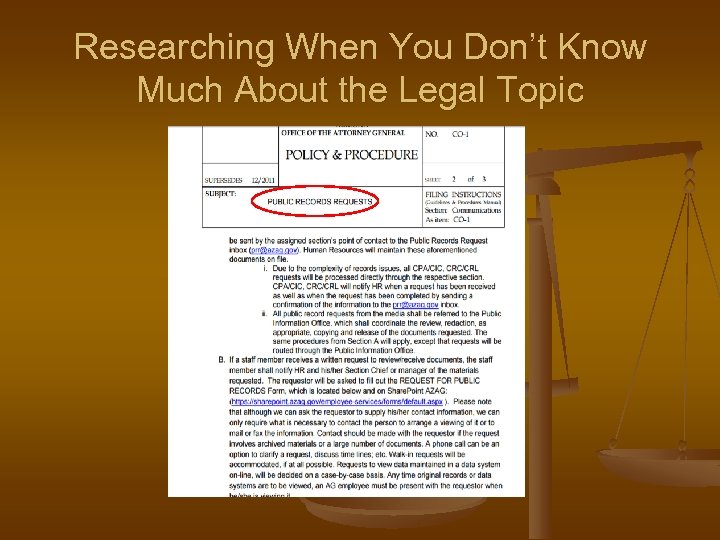
Researching When You Don’t Know Much About the Legal Topic Yes, a fee can be charged– but how much? Q: Where to look next? (nothing in statute’s annotations) A: Agency Policy or Office Policy -- Check: 1. 2. 3. AZ Administrative Code (note that there is no cross-reference to AAC in the statute’s history that has to do with charging fees, so probably nothing here). AG Office Policy manual (available on sharepoint) Sharepoint to see who Office “Public Record” contact or “guru” is, and to check to see whether any memos have been written on fees that may be charged for making copies of public records.
X Statutes (Legislative Branch) Administrative Code/ Regs (Executive Branch) X Agency Policy Statements
Researching When You Don’t Know Much About the Legal Topic
Researching When You Don’t Know Much About the Legal Topic
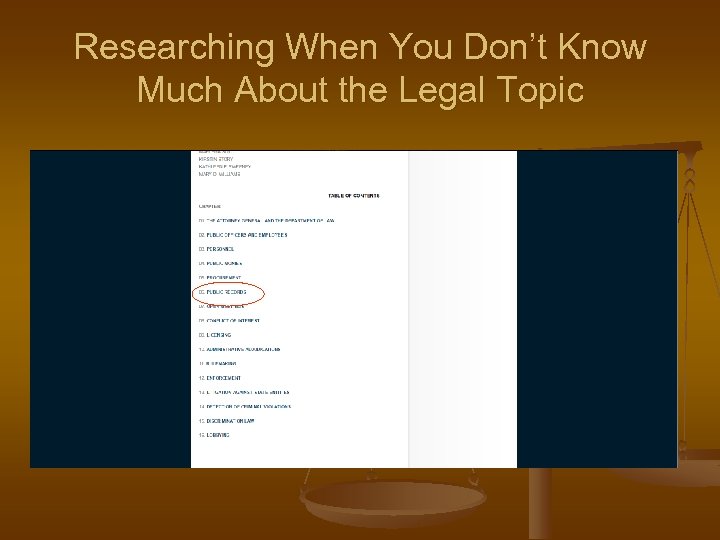
Arizona Agency Handbook Table of Contents
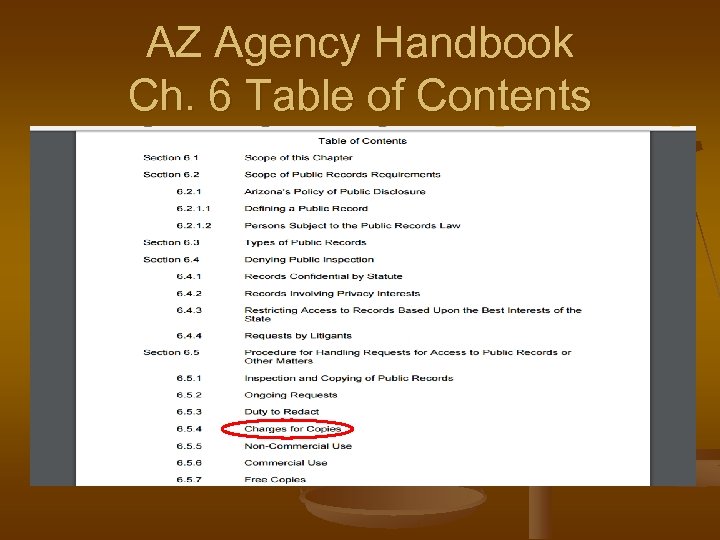
AZ Agency Handbook Ch. 6 Table of Contents
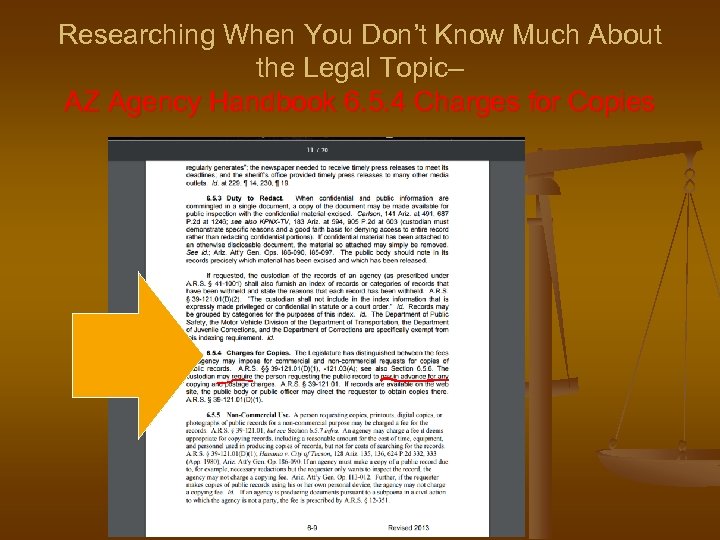
Researching When You Don’t Know Much About the Legal Topic– AZ Agency Handbook 6. 5. 4 Charges for Copies
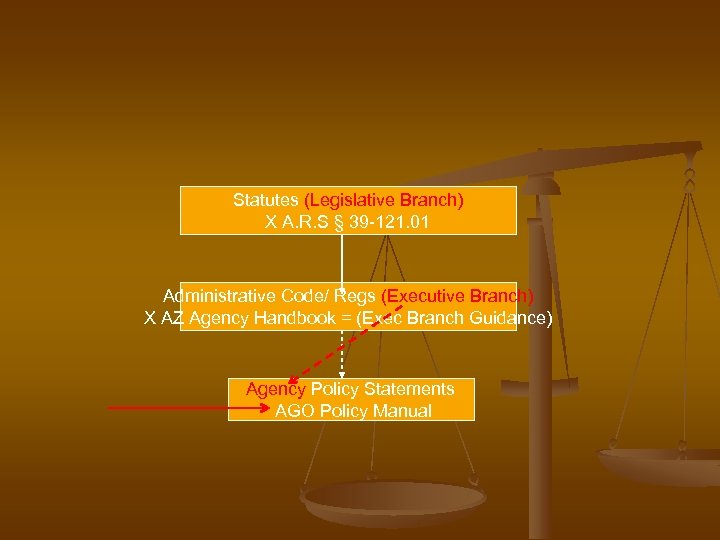
Statutes (Legislative Branch) X A. R. S § 39 -121. 01 Administrative Code/ Regs (Executive Branch) X AZ Agency Handbook = (Exec Branch Guidance) Agency Policy Statements AGO Policy Manual
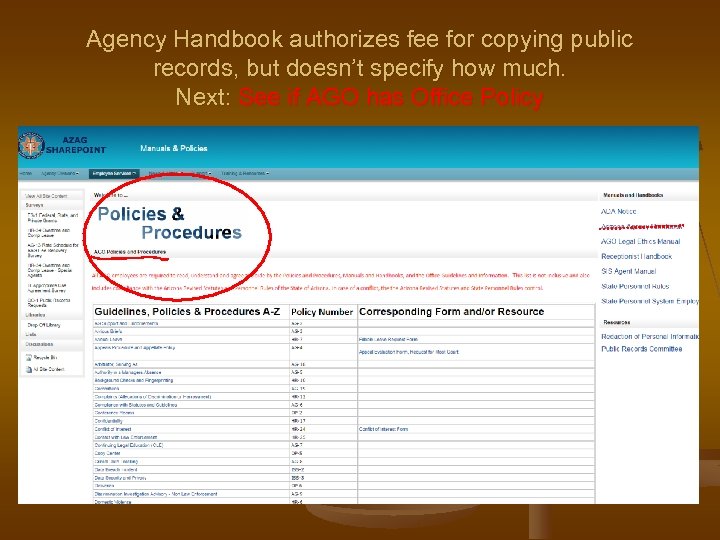
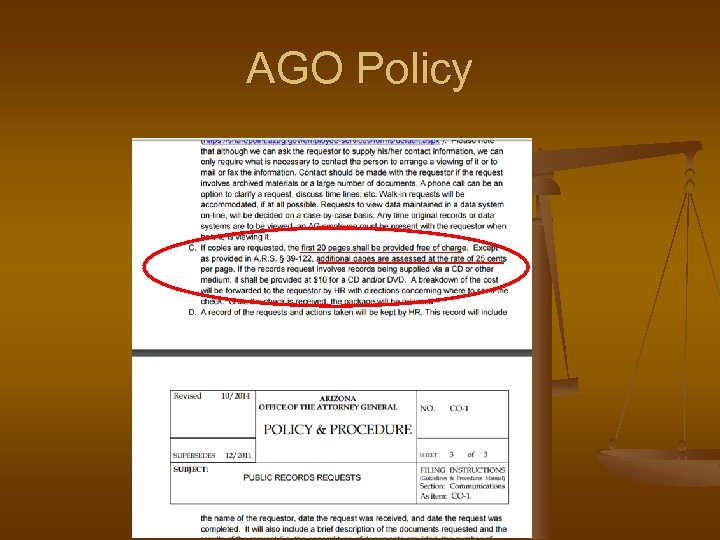
Agency Handbook authorizes fee for copying public records, but doesn’t specify how much. Next: See if AGO has Office Policy
Researching When You Don’t Know Much About the Legal Topic
Researching When You Don’t Know Much About the Legal Topic
Researching When You Don’t Know Much About the Legal Topic
AGO Policy
8. Research Sources Checklist 1. 2. 3. 4. 5. 6. Has anyone in your section researched this issue? (Check Hummingbird) Have any office briefs been filed that have handled this issue? (Check SGO Brief Bank) Did you try researching on the web or on sharepoint for your issue? Did you check all of your Secondary Authority sources? (don’t forget Arizona Agency Handbook) Did you check all of your Primary Authority sources? Did you key cite the materials you did find?
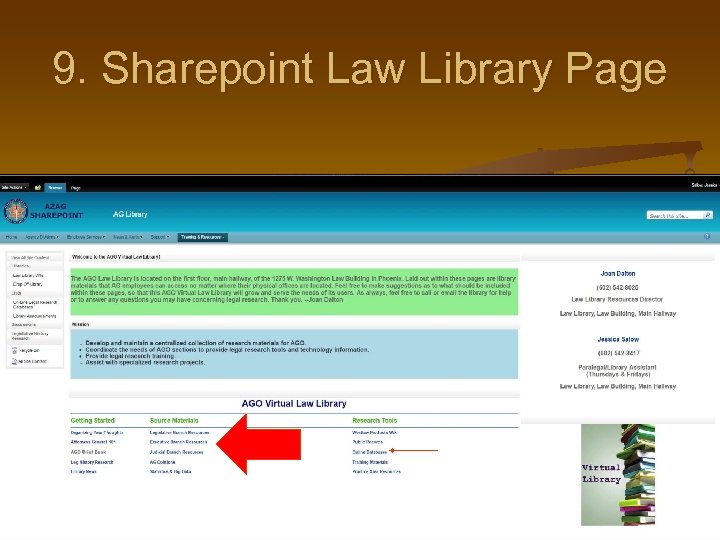
9. Sharepoint Law Library Page
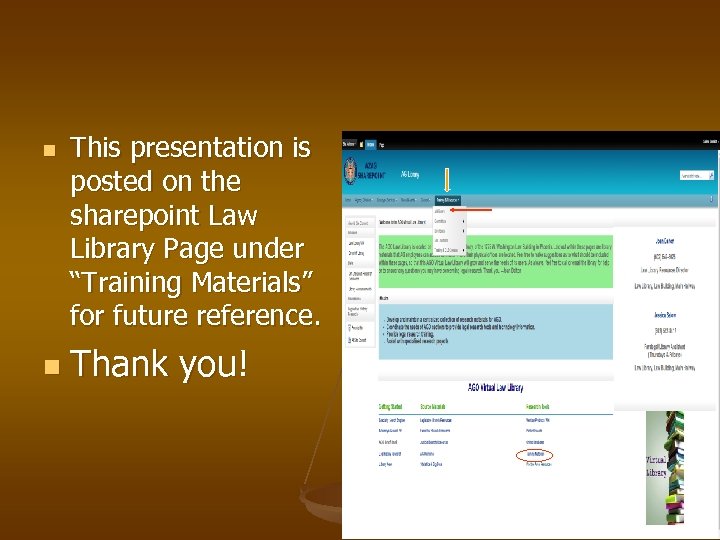
n n This presentation is posted on the sharepoint Law Library Page under “Training Materials” for future reference. Thank you!
Скачать презентацию Fundamentals of Legal Research for Paralegals Presented by
205f48794114b4fe9573d711f9a380e9.ppt