 Скачать презентацию Fundamentals of Grammar Introduction Literature 1 Блох
ТГ Пр 1. Fundamentals of Grammar..pptx
- Количество слайдов: 51



Fundamentals of Grammar Introduction
Literature 1. Блох М. Я. Теоретическая грамматика английского языка. М. , 1983. 2. Мороховская Э. Я. Fundamentals of theoretical English Grammar. Киев, 1984. 3. Александрова О. В. , Комова Т. В. Modern English Grammar. Morphology. Syntax. M. , 2007. 4. Хомутова Т. Н. Theory of English Grammar. Челябинск, 2006. 5. Каушанская В. Л. и др. A Grammar of the English Language. M. , 2008. 6. Хомутова Т. Н. , Власова Ю. А. Readings in the Theory of English Grammar. Челябинск, 2008. 7. Блох М. Я. , Семенова Т. Н. и др. Практикум по теоретической грамматике английского языка. М. , 2004.
Grammar is • widely recognized as one of the most sophisticated areas of linguistics; • based on scholarship from a number of different disciplines; • the backbone of the language.
Practical Grammar • is often used to refer to the best means of achieving a good command of a language; • prescribes a set of nominative rules based on the Standard English. THEORETICAL GRAMMAR • can be understood in a more scholarly way as the framework of grammatical concepts throughout the centuries.
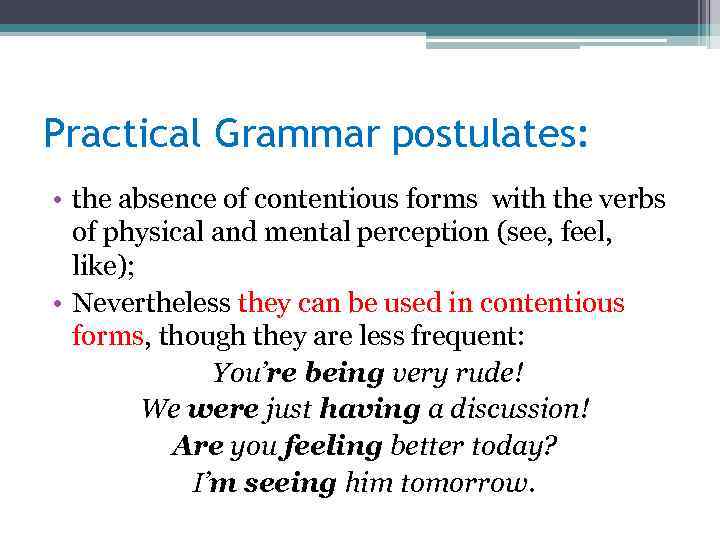
Practical Grammar postulates: • the absence of contentious forms with the verbs of physical and mental perception (see, feel, like); • Nevertheless they can be used in contentious forms, though they are less frequent: You’re being very rude! We were just having a discussion! Are you feeling better today? I’m seeing him tomorrow.
Theoretical Grammar: • describes and analyses facts of the language without giving any ‘prescriptions’; • is a scientific type of Grammar; • does not give a ready answer about how certain grammatical phenomena should be interpreted.
The goals of the course are • to provide a description of the grammatical structure of the English language as a system; • to clarify the scope of grammar in a systematic and theoretically coherent way; • to develop students’ critical thinking skills.
Fundamentals of Grammar Part 1.
Grammar as a Part of Linguistics • Grammar – ‘the methodological study of Literature’. • In classical Greek and Latin : Grammar = Philology. • In the Middle ages: the study of Latin language and Latin literature.
American linguists: G. Trager & H. Smith • Broad interpretation: • Grammar – the study of the language structure in general, including phonemics and lexis, thus identifying grammar with linguistics.
Majority of linguists • Narrow interpretation: • Grammar is a part of linguistics which studies the grammatical structure of the language, excluding phonemics and lexis.
Fundamentals of Linguistics • Linguistics - the scientific study of language or of particular languages.
The broadest philosophical concept: • 2 aspects: • 1) language proper (the system of signs); • 2) speech (the use of signs).
Language proper • is the underlying system (phonological, lexical, and grammatical) which speakers use to understand produce speech (the actual utterance speakers produce).
Speech • is an individual realization of the system. • Language and speech – inseparable forming and organic unity.
Language 1. In the broad sense – the unity of language proper and speech; 2. In the narrow sense: the system which lies at the base of all speaking.
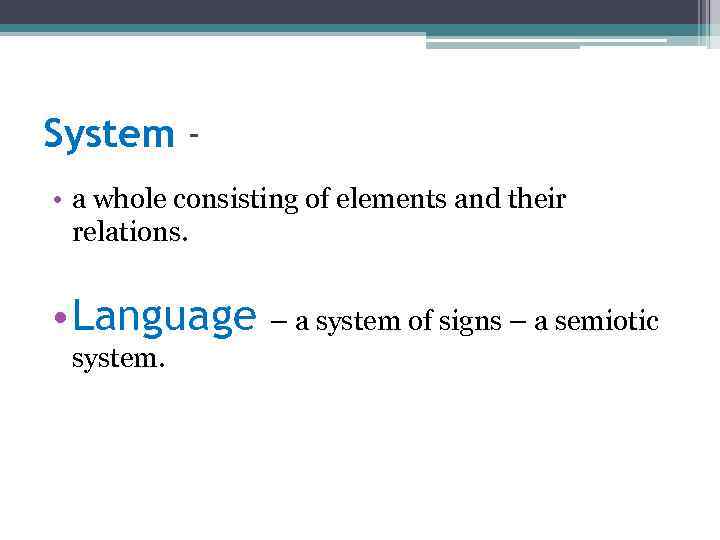
System • a whole consisting of elements and their relations. • Language system. – a system of signs – a semiotic
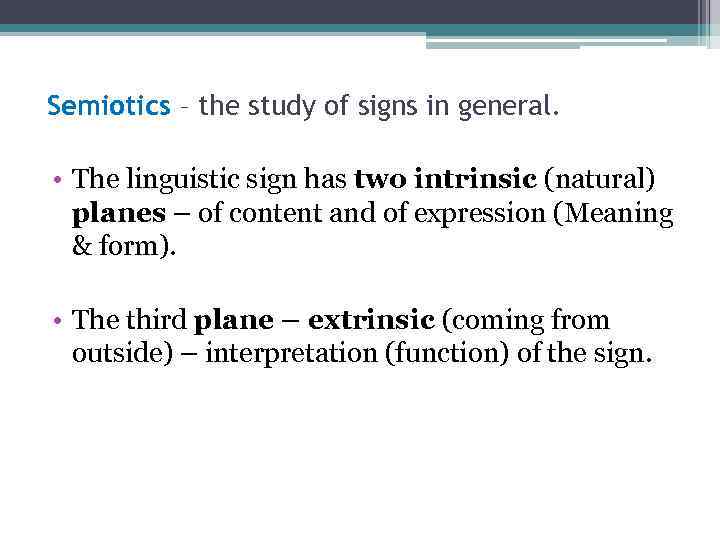
Semiotics – the study of signs in general. • The linguistic sign has two intrinsic (natural) planes – of content and of expression (Meaning & form). • The third plane – extrinsic (coming from outside) – interpretation (function) of the sign.
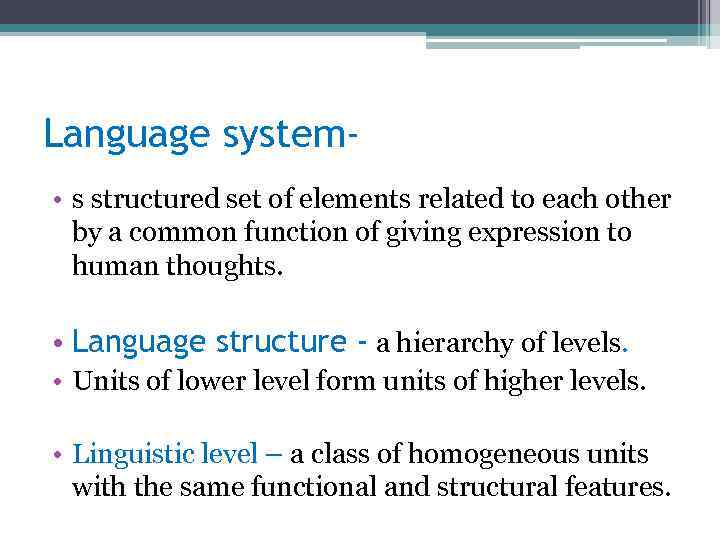
Language system • s structured set of elements related to each other by a common function of giving expression to human thoughts. • Language structure - a hierarchy of levels. • Units of lower level form units of higher levels. • Linguistic level – a class of homogeneous units with the same functional and structural features.
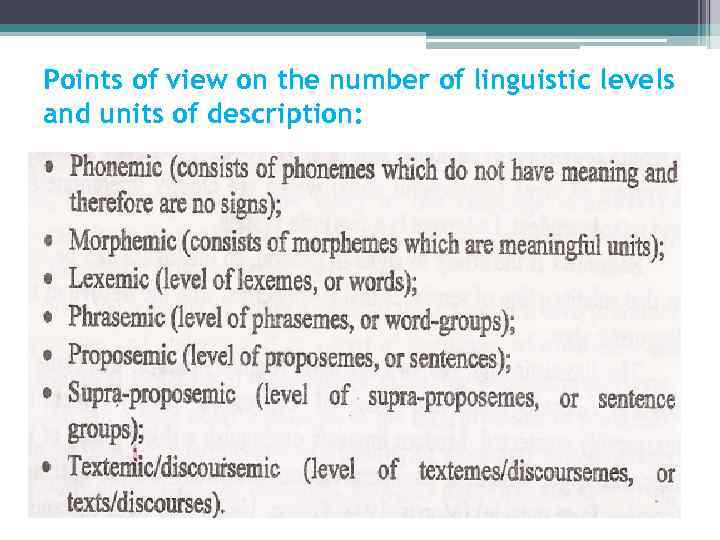
Points of view on the number of linguistic levels and units of description:
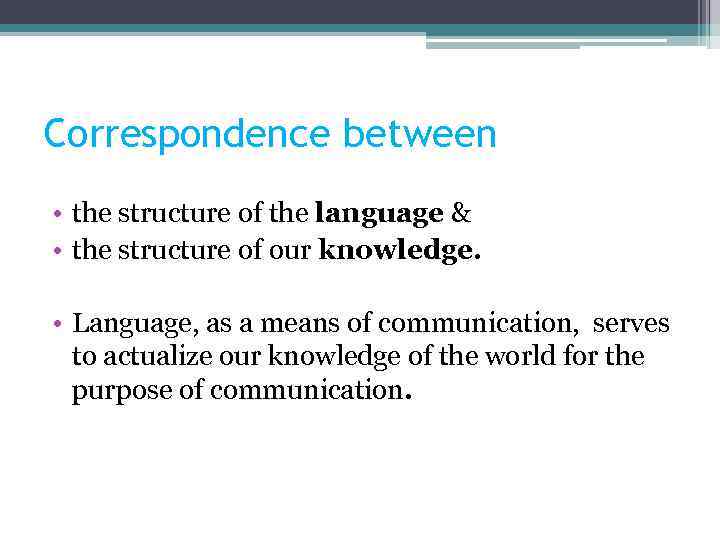
Correspondence between • the structure of the language & • the structure of our knowledge. • Language, as a means of communication, serves to actualize our knowledge of the world for the purpose of communication.
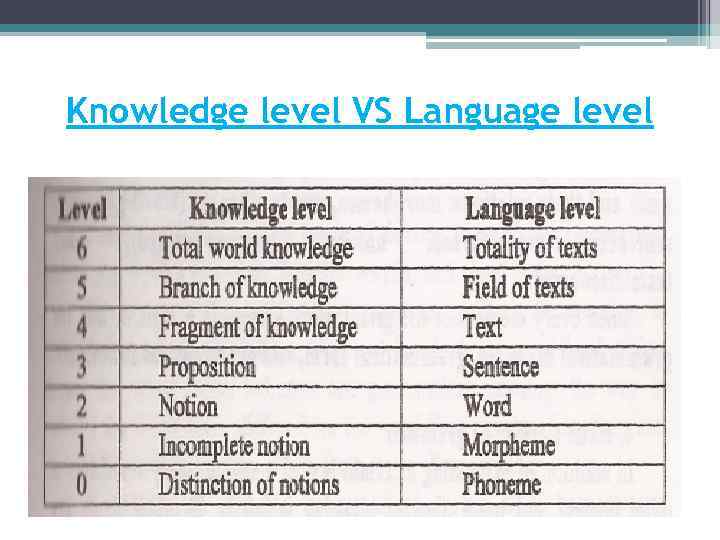
Knowledge level VS Language level
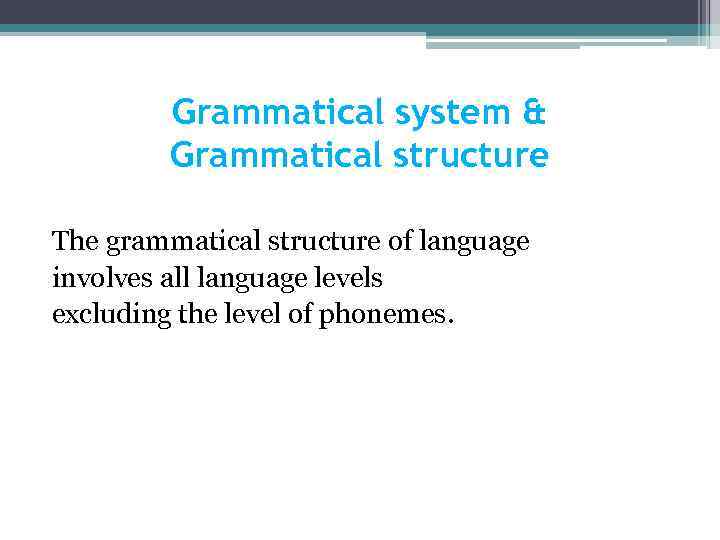
Grammatical system & Grammatical structure The grammatical structure of language involves all language levels excluding the level of phonemes.
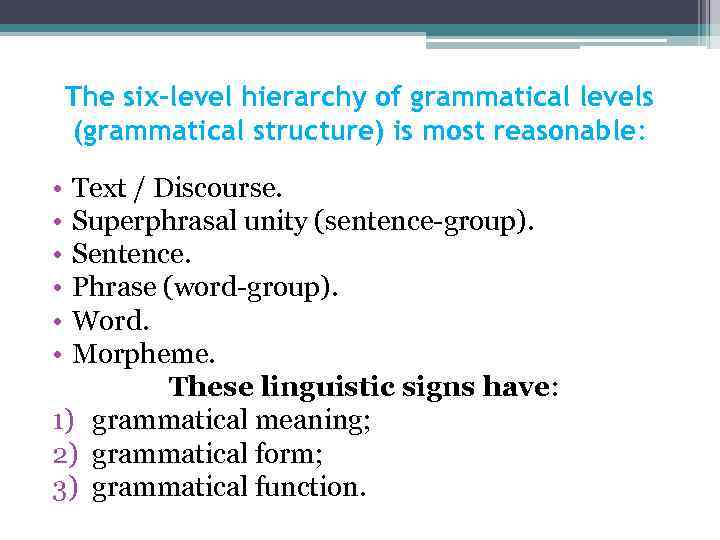
The six-level hierarchy of grammatical levels (grammatical structure) is most reasonable: • • • Text / Discourse. Superphrasal unity (sentence-group). Sentence. Phrase (word-group). Word. Morpheme. These linguistic signs have: 1) grammatical meaning; 2) grammatical form; 3) grammatical function.
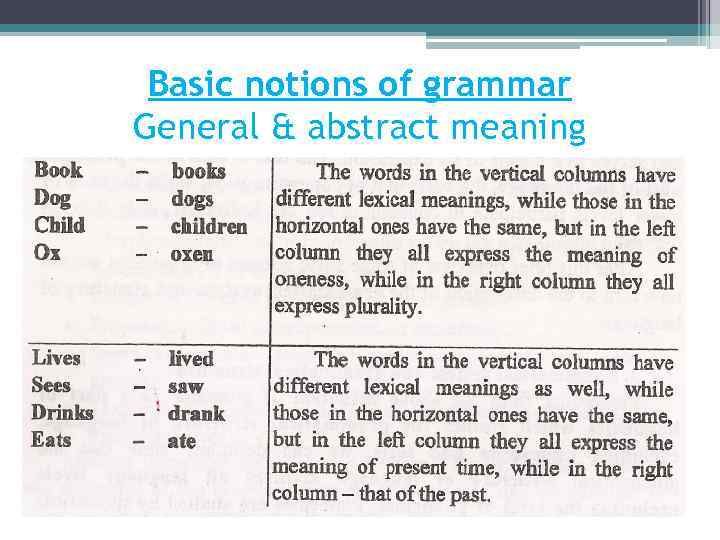
Basic notions of grammar General & abstract meaning
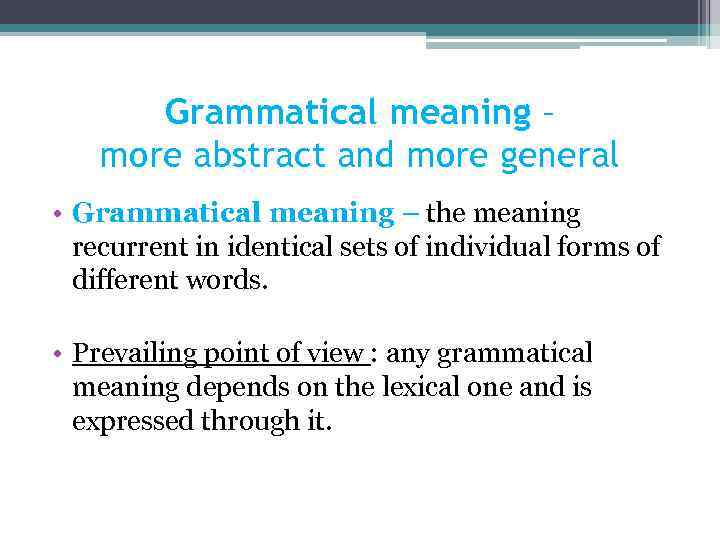
Grammatical meaning – more abstract and more general • Grammatical meaning – the meaning recurrent in identical sets of individual forms of different words. • Prevailing point of view : any grammatical meaning depends on the lexical one and is expressed through it.
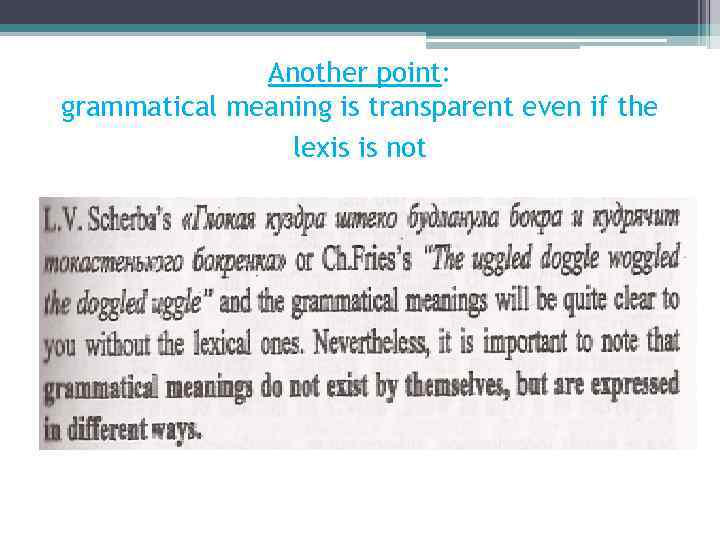
Another point: grammatical meaning is transparent even if the lexis is not
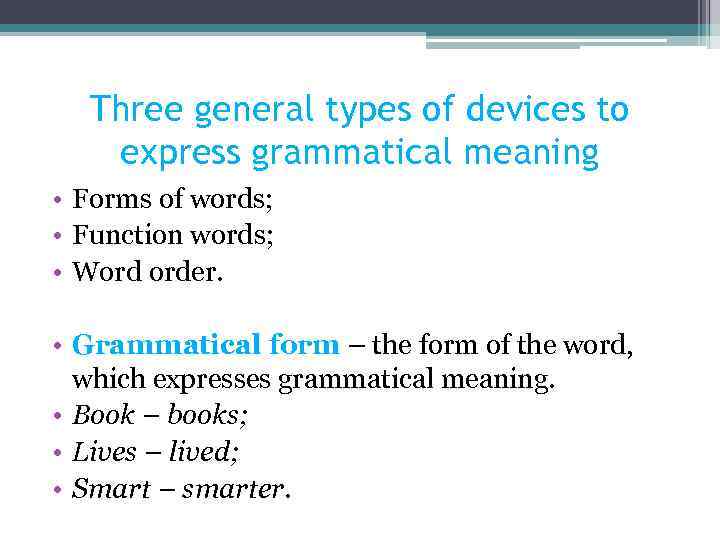
Three general types of devices to express grammatical meaning • Forms of words; • Function words; • Word order. • Grammatical form – the form of the word, which expresses grammatical meaning. • Book – books; • Lives – lived; • Smart – smarter.
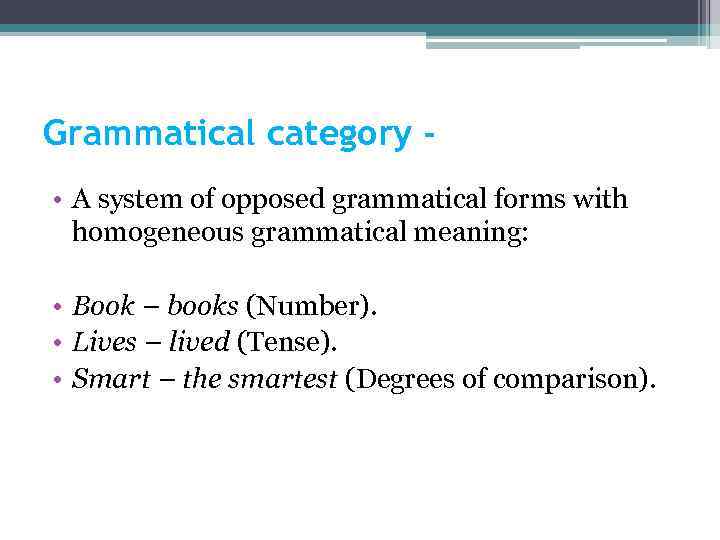
Grammatical category • A system of opposed grammatical forms with homogeneous grammatical meaning: • Book – books (Number). • Lives – lived (Tense). • Smart – the smartest (Degrees of comparison).
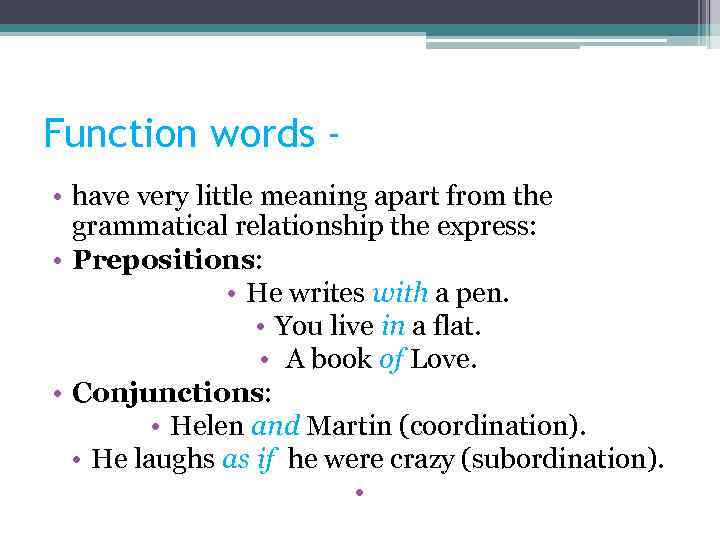
Function words • have very little meaning apart from the grammatical relationship the express: • Prepositions: • He writes with a pen. • You live in a flat. • A book of Love. • Conjunctions: • Helen and Martin (coordination). • He laughs as if he were crazy (subordination). •
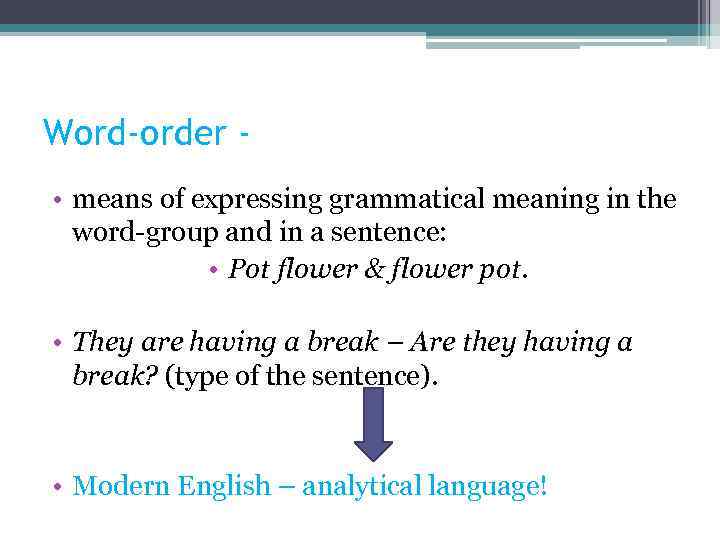
Word-order • means of expressing grammatical meaning in the word-group and in a sentence: • Pot flower & flower pot. • They are having a break – Are they having a break? (type of the sentence). • Modern English – analytical language!
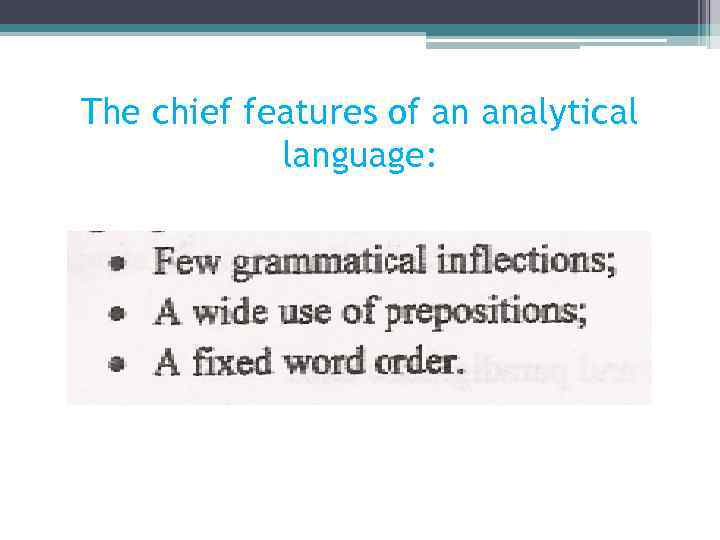
The chief features of an analytical language:
Extrinsic plane – Grammatical function • Grammatical function - the syntactic properties of a type of word, its method of combining with other words (coordination, subordination, interdependence, cumulation, apposition) and its function in the sentence subject, predicate, object, attribute, adverbial modifier).
Functional grammar • Studies sentences, superphrasal unities and texts in terms of three functions; 1. Ideational ‘content’ function (action, event, process, quality, quantity, time, place, etc. ). 2. Interpersonal function (statements, questions, offers, commands, mood, modality, person, etc. ). 3. Textual function (voice, information structure, theme-rheme, etc. ).
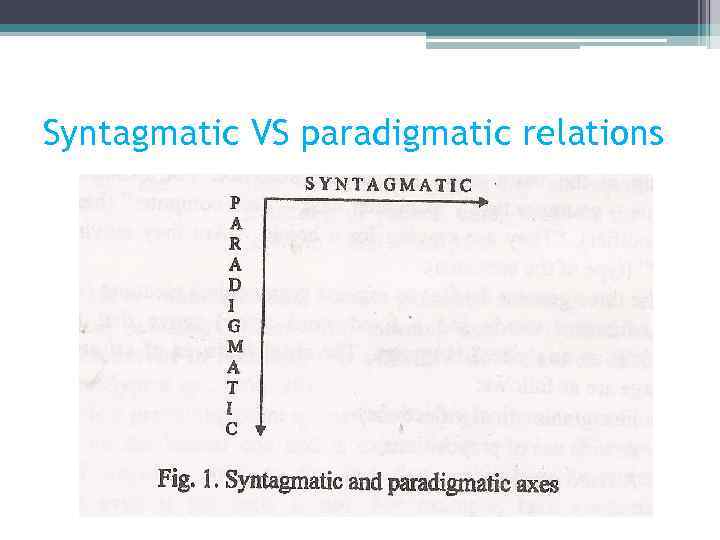
Syntagmatic VS paradigmatic relations
Syntagmatic relations • immediate linear between units in a sequence: (morphemes, words, phrases, sentences, superphrasal unitis are linked, or chained, together according to grammatical rules. •
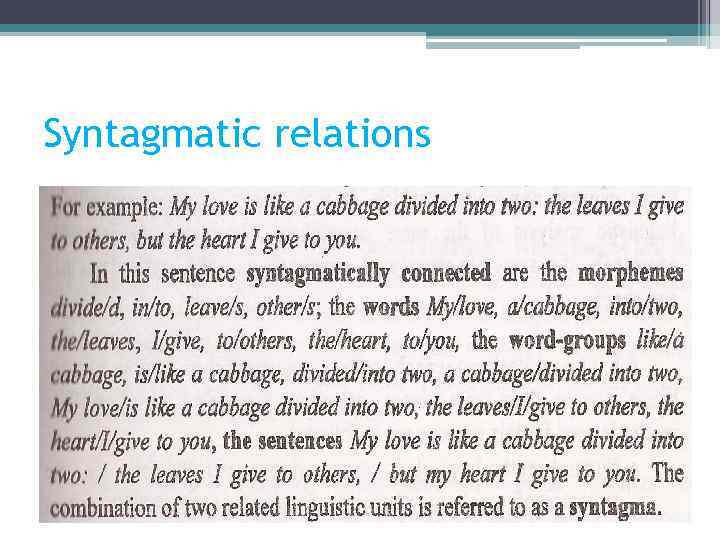
Syntagmatic relations
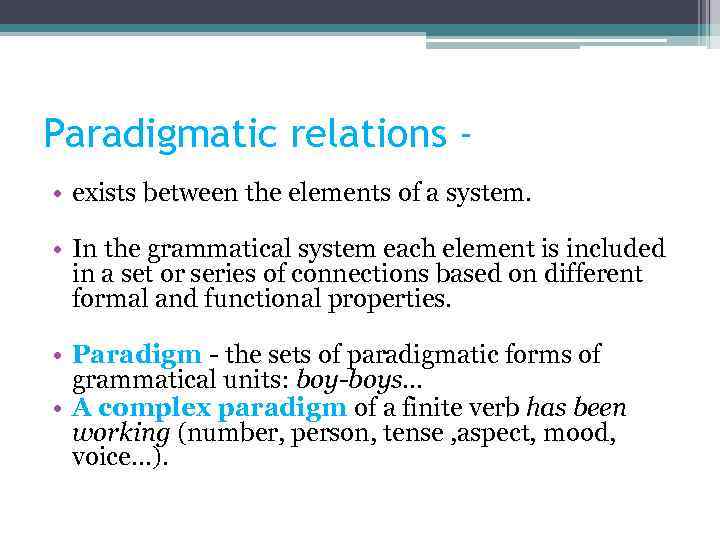
Paradigmatic relations • exists between the elements of a system. • In the grammatical system each element is included in a set or series of connections based on different formal and functional properties. • Paradigm - the sets of paradigmatic forms of grammatical units: boy-boys… • A complex paradigm of a finite verb has been working (number, person, tense , aspect, mood, voice…).
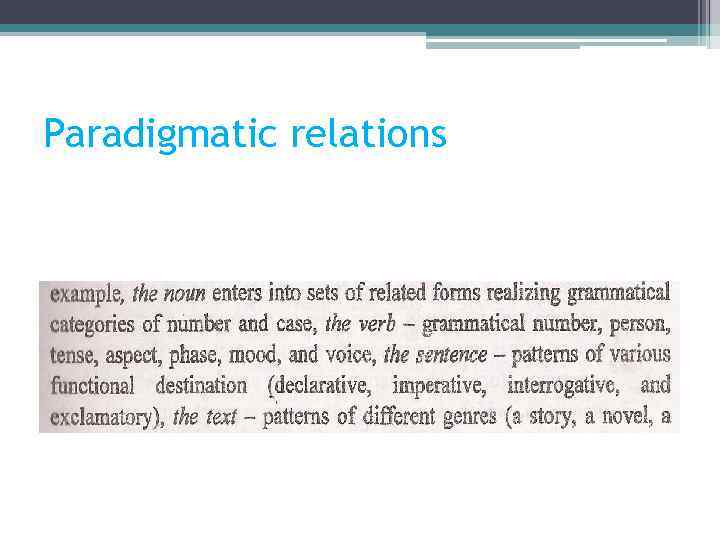
Paradigmatic relations
Different approaches to the analysis of grammatical phenomena
Three general approaches: 1. The semiotic approach. 2. The systemic-structural approach. 3. The static-dynamic approach.
The semiotic approach - grammatical units as signs • Three planes: 1. Meaning. 2. Form. 3. Function.
The methods used for this purpose: 1. Formal method – the structure of words, word-groups, superphrasal unities and texts: It lived here – If he lived here I would know about it. Grammatical polysemy – two or more units of the plane of content (meaning) correspond to one unit of the plane of expression (form). One form has several meanings, which are similar in some respect.
Semantic method – grammatical meaning of words, word-groups and sentences, etc. • It lived here – If he lived here I would know about it. • ‘Lived’ has two homonymous forms< each having its own meaning, which is no way similar to the other: • Past Indefinite Indicative vs Subjunctive II.
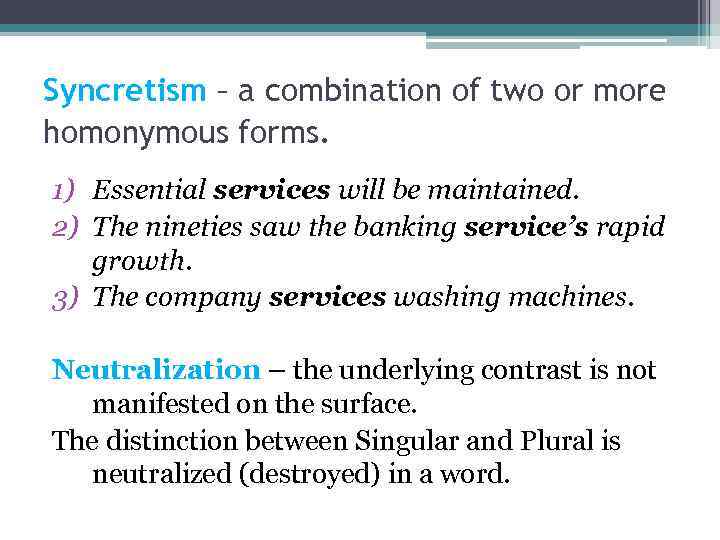
Syncretism – a combination of two or more homonymous forms. 1) Essential services will be maintained. 2) The nineties saw the banking service’s rapid growth. 3) The company services washing machines. Neutralization – the underlying contrast is not manifested on the surface. The distinction between Singular and Plural is neutralized (destroyed) in a word.
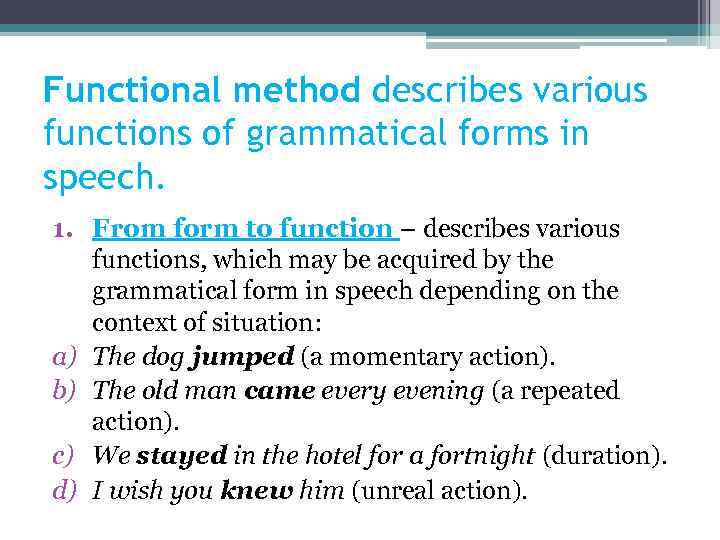
Functional method describes various functions of grammatical forms in speech. 1. From form to function – describes various functions, which may be acquired by the grammatical form in speech depending on the context of situation: a) The dog jumped (a momentary action). b) The old man came every evening (a repeated action). c) We stayed in the hotel for a fortnight (duration). d) I wish you knew him (unreal action).
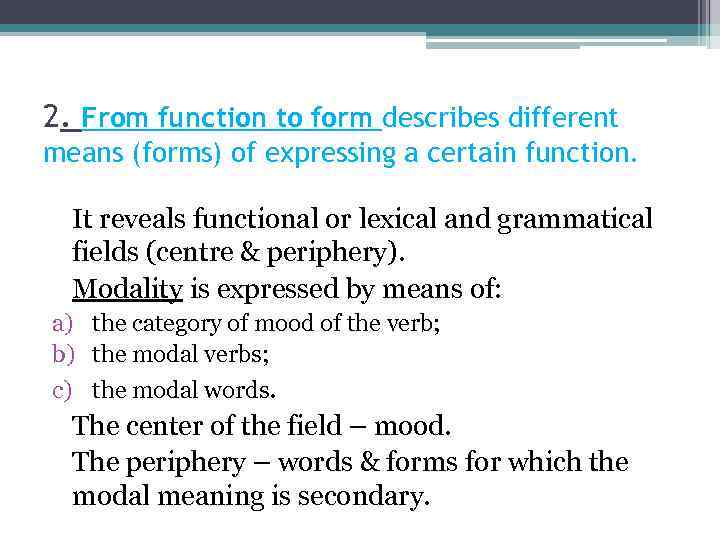
2. From function to form describes different means (forms) of expressing a certain function. It reveals functional or lexical and grammatical fields (centre & periphery). Modality is expressed by means of: a) the category of mood of the verb; b) the modal verbs; c) the modal words. The center of the field – mood. The periphery – words & forms for which the modal meaning is secondary.
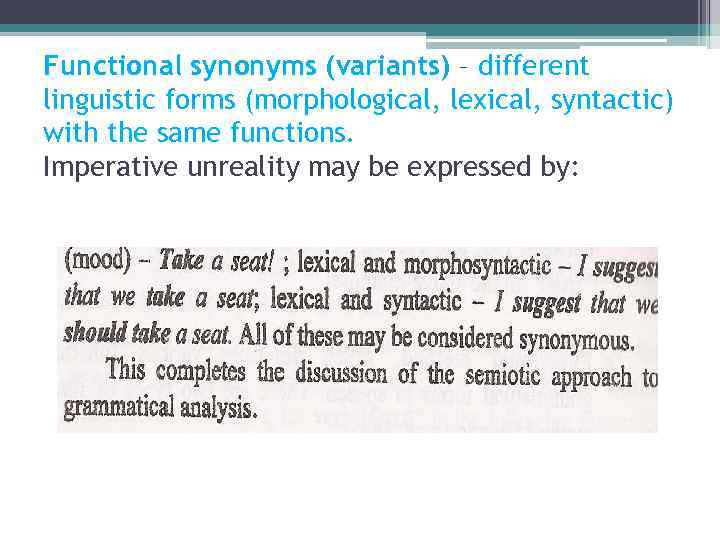
Functional synonyms (variants) – different linguistic forms (morphological, lexical, syntactic) with the same functions. Imperative unreality may be expressed by:
The syntactic-structural approach views grammatical units as interrelated elements of a structured system. • Modals of grammatical analysis: 1. WP – word & paradigm. 2. IP – item & process. 3. IA – item & arrangement. 4. TP – text & procedure. 5. DA – discourse & action, etc.
The static-dynamic approach Discriminates between lingual synchrony (static) and diachrony (dynamic). Synchronic language studies – language as a whole at a particular point in time. Diachronic language studies - comparing a language at different stages in its history.
Types of grammar 1. Case grammar. 2. Categorical grammar. 3. Competence grammar. 4. Functional grammar. 5. Generative grammar. 6. Structural grammar. 7. Systemic grammar. 8. Text grammar. 9. Traditional grammar. 10. Transformational grammar, etc.
Скачать презентацию Fundamentals of Grammar Introduction Literature 1 Блох
ТГ Пр 1. Fundamentals of Grammar..pptx