 Скачать презентацию Fundamentals of Electricity Franklin County Amateur Radio Club
82e9a43a4d77c0716468c12561e6b45d.ppt
- Количество слайдов: 57



Fundamentals of Electricity Franklin County Amateur Radio Club Technician Class License Course Class 3 – Fundamentals of Electricity Bob Solosko W 1 SRB
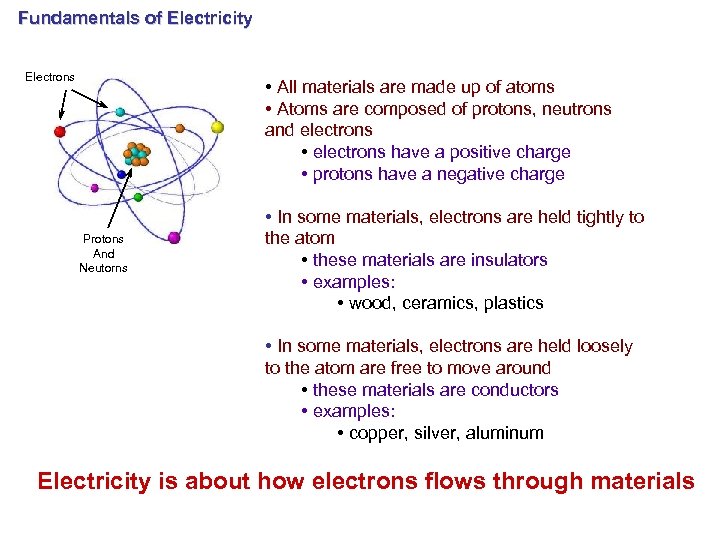
Fundamentals of Electricity Electrons • All materials are made up of atoms • Atoms are composed of protons, neutrons and electrons • electrons have a positive charge • protons have a negative charge Protons And Neutorns • In some materials, electrons are held tightly to the atom • these materials are insulators • examples: • wood, ceramics, plastics • In some materials, electrons are held loosely to the atom are free to move around • these materials are conductors • examples: • copper, silver, aluminum Electricity is about how electrons flows through materials
Fundamentals of Electricity Controlling the flow of electrons is the foundation for the operation of – Radios – Ipods – Computers – Telephones – Recorders – Stereos – House lights
Fundamentals of Electricity • There are three characteristics to electricity: – Electromotive Force – Current – Resistance • All three must be present for electrons to flow
Fundamentals of Electricity Electromotive Force (EMF or E) – “electro”: electrons – “motive”: movement – “force”: the push • Electromotive force is the push that causes electrons to move through a conductor • Measured in volts • Usually referred to as voltage
Fundamentals of Electricity Current (I) • Current is the amount of electrons that flow through a conductor over time • Measured in amperes – i. e. , amps
Fundamentals of Electricity Resistance (R) • A material's opposition to the flow of electric current; measured in ohms. • Measured in ohms • All materials, even very good conductors have some resistance
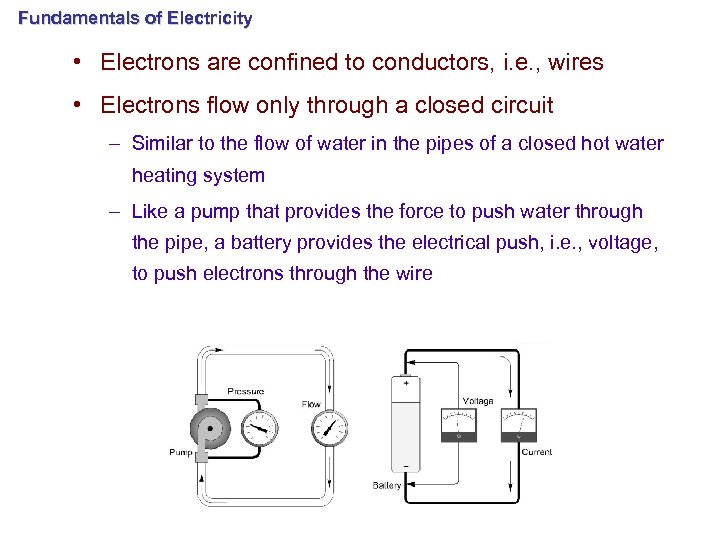
Fundamentals of Electricity • Electrons are confined to conductors, i. e. , wires • Electrons flow only through a closed circuit – Similar to the flow of water in the pipes of a closed hot water heating system – Like a pump that provides the force to push water through the pipe, a battery provides the electrical push, i. e. , voltage, to push electrons through the wire
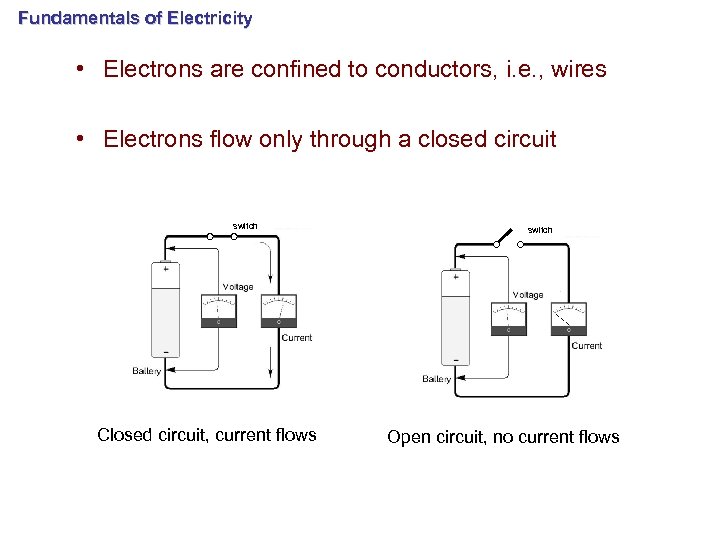
Fundamentals of Electricity • Electrons are confined to conductors, i. e. , wires • Electrons flow only through a closed circuit switch Closed circuit, current flows switch Open circuit, no current flows
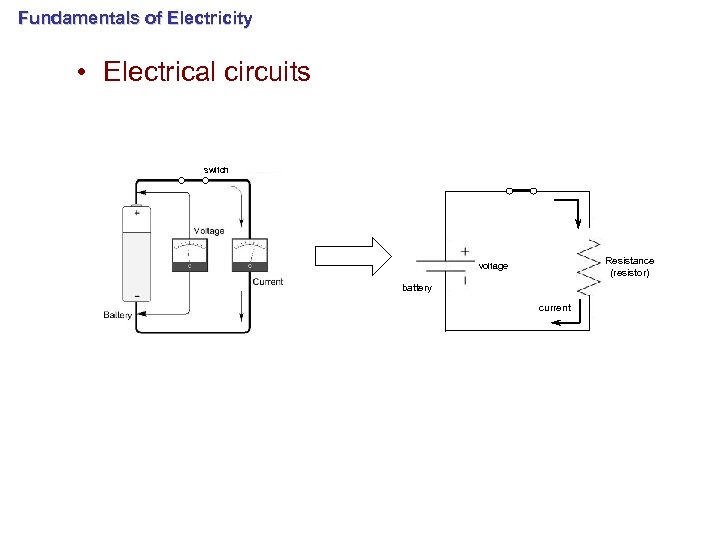
Fundamentals of Electricity • Electrical circuits switch Resistance (resistor) voltage battery current

Fundamentals of Electricity Relationship between Voltage (E), Current (I) and Resistance (R) • It takes a certain force (i. e. , voltage) to get a certain amount of current (amps) to flow against a specific reststance (ohms) • A greater resistance requires a greater force (i. e. , higher voltage) to get the same amount of current to flow
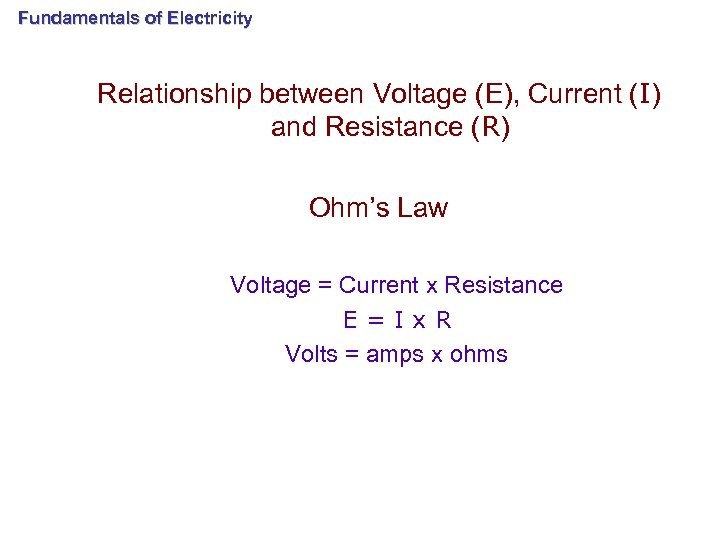
Fundamentals of Electricity Relationship between Voltage (E), Current (I) and Resistance (R) Ohm’s Law Voltage = Current x Resistance E=Ix. R Volts = amps x ohms
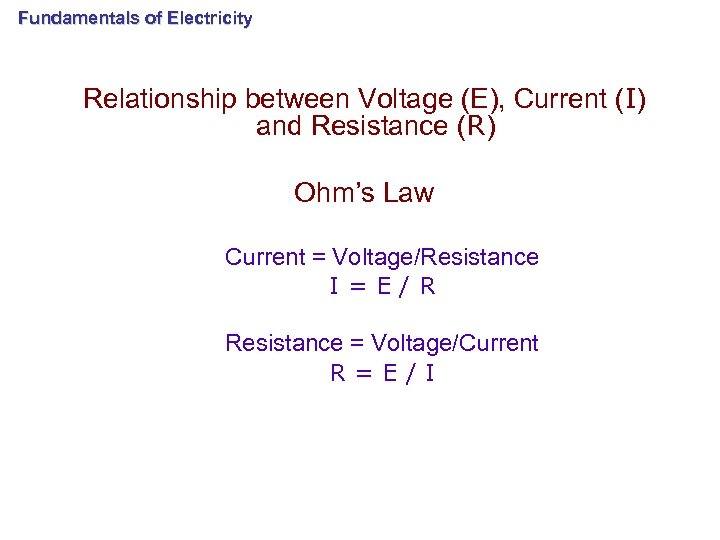
Fundamentals of Electricity Relationship between Voltage (E), Current (I) and Resistance (R) Ohm’s Law Current = Voltage/Resistance I=E/R Resistance = Voltage/Current R=E/I

Fundamentals of Electricity Ohm’s Law - Summary • E is voltage – Units - volts • I is current – Units - amperes • R is resistance – Units - ohms • R = E/I • I = E/R • E=Ix. R
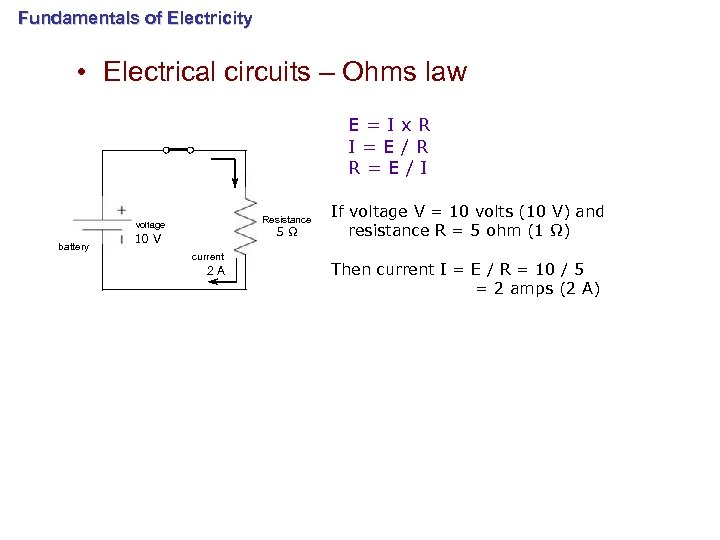
Fundamentals of Electricity • Electrical circuits – Ohms law E=Ix. R I=E/R R=E/I Resistance voltage battery 5Ω 10 V current 2 A If voltage V = 10 volts (10 V) and resistance R = 5 ohm (1 Ω) Then current I = E / R = 10 / 5 = 2 amps (2 A)
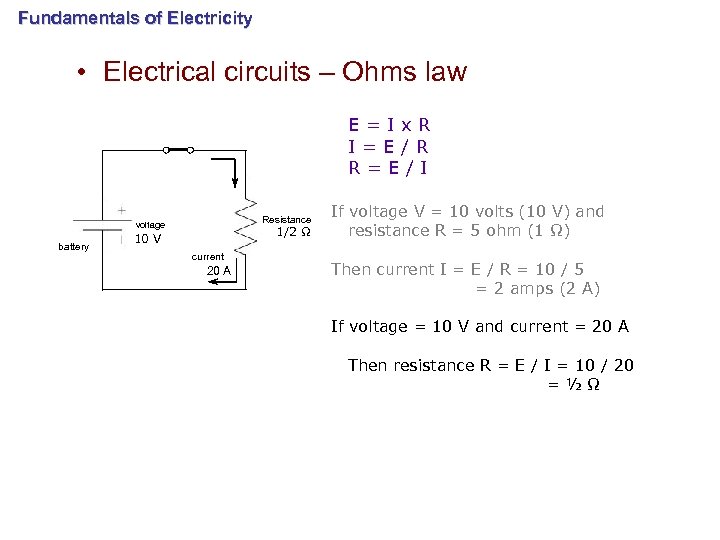
Fundamentals of Electricity • Electrical circuits – Ohms law E=Ix. R I=E/R R=E/I Resistance voltage battery 1/2 Ω 10 V current 20 A If voltage V = 10 volts (10 V) and resistance R = 5 ohm (1 Ω) Then current I = E / R = 10 / 5 = 2 amps (2 A) If voltage = 10 V and current = 20 A Then resistance R = E / I = 10 / 20 =½Ω
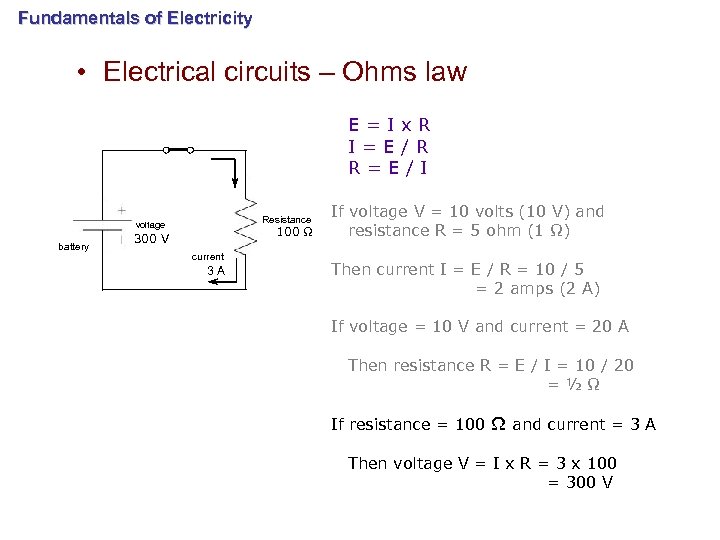
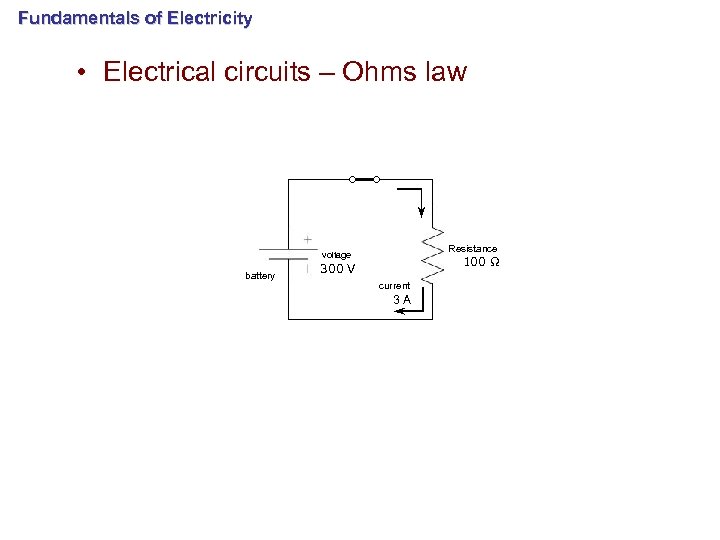
Fundamentals of Electricity • Electrical circuits – Ohms law E=Ix. R I=E/R R=E/I Resistance voltage battery 100 Ω 300 V current 3 A If voltage V = 10 volts (10 V) and resistance R = 5 ohm (1 Ω) Then current I = E / R = 10 / 5 = 2 amps (2 A) If voltage = 10 V and current = 20 A Then resistance R = E / I = 10 / 20 =½Ω If resistance = 100 Ω and current = 3 A Then voltage V = I x R = 3 x 100 = 300 V
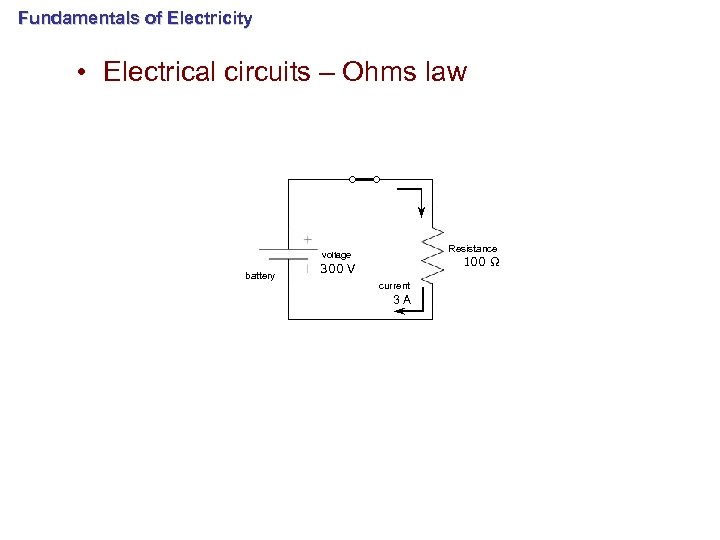
Fundamentals of Electricity • Electrical circuits – Ohms law Resistance voltage battery 100 Ω 300 V current 3 A
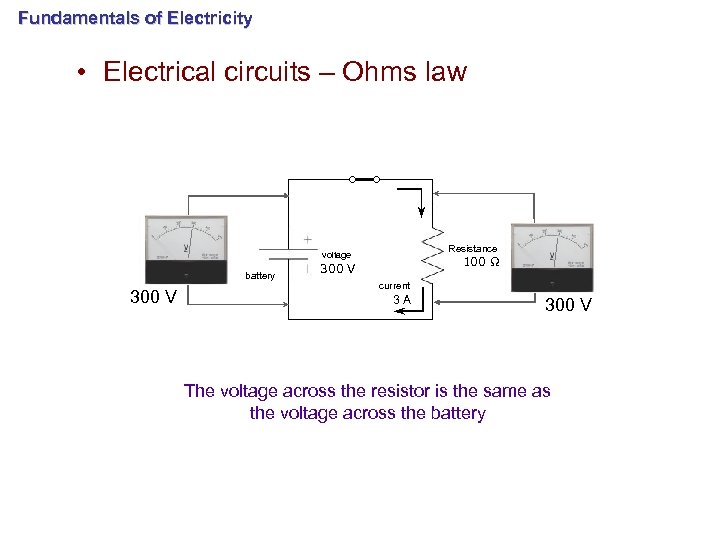
Fundamentals of Electricity • Electrical circuits – Ohms law Resistance voltage battery 300 V 100 Ω 300 V current 3 A 300 V The voltage across the resistor is the same as the voltage across the battery
Fundamentals of Electricity • Electrical circuits – Ohms law Resistance voltage battery 100 Ω 300 V current 3 A
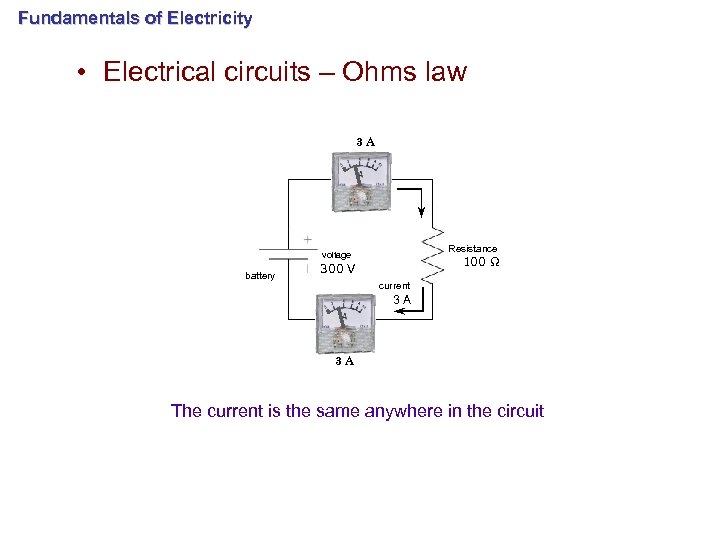
Fundamentals of Electricity • Electrical circuits – Ohms law 3 A Resistance voltage battery 100 Ω 300 V current 3 A 3 A The current is the same anywhere in the circuit
Fundamentals of Electricity Power • Moving electrons do work and expend energy: – generate heat – generate light – run motors – generate and receive radio signals – compute • Power is the rate at which electrical energy is generated or consumer – measured in the units of Watts • Power = voltage x current P=Ex. I
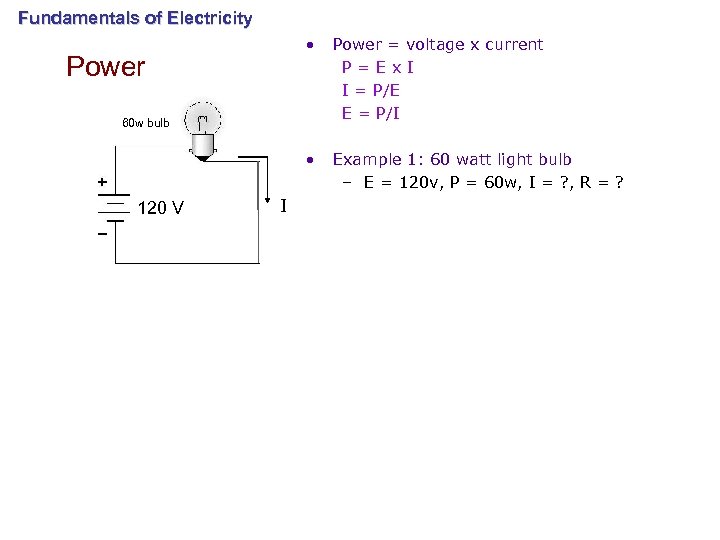
Fundamentals of Electricity • • Power = voltage x current P=Ex. I I = P/E E = P/I Example 1: 60 watt light bulb – E = 120 v, P = 60 w, I = ? , R = ? 60 w bulb 120 V I
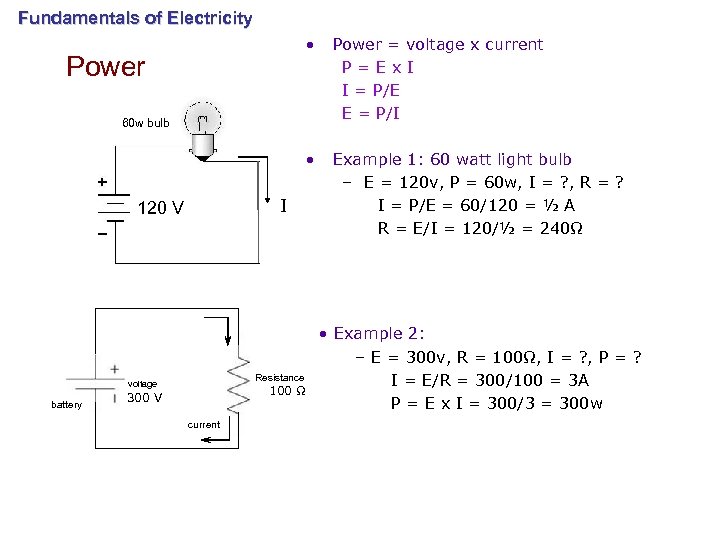
Fundamentals of Electricity • • Power = voltage x current P=Ex. I I = P/E E = P/I Example 1: 60 watt light bulb – E = 120 v, P = 60 w, I = ? , R = ? I = P/E = 60/120 = ½ A R = E/I = 120/½ = 240Ω 60 w bulb I 120 V Resistance voltage battery 100 Ω 300 V current • Example 2: – E = 300 v, R = 100Ω, I = ? , P = ? I = E/R = 300/100 = 3 A P = E x I = 300/3 = 300 w
Fundamentals of Electricity Types of Current • When current flows in only one direction, it is called direct current (DC). – batteries are a common source of DC. – most electronic devices are powered by DC. • When current flows alternatively in one direction then in the opposite direction, it is called alternating current (AC). – your household current is AC. – radio waves are AC
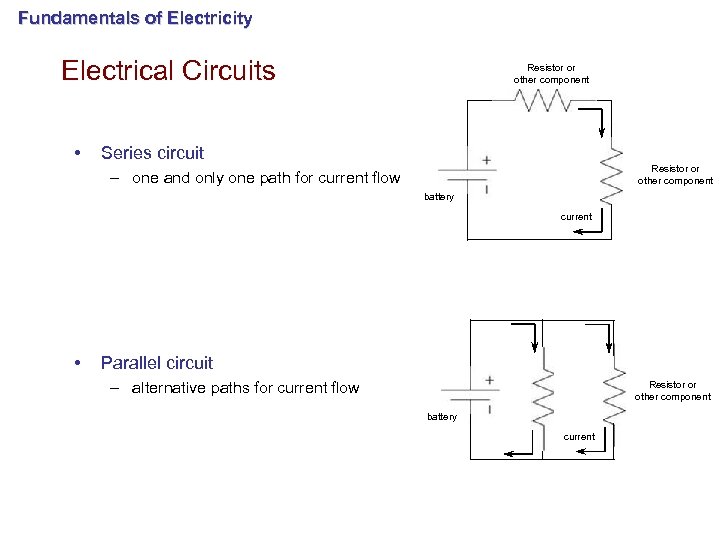
Fundamentals of Electricity Electrical Circuits • Resistor or other component Series circuit Resistor or other component – one and only one path for current flow battery current • Parallel circuit – alternative paths for current flow Resistor or other component battery current
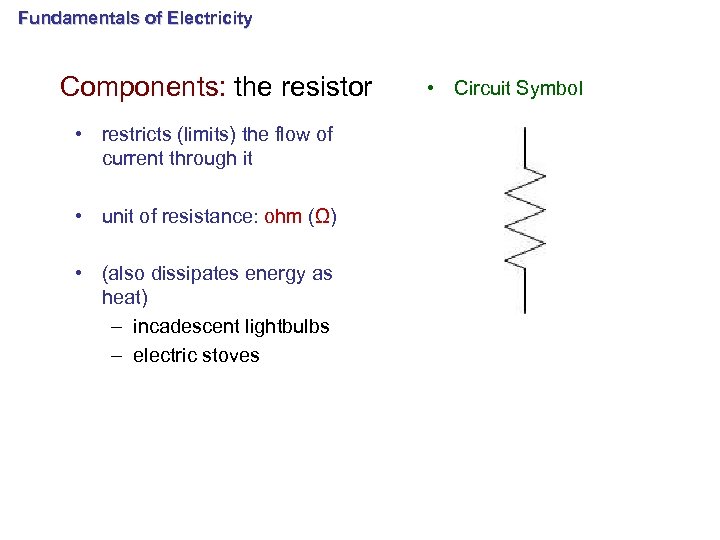
Fundamentals of Electricity Components: the resistor • restricts (limits) the flow of current through it • unit of resistance: ohm (Ω) • (also dissipates energy as heat) – incadescent lightbulbs – electric stoves • Circuit Symbol
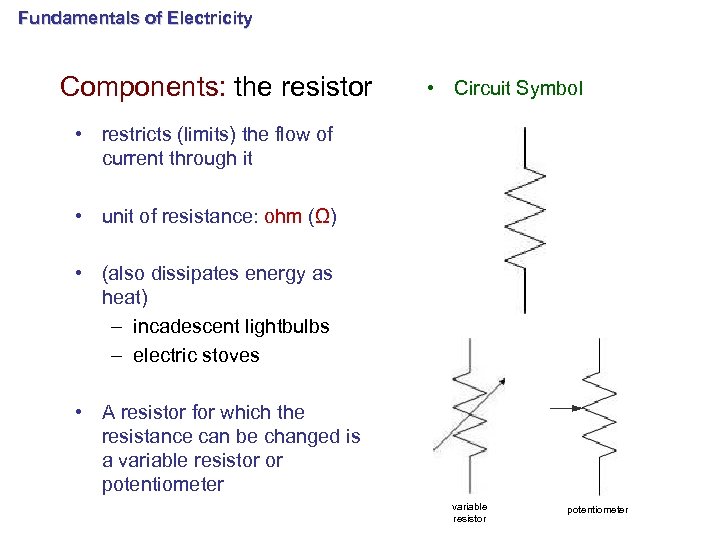
Fundamentals of Electricity Components: the resistor • Circuit Symbol • restricts (limits) the flow of current through it • unit of resistance: ohm (Ω) • (also dissipates energy as heat) – incadescent lightbulbs – electric stoves • A resistor for which the resistance can be changed is a variable resistor or potentiometer variable resistor potentiometer
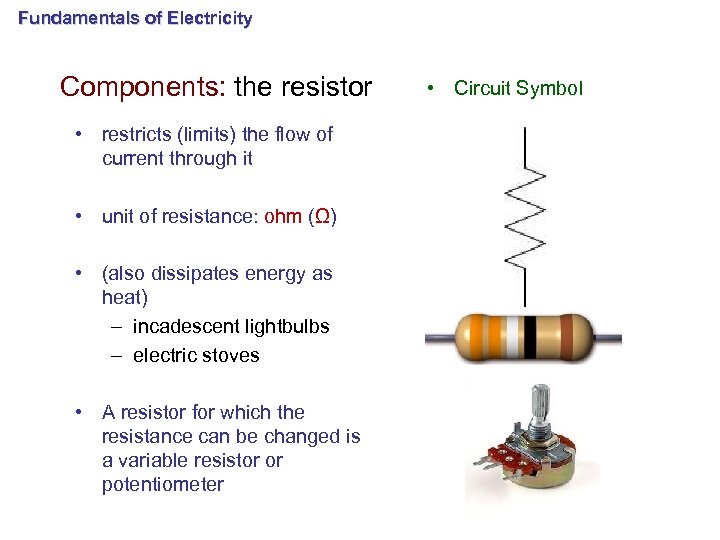
Fundamentals of Electricity Components: the resistor • restricts (limits) the flow of current through it • unit of resistance: ohm (Ω) • (also dissipates energy as heat) – incadescent lightbulbs – electric stoves • A resistor for which the resistance can be changed is a variable resistor or potentiometer • Circuit Symbol
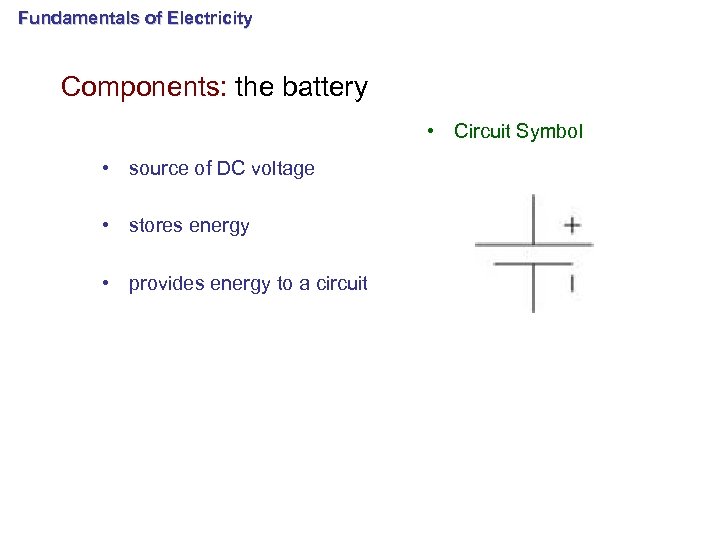
Fundamentals of Electricity Components: the battery • Circuit Symbol • source of DC voltage • stores energy • provides energy to a circuit
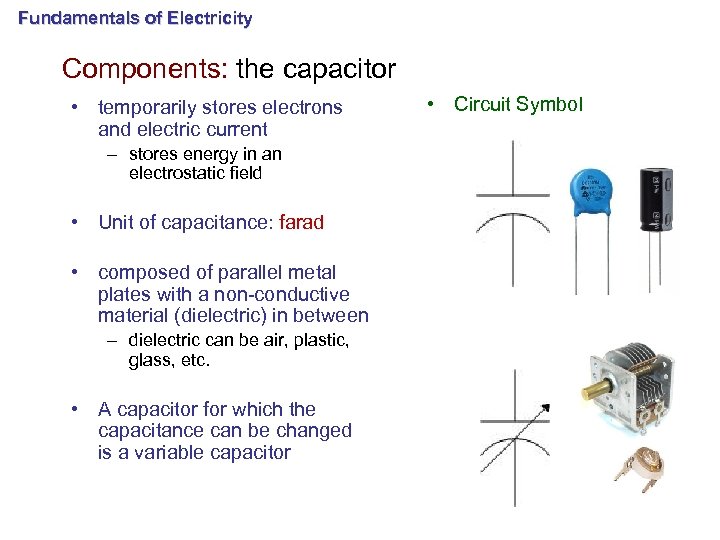
Fundamentals of Electricity Components: the capacitor • temporarily stores electrons and electric current – stores energy in an electrostatic field • Unit of capacitance: farad • composed of parallel metal plates with a non-conductive material (dielectric) in between – dielectric can be air, plastic, glass, etc. • A capacitor for which the capacitance can be changed is a variable capacitor • Circuit Symbol
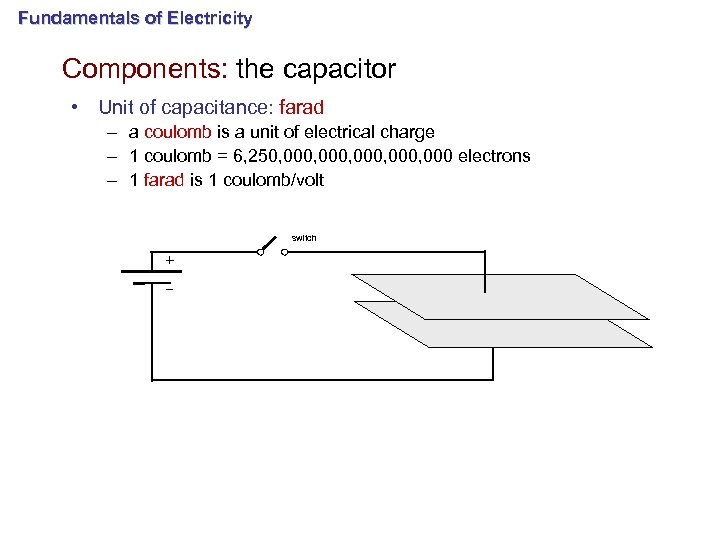
Fundamentals of Electricity Components: the capacitor • Unit of capacitance: farad – a coulomb is a unit of electrical charge – 1 coulomb = 6, 250, 000, 000 electrons – 1 farad is 1 coulomb/volt switch
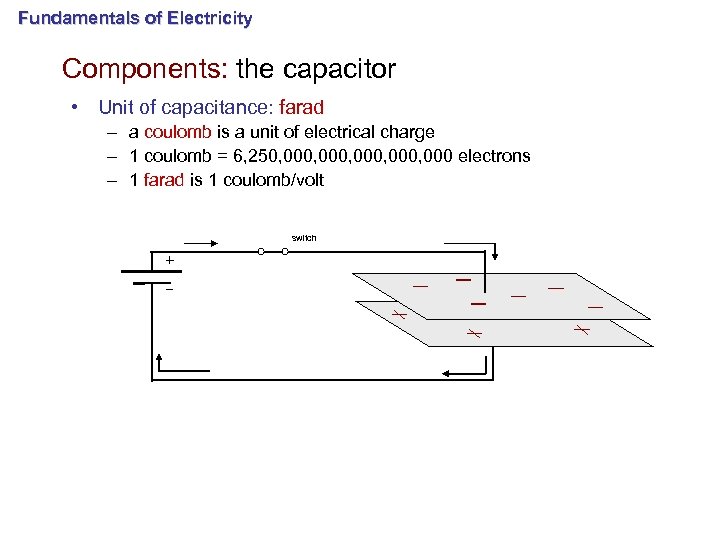
Fundamentals of Electricity Components: the capacitor • Unit of capacitance: farad – a coulomb is a unit of electrical charge – 1 coulomb = 6, 250, 000, 000 electrons – 1 farad is 1 coulomb/volt switch
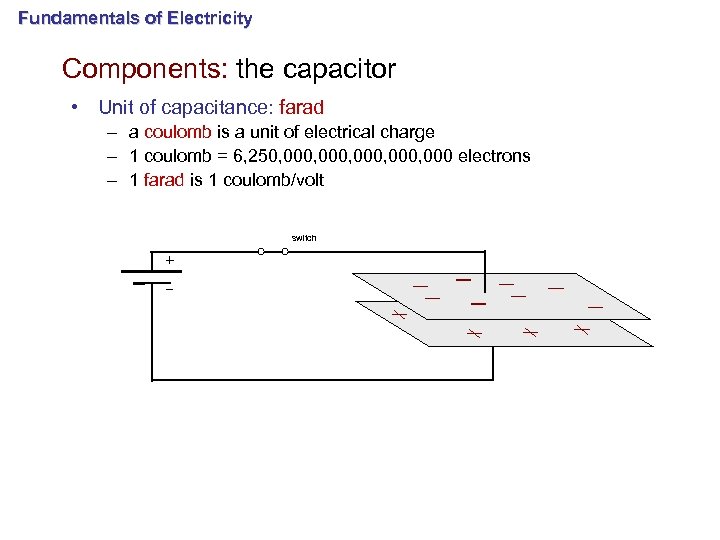
Fundamentals of Electricity Components: the capacitor • Unit of capacitance: farad – a coulomb is a unit of electrical charge – 1 coulomb = 6, 250, 000, 000 electrons – 1 farad is 1 coulomb/volt switch
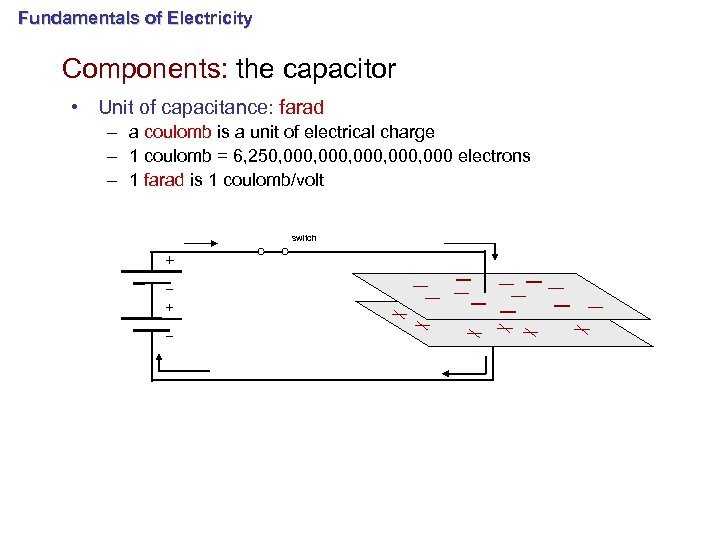
Fundamentals of Electricity Components: the capacitor • Unit of capacitance: farad – a coulomb is a unit of electrical charge – 1 coulomb = 6, 250, 000, 000 electrons – 1 farad is 1 coulomb/volt switch
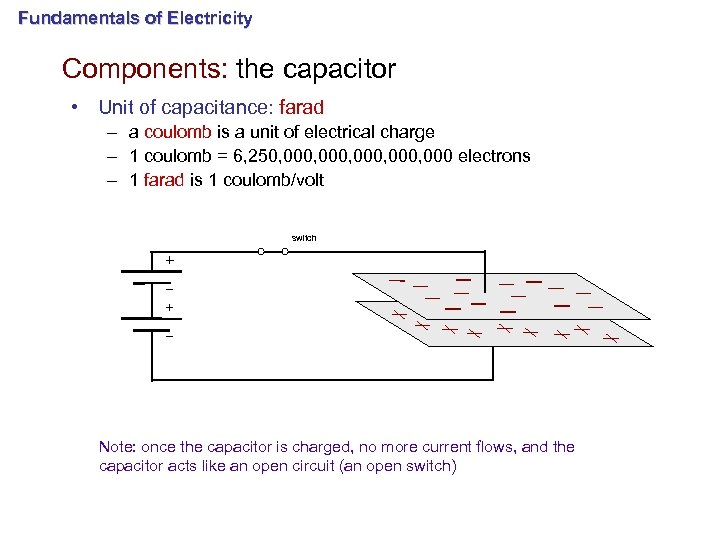
Fundamentals of Electricity Components: the capacitor • Unit of capacitance: farad – a coulomb is a unit of electrical charge – 1 coulomb = 6, 250, 000, 000 electrons – 1 farad is 1 coulomb/volt switch Note: once the capacitor is charged, no more current flows, and the capacitor acts like an open circuit (an open switch)
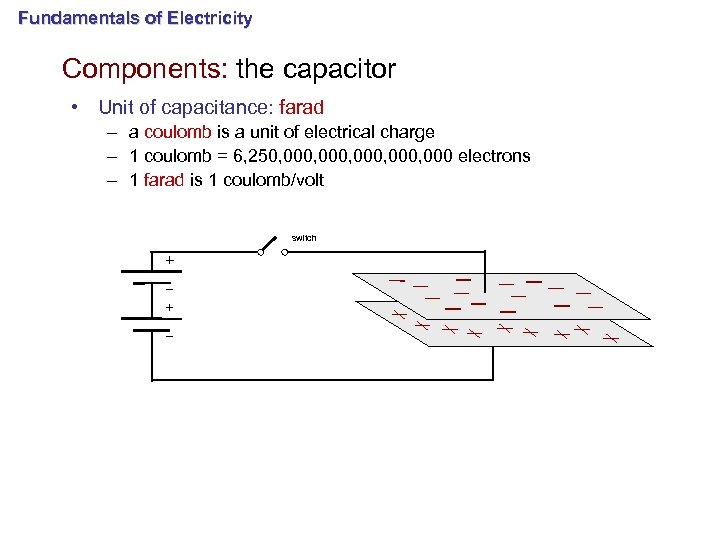
Fundamentals of Electricity Components: the capacitor • Unit of capacitance: farad – a coulomb is a unit of electrical charge – 1 coulomb = 6, 250, 000, 000 electrons – 1 farad is 1 coulomb/volt switch
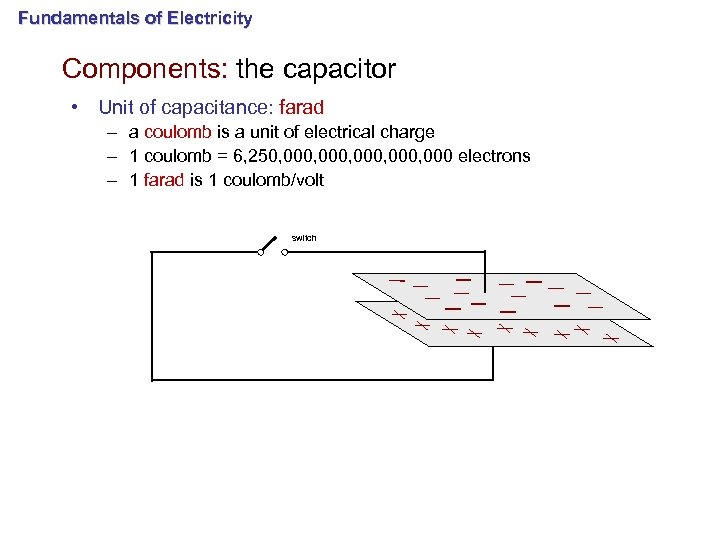
Fundamentals of Electricity Components: the capacitor • Unit of capacitance: farad – a coulomb is a unit of electrical charge – 1 coulomb = 6, 250, 000, 000 electrons – 1 farad is 1 coulomb/volt switch
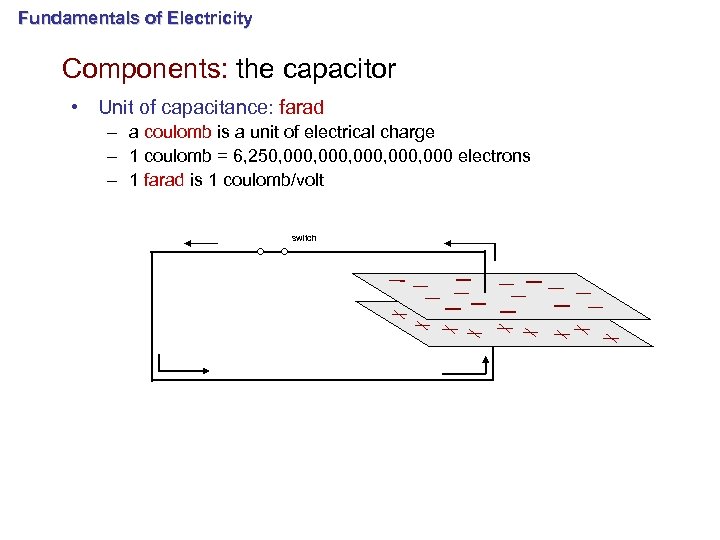
Fundamentals of Electricity Components: the capacitor • Unit of capacitance: farad – a coulomb is a unit of electrical charge – 1 coulomb = 6, 250, 000, 000 electrons – 1 farad is 1 coulomb/volt switch
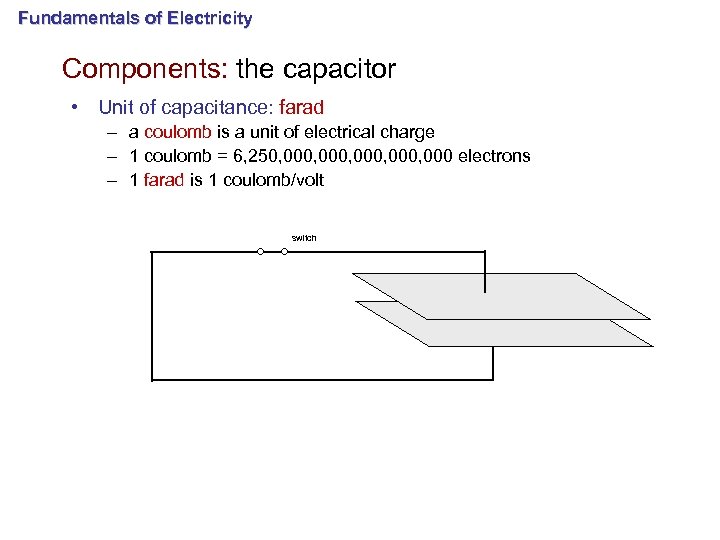
Fundamentals of Electricity Components: the capacitor • Unit of capacitance: farad – a coulomb is a unit of electrical charge – 1 coulomb = 6, 250, 000, 000 electrons – 1 farad is 1 coulomb/volt switch
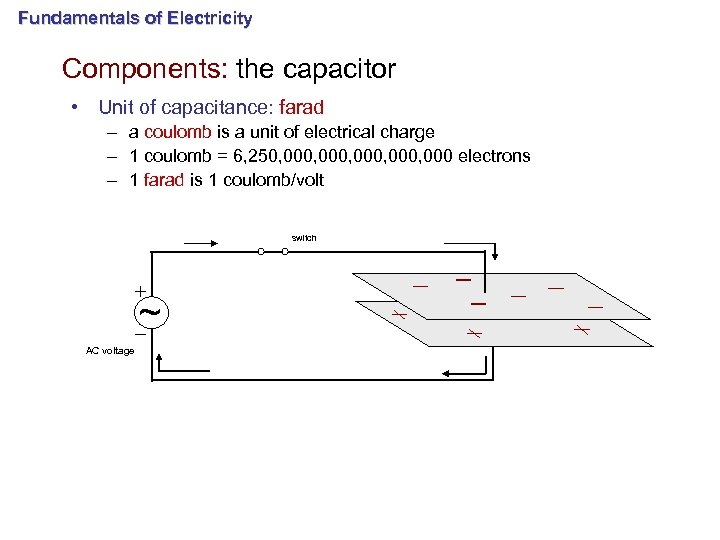
Fundamentals of Electricity Components: the capacitor • Unit of capacitance: farad – a coulomb is a unit of electrical charge – 1 coulomb = 6, 250, 000, 000 electrons – 1 farad is 1 coulomb/volt switch ~ AC voltage

Fundamentals of Electricity Components: the capacitor • Unit of capacitance: farad – a coulomb is a unit of electrical charge – 1 coulomb = 6, 250, 000, 000 electrons – 1 farad is 1 coulomb/volt switch ~ AC voltage Note: a capacitor allows AC current to flow
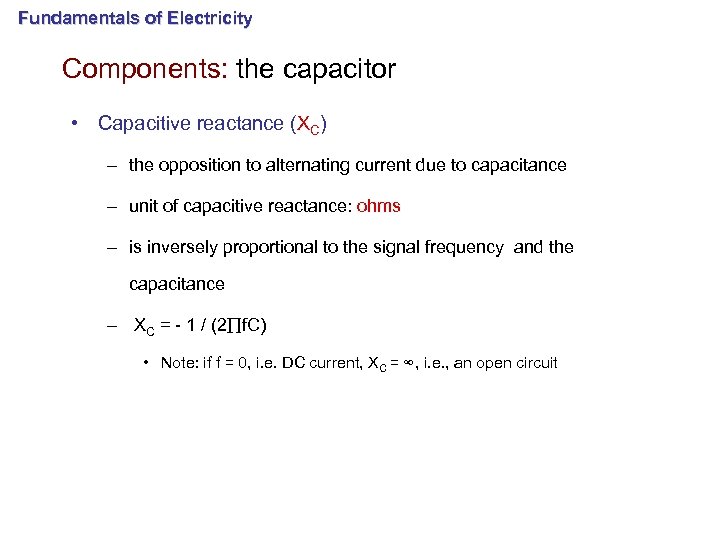
Fundamentals of Electricity Components: the capacitor • Capacitive reactance (XC) – the opposition to alternating current due to capacitance – unit of capacitive reactance: ohms – is inversely proportional to the signal frequency and the capacitance – XC = - 1 / (2Õf. C) • Note: if f = 0, i. e. DC current, XC = ∞, i. e. , an open circuit

Fundamentals of Electricity Components: the inductor • stores electric current – stores energy in a magnetic field – any wire with a current flowing through it creates a magnetic field • unit of inductance: henry • magnetic field is strengthened by coiling wire, i. e. , inductance is increases • an inductor for which the inductance can be changed is a variable inductance • An inductor may have an iron core to increase the inductance • Circuit Symbol
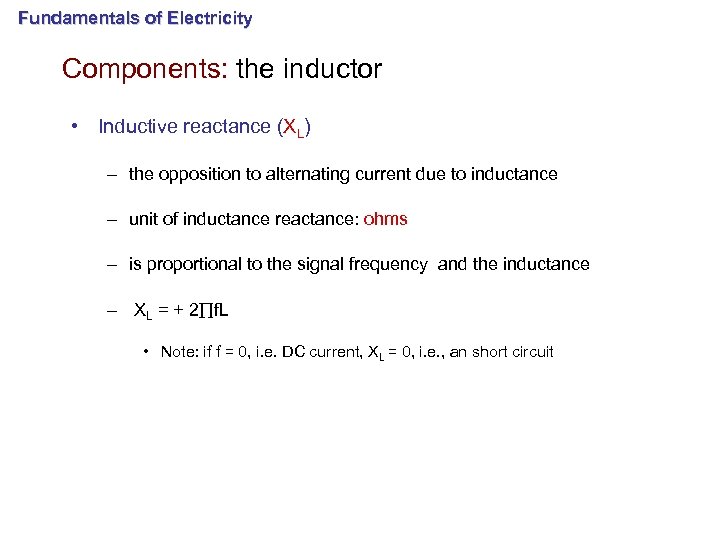
Fundamentals of Electricity Components: the inductor • Inductive reactance (XL) – the opposition to alternating current due to inductance – unit of inductance reactance: ohms – is proportional to the signal frequency and the inductance – XL = + 2Õf. L • Note: if f = 0, i. e. DC current, XL = 0, i. e. , an short circuit
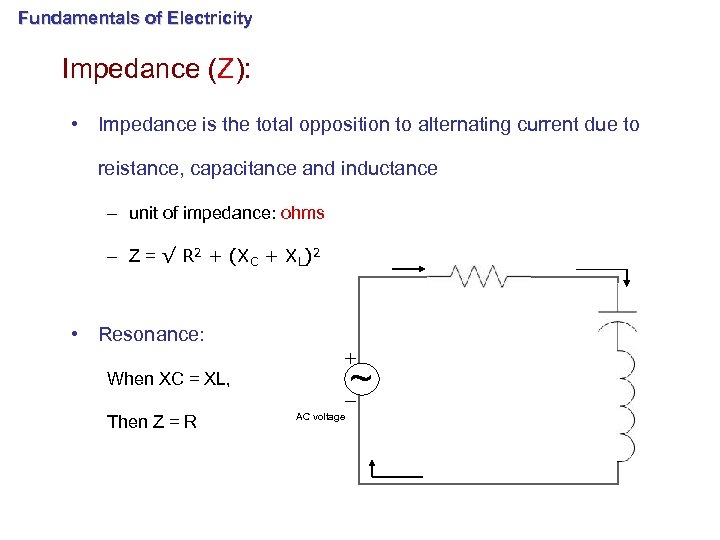
Fundamentals of Electricity Impedance (Z): • Impedance is the total opposition to alternating current due to reistance, capacitance and inductance – unit of impedance: ohms – Z = √ R 2 + (XC + XL)2 • Resonance: ~ When XC = XL, Then Z = R AC voltage
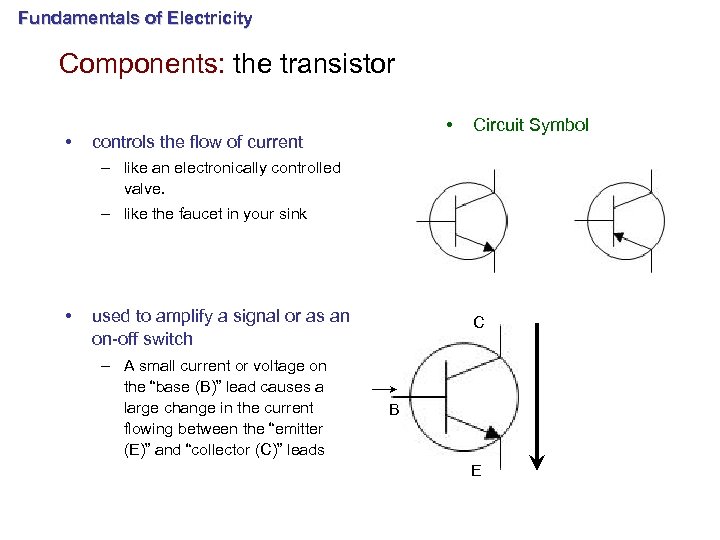
Fundamentals of Electricity Components: the transistor • • controls the flow of current Circuit Symbol – like an electronically controlled valve. – like the faucet in your sink • used to amplify a signal or as an on-off switch – A small current or voltage on the “base (B)” lead causes a large change in the current flowing between the “emitter (E)” and “collector (C)” leads C B E
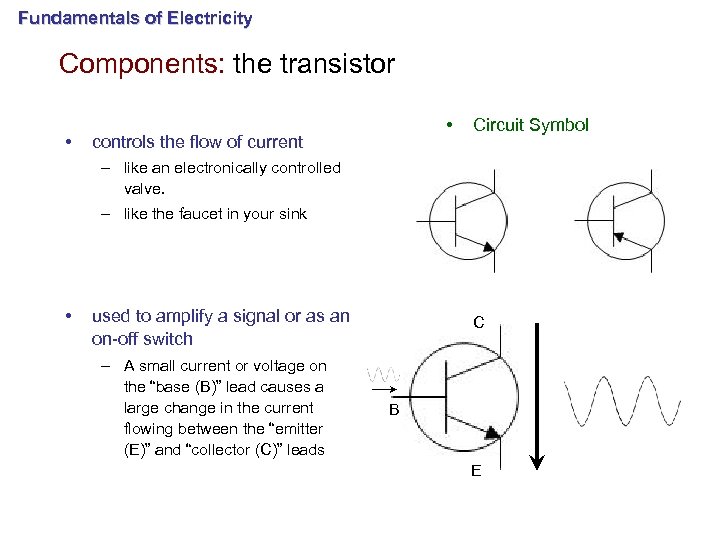
Fundamentals of Electricity Components: the transistor • • controls the flow of current Circuit Symbol – like an electronically controlled valve. – like the faucet in your sink • used to amplify a signal or as an on-off switch – A small current or voltage on the “base (B)” lead causes a large change in the current flowing between the “emitter (E)” and “collector (C)” leads C B E
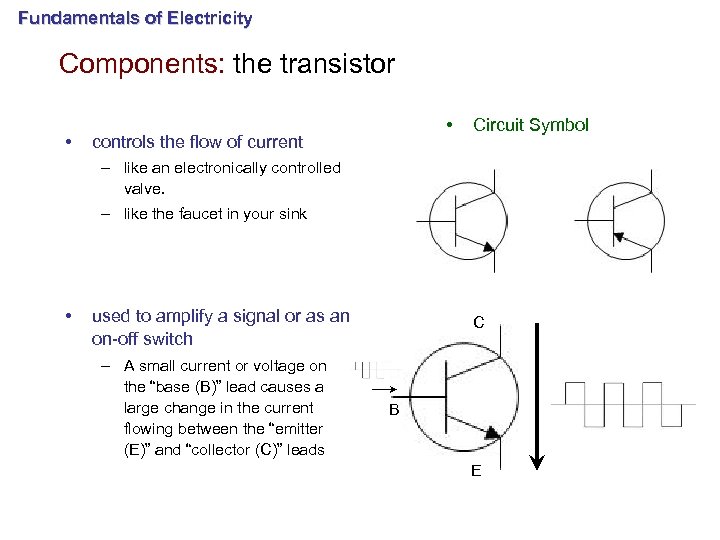
Fundamentals of Electricity Components: the transistor • • controls the flow of current Circuit Symbol – like an electronically controlled valve. – like the faucet in your sink • used to amplify a signal or as an on-off switch – A small current or voltage on the “base (B)” lead causes a large change in the current flowing between the “emitter (E)” and “collector (C)” leads C B E
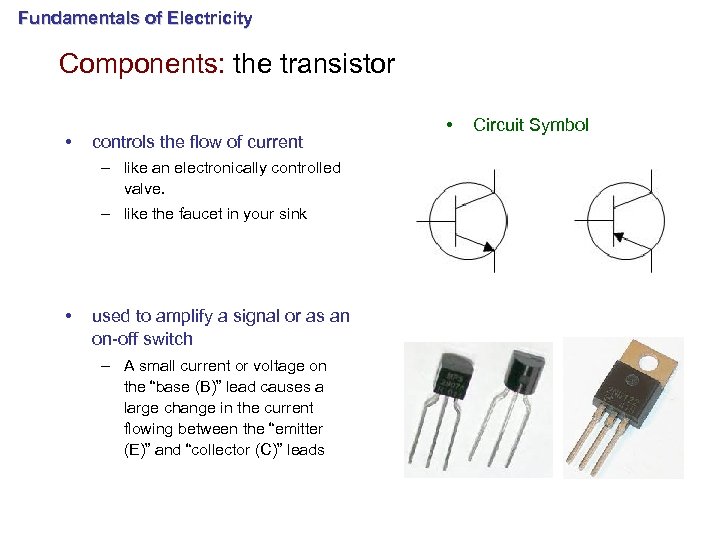
Fundamentals of Electricity Components: the transistor • controls the flow of current – like an electronically controlled valve. – like the faucet in your sink • used to amplify a signal or as an on-off switch – A small current or voltage on the “base (B)” lead causes a large change in the current flowing between the “emitter (E)” and “collector (C)” leads • Circuit Symbol

Fundamentals of Electricity Components: the integrated circuit • a collection of components contained in one device – replaces many individual components – a “black-box” for a specific function – examples: • • • amplifier switch voltage regulator mixer display controller • Circuit Symbol
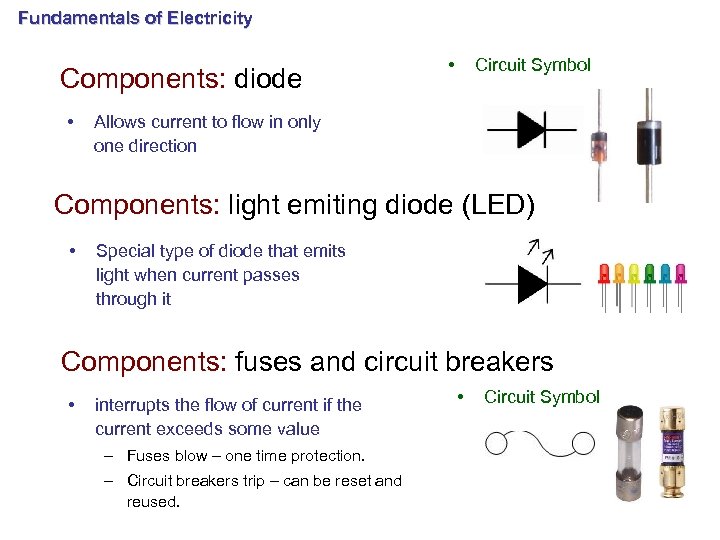
Fundamentals of Electricity Components: diode • • Circuit Symbol Allows current to flow in only one direction Components: light emiting diode (LED) • Special type of diode that emits light when current passes through it Components: fuses and circuit breakers • interrupts the flow of current if the current exceeds some value – Fuses blow – one time protection. – Circuit breakers trip – can be reset and reused. • Circuit Symbol
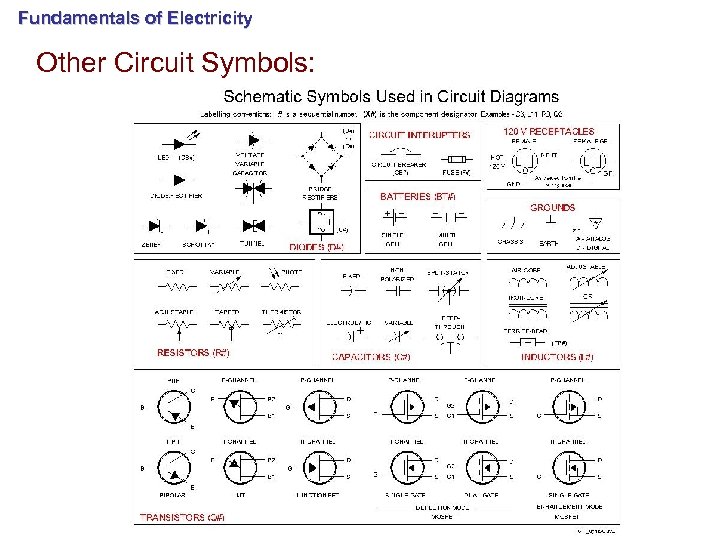
Fundamentals of Electricity Other Circuit Symbols:
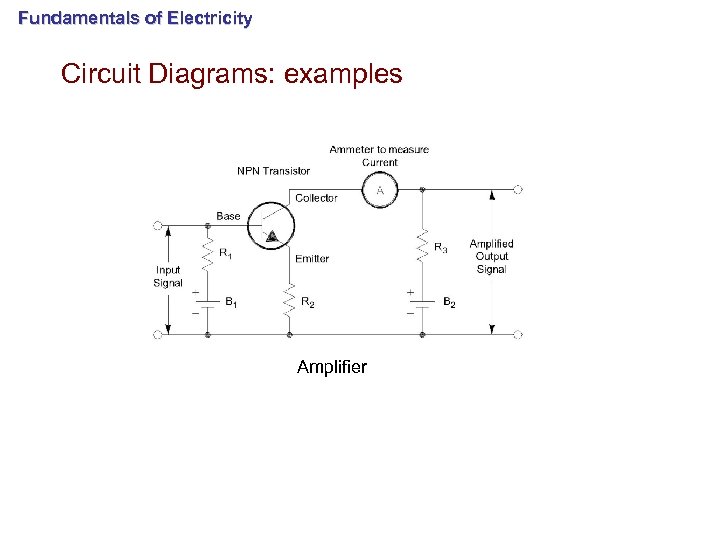
Fundamentals of Electricity Circuit Diagrams: examples Amplifier
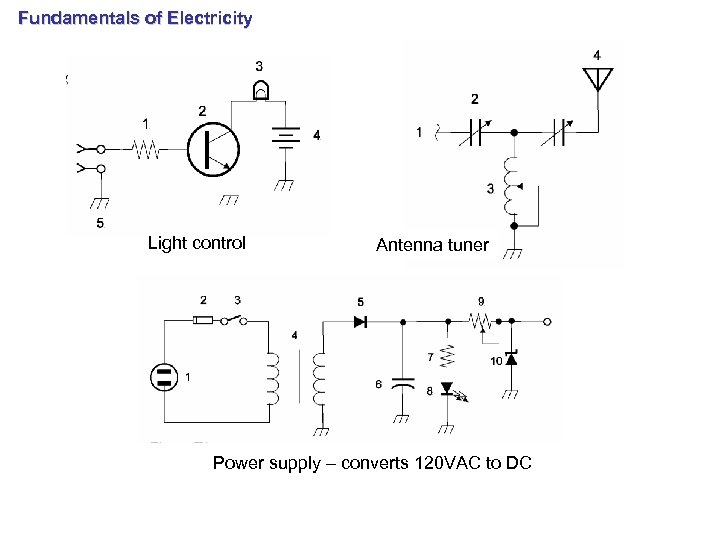
Fundamentals of Electricity Light control Antenna tuner Power supply – converts 120 VAC to DC
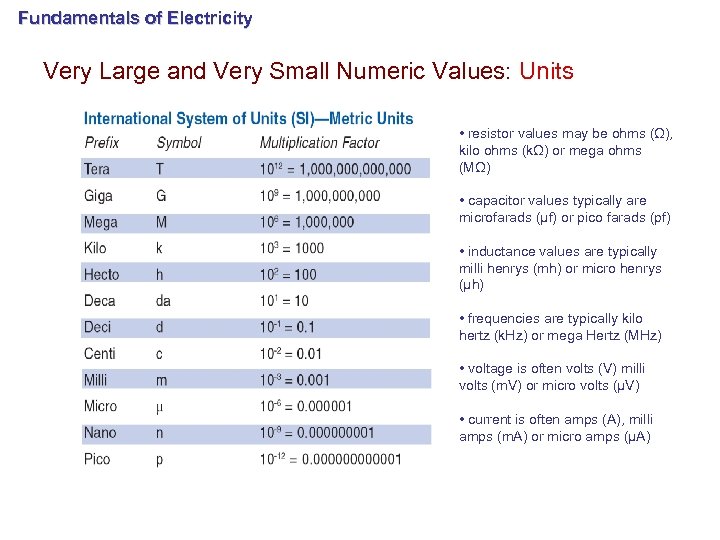
Fundamentals of Electricity Very Large and Very Small Numeric Values: Units • resistor values may be ohms (Ω), kilo ohms (kΩ) or mega ohms (MΩ) • capacitor values typically are microfarads (μf) or pico farads (pf) • inductance values are typically milli henrys (mh) or micro henrys (μh) • frequencies are typically kilo hertz (k. Hz) or mega Hertz (MHz) • voltage is often volts (V) milli volts (m. V) or micro volts (μV) • current is often amps (A), milli amps (m. A) or micro amps (μA)
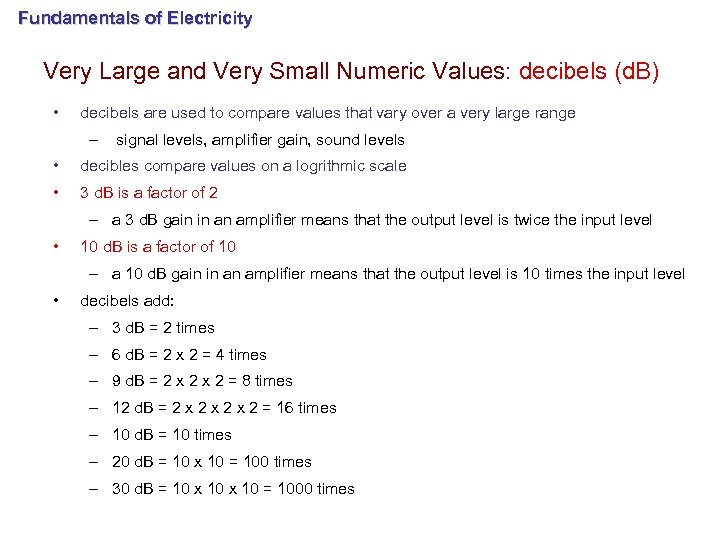
Fundamentals of Electricity Very Large and Very Small Numeric Values: decibels (d. B) • decibels are used to compare values that vary over a very large range – signal levels, amplifier gain, sound levels • decibles compare values on a logrithmic scale • 3 d. B is a factor of 2 – a 3 d. B gain in an amplifier means that the output level is twice the input level • 10 d. B is a factor of 10 – a 10 d. B gain in an amplifier means that the output level is 10 times the input level • decibels add: – 3 d. B = 2 times – 6 d. B = 2 x 2 = 4 times – 9 d. B = 2 x 2 = 8 times – 12 d. B = 2 x 2 x 2 = 16 times – 10 d. B = 10 times – 20 d. B = 10 x 10 = 100 times – 30 d. B = 10 x 10 = 1000 times
Скачать презентацию Fundamentals of Electricity Franklin County Amateur Radio Club
82e9a43a4d77c0716468c12561e6b45d.ppt