


 Скачать презентацию Fundamentals of ecology Theme Practical importance of ecology
Законы экологии.ppt
- Количество слайдов: 16
 Fundamentals of ecology Theme: ”Practical importance of ecology laws”
 As well as any science ecology has the laws, which characterize mutual relations, various elements of an ecosystem and, in the final analysis, all processes in biosphere.
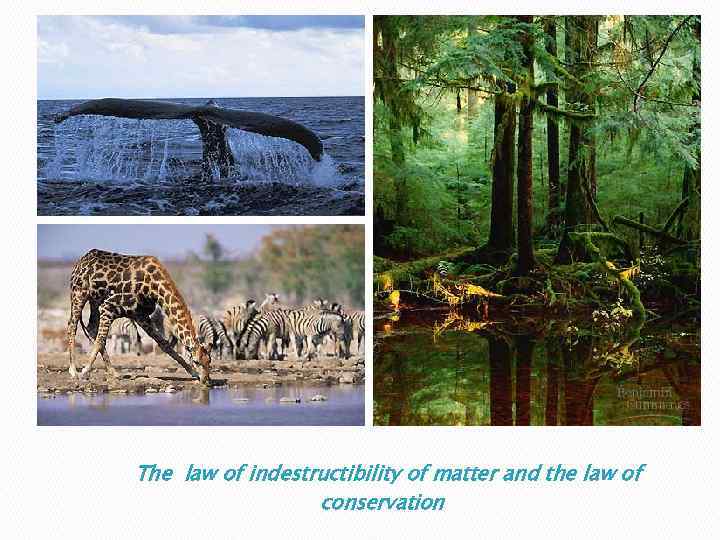 The law of indestructibility of matter and the law of conservation
 The second law of thermodynamics
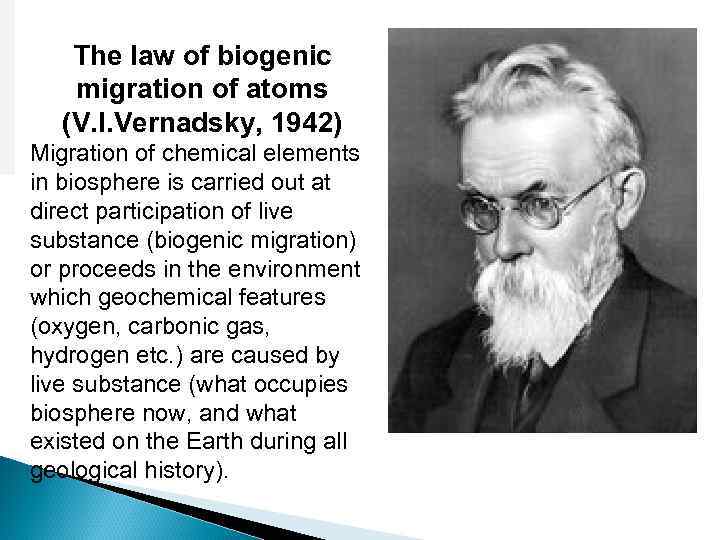 The law of biogenic migration of atoms (V. I. Vernadsky, 1942) Migration of chemical elements in biosphere is carried out at direct participation of live substance (biogenic migration) or proceeds in the environment which geochemical features (oxygen, carbonic gas, hydrogen etc. ) are caused by live substance (what occupies biosphere now, and what existed on the Earth during all geological history).
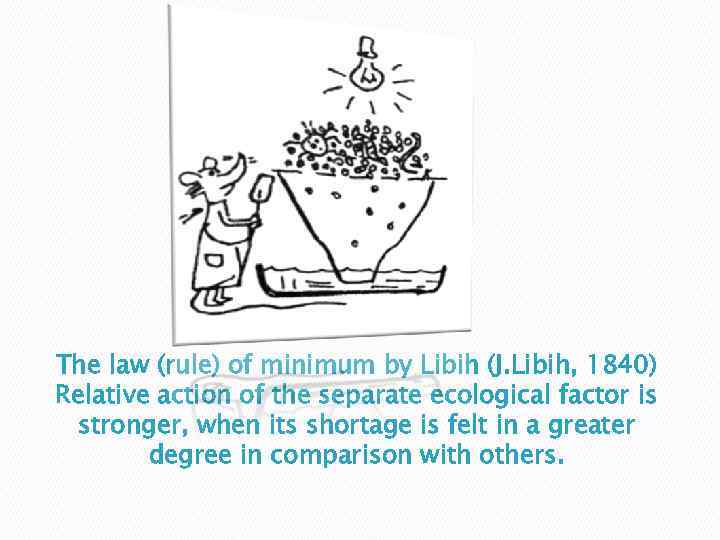 The law (rule) of minimum by Libih (J. Libih, 1840) Relative action of the separate ecological factor is stronger, when its shortage is felt in a greater degree in comparison with others.
 The law of tolerance by Shelford(V. Shelford, 1913) The limiting factor of prosperity can be the least, and the maximum of the ecological factor; the range between which defines size of tolerance (endurance) of an organism to the given factor.
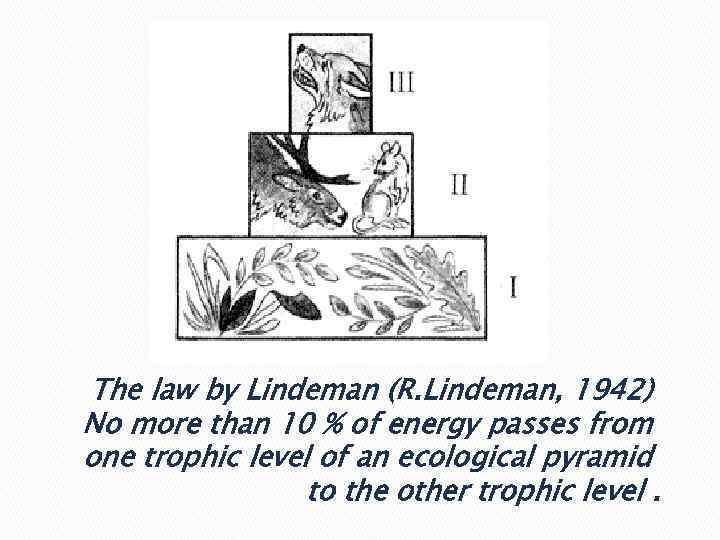 The law by Lindeman (R. Lindeman, 1942) No more than 10 % of energy passes from one trophic level of an ecological pyramid to the other trophic level.
 Ecological laws by B. Commoner (1970) 1. All is connected with all. 2. It is necessary to pay for all (or nothing is given by gift). 3. All should disappear somewhere. 4. The nature knows better.
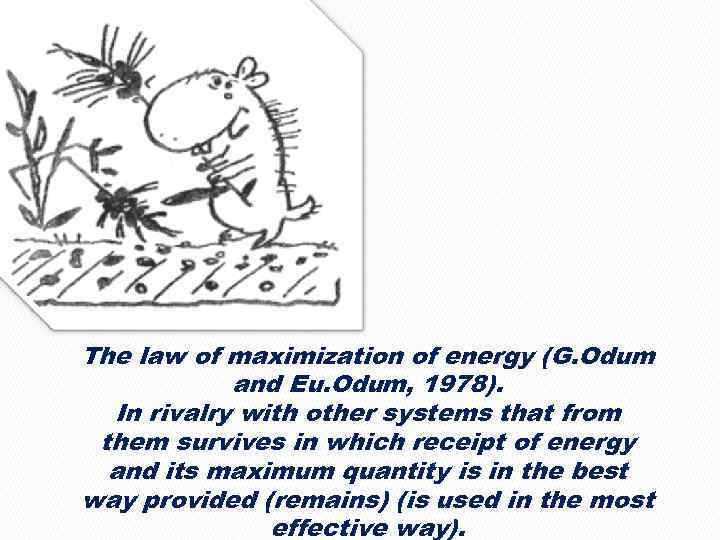 The law of maximization of energy (G. Odum and Eu. Odum, 1978). In rivalry with other systems that from them survives in which receipt of energy and its maximum quantity is in the best way provided (remains) (is used in the most effective way).
 The law of feedback of interaction in the system “Man – Biosphere” (P. Dansereau, 1957) Any change in the environment caused by economic activities of man comes as a boomerang back to man and has the undesirable consequences in influencing economy, social life and health of people.
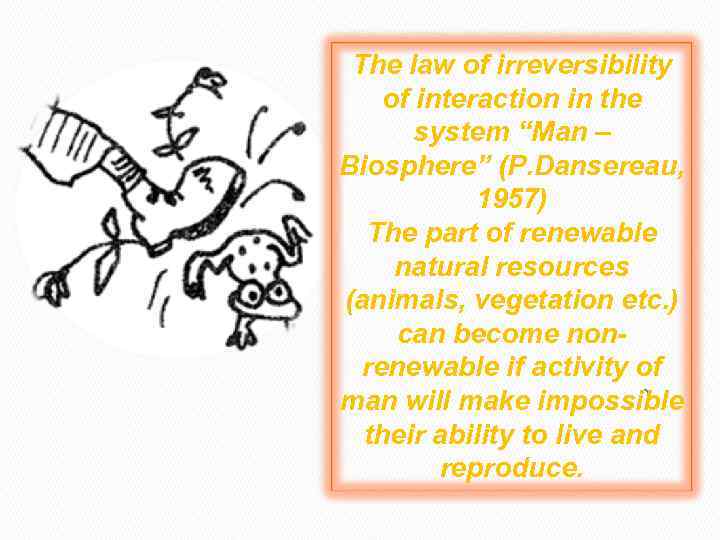 The law of irreversibility of interaction in the system “Man – Biosphere” (P. Dansereau, 1957) The part of renewable natural resources (animals, vegetation etc. ) can become nonrenewable if activity of ` man will make impossible their ability to live and reproduce.
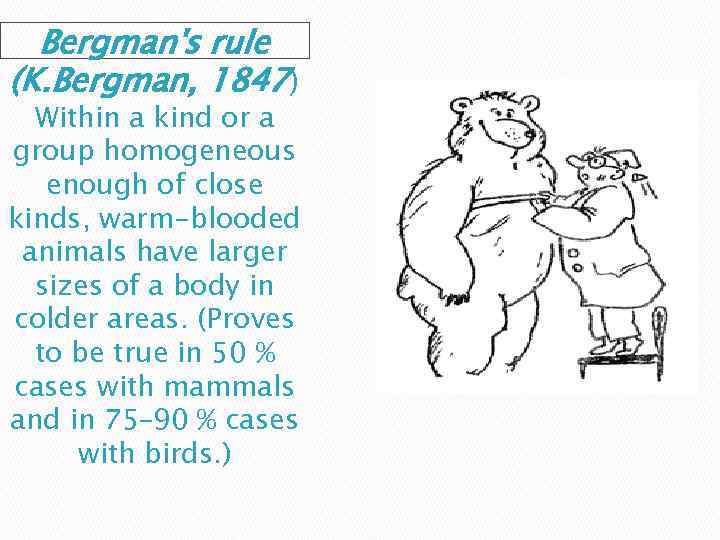 Bergman's rule (K. Bergman, 1847) Within a kind or a group homogeneous enough of close kinds, warm-blooded animals have larger sizes of a body in colder areas. (Proves to be true in 50 % cases with mammals and in 75– 90 % cases with birds. )
 Thank you for attention!