 Скачать презентацию Fundamentals of Artificial Intelligence and Knowledge-based Systems INTRODUCTION
92bccbb9d81d18afd65364f0592b254f.ppt
- Количество слайдов: 44



(Fundamentals of) Artificial Intelligence (and Knowledge-based Systems) INTRODUCTION to. . . … … Artificial Intelligence this course state-space representation basic search
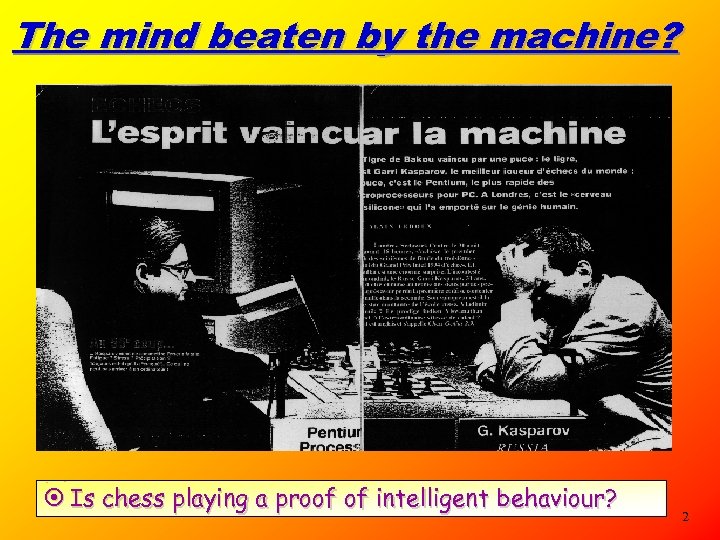
The mind beaten by the machine? ¤ Is chess playing a proof of intelligent behaviour? 2
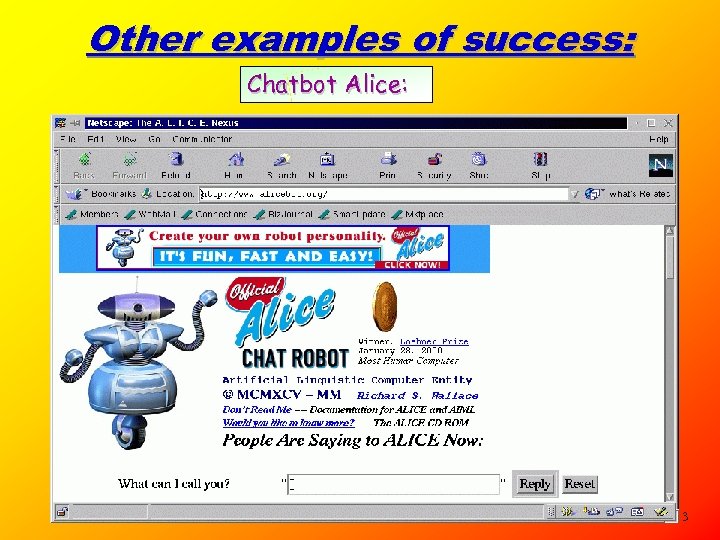
Other examples of success: Chatbot Alice: 3
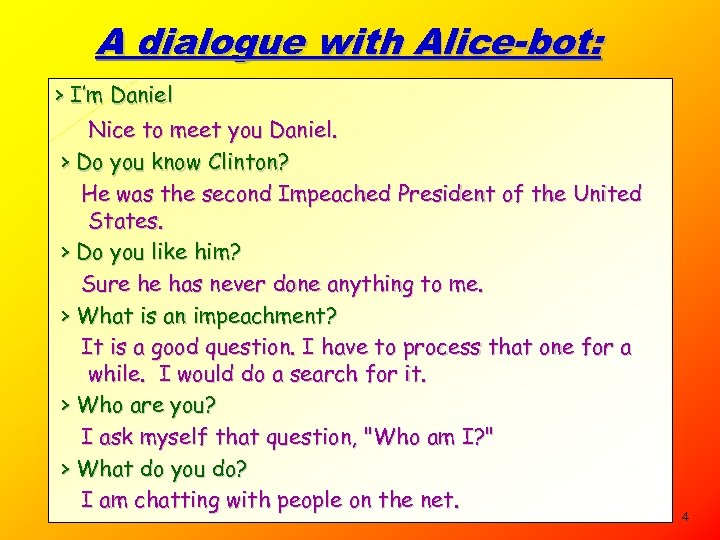
A dialogue with Alice-bot: > I’m Daniel Nice to meet you Daniel. > Do you know Clinton? He was the second Impeached President of the United States. > Do you like him? Sure he has never done anything to me. > What is an impeachment? It is a good question. I have to process that one for a while. I would do a search for it. > Who are you? I ask myself that question, "Who am I? " > What do you do? I am chatting with people on the net. 4
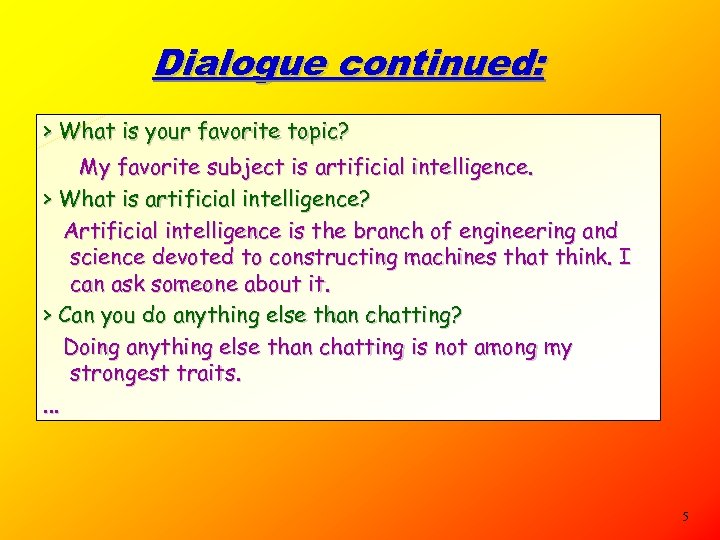
Dialogue continued: > What is your favorite topic? My favorite subject is artificial intelligence. > What is artificial intelligence? Artificial intelligence is the branch of engineering and science devoted to constructing machines that think. I can ask someone about it. > Can you do anything else than chatting? Doing anything else than chatting is not among my strongest traits. . 5
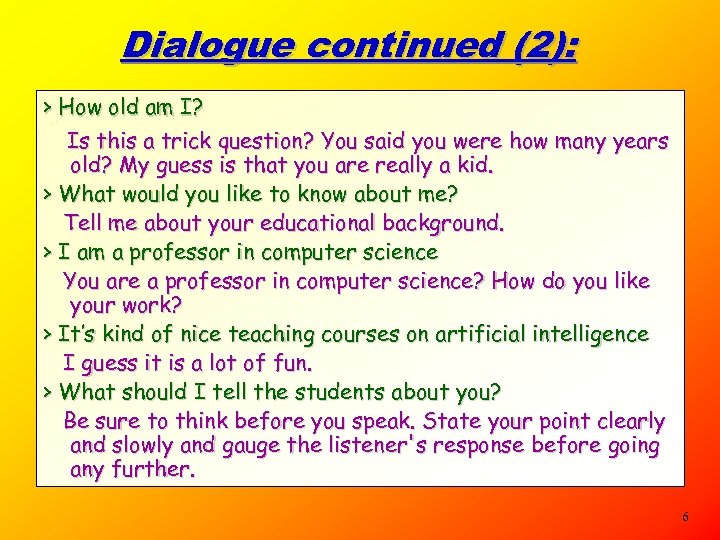
Dialogue continued (2): > How old am I? Is this a trick question? You said you were how many years old? My guess is that you are really a kid. > What would you like to know about me? Tell me about your educational background. > I am a professor in computer science You are a professor in computer science? How do you like your work? > It’s kind of nice teaching courses on artificial intelligence I guess it is a lot of fun. > What should I tell the students about you? Be sure to think before you speak. State your point clearly and slowly and gauge the listener's response before going any further. 6
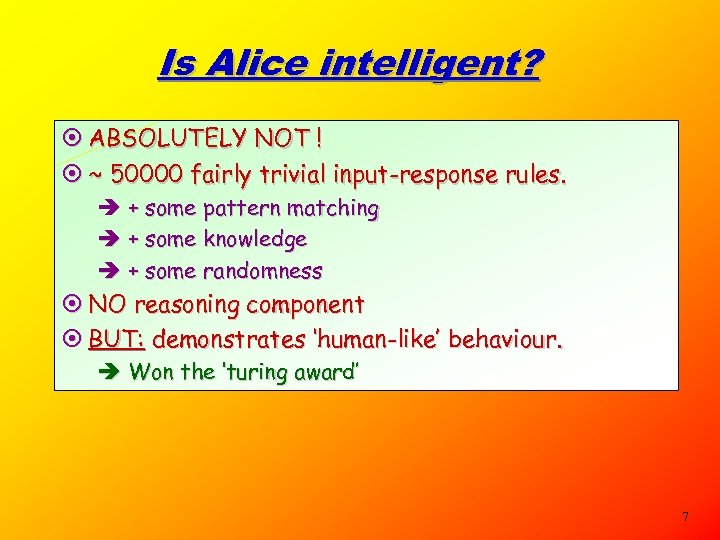
Is Alice intelligent? ¤ ABSOLUTELY NOT ! ¤ ~ 50000 fairly trivial input-response rules. è + some pattern matching è + some knowledge è + some randomness ¤ NO reasoning component ¤ BUT: demonstrates ‘human-like’ behaviour. è Won the ‘turing award’ 7
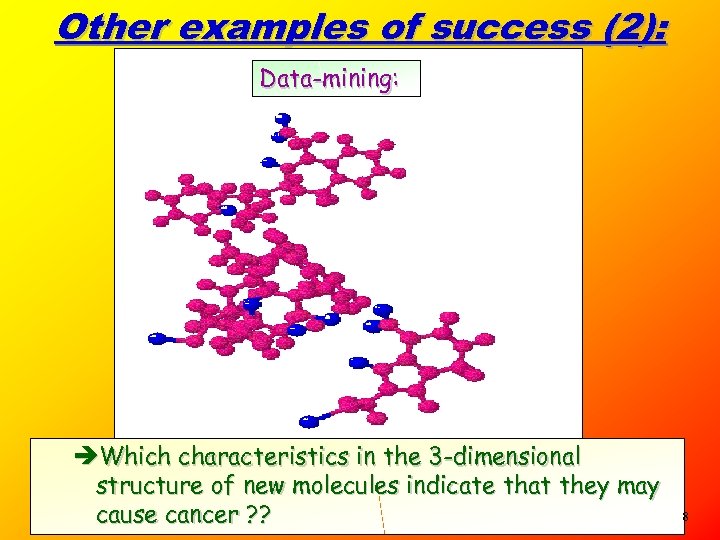
Other examples of success (2): Data-mining: èWhich characteristics in the 3 -dimensional structure of new molecules indicate that they may cause cancer ? ? 8
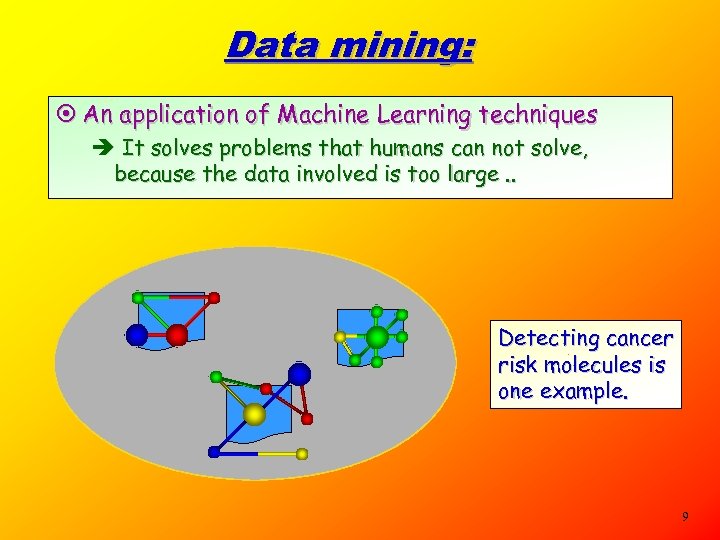
Data mining: ¤ An application of Machine Learning techniques è It solves problems that humans can not solve, because the data involved is too large. . Detecting cancer risk molecules is one example. 9
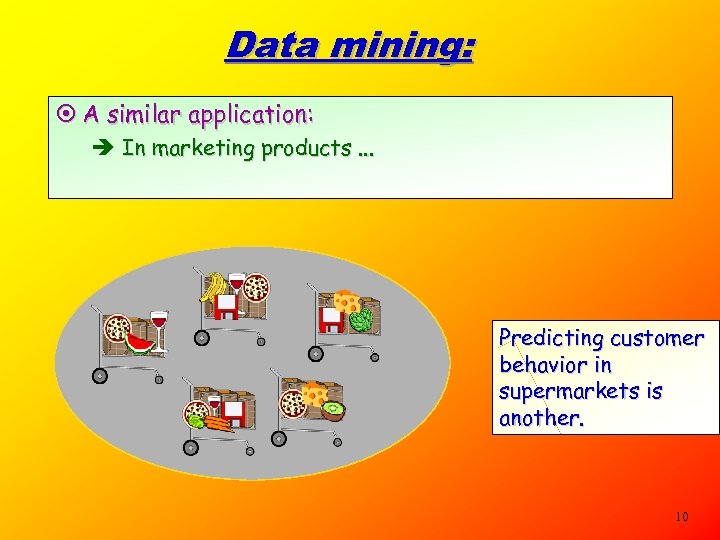
Data mining: ¤ A similar application: è In marketing products. . . Predicting customer behavior in supermarkets is another. 10
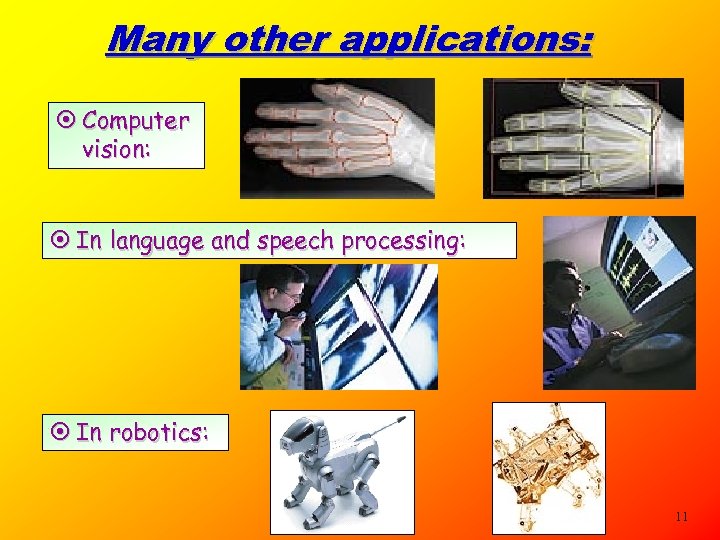
Many other applications: ¤ Computer vision: ¤ In language and speech processing: ¤ In robotics: 11
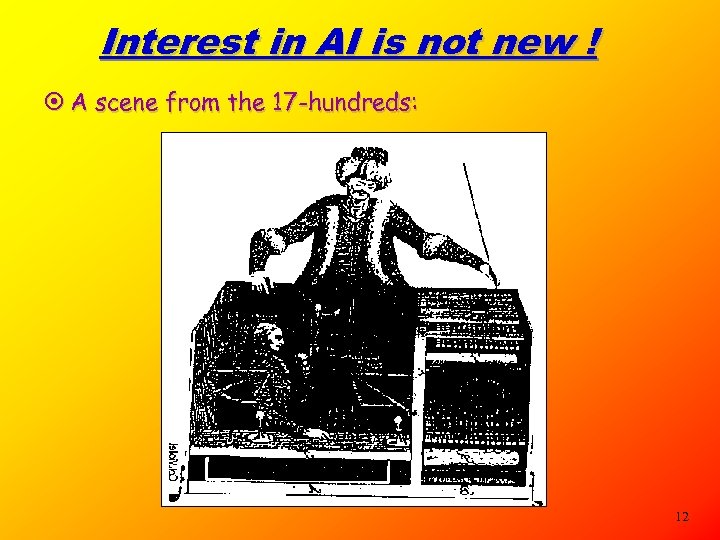
Interest in AI is not new ! ¤ A scene from the 17 -hundreds: 12
About intelligence. . . ¤ When would we consider a program intelligent ? ¤ When do we consider a creative activity of humans to require intelligence ? è Default answers : Never? / Always? 13
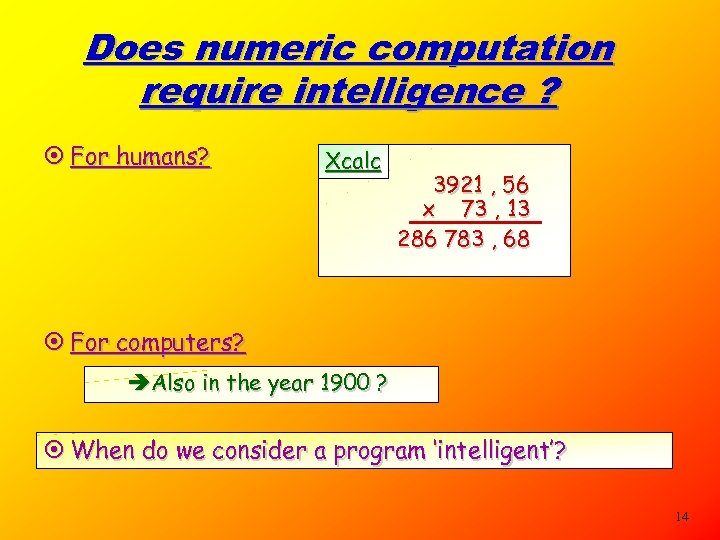
Does numeric computation require intelligence ? ¤ For humans? Xcalc 3921 , 56 x 73 , 13 286 783 , 68 ¤ For computers? èAlso in the year 1900 ? ¤ When do we consider a program ‘intelligent’? 14
To situate the question: Two different aims of AI: ¤ Long term aim: è develop systems that achieve a level of ‘intelligence’ similar / comparable / better? than that of humans. u not achievable in the next 20 to 30 years ¤ Short term aim: è on specific tasks that seem to require intelligence: develop systems that achieve a level of ‘intelligence’ similar / comparable / better? than that of humans. u achieved for very many tasks already 15
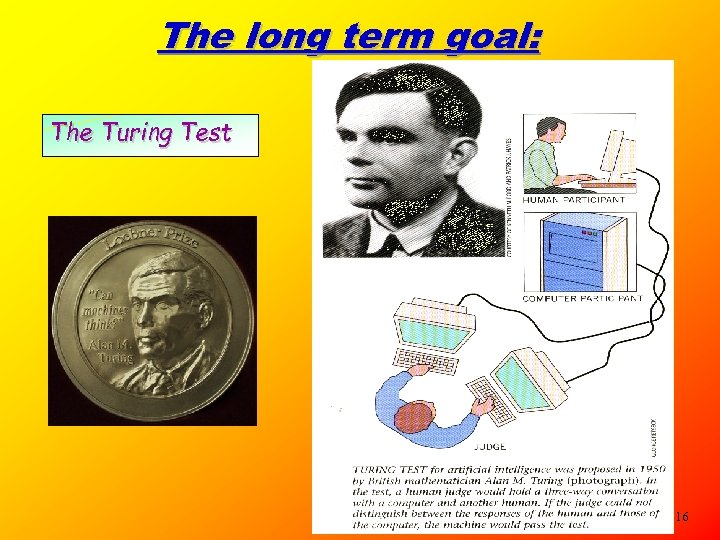
The long term goal: The Turing Test 16
The meta-Turing test counts a thing as intelligent if “it seeks to devise and apply Turing tests to objects of its own creation”. -- Lew Mammel, Jr. 17
Reproduction versus Simulation ¤ At the very least in the context of the short term aim of AI: è we do not want to SIMULATE human intelligence BUT: è REPRODUCE the effect of intelligence Nice analogy with flying ! 18
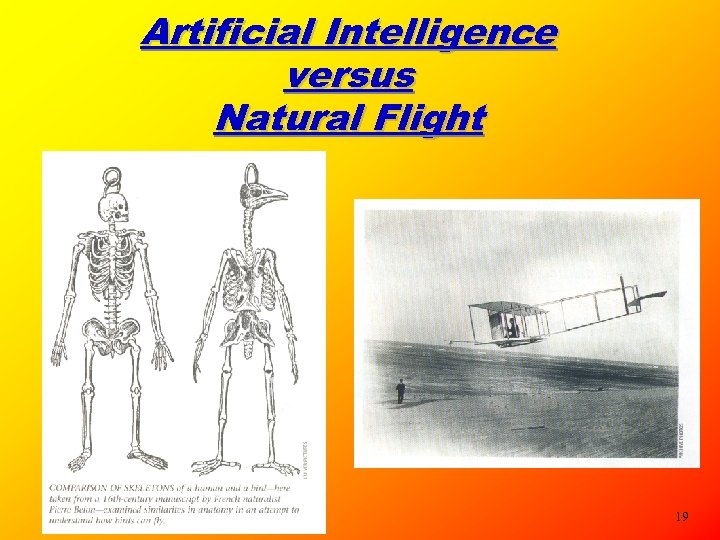
Artificial Intelligence versus Natural Flight 19
Is the case for most of the successful applications ! ¤ Deep blue ¤ Alice ¤ Data mining ¤ Computer vision ¤. . . 20
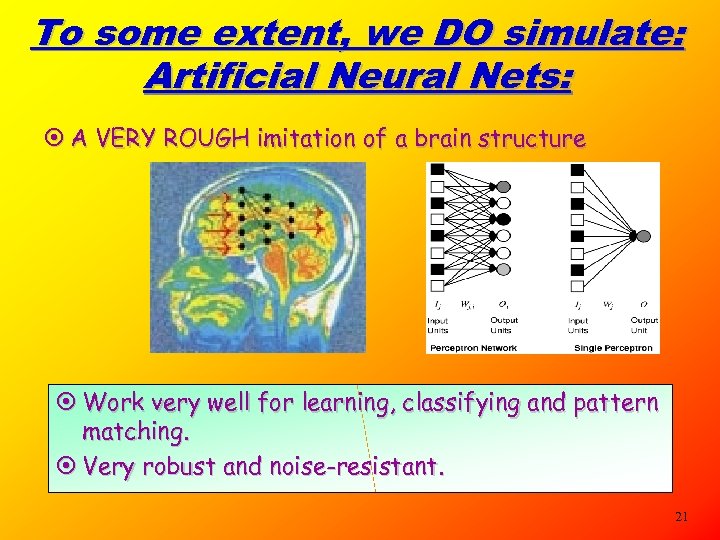
To some extent, we DO simulate: Artificial Neural Nets: ¤ A VERY ROUGH imitation of a brain structure ¤ Work very well for learning, classifying and pattern matching. ¤ Very robust and noise-resistant. 21
Different kinds of AI relate to different kinds of Intelligence ¤ Some people are very good in reasoning or mathematics, but can hardly learn to read or spell ! è seem to require different cognitive skills! è in AI: ANNs are good for learning and automation è for reasoning we need different techniques 22
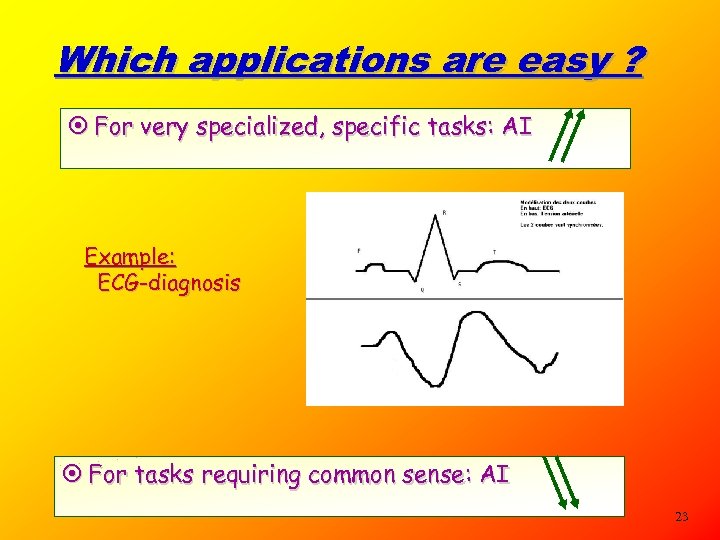
Which applications are easy ? ¤ For very specialized, specific tasks: AI Example: ECG-diagnosis ¤ For tasks requiring common sense: AI 23
Modeling Knowledge … and managing it. The LENAT experiment: 15 years of work by 15 to 30 people, trying to model the common knowledge in the word !!!! Knowledge should be learned, not engineered. AI: are we only dreaming ? ? 24
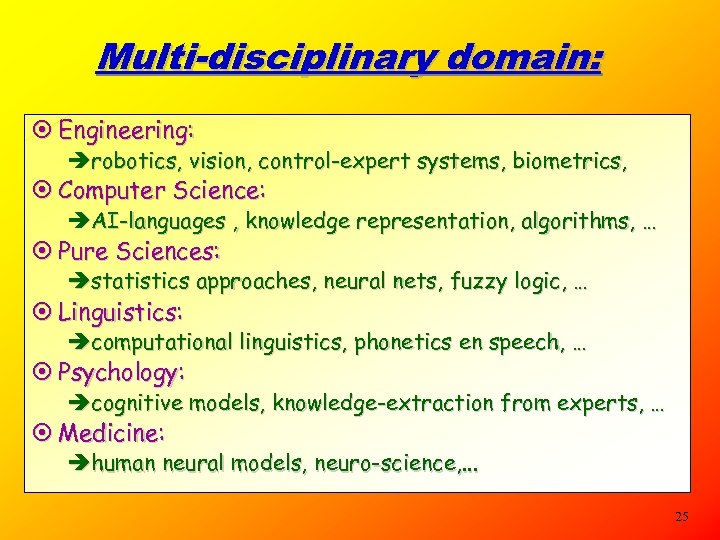
Multi-disciplinary domain: ¤ Engineering: èrobotics, vision, control-expert systems, biometrics, ¤ Computer Science: èAI-languages , knowledge representation, algorithms, … ¤ Pure Sciences: èstatistics approaches, neural nets, fuzzy logic, … ¤ Linguistics: ècomputational linguistics, phonetics en speech, … ¤ Psychology: ècognitive models, knowledge-extraction from experts, … ¤ Medicine: èhuman neural models, neuro-science, . . . 25
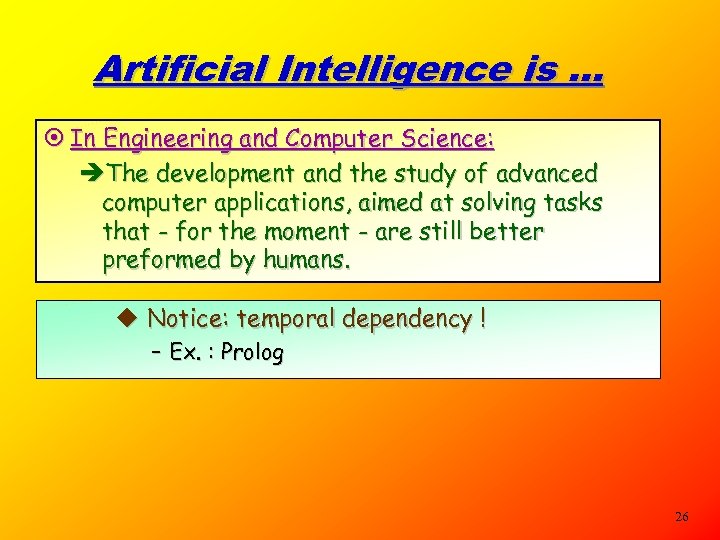
Artificial Intelligence is. . . ¤ In Engineering and Computer Science: èThe development and the study of advanced computer applications, aimed at solving tasks that - for the moment - are still better preformed by humans. u Notice: temporal dependency ! – Ex. : Prolog 26

About this course. . .
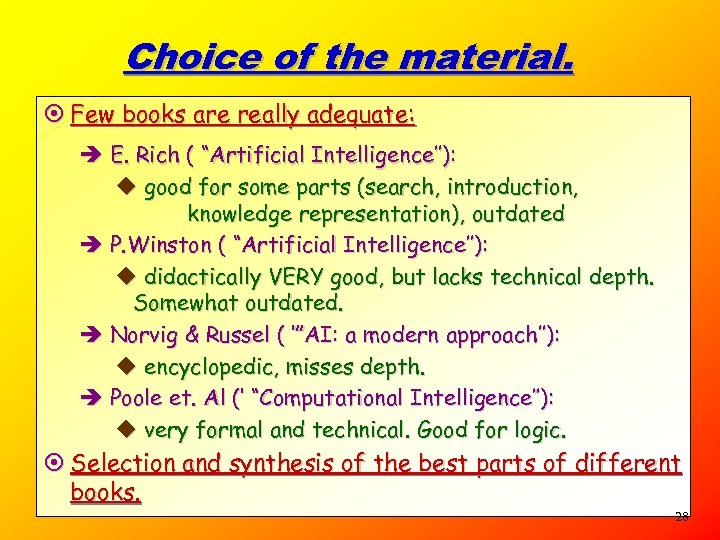
Choice of the material. ¤ Few books are really adequate: è E. Rich ( “Artificial Intelligence’’): u good for some parts (search, introduction, knowledge representation), outdated è P. Winston ( “Artificial Intelligence’’): u didactically VERY good, but lacks technical depth. Somewhat outdated. è Norvig & Russel ( ‘”AI: a modern approach’’): u encyclopedic, misses depth. è Poole et. Al (‘ “Computational Intelligence’’): u very formal and technical. Good for logic. ¤ Selection and synthesis of the best parts of different books. 28
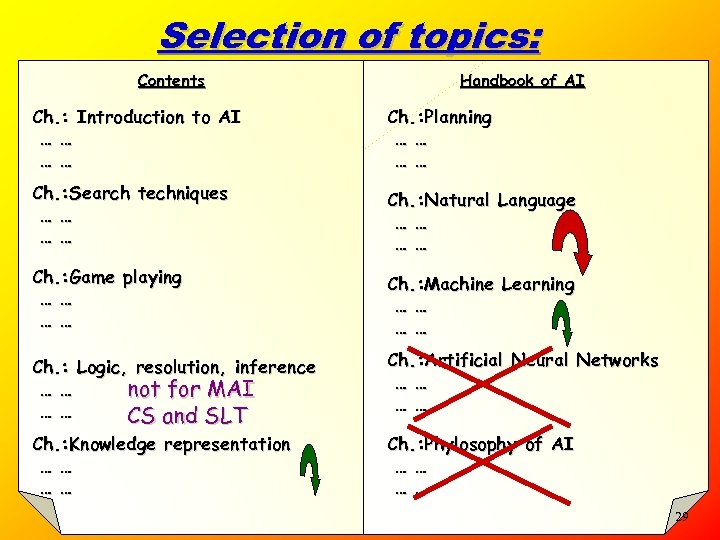
Selection of topics: Contents Handbook of AI Ch. : Introduction to AI … … Ch. : Planning … … Ch. : Search techniques … … Ch. : Natural Language … … Ch. : Game playing … … Ch. : Machine Learning … … Ch. : Logic, resolution, inference … … not for MAI … … CS and SLT Ch. : Artificial Neural Networks … … Ch. : Knowledge representation … … Ch. : Phylosophy of AI … … 29
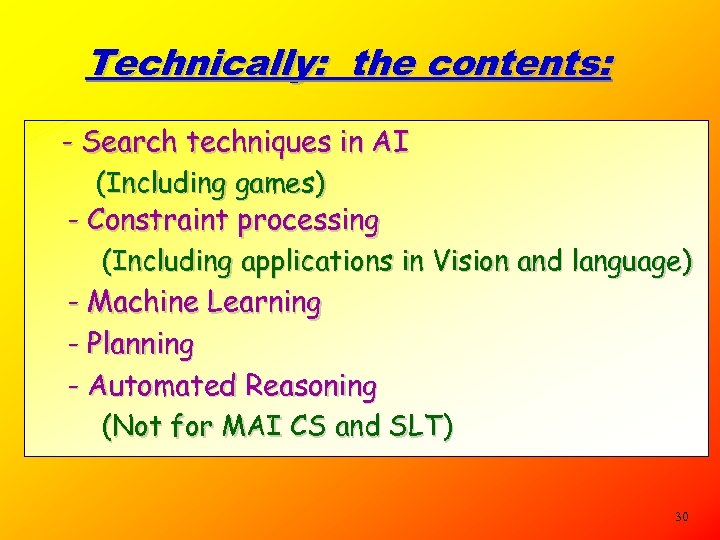
Technically: the contents: - Search techniques in AI (Including games) - Constraint processing (Including applications in Vision and language) - Machine Learning - Planning - Automated Reasoning (Not for MAI CS and SLT) 30
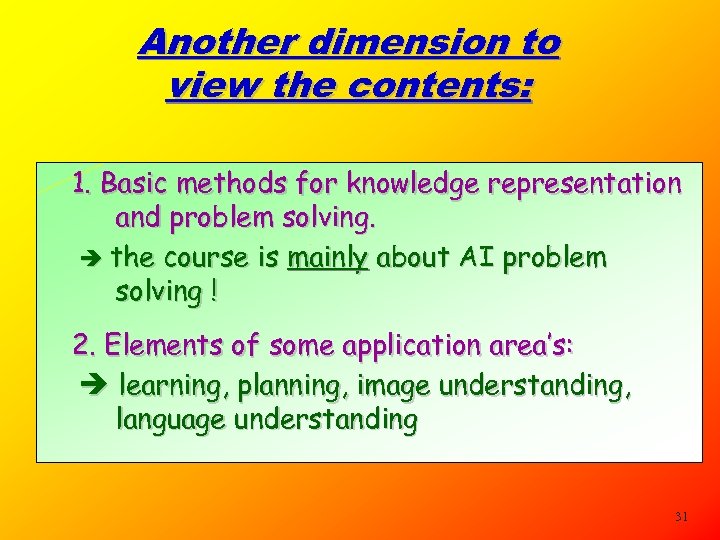
Another dimension to view the contents: 1. Basic methods for knowledge representation and problem solving. è the course is mainly about AI problem solving ! 2. Elements of some application area’s: è learning, planning, image understanding, language understanding 31
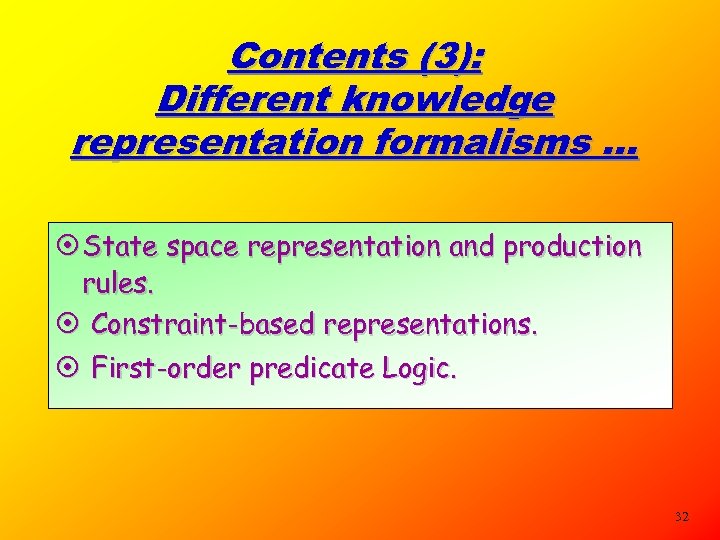
Contents (3): Different knowledge representation formalisms. . . ¤ State space representation and production rules. ¤ Constraint-based representations. ¤ First-order predicate Logic. 32
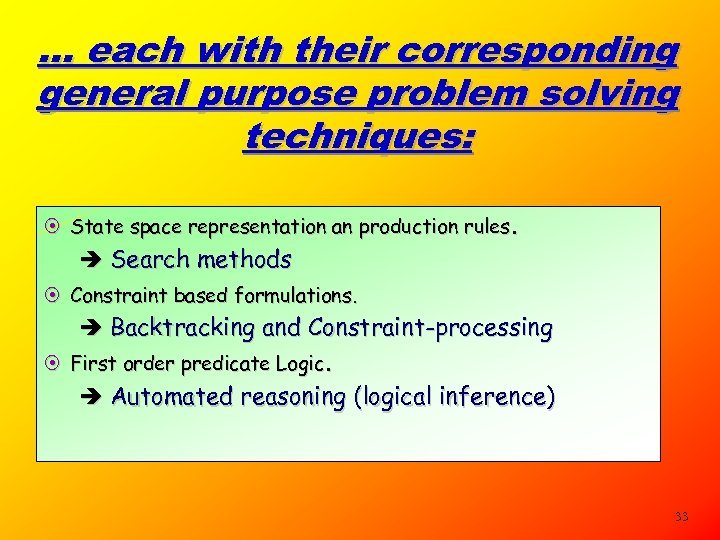
… each with their corresponding general purpose problem solving techniques: ¤ State space representation an production rules. è Search methods ¤ Constraint based formulations. è Backtracking and Constraint-processing ¤ First order predicate Logic. è Automated reasoning (logical inference) 33
Contents (4): Some application area’s: ¤ Game playing (in chapter on Search) ¤ Image understanding (in chapter on constraints) ¤ Language understanding (constraints) ¤ Expert systems (in chapter on logic) ¤ Planning ¤ Machine learning 34
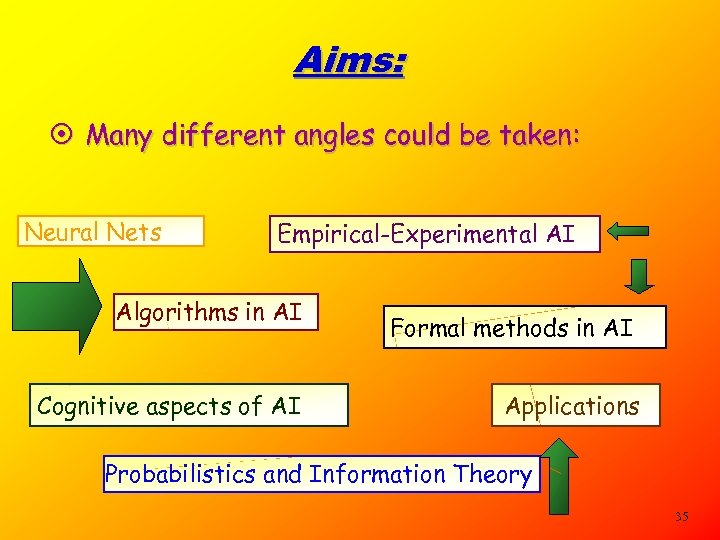
Aims: ¤ Many different angles could be taken: Neural Nets Empirical-Experimental AI Algorithms in AI Cognitive aspects of AI Formal methods in AI Applications Probabilistics and Information Theory 35
Concrete aims: ¤ Provide insight in the basic achievements of AI. è Prepares for more application oriented courses on AI, or on self-study in some application areas u ex. : artificial neural networks, machine learning, computer vision, natural language, etc. ¤ Through case-studies: provide more background in ‘problem solving’. è Mostly algorithmic aspects. è Also techniques for representing and modeling. ¤ The 6 -study point version: 2 projects for hands-on experience. 36
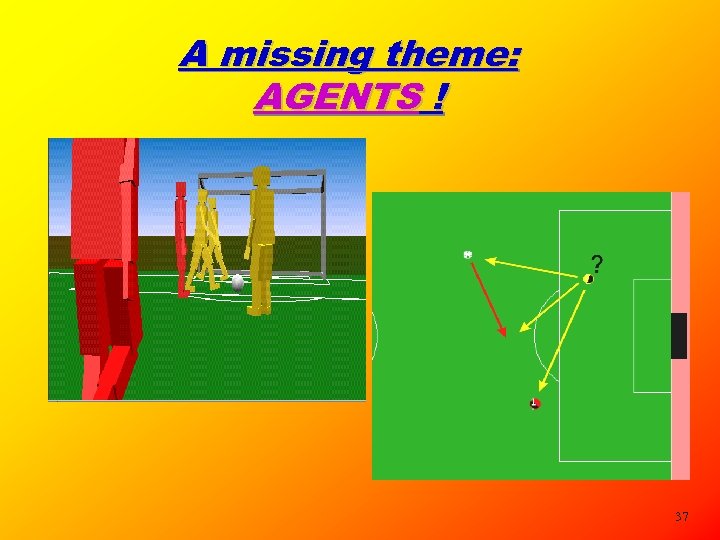
A missing theme: AGENTS ! 37
A missing theme: AGENTS (2). ¤ Yet, a central theme in recent books ! ¤ BUT: è Have as their main extra contribution: u Communication between system and: – other systems/agents – the outside world è In particular, also a useful conceptual model for integrating different components of an AI system uex: a robot that combines vision, natural language and planning 38
BUT: no intelligence without interaction with the world!! ¤ See: experiment in middle-ages. ¤ See also philosophy arguments against AI ¤ Plus: multi-agents is FUN ! 39
Practical info (FAI) ¤ Exercises: 12. 5 OR 20 hours: è mainly practice on the main methods/algorithms presented in the course u important preparation for the examination ¤ Course material: è copies of detailed slides è for some parts: supporting texts ¤ Required background: è understanding of algorithms (and recursion) 40
Practical info (AI) ¤ Exercises: 25 or 22. 5 hours: è mainly practice on the main methods/algorithms presented in the course u important preparation for the examination ¤ Course material: è copies of detailed slides è for some parts: supporting texts ¤ Required background: è understanding of algorithms (and recursion) 41
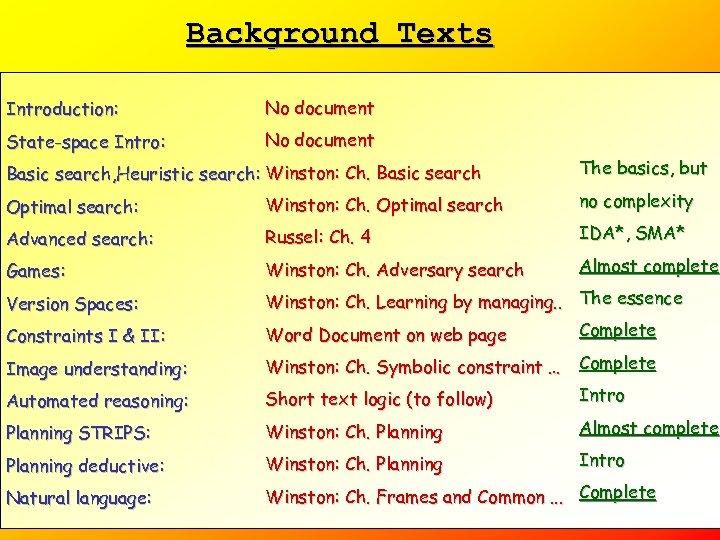
Background Texts Introduction: No document State-space Intro: No document Basic search, Heuristic search: Winston: Ch. Basic search The basics, but Optimal search: Winston: Ch. Optimal search no complexity Advanced search: Russel: Ch. 4 IDA*, SMA* Games: Winston: Ch. Adversary search Almost complete Version Spaces: Winston: Ch. Learning by managing. . The essence Constraints I & II: Word Document on web page Image understanding: Winston: Ch. Symbolic constraint … Complete Automated reasoning: Short text logic (to follow) Intro Planning STRIPS: Winston: Ch. Planning Almost complete Planning deductive: Winston: Ch. Planning Intro Natural language: Winston: Ch. Frames and Common. . . Complete
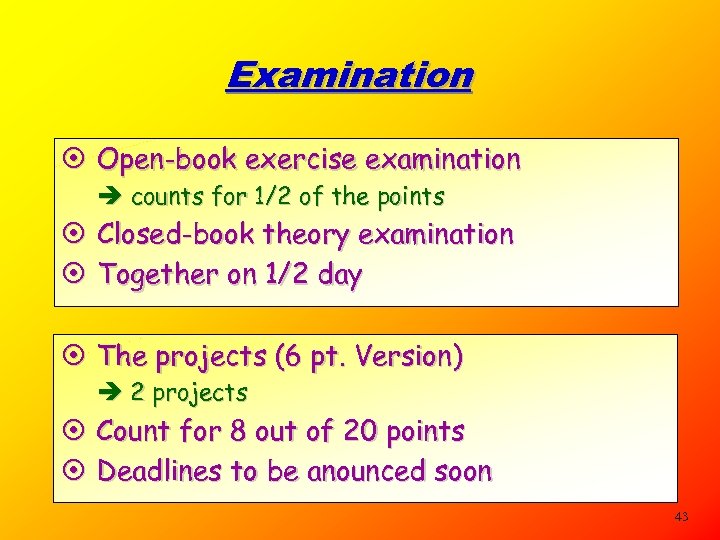
Examination ¤ Open-book exercise examination è counts for 1/2 of the points ¤ ¤ Closed-book theory examination Together on 1/2 day ¤ The projects (6 pt. Version) è 2 projects ¤ ¤ Count for 8 out of 20 points Deadlines to be anounced soon 43
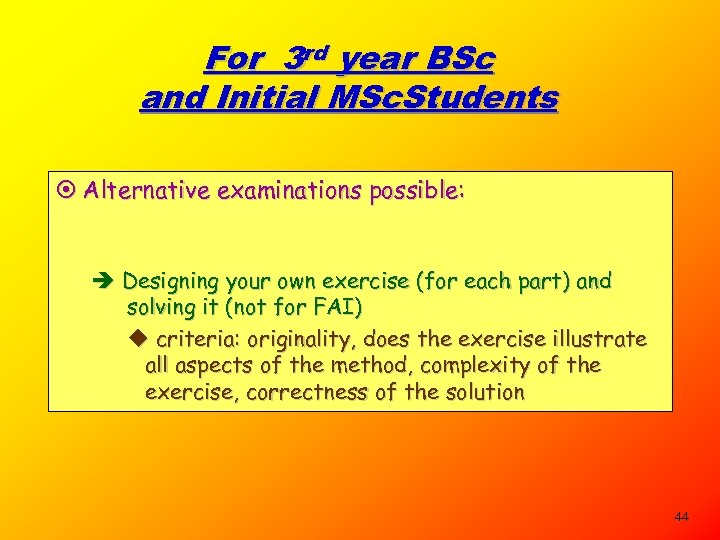
For 3 rd year BSc and Initial MSc. Students ¤ Alternative examinations possible: è Designing your own exercise (for each part) and solving it (not for FAI) u criteria: originality, does the exercise illustrate all aspects of the method, complexity of the exercise, correctness of the solution 44
Скачать презентацию Fundamentals of Artificial Intelligence and Knowledge-based Systems INTRODUCTION
92bccbb9d81d18afd65364f0592b254f.ppt