


 Скачать презентацию Functional specification the transaction log Andrew Howard UNFCCC
32f970f43a6e3b75196df495503d54ec.ppt
- Количество слайдов: 14
 Functional specification: the transaction log Andrew Howard UNFCCC secretariat www. unfccc. int ahoward@unfccc. int Pre-sessional consultations on registries 2 June 2003 Bonn, Germany 1
 Scope • Development stages • Interaction processes for registries and the transaction log • Introduce the functional specification • Map the specification against COP decisions • Indicate necessary refinements in the specification 2
 The transaction log Verifies the validity of transactions • Issuance of units • Transfer and acquisition of units between registries • Cancellation of units (not used for compliance) • Retirement of units (used for compliance) • Carry-over of ERUs, CERs and AAUs • Independent checks of proposed transactions • Integrated in electronic communications between registries • Ensures the integrity of transactions before completion 3
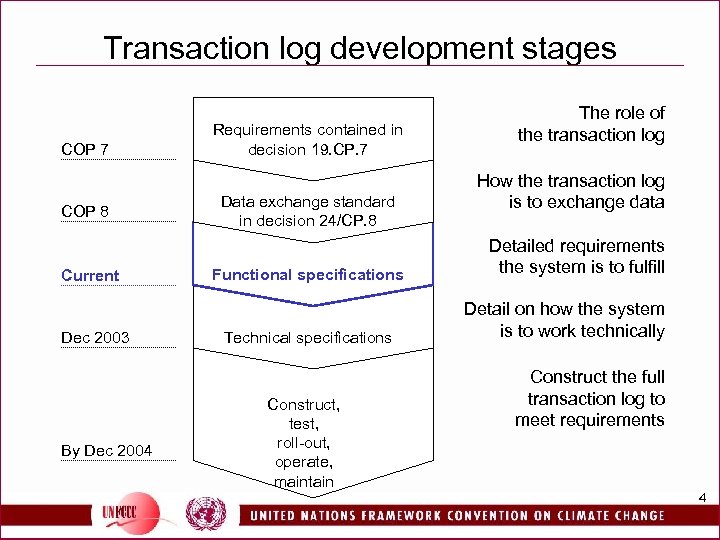 Transaction log development stages COP 7 COP 8 Current Dec 2003 By Dec 2004 Requirements contained in decision 19. CP. 7 Data exchange standard in decision 24/CP. 8 Functional specifications Technical specifications Construct, test, roll-out, operate, maintain The role of the transaction log How the transaction log is to exchange data Detailed requirements the system is to fulfill Detail on how the system is to work technically Construct the full transaction log to meet requirements 4
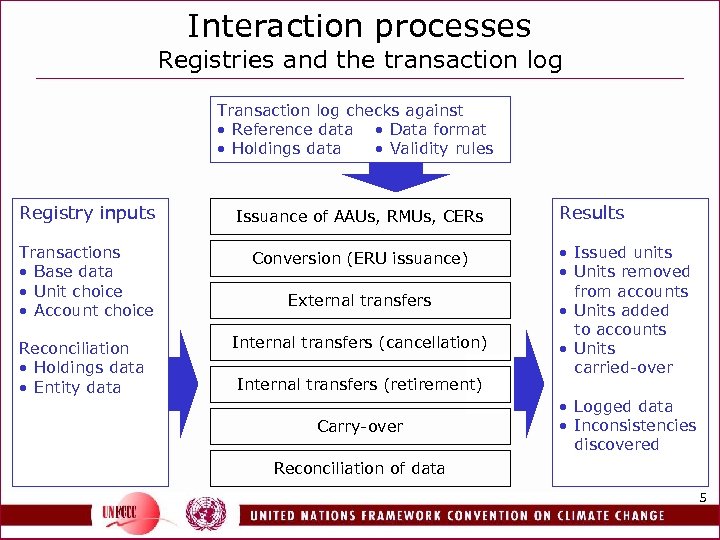 Interaction processes Registries and the transaction log Transaction log checks against • Reference data • Data format • Holdings data • Validity rules Registry inputs Issuance of AAUs, RMUs, CERs Transactions • Base data • Unit choice • Account choice Conversion (ERU issuance) Reconciliation • Holdings data • Entity data External transfers Internal transfers (cancellation) Internal transfers (retirement) Carry-over Results • Issued units • Units removed from accounts • Units added to accounts • Units carried-over • Logged data • Inconsistencies discovered Reconciliation of data 5
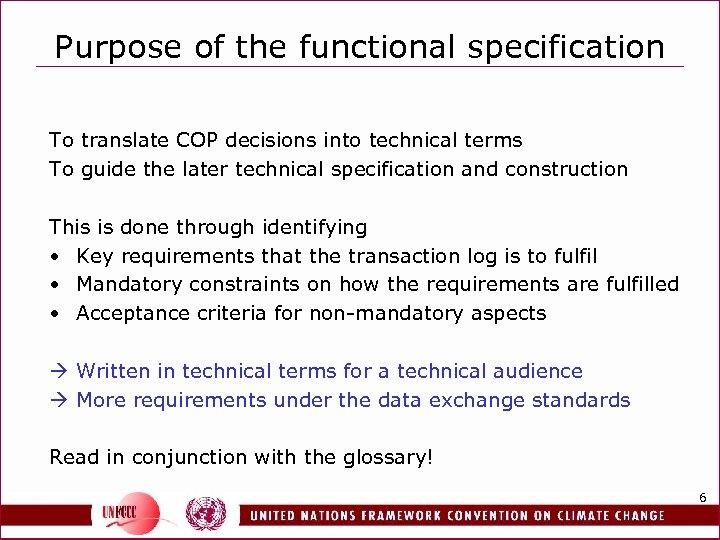 Purpose of the functional specification To translate COP decisions into technical terms To guide the later technical specification and construction This is done through identifying • Key requirements that the transaction log is to fulfil • Mandatory constraints on how the requirements are fulfilled • Acceptance criteria for non-mandatory aspects à Written in technical terms for a technical audience à More requirements under the data exchange standards Read in conjunction with the glossary! 6
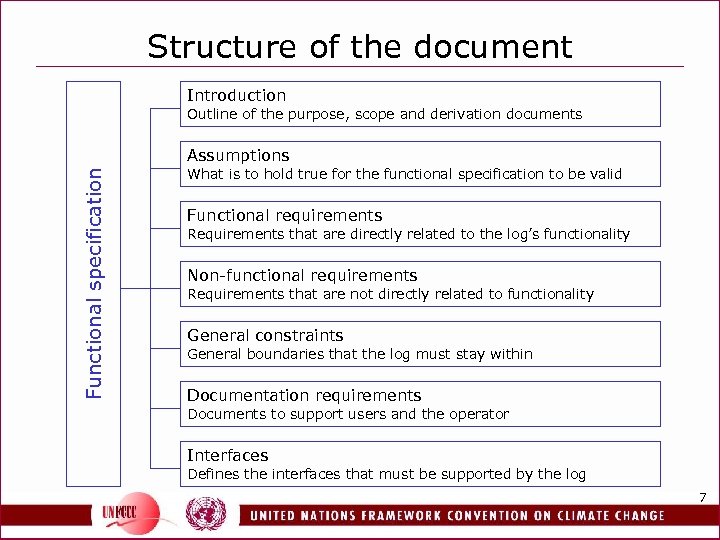 Structure of the document Introduction Outline of the purpose, scope and derivation documents Functional specification Assumptions What is to hold true for the functional specification to be valid Functional requirements Requirements that are directly related to the log’s functionality Non-functional requirements Requirements that are not directly related to functionality General constraints General boundaries that the log must stay within Documentation requirements Documents to support users and the operator Interfaces Defines the interfaces that must be supported by the log 7
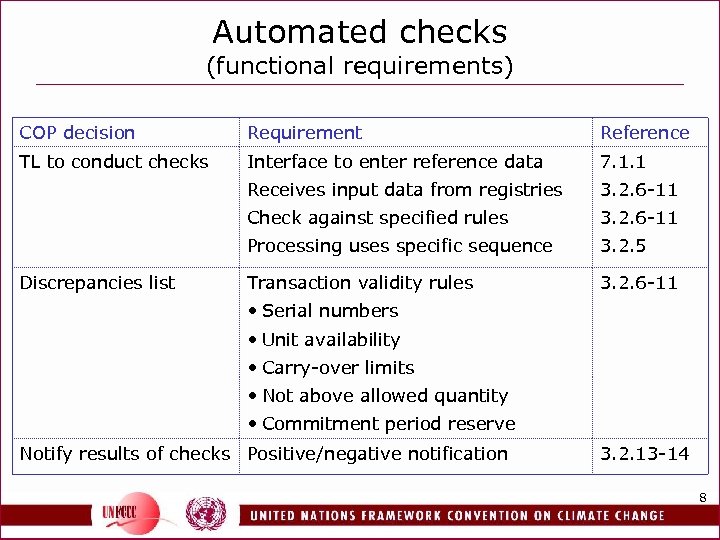 Automated checks (functional requirements) COP decision Requirement Reference TL to conduct checks Interface to enter reference data 7. 1. 1 Receives input data from registries 3. 2. 6 -11 Check against specified rules 3. 2. 6 -11 Processing uses specific sequence 3. 2. 5 Transaction validity rules 3. 2. 6 -11 Discrepancies list • Serial numbers • Unit availability • Carry-over limits • Not above allowed quantity • Commitment period reserve Notify results of checks Positive/negative notification 3. 2. 13 -14 8
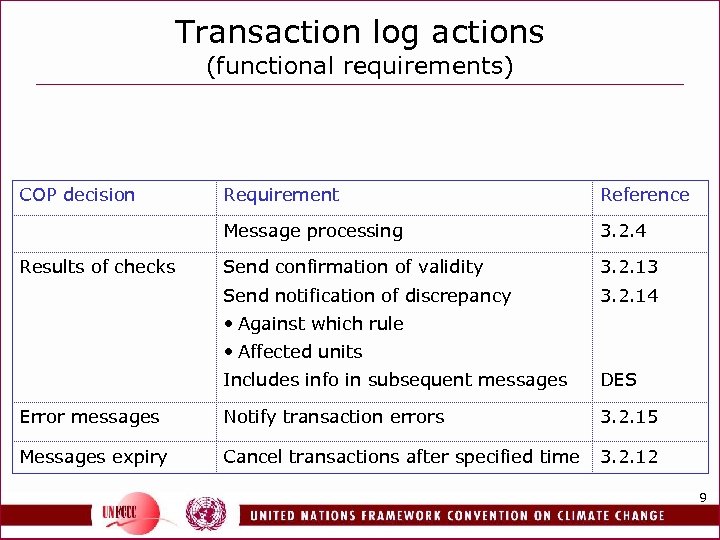 Transaction log actions (functional requirements) COP decision Reference Message processing 3. 2. 4 Send confirmation of validity 3. 2. 13 Send notification of discrepancy Results of checks Requirement 3. 2. 14 • Against which rule • Affected units Includes info in subsequent messages DES Error messages Notify transaction errors 3. 2. 15 Messages expiry Cancel transactions after specified time 3. 2. 12 9
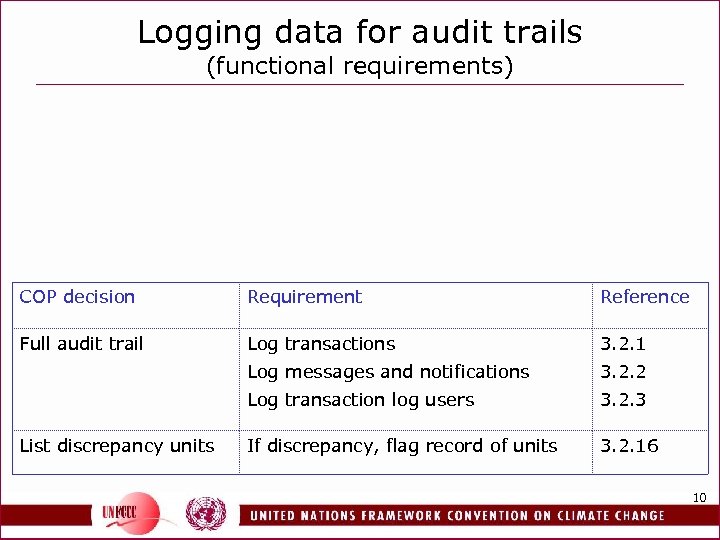 Logging data for audit trails (functional requirements) COP decision Requirement Reference Full audit trail Log transactions 3. 2. 1 Log messages and notifications 3. 2. 2 Log transaction log users 3. 2. 3 If discrepancy, flag record of units 3. 2. 16 List discrepancy units 10
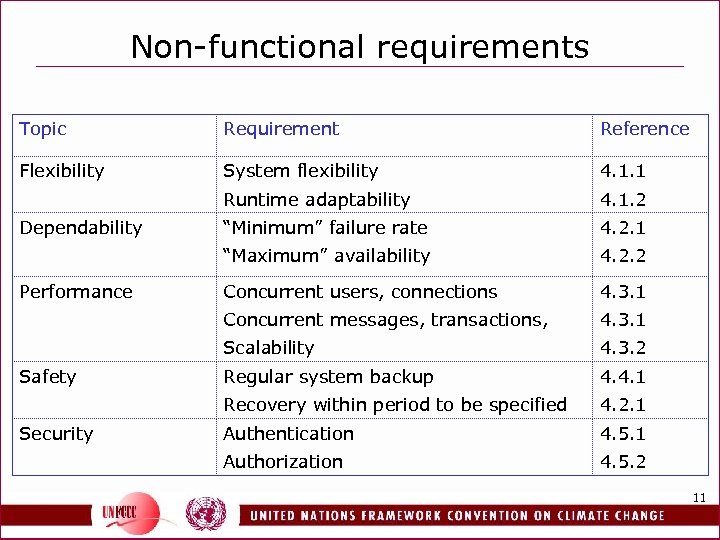 Non-functional requirements Topic Requirement Reference Flexibility System flexibility 4. 1. 1 Runtime adaptability 4. 1. 2 “Minimum” failure rate 4. 2. 1 “Maximum” availability 4. 2. 2 Concurrent users, connections 4. 3. 1 Concurrent messages, transactions, 4. 3. 1 Scalability 4. 3. 2 Regular system backup 4. 4. 1 Recovery within period to be specified 4. 2. 1 Authentication 4. 5. 1 Authorization 4. 5. 2 Dependability Performance Safety Security 11
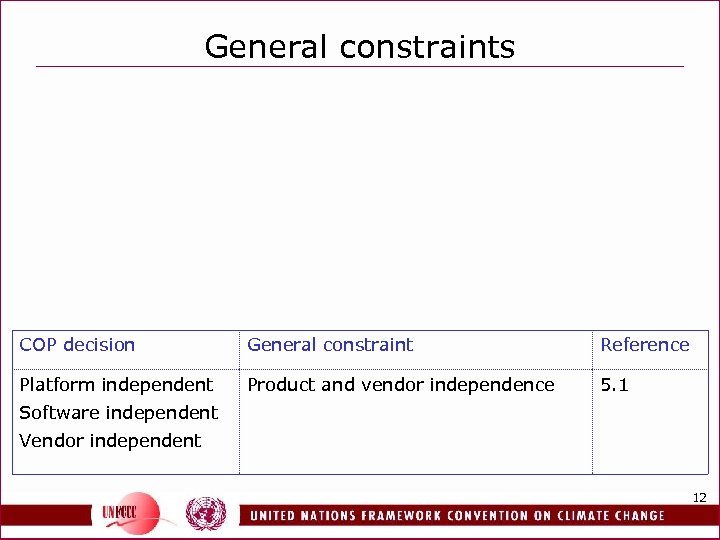 General constraints COP decision General constraint Reference Platform independent Product and vendor independence 5. 1 Software independent Vendor independent 12
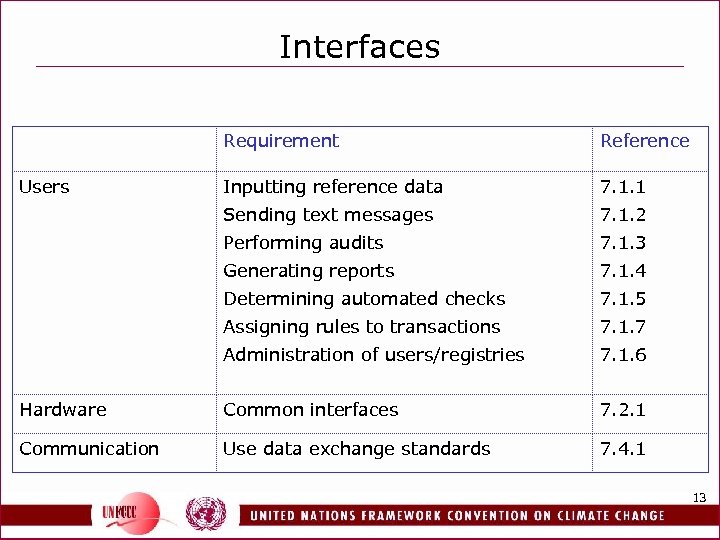 Interfaces Requirement Reference Inputting reference data 7. 1. 1 Sending text messages 7. 1. 2 Performing audits 7. 1. 3 Generating reports 7. 1. 4 Determining automated checks 7. 1. 5 Assigning rules to transactions 7. 1. 7 Administration of users/registries 7. 1. 6 Hardware Common interfaces 7. 2. 1 Communication Use data exchange standards 7. 4. 1 Users 13
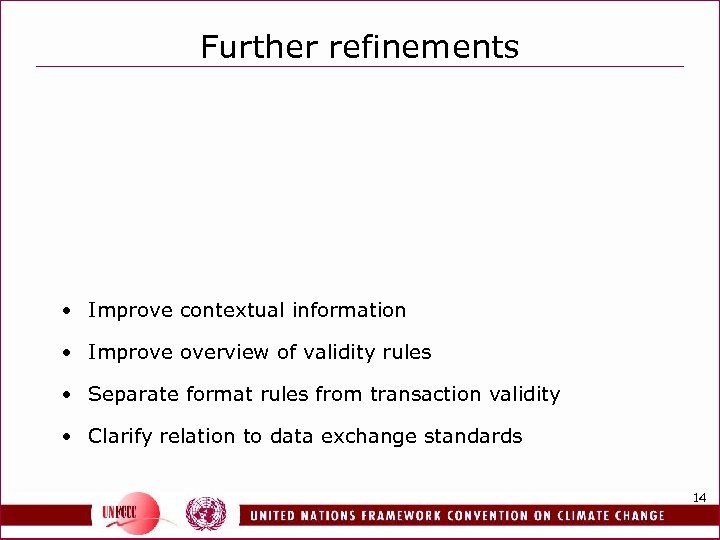 Further refinements • Improve contextual information • Improve overview of validity rules • Separate format rules from transaction validity • Clarify relation to data exchange standards 14