 Скачать презентацию Functional Regions Local Labour Market Areas in Italy
6ab21a27ed03e303aa75971389688bcf.ppt
- Количество слайдов: 32



Functional Regions: Local Labour Market Areas in Italy Giovanni Barbieri, Sandro Cruciani, Francesca Gambarotto NESIS Seminar June 26 th, 2003 26 June 2003 Functional regions in Italy
Aim of the Exercise n To map out local development n In Italy n Using a very detailed territorial grid n Over 25 years n (from the 1971 census to the 1996 intermediate census and beyond) 26 June 2003 Functional regions in Italy 2
Relevance of the Exercise n To explore new regional classification systems n To test it in the analysis of sub-national socioeconomic structures n To spot trends based on past evolution 26 June 2003 Functional regions in Italy 3
1. Territorial Grid n Local Labour Market Areas (LLMAs) Based on information on commuting between house and workplace across municipalities n Istat (1997). I sistemi locali del lavoro. Argomenti no. 10. Roma. n Features: n Geographical: The grid of LLMAs covers the whole territory of Italy, with no residuals n Statistical: Transparent, internationally acknowledged method n Economic: LLMAs from an economic standpoint approximate self-contained labour markets n 26 June 2003 Functional regions in Italy 4
The 1991 Grid n The latest available territorial grid is used (based on the results of the 1991 population census) n LLMAs are 784 n Kept constant over the whole 1971 -1996 period. Three reasons for this choice: n n n Interest in dynamics The territorial grid itself is affected by growth processes Possible under-estimation of agglomeration 26 June 2003 Functional regions in Italy 5
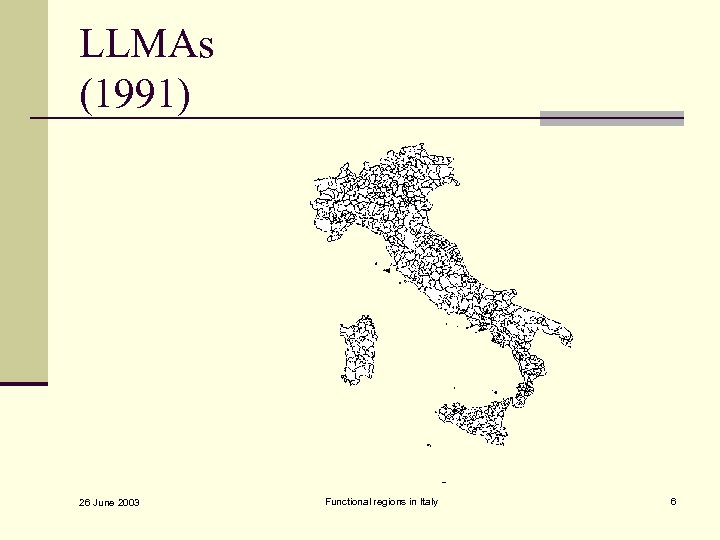
LLMAs (1991) 26 June 2003 Functional regions in Italy 6
2. Clustering LLMAs n Based on sectoral characteristics in the more recent available industrial census (1996). Namely: n n The variable considered is employment in local units (establishments) Industries are broken down in 51 classes The breakdown of manufacturing is more detailed The variable for each LLMA is obtained by aggregation of municipal data 26 June 2003 Functional regions in Italy 7
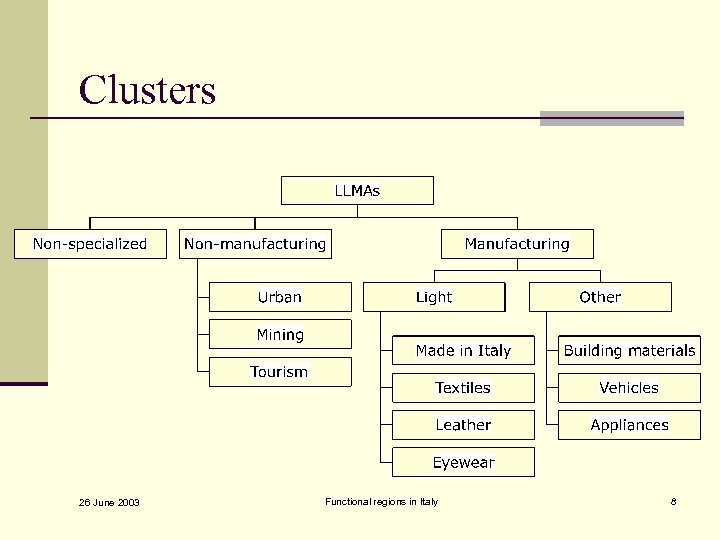
Clusters 26 June 2003 Functional regions in Italy 8
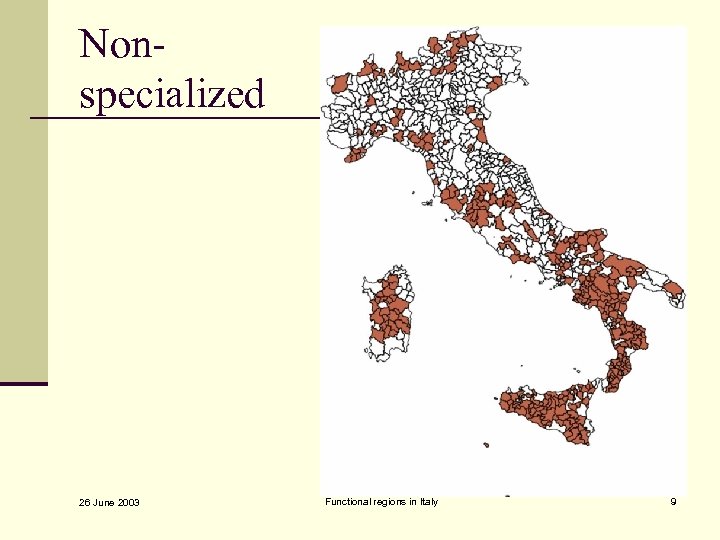
Nonspecialized 26 June 2003 Functional regions in Italy 9
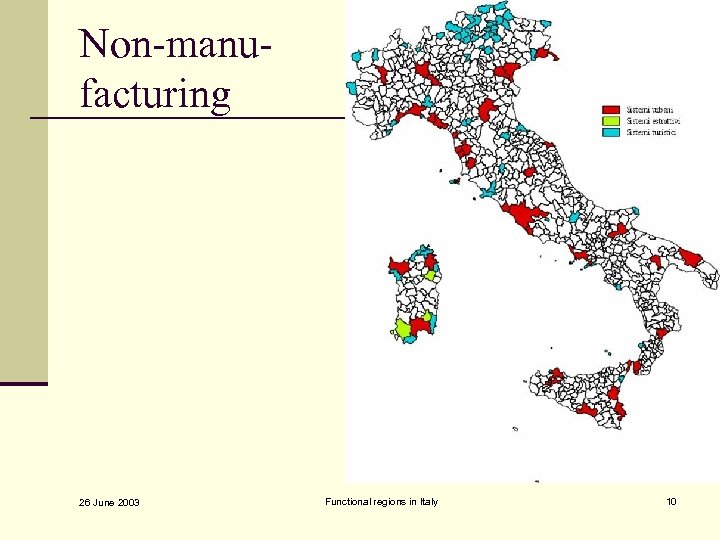
Non-manufacturing 26 June 2003 Functional regions in Italy 10
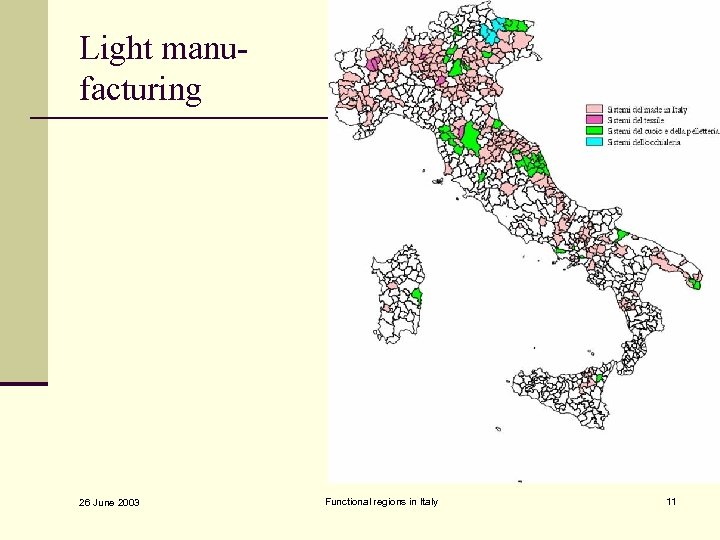
Light manufacturing 26 June 2003 Functional regions in Italy 11
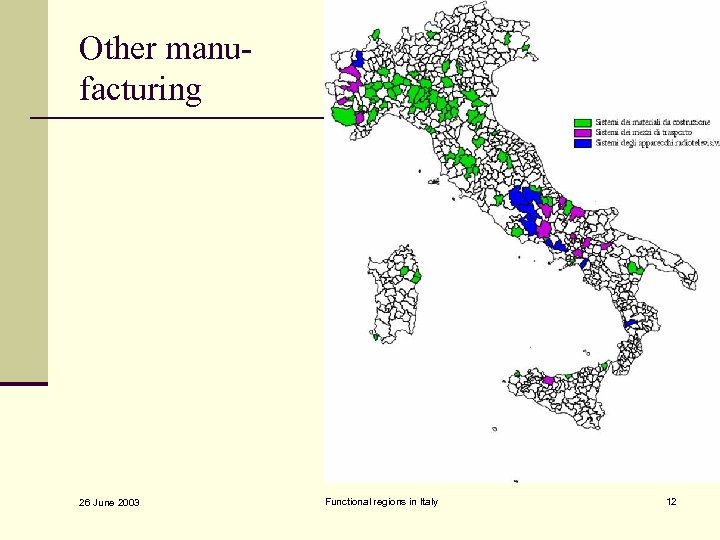
Other manufacturing 26 June 2003 Functional regions in Italy 12
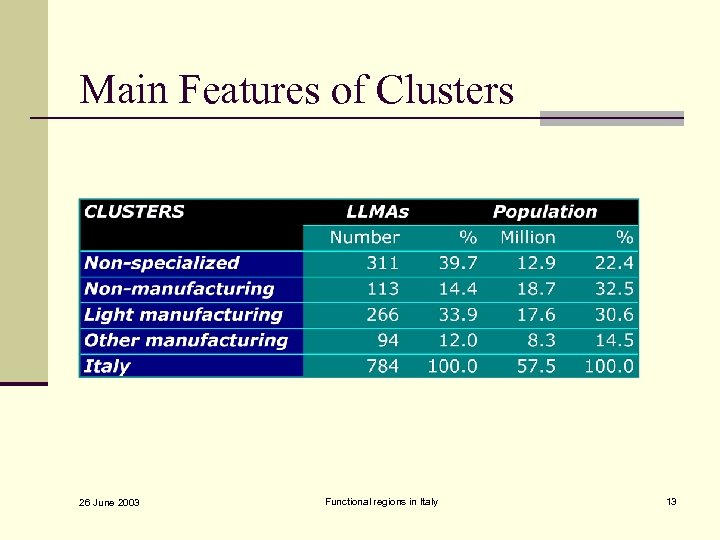
Main Features of Clusters 26 June 2003 Functional regions in Italy 13
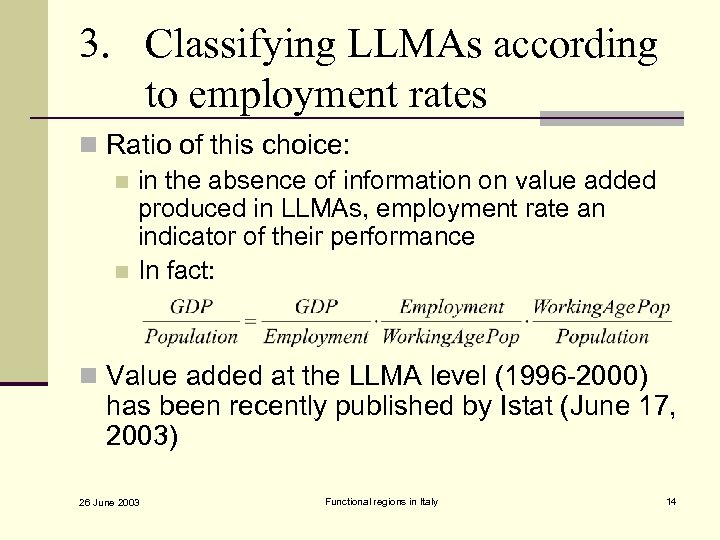
3. Classifying LLMAs according to employment rates n Ratio of this choice: n in the absence of information on value added produced in LLMAs, employment rate an indicator of their performance n In fact: n Value added at the LLMA level (1996 -2000) has been recently published by Istat (June 17, 2003) 26 June 2003 Functional regions in Italy 14
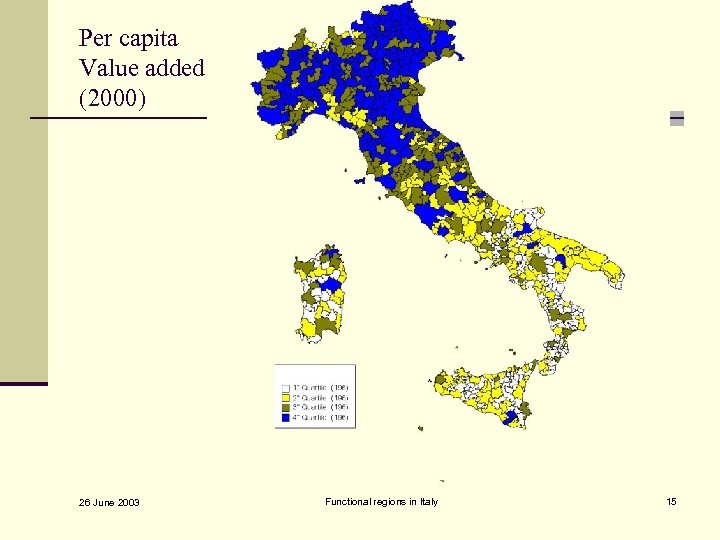
Per capita Value added (2000) 26 June 2003 Functional regions in Italy 15
4. Employment Rate Dynamics 1971 -1996 n A way to introduce the concept of “successful” and “unsuccessful” LLMAs n From a technical point of view, this is done by considering the transition matrix comparing employment rates in 1971 and 1996 n For a similar approach, see: OECD, Territorial Review of Italy, 2001 26 June 2003 Functional regions in Italy 17
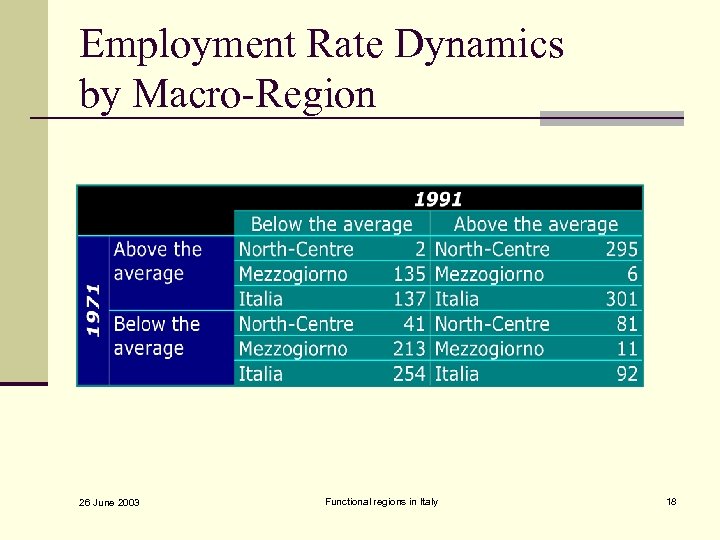
Employment Rate Dynamics by Macro-Region 26 June 2003 Functional regions in Italy 18
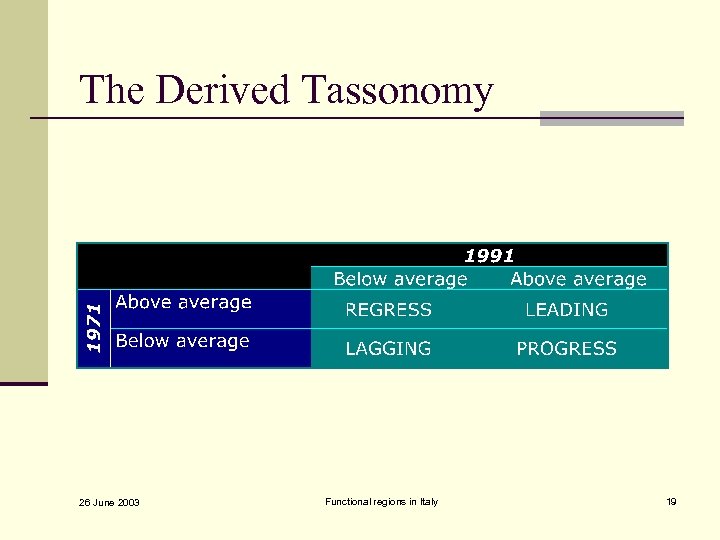
The Derived Tassonomy 26 June 2003 Functional regions in Italy 19
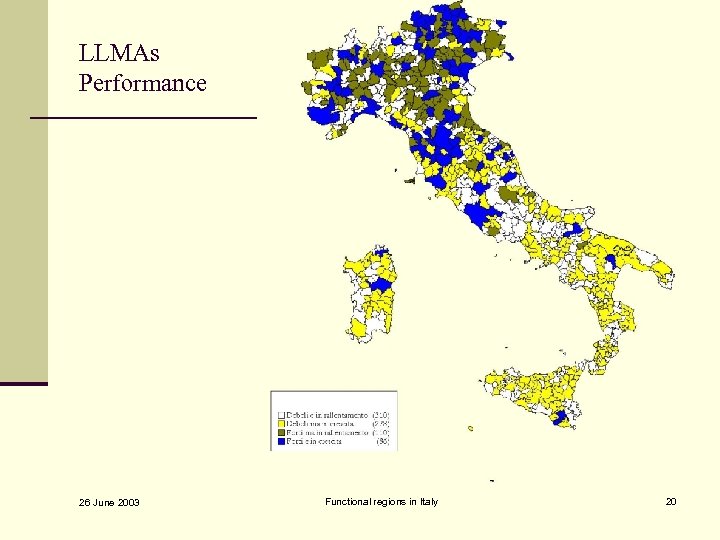
LLMAs Performance 26 June 2003 Functional regions in Italy 20
The Data-Base n Censuses 1971 through 1991, with updates to 1996 where possible n 5 main areas: Socio-demographic features n Dwellings n Employment and labour market n Economy and production n 26 June 2003 Functional regions in Italy 21
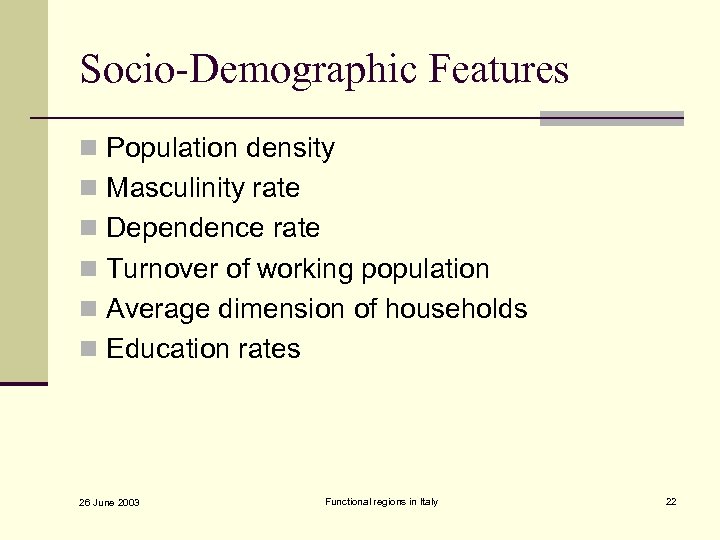
Socio-Demographic Features n Population density n Masculinity rate n Dependence rate n Turnover of working population n Average dimension of households n Education rates 26 June 2003 Functional regions in Italy 22
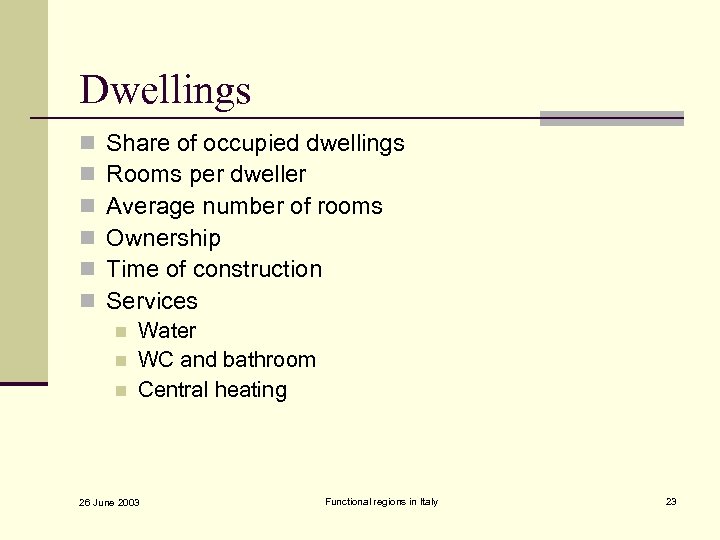
Dwellings n n n Share of occupied dwellings Rooms per dweller Average number of rooms Ownership Time of construction Services n n n Water WC and bathroom Central heating 26 June 2003 Functional regions in Italy 23
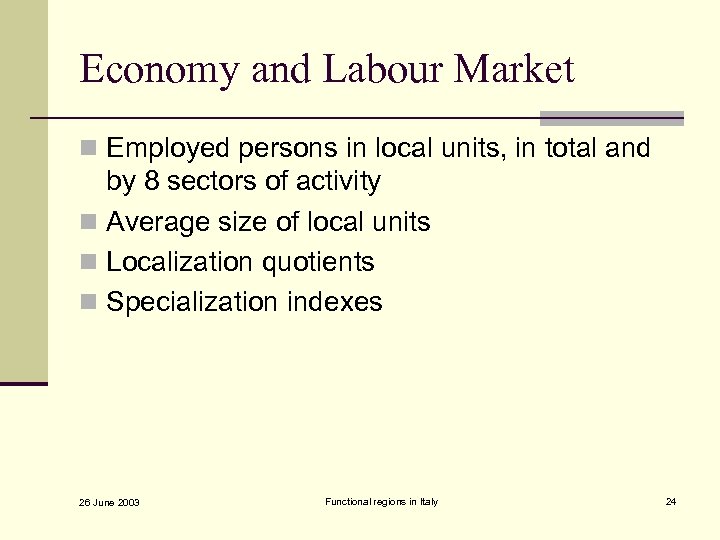
Economy and Labour Market n Employed persons in local units, in total and by 8 sectors of activity n Average size of local units n Localization quotients n Specialization indexes 26 June 2003 Functional regions in Italy 24
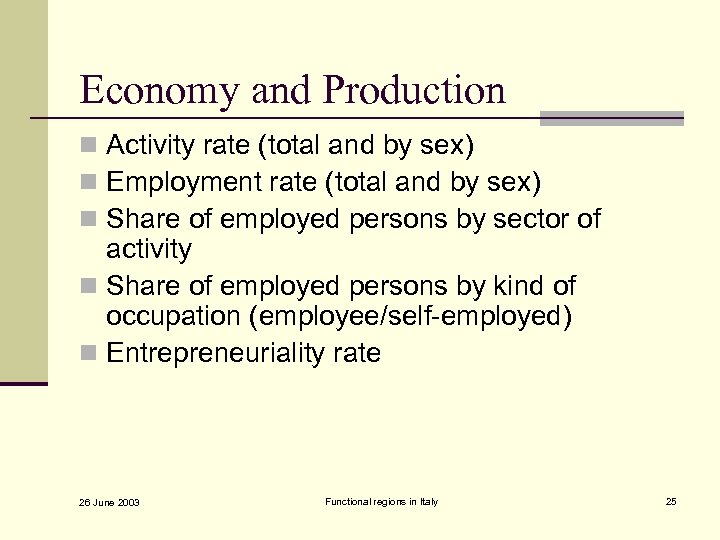
Economy and Production n Activity rate (total and by sex) n Employment rate (total and by sex) n Share of employed persons by sector of activity n Share of employed persons by kind of occupation (employee/self-employed) n Entrepreneuriality rate 26 June 2003 Functional regions in Italy 25
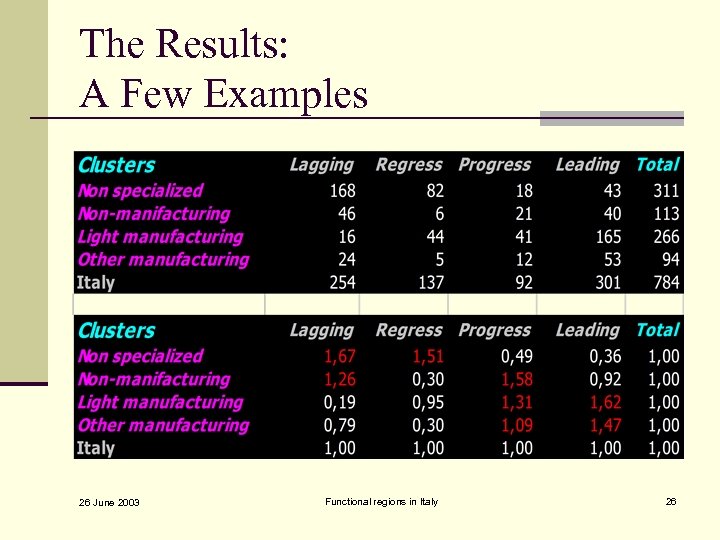
The Results: A Few Examples 26 June 2003 Functional regions in Italy 26
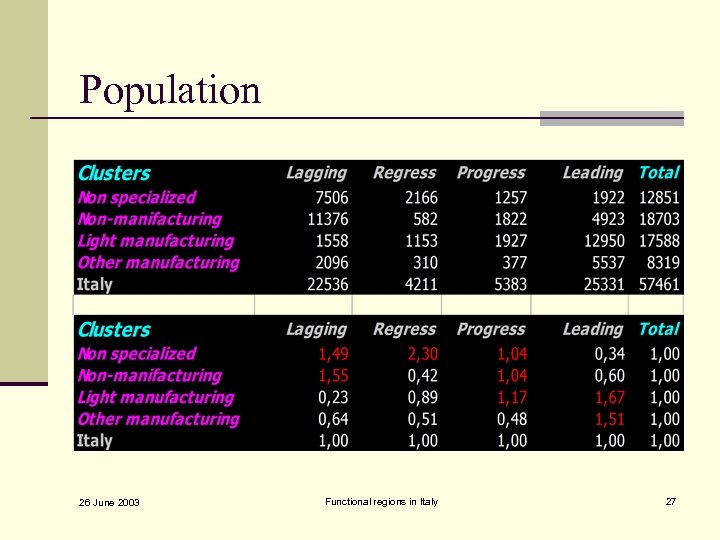
Population 26 June 2003 Functional regions in Italy 27
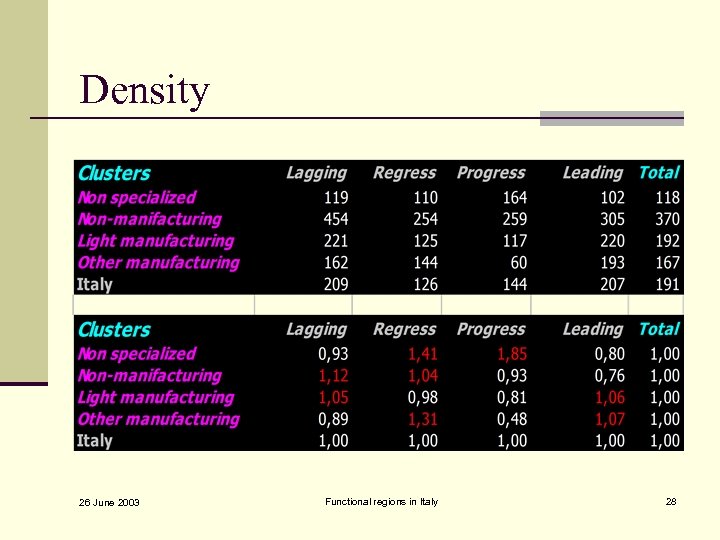
Density 26 June 2003 Functional regions in Italy 28
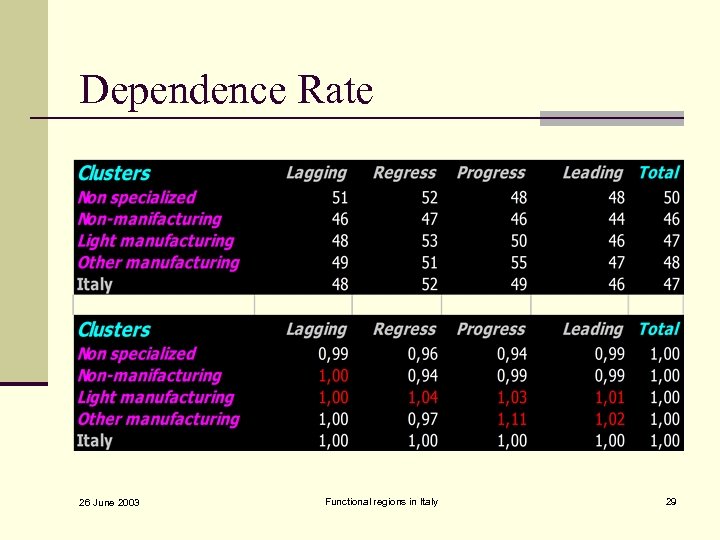
Dependence Rate 26 June 2003 Functional regions in Italy 29
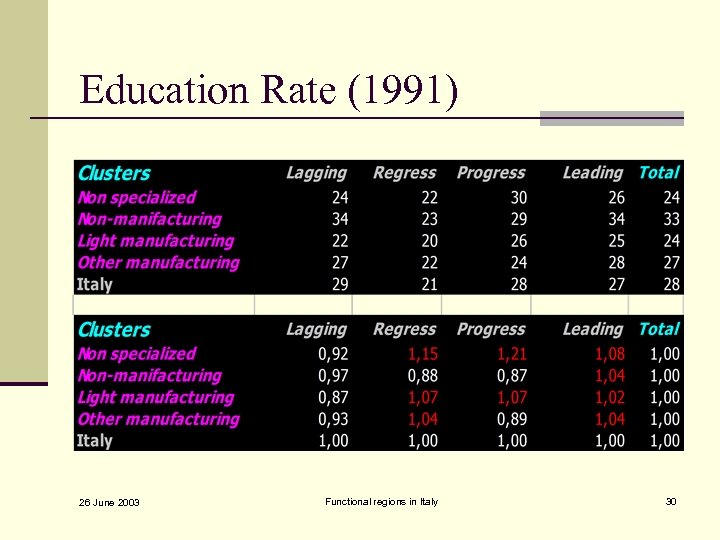
Education Rate (1991) 26 June 2003 Functional regions in Italy 30
And so on… 26 June 2003 Functional regions in Italy 31
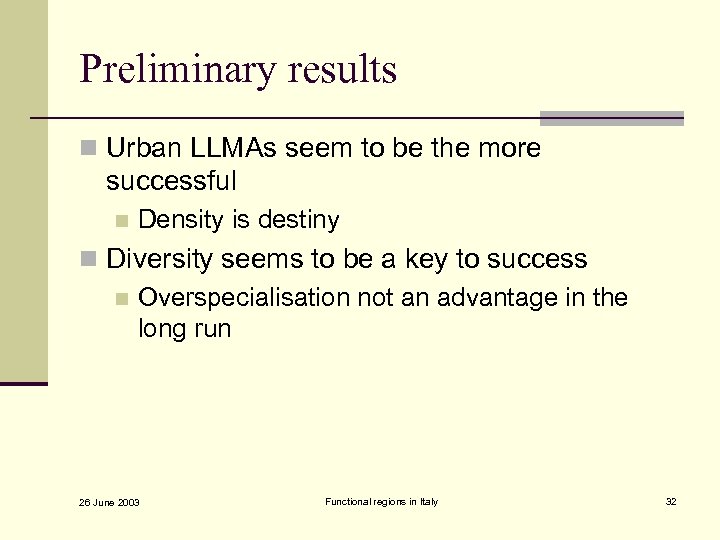
Preliminary results n Urban LLMAs seem to be the more successful n Density is destiny n Diversity seems to be a key to success n Overspecialisation not an advantage in the long run 26 June 2003 Functional regions in Italy 32
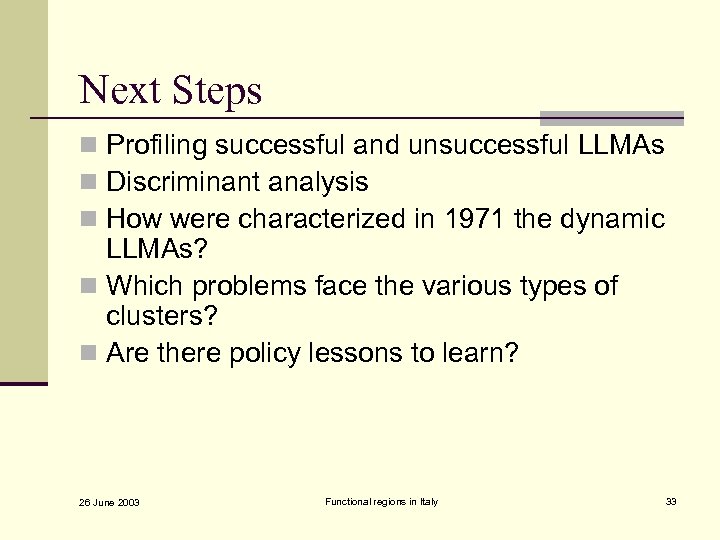
Next Steps n Profiling successful and unsuccessful LLMAs n Discriminant analysis n How were characterized in 1971 the dynamic LLMAs? n Which problems face the various types of clusters? n Are there policy lessons to learn? 26 June 2003 Functional regions in Italy 33
Скачать презентацию Functional Regions Local Labour Market Areas in Italy
6ab21a27ed03e303aa75971389688bcf.ppt