


 Скачать презентацию Function and Structure Notes Master List A Proficiency
b55a23dc32b3887ec8a01fd66ea8a805.ppt
- Количество слайдов: 150
 Function and Structure Notes Master List A Proficiency Planning Document
 Novice Levels I and II
 Function: Getting to Know Someone
 n Examples: n n Lkja; skdj Jljk jlkjj Practice: 1. 2. 3. 4. 5. Kljl Kjlj Lkjl jlkjl
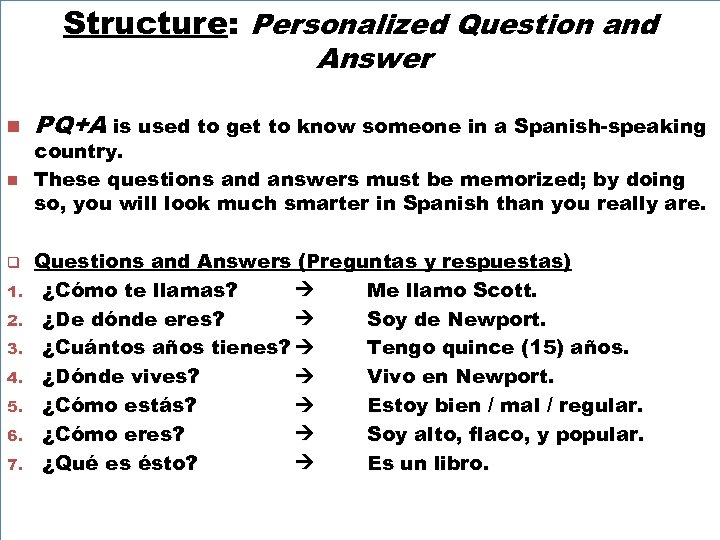 Structure: Personalized Question and Answer n n q 1. 2. 3. 4. 5. 6. 7. PQ+A is used to get to know someone in a Spanish-speaking country. These questions and answers must be memorized; by doing so, you will look much smarter in Spanish than you really are. Questions and Answers (Preguntas y respuestas) ¿Cómo te llamas? Me llamo Scott. ¿De dónde eres? Soy de Newport. ¿Cuántos años tienes? Tengo quince (15) años. ¿Dónde vives? Vivo en Newport. ¿Cómo estás? Estoy bien / mal / regular. ¿Cómo eres? Soy alto, flaco, y popular. ¿Qué es ésto? Es un libro.
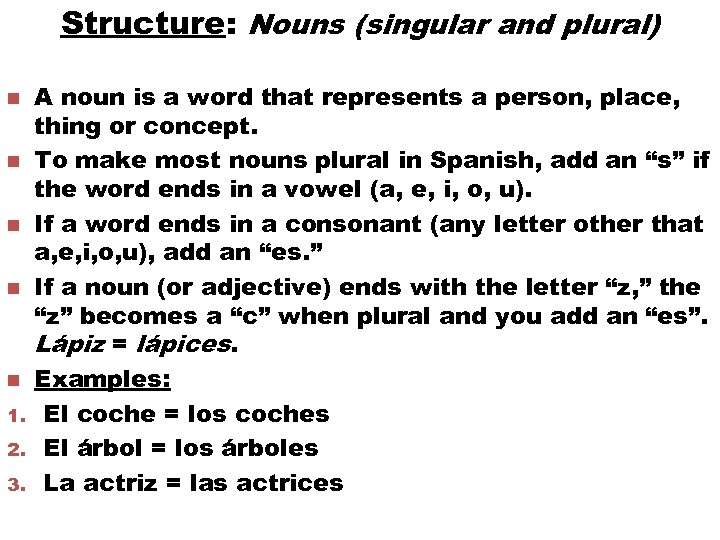 Structure: Nouns (singular and plural) n n n 1. 2. 3. A noun is a word that represents a person, place, thing or concept. To make most nouns plural in Spanish, add an “s” if the word ends in a vowel (a, e, i, o, u). If a word ends in a consonant (any letter other that a, e, i, o, u), add an “es. ” If a noun (or adjective) ends with the letter “z, ” the “z” becomes a “c” when plural and you add an “es”. Lápiz = lápices. Examples: El coche = los coches El árbol = los árboles La actriz = las actrices
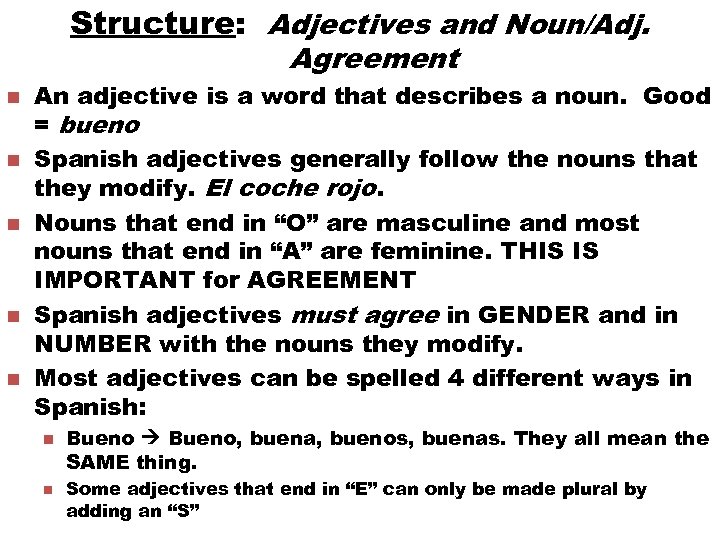 Structure: Adjectives and Noun/Adj. Agreement n n n An adjective is a word that describes a noun. Good = bueno Spanish adjectives generally follow the nouns that they modify. El coche rojo. Nouns that end in “O” are masculine and most nouns that end in “A” are feminine. THIS IS IMPORTANT for AGREEMENT Spanish adjectives must agree in GENDER and in NUMBER with the nouns they modify. Most adjectives can be spelled 4 different ways in Spanish: n n Bueno, buena, buenos, buenas. They all mean the SAME thing. Some adjectives that end in “E” can only be made plural by adding an “S”
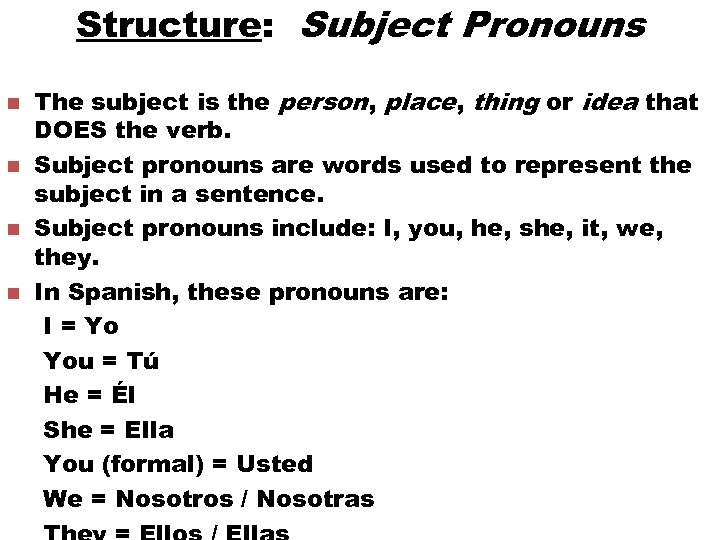 Structure: Subject Pronouns n n The subject is the person, place, thing or idea that DOES the verb. Subject pronouns are words used to represent the subject in a sentence. Subject pronouns include: I, you, he, she, it, we, they. In Spanish, these pronouns are: I = Yo You = Tú He = Él She = Ella You (formal) = Usted We = Nosotros / Nosotras
 Structure: Present tense AR verbs n n n Verbs are the action or power words in a sentence; they describe what someone is doing. In Spanish, verbs must be changed (conjugated) to match the person (subject) using the verb. There is nice, easy pattern to these changes (conjugations) of the verb. Simply memorize the pattern in order to conjugate verbs. Remember: YOU MUST CHANGE THE VERBS TO MATCH THE SUBJECT!
 Pattern: n n n To conjugate AR verbs, you must first take the STEM of the verb. The stem of any AR verb is the INFINITIVE minus AR (the infinitive is the stem + AR). Ø HABLAR = infinitive meaning “to speak” Ø The STEM of HABLAR HABL Once you have the stem of the verb, simply add the ending that match each subject. Yo = O I speak= Yo hablo. Tú = AS You speak= Tú hablas. Él / Ella / Usted = A He/She speaks= Habla. Nosotros (as)= AMOS We speak= Nosotros hablamos. Ellos / ellas / Uds. = AN They/You all speak = Hablan.
 Structure: Present tense ER/IR verbs n n n Verbs are the action or power words in a sentence; they describe what someone is doing. In Spanish, verbs must be changed (conjugated) to match the person (subject) using the verb. There is nice, easy pattern to these changes (conjugations) of the verb. Simply memorize the pattern in order to conjugate verbs. Remember: YOU MUST CHANGE THE VERBS TO MATCH THE SUBJECT!
 q Pattern: n To conjugate ER/IR verbs, you must first take the stem of the verb. The STEM of any ER/IR verb is the INFINITIVE minus ER/IR (the infinitive is the stem + ER/IR). n n n VIVIR = infinitive meaning “to live” The STEM of VIVIR VIV Once you have the stem of the verb, simply add the ending that match each subject. n n n Yo = O I live = Yo vivo. Tú = ES You live = Tú vives. Él / Ella / Usted = E He/She lives = Vive. Nosotros(as)=EMOS/IMOS We live= Vivimos. Ellos / ellas / Uds. = EN They/You all live = Viven.
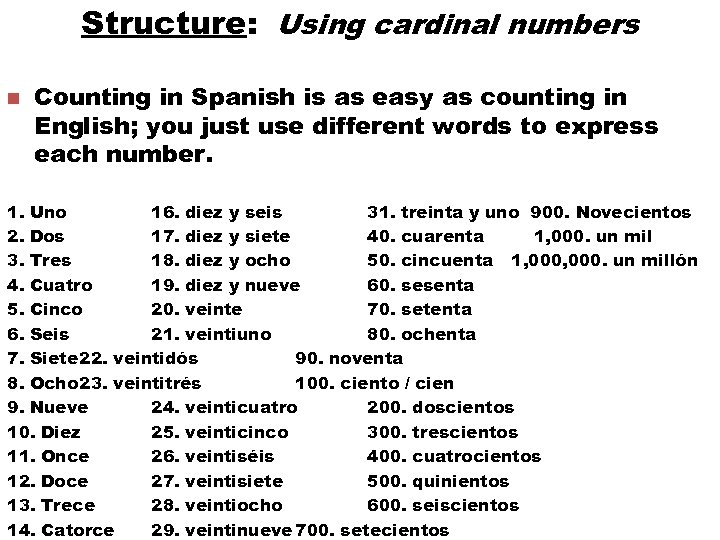 Structure: Using cardinal numbers n Counting in Spanish is as easy as counting in English; you just use different words to express each number. 1. Uno 16. diez y seis 31. treinta y uno 900. Novecientos 2. Dos 17. diez y siete 40. cuarenta 1, 000. un mil 3. Tres 18. diez y ocho 50. cincuenta 1, 000. un millón 4. Cuatro 19. diez y nueve 60. sesenta 5. Cinco 20. veinte 70. setenta 6. Seis 21. veintiuno 80. ochenta 7. Siete 22. veintidós 90. noventa 8. Ocho 23. veintitrés 100. ciento / cien 9. Nueve 24. veinticuatro 200. doscientos 10. Diez 25. veinticinco 300. trescientos 11. Once 26. veintiséis 400. cuatrocientos 12. Doce 27. veintisiete 500. quinientos 13. Trece 28. veintiocho 600. seiscientos 14. Catorce 29. veintinueve 700. setecientos
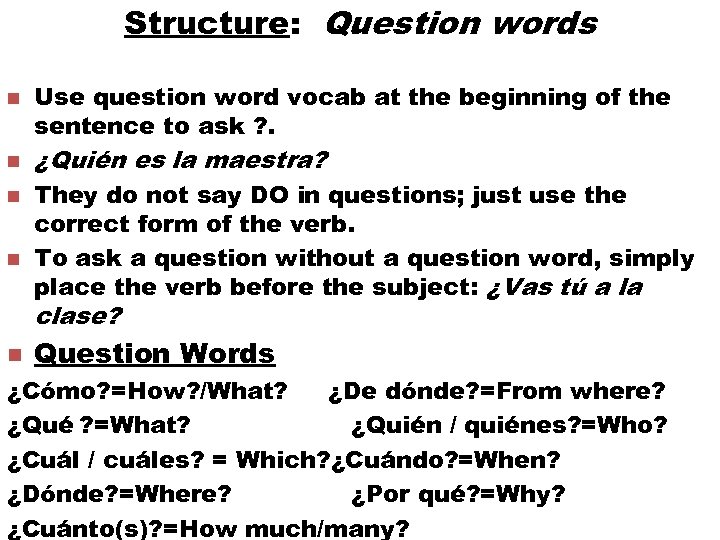 Structure: Question words n n Use question word vocab at the beginning of the sentence to ask ? . ¿Quién es la maestra? They do not say DO in questions; just use the correct form of the verb. To ask a question without a question word, simply place the verb before the subject: ¿Vas tú a la clase? n Question Words ¿Cómo? =How? /What? ¿De dónde? =From where? ¿Qué ? =What? ¿Quién / quiénes? =Who? ¿Cuál / cuáles? = Which? ¿Cuándo? =When? ¿Dónde? =Where? ¿Por qué? =Why? ¿Cuánto(s)? =How much/many?
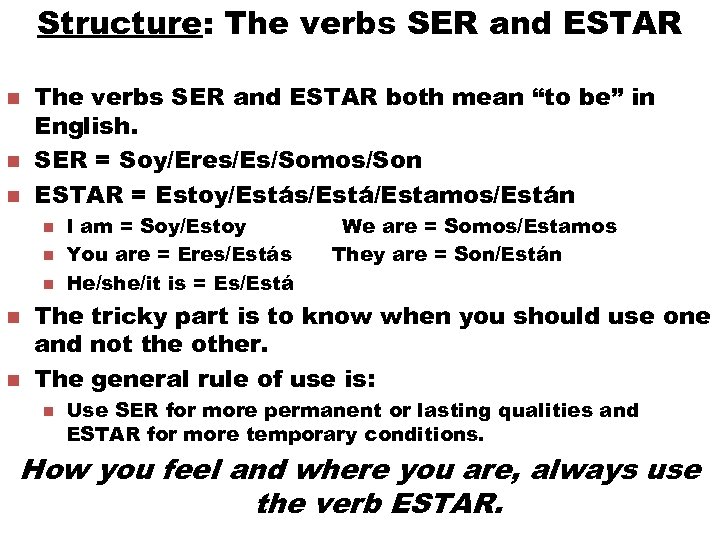 Structure: The verbs SER and ESTAR n n n The verbs SER and ESTAR both mean “to be” in English. SER = Soy/Eres/Es/Somos/Son ESTAR = Estoy/Estás/Está/Estamos/Están n n I am = Soy/Estoy You are = Eres/Estás He/she/it is = Es/Está We are = Somos/Estamos They are = Son/Están The tricky part is to know when you should use one and not the other. The general rule of use is: n Use SER for more permanent or lasting qualities and ESTAR for more temporary conditions. How you feel and where you are, always use the verb ESTAR.
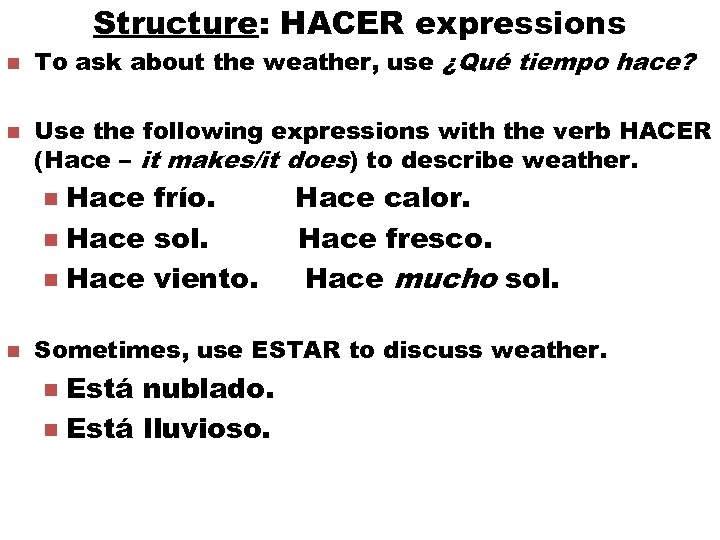 Structure: HACER expressions n n To ask about the weather, use ¿Qué tiempo hace? Use the following expressions with the verb HACER (Hace – it makes/it does) to describe weather. Hace frío. n Hace sol. n Hace viento. n n Hace calor. Hace fresco. Hace mucho sol. Sometimes, use ESTAR to discuss weather. Está nublado. n Está lluvioso. n
 Structure: NEVAR and LLOVER n n n To ask about the weather, use ¿Qué tiempo hace? Use the verbs NEVAR (e ie) and LLOVER (o ue) to discuss when it snows or rains. It’s snowing n Nieva. It’s raining. n Llueve. To discuss if it is SNOWY (nevado) or RAINY (lluvioso), use the verb ESTAR.
 Structure: IR + A + Infinitive n n To discuss what is going to happen or what someone is going to do, use the IR + A + Infinitive An INFINITIVE is an unconjugated or unchanged verb. IR means to go and its forms include: Voy, Vas, Vamos, Van. Examples: n Voy a acechar el animal. I’m going to stalk the animal. n Vamos a cazar los tigres. We’re going to hunt the tigers.
 Structure: The Verb ESTAR and Prepositions n n n Use the verb ESTAR (to be) to describe the location of nouns. Use prepositions to locate the object. Prepositions: Cerca de = near or close to lejos de = far from al lado de = next to or beside alrededor de = around or surrounding delante de = in front of en frente de = facing detrás de = behind a la derecha de = to the right of a la izquierda de = to the left of dentro de = inside of afuera de = outside of
 Structure: Adverbs n n Use these adverbs to express frequency of actions. Adverbs do not change like adjectives do! Siempre = always nunca = never rara vez = rarely a veces = sometimes todos los días = everyday poco = a little Mucho = a lot / often de vez en cuando = once in a while
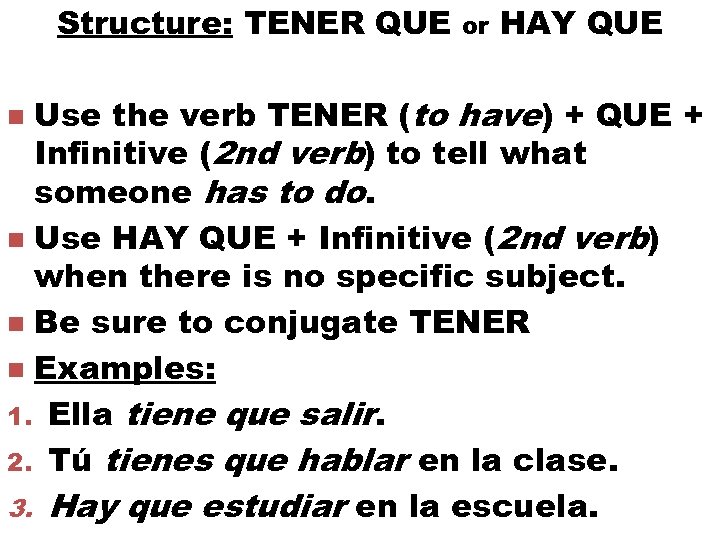 Structure: TENER QUE or HAY QUE Use the verb TENER (to have) + QUE + Infinitive (2 nd verb) to tell what someone has to do. n Use HAY QUE + Infinitive (2 nd verb) when there is no specific subject. n Be sure to conjugate TENER n Examples: 1. Ella tiene que salir. 2. Tú tienes que hablar en la clase. 3. Hay que estudiar en la escuela. n
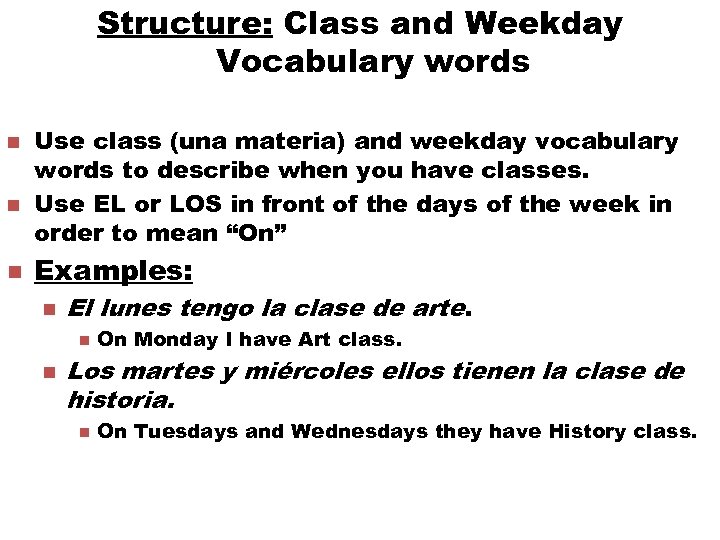 Structure: Class and Weekday Vocabulary words n n n Use class (una materia) and weekday vocabulary words to describe when you have classes. Use EL or LOS in front of the days of the week in order to mean “On” Examples: n El lunes tengo la clase de arte. n n On Monday I have Art class. Los martes y miércoles ellos tienen la clase de historia. n On Tuesdays and Wednesdays they have History class.
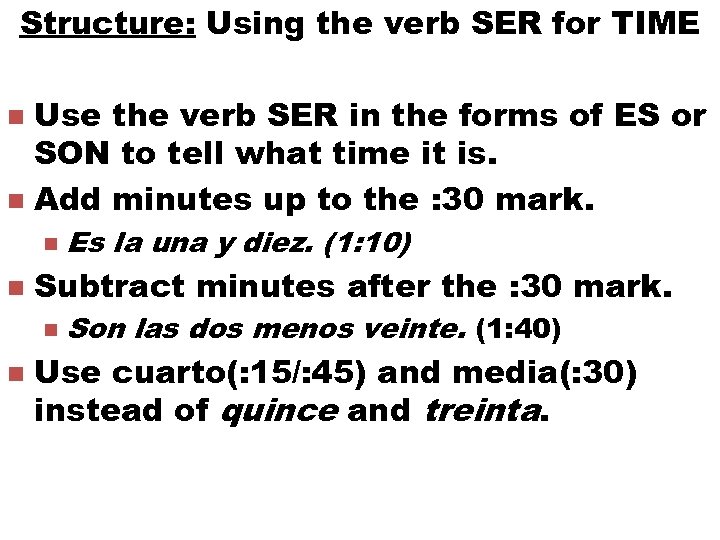 Structure: Using the verb SER for TIME Use the verb SER in the forms of ES or SON to tell what time it is. n Add minutes up to the : 30 mark. n n n Subtract minutes after the : 30 mark. n n Es la una y diez. (1: 10) Son las dos menos veinte. (1: 40) Use cuarto(: 15/: 45) and media(: 30) instead of quince and treinta.
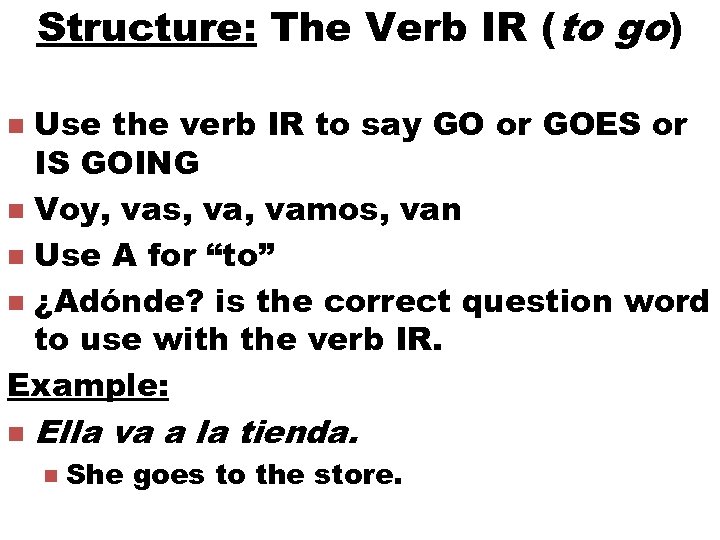 Structure: The Verb IR (to go) Use the verb IR to say GO or GOES or IS GOING n Voy, vas, vamos, van n Use A for “to” n ¿Adónde? is the correct question word to use with the verb IR. Example: n n Ella va a la tienda. n She goes to the store.
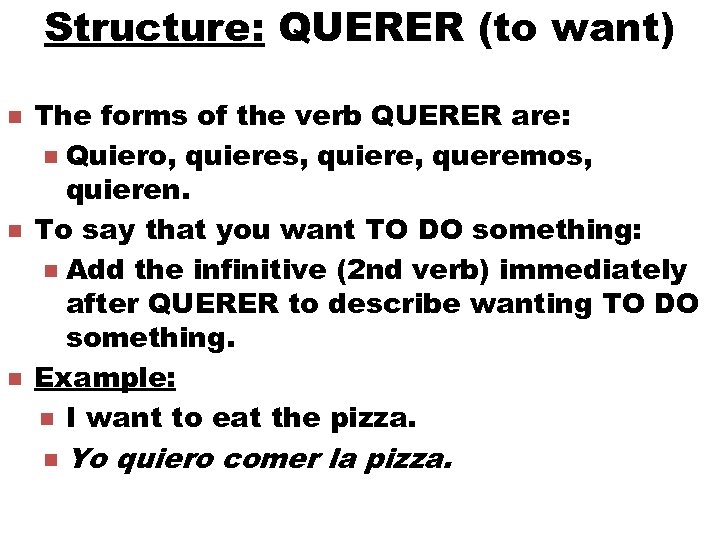 Structure: QUERER (to want) n n n The forms of the verb QUERER are: n Quiero, quieres, quiere, queremos, quieren. To say that you want TO DO something: n Add the infinitive (2 nd verb) immediately after QUERER to describe wanting TO DO something. Example: n I want to eat the pizza. n Yo quiero comer la pizza.
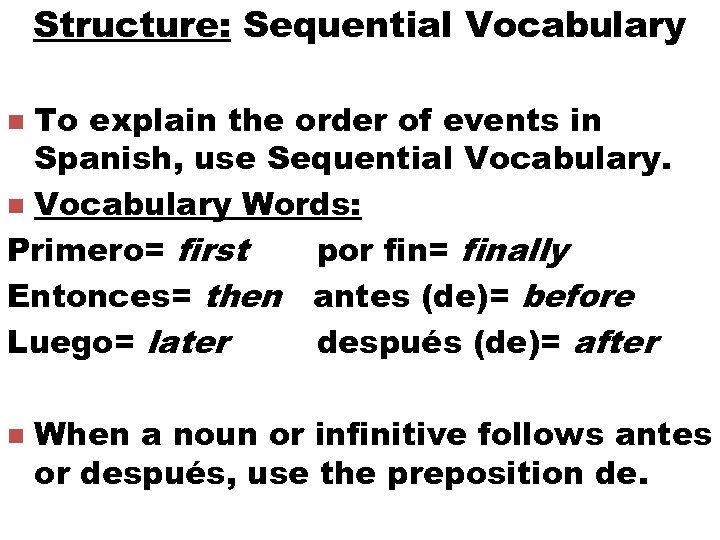 Structure: Sequential Vocabulary To explain the order of events in Spanish, use Sequential Vocabulary. n Vocabulary Words: Primero= first por fin= finally Entonces= then antes (de)= before Luego= later después (de)= after n n When a noun or infinitive follows antes or después, use the preposition de.
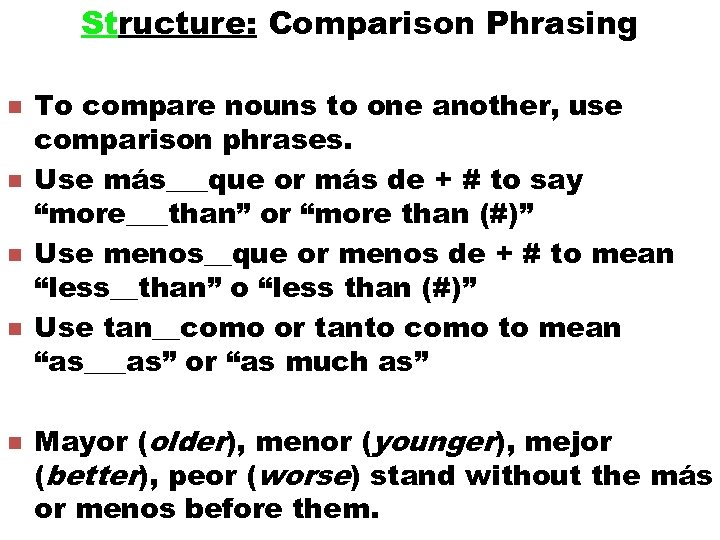 Structure: Comparison Phrasing n n n To compare nouns to one another, use comparison phrases. Use más___que or más de + # to say “more___than” or “more than (#)” Use menos__que or menos de + # to mean “less__than” o “less than (#)” Use tan__como or tanto como to mean “as___as” or “as much as” Mayor (older), menor (younger), mejor (better), peor (worse) stand without the más or menos before them.
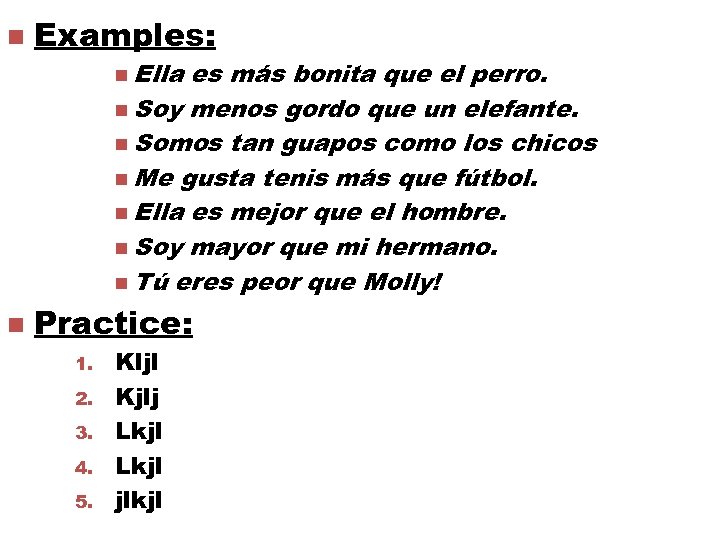 n Examples: n Ella es más bonita que el perro. n Soy menos gordo que un elefante. n Somos tan guapos como los chicos n Me gusta tenis más que fútbol. n Ella es mejor que el hombre. n Soy mayor que mi hermano. n Tú eres peor que Molly! n Practice: 1. 2. 3. 4. 5. Kljl Kjlj Lkjl jlkjl
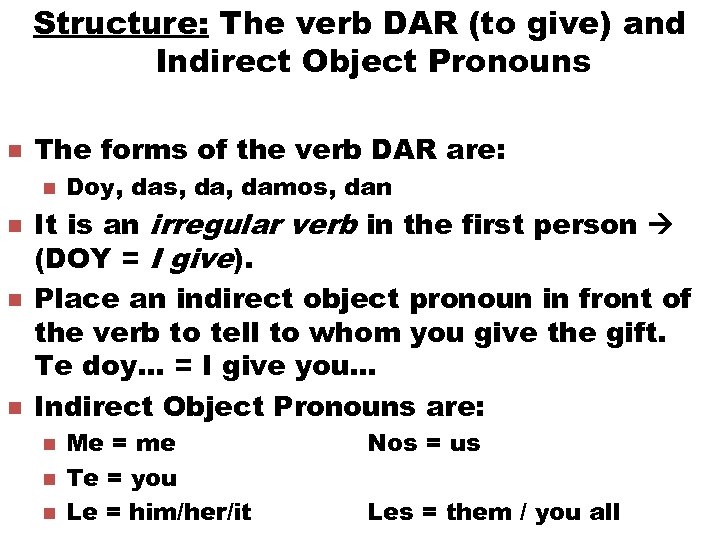 Structure: The verb DAR (to give) and Indirect Object Pronouns n The forms of the verb DAR are: n n Doy, das, damos, dan It is an irregular verb in the first person (DOY = I give). Place an indirect object pronoun in front of the verb to tell to whom you give the gift. Te doy… = I give you… Indirect Object Pronouns are: n n n Me = me Te = you Le = him/her/it Nos = us Les = them / you all
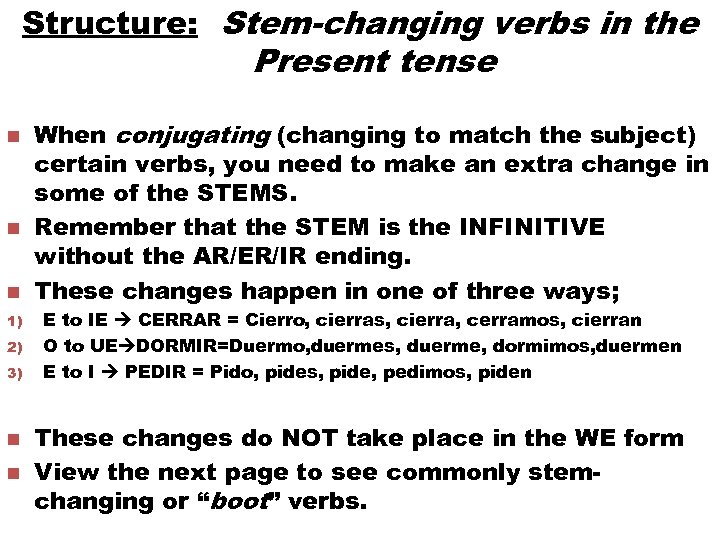 Structure: Stem-changing verbs in the Present tense n n n 1) 2) 3) n n When conjugating (changing to match the subject) certain verbs, you need to make an extra change in some of the STEMS. Remember that the STEM is the INFINITIVE without the AR/ER/IR ending. These changes happen in one of three ways; E to IE CERRAR = Cierro, cierras, cierra, cerramos, cierran O to UE DORMIR=Duermo, duermes, duerme, dormimos, duermen E to I PEDIR = Pido, pides, pide, pedimos, piden These changes do NOT take place in the WE form View the next page to see commonly stemchanging or “boot” verbs.
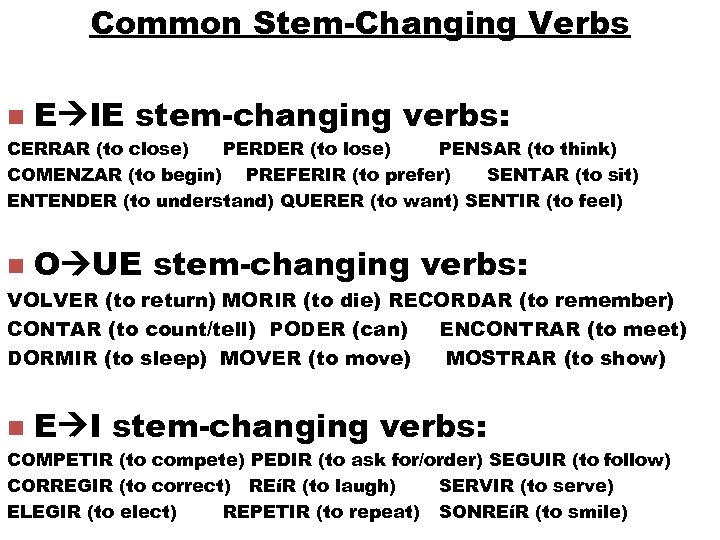 Common Stem-Changing Verbs n E IE stem-changing verbs: CERRAR (to close) PERDER (to lose) PENSAR (to think) COMENZAR (to begin) PREFERIR (to prefer) SENTAR (to sit) ENTENDER (to understand) QUERER (to want) SENTIR (to feel) n O UE stem-changing verbs: VOLVER (to return) MORIR (to die) RECORDAR (to remember) CONTAR (to count/tell) PODER (can) ENCONTRAR (to meet) DORMIR (to sleep) MOVER (to move) MOSTRAR (to show) n E I stem-changing verbs: COMPETIR (to compete) PEDIR (to ask for/order) SEGUIR (to follow) CORREGIR (to correct) REíR (to laugh) SERVIR (to serve) ELEGIR (to elect) REPETIR (to repeat) SONREíR (to smile)
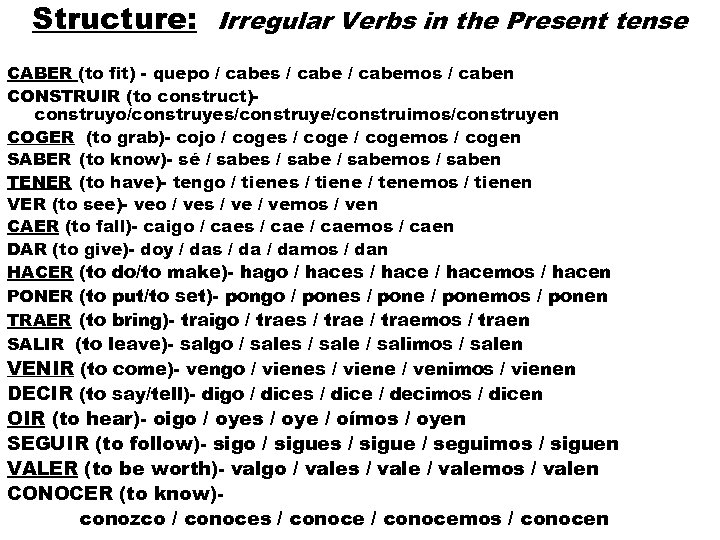 Structure: Irregular Verbs in the Present tense CABER (to fit) - quepo / cabes / cabemos / caben CONSTRUIR (to construct)construyo/construyes/construye/construimos/construyen COGER (to grab)- cojo / coges / cogemos / cogen SABER (to know)- sé / sabes / sabemos / saben TENER (to have)- tengo / tienes / tiene / tenemos / tienen VER (to see)- veo / ves / vemos / ven CAER (to fall)- caigo / caes / caemos / caen DAR (to give)- doy / das / damos / dan HACER (to do/to make)- hago / haces / hacemos / hacen PONER (to put/to set)- pongo / pones / ponemos / ponen TRAER (to bring)- traigo / traes / traemos / traen SALIR (to leave)- salgo / sales / sale / salimos / salen VENIR (to come)- vengo / vienes / viene / venimos / vienen DECIR (to say/tell)- digo / dices / dice / decimos / dicen OIR (to hear)- oigo / oyes / oye / oímos / oyen SEGUIR (to follow)- sigo / sigues / sigue / seguimos / siguen VALER (to be worth)- valgo / vales / valemos / valen CONOCER (to know)conozco / conoces / conocemos / conocen
 Structure: Conjunctions n n n v v Conjunctions are words that join parts of sentences or even entire sentences. They are connecting words such as “and, or/either, nor/neither, but. ” Here are the forms in Spanish: n Y = and n O = or n Ni = neither / nor n Pero = but Spanish requires the use of the “double negative” There are other ways to say but, including SINO and SINO QUE; these are used for specific reasons and will be discussed later.
 Structure: Definite and Indefinite articles n n Articles are adjectives that help to identify nouns. In English, we have 1 definite article, THE, which refers to specific things (the boy, the idiot). We also have indefinite articles, A and AN, which refer to one of those things in general (a boy, an idiot). Here are the Spanish definite articles. There are 4 of them because they act like adjectives and must match the noun they are describing for Noun/Adjective agreement. n El coche La puerta n Los coches Las puertas Indefinite articles also have 4 forms, one to correspond to the gender and number of the noun they modify
 Structure: Negative sentences n If one answers a question negatively, a negative word must come before the verb. Here is a list of negative words that will come in handy: n n n n Nada Nadie Ni, ni No Nunca = = = nothing no one neither, nor no, not never In addition to saying “no”, you must use one of the words to continue the negative meaning through the verb phrase. Example: n ¿Vas a la tienda?
 Structure: Expressions with the verb TENER n n v The Spanish word, TENER (to have), combines with many other words to form commonly-used expressions. These expressions will seem weird to an English-speaker but you must simply memorize them. Tengo sed. = I’m thirsty. Tengo diez años. = I’m ten years old. Tengo calor. = I’m hot. Tengo frío. = I’m cold. Tengo hambre. = I’m hungry. Tengo miedo. = I’m scared/afraid. Tengo sueño. = I’m sleepy. Tengo suerte. = I’m lucky. Tengo razón. = I’m right. Tengo prisa. = I’m in a hurry. These expressions can be used with any form of TENER.
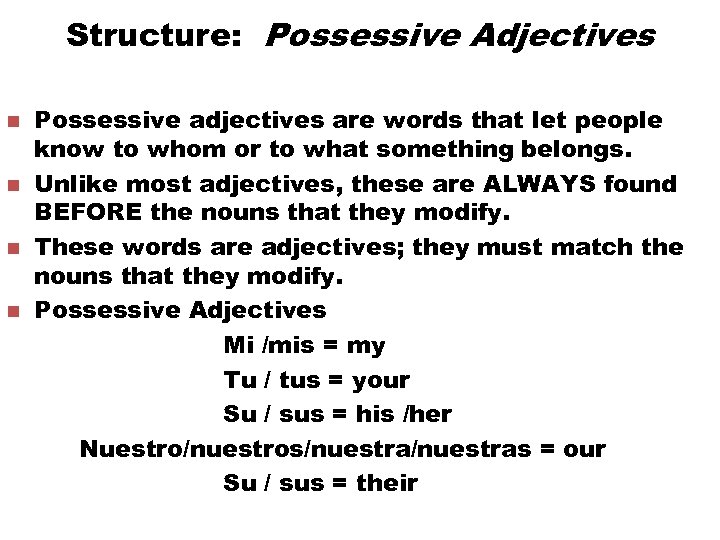 Structure: Possessive Adjectives n n Possessive adjectives are words that let people know to whom or to what something belongs. Unlike most adjectives, these are ALWAYS found BEFORE the nouns that they modify. These words are adjectives; they must match the nouns that they modify. Possessive Adjectives Mi /mis = my Tu / tus = your Su / sus = his /her Nuestro/nuestros/nuestras = our Su / sus = their
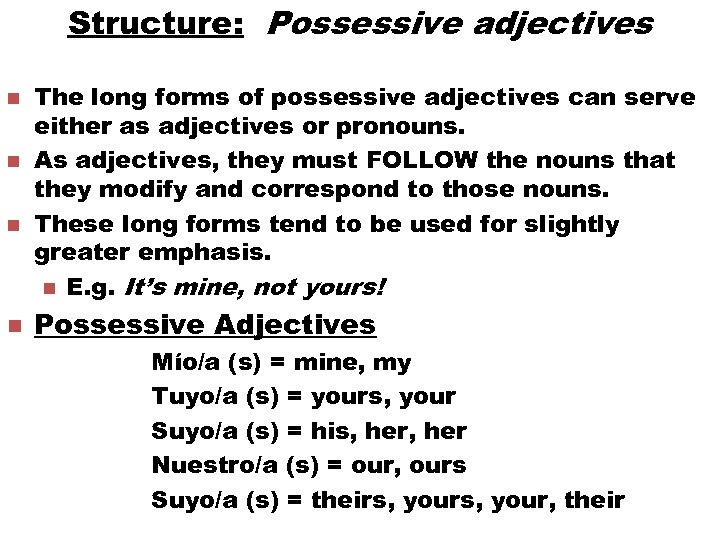 Structure: Possessive adjectives n n The long forms of possessive adjectives can serve either as adjectives or pronouns. As adjectives, they must FOLLOW the nouns that they modify and correspond to those nouns. These long forms tend to be used for slightly greater emphasis. n E. g. It’s mine, not yours! Possessive Adjectives Mío/a (s) = mine, my Tuyo/a (s) = yours, your Suyo/a (s) = his, her Nuestro/a (s) = our, ours Suyo/a (s) = theirs, your, their
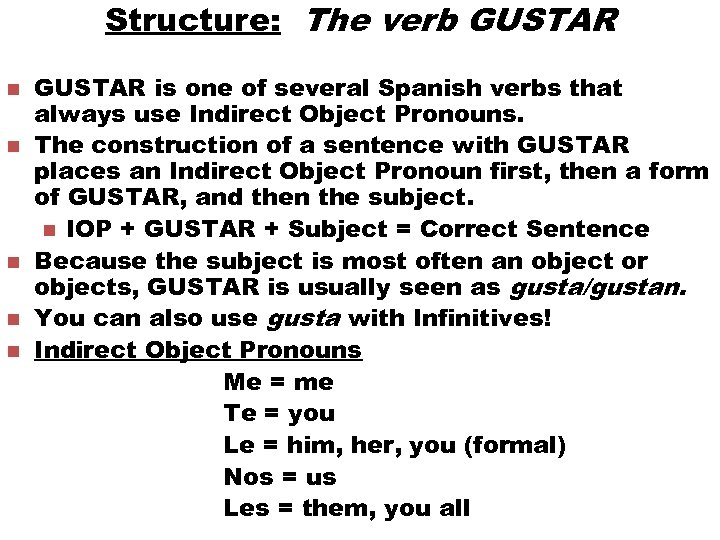 Structure: The verb GUSTAR n n n GUSTAR is one of several Spanish verbs that always use Indirect Object Pronouns. The construction of a sentence with GUSTAR places an Indirect Object Pronoun first, then a form of GUSTAR, and then the subject. n IOP + GUSTAR + Subject = Correct Sentence Because the subject is most often an object or objects, GUSTAR is usually seen as gusta/gustan. You can also use gusta with Infinitives! Indirect Object Pronouns Me = me Te = you Le = him, her, you (formal) Nos = us Les = them, you all
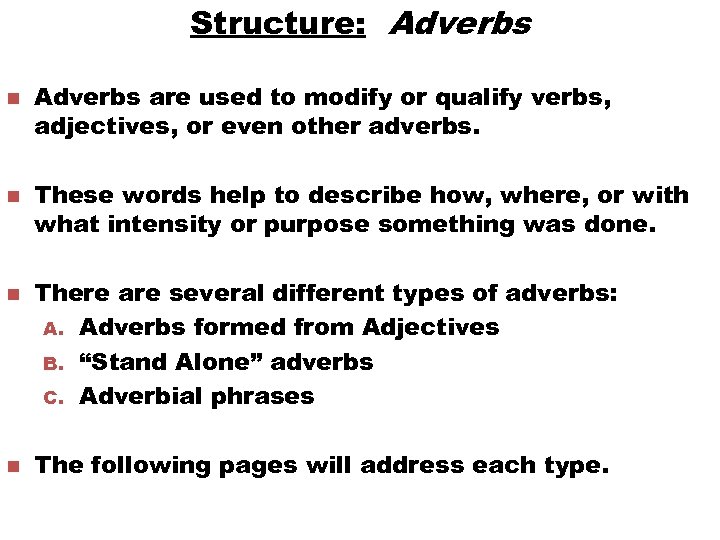 Structure: Adverbs n n Adverbs are used to modify or qualify verbs, adjectives, or even other adverbs. These words help to describe how, where, or with what intensity or purpose something was done. There are several different types of adverbs: A. Adverbs formed from Adjectives B. “Stand Alone” adverbs C. Adverbial phrases The following pages will address each type.
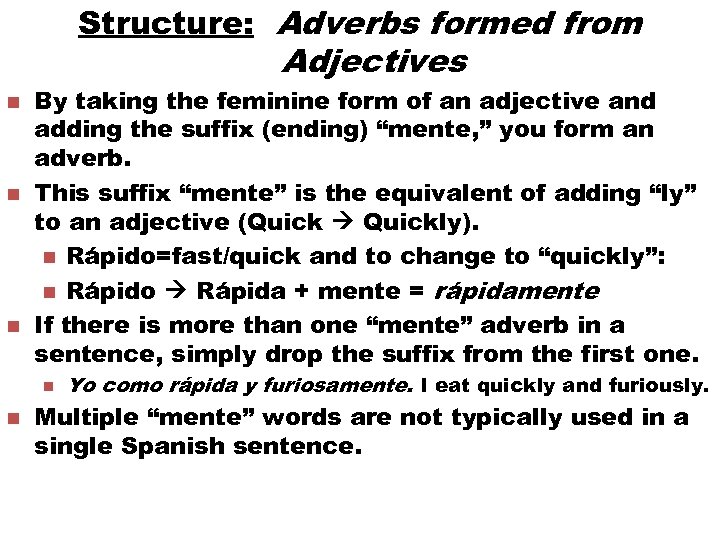 Structure: Adverbs formed from Adjectives n n n By taking the feminine form of an adjective and adding the suffix (ending) “mente, ” you form an adverb. This suffix “mente” is the equivalent of adding “ly” to an adjective (Quick Quickly). n Rápido=fast/quick and to change to “quickly”: n Rápido Rápida + mente = rápidamente If there is more than one “mente” adverb in a sentence, simply drop the suffix from the first one. n n Yo como rápida y furiosamente. I eat quickly and furiously. Multiple “mente” words are not typically used in a single Spanish sentence.
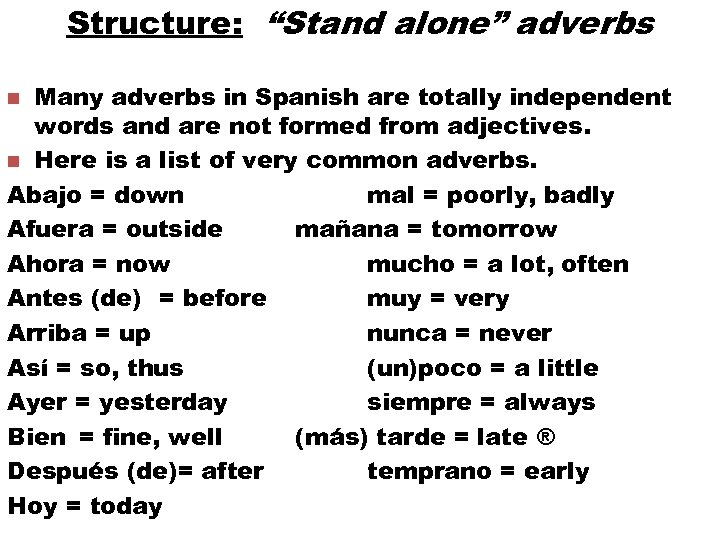 Structure: “Stand alone” adverbs Many adverbs in Spanish are totally independent words and are not formed from adjectives. n Here is a list of very common adverbs. Abajo = down mal = poorly, badly Afuera = outside mañana = tomorrow Ahora = now mucho = a lot, often Antes (de) = before muy = very Arriba = up nunca = never Así = so, thus (un)poco = a little Ayer = yesterday siempre = always Bien = fine, well (más) tarde = late ® Después (de)= after temprano = early Hoy = today n
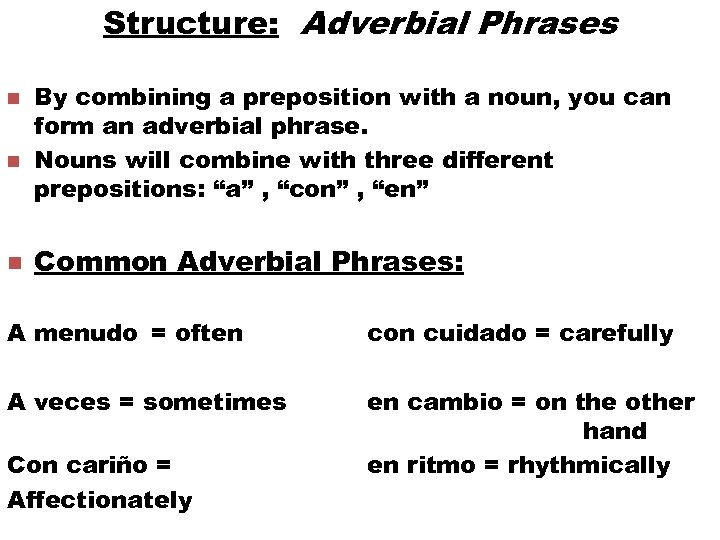 Structure: Adverbial Phrases n n n By combining a preposition with a noun, you can form an adverbial phrase. Nouns will combine with three different prepositions: “a” , “con” , “en” Common Adverbial Phrases: A menudo = often con cuidado = carefully A veces = sometimes en cambio = on the other hand en ritmo = rhythmically Con cariño = Affectionately
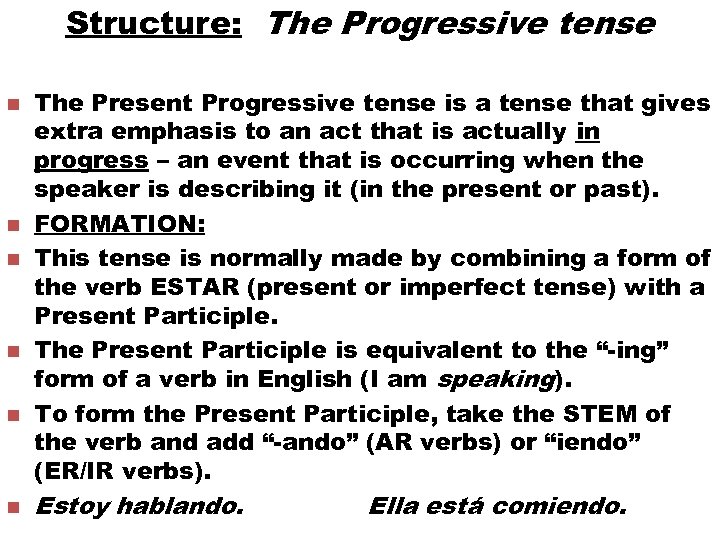 Structure: The Progressive tense n n n The Present Progressive tense is a tense that gives extra emphasis to an act that is actually in progress – an event that is occurring when the speaker is describing it (in the present or past). FORMATION: This tense is normally made by combining a form of the verb ESTAR (present or imperfect tense) with a Present Participle. The Present Participle is equivalent to the “-ing” form of a verb in English (I am speaking). To form the Present Participle, take the STEM of the verb and add “-ando” (AR verbs) or “iendo” (ER/IR verbs). Estoy hablando. Ella está comiendo.
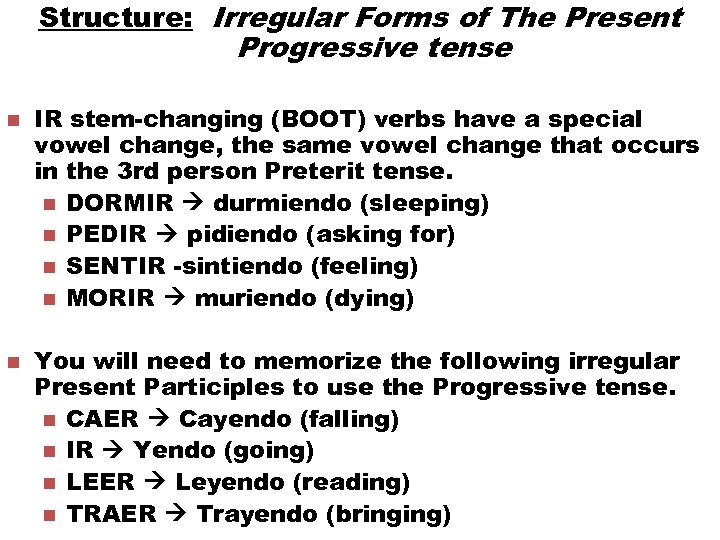 Structure: Irregular Forms of The Present Progressive tense n n IR stem-changing (BOOT) verbs have a special vowel change, the same vowel change that occurs in the 3 rd person Preterit tense. n DORMIR durmiendo (sleeping) n PEDIR pidiendo (asking for) n SENTIR -sintiendo (feeling) n MORIR muriendo (dying) You will need to memorize the following irregular Present Participles to use the Progressive tense. n CAER Cayendo (falling) n IR Yendo (going) n LEER Leyendo (reading) n TRAER Trayendo (bringing)
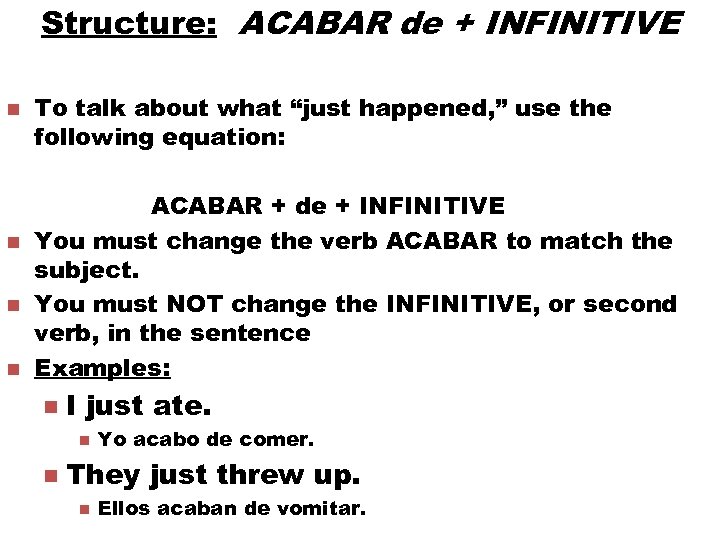 Structure: ACABAR de + INFINITIVE n n To talk about what “just happened, ” use the following equation: ACABAR + de + INFINITIVE You must change the verb ACABAR to match the subject. You must NOT change the INFINITIVE, or second verb, in the sentence Examples: n I just ate. n n Yo acabo de comer. They just threw up. n Ellos acaban de vomitar.
 Structure: Common Cognate rules
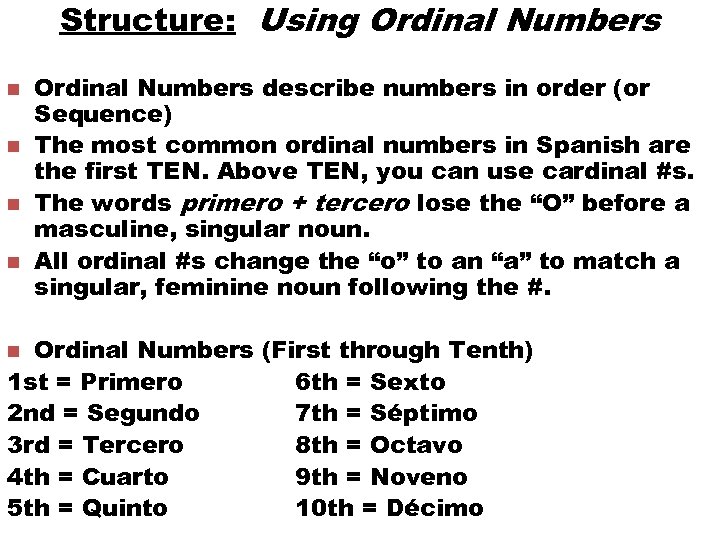 Structure: Using Ordinal Numbers n n Ordinal Numbers describe numbers in order (or Sequence) The most common ordinal numbers in Spanish are the first TEN. Above TEN, you can use cardinal #s. The words primero + tercero lose the “O” before a masculine, singular noun. All ordinal #s change the “o” to an “a” to match a singular, feminine noun following the #. Ordinal Numbers (First through Tenth) 1 st = Primero 6 th = Sexto 2 nd = Segundo 7 th = Séptimo 3 rd = Tercero 8 th = Octavo 4 th = Cuarto 9 th = Noveno 5 th = Quinto 10 th = Décimo n
 Intermediate Level II Honors and above
 Structure: Pronouns after prepositions n n You remember the subject pronouns we learned earlier (yo, tú, él/ella/Ud. , Nosotros, Ellos/ellas, Uds. ). These pronouns served as the main actors or stars in the sentence, doing the action of the verb. When a pronoun follows a preposition, the 1 st and 2 nd person pronouns must change. Pronouns that follow prepositions: Mí = me Ti = you Él, ella, Ud. = him, her, it, You (formal) Nosotros(as) = us Ellos, ellas, Uds. = them, you all.
 Structure: PRETERIT tense n n n To talk about specific past events use the Preterit tense To form the Preterit, you simply take the STEM of the AR/ER/IR verb and add different endings. n AR verb endings: é, aste, ó, amos, aron n ER/IR verbs: í, iste, ió, imos, ieron Example: n Yo comí la pizza ayer. n Anoche ella habló con su amigo.
 Structure: CAR, GAR, ZAR verbs n n Some verbs require spelling changes in the 1 st person (YO) form of the Preterit tense. The rest of the forms use the same Preterit endings • In the YO form only, • Verbs that end in -gar change g to gu • Verbs that end in -car change c to qu • Verbs that end in -zar change z to c jugué (jugar) = I played busqué (buscar) = I looked for almorcé (almorzar) = I ate lunch
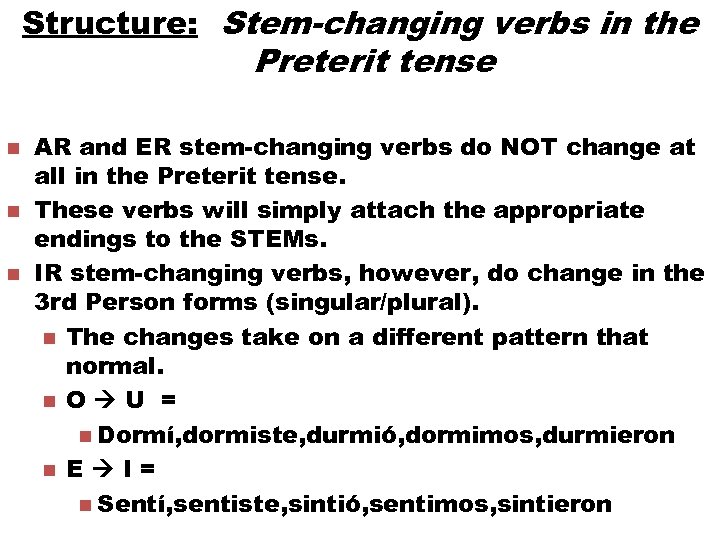 Structure: Stem-changing verbs in the Preterit tense n n n AR and ER stem-changing verbs do NOT change at all in the Preterit tense. These verbs will simply attach the appropriate endings to the STEMs. IR stem-changing verbs, however, do change in the 3 rd Person forms (singular/plural). n The changes take on a different pattern that normal. n O U = n Dormí, dormiste, durmió, dormimos, durmieron n E I = n Sentí, sentiste, sintió, sentimos, sintieron
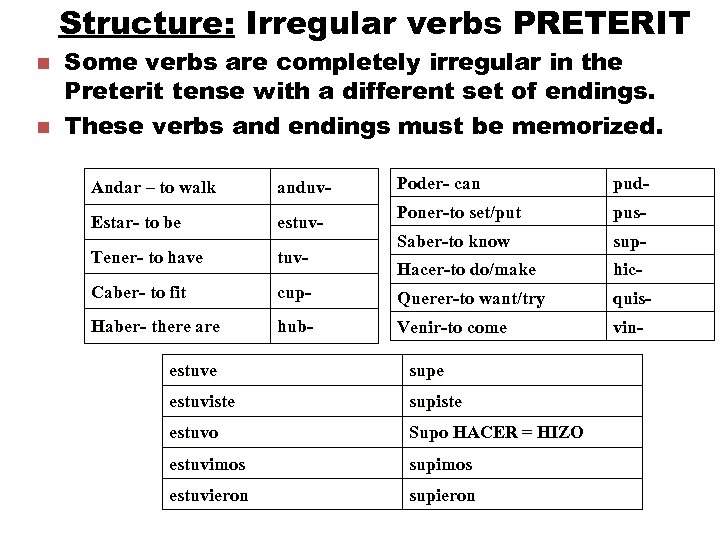 Structure: Irregular verbs PRETERIT n n Some verbs are completely irregular in the Preterit tense with a different set of endings. These verbs and endings must be memorized. Poder- can pud- Poner-to set/put pus- Saber-to know sup- Hacer-to do/make hic- cup- Querer-to want/try quis- hub- Venir-to come vin- Andar – to walk anduv- Estar- to be estuv- Tener- to have tuv- Caber- to fit Haber- there are estuve supe estuviste supiste estuvo Supo HACER = HIZO estuvimos supimos estuvieron supieron
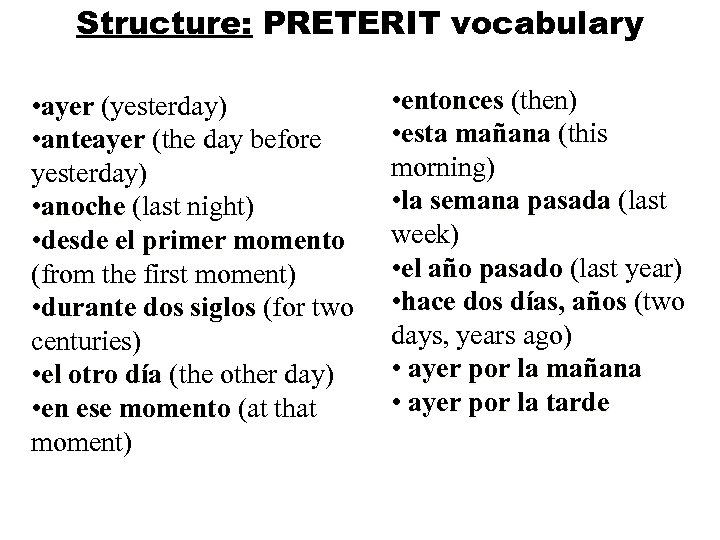 Structure: PRETERIT vocabulary • ayer (yesterday) • anteayer (the day before yesterday) • anoche (last night) • desde el primer momento (from the first moment) • durante dos siglos (for two centuries) • el otro día (the other day) • en ese momento (at that moment) • entonces (then) • esta mañana (this morning) • la semana pasada (last week) • el año pasado (last year) • hace dos días, años (two days, years ago) • ayer por la mañana • ayer por la tarde
 Structure: Object Pronouns n n Pronouns are words that stand for nouns. Object pronouns, as opposed to subject pronouns, RECEIVE the action from the verb; they do not DO the verb. There are 3 types of Object Pronouns n Direct Object Pronouns n Indirect Object Pronouns n Reflexive Pronouns The following three pages will discuss each type of pronoun and explain when or when not to use them.
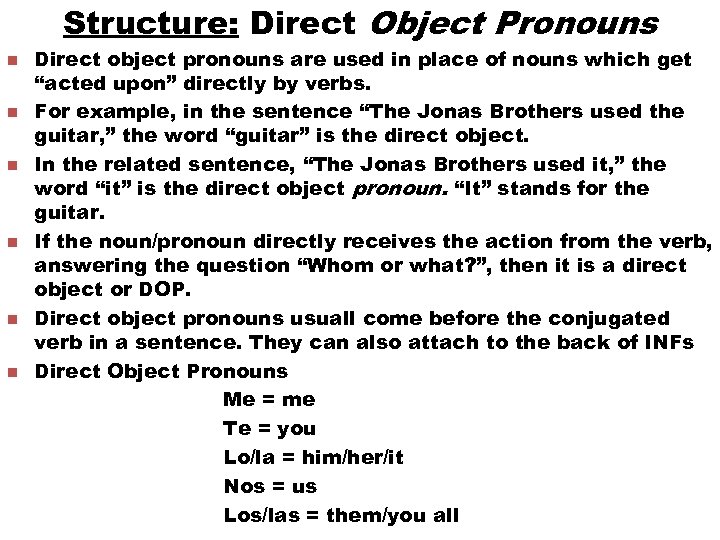 Structure: Direct Object Pronouns n n n Direct object pronouns are used in place of nouns which get “acted upon” directly by verbs. For example, in the sentence “The Jonas Brothers used the guitar, ” the word “guitar” is the direct object. In the related sentence, “The Jonas Brothers used it, ” the word “it” is the direct object pronoun. “It” stands for the guitar. If the noun/pronoun directly receives the action from the verb, answering the question “Whom or what? ”, then it is a direct object or DOP. Direct object pronouns usuall come before the conjugated verb in a sentence. They can also attach to the back of INFs Direct Object Pronouns Me = me Te = you Lo/la = him/her/it Nos = us Los/las = them/you all
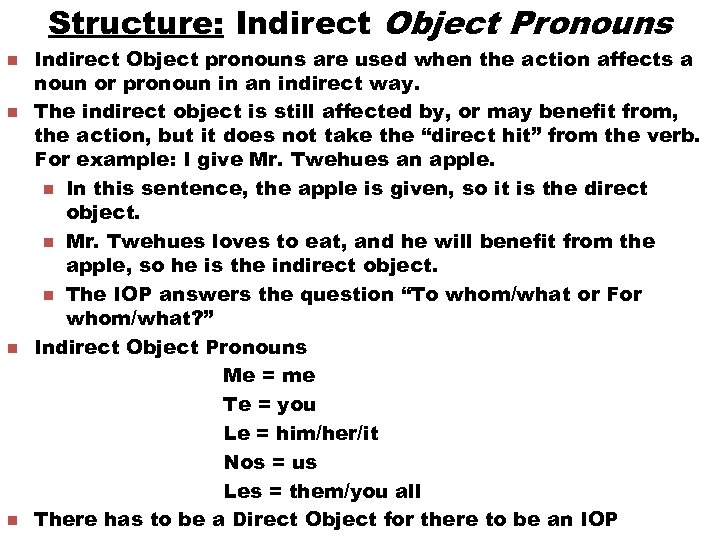 Structure: Indirect Object Pronouns n n Indirect Object pronouns are used when the action affects a noun or pronoun in an indirect way. The indirect object is still affected by, or may benefit from, the action, but it does not take the “direct hit” from the verb. For example: I give Mr. Twehues an apple. n In this sentence, the apple is given, so it is the direct object. n Mr. Twehues loves to eat, and he will benefit from the apple, so he is the indirect object. n The IOP answers the question “To whom/what or For whom/what? ” Indirect Object Pronouns Me = me Te = you Le = him/her/it Nos = us Les = them/you all There has to be a Direct Object for there to be an IOP
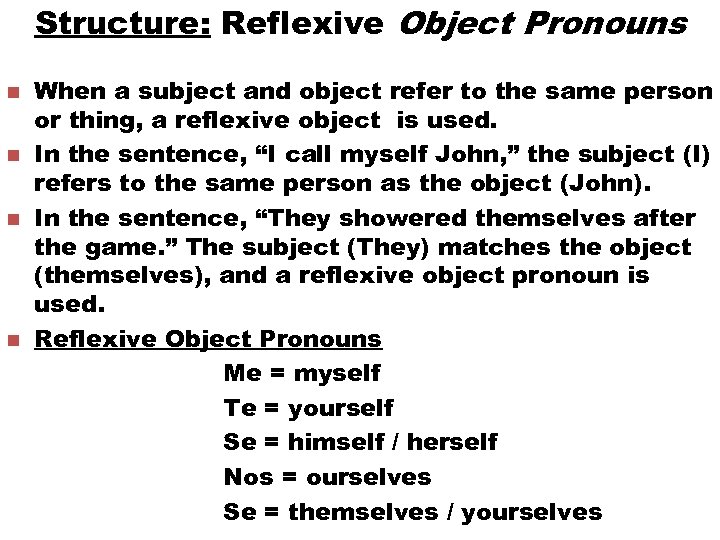 Structure: Reflexive Object Pronouns n n When a subject and object refer to the same person or thing, a reflexive object is used. In the sentence, “I call myself John, ” the subject (I) refers to the same person as the object (John). In the sentence, “They showered themselves after the game. ” The subject (They) matches the object (themselves), and a reflexive object pronoun is used. Reflexive Object Pronouns Me = myself Te = yourself Se = himself / herself Nos = ourselves Se = themselves / yourselves
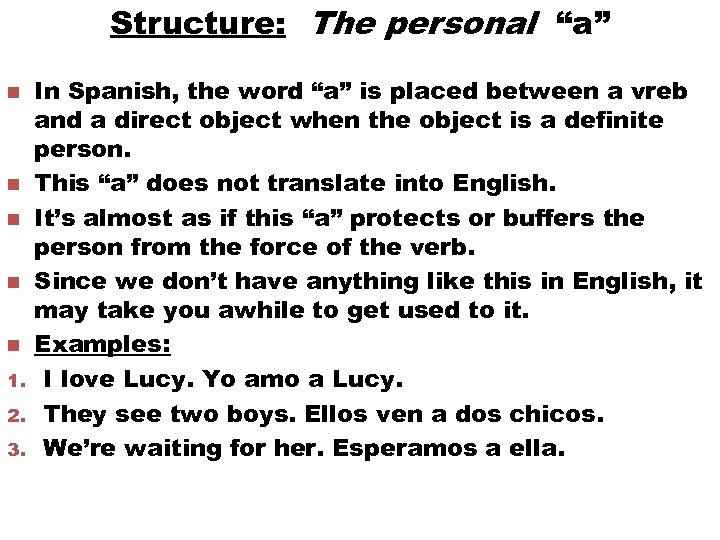 Structure: The personal “a” n n n 1. 2. 3. In Spanish, the word “a” is placed between a vreb and a direct object when the object is a definite person. This “a” does not translate into English. It’s almost as if this “a” protects or buffers the person from the force of the verb. Since we don’t have anything like this in English, it may take you awhile to get used to it. Examples: I love Lucy. Yo amo a Lucy. They see two boys. Ellos ven a dos chicos. We’re waiting for her. Esperamos a ella.
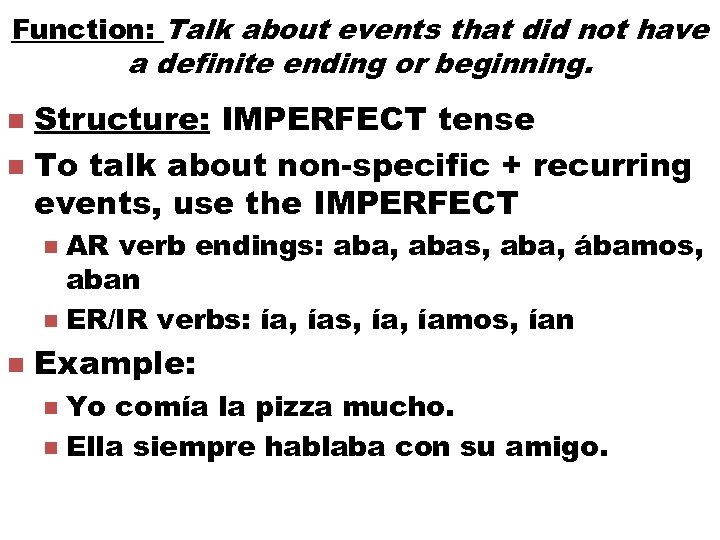 Function: Talk about events that did not have a definite ending or beginning. Structure: IMPERFECT tense n To talk about non-specific + recurring events, use the IMPERFECT n AR verb endings: aba, abas, aba, ábamos, aban n ER/IR verbs: ía, ías, íamos, ían n n Example: Yo comía la pizza mucho. n Ella siempre hablaba con su amigo. n
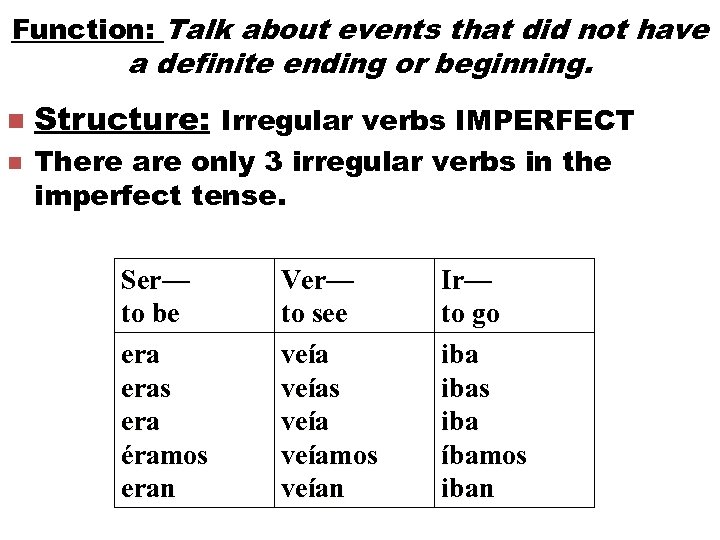 Function: Talk about events that did not have a definite ending or beginning. n n Structure: Irregular verbs IMPERFECT There are only 3 irregular verbs in the imperfect tense. Ser— to be eras era éramos eran Ver— to see veías veíamos veían Ir— to go ibas iba íbamos iban
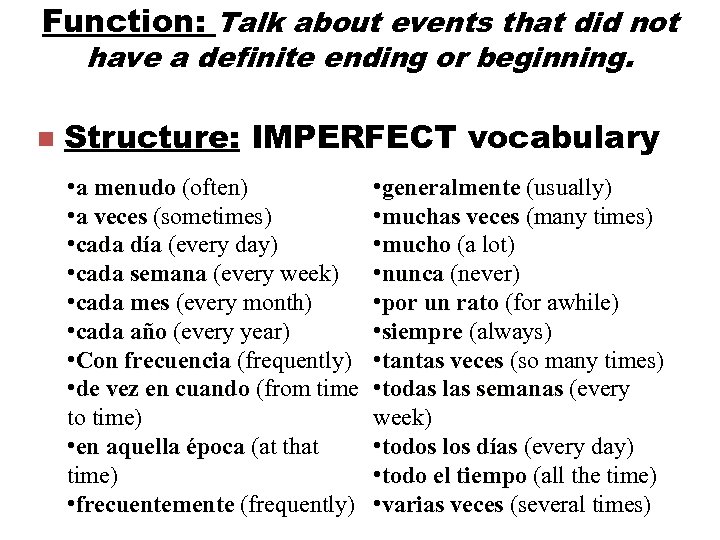 Function: Talk about events that did not have a definite ending or beginning. n Structure: IMPERFECT vocabulary • a menudo (often) • a veces (sometimes) • cada día (every day) • cada semana (every week) • cada mes (every month) • cada año (every year) • Con frecuencia (frequently) • de vez en cuando (from time to time) • en aquella época (at that time) • frecuentemente (frequently) • generalmente (usually) • muchas veces (many times) • mucho (a lot) • nunca (never) • por un rato (for awhile) • siempre (always) • tantas veces (so many times) • todas las semanas (every week) • todos los días (every day) • todo el tiempo (all the time) • varias veces (several times)
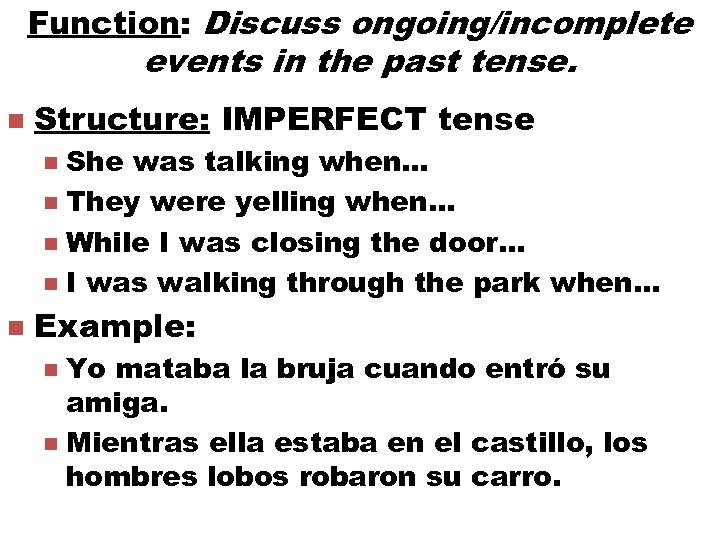 Function: Discuss ongoing/incomplete events in the past tense. n Structure: IMPERFECT tense She was talking when… n They were yelling when… n While I was closing the door… n I was walking through the park when… n n Example: Yo mataba la bruja cuando entró su amiga. n Mientras ella estaba en el castillo, los hombres lobos robaron su carro. n
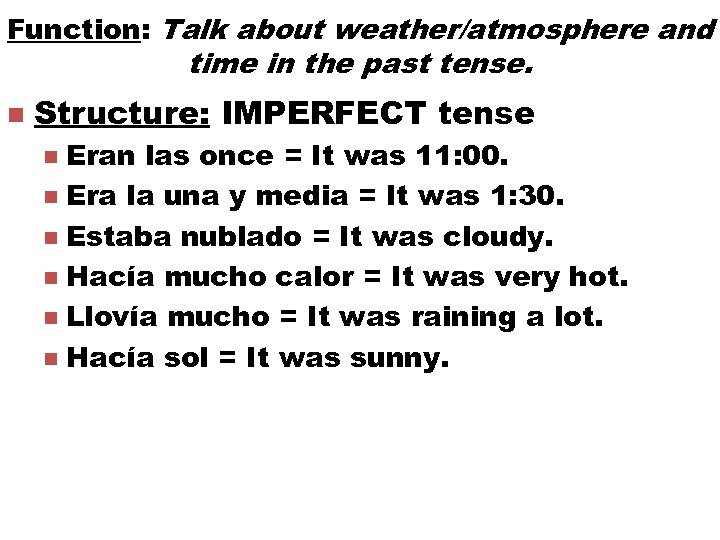 Function: Talk about weather/atmosphere and time in the past tense. n Structure: IMPERFECT tense Eran las once = It was 11: 00. n Era la una y media = It was 1: 30. n Estaba nublado = It was cloudy. n Hacía mucho calor = It was very hot. n Llovía mucho = It was raining a lot. n Hacía sol = It was sunny. n
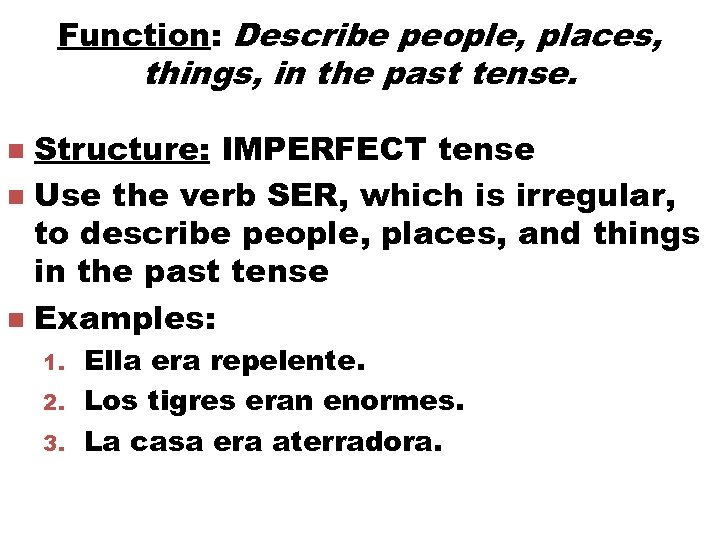 Function: Describe people, places, things, in the past tense. Structure: IMPERFECT tense n Use the verb SER, which is irregular, to describe people, places, and things in the past tense n Examples: n 1. 2. 3. Ella era repelente. Los tigres eran enormes. La casa era aterradora.
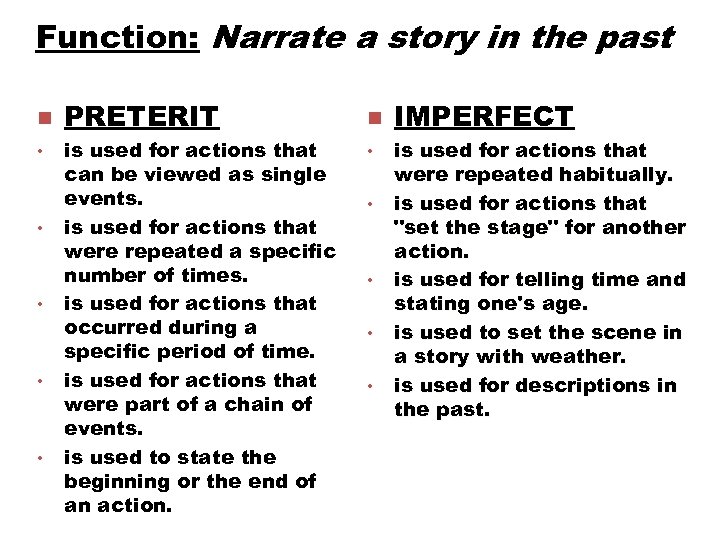 Function: Narrate a story in the past n • • • PRETERIT is used for actions that can be viewed as single events. is used for actions that were repeated a specific number of times. is used for actions that occurred during a specific period of time. is used for actions that were part of a chain of events. is used to state the beginning or the end of an action. n • • • IMPERFECT is used for actions that were repeated habitually. is used for actions that "set the stage" for another action. is used for telling time and stating one's age. is used to set the scene in a story with weather. is used for descriptions in the past.
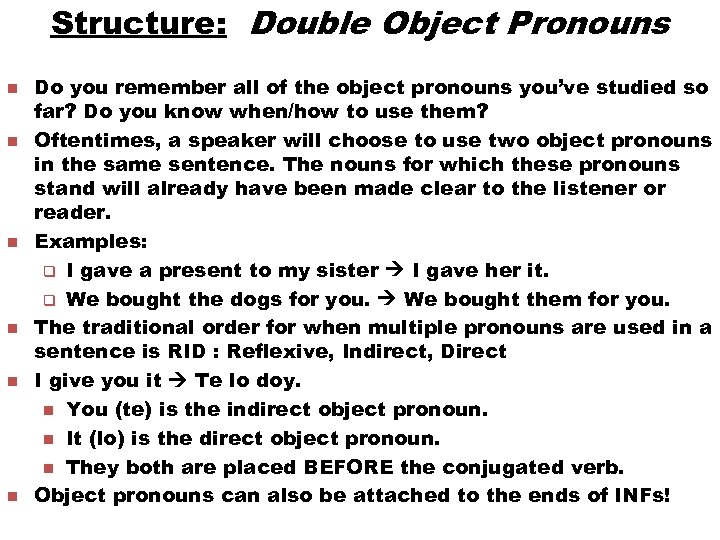 Structure: Double Object Pronouns n n n Do you remember all of the object pronouns you’ve studied so far? Do you know when/how to use them? Oftentimes, a speaker will choose to use two object pronouns in the same sentence. The nouns for which these pronouns stand will already have been made clear to the listener or reader. Examples: q I gave a present to my sister I gave her it. q We bought the dogs for you. We bought them for you. The traditional order for when multiple pronouns are used in a sentence is RID : Reflexive, Indirect, Direct I give you it Te lo doy. n You (te) is the indirect object pronoun. n It (lo) is the direct object pronoun. n They both are placed BEFORE the conjugated verb. Object pronouns can also be attached to the ends of INFs!
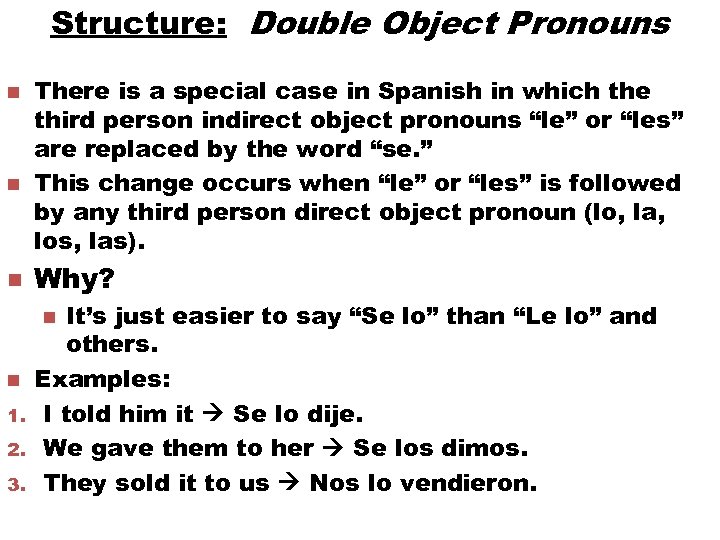 Structure: Double Object Pronouns n n n There is a special case in Spanish in which the third person indirect object pronouns “le” or “les” are replaced by the word “se. ” This change occurs when “le” or “les” is followed by any third person direct object pronoun (lo, la, los, las). Why? It’s just easier to say “Se lo” than “Le lo” and others. Examples: I told him it Se lo dije. We gave them to her Se los dimos. They sold it to us Nos lo vendieron. n n 1. 2. 3.
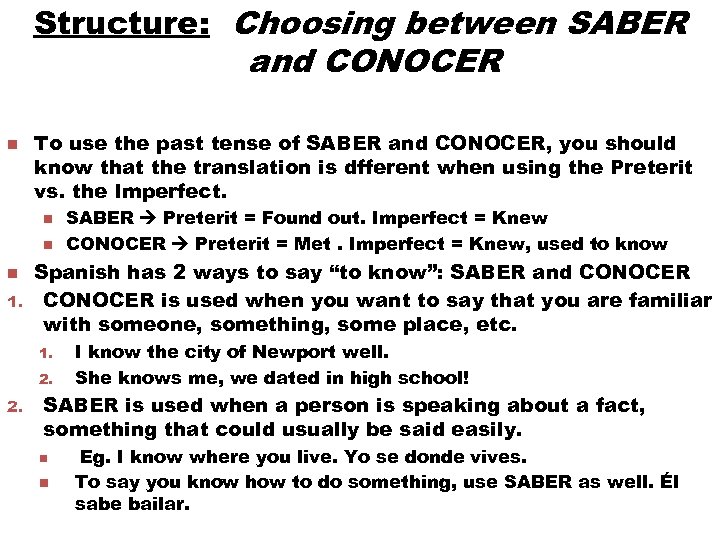 Structure: Choosing between SABER and CONOCER n To use the past tense of SABER and CONOCER, you should know that the translation is dfferent when using the Preterit vs. the Imperfect. n n n 1. Spanish has 2 ways to say “to know”: SABER and CONOCER is used when you want to say that you are familiar with someone, something, some place, etc. 1. 2. SABER Preterit = Found out. Imperfect = Knew CONOCER Preterit = Met. Imperfect = Knew, used to know I know the city of Newport well. She knows me, we dated in high school! SABER is used when a person is speaking about a fact, something that could usually be said easily. n n Eg. I know where you live. Yo se donde vives. To say you know how to do something, use SABER as well. Él sabe bailar.
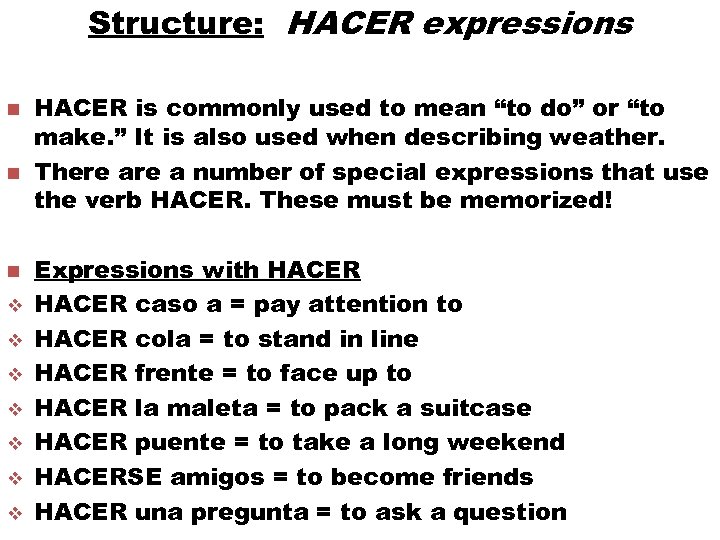 Structure: HACER expressions n n n v v v v HACER is commonly used to mean “to do” or “to make. ” It is also used when describing weather. There a number of special expressions that use the verb HACER. These must be memorized! Expressions with HACER caso a = pay attention to HACER cola = to stand in line HACER frente = to face up to HACER la maleta = to pack a suitcase HACER puente = to take a long weekend HACERSE amigos = to become friends HACER una pregunta = to ask a question
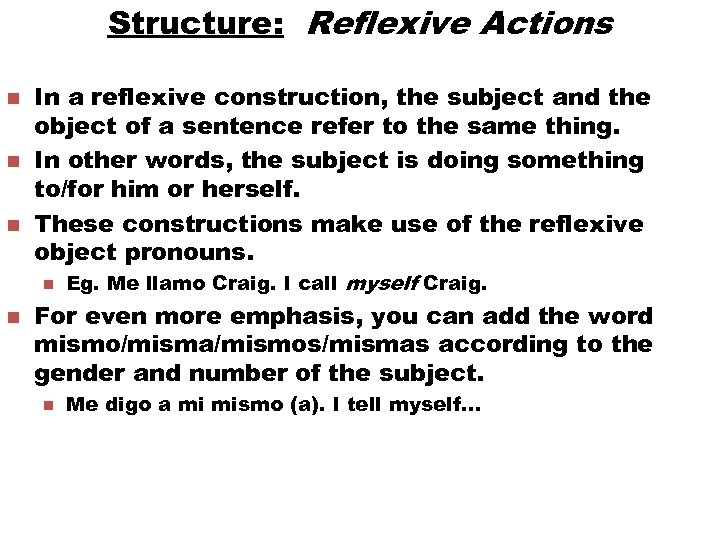 Structure: Reflexive Actions n n n In a reflexive construction, the subject and the object of a sentence refer to the same thing. In other words, the subject is doing something to/for him or herself. These constructions make use of the reflexive object pronouns. n n Eg. Me llamo Craig. I call myself Craig. For even more emphasis, you can add the word mismo/misma/mismos/mismas according to the gender and number of the subject. n Me digo a mi mismo (a). I tell myself…
 Structure: Reciprocal Actions n n n Sometimes two people do the exact same thing to eachother. If two people write a letter to eachother, it is a reciprocal action. For reciprocal actions, two or more people are needed; therefore only 2 object pronouns are used: SE and NOS. For added emphasis and to avoid confusion with reciprocal sentences, the following words may be added after the verb: uno a otro, una a otra, unos a otros, unas a otras. These are the only 4 possibilities. It is not possible to “mix” genders here. n The boy and the girl talk to eachother.
 Structure: Formal Command forms (Ud. /Uds. ) We use direct commands to ask or tell someone to do something. n One person can look at another and say “Do it!” or “Don’t do it!” n A formal command is addressed to a person or persons with whom you would use Ud. /Uds. Formation: n Use the subjunctive tense for conjugating these command forms. n Remember to take the STEM of the verb and to add the opposite ending to make the subjunctive, or in this case, the formal command conjugation. n AR: Hable, hablen! or No hable! No hablen! n ER/IR : Viva, no viva! Vivan, no vivan! n
 Structure: Formal Command forms (Ud. /Uds. ) n With stem-changing “boot” verbs, change the stem, and then add the opposite ending: n n Spelling changers in the 1 st person preterit will change as well in command forms: n n Busque!, Conozca!, Paguen!, Dirijan!, Comience!, Toquen! Any verbs that have an irregular YO form in the first person will be irregular in the command form. n n Sienten! Sientense! No se sienten! Haga!, Diga!, Ponga!, Salgan!, etc. There are some super-irregulars as well: SER= Sea / Sean IR = Vaya / Vayan DAR = Dé / Den ESTAR = Esté / Estén
 Structure: Demonstrative Adjectives Demonstrative adjectives help to distinguish one noun from another. n They use spatial imagery (? ) to place an object in relationship to the speaker or listener. Demonstrative adjectives Este = this esta = this Estos = these estas = these Ese = that esa = that Esos = those esas = those Aquel= that (over there) aquella= that (over there) Aquellos /aquellas = those (over there) n These adjectives are placed in front of nouns. n Also, aquel/aquellos refer to objects farther away n
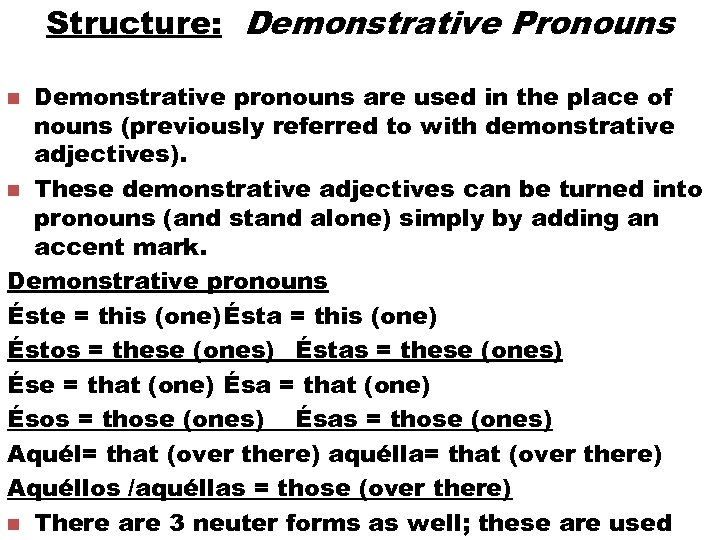 Structure: Demonstrative Pronouns Demonstrative pronouns are used in the place of nouns (previously referred to with demonstrative adjectives). n These demonstrative adjectives can be turned into pronouns (and stand alone) simply by adding an accent mark. Demonstrative pronouns Éste = this (one)Ésta = this (one) Éstos = these (ones) Éstas = these (ones) Ése = that (one) Ésa = that (one) Ésos = those (ones) Ésas = those (ones) Aquél= that (over there) aquélla= that (over there) Aquéllos /aquéllas = those (over there) n There are 3 neuter forms as well; these are used n
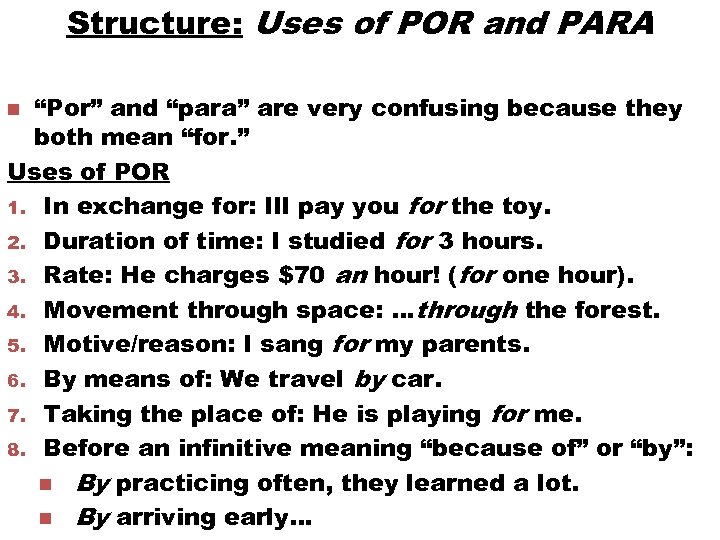 Structure: Uses of POR and PARA “Por” and “para” are very confusing because they both mean “for. ” Uses of POR 1. In exchange for: Ill pay you for the toy. 2. Duration of time: I studied for 3 hours. 3. Rate: He charges $70 an hour! (for one hour). 4. Movement through space: …through the forest. 5. Motive/reason: I sang for my parents. 6. By means of: We travel by car. 7. Taking the place of: He is playing for me. 8. Before an infinitive meaning “because of” or “by”: n By practicing often, they learned a lot. n By arriving early… n
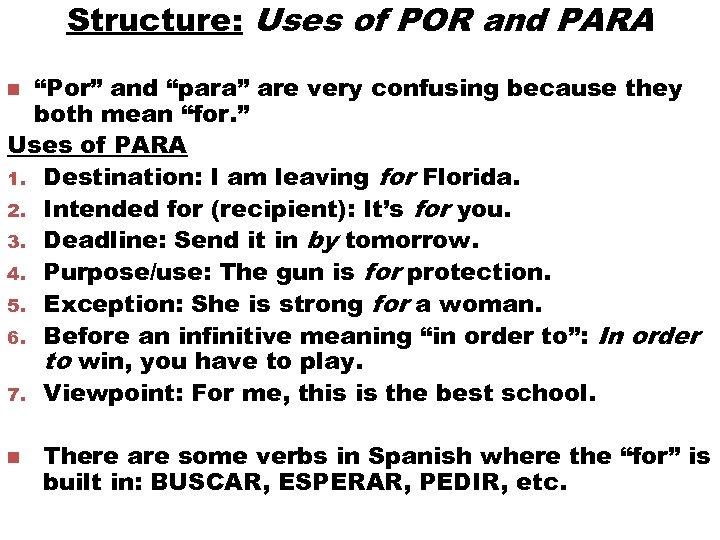 Structure: Uses of POR and PARA “Por” and “para” are very confusing because they both mean “for. ” Uses of PARA 1. Destination: I am leaving for Florida. 2. Intended for (recipient): It’s for you. 3. Deadline: Send it in by tomorrow. 4. Purpose/use: The gun is for protection. 5. Exception: She is strong for a woman. 6. Before an infinitive meaning “in order to”: In order to win, you have to play. 7. Viewpoint: For me, this is the best school. n n There are some verbs in Spanish where the “for” is built in: BUSCAR, ESPERAR, PEDIR, etc.
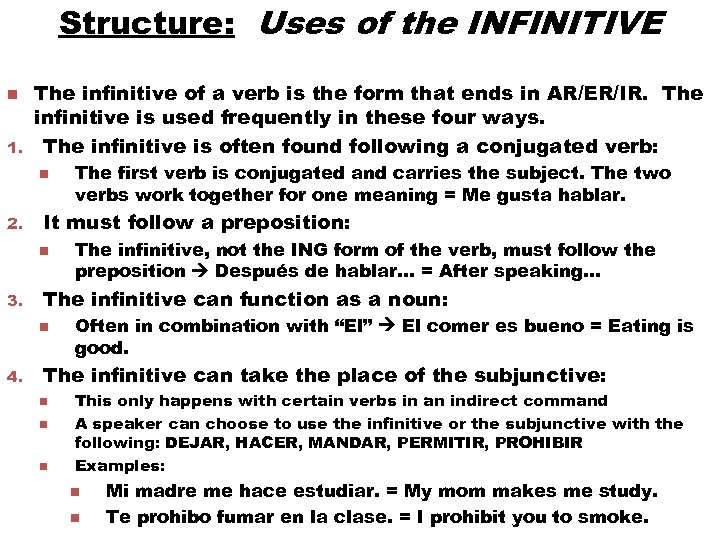 Structure: Uses of the INFINITIVE n 1. The infinitive of a verb is the form that ends in AR/ER/IR. The infinitive is used frequently in these four ways. The infinitive is often found following a conjugated verb: n 2. It must follow a preposition: n 3. The infinitive, not the ING form of the verb, must follow the preposition Después de hablar… = After speaking… The infinitive can function as a noun: n 4. The first verb is conjugated and carries the subject. The two verbs work together for one meaning = Me gusta hablar. Often in combination with “El” El comer es bueno = Eating is good. The infinitive can take the place of the subjunctive: n n n This only happens with certain verbs in an indirect command A speaker can choose to use the infinitive or the subjunctive with the following: DEJAR, HACER, MANDAR, PERMITIR, PROHIBIR Examples: n n Mi madre me hace estudiar. = My mom makes me study. Te prohibo fumar en la clase. = I prohibit you to smoke.
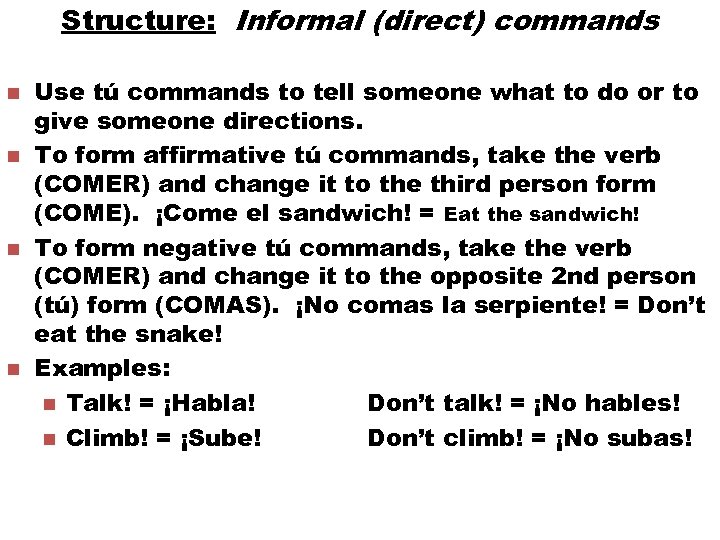 Structure: Informal (direct) commands n n Use tú commands to tell someone what to do or to give someone directions. To form affirmative tú commands, take the verb (COMER) and change it to the third person form (COME). ¡Come el sandwich! = Eat the sandwich! To form negative tú commands, take the verb (COMER) and change it to the opposite 2 nd person (tú) form (COMAS). ¡No comas la serpiente! = Don’t eat the snake! Examples: n Talk! = ¡Habla! Don’t talk! = ¡No hables! n Climb! = ¡Sube! Don’t climb! = ¡No subas!
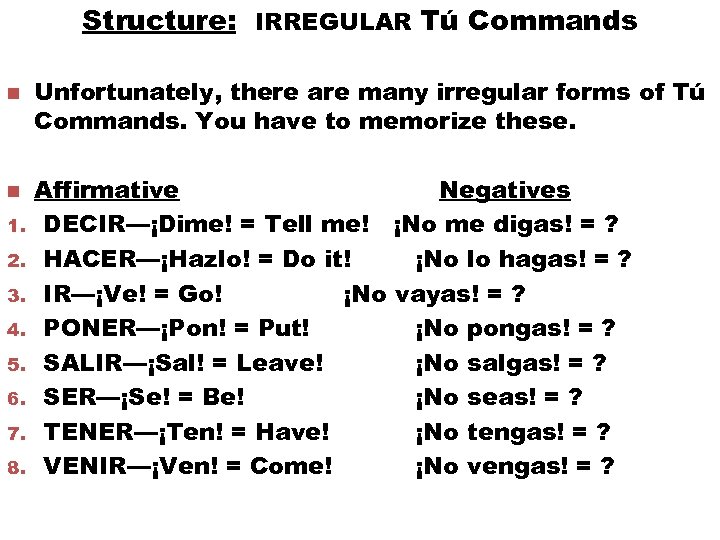 Structure: IRREGULAR Tú Commands n n 1. 2. 3. 4. 5. 6. 7. 8. Unfortunately, there are many irregular forms of Tú Commands. You have to memorize these. Affirmative Negatives DECIR—¡Dime! = Tell me! ¡No me digas! = ? HACER—¡Hazlo! = Do it! ¡No lo hagas! = ? IR—¡Ve! = Go! ¡No vayas! = ? PONER—¡Pon! = Put! ¡No pongas! = ? SALIR—¡Sal! = Leave! ¡No salgas! = ? SER—¡Se! = Be! ¡No seas! = ? TENER—¡Ten! = Have! ¡No tengas! = ? VENIR—¡Ven! = Come! ¡No vengas! = ?
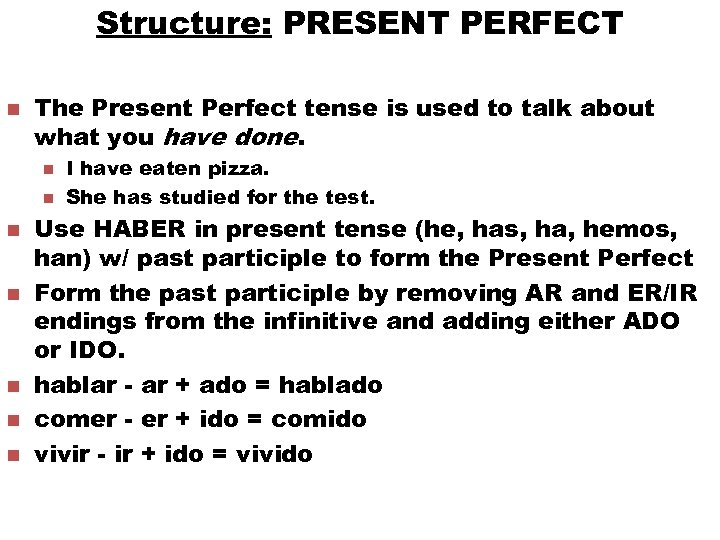 Structure: PRESENT PERFECT n The Present Perfect tense is used to talk about what you have done. n n n n I have eaten pizza. She has studied for the test. Use HABER in present tense (he, has, ha, hemos, han) w/ past participle to form the Present Perfect Form the past participle by removing AR and ER/IR endings from the infinitive and adding either ADO or IDO. hablar - ar + ado = hablado comer - er + ido = comido vivir - ir + ido = vivido
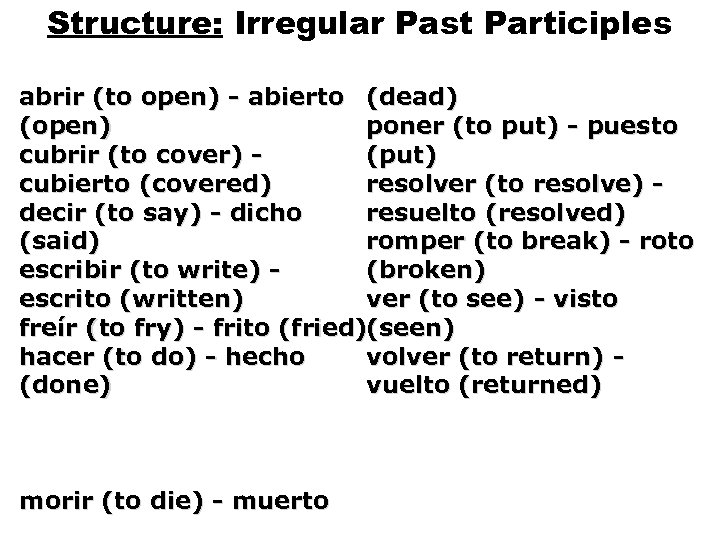 Structure: Irregular Past Participles abrir (to open) - abierto (dead) (open) poner (to put) - puesto (put) cubrir (to cover) resolver (to resolve) cubierto (covered) resuelto (resolved) decir (to say) - dicho romper (to break) - roto (said) (broken) escribir (to write) ver (to see) - visto escrito (written) freír (to fry) - frito (fried)(seen) volver (to return) hacer (to do) - hecho vuelto (returned) (done) morir (to die) - muerto
 Structure: Past Participles as adjectives n n 1. 2. 3. The past participles used in the Present Perfect tense (and all perfect tenses) end in “o” and can were used in a verbal function. However, past participles can be used as adjectives as well. These past participles can follow a noun directly, and are often found after the verb ESTAR. Examples: La puerta está cerrada. Las sillas rotas no sirven para nada. El televisor está roto.
 Structure: The Future tense n n The future tense is used when discussing what will happen or what someone will do. The true future tense (will) is used to describe events that are a little further away in the mind of the speaker. All AR/ER/IR verbs take the following endings attached to the INFINITIVE: n Hablaré, Hablarás, hablará, hablaremos, hablarán. n Comeré, comerás, comerá, comeremos, comerán. There are several irregular verbs in the future tense; the only thing to remember is the different stem. The endings are the same! DECIR -- diré SABER -- sabré PODER -- podré PONER -- pondré TENER -- tendré SALIR -- saldré CABER -- cabré VALER -- valdré HABER -- habré VENIR -- vendré QUERER – querré HACER -- haré
 Advanced Levels III and above
 Structure: Relative Pronouns n n 1. 2. 3. 4. n A relative pronoun is a word or group of words that connect a dependent clause to a subject found at the beginning of the sentence. A relative pronoun “relates” these two parts of a sentence and, as a pronoun, refers to the subject of a sentence. There are four common Relatives. QUE QUIEN/QUIENES EL QUE, LA QUE, LOS QUE, LAS QUE EL CUAL, LA CUAL, LOS CUALES, LAS CUALES These relative pronouns will be described in detail on the following 3 pages.
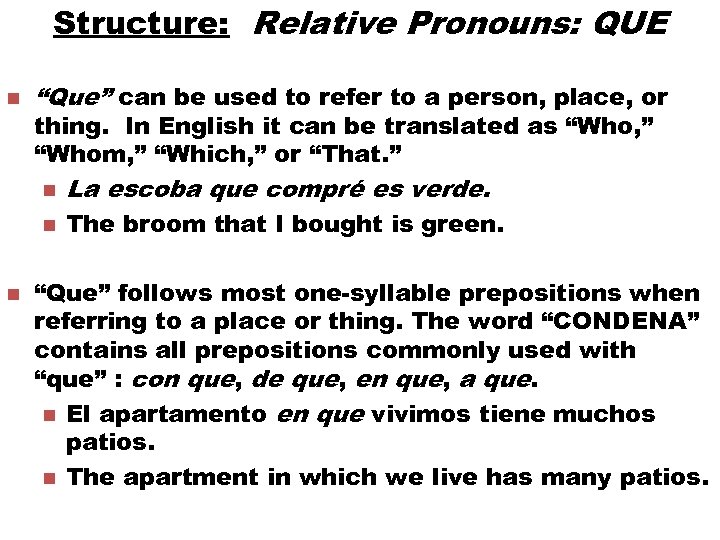 Structure: Relative Pronouns: QUE n “Que” can be used to refer to a person, place, or thing. In English it can be translated as “Who, ” “Whom, ” “Which, ” or “That. ” n n n La escoba que compré es verde. The broom that I bought is green. “Que” follows most one-syllable prepositions when referring to a place or thing. The word “CONDENA” contains all prepositions commonly used with “que” : con que, de que, en que, a que. n El apartamento en que vivimos tiene muchos patios. n The apartment in which we live has many patios.
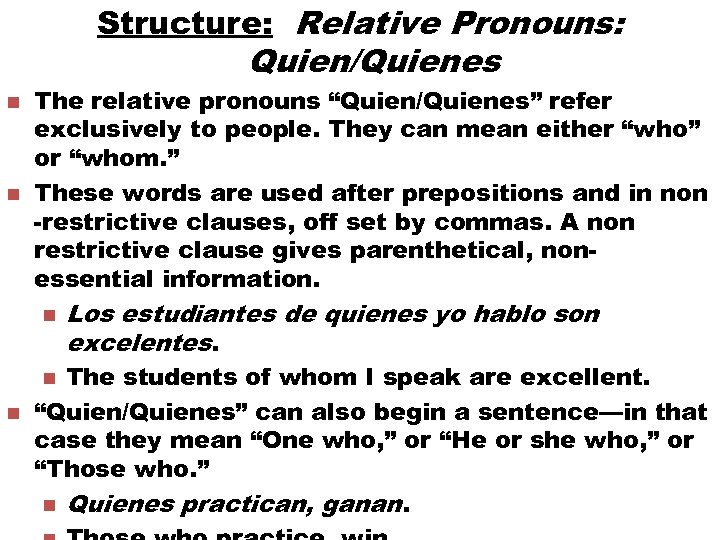 Structure: Relative Pronouns: Quien/Quienes n n The relative pronouns “Quien/Quienes” refer exclusively to people. They can mean either “who” or “whom. ” These words are used after prepositions and in non -restrictive clauses, off set by commas. A non restrictive clause gives parenthetical, nonessential information. n The students of whom I speak are excellent. “Quien/Quienes” can also begin a sentence—in that case they mean “One who, ” or “He or she who, ” or “Those who. ” n Quienes practican, ganan. n n Los estudiantes de quienes yo hablo son excelentes.
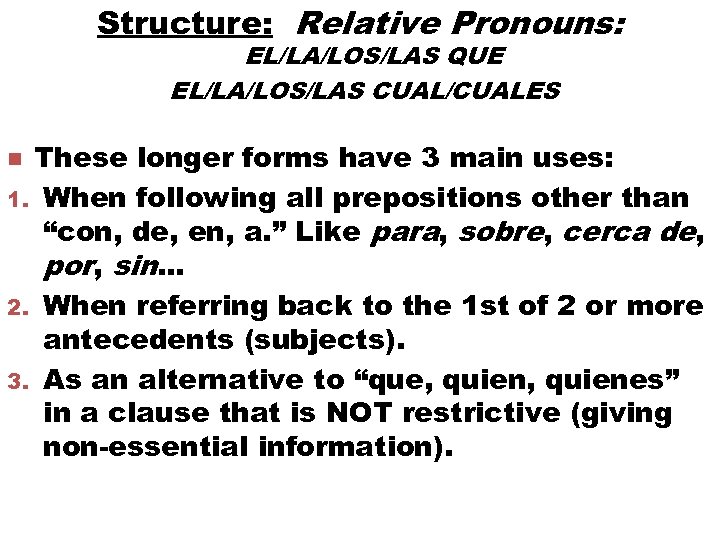 Structure: Relative Pronouns: EL/LA/LOS/LAS QUE EL/LA/LOS/LAS CUAL/CUALES These longer forms have 3 main uses: 1. When following all prepositions other than “con, de, en, a. ” Like para, sobre, cerca de, por, sin… 2. When referring back to the 1 st of 2 or more antecedents (subjects). 3. As an alternative to “que, quienes” in a clause that is NOT restrictive (giving non-essential information). n
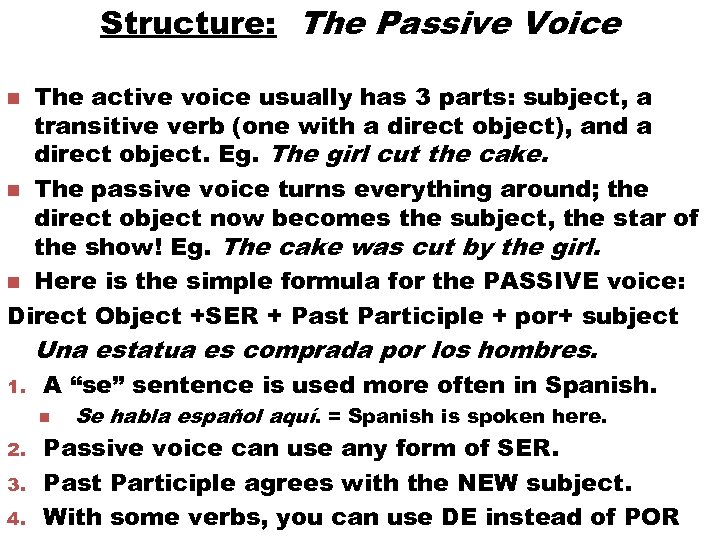 Structure: The Passive Voice The active voice usually has 3 parts: subject, a transitive verb (one with a direct object), and a direct object. Eg. The girl cut the cake. n The passive voice turns everything around; the direct object now becomes the subject, the star of the show! Eg. The cake was cut by the girl. n Here is the simple formula for the PASSIVE voice: Direct Object +SER + Past Participle + por+ subject n Una estatua es comprada por los hombres. 1. A “se” sentence is used more often in Spanish. n 2. 3. 4. Se habla español aquí. = Spanish is spoken here. Passive voice can use any form of SER. Past Participle agrees with the NEW subject. With some verbs, you can use DE instead of POR
 Structure: “IF” clauses n n 1. 2. 3. 4. 5. “If clauses” in Spanish contain the word “si. ” These clauses may introduce a condition and a promise (If it rains, he will not come) or a hypothetical situation (If she were taller, she would be happier). There are 2 categories of “If clauses” in Spanish: those that use the Indicative and those that use the Subjunctive. We will discuss 5 separate types of “If clauses”: The Present with the Future The Present with the Present The Imperfect Subjunctive with the Conditional The Pluperfect Subjunctive and Conditional Perf. Sentences with “Como si. ”
 Structure: “IF” clauses: Indicative The Present/Future n n n This type of “If clause” answers the question, “If “X” happens, what will be the consequence? ” The formula for using the Present/Future “If clause” is simple: Si + Present tense + “, ” + Future tense or Future tense + Si + Present tense Si llueve mañana, él no viajará aquí. n If it rains tomorrow, he will not travel here. n No compraremos el sofá si cuesta demasiado. n We will not buy the couch if it costs too much. These sentences share the use of the Present n
 Structure: “IF” clauses: Indicative Present / Present n The “If clauses” that use the Present Indicative with the Present Indicative follow this pattern: If “X” happens, then “Y” always happens. n 1. Examples: Vamos a la finca si tenemos tiempo. n 2. Si llueve, no jugamos al béisbol. n n We go to the farm if (when) we have time. If it rains, we don’t play baseball. All of these sentences will express habitual activities; not one time events or conditions.
 Structure: “IF” clauses using the Subunctive Mood n n n 1. 2. 3. In these sentences, a hypothetical situation is presented. The situation is explained in a way that makes it seem doubtful, unlikely to happen, or even contrary to fact. It is for this reason that the Subjunctive is used along with the Conditional. Which form of the Subjunctive? Either the Imperfect Subjunctive or Pluperfect Subjunctive. There are three formations to examine: Imperfect Subjunctive with Conditional Pluperfect Subjunctive and Conditional Perfect Sentences with “Como si” (As IF clauses)
 Structure: “IF” clauses: Subjunctive Imperfect Subjunctive / Conditional n n The Present Subjunctive or Present Perfect Subjunctive is NEVER used with an “If clause. ” These sentences follow the pattern: Si + Imperfect Subjunctive + “, ” + Conditional or Conditional + Si + Imerfect Subjunctive n 1. 2. n Examples: Si lloviera, no jugaríamos al beisbol. Iríamos a la finca si tuviéramos tiempo. These sentences may be read as excuses for not doing something now, or for not having done something in the past.
 Structure: “IF” clauses: Subunctive Pluperfect Subjunctive / Conditional Perfect n Similar to Imperfect Subjunctive/Conditional, these sentences will imply the same thing, only with a more complicated (perfect) translation into English. n Formula 1= Si + PP. Subj + “, ” + Cond. Perf. Formula 2= Cond. Perf + Si + Pluperfect Subj. n Examples: n 1. Si hubiera llovido, no habríamos jugado al béisbol. n 2. If it had rained, we would not have played baseball. Habríamos ido a la finca si hubiéramos tenido tiempo. n We would have gone to the farm if we had time.
 Structure: “IF” clauses: Subunctive “Como si” clauses (AS IF) n n 1. The words “como si, ” meaning “as if” will always require a past subjunctive tense in the formula. “Como si” introduces an idea that appears to be contrary to fact. Formulas: n Present + como si + Imperfect Subjunctive n Present + como si + Pluperfect Subjunctive Examples: Ella actúa como si fuera una princesa. n 2. She acts as if she were a princess. Los chicos hablan como si hubieran sabido todo. n The boys talk as if they had known everything.
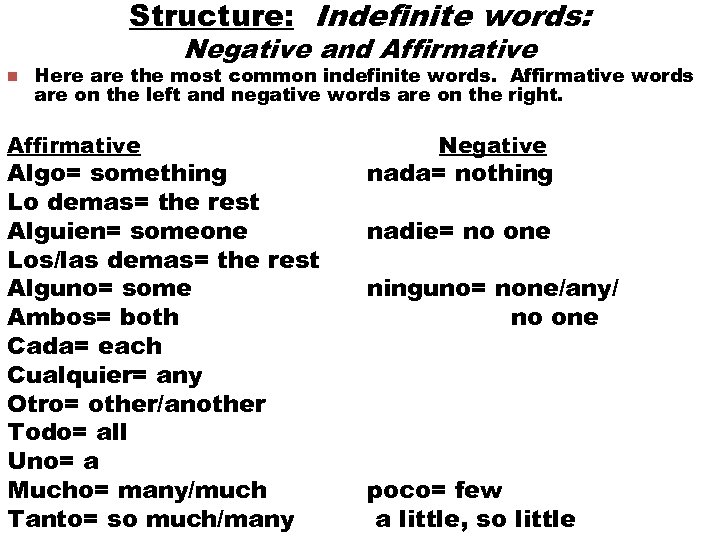 Structure: Indefinite words: Negative and Affirmative n Here are the most common indefinite words. Affirmative words are on the left and negative words are on the right. Affirmative Algo= something Lo demas= the rest Alguien= someone Los/las demas= the rest Alguno= some Ambos= both Cada= each Cualquier= any Otro= other/another Todo= all Uno= a Mucho= many/much Tanto= so much/many Negative nada= nothing nadie= no one ninguno= none/any/ no one poco= few a little, so little
 Structure: Past Perfect Tense n n n Use HABER in imperfect (había, habías, habíamos, habían) w/ past participle to form the Past Perfect Forming the Past Participle: Examples: n Ellos habían puesto la mesa. n They had set the table. n Yo había visto la película. n I had seen the movie.
 Structure: Accent Marks n In Spanish, a syllable has one vowel sound n n If a word ends with a vowel or with the letters “n” or “s, ” the stress, or emphasis, is naturally on the second to last syllable. n n Co-mo, vi-da, hi-jo, es-tu-dian-tes If a word ends with a consonant other than “n” or “s, ” the stress is naturally on the last syllable n n Dedo: de-do Varie-dad, trop-i-cal, cam-i-nar Accent marks are necessary to distinguish one word from another when they have the same spelling (si and sí), with interrogatives (¿qué? ), and to signal a break from the normal rules that indicate which syllable of a word is stressed (inglés)
 Structure: The Conditional tense q The Conditional tense is used to explain what would happen in a hypothetical situation. q q It is also used commonly to describe an action subsequent to another past action or to a time in the past. q q q 1. Keep the ar/er/ir and add Ía, ías, íamos, ían (hablaría, comerías, viviríamos) Irregular Verbs n 3. I would like to speak to the manager, please. Could you (would you be able to) tell me when the next train leaves? How it’s formed: Regular AR/IR/ER Verbs n 2. My friends told me they would come to the party later. The Conditional is also used to make a polite or softened requeset. q q I would go to the movies if I had money. Hacer: Har-ía, ías…. Saber: Sabr-ía, ías… Salir: Saldr-ía, ías… Other irregulars
 Structure: The Subjunctive mood is used for a variety of things in the Spanish language such as talking about something that is wished for or something that may not be true (i. e. expressing doubt) q For example, “I hope she calls” or “I doubt he will come. ” q Forming the Subjunctive: 1. Regular verbs n 2. Drop the AR and add the opposite ending: AR- e, es, e, emos, en ER/IR- a, as, a, amos, an Examples: n n Casar- Case, cases, casemos, casen Comer- Coma, comas, comamos, coman
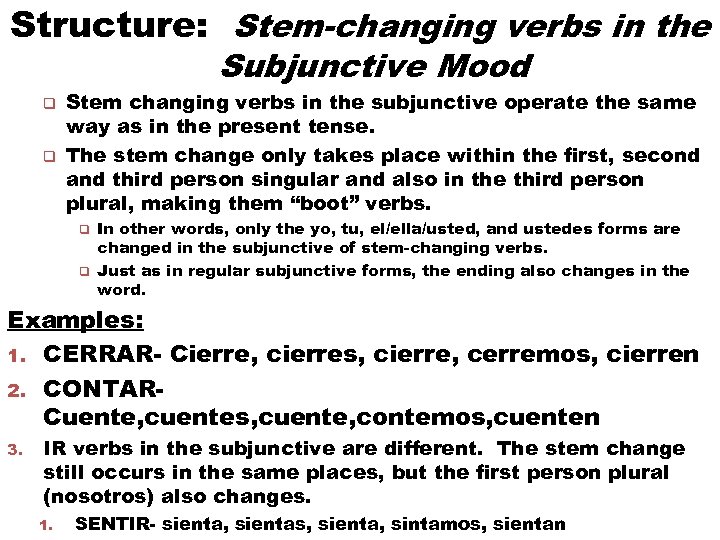 Structure: Stem-changing verbs in the Subjunctive Mood q q Stem changing verbs in the subjunctive operate the same way as in the present tense. The stem change only takes place within the first, second and third person singular and also in the third person plural, making them “boot” verbs. q q In other words, only the yo, tu, el/ella/usted, and ustedes forms are changed in the subjunctive of stem-changing verbs. Just as in regular subjunctive forms, the ending also changes in the word. Examples: 1. CERRAR- Cierre, cierres, cierre, cerremos, cierren 2. CONTARCuente, cuentes, cuente, contemos, cuenten 3. IR verbs in the subjunctive are different. The stem change still occurs in the same places, but the first person plural (nosotros) also changes. 1. SENTIR- sienta, sientas, sienta, sintamos, sientan
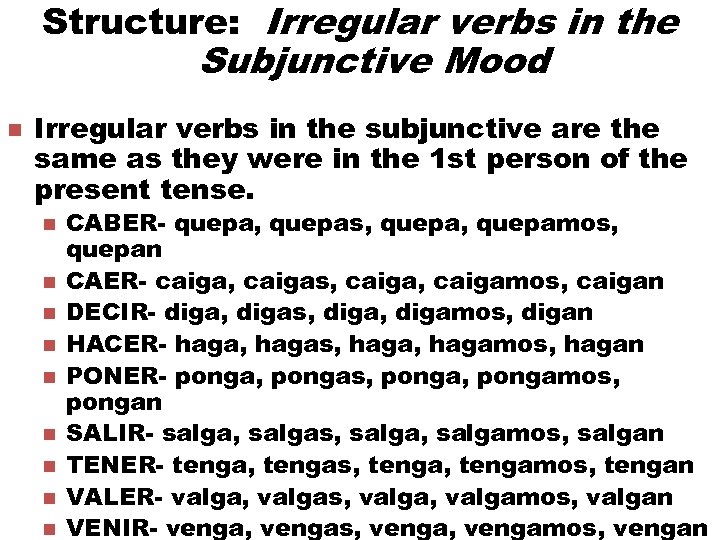 Structure: Irregular verbs in the Subjunctive Mood n Irregular verbs in the subjunctive are the same as they were in the 1 st person of the present tense. n n n n n CABER- quepa, quepas, quepamos, quepan CAER- caiga, caigas, caigamos, caigan DECIR- diga, digas, digamos, digan HACER- haga, hagas, hagamos, hagan PONER- ponga, pongas, pongamos, pongan SALIR- salga, salgas, salgamos, salgan TENER- tenga, tengas, tengamos, tengan VALER- valga, valgas, valgamos, valgan VENIR- venga, vengas, vengamos, vengan
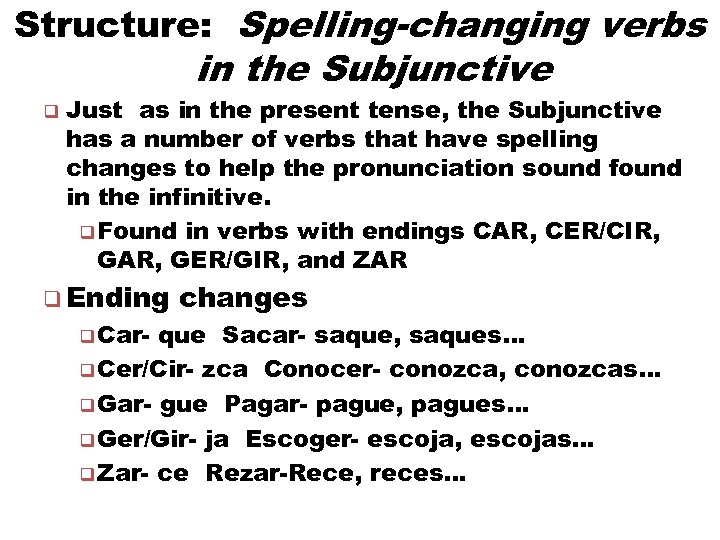 Structure: Spelling-changing verbs in the Subjunctive q Just as in the present tense, the Subjunctive has a number of verbs that have spelling changes to help the pronunciation sound found in the infinitive. q Found in verbs with endings CAR, CER/CIR, GAR, GER/GIR, and ZAR q Ending q Car- changes que Sacar- saque, saques… q Cer/Cir- zca Conocer- conozca, conozcas… q Gar- gue Pagar- pague, pagues… q Ger/Gir- ja Escoger- escoja, escojas… q Zar- ce Rezar-Rece, reces…
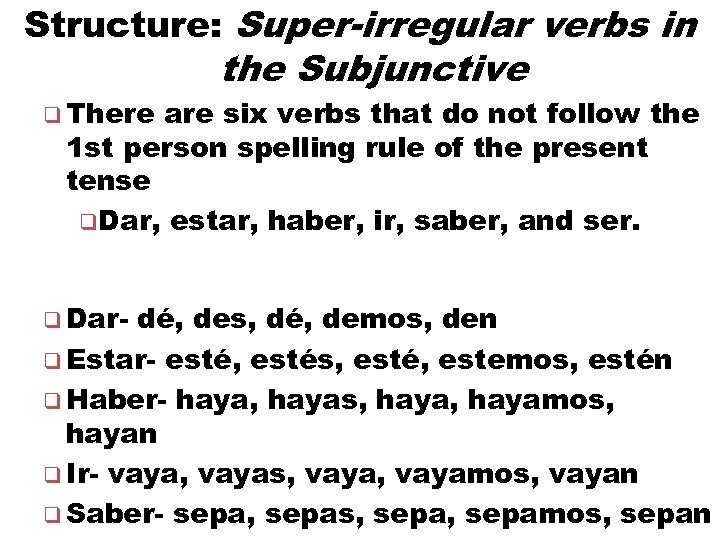 Structure: Super-irregular verbs in q There the Subjunctive are six verbs that do not follow the 1 st person spelling rule of the present tense q. Dar, estar, haber, ir, saber, and ser. q Dar- dé, des, dé, demos, den q Estar- esté, estés, esté, estemos, estén q Haber- haya, hayas, hayamos, hayan q Ir- vaya, vayas, vayamos, vayan q Saber- sepa, sepas, sepamos, sepan
 Structure: The Subjunctive after Indirect commands An indirect command features a main clause that asks someone to do something, and a dependent clause, after the word que, that mentions the action that the speaker wants the person to do. q The subjunctive is used in the dependent clause, after “que” q Example: “Quiero que mi amigo me llame- I want my friend to call me” q In the sentence above, the dependent clause hasn’t happened yet; it’s not yet true, which is why the subjunctive is used. Common command verbs which the Subjunctive follows: q n n n Decir- to tell Desear- to desire Esperar- to hope Querer- to want
 Structure: The Subjunctive after verbs of Emotion q q The Subjunctive is not only used for uncertainty; it can be found in any dependent clause after “que” when the main clause expresses an emotional reaction to the action in the second clause. Verbs that express emotion: q q q q q Alegrarse de- to be glad that Frustrale a alguien- to be frustrating to someone Gustarle a alguien- to be pleasing to someone Molestarle a alguien- to bother someone Preocuparle a alguien- to worry someone Sentir (ie)- to regret Sorprenderle a alguien- to surprise someone Tener miedo de- to be scared Formula for this type of sentence: q Verb or expression of emotion in main clause + que + verb in the subjunctive
 Structure: Indefinite Pronouns q Pronouns are words that take places of nouns q q Indefinite pronouns do not refer to specific people or things q q q Yo, tú, él, ella, usted, nosotros/as, ellos, ellas, ustedes Me, te, le, nos, les These can be direct, indirect, or reflexive. The three most common indefinites are: algo- something, alguien- someone/somebody, and alguno/a/os/as- some, someone (of a larger group). Before a masculine singular noun, alguno is shortened to algún! Corresponding negatives also go with these indefinites q q q Algo- nada- nothing Alguien- nadie- no one Alguno/a/os/as- ninguno/a- none q Before a masculine singular noun, ninguno is shortened to ningún!
 Structure: The Present Perfect Subjunctive q q The present perfect subjunctive is used in the dependent clasue after “que” when the main clause expresses emotion about an action that has occured in the recent past. It is formed using haber in the subjunctive followed by a past participle q Haya, hayas, hayamos, hayan follwed by (hablar) hablado, (comer) comido, or (vivir) vivido etc. q Examples: q Me q. I alegro de que hayan visto la película. am glad that you have seen the movie. q Nos q It frustra que no haya llovido hoy. frustrates us that it has not rained today.
 Structure: Temporal Expressions using LLEVAR + HACER q q q The verbs LLEVAR and HACER can be used to describe action that has been going on for a certain length of time The most common way to express ongoing action is with LLEVAR followed by a length of time and then a present participle; LLEVAR + length of time + present participle (i. e. hablando, comiendo, or viviendo) Construction of this tense with HACER is slightly more formal. This formula takes a form of HACER with “que” followed by a conjugated verb. q q For ongoing present actions, both the form of HACER and the verb following “que” must be in the present tense; for actions in the past, HACER and the verb after ‘que” must both be in the past tense. “Hace” or “Hacía” + period of time + que + verb in present or imperfect
 Structure: Idiomatic Expressions with the following: (DAR/HABER/HACER/TENER/VOLVER) q Expressions with DAR q q q q q Expressions with HABER q q q q Dar la luz- to bring out, come to light, also to give birth Dar con- to run into, to find Dar cuerda a- to wind Dar de beber/comer- to give drink/food to Dar una vuelta- to take a stroll Darse cuenta de- to realice Darse la mano- to shake hands Darse prisa- to be in a hurry Haber de + infinitive- to ought to do something Hay mucho que hacer- there’s alot to do Hay neblina- its foggy Hay que + infinitive- one must do something Hay sol- it’s sunny No hay de qué- you’re welcome Expressions with HACER q q q Hacerse viejo/a- to grow old Hacer el papel- to play a role Hacer caso a- to pay attention to
 Structure: Idiomatic expressions contd. n Expressions with TENER n n n n Tener la culpa- to be guilty Tener cuidado- to be careful Tener éxito- to be successful Tener ganas de- to want to do something/to feel like Tener prisa- to be in a hurry Tener que- to have to do something Tener que ver con- to have to do with Expressions with VOLVER n n Volver a + infinitive- to do something again Volver en sí- to come to; to regain consciousness Volver(le) loco/a- to drive someone crazy Volverse loco/a- to go crazy
 Structure: The Future Perfect tense q q n 1. Examples: Habrán hecho las enchiladas. n 2. They will have made the enchiladas. Antes de las siete nos habremos cepillado los dientes. n 3. The Future Perfect describes an event that will take place prior to another event, or before a time in the future. It is formed with the future form of HABER with a past participle q Habré, habrás, habrá, habremos, habrán + hablado, comido, vivido etc. Before seven we will have brushed our teeth. Lo habrás entendido todo. n You will have understood it all.
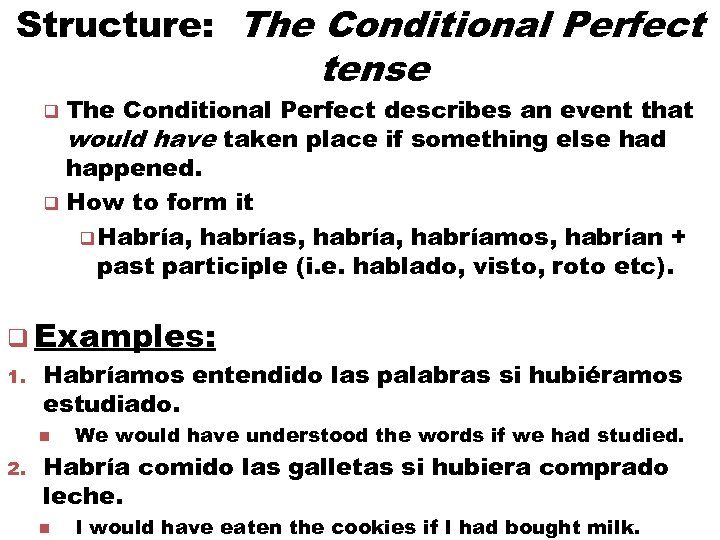 Structure: The Conditional Perfect tense The Conditional Perfect describes an event that would have taken place if something else had happened. q How to form it q Habría, habrías, habríamos, habrían + past participle (i. e. hablado, visto, roto etc). q q Examples: 1. Habríamos entendido las palabras si hubiéramos estudiado. n 2. We would have understood the words if we had studied. Habría comido las galletas si hubiera comprado leche. n I would have eaten the cookies if I had bought milk.
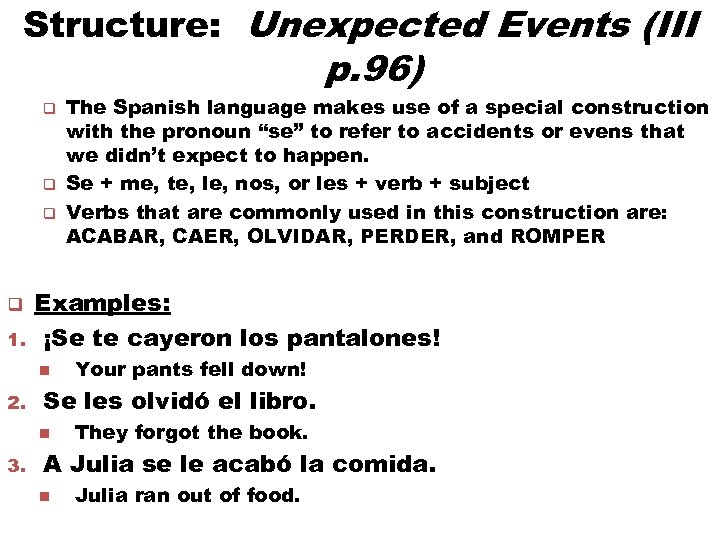 Structure: Unexpected Events (III p. 96) q q 1. Examples: ¡Se te cayeron los pantalones! n 2. Your pants fell down! Se les olvidó el libro. n 3. The Spanish language makes use of a special construction with the pronoun “se” to refer to accidents or evens that we didn’t expect to happen. Se + me, te, le, nos, or les + verb + subject Verbs that are commonly used in this construction are: ACABAR, CAER, OLVIDAR, PERDER, and ROMPER They forgot the book. A Julia se le acabó la comida. n Julia ran out of food.
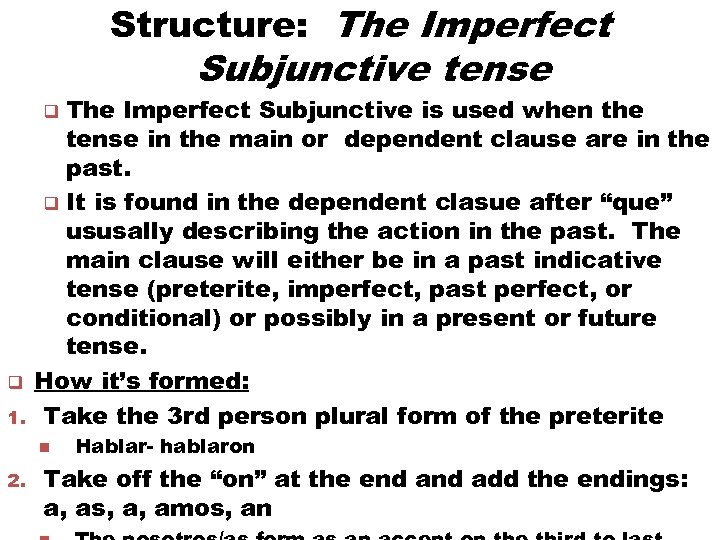 Structure: The Imperfect Subjunctive tense The Imperfect Subjunctive is used when the tense in the main or dependent clause are in the past. q It is found in the dependent clasue after “que” ususally describing the action in the past. The main clause will either be in a past indicative tense (preterite, imperfect, past perfect, or conditional) or possibly in a present or future tense. How it’s formed: Take the 3 rd person plural form of the preterite q q 1. n 2. Hablar- hablaron Take off the “on” at the end add the endings: a, as, a, amos, an
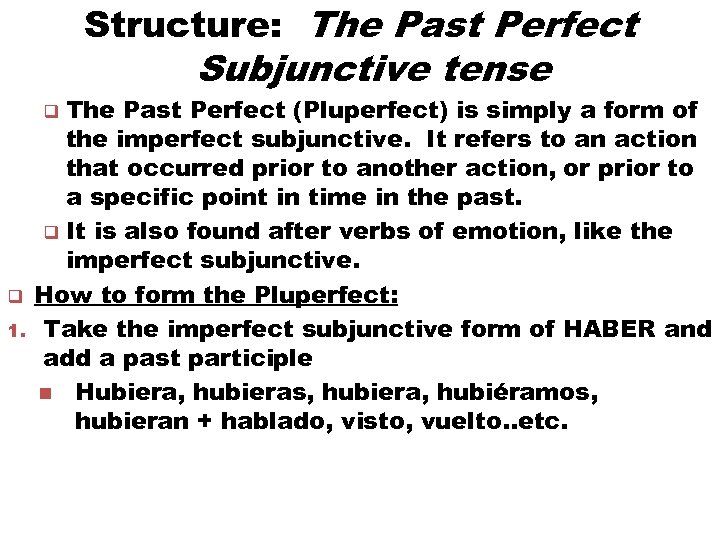 Structure: The Past Perfect Subjunctive tense The Past Perfect (Pluperfect) is simply a form of the imperfect subjunctive. It refers to an action that occurred prior to another action, or prior to a specific point in time in the past. q It is also found after verbs of emotion, like the imperfect subjunctive. How to form the Pluperfect: Take the imperfect subjunctive form of HABER and add a past participle n Hubiera, hubieras, hubiera, hubiéramos, hubieran + hablado, visto, vuelto. . etc. q q 1.
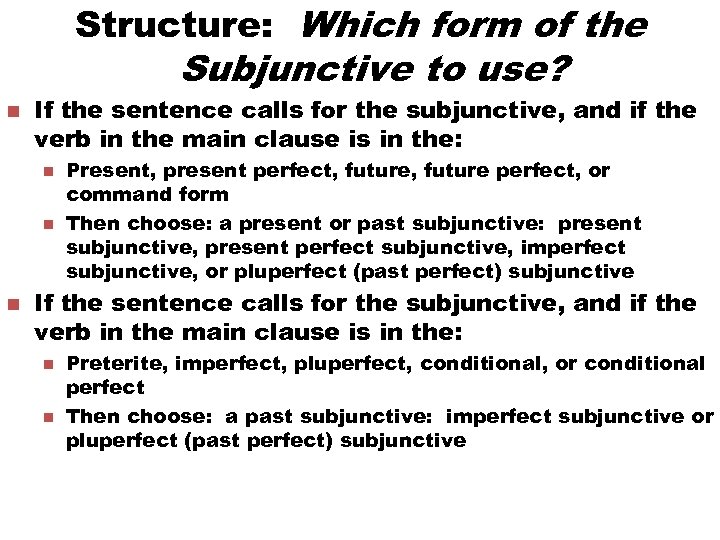 Structure: Which form of the Subjunctive to use? n If the sentence calls for the subjunctive, and if the verb in the main clause is in the: n n n Present, present perfect, future perfect, or command form Then choose: a present or past subjunctive: present subjunctive, present perfect subjunctive, imperfect subjunctive, or pluperfect (past perfect) subjunctive If the sentence calls for the subjunctive, and if the verb in the main clause is in the: n n Preterite, imperfect, pluperfect, conditional, or conditional perfect Then choose: a past subjunctive: imperfect subjunctive or pluperfect (past perfect) subjunctive
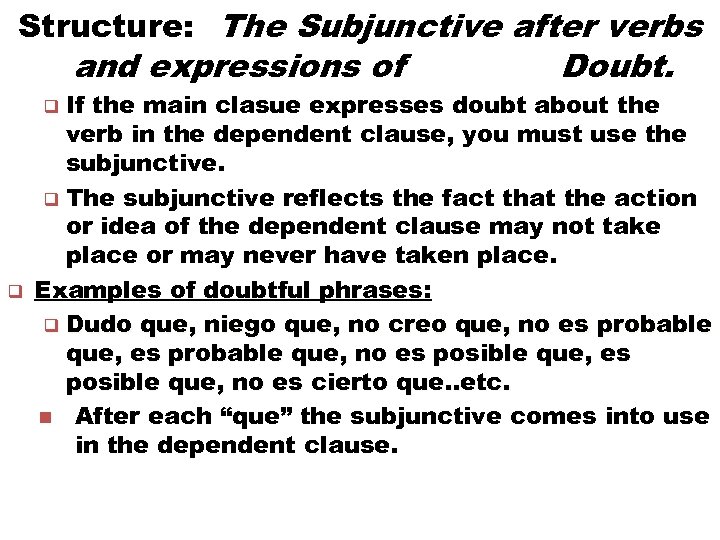 Structure: The Subjunctive after verbs and expressions of If the main clasue expresses doubt about the verb in the dependent clause, you must use the subjunctive. q The subjunctive reflects the fact that the action or idea of the dependent clause may not take place or may never have taken place. Examples of doubtful phrases: q Dudo que, niego que, no creo que, no es probable que, no es posible que, no es cierto que. . etc. n After each “que” the subjunctive comes into use in the dependent clause. q q Doubt.
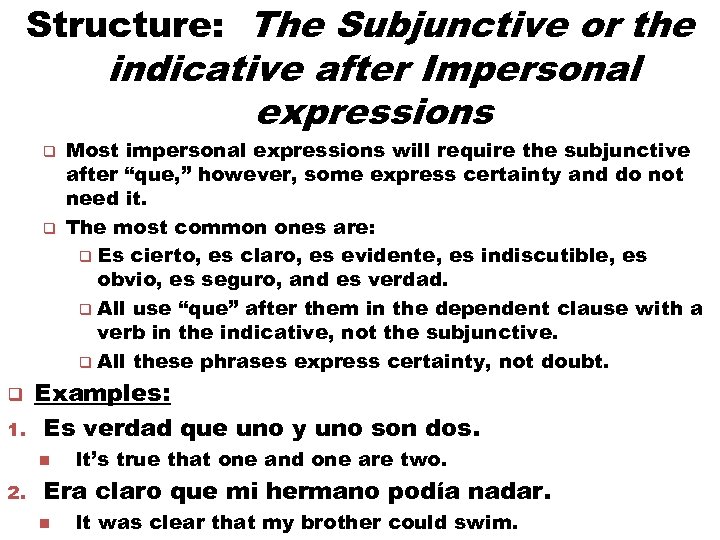 Structure: The Subjunctive or the indicative after Impersonal expressions q q q 1. Examples: Es verdad que uno y uno son dos. n 2. Most impersonal expressions will require the subjunctive after “que, ” however, some express certainty and do not need it. The most common ones are: q Es cierto, es claro, es evidente, es indiscutible, es obvio, es seguro, and es verdad. q All use “que” after them in the dependent clause with a verb in the indicative, not the subjunctive. q All these phrases express certainty, not doubt. It’s true that one and one are two. Era claro que mi hermano podía nadar. n It was clear that my brother could swim.
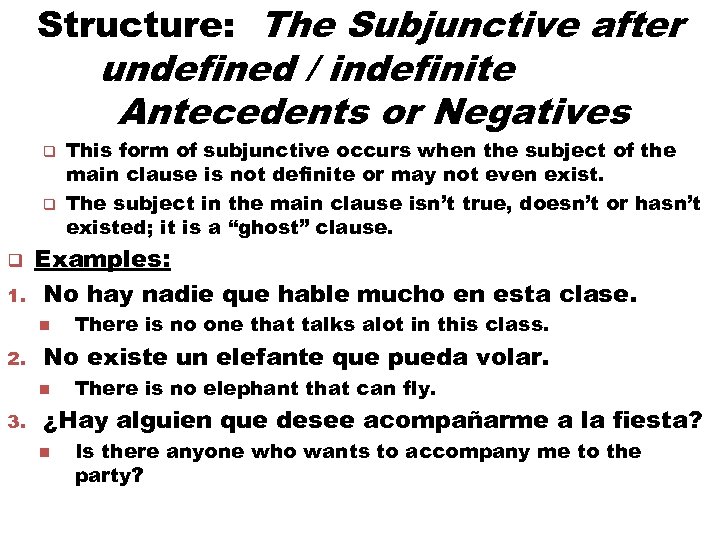 Structure: The Subjunctive after undefined / indefinite Antecedents or Negatives q q q 1. Examples: No hay nadie que hable mucho en esta clase. n 2. There is no one that talks alot in this class. No existe un elefante que pueda volar. n 3. This form of subjunctive occurs when the subject of the main clause is not definite or may not even exist. The subject in the main clause isn’t true, doesn’t or hasn’t existed; it is a “ghost” clause. There is no elephant that can fly. ¿Hay alguien que desee acompañarme a la fiesta? n Is there anyone who wants to accompany me to the party?
 Structure: The Subjunctive after some Adverbial expressions q q q 1. Examples: Voy a salir ahora a menos que quieras hablar conmigo. n 2. The most common adverbial expressions can be remembered by ESCAPA: En caso de que- in case, Sin quewithout, Con tal que- provided that, A menos que- unless, Para que- in order that, and Antes de que- before. Each of these expressions ends with “que” and must have the subjunctive, no matter what. I’m going to leave now unless you want to talk to me. Vas a salir sin que yo te hable. n You are going to leave without my speaking to you.
 Structure: The use of the Imperfect Subjunctive to make polite requests The imperfect subjunctive can also be used to make a polite request, an alternative to the conditional. q It uses the following verbs: DEBER, PODER, and QUERER. Examples: Debiéramos ir al cine. ¿Tienes dinero? q q 1. n 2. ¿Pudiéramos pasar un rato en el parque? n 3. We should go to the movies. Do you have money? Could we spend time in the park? Quisiéra hablar con mis amigos, por favor. n I’d like to speak with my friends, please.
 Structure: The use of “se” to express the passive voice or an impersonal subject q q q 1. Examples: Se busca una criada nueva en esa casa. n 2. A new maid is being searched for in that house. Se desean profesores de español. n 3. The passive voice can be formed by using “se” before the verb in the sentence. The verb will be in the 3 rd person singular or plural. Se + verb + subject Spanish teachers are wanted. Se venden carros aquí. n Cars are sold here.
 Structure: The use of the 3 rd Person Plural (undefined) to express the Passive Voice To form the passive voice, simply use the indefinite 3 rd person plural form. Examples: Construyeron esos edificios en 1990. q q 1. n 2. Hablan español in Puerto Rico. n 3. Spanish is spoken in Puerto Rico. Dicen que va a llover hoy. n 4. Those buildings were built in 1990. They say that it is going to rain today. Lo descubrieron en México. n It was discovered in Mexico.
 Structure: Punctuation and Spanish Capitalization (Bk III p. 220) q Upside down question marks and exclamation point are found at the beginning of a sentence that is a question or an exclamation, or at the point in the sentence that is the actual question q q Spanish notations: q q q 5, 000 - 5. 000 5. 5%- 5, 5% $1, 000. 55 - $1. 000, 55 Cents- centavos In dialogue: q q Bailas bien, ¿no? Periods and commas are found outside quotations, not inside like in English. Months, days of the week, and nationalities aren’t capitalized. q El martes, noviembre, norteamericano.
 Structure: The uses of the word “lo” q q 1. Examples: Comprendo lo peligrosos que son esos ladrones. n 2. I understand how dangerous those robbers are. Mi amigo y yo siempre pensamos lo mismo. n 3. Adjectives or adverbs can function as abstract nouns in combination with the article “lo. ” “Lo” is often used with verbs such as SER, ESTAR, and PARECER to represent a previously stated idea or description. Lo is also used in many idiomatic expressions: a lo lejosin the distance, a lo mejor- probably, lo de siempre- the same as usual. My friend and I always think the same. No nos gusta lo despacio que ella se peina el pelo. n We don’t like how slowly she combs her hair.
 Structure: The uses of PERO, SINO and SINO QUE q q q Pero, sino, and sino que, meaning but, nevertheless, or but rather, are words used to help connect clauses within sentences. Pero is the most common way to say “but” and is found after affirmative clauses or after negaive clauses when there are no direct contrasts of equivalent parts of speech. Sino can mean but rather and is used after a negative clause when there is a direct contradiction in the second clause. q q No soy alta, sino baja. I’m not tall, but (rather) short. Sino que also means but rather and is found after negative clauses when there is a contradicting idea expressed with a conjugated verb in the second clause. q No preparamos enchiladas en esta cocina, sino que las comemos. We don’t prepare enchiladas in this kitchen, but rather we eat them.
 Intermediate Low (4) Function Make suggestions / Give Advice Structure: The SUBJUNCTIVE n The SUBJUNCTIVE is formed by taking the yo form of the verb, dropping the “o” and adding the opposite (AR or ER) ending. n Hablar Habl- Hable, hables, hablemos, hablen. n Comer Com- Coma, comas, comamos, coman. n Tener Teng- Tenga, tengas, tengamos, tengan. n
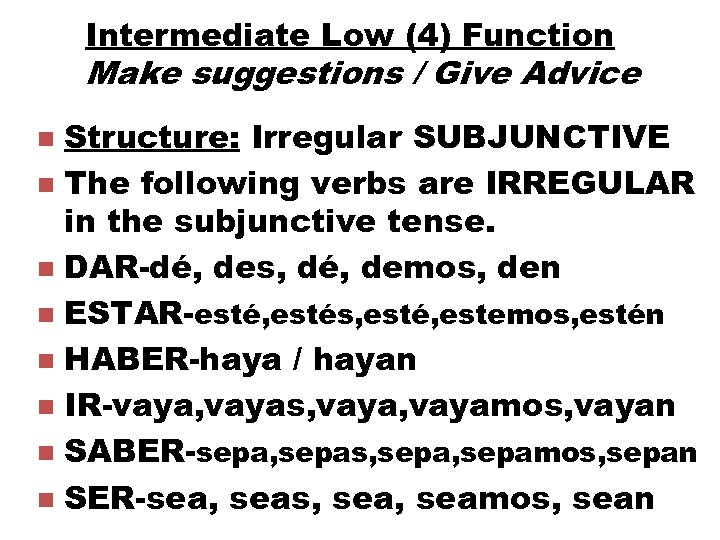 Intermediate Low (4) Function Make suggestions / Give Advice Structure: Irregular SUBJUNCTIVE n The following verbs are IRREGULAR in the subjunctive tense. n DAR-dé, des, dé, demos, den n ESTAR-esté, estés, esté, estemos, estén n HABER-haya / hayan n IR-vaya, vayas, vayamos, vayan n SABER-sepa, sepas, sepamos, sepan n SER-sea, seas, seamos, sean n
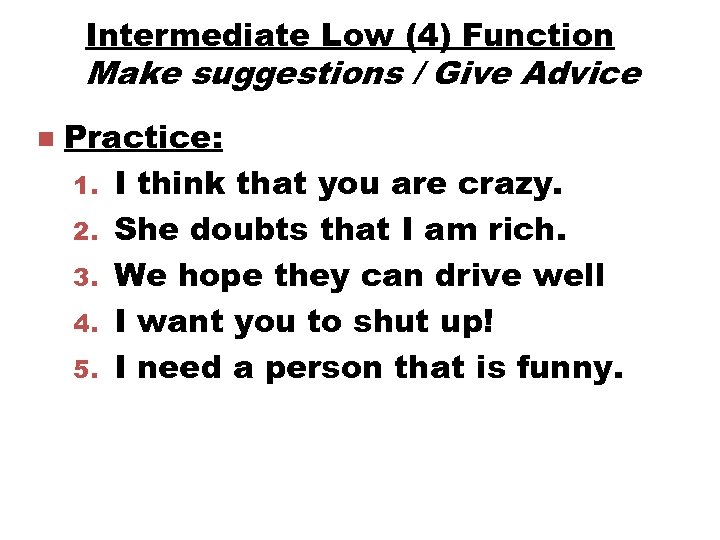 Intermediate Low (4) Function Make suggestions / Give Advice n Practice: 1. I think that you are crazy. 2. She doubts that I am rich. 3. We hope they can drive well 4. I want you to shut up! 5. I need a person that is funny.
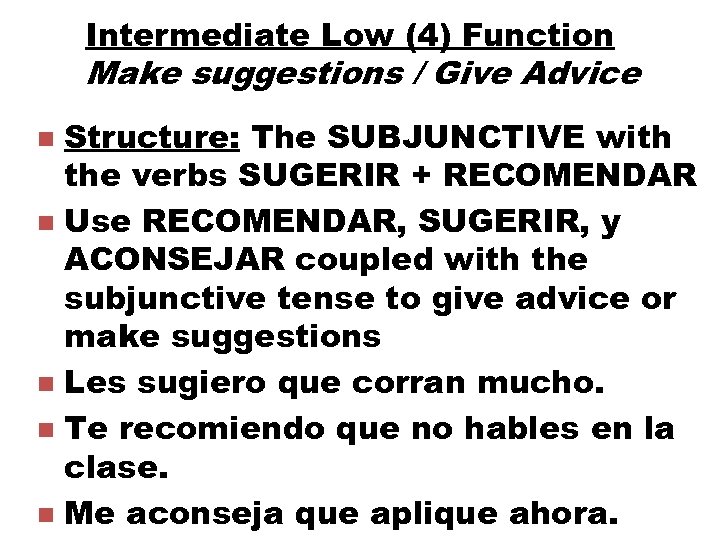 Intermediate Low (4) Function Make suggestions / Give Advice Structure: The SUBJUNCTIVE with the verbs SUGERIR + RECOMENDAR n Use RECOMENDAR, SUGERIR, y ACONSEJAR coupled with the subjunctive tense to give advice or make suggestions n Les sugiero que corran mucho. n Te recomiendo que no hables en la clase. n Me aconseja que aplique ahora. n
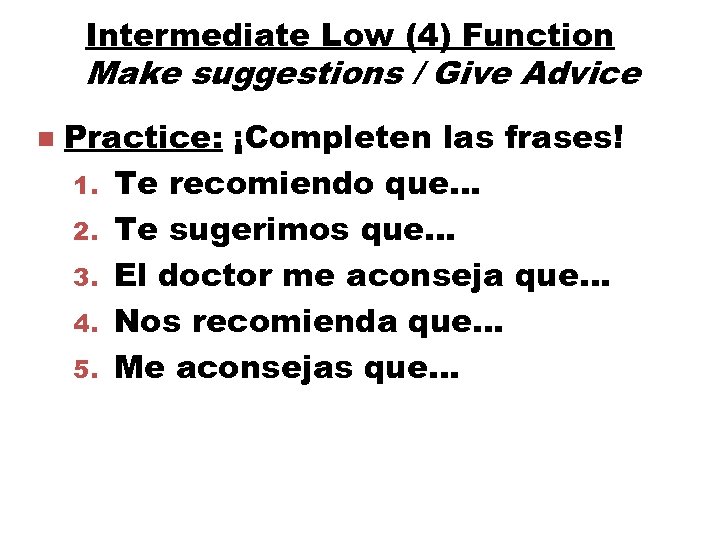 Intermediate Low (4) Function Make suggestions / Give Advice n Practice: ¡Completen las frases! 1. Te recomiendo que… 2. Te sugerimos que… 3. El doctor me aconseja que… 4. Nos recomienda que… 5. Me aconsejas que…
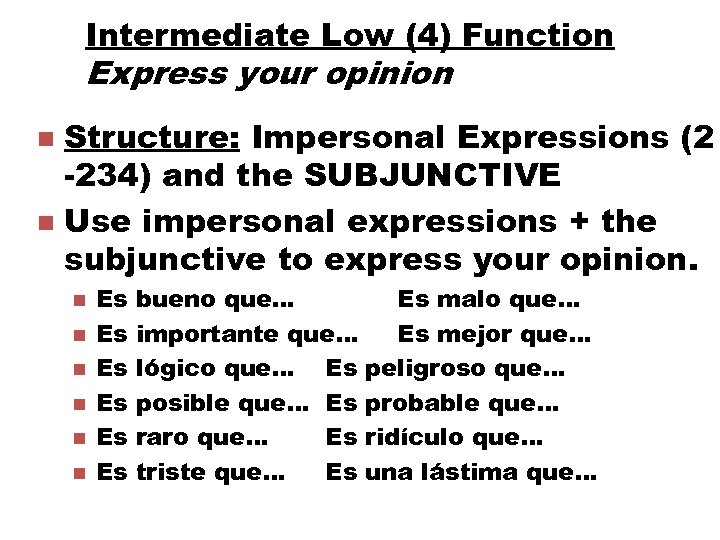 Intermediate Low (4) Function Express your opinion Structure: Impersonal Expressions (2 -234) and the SUBJUNCTIVE n Use impersonal expressions + the subjunctive to express your opinion. n n n n Es Es Es bueno que… Es malo que… importante que… Es mejor que… lógico que… Es peligroso que… posible que… Es probable que… raro que… Es ridículo que… triste que… Es una lástima que…
 Intermediate Low (4) Function Express your opinion n Practice: ¡Completen las frases! 1. Es lógico que… 2. Es probable que… 3. Es raro que… 4. Es una lástima que… 5. Es peligroso que…
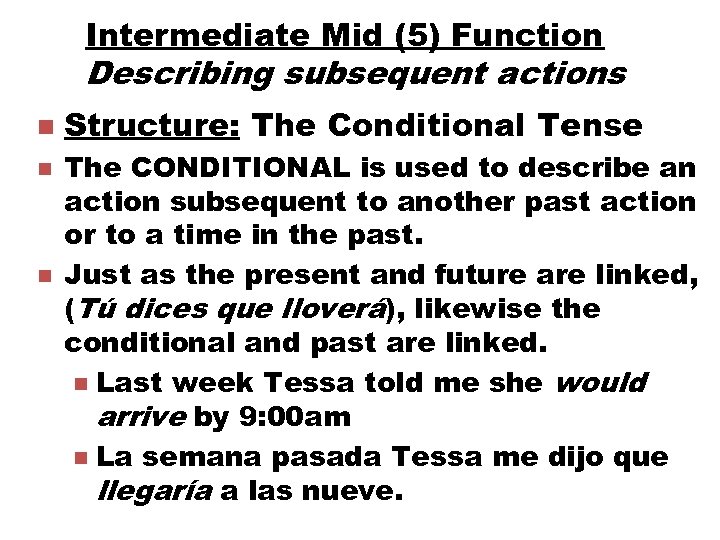 Intermediate Mid (5) Function Describing subsequent actions n n n Structure: The Conditional Tense The CONDITIONAL is used to describe an action subsequent to another past action or to a time in the past. Just as the present and future are linked, (Tú dices que lloverá), likewise the conditional and past are linked. n Last week Tessa told me she would arrive by 9: 00 am n La semana pasada Tessa me dijo que llegaría a las nueve.
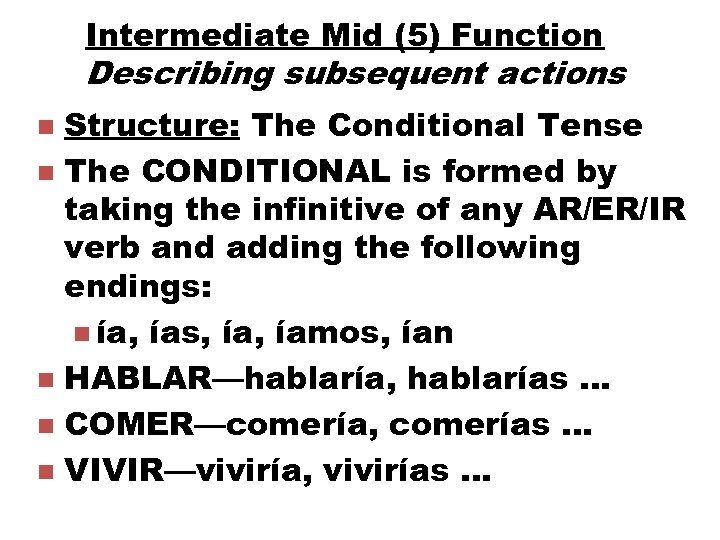 Intermediate Mid (5) Function Describing subsequent actions Structure: The Conditional Tense n The CONDITIONAL is formed by taking the infinitive of any AR/ER/IR verb and adding the following endings: n ía, ías, íamos, ían n HABLAR—hablaría, hablarías … n COMER—comería, comerías … n VIVIR—viviría, vivirías … n
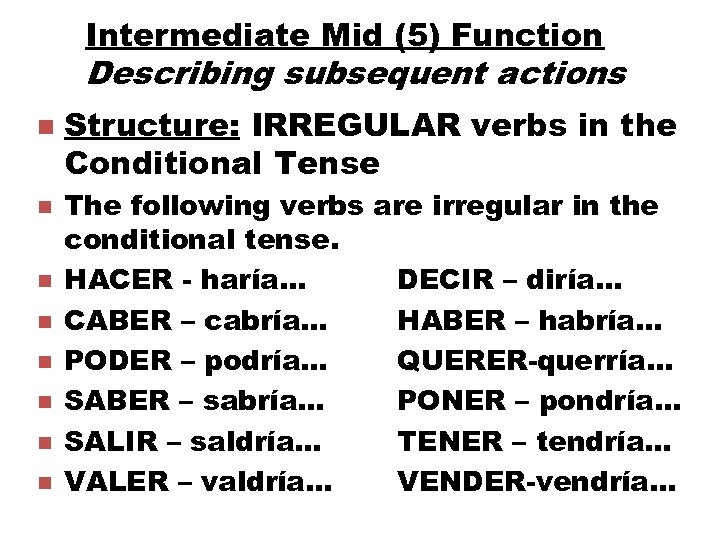 Intermediate Mid (5) Function Describing subsequent actions n n n n Structure: IRREGULAR verbs in the Conditional Tense The following verbs are irregular in the conditional tense. HACER - haría… DECIR – diría… CABER – cabría… HABER – habría… PODER – podría… QUERER-querría… SABER – sabría… PONER – pondría… SALIR – saldría… TENER – tendría… VALER – valdría… VENDER-vendría…
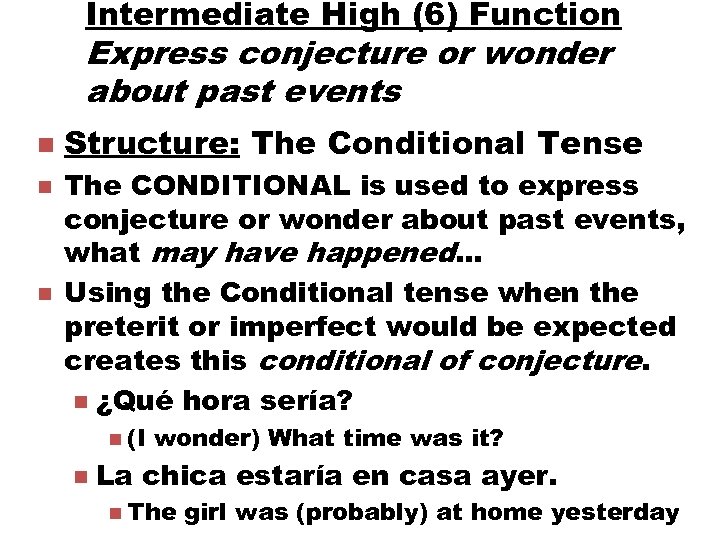 Intermediate High (6) Function Express conjecture or wonder about past events n n n Structure: The Conditional Tense The CONDITIONAL is used to express conjecture or wonder about past events, what may have happened… Using the Conditional tense when the preterit or imperfect would be expected creates this conditional of conjecture. n ¿Qué hora sería? n (I n wonder) What time was it? La chica estaría en casa ayer. n The girl was (probably) at home yesterday
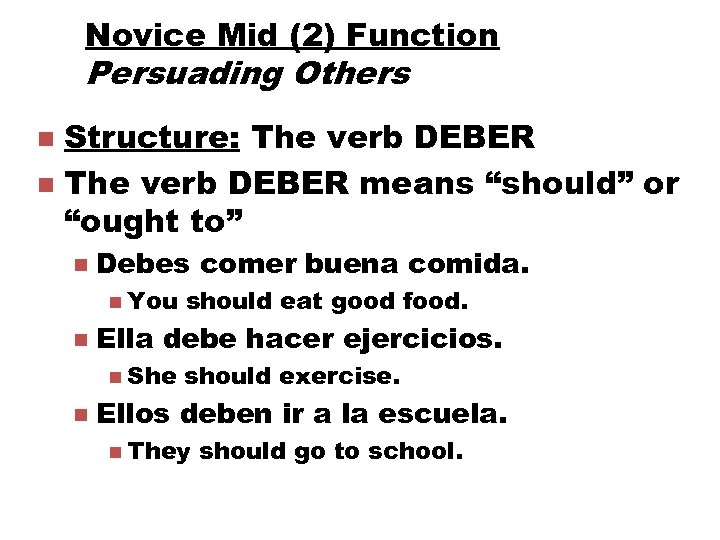 Novice Mid (2) Function Persuading Others Structure: The verb DEBER n The verb DEBER means “should” or “ought to” n n Debes comer buena comida. n You n Ella debe hacer ejercicios. n She n should eat good food. should exercise. Ellos deben ir a la escuela. n They should go to school.
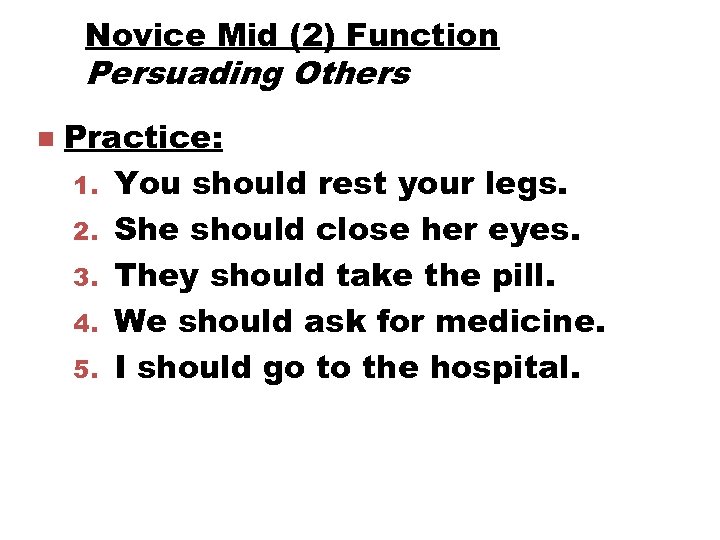 Novice Mid (2) Function Persuading Others n Practice: 1. You should rest your legs. 2. She should close her eyes. 3. They should take the pill. 4. We should ask for medicine. 5. I should go to the hospital.
 Novice Mid (2) Function Describe Daily Routine Structure: Reflexive Verbs (2 -187) n Reflexive verbs use reflexive pronouns to bounce or reflect the action back to the speaker. n Reflexive pronouns include ME, TE, SE, NOS, SE, and are placed in front of the conjugated (changed) verb. n Me afeito en la mañana. n Te cepillas los dientes en la noche. n Ella se lava la cara en el baño. n
 Novice Mid (2) Function Describe body parts and pain Structure: The verb DOLERSE and body part vocabulary n The verb DOLERSE is very similar to GUSTARSE. n n Me duele la pierna. n My n leg hurts. Te duelen los ojos. n Your n eyes hurt. Nos duelen las manos. n Our hands hurt.
 Novice High (3) Function Talk about feelings n n n Structure: The verb ESTAR or SENTIRSE or TENER and vocabulary (1 -195) ESTAR can be coupled with emotional vocabulary like triste, contento, deprimido, aburrido, etc. TENER is used with the following vocab (1229) n n n Calor, frío, cuidado, miedo, prisa, razón, sueño, suerte, hambre, and sed. Yo tengo prisa = I’m in a hurry. SENTIRSE means “to feel” and is reflexive. n Me siento mal. n Ella se siente bien. n Te sientes enfermo.
 Novice Mid (3) Function Describe time periods n n Structure: HACE QUE expressions Use HACE + period of time + que + present tense to describe how long it has been or how long it has been going on. n n n Hace cuatro años que quiero hablar con ella. (I’ve wanted to talk to her for 4 years). Hace una hora que lo espero. (I’ve been waiting for him for an hour). If asking a question, use ¿Cuánto tiempo + hace que + present tense. n ¿Cuánto tiempo hace que miras la TV? n How long have you been watching TV?
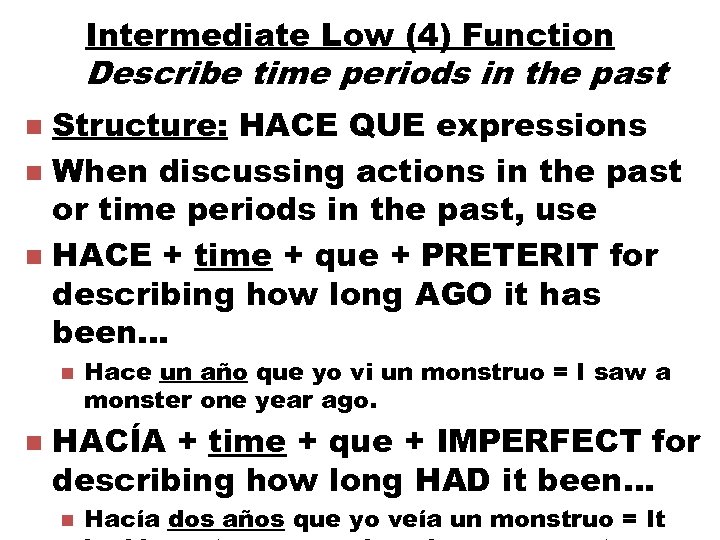 Intermediate Low (4) Function Describe time periods in the past Structure: HACE QUE expressions n When discussing actions in the past or time periods in the past, use n HACE + time + que + PRETERIT for describing how long AGO it has been… n n n Hace un año que yo vi un monstruo = I saw a monster one year ago. HACÍA + time + que + IMPERFECT for describing how long HAD it been… n Hacía dos años que yo veía un monstruo = It
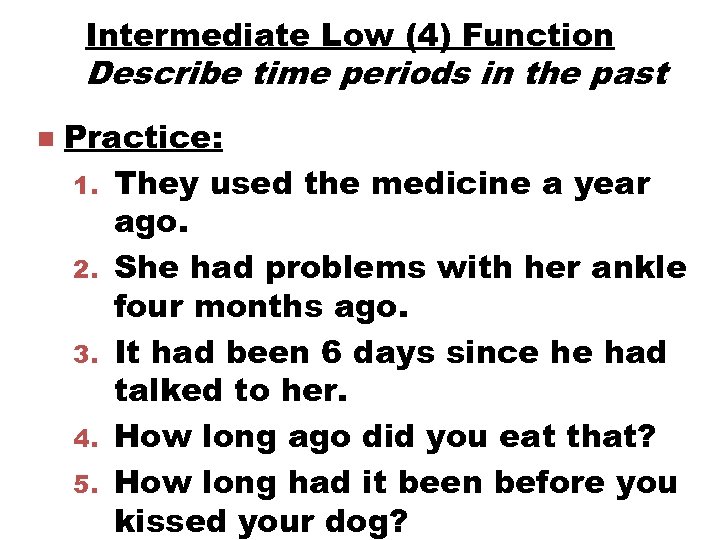 Intermediate Low (4) Function Describe time periods in the past n Practice: 1. They used the medicine a year ago. 2. She had problems with her ankle four months ago. 3. It had been 6 days since he had talked to her. 4. How long ago did you eat that? 5. How long had it been before you kissed your dog?