


 Скачать презентацию Full employment or a natural rate of unemployment
33d50f5d8cdce61b7cd50a5631dd8c56.ppt
- Количество слайдов: 36
 Full employment or a 'natural' rate of unemployment (NAIRU)? by Dr Alfred Kleinknecht Emeritus Professor of Economics Fellow of WSI, Wirtschafts und Sozialwissenschaftliches Institut, Hans Bӧckler Stiftung, Düsseldorf alfred kleinknecht@boeckler. de
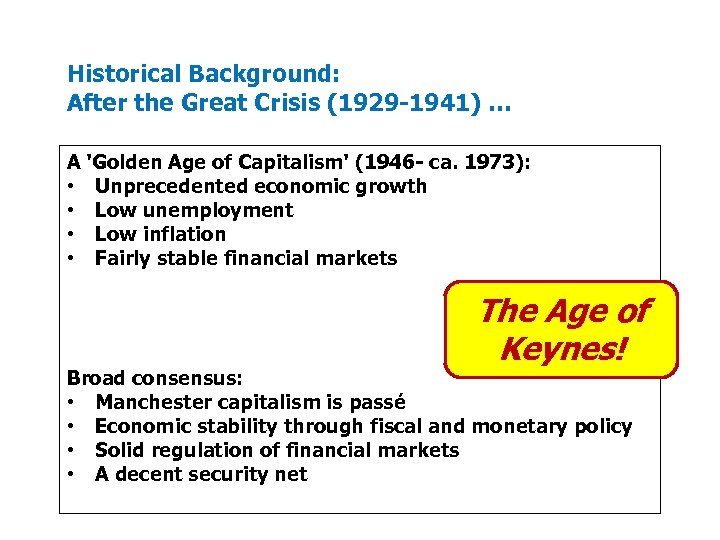 Historical Background: After the Great Crisis (1929 1941) … A 'Golden Age of Capitalism' (1946 ca. 1973): • Unprecedented economic growth • Low unemployment • Low inflation • Fairly stable financial markets The Age of Keynes! Broad consensus: • Manchester capitalism is passé • Economic stability through fiscal and monetary policy • Solid regulation of financial markets • A decent security net
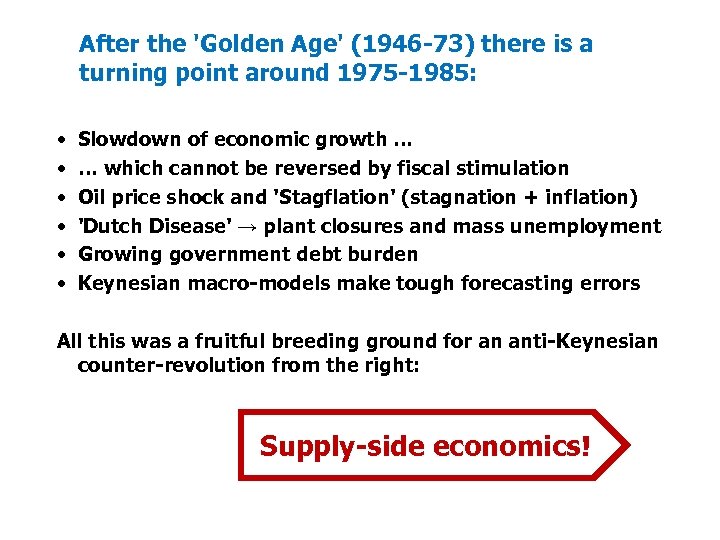 After the 'Golden Age' (1946 73) there is a turning point around 1975 1985: • • • Slowdown of economic growth … … which cannot be reversed by fiscal stimulation Oil price shock and 'Stagflation' (stagnation + inflation) 'Dutch Disease' → plant closures and mass unemployment Growing government debt burden Keynesian macro models make tough forecasting errors All this was a fruitful breeding ground for an anti Keynesian counter revolution from the right: Supply side economics!
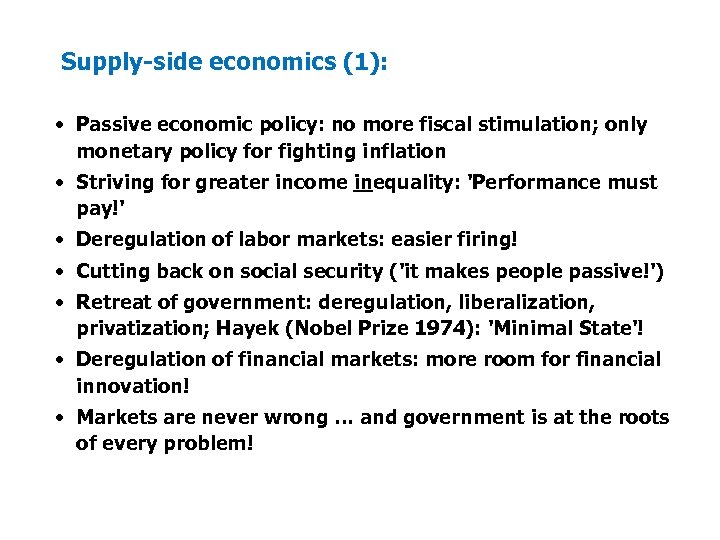 Supply side economics (1): • Passive economic policy: no more fiscal stimulation; only monetary policy for fighting inflation • Striving for greater income inequality: 'Performance must pay!' • Deregulation of labor markets: easier firing! • Cutting back on social security ('it makes people passive!') • Retreat of government: deregulation, liberalization, privatization; Hayek (Nobel Prize 1974): 'Minimal State'! • Deregulation of financial markets: more room for financial innovation! • Markets are never wrong … and government is at the roots of every problem!
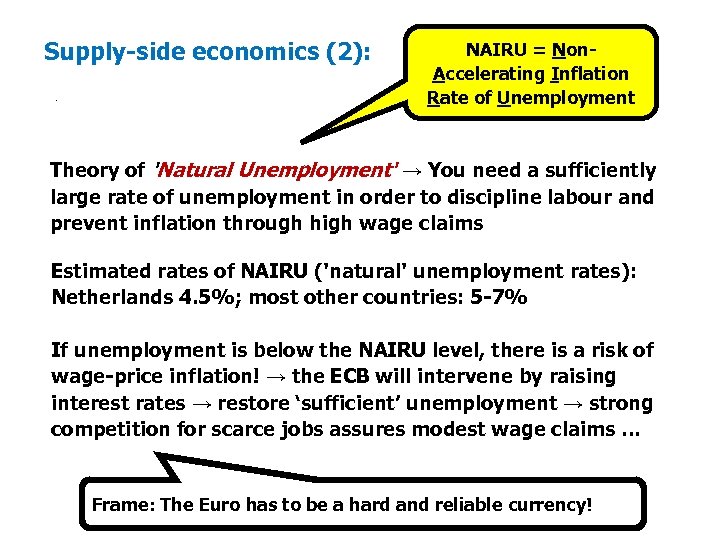 Supply side economics (2): . NAIRU = Non Accelerating Inflation Rate of Unemployment Theory of 'Natural Unemployment' → You need a sufficiently large rate of unemployment in order to discipline labour and prevent inflation through high wage claims Estimated rates of NAIRU ('natural' unemployment rates): Netherlands 4. 5%; most other countries: 5 7% If unemployment is below the NAIRU level, there is a risk of wage price inflation! → the ECB will intervene by raising interest rates → restore ‘sufficient’ unemployment → strong competition for scarce jobs assures modest wage claims … Frame: The Euro has to be a hard and reliable currency!
 Supply side economics works (at least in one point): Greater inequality … Share in National Income in the US: Of the richest 10%: q 33% in 1976 q 50% in 2007 … and of the richest 1%: q 8. 9% in 1976 q 23. 5% in 2007 Source: Atkinson, Piketty and Saez (2011)
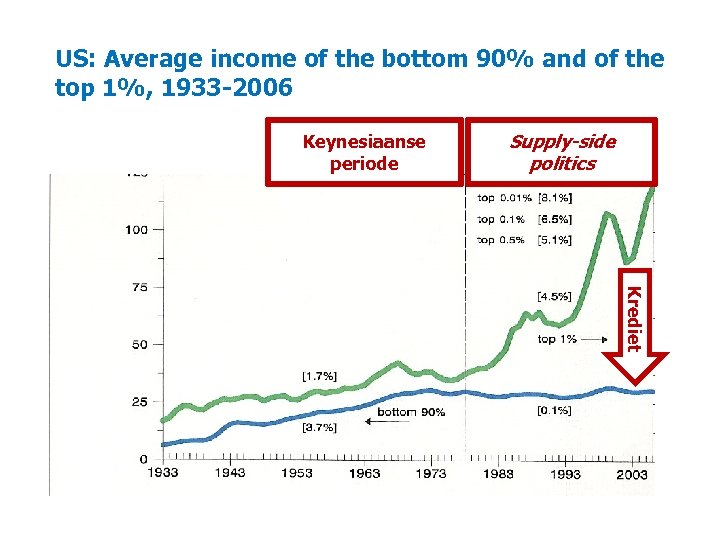 US: Average income of the bottom 90% and of the top 1%, 1933 2006 Keynesiaanse periode Supply side politics Krediet
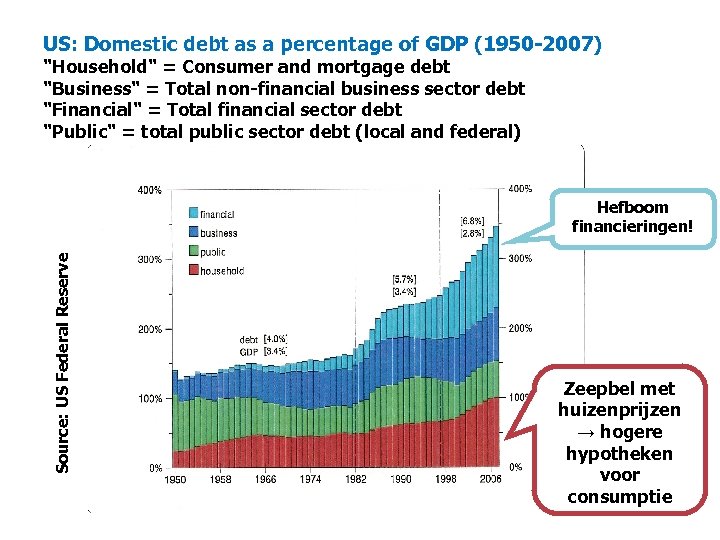 US: Domestic debt as a percentage of GDP (1950 2007) "Household" = Consumer and mortgage debt "Business" = Total non financial business sector debt "Financial" = Total financial sector debt "Public" = total public sector debt (local and federal) Source: US Federal Reserve Hefboom financieringen! Zeepbel met huizenprijzen → hogere hypotheken voor consumptie
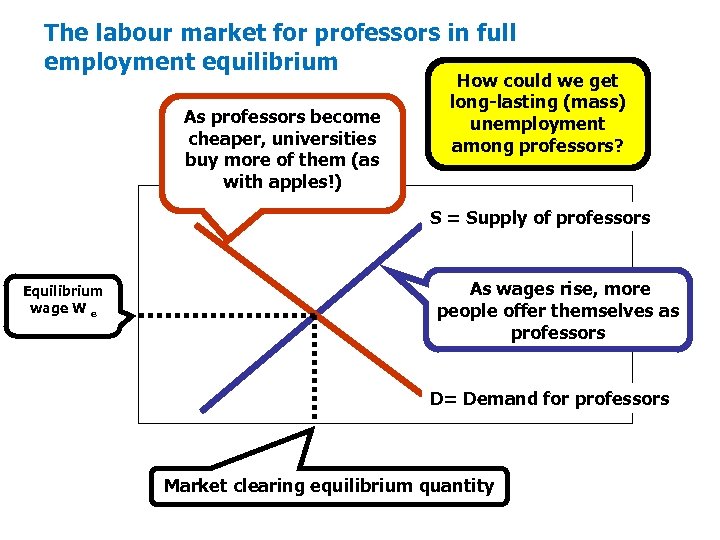 The labour market for professors in full employment equilibrium As professors become cheaper, universities buy more of them (as with apples!) How could we get long lasting (mass) unemployment among professors? S = Supply of professors Equilibrium wage W e As wages rise, more people offer themselves as professors D= Demand for professors Market clearing equilibrium quantity
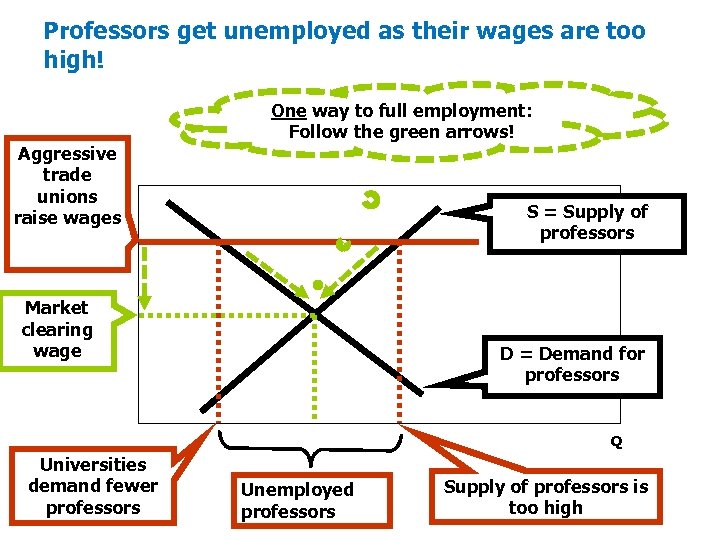 Professors get unemployed as their wages are too high! Aggressive trade unions raise wages One way to full employment: Follow the green arrows! S = Supply of professors Market clearing wage D = Demand for professors Q Universities demand fewer professors Unemployed professors Supply of professors is too high
 The dominant neo classical view: High European unemployment is due to labour market rigidities: the price of labour is downwardly rigid and cannot adapt to economic shocks Key policy targets: § Lower minimum wages § Lower social benefits § More tailor made wage contracts (de centralization of wage bargaining → allow for a more unequal income distribution!) § Easier firing: change power relations on the shop floor § Reduce the power of trade unions (= cartels that act against the real interest of labour!)
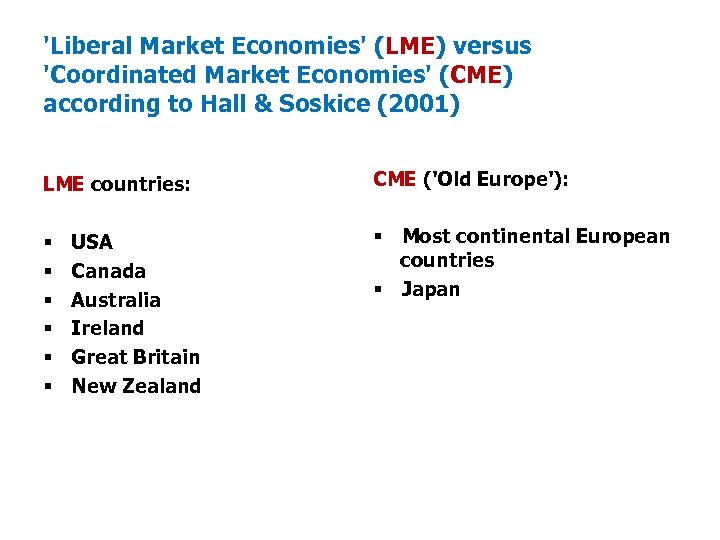 'Liberal Market Economies' (LME) versus 'Coordinated Market Economies' (CME) according to Hall & Soskice (2001) LME countries: § § § USA Canada Australia Ireland Great Britain New Zealand CME ('Old Europe'): § Most continental European countries § Japan
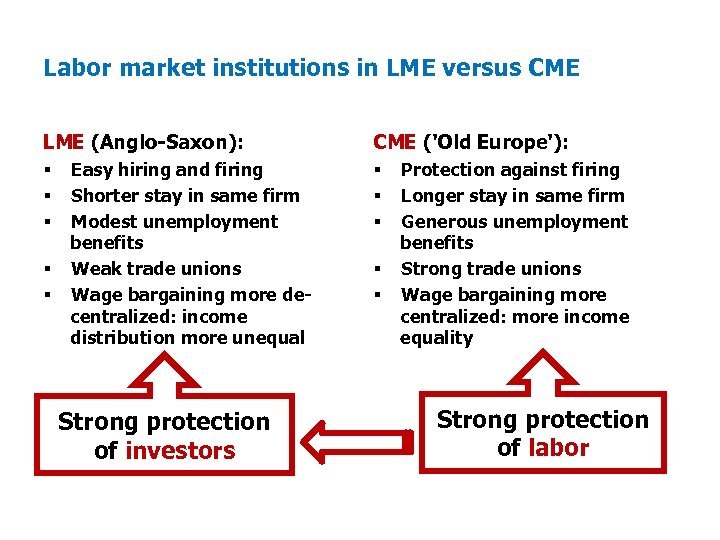 Labor market institutions in LME versus CME LME (Anglo Saxon): § § § Easy hiring and firing Shorter stay in same firm Modest unemployment benefits Weak trade unions Wage bargaining more de centralized: income distribution more unequal Strong protection of investors CME ('Old Europe'): § § § Protection against firing Longer stay in same firm Generous unemployment benefits Strong trade unions Wage bargaining more centralized: more income equality Strong protection of labor
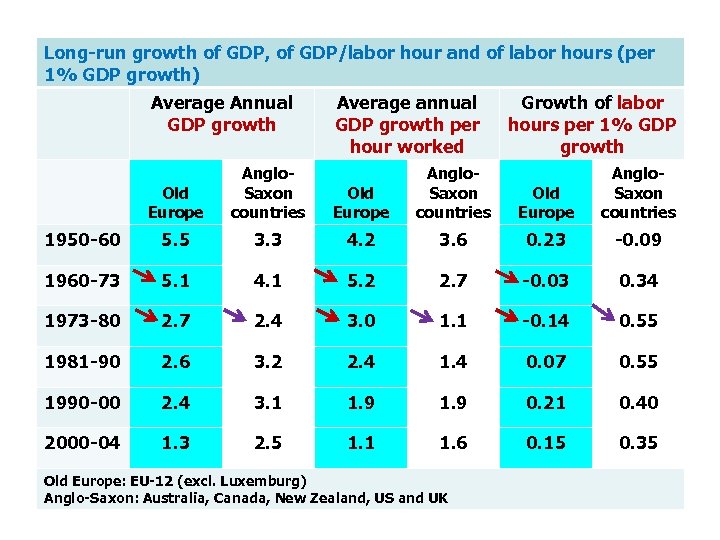
 Labor market institutions in LME versus CME: Is there a difference in economic performance? (incomes? job creation? Productivity growth? GDP growth? ) Looking at some key variables …
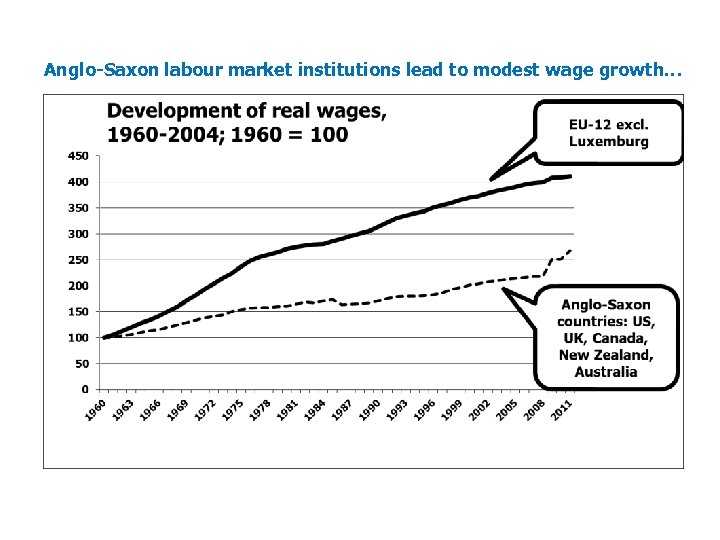 Anglo Saxon labour market institutions lead to modest wage growth… Development of real wages, 1960 = 100
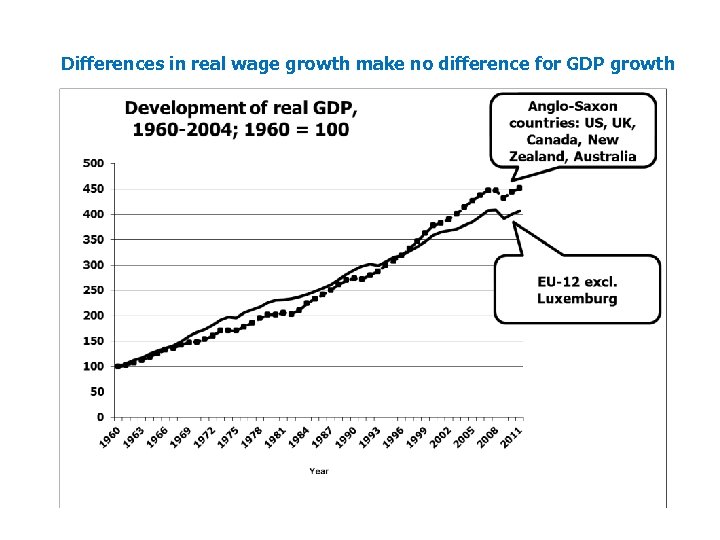 Differences in real wage growth make no difference for GDP growth
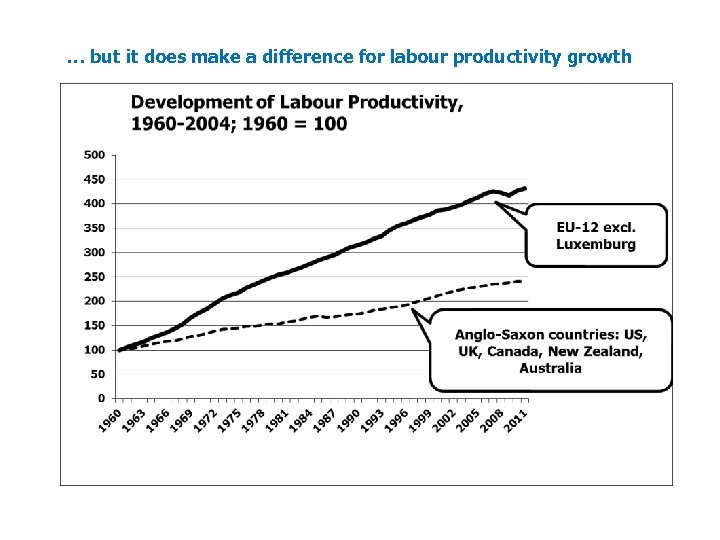 … but it does make a difference for labour productivity growth
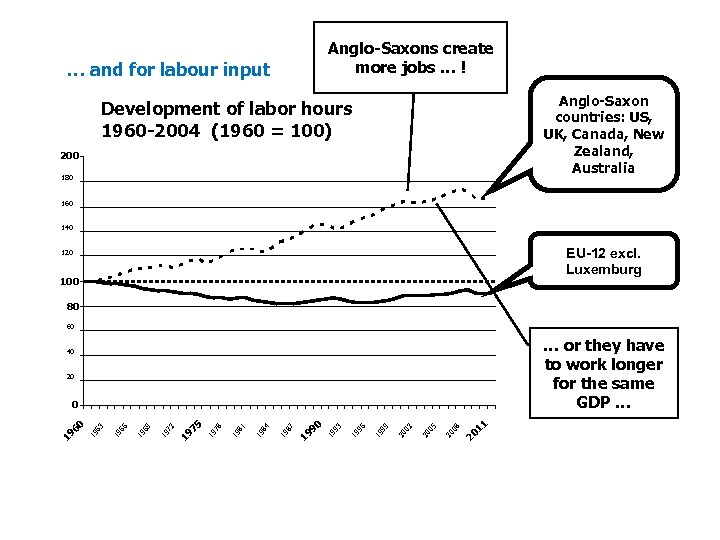 Anglo Saxons create more jobs … ! … and for labour input Anglo Saxon countries: US, UK, Canada, New Zealand, Australia Development of labor hours 1960 2004 (1960 = 100) 200 180 160 140 EU-12 excl. Luxemburg 120 100 80 60 … or they have to work longer for the same GDP … 40 20 1 8 20 1 20 0 5 20 0 2 20 0 9 19 9 6 19 9 0 3 19 9 7 19 8 4 19 8 1 19 8 5 8 19 7 2 19 7 9 19 6 6 19 6 3 19 6 0 0
 Is there a causal link from wage growth to labour productivity growth? Traditional argument: § Labour productivity growth → wage growth (end of story) Alternative view: § There is also a link: wage growth → labour productivity growth (estimated coefficients: 0. 39 ~ 0. 49) Source: R. Vergeer & A. Kleinknecht (2011): 'The impact of labor market deregulation on productivity: A panel data analysis of 19 OECD countries (1960 2004)', Journal of Post Keynesian Economics, Vol. 33 (2): 371 407. N. B. Evidence at macro level is meanwhile confirmed by a series of firm level studies
 Reasons for feedback from wages to labour productivity growth: Neoclassical theory: § Factor substitution § Vintage effect § 'Induced' technical change Evolutionary theory: § 'Creative destruction' (Rehn Meidner theorem)
 Theoretical arguments about the impact of flexible labour on labour productivity (1): § § Difficult and expensive firing of redundant personnel frustrates labour saving process innovations (Bassanini & Ernst, 2002; Scarpetta & Tressel, 2004) With easier firing, shifting labour from old and declining industries to innovative activities is easier (Nickell & Layard, 1999) Counter arguments: § Difficult firing gives incentives for training thus increasing functional flexibility; § People on the shop floor possess much of the (tacit) knowledge required for process innovations. People threatened by easy firing have incentives to hide knowledge relevant to labour saving process innovations (Lorenz, 1992, 1999)
 Theoretical arguments about the impact of flexible labour on labour productivity (2): § Easier firing enhances the inflow of 'fresh blood' (i. e. of people with novel ideas and networks) § Powerful labour may appropriate rents from innovation, thus reducing the incentive to take innovative risks (Malcom son, 1997; Menezhes Filho & Van Reenen, 2003; Metcalf 2002) ↕ § Counter argument: This holds primarily for (Anglo Saxon) de centralized wage bargaining and much less for (European) centralized bargaining
 Theoretical arguments about the impact of flexible labour on labour productivity (3): § The (latent) threat of easy firing reduces shirking (→ Counter argument: this is poor HRM policy!) § Firms can more easily replace weak people by better personnel (→ Counter argument: a fallacy of composition!)
 Theoretical arguments about the impact of flexible labour on labour productivity (4): Flexible 'hire & fire' reduces loyalty and commitment: § Greater chances that trade secrets and technological knowledge will leak to competitors, larger positive externalities leading to stronger under investment in knowledge. § There is more need for monitoring and control. Anglo Saxon countries have substantially larger management bureaucracies which is frustrating for creative people (Kleinknecht et al. 2006).
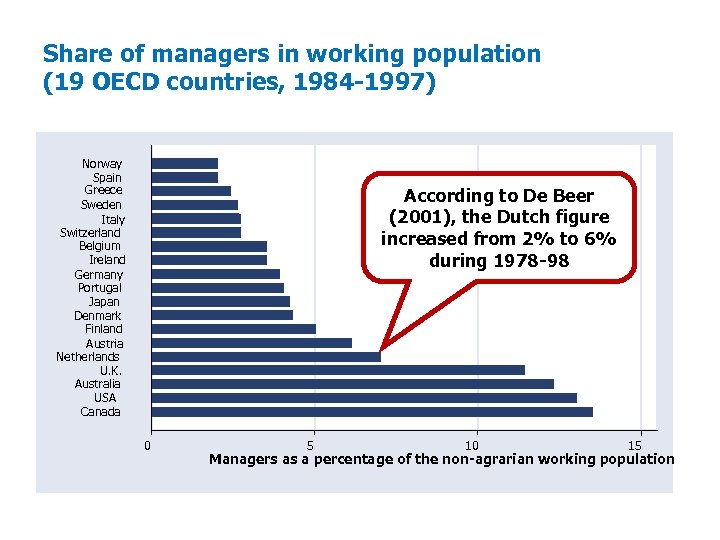 Share of managers in working population (19 OECD countries, 1984 1997) Norway Spain Greece Sweden Italy Switzerland Belgium Ireland Germany Portugal Japan Denmark Finland Austria Netherlands U. K. Australia USA Canada According to De Beer (2001), the Dutch figure increased from 2% to 6% during 1978 98 0 5 10 15 Managers as a percentage of the non agrarian working population
 Theoretical arguments about the impact of flexible labour on labour productivity (5): Given easier firing and higher labour turnover: § Firms will reduce investments in manpower training as pay back periods become shorter. § Personnel have fewer incentives to invest in firm specific knowledge (e. g. safety instructions) § A larger personnel turnover weakens the 'historical memory' of organizations and the 'learning organization'. § Easy firing of personnel will change power relations in firms. People will less easily criticize management decisions. Lack of critical feedback from the shop floor can favour problematic management practices.
 Theoretical arguments about the impact of flexible labour on labour productivity (6): Schumpeter I model (1912): § 'Entrepreneurial model': new firm foundation (e. g. in ICT, biotechnology); inventor entrepreneur ('Garage business'). Schumpeter II model (1942): § 'Routinized innovation model': Professionalized R&D labs in large firms. Incremental innovations based on continuous accumulation of (tacit) knowledge with strong path dependencies Impression from trade statistics: § Anglo Saxon countries perform better in Schumpeter I regimes § 'Old Europe' performs better in Schumpeter II regimes
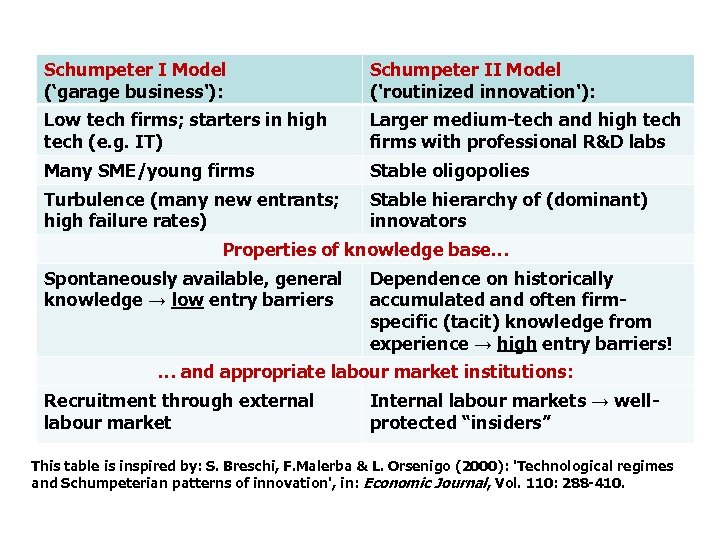 Schumpeter I Model (‘garage business'): Schumpeter II Model ('routinized innovation'): Low tech firms; starters in high tech (e. g. IT) Larger medium tech and high tech firms with professional R&D labs Many SME/young firms Stable oligopolies Turbulence (many new entrants; high failure rates) Stable hierarchy of (dominant) innovators Properties of knowledge base… Spontaneously available, general knowledge → low entry barriers Dependence on historically accumulated and often firm specific (tacit) knowledge from experience → high entry barriers! … and appropriate labour market institutions: Recruitment through external labour market Internal labour markets → well protected “insiders” This table is inspired by: S. Breschi, F. Malerba & L. Orsenigo (2000): 'Technological regimes and Schumpeterian patterns of innovation', in: Economic Journal, Vol. 110: 288 410.
 Rounding up (1): Are flexible labour markets good for labour productivity growth? Evidence at macro and micro level: § Flexible labour relations and wage restraint lead a to lower growth of labour productivity and a more labour intensive (less capital intensive) growth path § Ironically, this resembles the factor intensive growth pattern in Eastern Europe before 1989! § A low productive and labour intensive growth path is problematic with an ageing population in Europe!
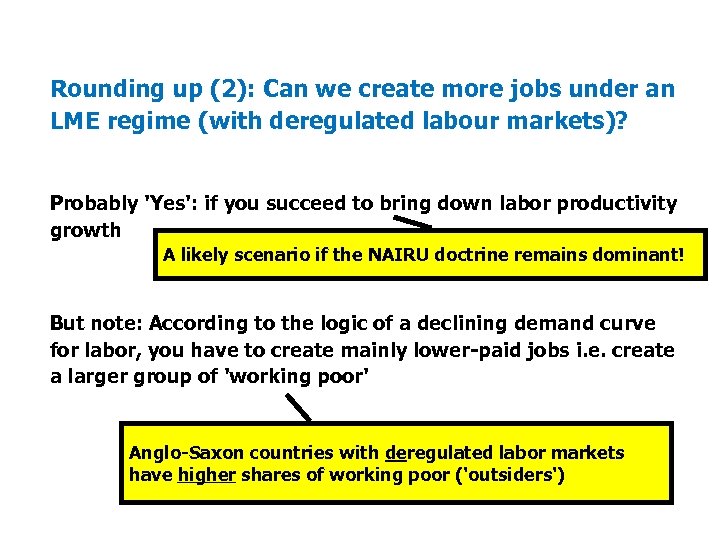 Rounding up (2): Can we create more jobs under an LME regime (with deregulated labour markets)? Probably 'Yes': if you succeed to bring down labor productivity growth A likely scenario if the NAIRU doctrine remains dominant! But note: According to the logic of a declining demand curve for labor, you have to create mainly lower paid jobs i. e. create a larger group of 'working poor' Anglo Saxon countries with deregulated labor markets have higher shares of working poor ('outsiders')
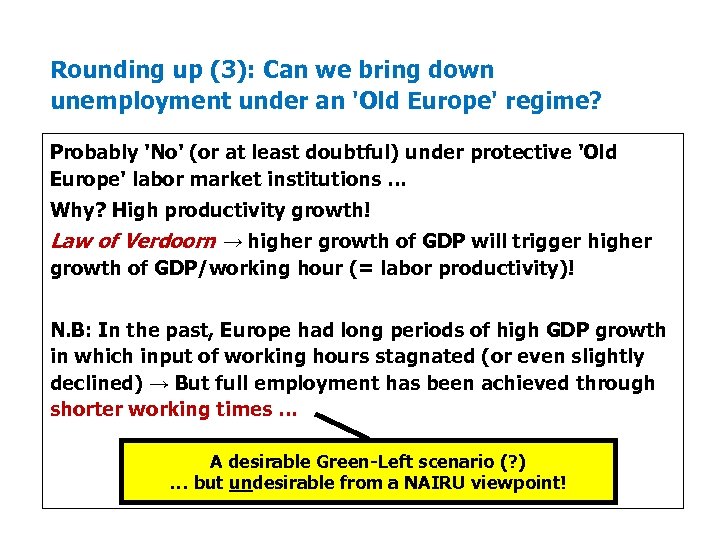 Rounding up (3): Can we bring down unemployment under an 'Old Europe' regime? Probably 'No' (or at least doubtful) under protective 'Old Europe' labor market institutions … Why? High productivity growth! Law of Verdoorn → higher growth of GDP will trigger higher growth of GDP/working hour (= labor productivity)! N. B: In the past, Europe had long periods of high GDP growth in which input of working hours stagnated (or even slightly declined) → But full employment has been achieved through shorter working times … A desirable Green Left scenario (? ) … but undesirable from a NAIRU viewpoint!
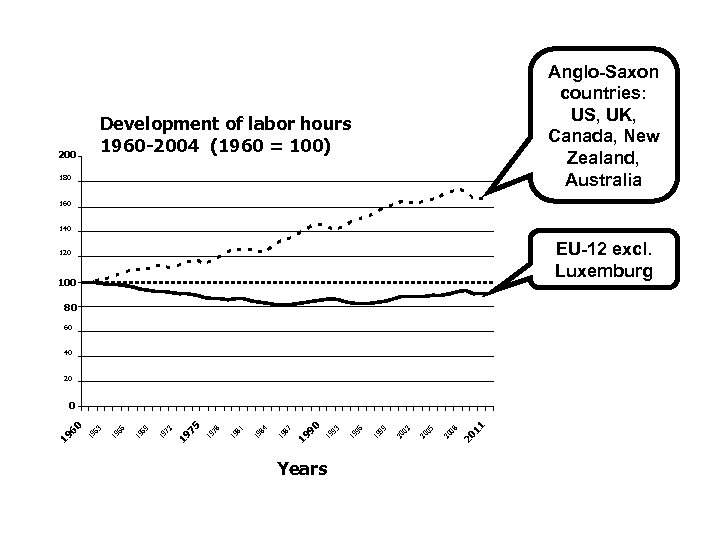 Anglo-Saxon countries: US, UK, Canada, New Zealand, Australia Development of labor hours 1960 2004 (1960 = 100) 200 180 160 140 EU-12 excl. Luxemburg 120 100 80 60 40 20 Years 1 8 20 1 20 0 5 20 0 2 20 0 9 6 19 9 3 0 7 19 9 19 8 4 19 8 1 19 8 5 8 19 7 2 19 7 9 19 6 6 19 6 3 19 6 0 0
 Long run growth of GDP, of GDP/labor hour and of labor hours (per 1% GDP growth) Average Annual GDP growth Old Europe Anglo Saxon countries 1950 60 5. 5 1960 73 Average annual GDP growth per hour worked Growth of labor hours per 1% GDP growth Old Europe Anglo Saxon countries 3. 3 4. 2 3. 6 0. 23 0. 09 5. 1 4. 1 5. 2 2. 7 0. 03 0. 34 1973 80 2. 7 2. 4 3. 0 1. 1 0. 14 0. 55 1981 90 2. 6 3. 2 2. 4 1. 4 0. 07 0. 55 1990 00 2. 4 3. 1 1. 9 0. 21 0. 40 2000 04 1. 3 2. 5 1. 1 1. 6 0. 15 0. 35 Old Europe: EU 12 (excl. Luxemburg) Anglo Saxon: Australia, Canada, New Zealand, US and UK
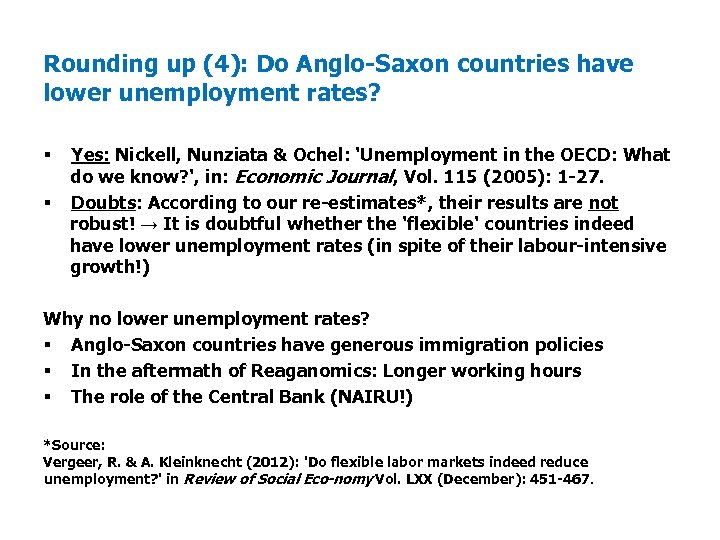 Rounding up (4): Do Anglo Saxon countries have lower unemployment rates? § § Yes: Nickell, Nunziata & Ochel: 'Unemployment in the OECD: What do we know? ', in: Economic Journal, Vol. 115 (2005): 1 27. Doubts: According to our re estimates*, their results are not robust! → It is doubtful whether the 'flexible' countries indeed have lower unemployment rates (in spite of their labour intensive growth!) Why no lower unemployment rates? § Anglo Saxon countries have generous immigration policies § In the aftermath of Reaganomics: Longer working hours § The role of the Central Bank (NAIRU!) *Source: Vergeer, R. & A. Kleinknecht (2012): 'Do flexible labor markets indeed reduce unemployment? ' in Review of Social Eco nomy Vol. LXX (December): 451 467. ,
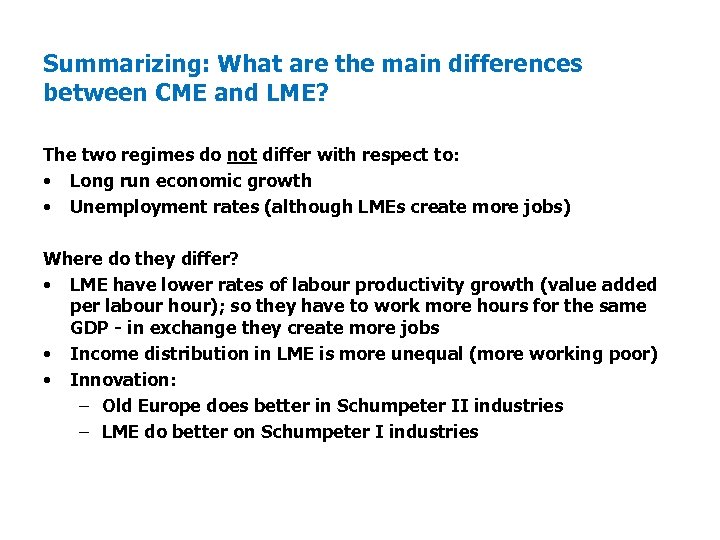 Summarizing: What are the main differences between CME and LME? The two regimes do not differ with respect to: • Long run economic growth • Unemployment rates (although LMEs create more jobs) Where do they differ? • LME have lower rates of labour productivity growth (value added per labour hour); so they have to work more hours for the same GDP in exchange they create more jobs • Income distribution in LME is more unequal (more working poor) • Innovation: – Old Europe does better in Schumpeter II industries – LME do better on Schumpeter I industries
 Summarizing: The most important barrier to full employment: NAIRU theory NAIRU = Non Accelerating Inflation Rate of Unemployment The European Central Bank has the task of assuring a sufficiently high level of unemployment (in the name of fighting inflation) → prevent 'too much' solidarity by assuring strong competition for scarce jobs Handsome frame: The Euro should be a 'hard' and 'solid' (say: investor friendly) currency!