


 Скачать презентацию Full Electric and Natural Gas Utility Credit Reporting
bd499acff05c710b9eecc8ad22eef6fb.ppt
- Количество слайдов: 23
 Full Electric and Natural Gas Utility Credit Reporting: Risks to Low Income Consumers John Howat – National Consumer Law Center jhowat@nclc. org 617 -542 -8010 NASUCA Mid-Year Meeting San Francisco, CA June 14, 2010
 What is Full Utility Credit Reporting? • Electric and natural gas utility reporting of all customer payment behaviors and transactions to the major consumer reporting agencies (CRAs) • Lenders, such as credit card and mortgage companies, fully report all transactions including those payments that are made 30 days after the due date
 Current Utility Reporting Practices • Electric and Gas – Vast majority of regulated electric and natural gas utilities report to the credit bureaus only when an account is written off as bad debt or referred to a collection agency • Telecommunications Utilities – Many cell phone companies and some landline carriers fully report to credit bureaus 7 Winthrop Sq. 4 th fl. Boston 02110 617 542 -8010 John Howat – jhowat@nclc. org p. 3
 Full Electric and Gas Utility Credit Reporting – Proponents’ Objectives • Most arguments in favor of full utility credit reporting focus on the notion that consumers who cannot presently be “scored” could gain credit history and better access to credit • Some Utilities: Move utility bills to top of customers’ “to pay” piles • Credit Reporting Agencies: Lots of new business and revenues!!! • However, many proponents fail to consider – the realities that low-income households commonly face in seeking to meet their energy needs and their financial responsibilities – the ramifications of low credit scores – fairness issues raised by state and regional differences in utility rates and expenditures, regulatory consumer protections, and Availability of energy assistance and efficiency resources
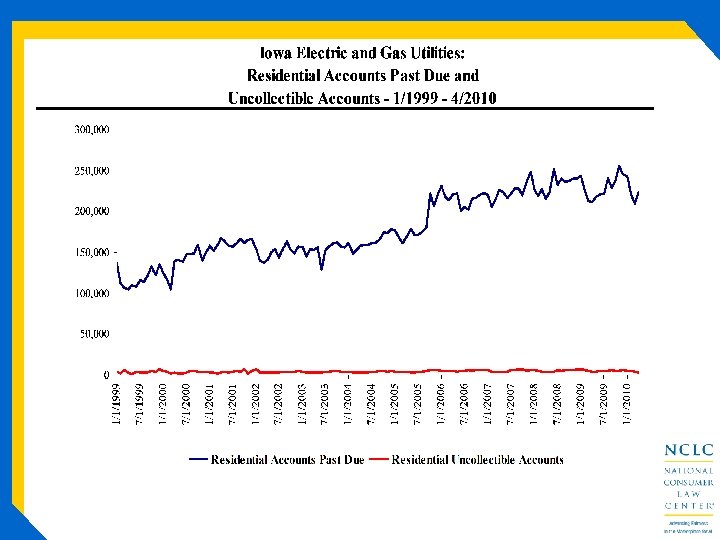
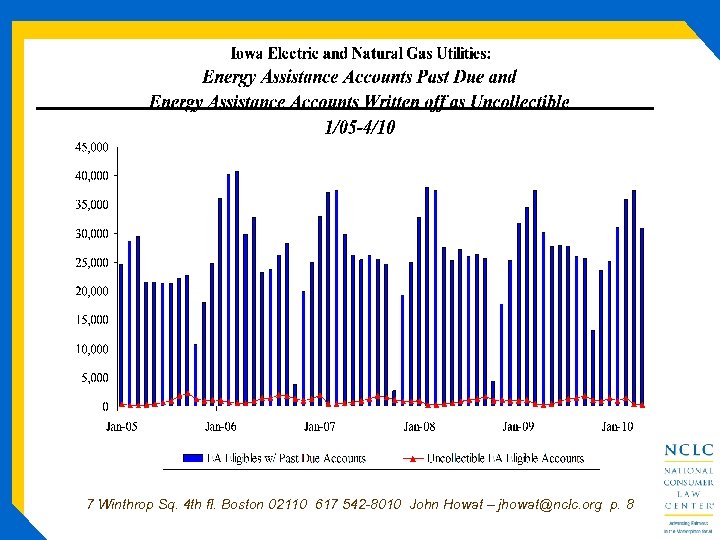
 Electric and Natural Gas Utilities • Only a tiny fraction of accounts in arrears are written off as uncollectible • Full utility credit reporting of accounts 30+ days late would result in millions of new negative reports in instances where late utility payments currently go unreported • Each late payment reported to Credit Reporting Agencies lowers a consumer’s credit score by 60 – 110 points 7 Winthrop Sq. 4 th fl. Boston 02110 617 542 -8010 John Howat – jhowat@nclc. org p. 5
 Full Utility Reporting – Low Score versus No Score • What are the ramifications of low credit scores? – Employment • Increasingly, employers check credit scores when screening prospective employees • Low scores may harm applicants more than no scores or thin files – Housing • Landlord screening of prospective tenants – Military Security Clearance • Low credit scores influence security clearance and deployment of military personnel
 7 Winthrop Sq. 4 th fl. Boston 02110 617 542 -8010 John Howat – jhowat@nclc. org p. 8
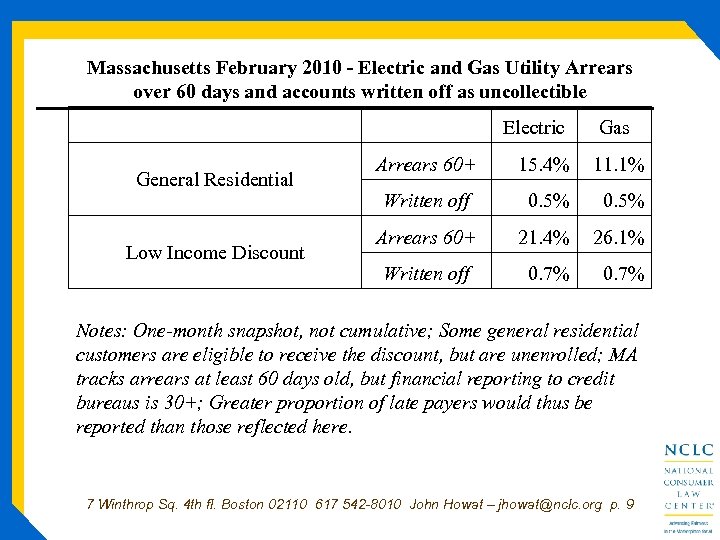 Massachusetts February 2010 - Electric and Gas Utility Arrears over 60 days and accounts written off as uncollectible General Residential Low Income Discount Electric Gas Arrears 60+ 15. 4% 11. 1% Written off 0. 5% Arrears 60+ 21. 4% 26. 1% Written off 0. 7% Notes: One-month snapshot, not cumulative; Some general residential customers are eligible to receive the discount, but are unenrolled; MA tracks arrears at least 60 days old, but financial reporting to credit bureaus is 30+; Greater proportion of late payers would thus be reported than those reflected here. 7 Winthrop Sq. 4 th fl. Boston 02110 617 542 -8010 John Howat – jhowat@nclc. org p. 9
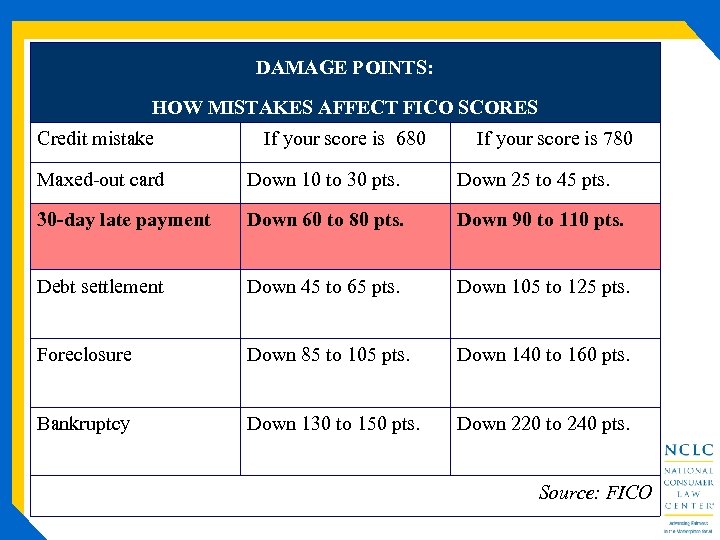 DAMAGE POINTS: HOW MISTAKES AFFECT FICO SCORES Credit mistake If your score is 680 If your score is 780 Maxed-out card Down 10 to 30 pts. Down 25 to 45 pts. 30 -day late payment Down 60 to 80 pts. Down 90 to 110 pts. Debt settlement Down 45 to 65 pts. Down 105 to 125 pts. Foreclosure Down 85 to 105 pts. Down 140 to 160 pts. Bankruptcy Down 130 to 150 pts. Down 220 to 240 pts. Source: FICO
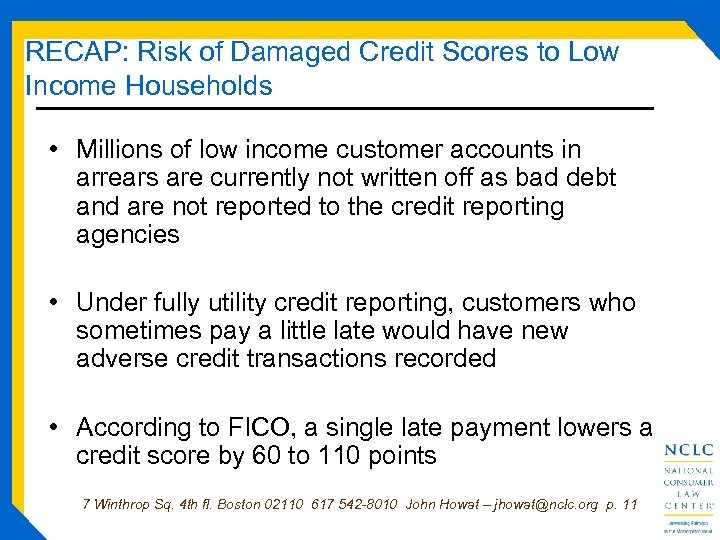 RECAP: Risk of Damaged Credit Scores to Low Income Households • Millions of low income customer accounts in arrears are currently not written off as bad debt and are not reported to the credit reporting agencies • Under fully utility credit reporting, customers who sometimes pay a little late would have new adverse credit transactions recorded • According to FICO, a single late payment lowers a credit score by 60 to 110 points 7 Winthrop Sq. 4 th fl. Boston 02110 617 542 -8010 John Howat – jhowat@nclc. org p. 11
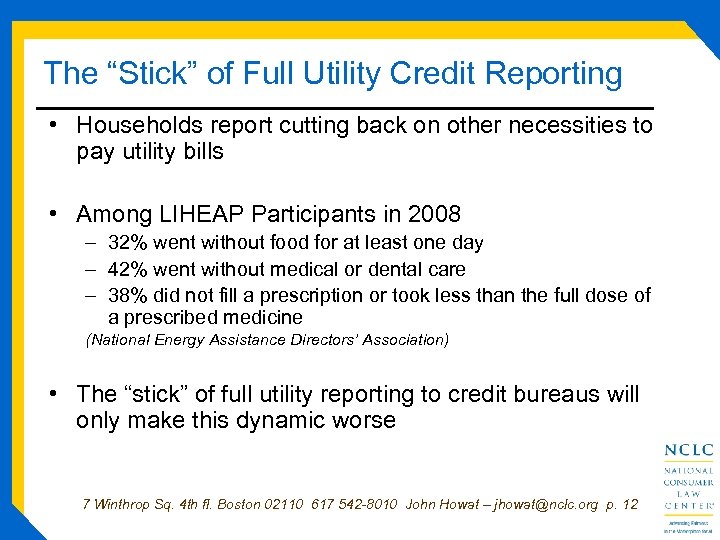 The “Stick” of Full Utility Credit Reporting • Households report cutting back on other necessities to pay utility bills • Among LIHEAP Participants in 2008 – 32% went without food for at least one day – 42% went without medical or dental care – 38% did not fill a prescription or took less than the full dose of a prescribed medicine (National Energy Assistance Directors’ Association) • The “stick” of full utility reporting to credit bureaus will only make this dynamic worse 7 Winthrop Sq. 4 th fl. Boston 02110 617 542 -8010 John Howat – jhowat@nclc. org p. 12
 Why are low income utility customers sometimes late? • Income and expenses simply don’t match up! • Seasonal variation in payments • Price volatility and unexpected billing increase 7 Winthrop Sq. 4 th fl. Boston 02110 617 542 -8010 John Howat – jhowat@nclc. org p. 13
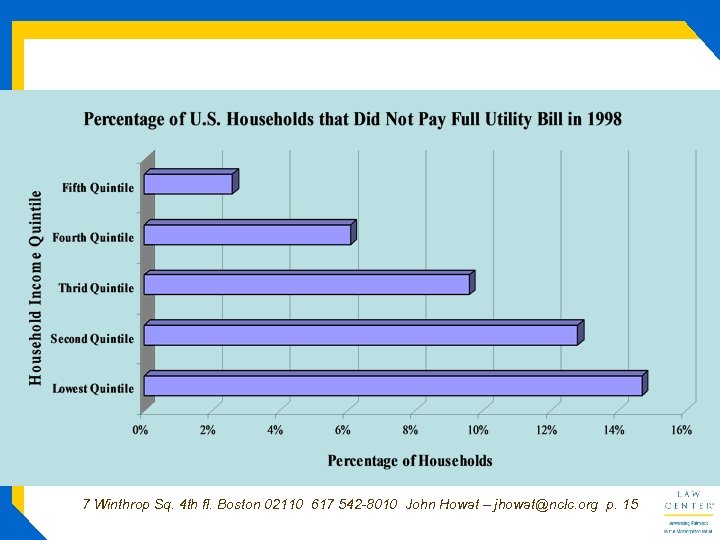
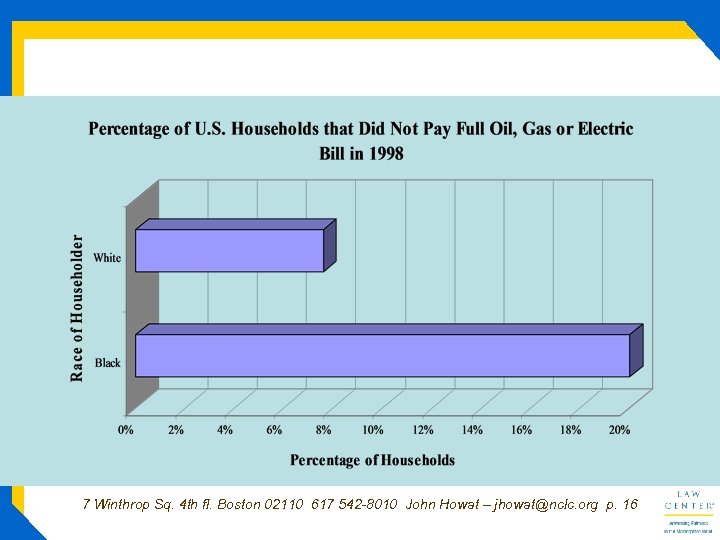
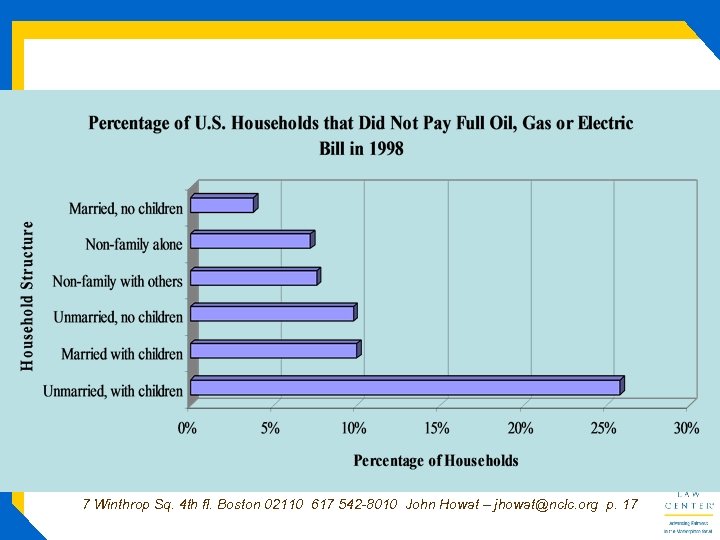
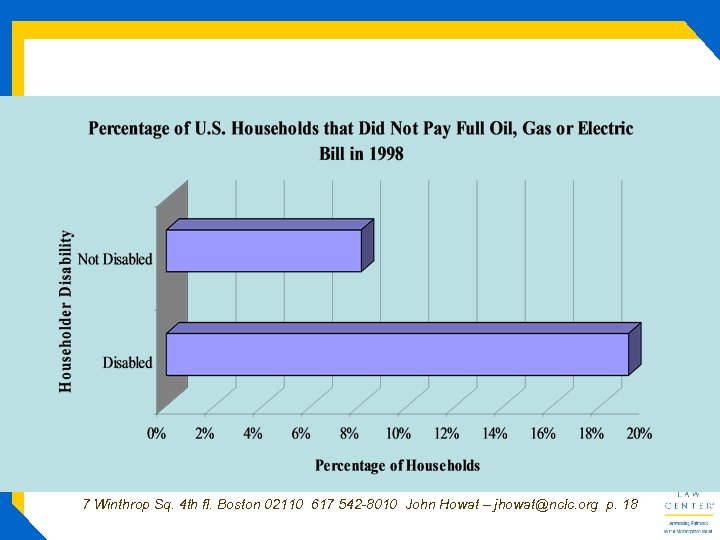
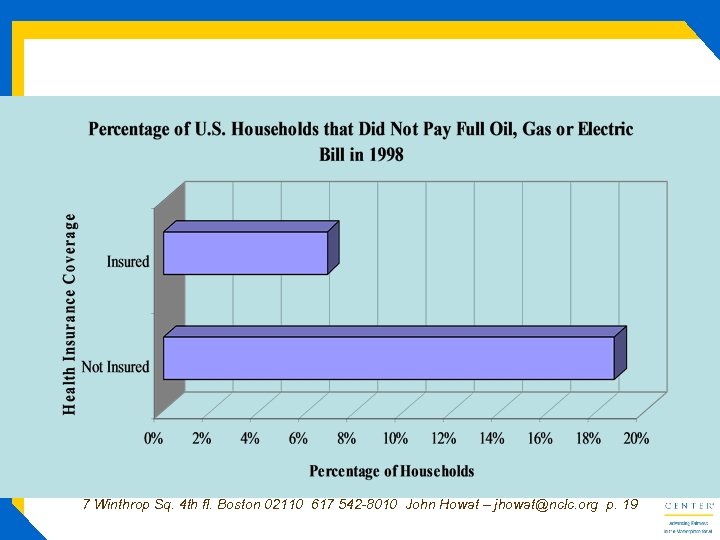
 Full Utility Credit Reporting: Disproportionate Harm to Latepaying Customer Groups The most recent Census Bureau Survey of Income and Program Participation demonstrates that late or nonpayment of energy and utility bills is driven by income and a range of related factors: • • Race Household Structure Disability Health Insurance Enrollment Status 7 Winthrop Sq. 4 th fl. Boston 02110 617 542 -8010 John Howat – jhowat@nclc. org p. 14
 7 Winthrop Sq. 4 th fl. Boston 02110 617 542 -8010 John Howat – jhowat@nclc. org p. 15
 7 Winthrop Sq. 4 th fl. Boston 02110 617 542 -8010 John Howat – jhowat@nclc. org p. 16
 7 Winthrop Sq. 4 th fl. Boston 02110 617 542 -8010 John Howat – jhowat@nclc. org p. 17
 7 Winthrop Sq. 4 th fl. Boston 02110 617 542 -8010 John Howat – jhowat@nclc. org p. 18
 7 Winthrop Sq. 4 th fl. Boston 02110 617 542 -8010 John Howat – jhowat@nclc. org p. 19
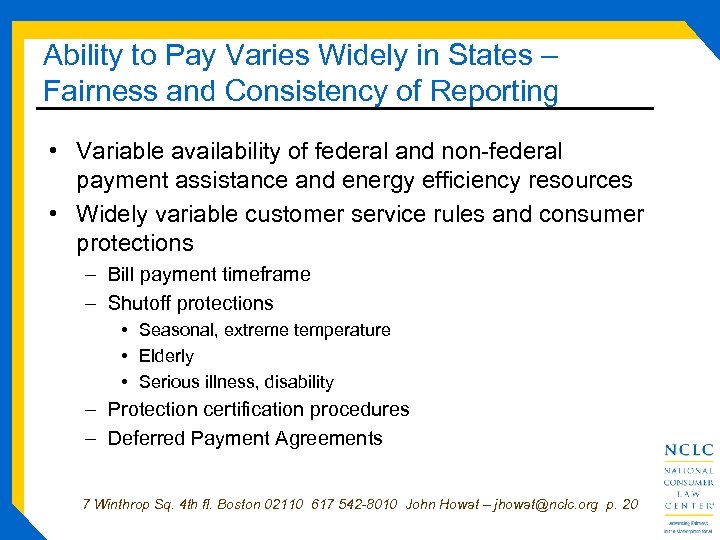 Ability to Pay Varies Widely in States – Fairness and Consistency of Reporting • Variable availability of federal and non-federal payment assistance and energy efficiency resources • Widely variable customer service rules and consumer protections – Bill payment timeframe – Shutoff protections • Seasonal, extreme temperature • Elderly • Serious illness, disability – Protection certification procedures – Deferred Payment Agreements 7 Winthrop Sq. 4 th fl. Boston 02110 617 542 -8010 John Howat – jhowat@nclc. org p. 20
 State Regulation, State/Federal Programs Recognize Unique Nature of Utility Service • Access to affordable home energy and utility services are vital to health, safety and general well-being • States and the federal government, in recognition of the vital nature of these services, have adopted programs and provisions to help ensure affordable access to these services – particularly for vulnerable and low-income consumers • Full utility reporting would operate contrary to the policy objectives of these programs and provisions
 Full Utility Credit Reporting and the Fair Credit Reporting Act • Proponents propose to amend the FCRA to preempt the authority of the states to regulate the credit reporting practices of jurisdictional utility companies • NCLC views this proposal as a hostile amendment to the FCRA and supports the continuation of full state legislative and regulatory jurisdictional authority over gas and electric credit and collection activities, including the reporting of customer payment history to credit reporting agencies
 NASUCA RESOULUTION • Oppose full utility credit reporting • Urge state policy-makers to prohibit the practice • If a state authorizes utility credit reporting, it should only be on seriously delinquent accounts that have been written off as uncollectible or referred to a collection agency • Further, if a state authorizes utility credit reporting, consistently with the stated purpose of helping consumers establish a credit history, that authorization should be subject to a consumer “opt-in” requirement. 7 Winthrop Sq. 4 th fl. Boston 02110 617 542 -8010 John Howat – jhowat@nclc. org p. 23