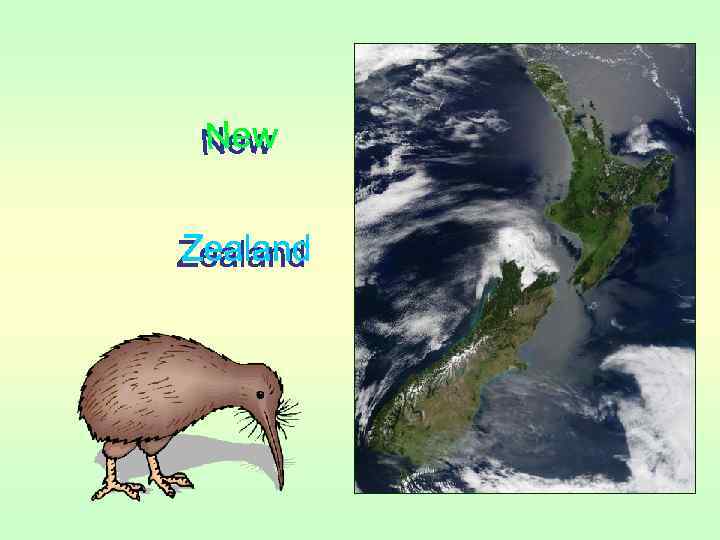
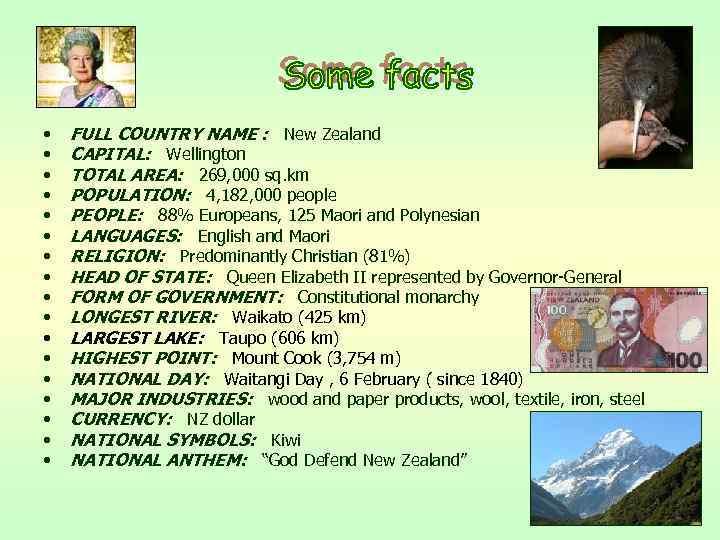
 • • • • • FULL COUNTRY NAME : New Zealand CAPITAL: Wellington TOTAL AREA: 269, 000 sq. km POPULATION: 4, 182, 000 people PEOPLE: 88% Europeans, 125 Maori and Polynesian LANGUAGES: English and Maori RELIGION: Predominantly Christian (81%) HEAD OF STATE: Queen Elizabeth II represented by Governor-General FORM OF GOVERNMENT: Constitutional monarchy LONGEST RIVER: Waikato (425 km) LARGEST LAKE: Taupo (606 km) HIGHEST POINT: Mount Cook (3, 754 m) NATIONAL DAY: Waitangi Day , 6 February ( since 1840) MAJOR INDUSTRIES: wood and paper products, wool, textile, iron, steel CURRENCY: NZ dollar NATIONAL SYMBOLS: Kiwi NATIONAL ANTHEM: “God Defend New Zealand”
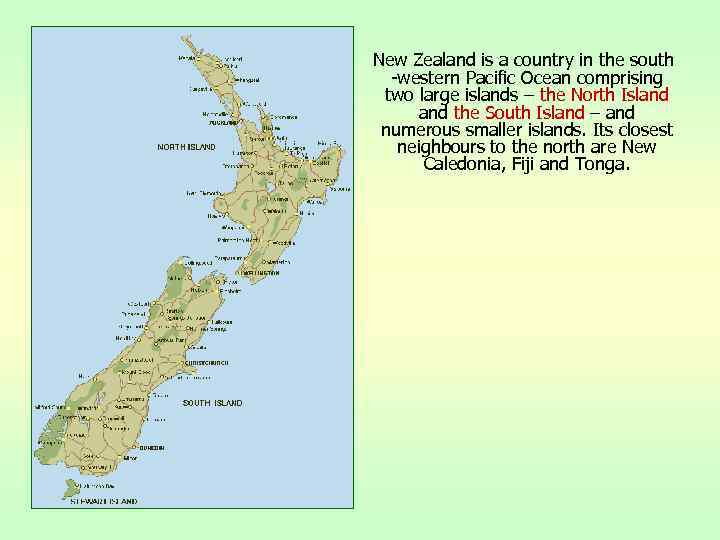 New Zealand is a country in the south -western Pacific Ocean comprising two large islands – the North Island the South Island – and numerous smaller islands. Its closest neighbours to the north are New Caledonia, Fiji and Tonga.
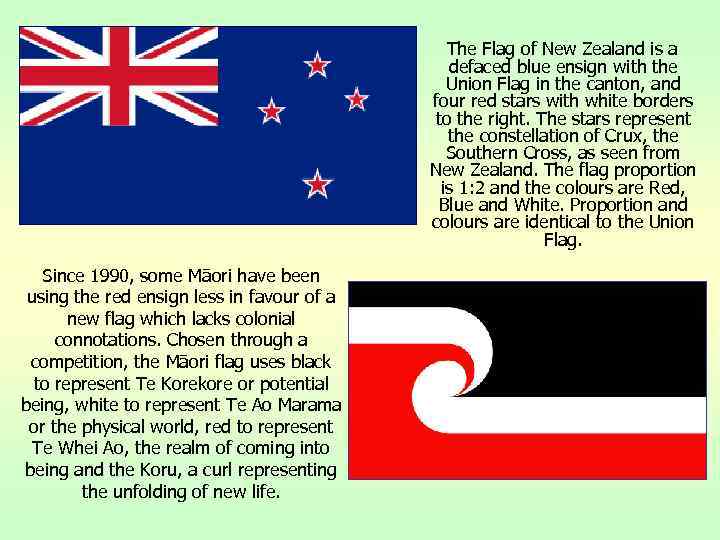 The Flag of New Zealand is a defaced blue ensign with the Union Flag in the canton, and four red stars with white borders to the right. The stars represent the constellation of Crux, the Southern Cross, as seen from New Zealand. The flag proportion is 1: 2 and the colours are Red, Blue and White. Proportion and colours are identical to the Union Flag. Since 1990, some Māori have been using the red ensign less in favour of a new flag which lacks colonial connotations. Chosen through a competition, the Māori flag uses black to represent Te Korekore or potential being, white to represent Te Ao Marama or the physical world, red to represent Te Whei Ao, the realm of coming into being and the Koru, a curl representing the unfolding of new life.
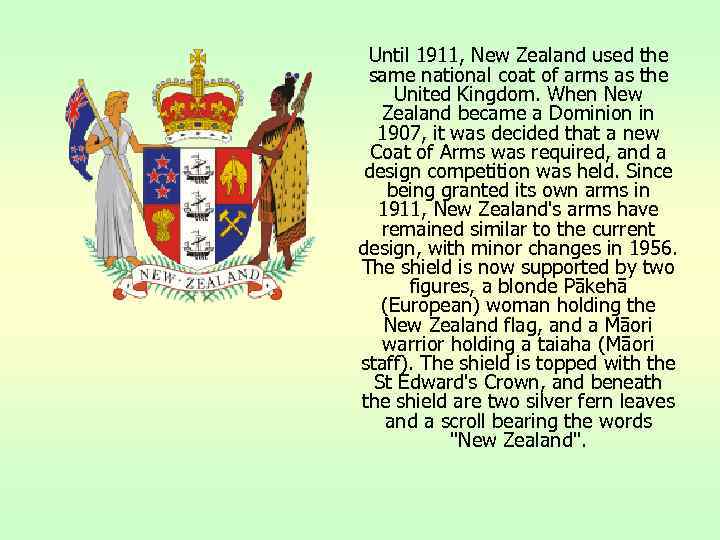 Until 1911, New Zealand used the same national coat of arms as the United Kingdom. When New Zealand became a Dominion in 1907, it was decided that a new Coat of Arms was required, and a design competition was held. Since being granted its own arms in 1911, New Zealand's arms have remained similar to the current design, with minor changes in 1956. The shield is now supported by two figures, a blonde Pākehā (European) woman holding the New Zealand flag, and a Māori warrior holding a taiaha (Māori staff). The shield is topped with the St Edward's Crown, and beneath the shield are two silver fern leaves and a scroll bearing the words "New Zealand".
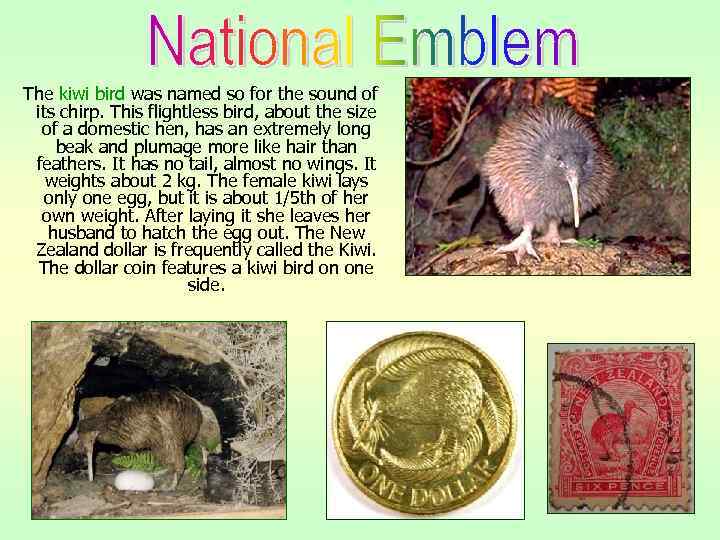 The kiwi bird was named so for the sound of its chirp. This flightless bird, about the size of a domestic hen, has an extremely long beak and plumage more like hair than feathers. It has no tail, almost no wings. It weights about 2 kg. The female kiwi lays only one egg, but it is about 1/5 th of her own weight. After laying it she leaves her husband to hatch the egg out. The New Zealand dollar is frequently called the Kiwi. The dollar coin features a kiwi bird on one side.
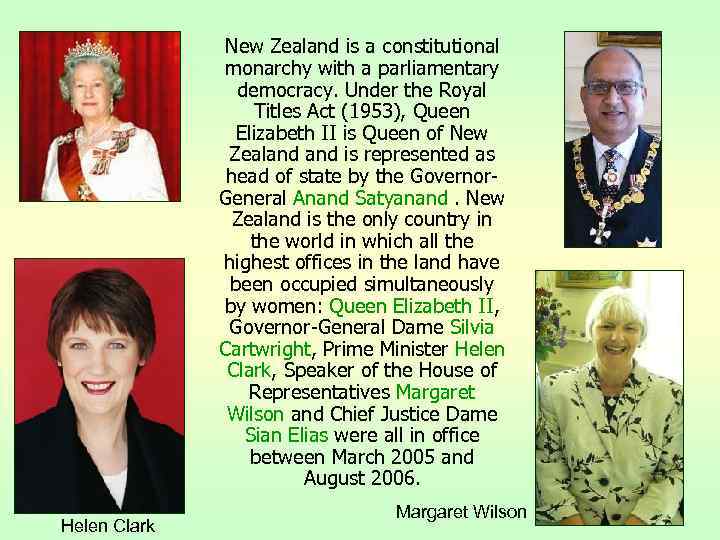 New Zealand is a constitutional monarchy with a parliamentary democracy. Under the Royal Titles Act (1953), Queen Elizabeth II is Queen of New Zealand is represented as head of state by the Governor. General Anand Satyanand. New Zealand is the only country in the world in which all the highest offices in the land have been occupied simultaneously by women: Queen Elizabeth II, Governor-General Dame Silvia Cartwright, Prime Minister Helen Clark, Speaker of the House of Representatives Margaret Wilson and Chief Justice Dame Sian Elias were all in office between March 2005 and August 2006. Helen Clark Margaret Wilson
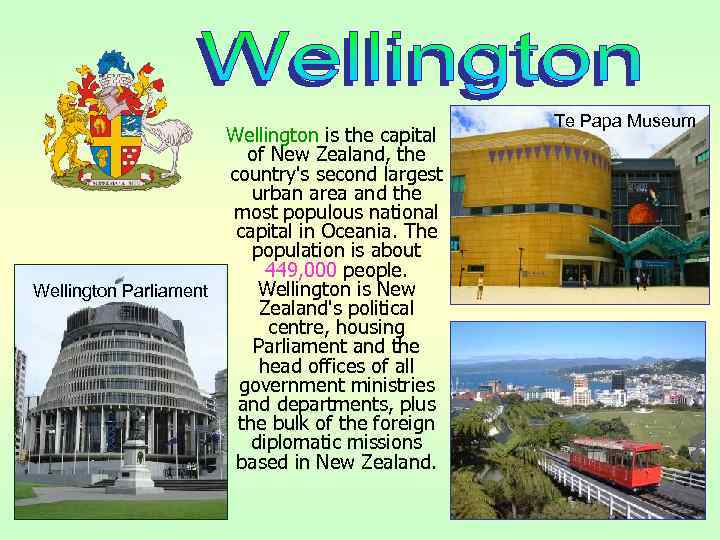 Wellington is the capital of New Zealand, the country's second largest urban area and the most populous national capital in Oceania. The population is about 449, 000 people. Wellington is New Wellington Parliament Zealand's political centre, housing Parliament and the head offices of all government ministries and departments, plus the bulk of the foreign diplomatic missions based in New Zealand. Te Papa Museum