


 Скачать презентацию Fuel Cells with no Precious Metals and no
f969bcc4fda80cf875d7343ad377babf.ppt
- Количество слайдов: 22
 Fuel Cells with no Precious Metals and no Liquid Electrolyte Shimshon Gottesfeld Cellera Technologies, Ltd Caesaria Industrial Park, Israel TAU, Feb 5, 2010
 Outline • Brief report on AMFC development at Cellera • Is there a common “activity yardstick” which applies to all fuel cell elecrtocatalysts ?
 Outline • Brief report on AMFC development at Cellera • Is there a common “activity yardstick” which applies to all fuel cell elecrtocatalysts ?
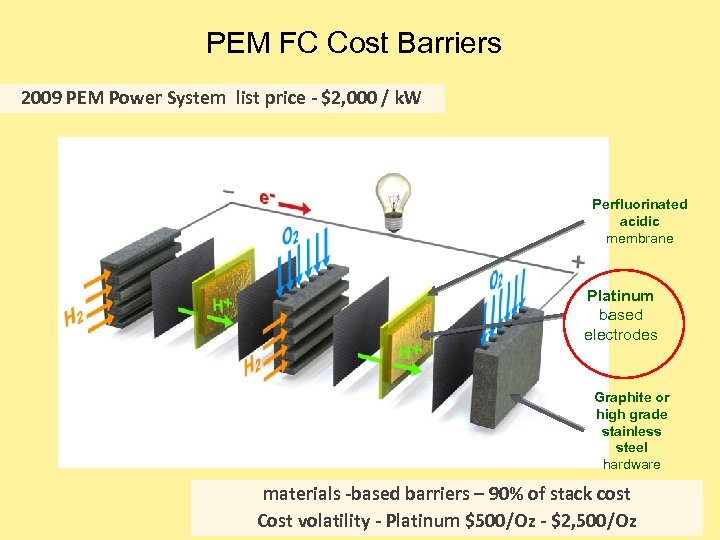 PEM FC Cost Barriers 2009 PEM Power System list price - $2, 000 / k. W Perfluorinated acidic membrane Platinum based electrodes Graphite or high grade stainless steel hardware materials -based barriers – 90% of stack cost Cost volatility - Platinum $500/Oz - $2, 500/Oz 4
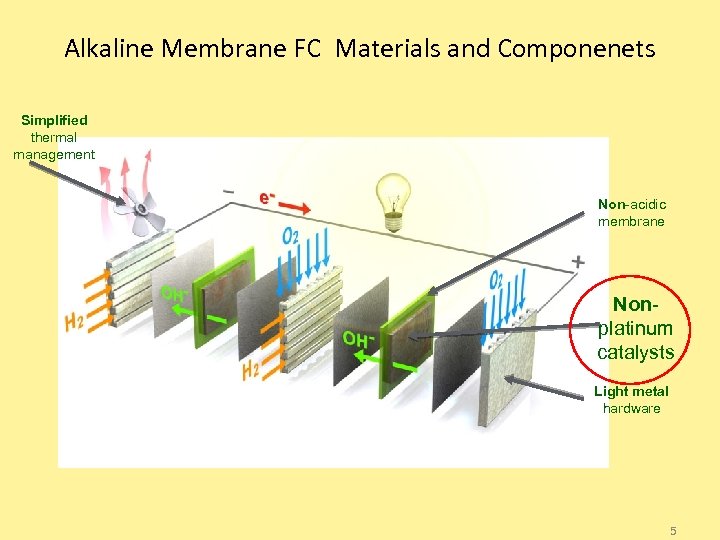 Alkaline Membrane FC Materials and Componenets Simplified thermal management Non-acidic membrane Nonplatinum catalysts Light metal hardware 5
 Outline • Brief report on AMFC development at Cellera • Is there a common “activity yardstick” which applies to all fuel cell elecrtocatalysts ? metal catalysts & non-metal catalysts , in acid media & alkaline media , is there an activity-determining factor common to all ?
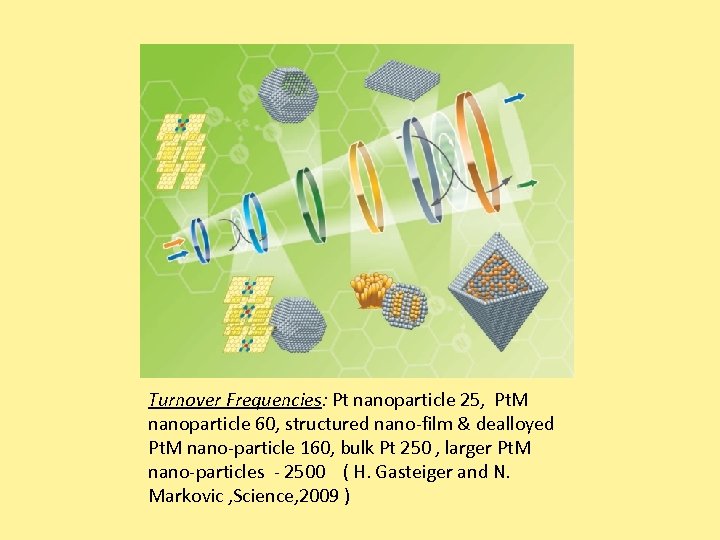 Turnover Frequencies: Pt nanoparticle 25, Pt. M nanoparticle 60, structured nano-film & dealloyed Pt. M nano-particle 160, bulk Pt 250 , larger Pt. M nano-particles - 2500 ( H. Gasteiger and N. Markovic , Science, 2009 )
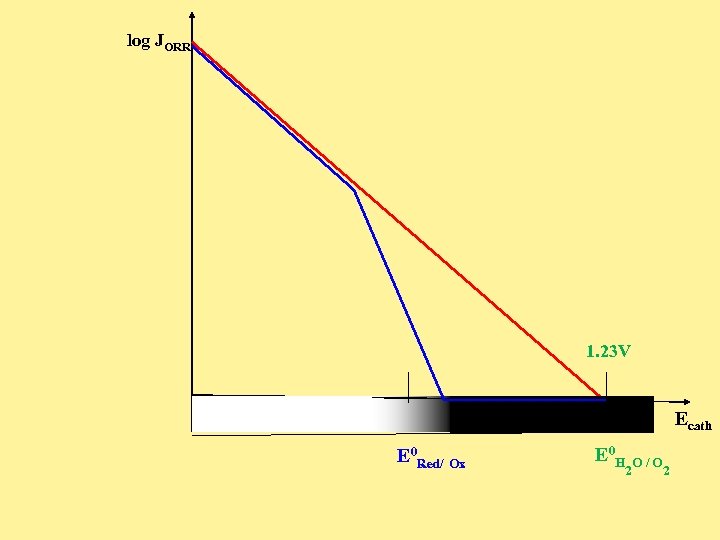
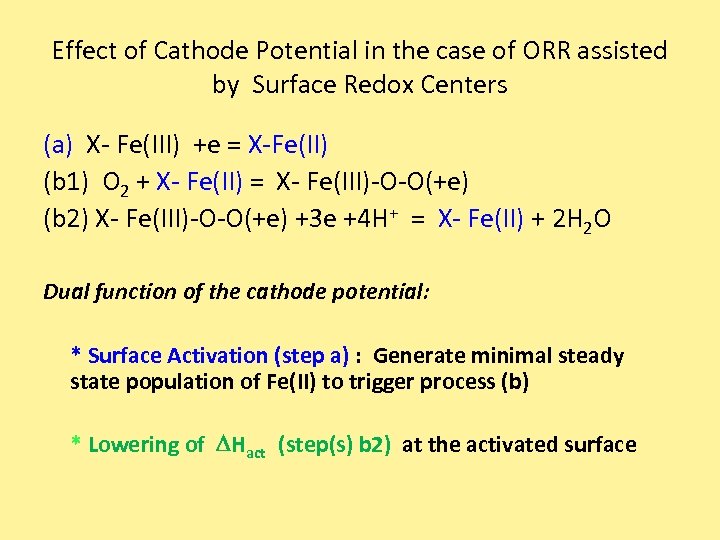 Effect of Cathode Potential in the case of ORR assisted by Surface Redox Centers (a) X- Fe(III) +e = X-Fe(II) (b 1) O 2 + X- Fe(II) = X- Fe(III)-O-O(+e) (b 2) X- Fe(III)-O-O(+e) +3 e +4 H+ = X- Fe(II) + 2 H 2 O Dual function of the cathode potential: * Surface Activation (step a) : Generate minimal steady state population of Fe(II) to trigger process (b) * Lowering of DHact (step(s) b 2) at the activated surface
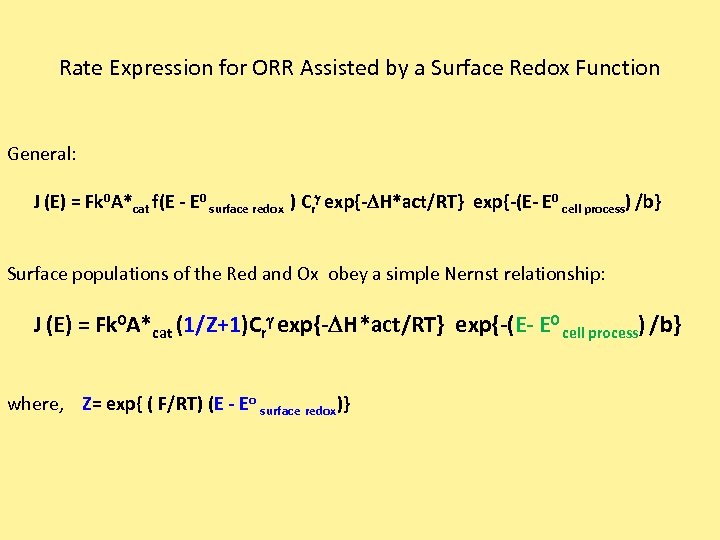 Rate Expression for ORR Assisted by a Surface Redox Function General: J (E) = Fk 0 A*cat f(E - E 0 surface redox ) Crg exp{-DH*act/RT} exp{-(E- E 0 cell process) /b} Surface populations of the Red and Ox obey a simple Nernst relationship: J (E) = Fk 0 A*cat (1/Z+1)Crg exp{-DH*act/RT} exp{-(E- E 0 cell process) /b} where, Z= exp{ ( F/RT) (E - Eo surface redox)}
 log JORR 1. 23 V Ecath E 0 Red/ Ox E 0 H 2 O/O 2
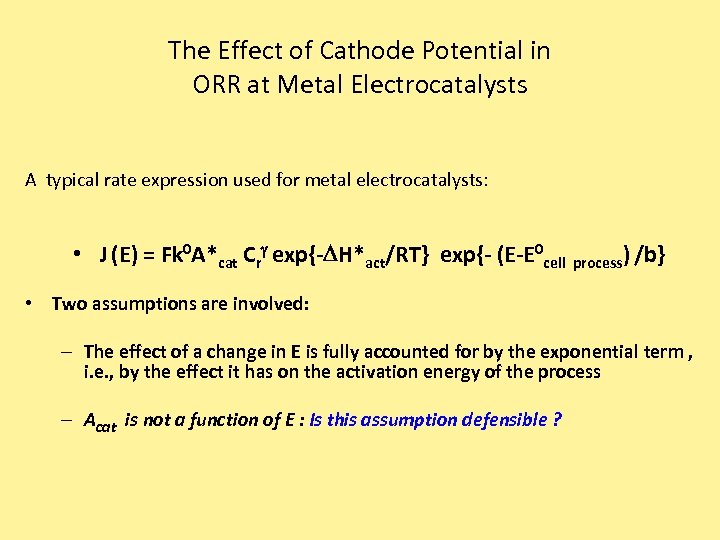 The Effect of Cathode Potential in ORR at Metal Electrocatalysts A typical rate expression used for metal electrocatalysts: • J (E) = Fk 0 A*cat Crg exp{-DH*act/RT} exp{- (E-E 0 cell process) /b} • Two assumptions are involved: – The effect of a change in E is fully accounted for by the exponential term , i. e. , by the effect it has on the activation energy of the process – Acat is not a function of E : Is this assumption defensible ?
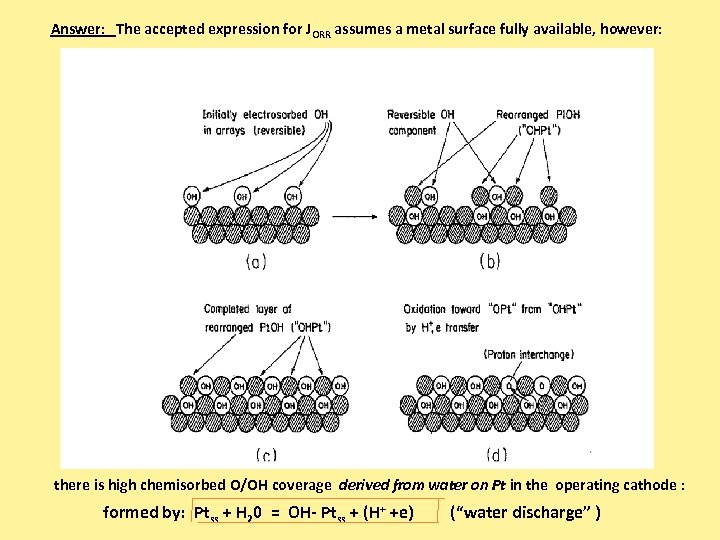 Answer: The accepted expression for JORR assumes a metal surface fully available, however: there is high chemisorbed O/OH coverage derived from water on Pt in the operating cathode : formed by: Ptss + H 20 = OH- Ptss + (H+ +e) (“water discharge” )
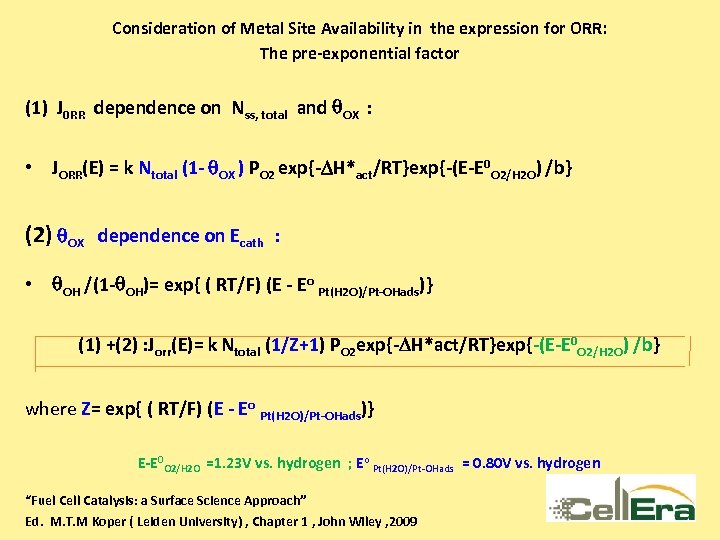 Consideration of Metal Site Availability in the expression for ORR: The pre-exponential factor (1) J 0 RR dependence on Nss, total and q. OX : • JORR(E) = k Ntotal (1 - q. OX ) PO 2 exp{-DH*act/RT}exp{-(E-E 0 O 2/H 2 O) /b} (2) q. OX dependence on Ecath : • q. OH /(1 -q. OH)= exp{ ( RT/F) (E - Eo Pt(H 2 O)/Pt-OHads)} (1) +(2) : Jorr(E)= k Ntotal (1/Z+1) PO 2 exp{-DH*act/RT}exp{-(E-E 0 O 2/H 2 O) /b} where Z= exp{ ( RT/F) (E - Eo Pt(H 2 O)/Pt-OHads)} E-E 0 O 2/H 2 O =1. 23 V vs. hydrogen ; Eo Pt(H 2 O)/Pt-OHads = 0. 80 V vs. hydrogen “Fuel Cell Catalysis: a Surface Science Approach” Ed. M. T. M Koper ( Leiden University) , Chapter 1 , John Wiley , 2009
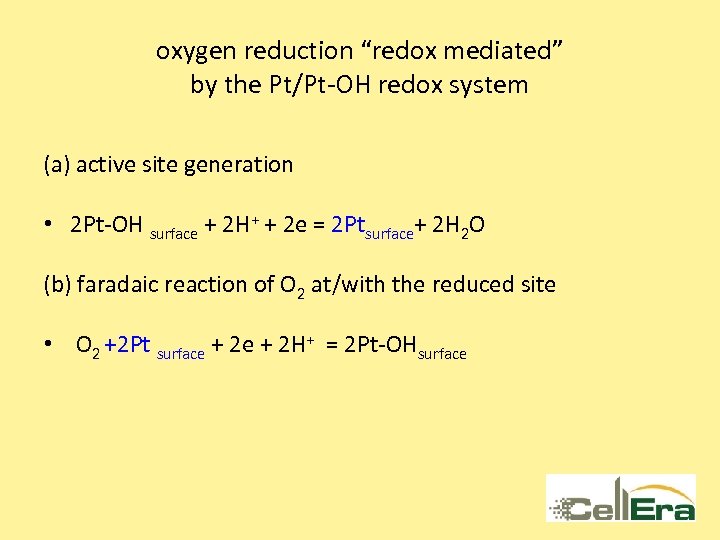 oxygen reduction “redox mediated” by the Pt/Pt-OH redox system (a) active site generation • 2 Pt-OH surface + 2 H+ + 2 e = 2 Ptsurface+ 2 H 2 O (b) faradaic reaction of O 2 at/with the reduced site • O 2 +2 Pt surface + 2 H+ = 2 Pt-OHsurface
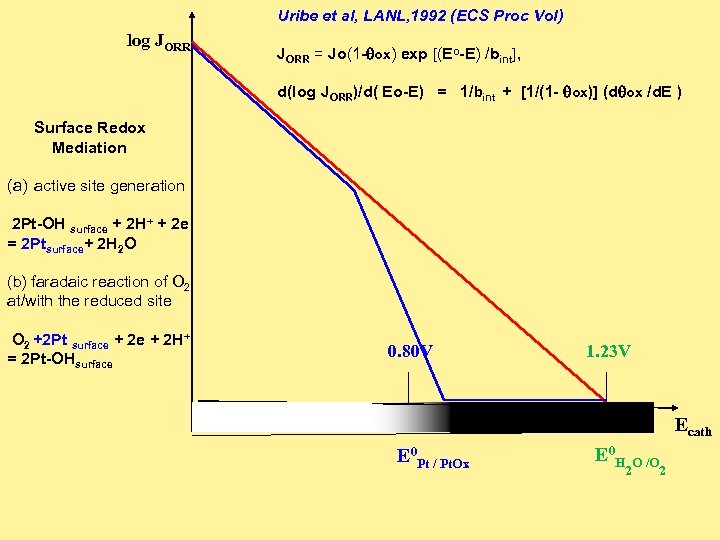 Uribe et al, LANL, 1992 (ECS Proc Vol) log JORR Surface Redox Mediation JORR = Jo(1 -qox) exp [(Eo-E) /bint], d(log JORR)/d( Eo-E) = 1/bint + [1/(1 - qox)] (dqox /d. E ) (a) active site generation 2 Pt-OH surface + 2 H+ + 2 e = 2 Ptsurface+ 2 H 2 O (b) faradaic reaction of O 2 at/with the reduced site O 2 +2 Pt surface + 2 H+ = 2 Pt-OHsurface 0. 80 V 1. 23 V Ecath E 0 Pt / Pt. Ox E 0 H 2 O /O 2
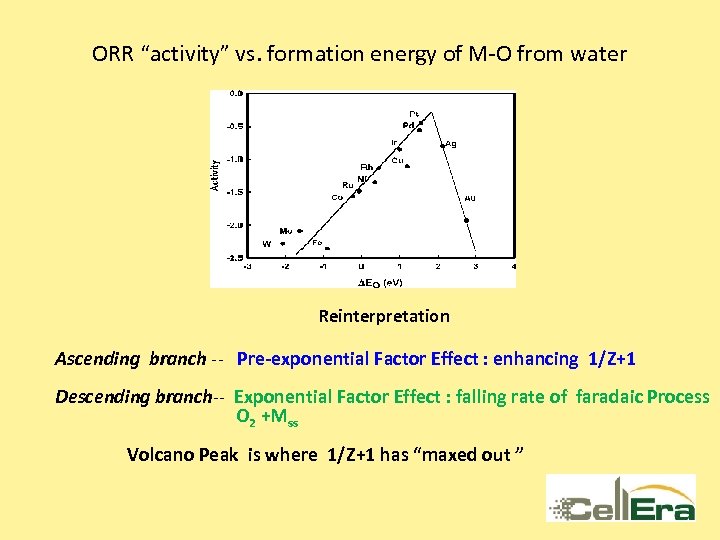 ORR “activity” vs. formation energy of M-O from water Reinterpretation Ascending branch -- Pre-exponential Factor Effect : enhancing 1/Z+1 Descending branch-- Exponential Factor Effect : falling rate of faradaic Process O 2 +Mss Volcano Peak is where 1/Z+1 has “maxed out ”
 Good general principle for searching an active ORR catalyst “A Pourbaix guide for electrocatalysis galaxy travel”: match the target electrode potential in the operating fuel cell, with : the M/M-OHads standard potential of the metal , or metal alloy catalyst, or with: the M+n/+(n+1) standard potential of the active surface redox couple
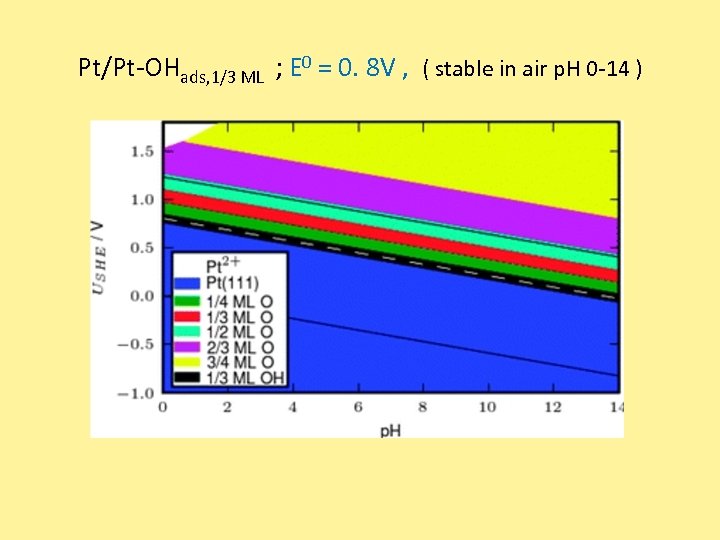 Pt/Pt-OHads, 1/3 ML ; E 0 = 0. 8 V , ( stable in air p. H 0 -14 )
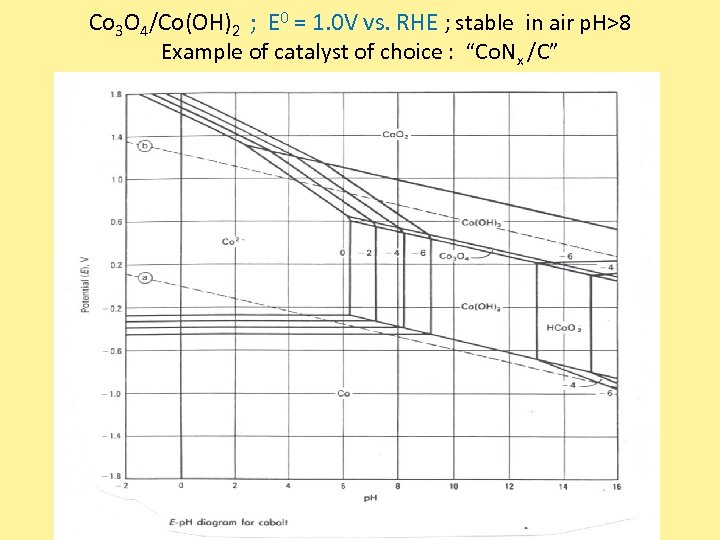 Co 3 O 4/Co(OH)2 ; E 0 = 1. 0 V vs. RHE ; stable in air p. H>8 Example of catalyst of choice : “Co. Nx /C”
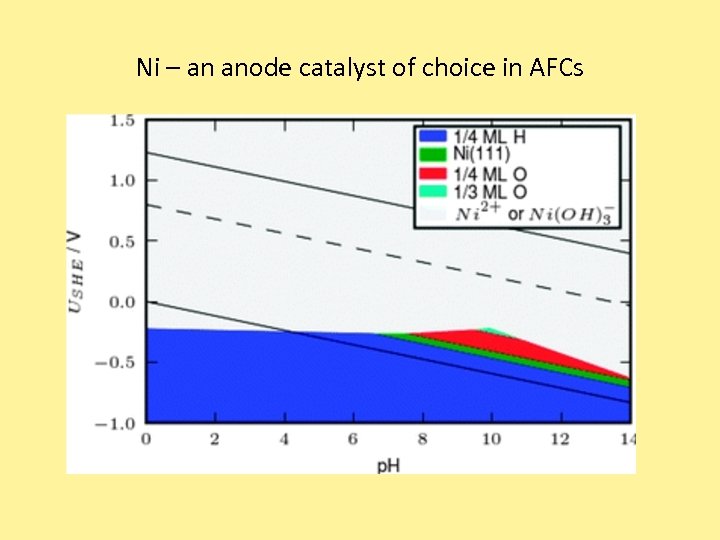 Ni – an anode catalyst of choice in AFCs
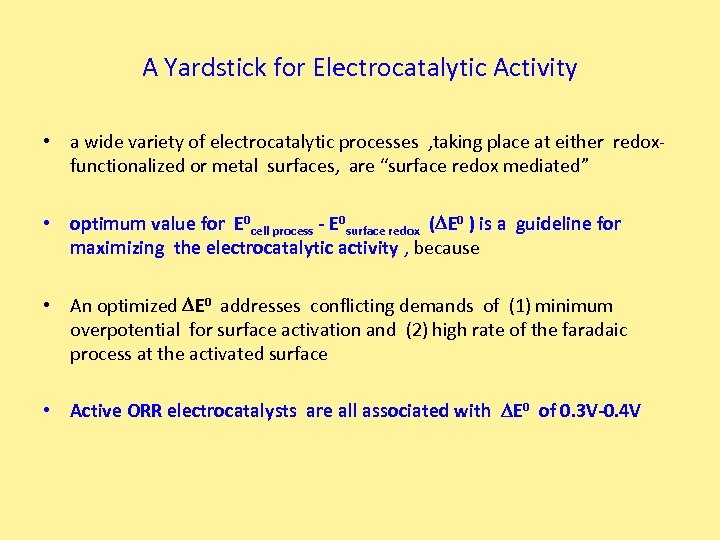 A Yardstick for Electrocatalytic Activity • a wide variety of electrocatalytic processes , taking place at either redoxfunctionalized or metal surfaces, are “surface redox mediated” • optimum value for E 0 cell process - E 0 surface redox (DE 0 ) is a guideline for maximizing the electrocatalytic activity , because • An optimized DE 0 addresses conflicting demands of (1) minimum overpotential for surface activation and (2) high rate of the faradaic process at the activated surface • Active ORR electrocatalysts are all associated with DE 0 of 0. 3 V-0. 4 V
 Acknowledgements of Support *Israel Cleantech Ventures *Office of the Chief Scientist Ministry of Commerce & Industry