


 Скачать презентацию Fuel Cells for Micro Air Vehicles James C
5e2010b75fa316625887eeb5a57e307c.ppt
- Количество слайдов: 18
 Fuel Cells for Micro Air Vehicles James C. Kellogg, Lesli Monforton, Danielle White, and Michael Vick Tactical Electronic Warfare Division Karen Swider Lyons and Peter Bouwman Chemistry Division Naval Research Laboratory, Washington DC Joint Service Power Expo, Tampa FL 5 May 2005
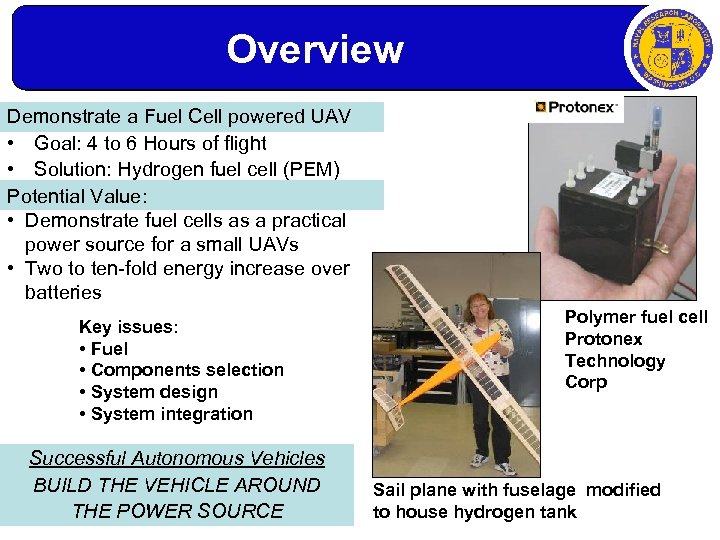 Overview Demonstrate a Fuel Cell powered UAV • Goal: 4 to 6 Hours of flight • Solution: Hydrogen fuel cell (PEM) Potential Value: • Demonstrate fuel cells as a practical power source for a small UAVs • Two to ten-fold energy increase over batteries Key issues: • Fuel • Components selection • System design • System integration Successful Autonomous Vehicles BUILD THE VEHICLE AROUND THE POWER SOURCE Polymer fuel cell Protonex Technology Corp Sail plane with fuselage modified to house hydrogen tank
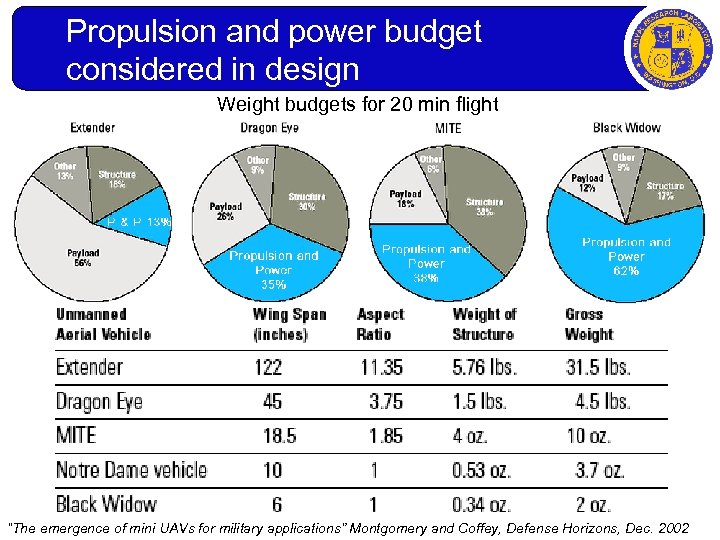 Propulsion and power budget considered in design Weight budgets for 20 min flight “The emergence of mini UAVs for military applications” Montgomery and Coffey, Defense Horizons, Dec. 2002
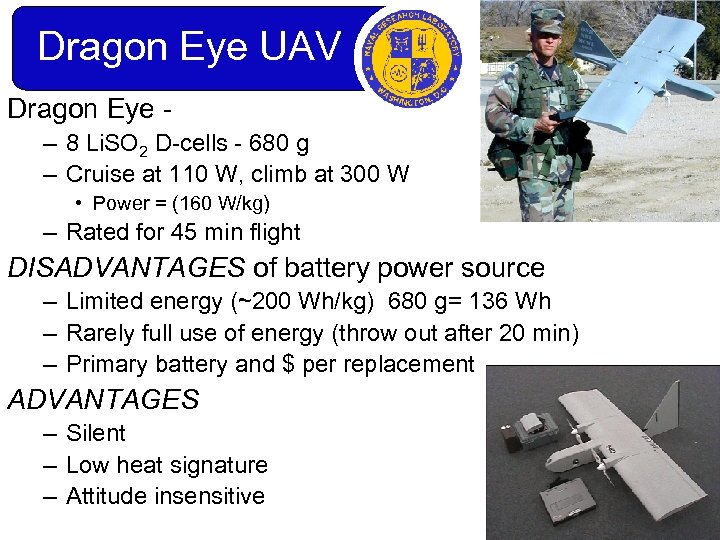 Dragon Eye UAV Dragon Eye – 8 Li. SO 2 D-cells - 680 g – Cruise at 110 W, climb at 300 W • Power = (160 W/kg) – Rated for 45 min flight DISADVANTAGES of battery power source – Limited energy (~200 Wh/kg) 680 g= 136 Wh – Rarely full use of energy (throw out after 20 min) – Primary battery and $ per replacement ADVANTAGES – Silent – Low heat signature – Attitude insensitive
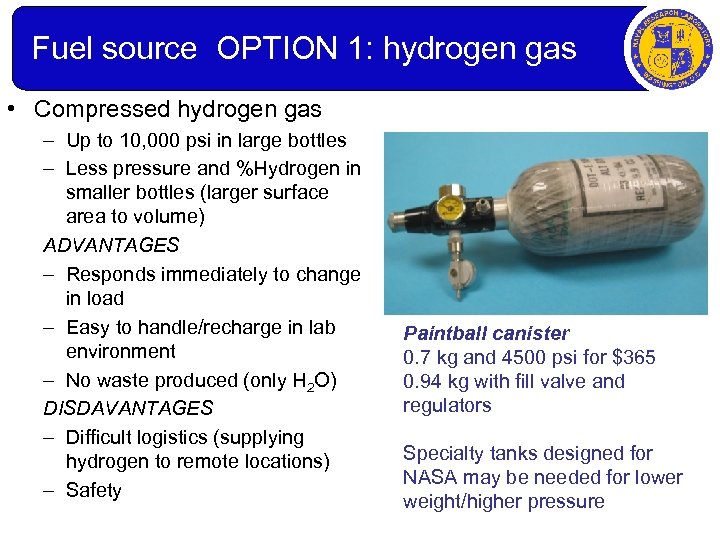 Fuel source OPTION 1: hydrogen gas • Compressed hydrogen gas – Up to 10, 000 psi in large bottles – Less pressure and %Hydrogen in smaller bottles (larger surface area to volume) ADVANTAGES – Responds immediately to change in load – Easy to handle/recharge in lab environment – No waste produced (only H 2 O) DISDAVANTAGES – Difficult logistics (supplying hydrogen to remote locations) – Safety Paintball canister 0. 7 kg and 4500 psi for $365 0. 94 kg with fill valve and regulators Specialty tanks designed for NASA may be needed for lower weight/higher pressure
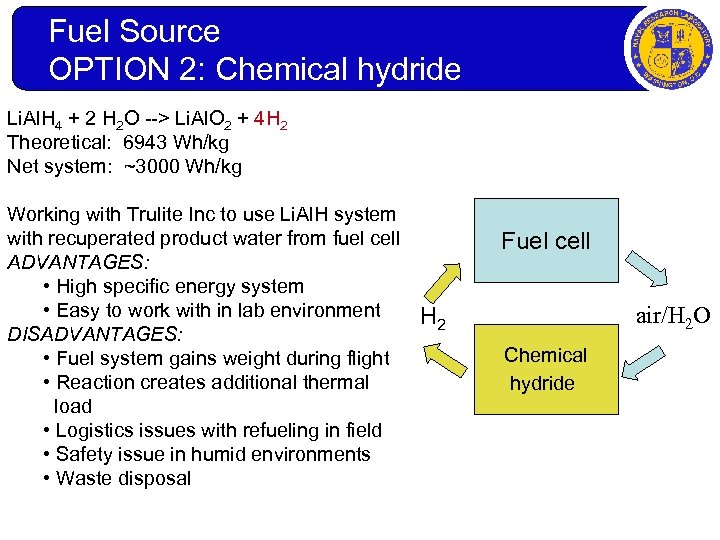 Fuel Source OPTION 2: Chemical hydride Li. Al. H 4 + 2 H 2 O --> Li. Al. O 2 + 4 H 2 Theoretical: 6943 Wh/kg Net system: ~3000 Wh/kg Working with Trulite Inc to use Li. Al. H system with recuperated product water from fuel cell ADVANTAGES: • High specific energy system • Easy to work with in lab environment DISADVANTAGES: • Fuel system gains weight during flight • Reaction creates additional thermal load • Logistics issues with refueling in field • Safety issue in humid environments • Waste disposal Fuel cell air/H 2 O H 2 Chemical hydride
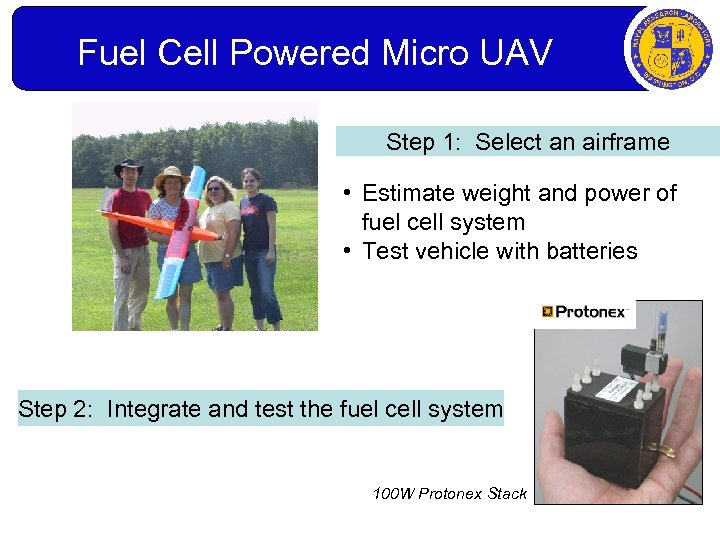 Fuel Cell Powered Micro UAV Step 1: Select an airframe • Estimate weight and power of fuel cell system • Test vehicle with batteries Step 2: Integrate and test the fuel cell system 100 W Protonex Stack
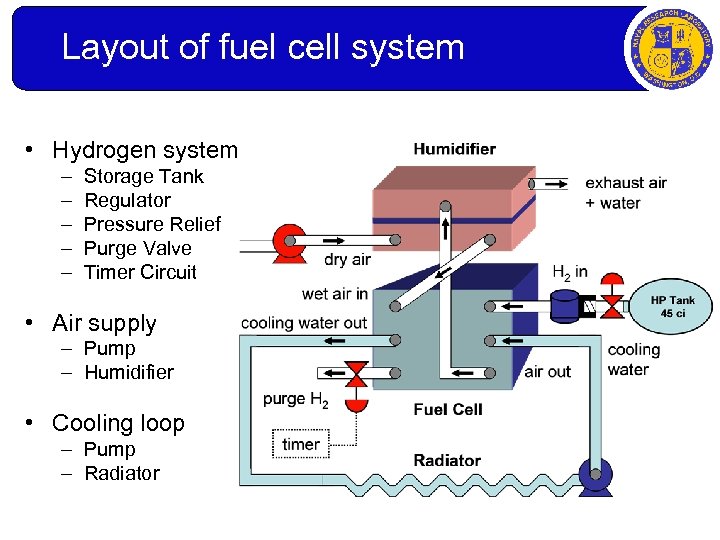 Layout of fuel cell system • Hydrogen system – – – Storage Tank Regulator Pressure Relief Purge Valve Timer Circuit • Air supply – Pump – Humidifier • Cooling loop – Pump – Radiator
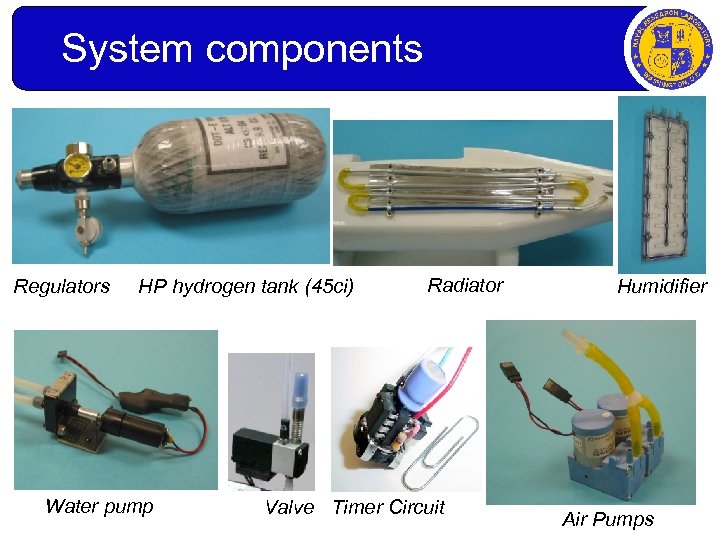 System components Regulators HP hydrogen tank (45 ci) Water pump Radiator Valve Timer Circuit Humidifier Air Pumps
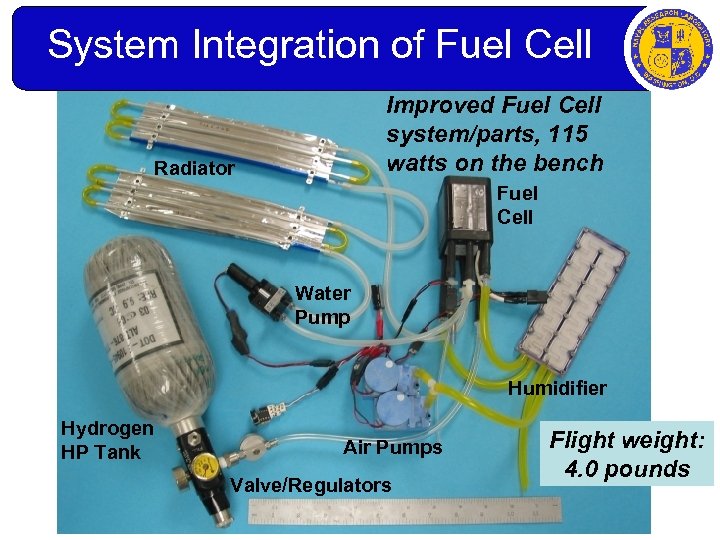 System Integration of Fuel Cell Improved Fuel Cell system/parts, 115 watts on the bench Radiator Fuel Cell Water Pump Humidifier Hydrogen HP Tank Air Pumps Valve/Regulators Flight weight: 4. 0 pounds
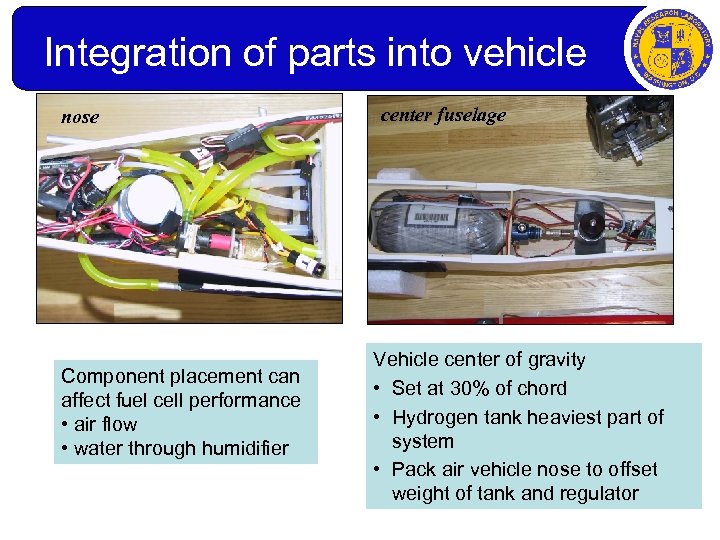 Integration of parts into vehicle nose Component placement can affect fuel cell performance • air flow • water through humidifier center fuselage Vehicle center of gravity • Set at 30% of chord • Hydrogen tank heaviest part of system • Pack air vehicle nose to offset weight of tank and regulator
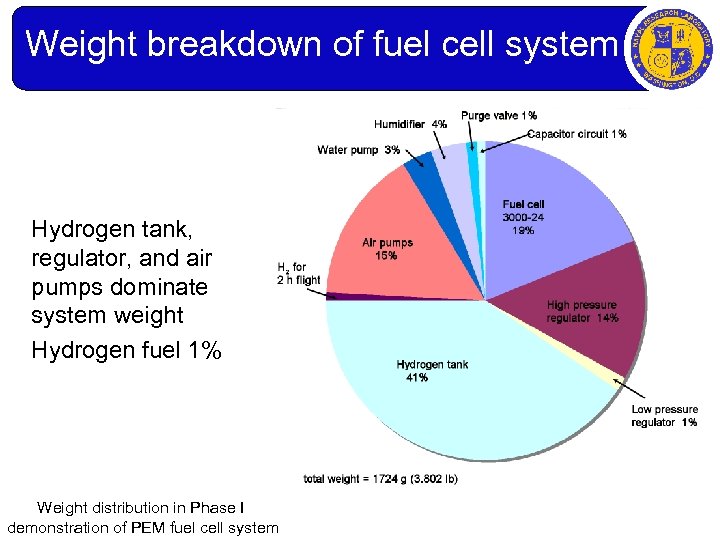 Weight breakdown of fuel cell system Hydrogen tank, regulator, and air pumps dominate system weight Hydrogen fuel 1% Weight distribution in Phase I demonstration of PEM fuel cell system
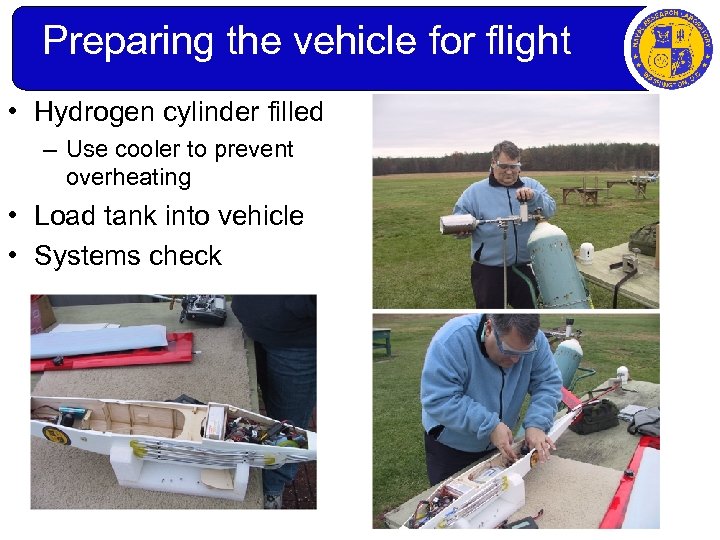 Preparing the vehicle for flight • Hydrogen cylinder filled – Use cooler to prevent overheating • Load tank into vehicle • Systems check
 The Fuel Cell Flyer Flight test, November 2004
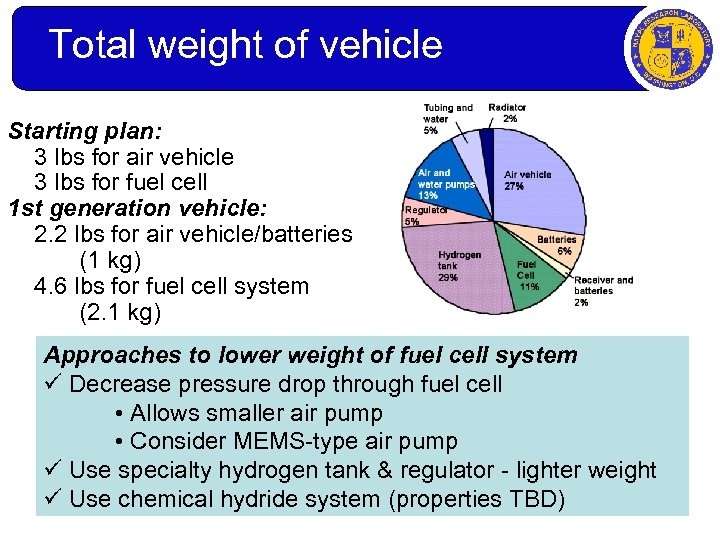 Total weight of vehicle Starting plan: 3 lbs for air vehicle 3 lbs for fuel cell 1 st generation vehicle: 2. 2 lbs for air vehicle/batteries (1 kg) 4. 6 lbs for fuel cell system (2. 1 kg) Approaches to lower weight of fuel cell system ü Decrease pressure drop through fuel cell • Allows smaller air pump • Consider MEMS-type air pump ü Use specialty hydrogen tank & regulator - lighter weight ü Use chemical hydride system (properties TBD)
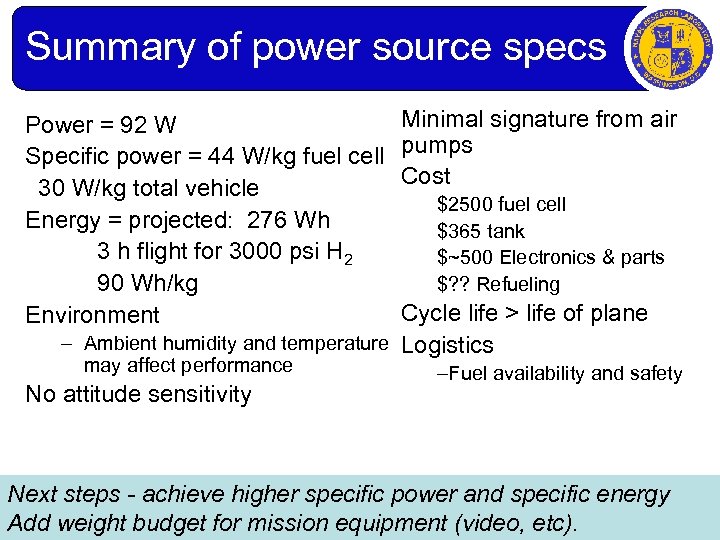 Summary of power source specs Power = 92 W Specific power = 44 W/kg fuel cell 30 W/kg total vehicle Energy = projected: 276 Wh 3 h flight for 3000 psi H 2 90 Wh/kg Environment Minimal signature from air pumps Cost $2500 fuel cell $365 tank $~500 Electronics & parts $? ? Refueling Cycle life > life of plane – Ambient humidity and temperature Logistics may affect performance No attitude sensitivity –Fuel availability and safety Next steps - achieve higher specific power and specific energy Add weight budget for mission equipment (video, etc).
 Summary • • • 8 h micro air vehicle flight State-of-art batteries are inadequate Fuel cells are a viable option for 8 to 12 h flights Building the vehicle around the power source is key to success Development team with expertise in fuel cells, air vehicles, and modeling Weight of fuel cell systems must be reduced for use in tactical vehicles – Consider hydride fuels for PEMFCs – Possibility of butane-fueled SOFCs
 Acknowledgements • Greg Ariff, Brian James Directed Technologies, Arlington VA • William Skrivan, Paul Sabin, Paul Osenar Protonex Technology Corporation, Southboro, MA • Timothy La. Breche, Aaron Crumm Adaptive Materials, Ann Arbor MI kellogg@suzie. nrl. navy. mil