


 Скачать презентацию FSU Holocaust Institute for Educators Cynthia Edelman Art
73df6a2c6860720cc6db1a83b772076a.ppt
- Количество слайдов: 77
 FSU Holocaust Institute for Educators Cynthia Edelman Art History Opening Lecture Drawing Strength: The Art of the Holocaust Dr. David Gussak Asst. Professor, Art Education/Art Therapy
 When Viewing The Following Images, Consider the Following Questions… • Why did the victims create this art? – What did it accomplish? – Why the risk? • Why is it important to see this art? – How do we talk about this art? – What does it show us?
 “…painting is designed as a mediator between us and the world around it and it is not necessarily an aesthetic operation, but a way of acquiring power and giving concrete form to our fears, hopes, and wishes. ”--Picasso
 The following images are in many locations, including the Terezin Ghetto Museum, the Auschwitz Museum and private collections (By no means is this an exhaustive collection—there are many more art pieces that have been discovered, but space and time does not permit full exploration…)
 The images for this presentation have been borrowed from various public domain internet sites that focus on the art of the Holocaust as well as several publications. These images will be used to provide background and discussion points forthe program session. These sites will be listed in the last several slides.
 Many of these artists started at Terezin but were subsequently deported to Auschwitz Four of the most well-known artists were from the situation known as the “Terezin Painters Affair”: Otto Ungar Bedrich Fritta Karel Fleishmann Leo Haas
 Many other artists are represented here as well: Wincenty Gawron Franciszek Jazwiecki Miecyslaw Koscielniak Waldemar Nowakowski Zofia Rozenstrauch Aldo Carpi Pavel Fantl Yehuda Bacon Helga Weissova To name just a few… . . and of course, the children.
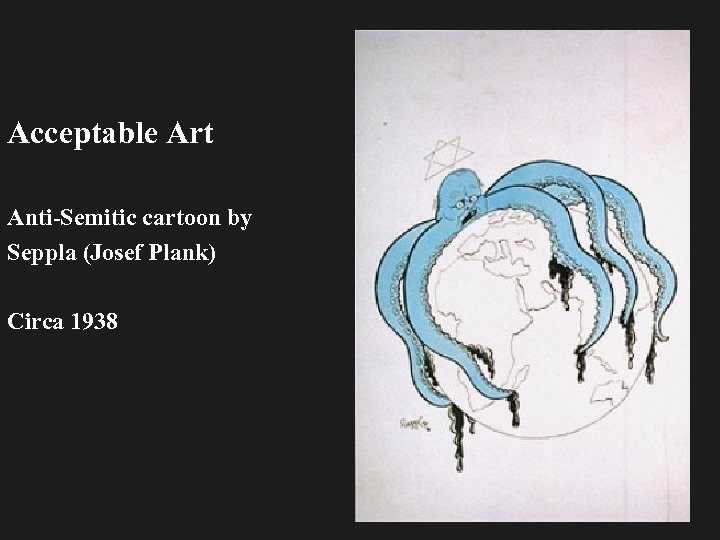 Acceptable Art Anti-Semitic cartoon by Seppla (Josef Plank) Circa 1938
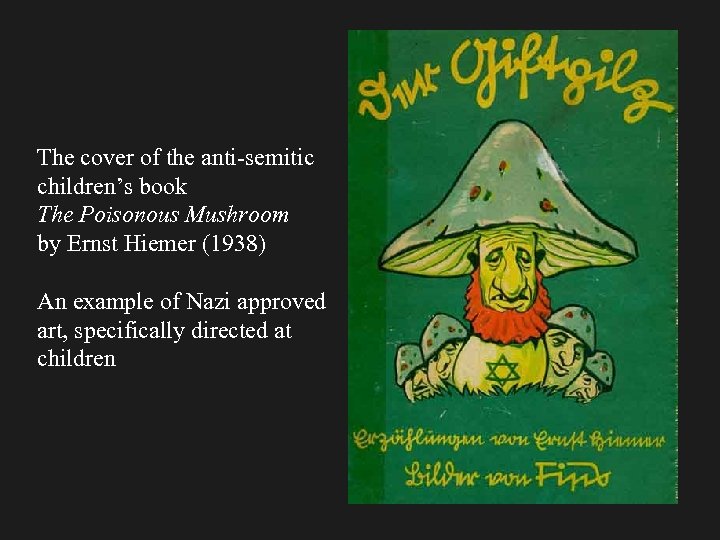 The cover of the anti-semitic children’s book The Poisonous Mushroom by Ernst Hiemer (1938) An example of Nazi approved art, specifically directed at children
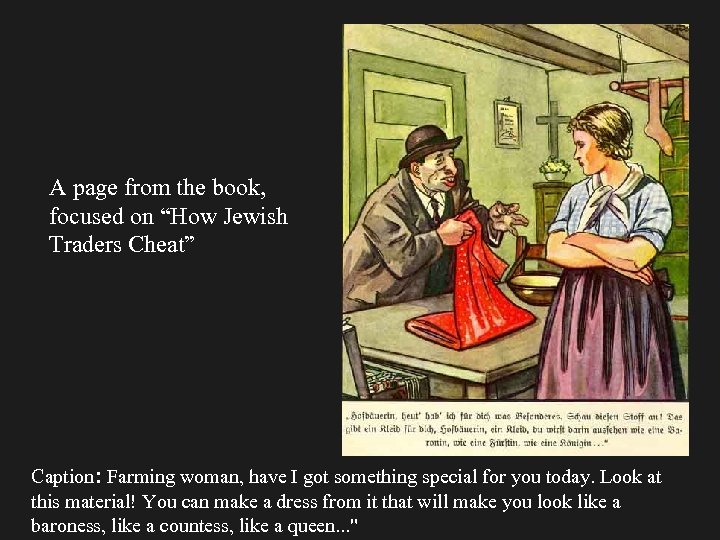 A page from the book, focused on “How Jewish Traders Cheat” Caption: Farming woman, have I got something special for you today. Look at this material! You can make a dress from it that will make you look like a baroness, like a countess, like a queen. . . "
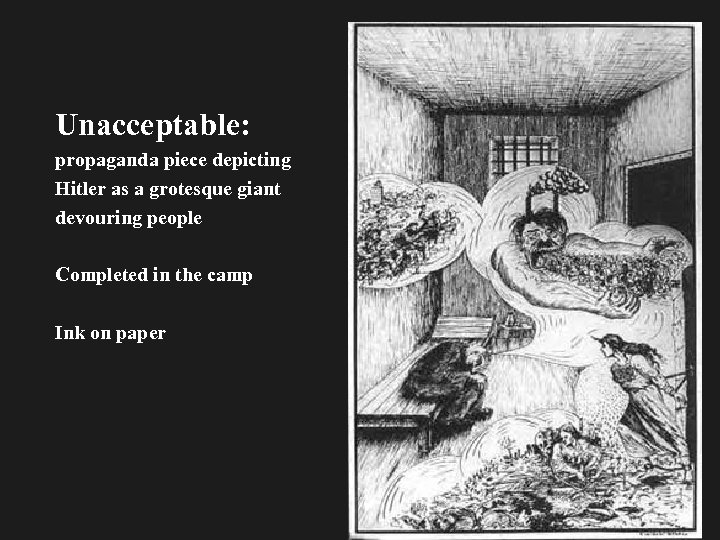 Unacceptable: propaganda piece depicting Hitler as a grotesque giant devouring people Completed in the camp Ink on paper
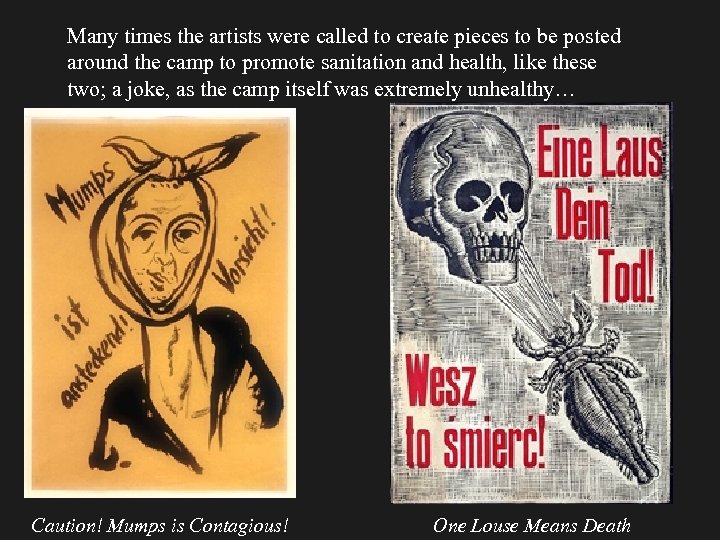 Many times the artists were called to create pieces to be posted around the camp to promote sanitation and health, like these two; a joke, as the camp itself was extremely unhealthy… Caution! Mumps is Contagious! One Louse Means Death
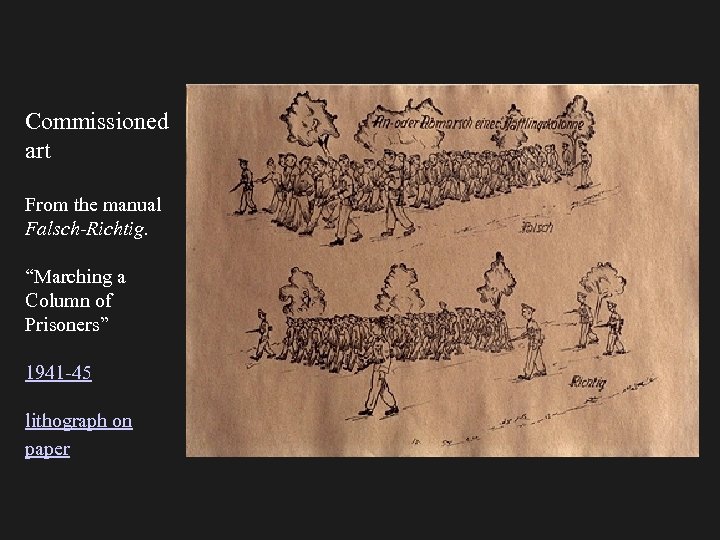 Commissioned art From the manual Falsch-Richtig. “Marching a Column of Prisoners” 1941 -45 lithograph on paper
 Artists of the ‘Terezin Painters Affair’
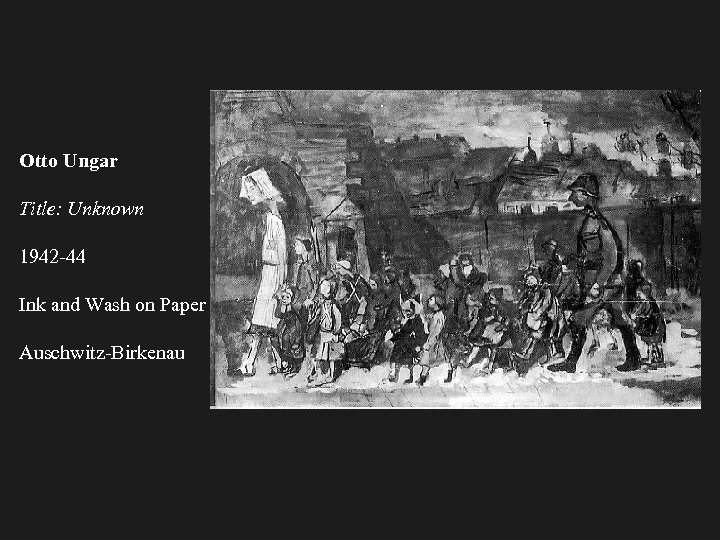 Otto Ungar Title: Unknown 1942 -44 Ink and Wash on Paper Auschwitz-Birkenau
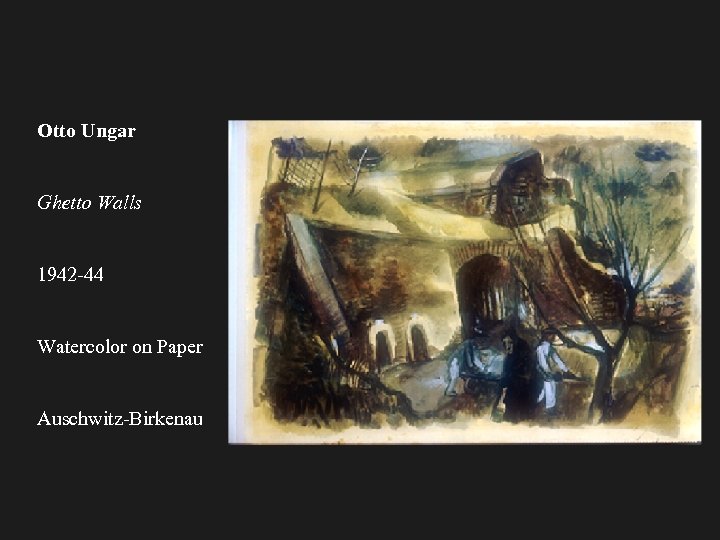 Otto Ungar Ghetto Walls 1942 -44 Watercolor on Paper Auschwitz-Birkenau
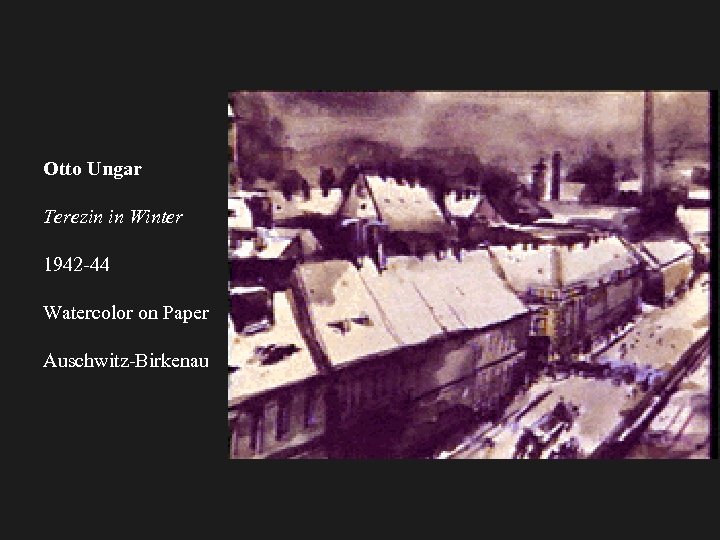 Otto Ungar Terezin in Winter 1942 -44 Watercolor on Paper Auschwitz-Birkenau
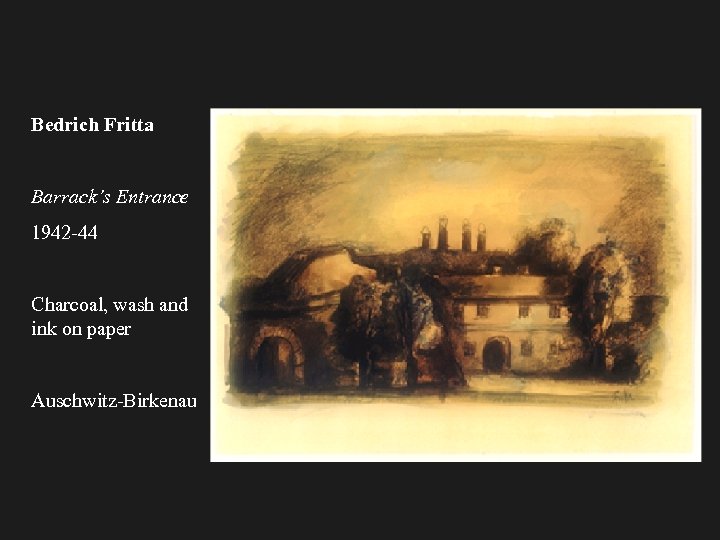 Bedrich Fritta Barrack’s Entrance 1942 -44 Charcoal, wash and ink on paper Auschwitz-Birkenau
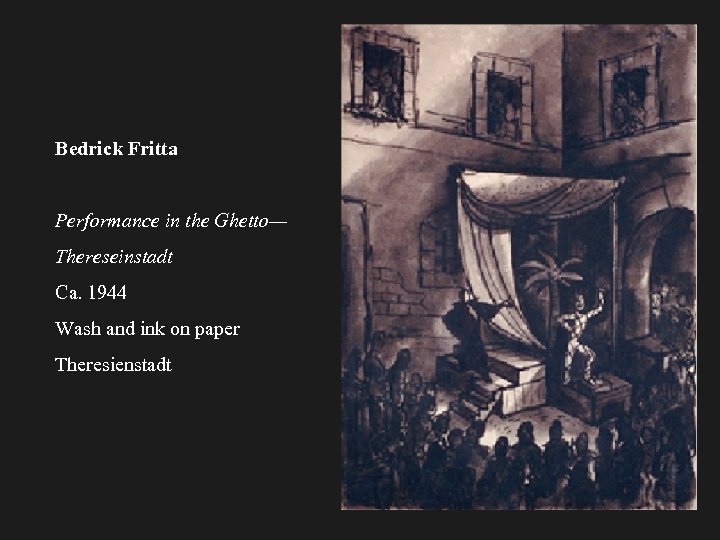 Bedrick Fritta Performance in the Ghetto— Thereseinstadt Ca. 1944 Wash and ink on paper Theresienstadt
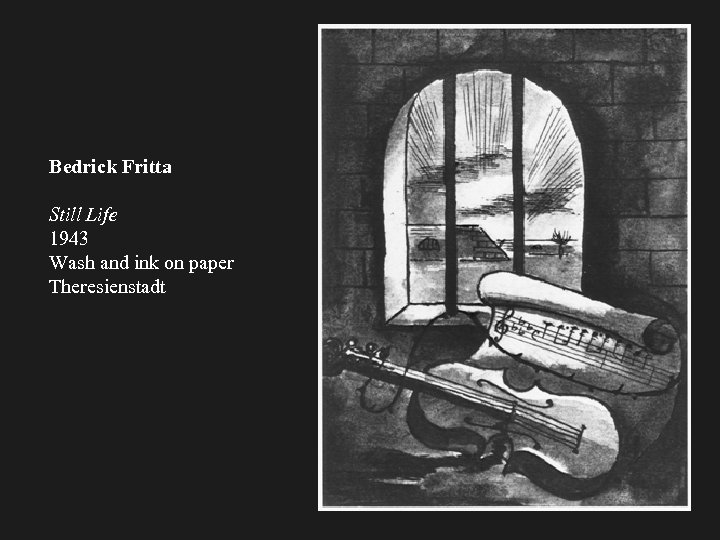 Bedrick Fritta Still Life 1943 Wash and ink on paper Theresienstadt
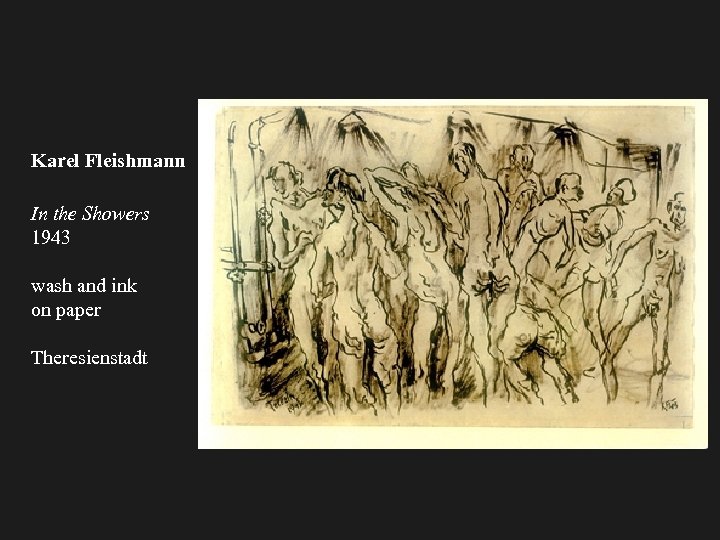 Karel Fleishmann In the Showers 1943 wash and ink on paper Theresienstadt
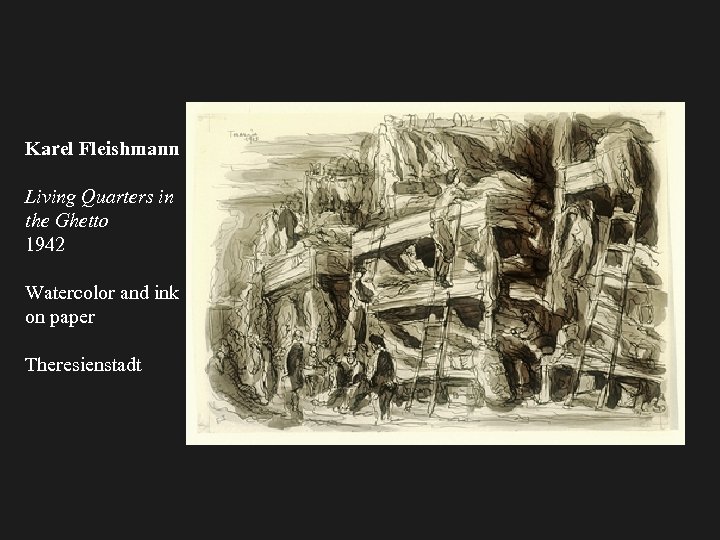 Karel Fleishmann Living Quarters in the Ghetto 1942 Watercolor and ink on paper Theresienstadt
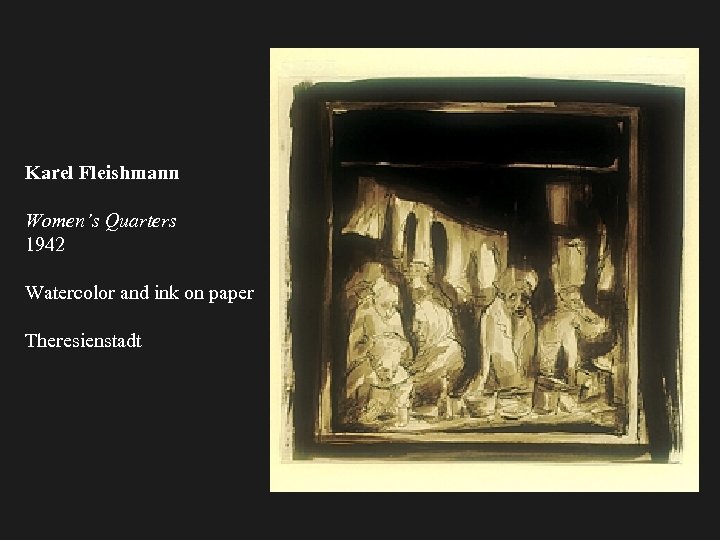 Karel Fleishmann Women’s Quarters 1942 Watercolor and ink on paper Theresienstadt
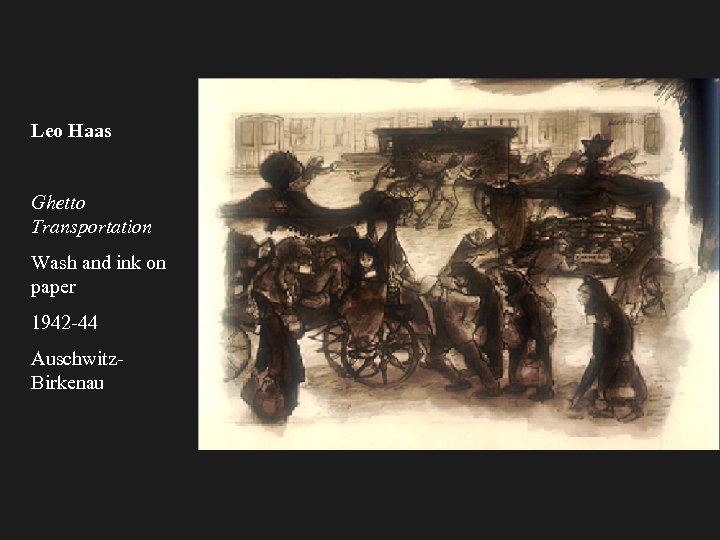 Leo Haas Ghetto Transportation Wash and ink on paper 1942 -44 Auschwitz. Birkenau
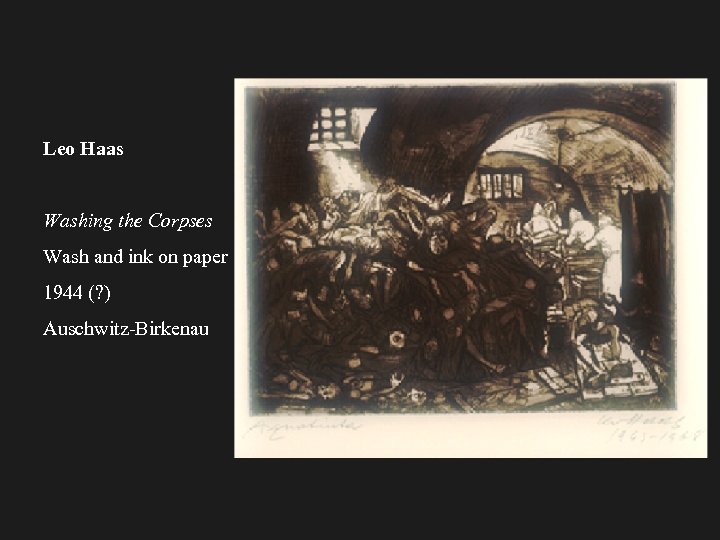 Leo Haas Washing the Corpses Wash and ink on paper 1944 (? ) Auschwitz-Birkenau
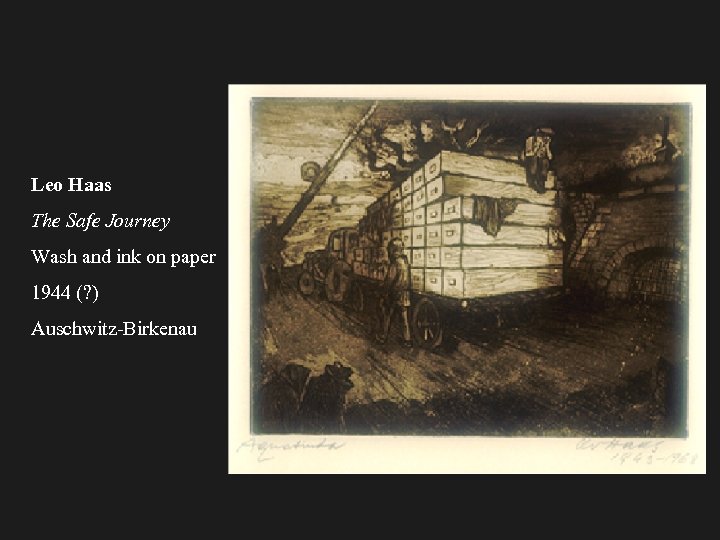 Leo Haas The Safe Journey Wash and ink on paper 1944 (? ) Auschwitz-Birkenau
 Further Examples of Art as Evidence and Resistance
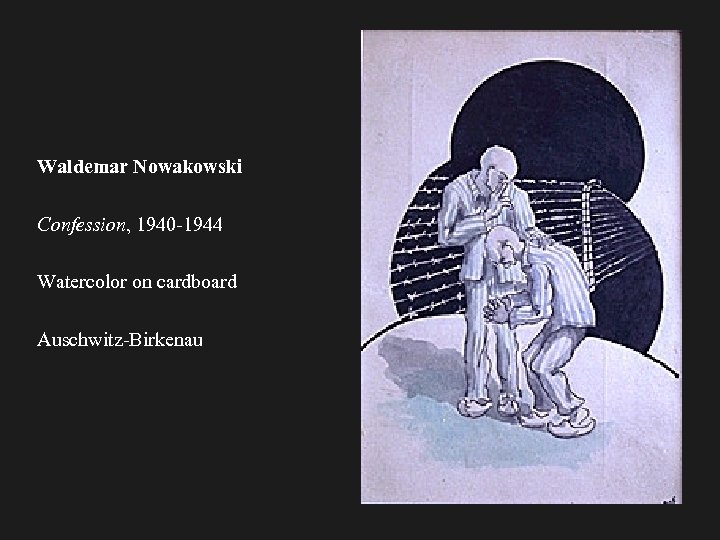 Waldemar Nowakowski Confession, 1940 -1944 Watercolor on cardboard Auschwitz-Birkenau
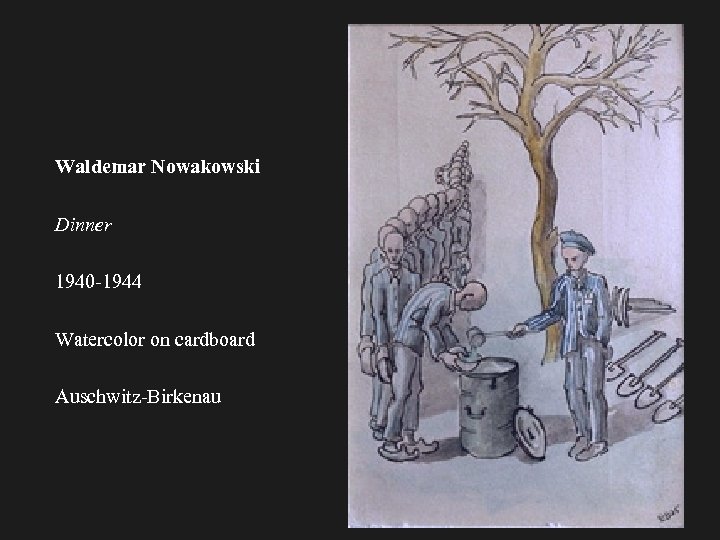 Waldemar Nowakowski Dinner 1940 -1944 Watercolor on cardboard Auschwitz-Birkenau
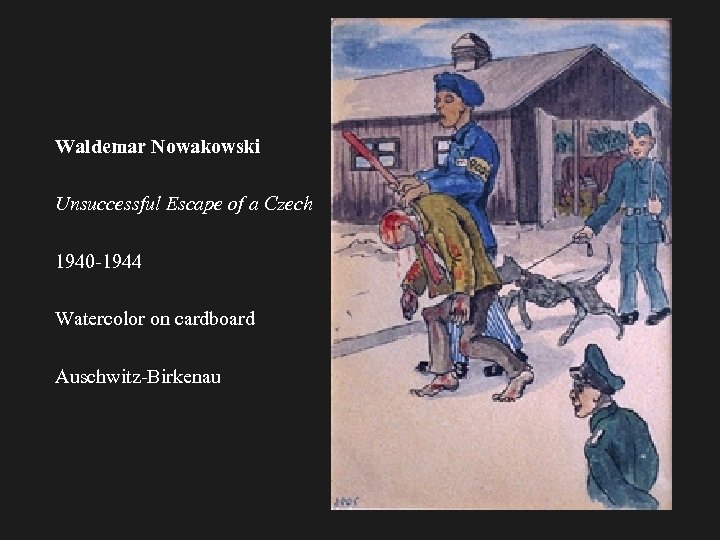 Waldemar Nowakowski Unsuccessful Escape of a Czech 1940 -1944 Watercolor on cardboard Auschwitz-Birkenau
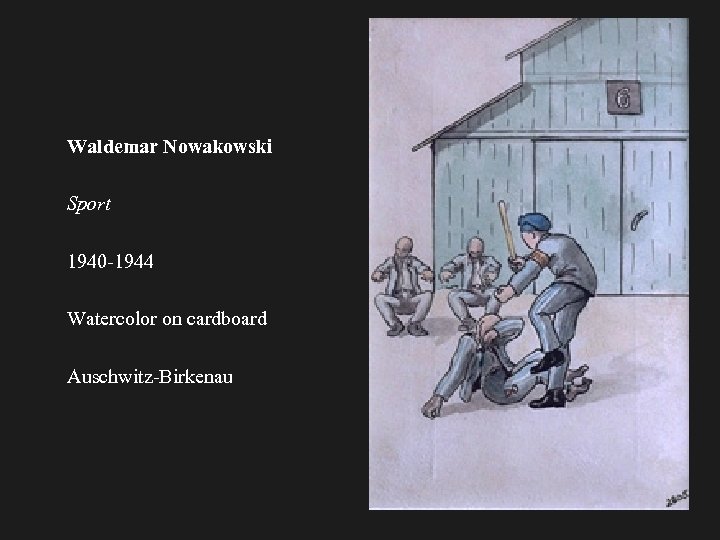 Waldemar Nowakowski Sport 1940 -1944 Watercolor on cardboard Auschwitz-Birkenau
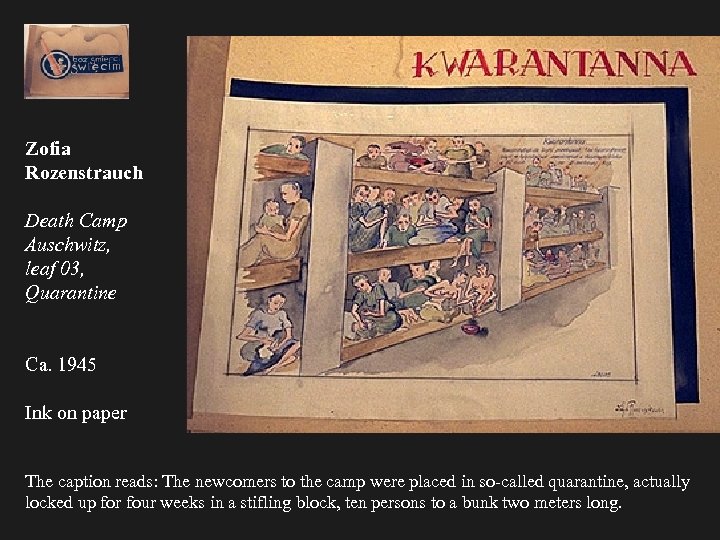 Zofia Rozenstrauch Death Camp Auschwitz, leaf 03, Quarantine Ca. 1945 Ink on paper The caption reads: The newcomers to the camp were placed in so-called quarantine, actually locked up for four weeks in a stifling block, ten persons to a bunk two meters long.
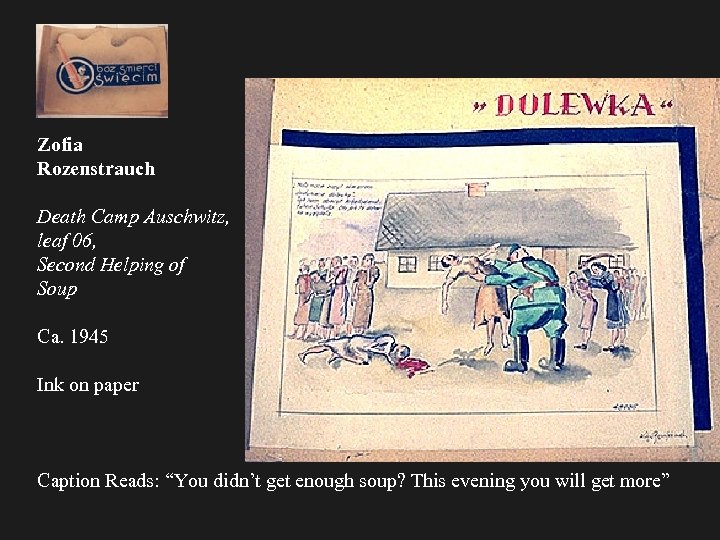 Zofia Rozenstrauch Death Camp Auschwitz, leaf 06, Second Helping of Soup Ca. 1945 Ink on paper Caption Reads: “You didn’t get enough soup? This evening you will get more”
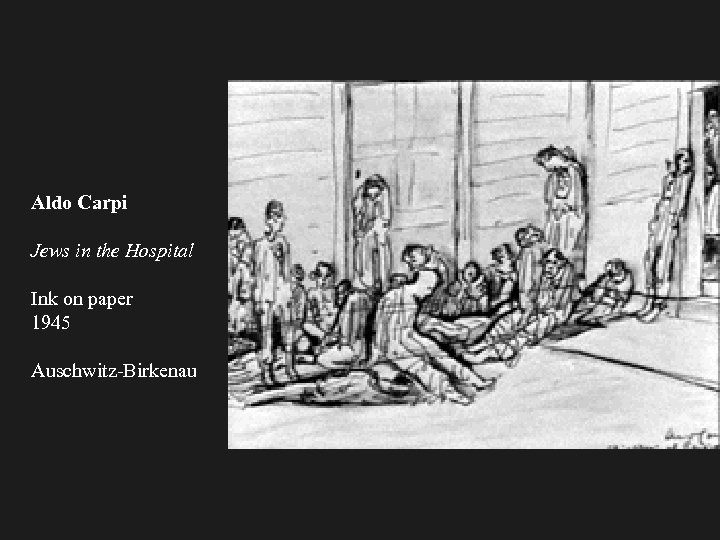 Aldo Carpi Jews in the Hospital Ink on paper 1945 Auschwitz-Birkenau
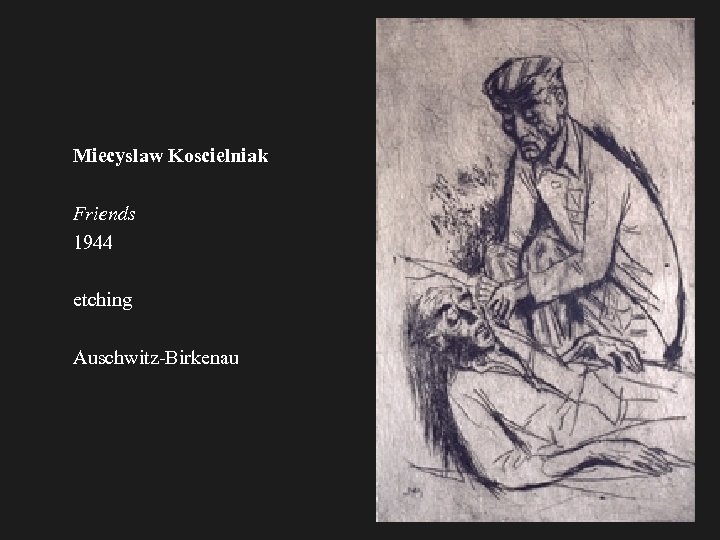 Miecyslaw Koscielniak Friends 1944 etching Auschwitz-Birkenau
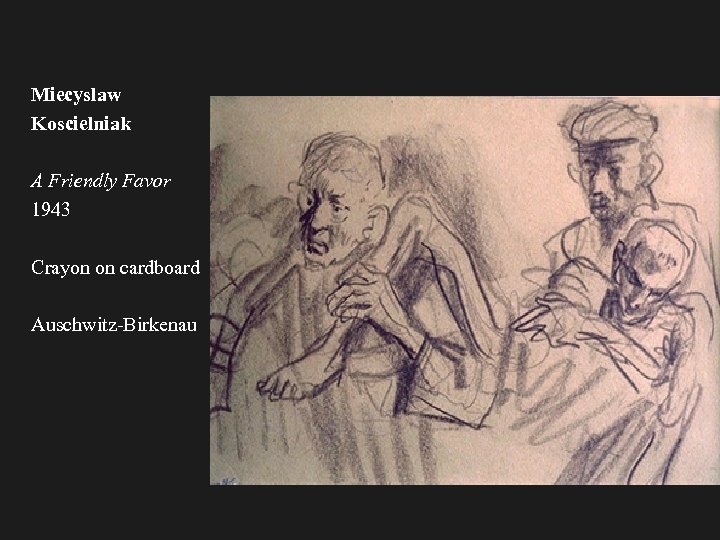 Miecyslaw Koscielniak A Friendly Favor 1943 Crayon on cardboard Auschwitz-Birkenau
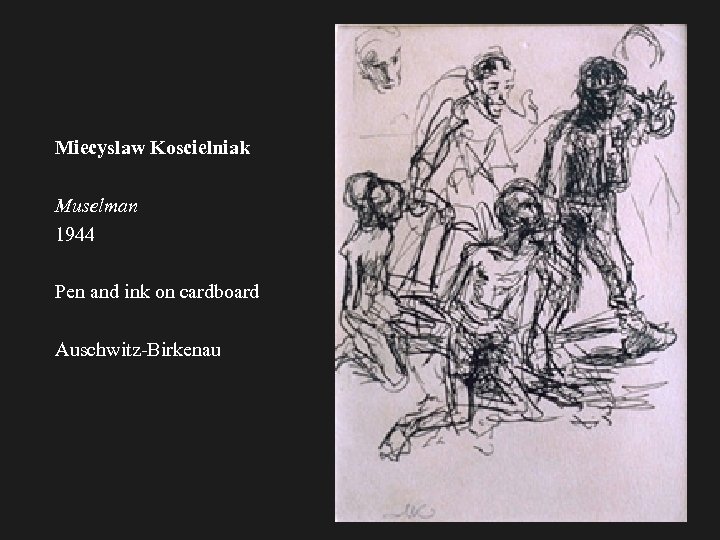 Miecyslaw Koscielniak Muselman 1944 Pen and ink on cardboard Auschwitz-Birkenau
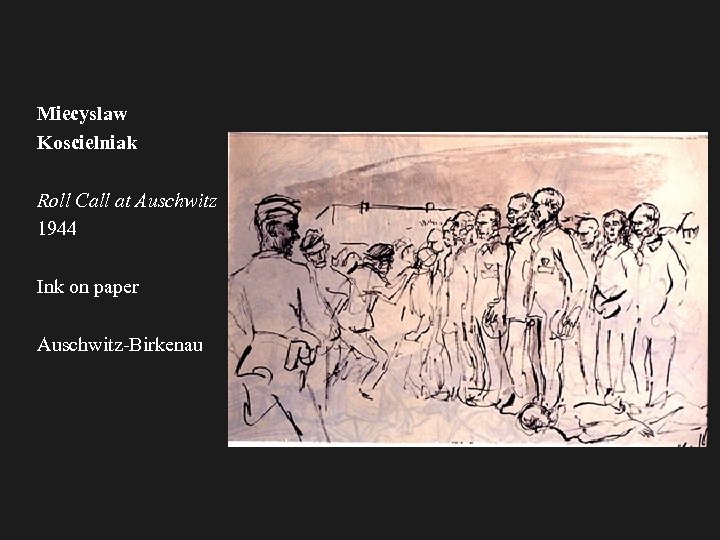 Miecyslaw Koscielniak Roll Call at Auschwitz 1944 Ink on paper Auschwitz-Birkenau
 “Humor”
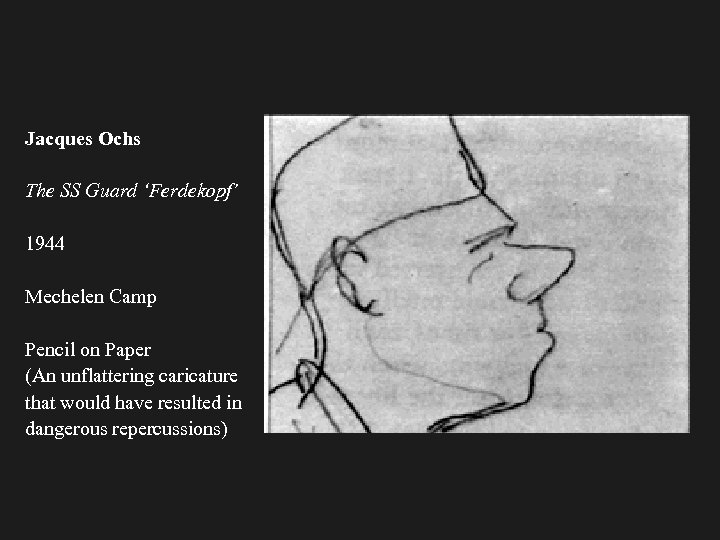 Jacques Ochs The SS Guard ‘Ferdekopf’ 1944 Mechelen Camp Pencil on Paper (An unflattering caricature that would have resulted in dangerous repercussions)
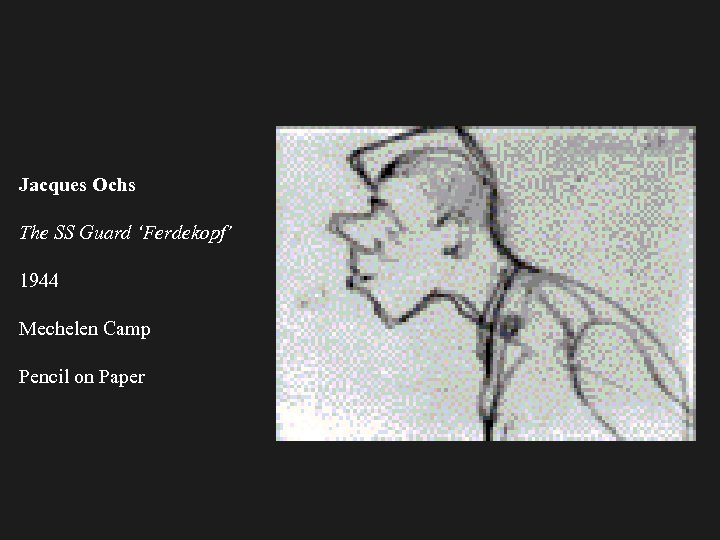 Jacques Ochs The SS Guard ‘Ferdekopf’ 1944 Mechelen Camp Pencil on Paper
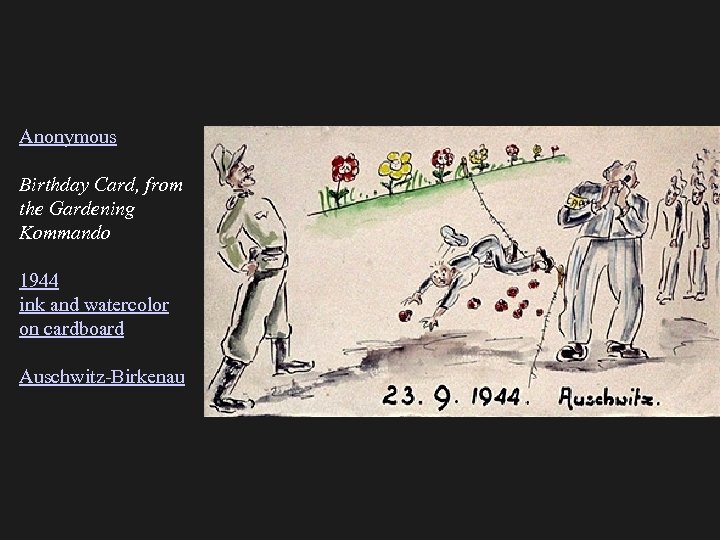 Anonymous Birthday Card, from the Gardening Kommando 1944 ink and watercolor on cardboard Auschwitz-Birkenau
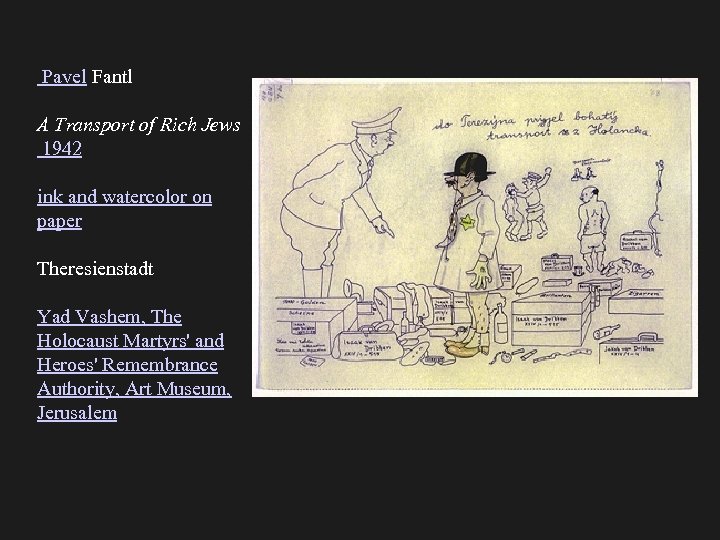 Pavel Fantl A Transport of Rich Jews 1942 ink and watercolor on paper Theresienstadt Yad Vashem, The Holocaust Martyrs' and Heroes' Remembrance Authority, Art Museum, Jerusalem
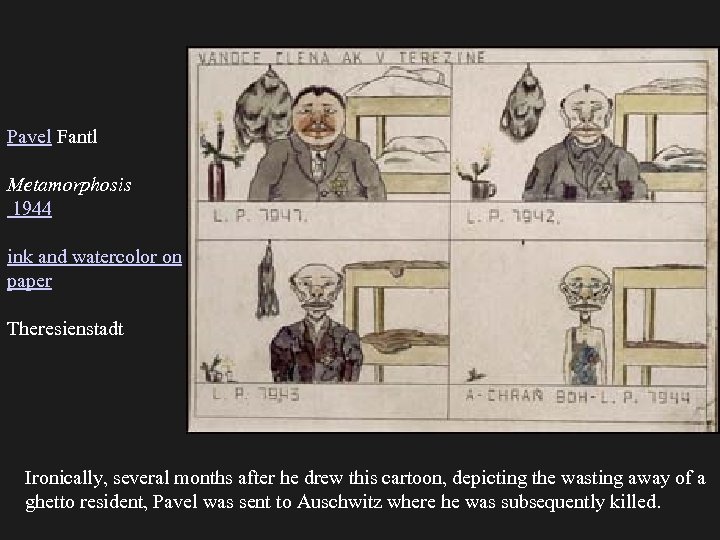 Pavel Fantl Metamorphosis 1944 ink and watercolor on paper Theresienstadt Ironically, several months after he drew this cartoon, depicting the wasting away of a ghetto resident, Pavel was sent to Auschwitz where he was subsequently killed.
 Portraiture: Keeping Them Alive
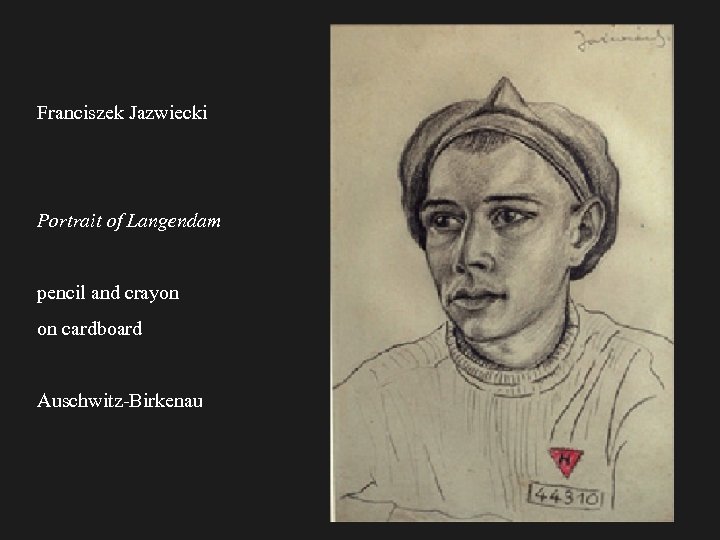 Franciszek Jazwiecki Portrait of Langendam pencil and crayon on cardboard Auschwitz-Birkenau
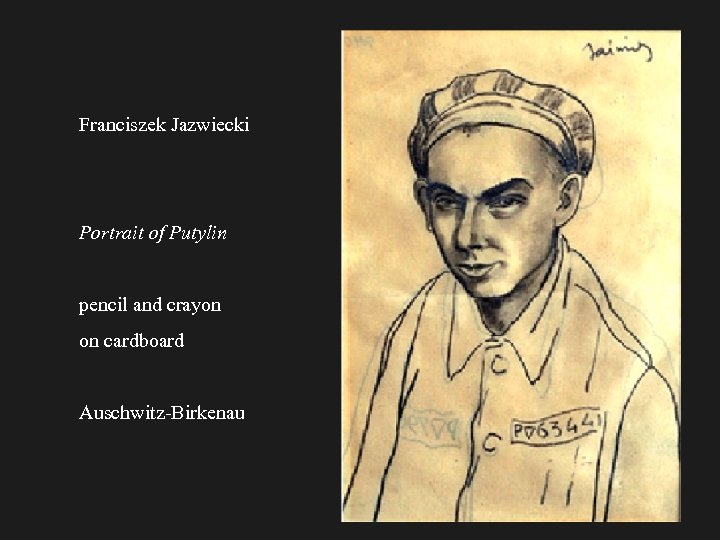 Franciszek Jazwiecki Portrait of Putylin pencil and crayon on cardboard Auschwitz-Birkenau
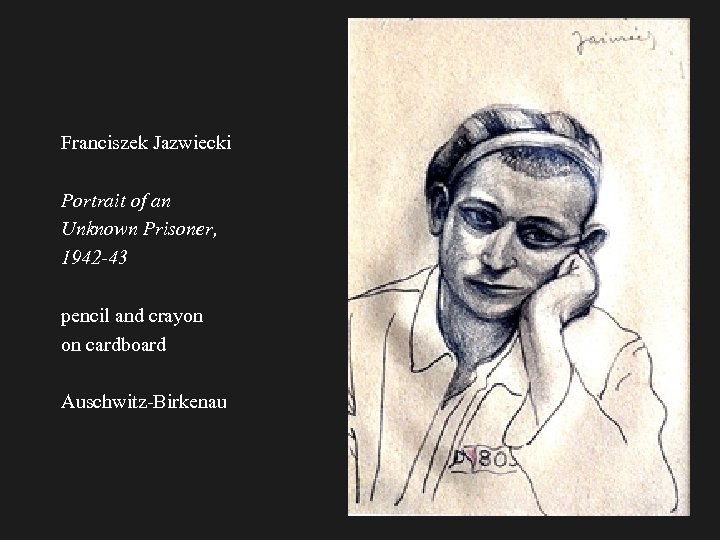 Franciszek Jazwiecki Portrait of an Unknown Prisoner, 1942 -43 pencil and crayon on cardboard Auschwitz-Birkenau
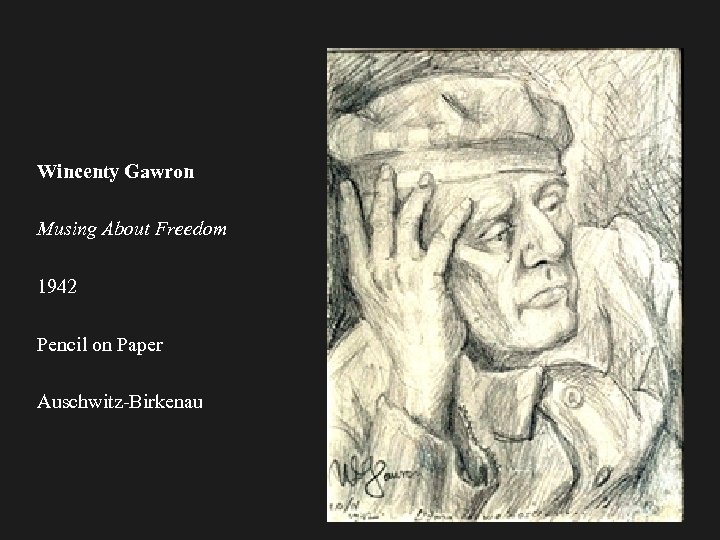 Wincenty Gawron Musing About Freedom 1942 Pencil on Paper Auschwitz-Birkenau
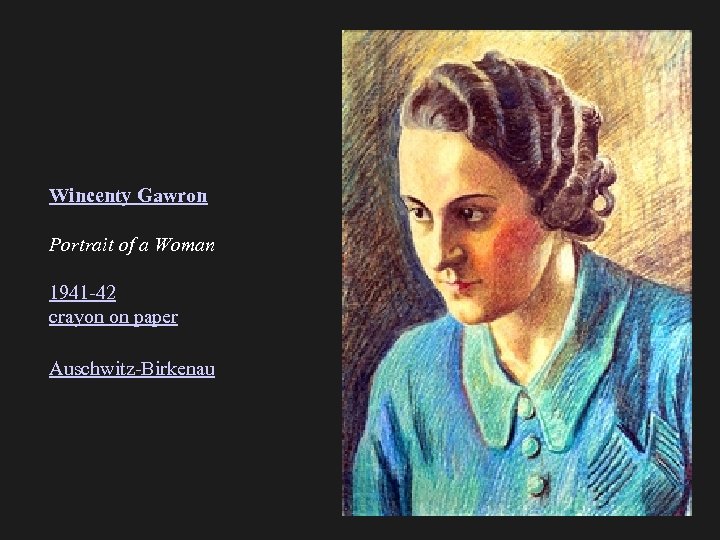 Wincenty Gawron Portrait of a Woman 1941 -42 crayon on paper Auschwitz-Birkenau
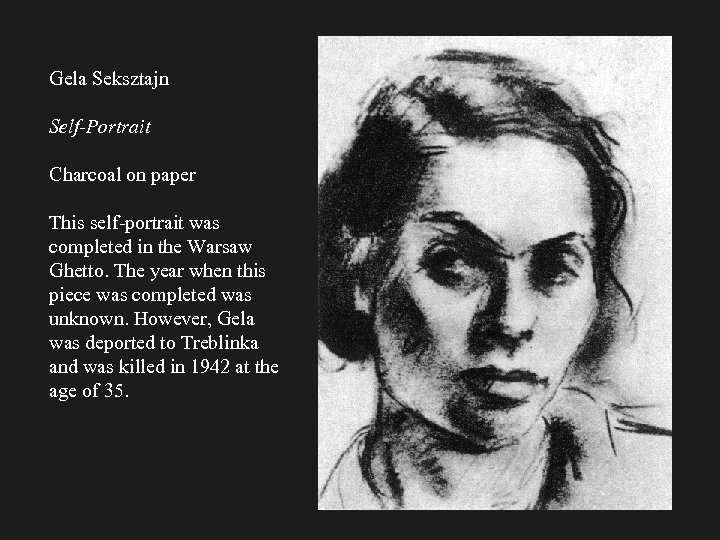 Gela Seksztajn Self-Portrait Charcoal on paper This self-portrait was completed in the Warsaw Ghetto. The year when this piece was completed was unknown. However, Gela was deported to Treblinka and was killed in 1942 at the age of 35.
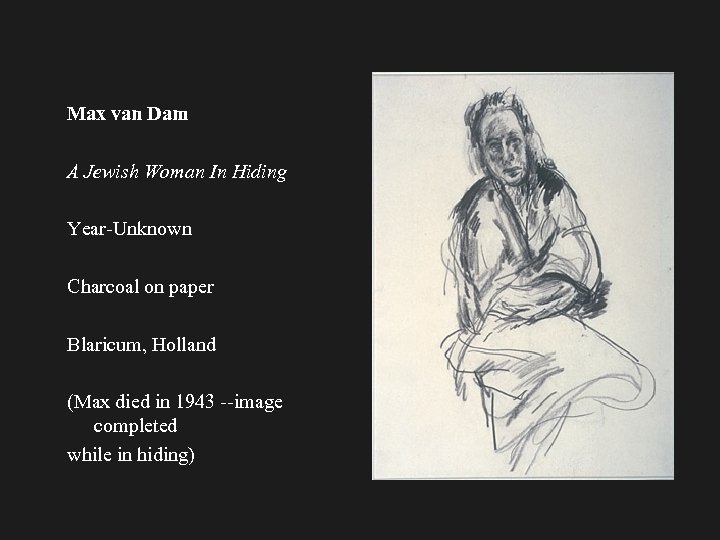 Max van Dam A Jewish Woman In Hiding Year-Unknown Charcoal on paper Blaricum, Holland (Max died in 1943 --image completed while in hiding)
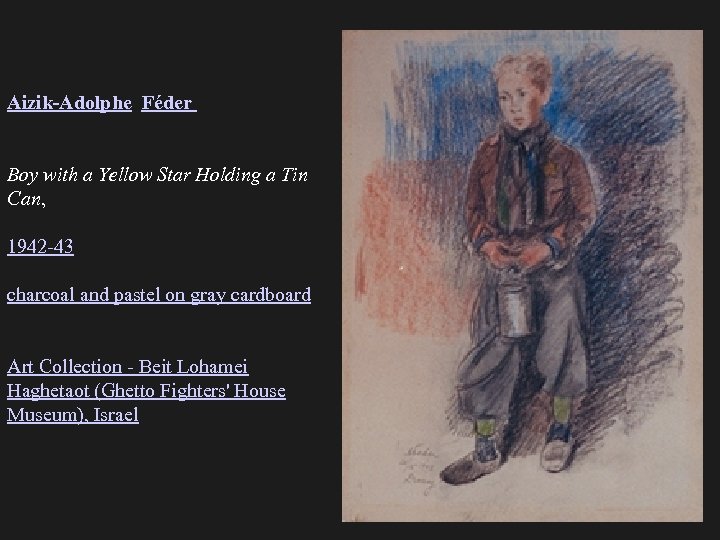 Aizik-Adolphe Féder Boy with a Yellow Star Holding a Tin Can, 1942 -43 charcoal and pastel on gray cardboard Art Collection - Beit Lohamei Haghetaot (Ghetto Fighters' House Museum), Israel
 Art of the Children
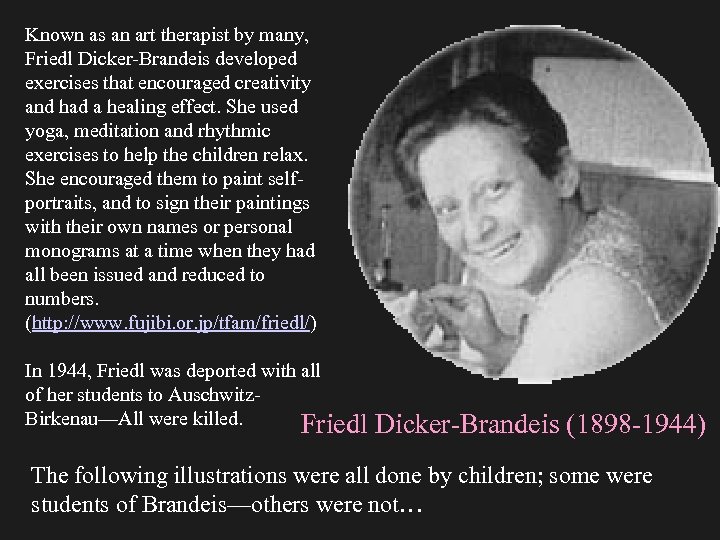 Known as an art therapist by many, Friedl Dicker-Brandeis developed exercises that encouraged creativity and had a healing effect. She used yoga, meditation and rhythmic exercises to help the children relax. She encouraged them to paint selfportraits, and to sign their paintings with their own names or personal monograms at a time when they had all been issued and reduced to numbers. (http: //www. fujibi. or. jp/tfam/friedl/) In 1944, Friedl was deported with all of her students to Auschwitz. Birkenau—All were killed. Friedl Dicker-Brandeis (1898 -1944) The following illustrations were all done by children; some were students of Brandeis—others were not…
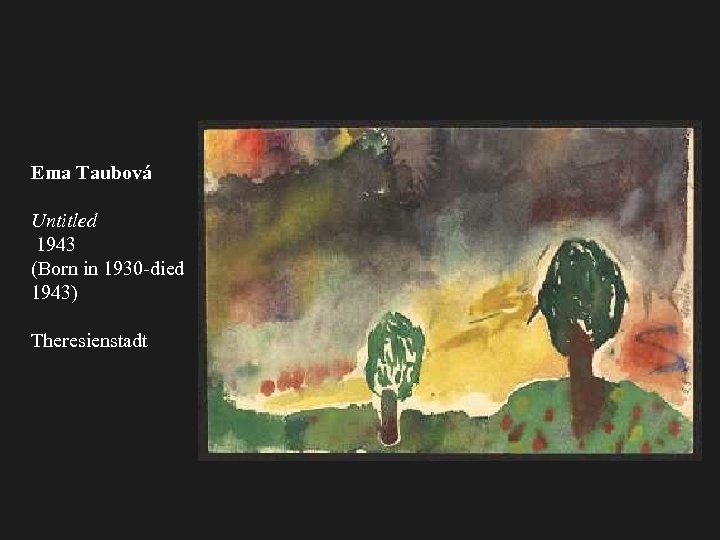 Ema Taubová Untitled 1943 (Born in 1930 -died 1943) Theresienstadt
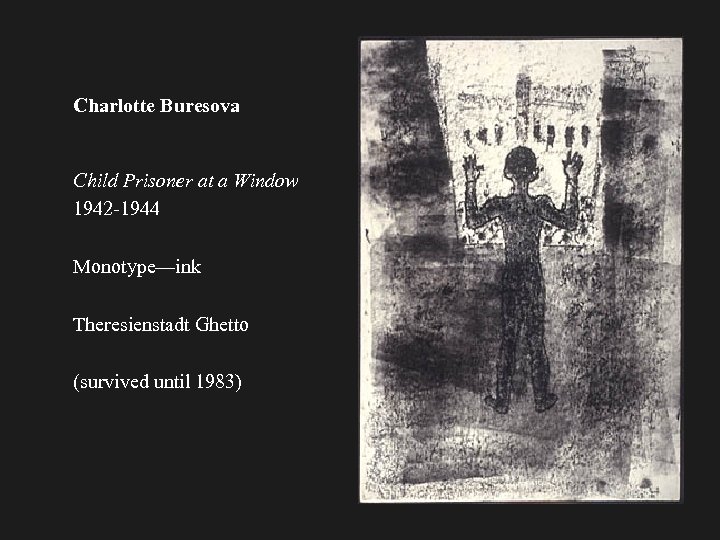 Charlotte Buresova Child Prisoner at a Window 1942 -1944 Monotype—ink Theresienstadt Ghetto (survived until 1983)
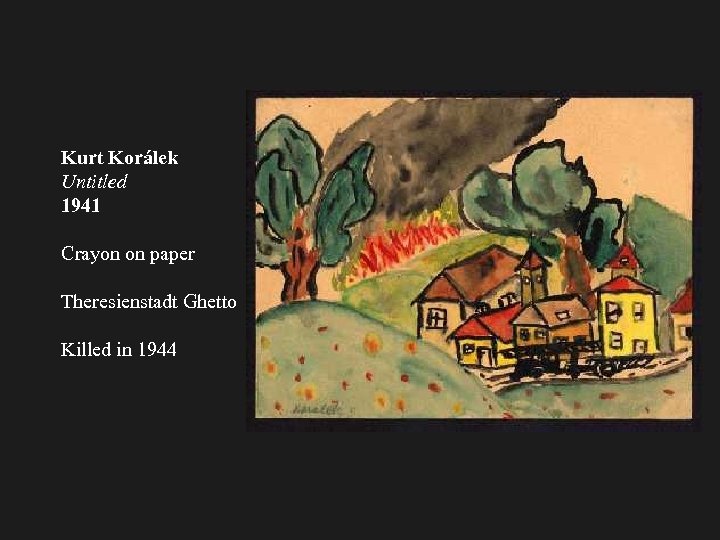 Kurt Korálek Untitled 1941 Crayon on paper Theresienstadt Ghetto Killed in 1944
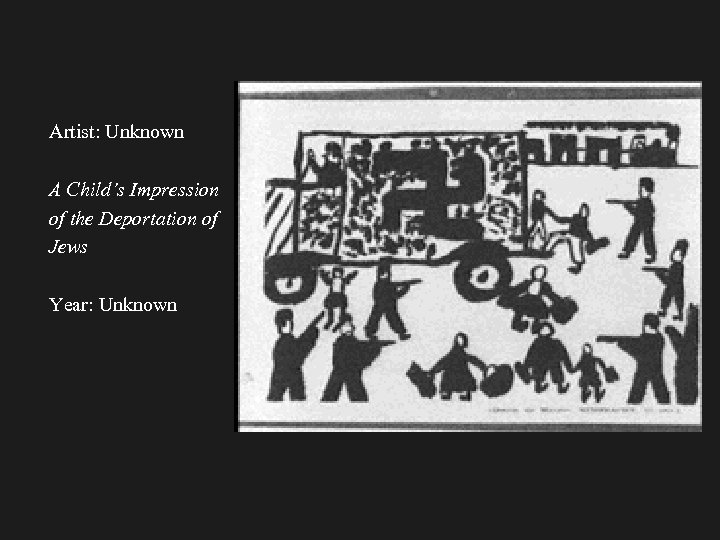 Artist: Unknown A Child’s Impression of the Deportation of Jews Year: Unknown
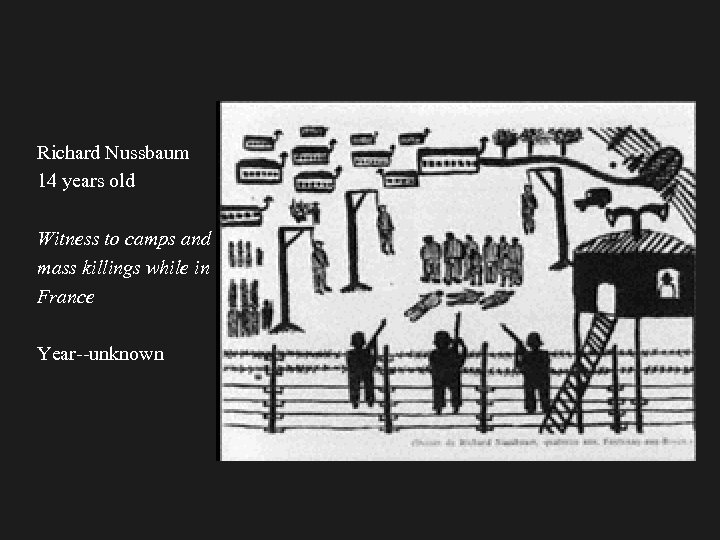 Richard Nussbaum 14 years old Witness to camps and mass killings while in France Year--unknown
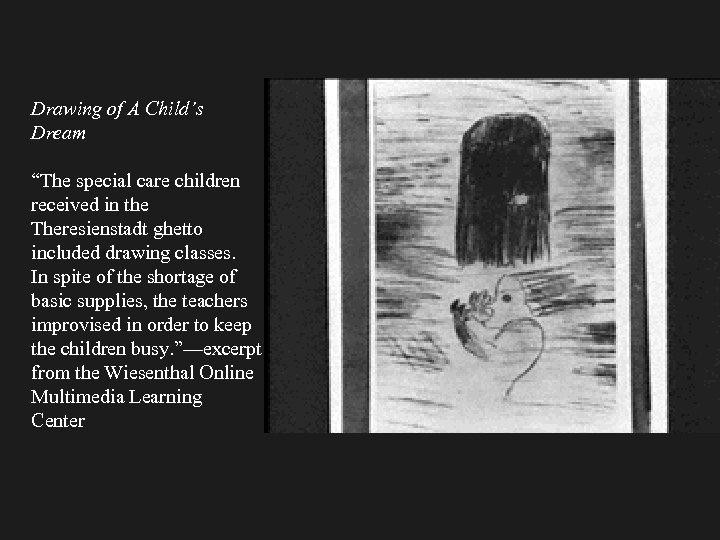 Drawing of A Child’s Dream “The special care children received in the Theresienstadt ghetto included drawing classes. In spite of the shortage of basic supplies, the teachers improvised in order to keep the children busy. ”—excerpt from the Wiesenthal Online Multimedia Learning Center
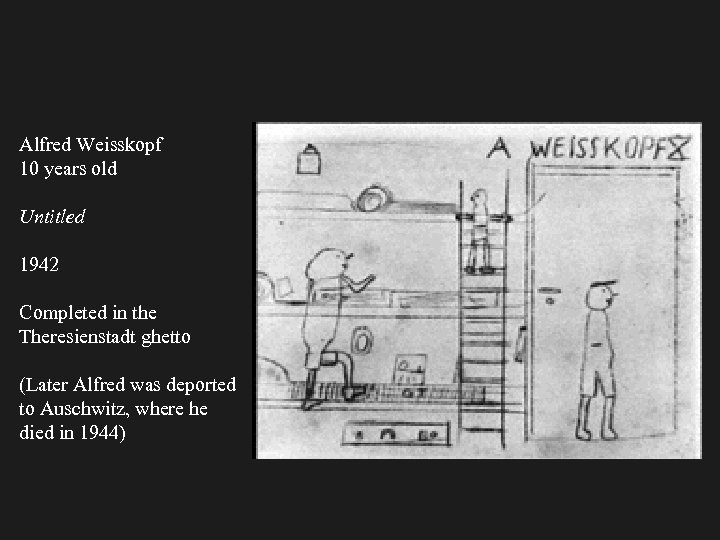 Alfred Weisskopf 10 years old Untitled 1942 Completed in the Theresienstadt ghetto (Later Alfred was deported to Auschwitz, where he died in 1944)
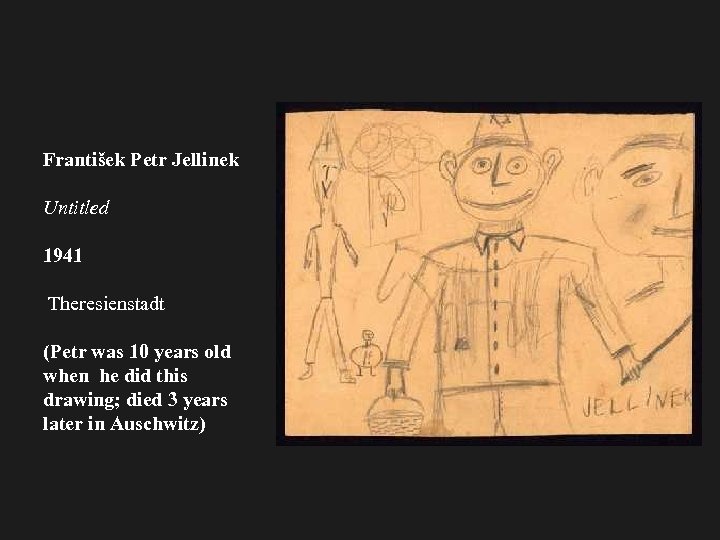 František Petr Jellinek Untitled 1941 Theresienstadt (Petr was 10 years old when he did this drawing; died 3 years later in Auschwitz)
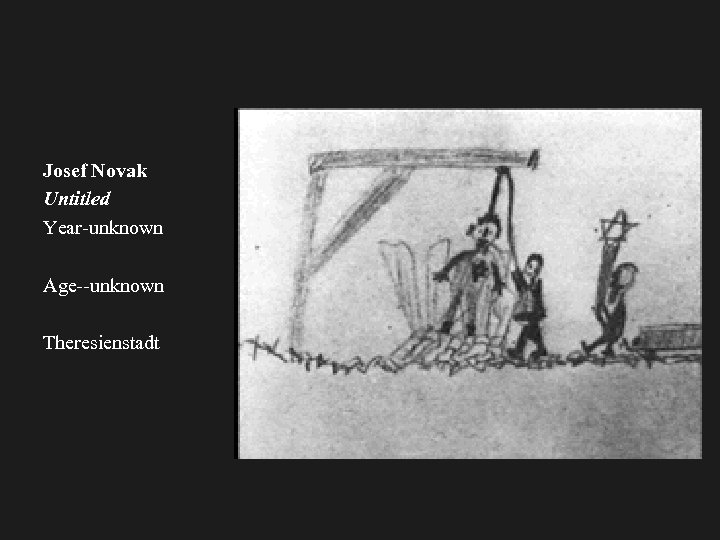 Josef Novak Untitled Year-unknown Age--unknown Theresienstadt
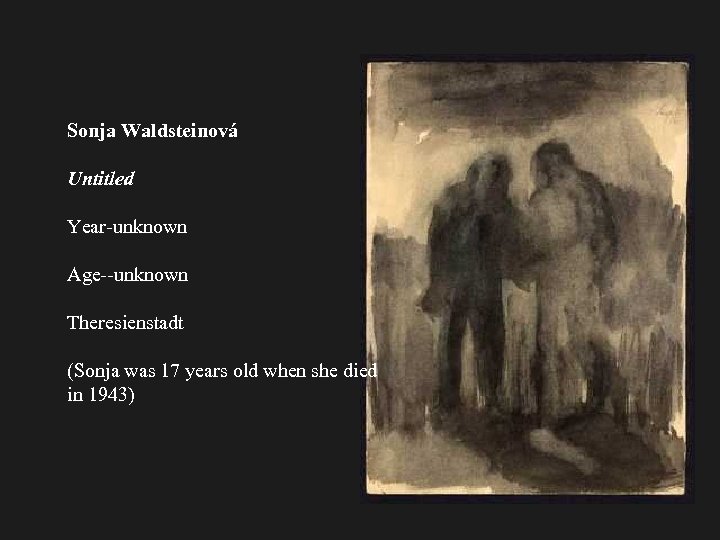 Sonja Waldsteinová Untitled Year-unknown Age--unknown Theresienstadt (Sonja was 17 years old when she died in 1943)
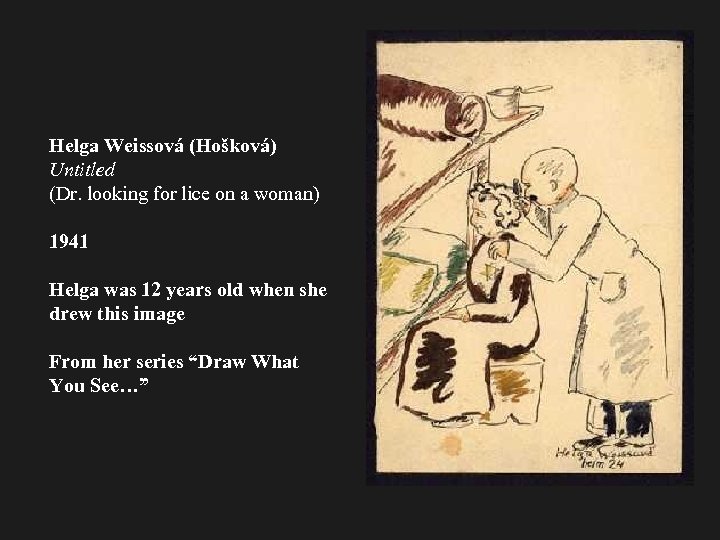 Helga Weissová (Hošková) Untitled (Dr. looking for lice on a woman) 1941 Helga was 12 years old when she drew this image From her series “Draw What You See…”
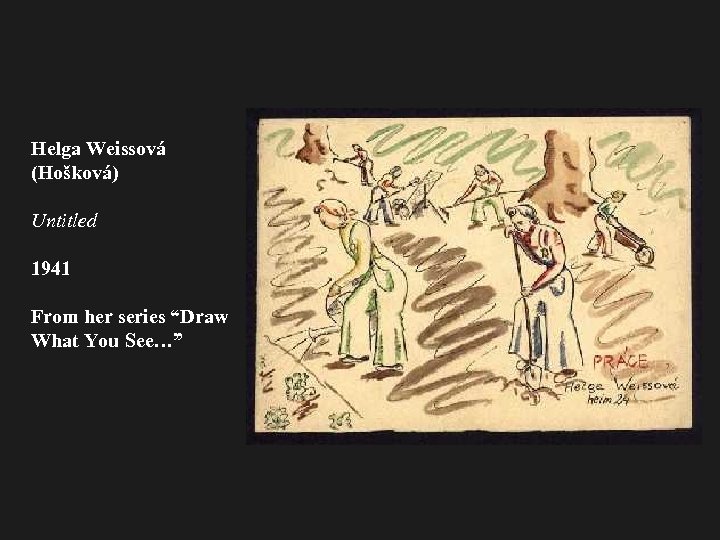 Helga Weissová (Hošková) Untitled 1941 From her series “Draw What You See…”
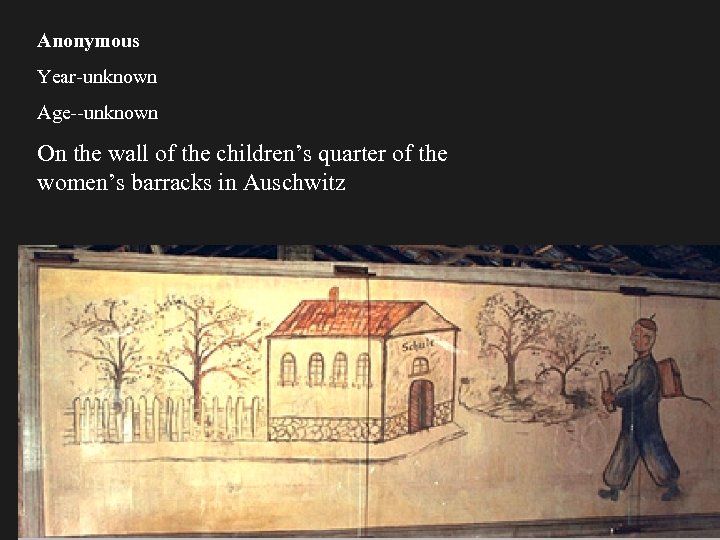 Anonymous Year-unknown Age--unknown On the wall of the children’s quarter of the women’s barracks in Auschwitz
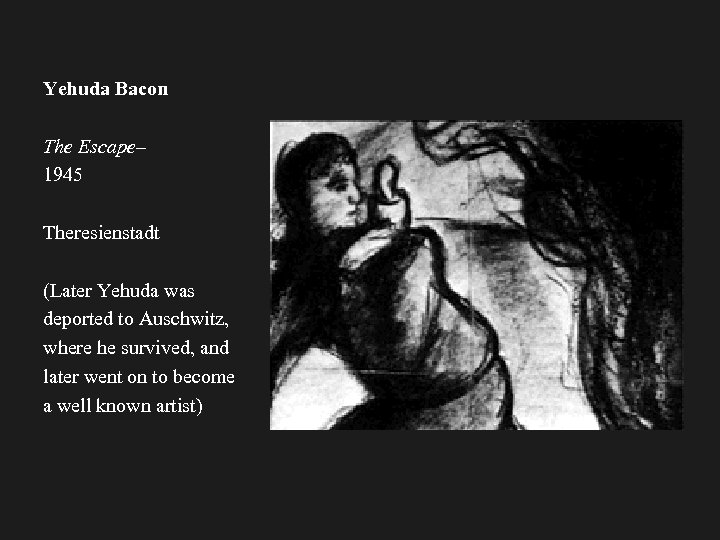 Yehuda Bacon The Escape– 1945 Theresienstadt (Later Yehuda was deported to Auschwitz, where he survived, and later went on to become a well known artist)
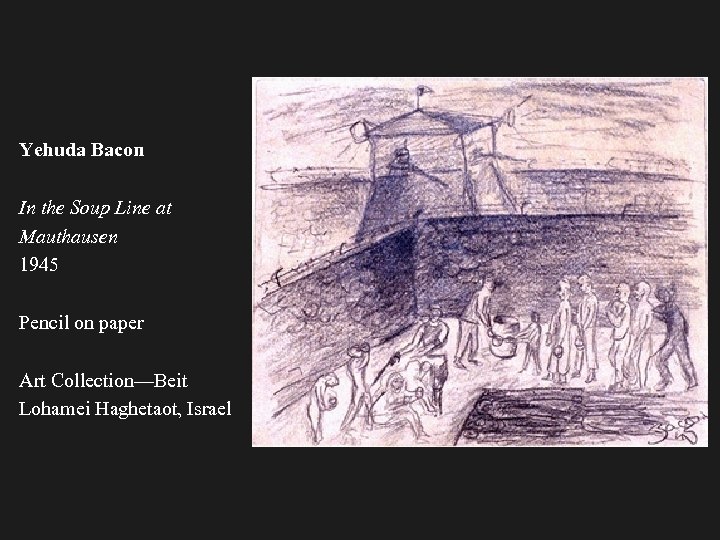 Yehuda Bacon In the Soup Line at Mauthausen 1945 Pencil on paper Art Collection—Beit Lohamei Haghetaot, Israel
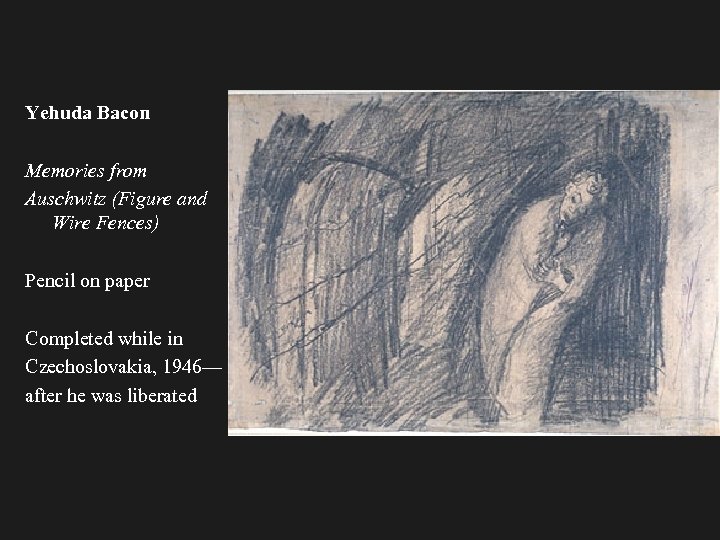 Yehuda Bacon Memories from Auschwitz (Figure and Wire Fences) Pencil on paper Completed while in Czechoslovakia, 1946— after he was liberated
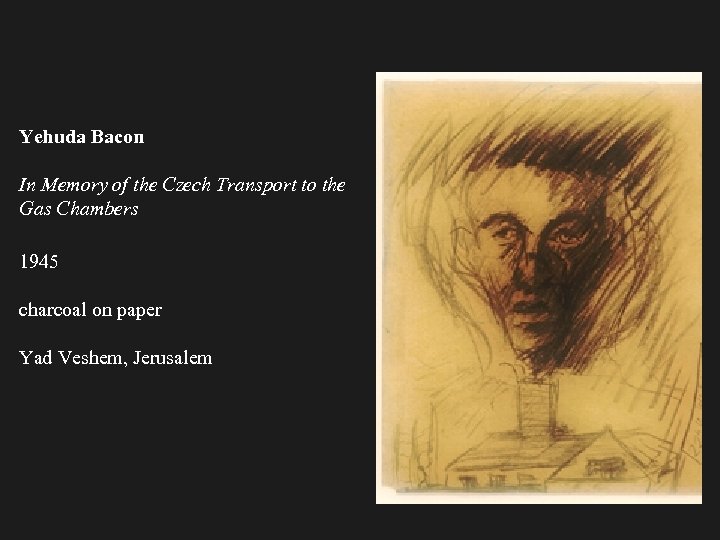 Yehuda Bacon In Memory of the Czech Transport to the Gas Chambers 1945 charcoal on paper Yad Veshem, Jerusalem
 Sources
 Various available Internet Sites featuring the Art of the Holocaustforgotten. com • http: //www. holocaustforgotten. com/holocau stpictures. htm Holocaust Education Through Art • http: //www. connectexpress. com/~holocaust art/
 Learning About the Holocaust Through Art • http: //art. holocaust-education. net/ Last Expression-Art from Auschwitz • http: //lastexpression. northwestern. edu/ A Teacher’s Guide To The Holocaust: The Art • http: //lastexpression. northwestern. edu/
 Simon Wiesenthal Center—Multimedia Learning Center • http: //motlc. wiesenthal. com/albums/palbum /p 00/a 0021 p 3. html
 “HOPE”