


 Скачать презентацию FS 202 Unit 9 Current Issues in Fire
e48193dbe4685818a78ebe869f9dc58d.ppt
- Количество слайдов: 18
 FS 202 Unit 9: Current Issues in Fire Service Training Fall 2009
 COURSE OVERVIEW • Philosophies of Modern Fire Protection Services • Internal & External Influences on FD Roles & Philosophies • Understanding FD Structures and Organization • IMS • Codes & Ordinances • Fire Prevention & Code Enforcement • Initial Training and Professional Continuing Education • Course Outcomes 1. Explain the current roles of fire protection agencies. 2. Explain how fire protection services are organized. 3. Identify fire service laws, regulations, and terminology. 4. Describe how fire departments function as part of local governments. 5. Apply the components of planning and operations of multiple agency responses to major incidents.
 UNIT – 9 INITIAL TRAINING AND PROFESSIONAL CONED • Unit Outcomes - The differences between technical and manipulative training - Record keeping issues in emergency services training - The value of using qualified instructors and validated curriculums - Common compliance partners in live-fire training - Organization of training delivery • Discussion Board - What are the benefits and limitations of conducting in-house training for initial education of firefighters? Do these differ for on-going and specialty training? • Project - At least two services by which the fire department helps local government meet its responsibilities to its citizens - At least two ways in which the fire department depends on other local government entities
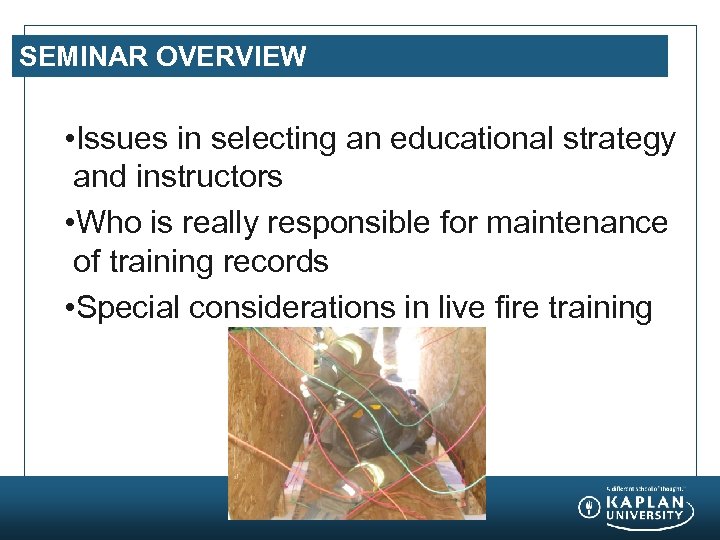 SEMINAR OVERVIEW • Issues in selecting an educational strategy and instructors • Who is really responsible for maintenance of training records • Special considerations in live fire training
 SELECTING EDUCATIONAL STRATEGIES AND INSTRUCTORS • Strategies (Initial) 1. Come with your training 2. Let us train you • Strategies (Continuing) 1. Let us train you 2. Let you train you 3. Let us tell you where to train
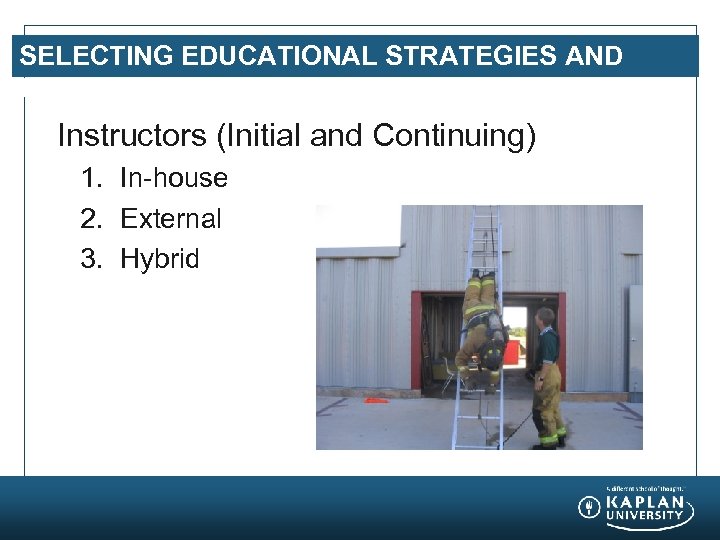 SELECTING EDUCATIONAL STRATEGIES AND INSTRUCTORS Instructors (Initial and Continuing) 1. In-house 2. External 3. Hybrid
 SELECTING EDUCATIONAL STRATEGIES AND INSTRUCTORS Instructor Credentialing 1. NFPA Standard through IFSAC or Pro. Board 2. Program specific 3. In-house
 MAINTENANCE OF TRAINING RECORDS Whose responsibility is it, really? • The agency? • The employee? • The state?
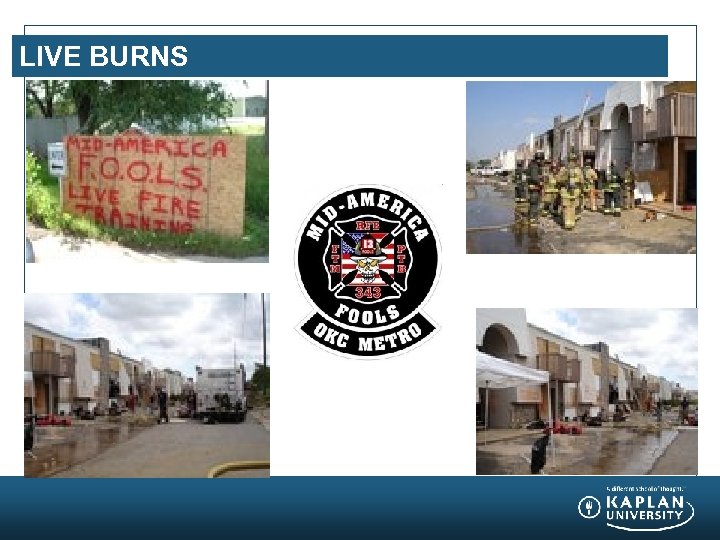
 SPECIAL ISSUES IN LIVE BURN TRAINING 1. 2. 3. 4. 5. 6. Permission to destroy Air quality regulations NFPA Standards Traffic and external liability Risk to personnel Alternatives
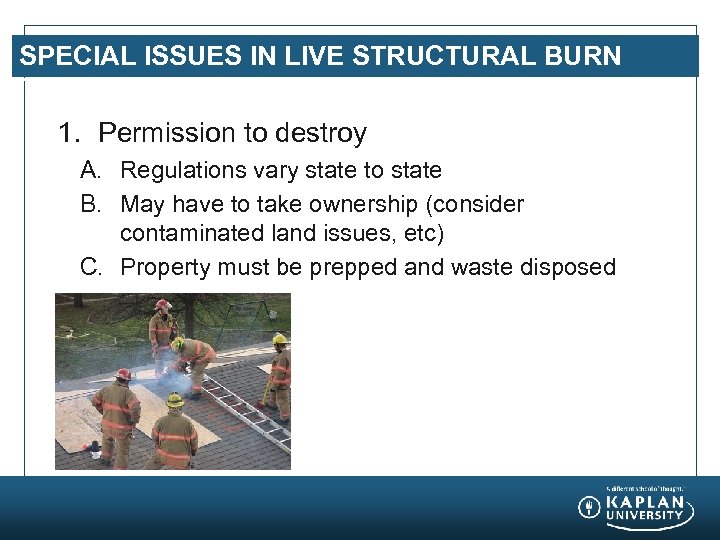 SPECIAL ISSUES IN LIVE STRUCTURAL BURN TRAINING 1. Permission to destroy A. Regulations vary state to state B. May have to take ownership (consider contaminated land issues, etc) C. Property must be prepped and waste disposed
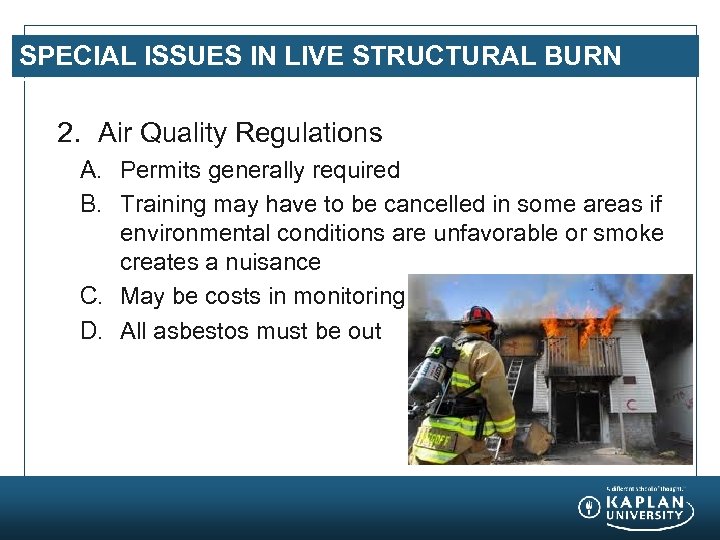 SPECIAL ISSUES IN LIVE STRUCTURAL BURN TRAINING 2. Air Quality Regulations A. Permits generally required B. Training may have to be cancelled in some areas if environmental conditions are unfavorable or smoke creates a nuisance C. May be costs in monitoring D. All asbestos must be out
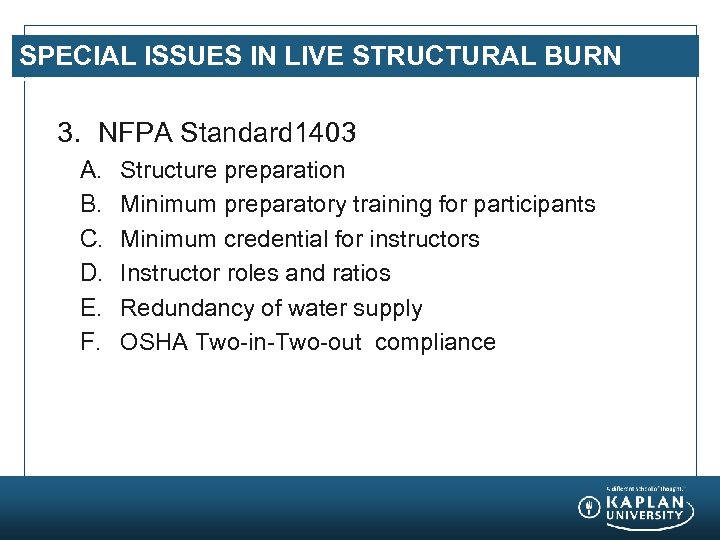 SPECIAL ISSUES IN LIVE STRUCTURAL BURN TRAINING 3. NFPA Standard 1403 A. B. C. D. E. F. Structure preparation Minimum preparatory training for participants Minimum credential for instructors Instructor roles and ratios Redundancy of water supply OSHA Two-in-Two-out compliance
 SPECIAL ISSUES IN LIVE STRUCTURAL BURN TRAINING 4. Traffic and external liabilities A. Passerby and observers are your responsibility B. Nearby structures and vegetation affected by radiant heat, direct heat, wind-blown (smoke carried) embers, etc. C. Environmental damage may be your responsibility
 SPECIAL ISSUES IN LIVE STRUCTURAL BURN TRAINING 5. Risk to Personnel A. The fire does not know it is training B. Physical, environmental, and cardiovascular health threats (rehab and medical standby needed) C. Exhaustion if returning to duty after training D. Liability for those involved E. Death
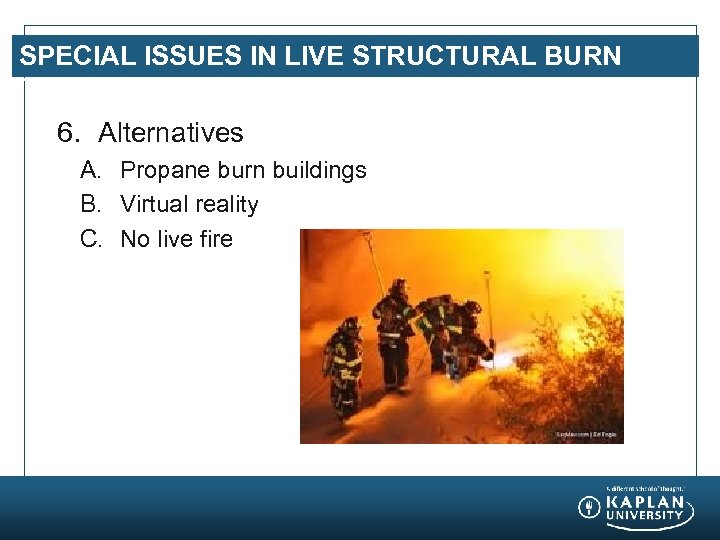 SPECIAL ISSUES IN LIVE STRUCTURAL BURN TRAINING 6. Alternatives A. Propane burn buildings B. Virtual reality C. No live fire
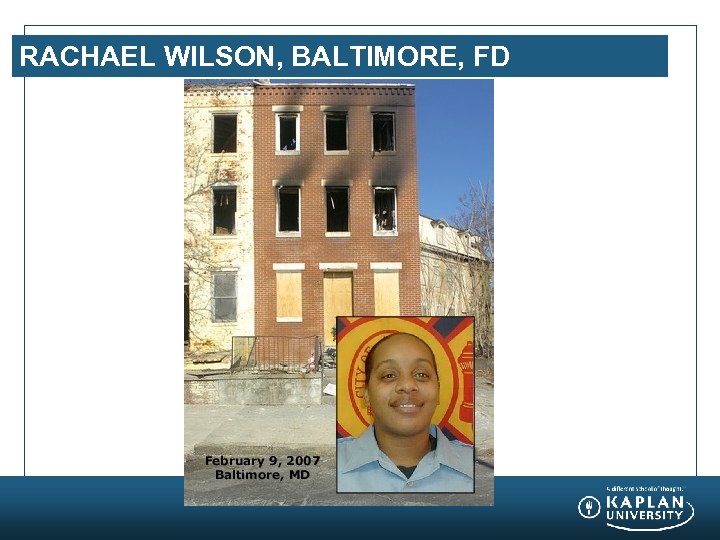 RACHAEL WILSON, BALTIMORE, FD
 LIVE BURNS
 SEMINAR SUMMARY Aside from suppression, the training division often receives the greatest attention. There a variety of approaches to initial and on-going education that departments can consider in light of their circumstances. Live structural burns are the most realistic fire training, but pose significant risk and liabilities. Current alternatives are limited.