


 Скачать презентацию Front-Wheel-Drive Transaxle and CV Joint Fundamentals Chapter 77
088b612699723dc35e4ac67dfc7956dd.ppt
- Количество слайдов: 25
 Front-Wheel-Drive (Transaxle and CV Joint) Fundamentals Chapter 77 © 2012 Delmar, Cengage Learning
 Objectives • Describe differences between front- and rearwheel drivetrains • Tell the names of parts of a transaxle • Trace the power flow through four- and fivespeed transaxles © 2012 Delmar, Cengage Learning
 Introduction • Most automobiles today have front-wheel drive – FWD car has transaxle – Drive axles extend to front wheels out of each side of transaxle – Each end of the drive axle is a CV joint – Transaxle can be either manual or automatic © 2012 Delmar, Cengage Learning
 © 2012 Delmar, Cengage Learning
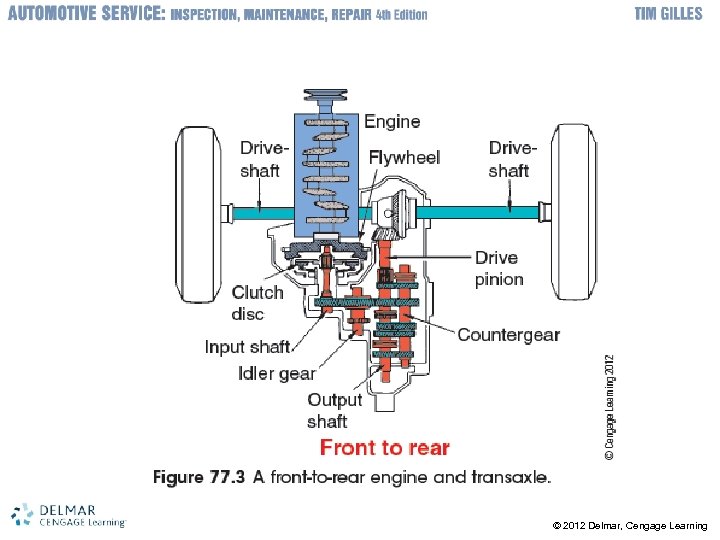
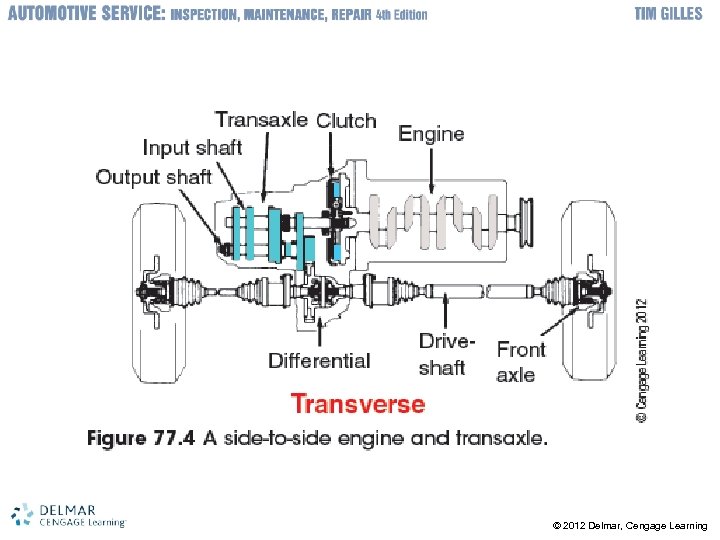
 Front-Wheel Drive • Advantages – More efficient drivetrain – Better fuel economy – Combined with Mac. Pherson struts: less unsprung weight for better handling • Transmission hump is eliminated • A few FWD engines have been mounted longitudinally – Most transaxles mounted sideways © 2012 Delmar, Cengage Learning
 © 2012 Delmar, Cengage Learning
 © 2012 Delmar, Cengage Learning
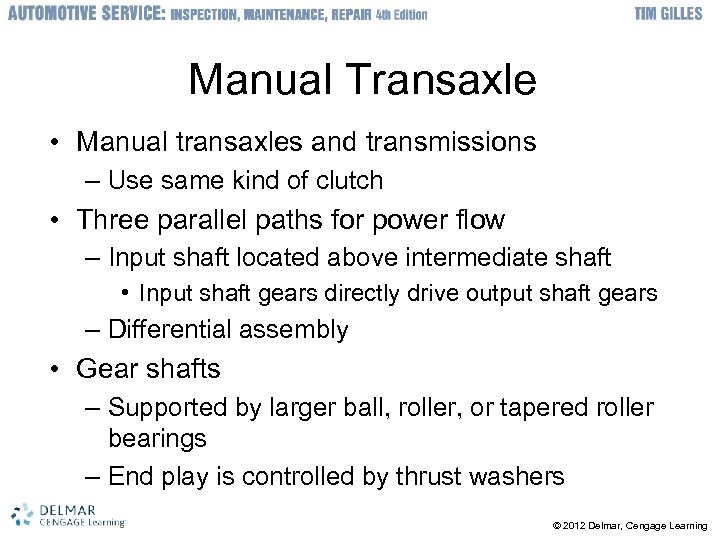 Manual Transaxle • Manual transaxles and transmissions – Use same kind of clutch • Three parallel paths for power flow – Input shaft located above intermediate shaft • Input shaft gears directly drive output shaft gears – Differential assembly • Gear shafts – Supported by larger ball, roller, or tapered roller bearings – End play is controlled by thrust washers © 2012 Delmar, Cengage Learning
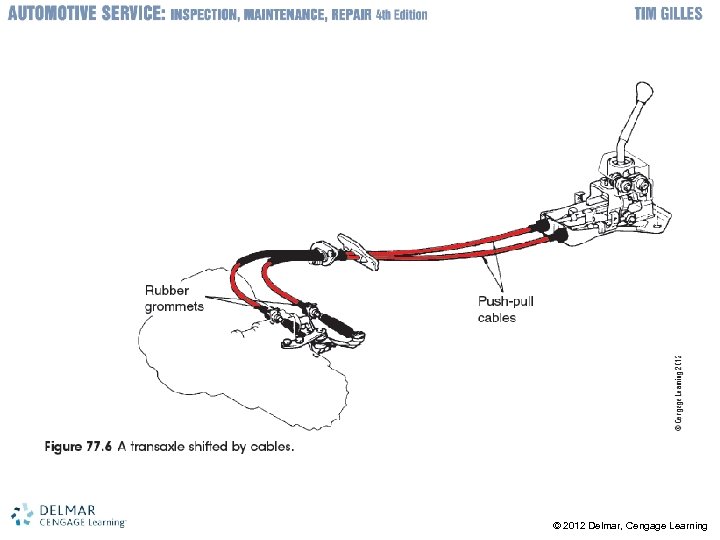
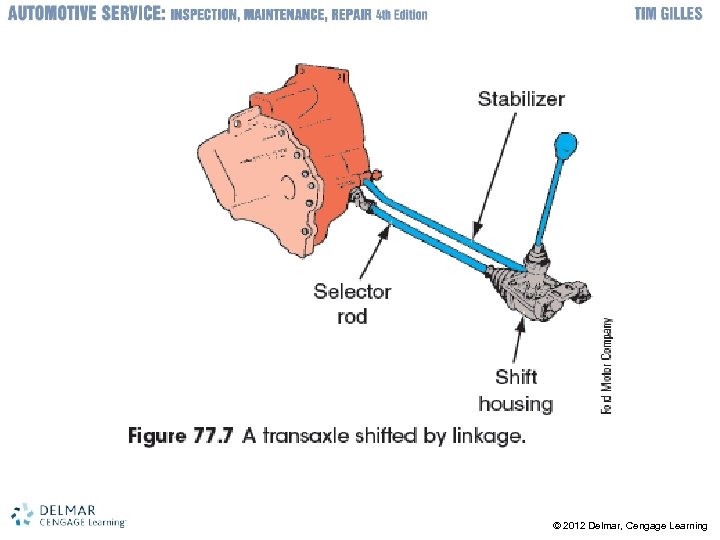
 Shift Linkage • Transverse transaxles – Shifted by cables or shift linkage • Two shift cables or rods – One moves a selector on transaxle – Other moves shift fork back and forth • Advantage – Engine shake is not transmitted back to driver’s hand on shift lever © 2012 Delmar, Cengage Learning
 © 2012 Delmar, Cengage Learning
 © 2012 Delmar, Cengage Learning
 Transaxle Differential • Allows wheels to turn at different speeds when rounding corners – Same as rear-wheel-drive differential • Ordinary helical gearset – Used instead of bevel gears – Power from differential side gears is transmitted to front drive axles through axle shafts © 2012 Delmar, Cengage Learning
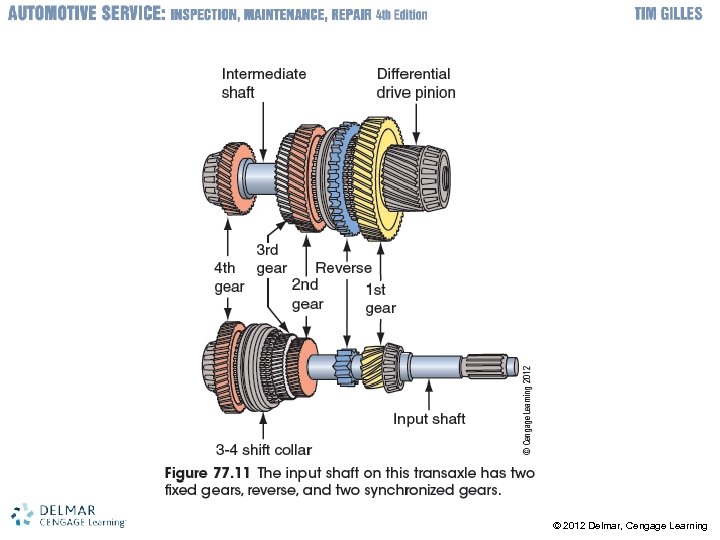
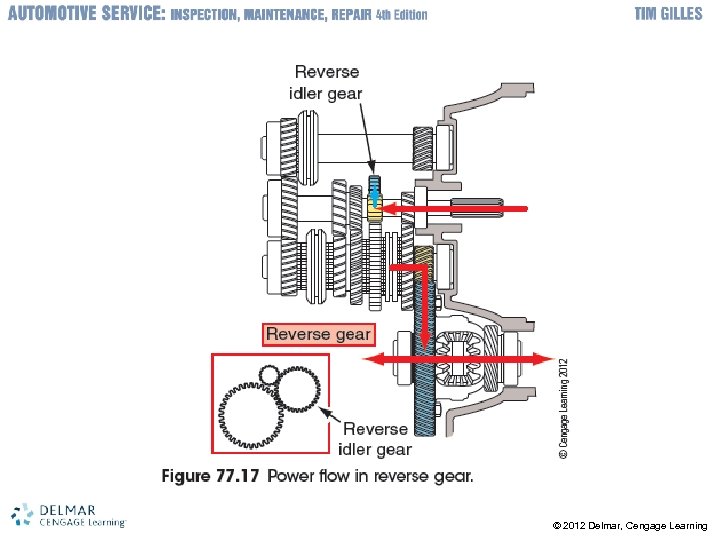
 Transaxle Power Flow • Five-speed power flow – Fixed gears for first, second, and reverse on input shaft – Fixed gears for third, fourth, fifth on intermediate shaft – Power flow leaves transmission intermediate shaft • Continues through drive pinion to axles – Engine is mounted sideways • Axles run parallel to input shaft © 2012 Delmar, Cengage Learning
 © 2012 Delmar, Cengage Learning
 © 2012 Delmar, Cengage Learning
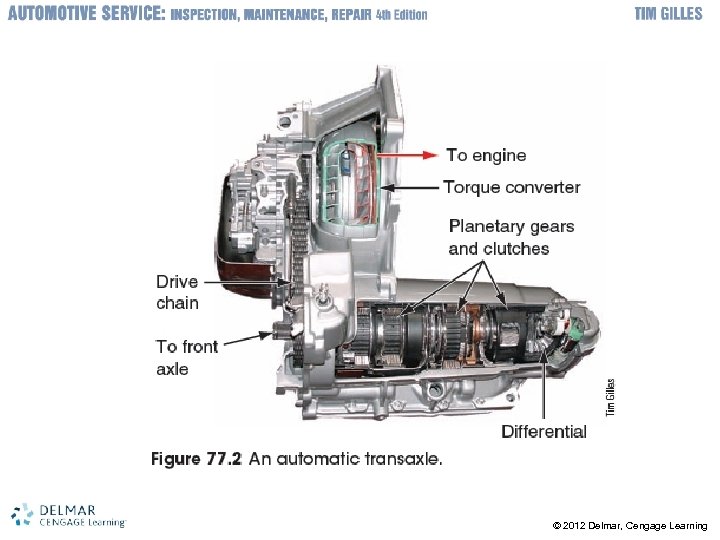
 Automatic Transaxle • Combination of automatic transmission and differential – Same parts and operation apply • Transverse engine – Power flow is through gears or sprocket and chain • Chain drive – Allows transaxle to be mounted slightly below and to the side of the engine © 2012 Delmar, Cengage Learning
 Front Drive Axles • Difference between rear-wheel drive and frontwheel drive axles – Front-wheel drive axles have CV joints at ends • Axles driven at sharper angles • Allow steering front wheels during power transmission – Universal joint changes output speed twice in every revolution when run at an angle – Rear-wheel drive vehicle drive shaft turns very fast • Positioned before gear reduction of differential © 2012 Delmar, Cengage Learning
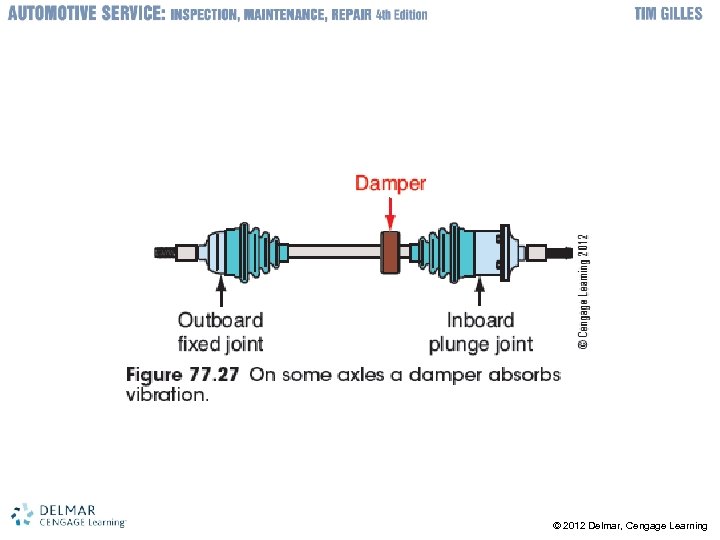
 Axle Shaft Parts • Drive axle is called half shaft or axle shaft • Stub shaft (stub axle) – Short shaft at outside end – Splined to front hub so it can drive front wheels • CV joint classifications – Inboard and outboard – Fixed and plunge – Ball and tripod © 2012 Delmar, Cengage Learning
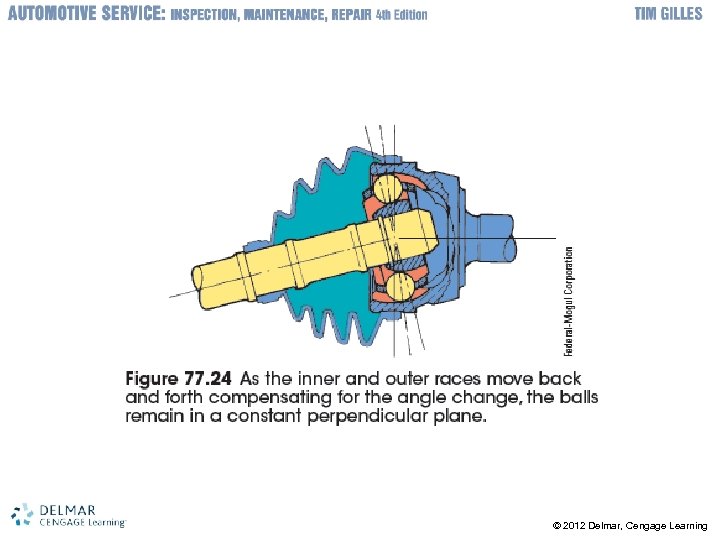
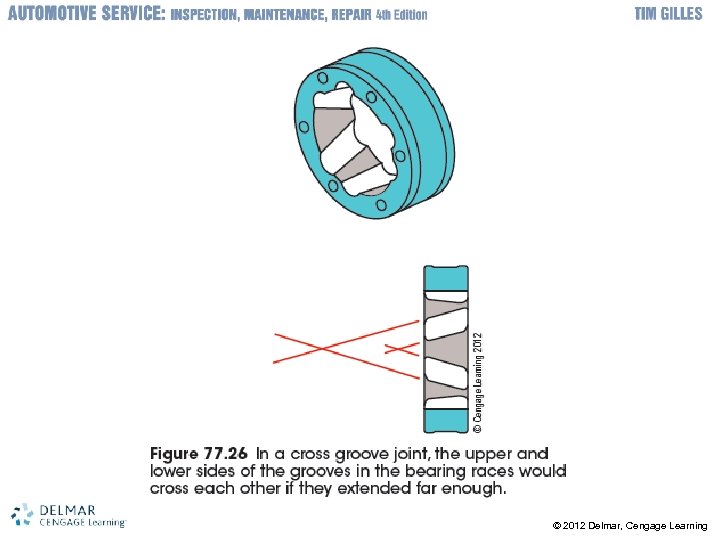
 CV Joint Construction • Most common joint combination – Rzeppa joint for outside fixed joint and a tripod for inside plunge joint • Fixed joints – Rzeppa joint: ball-and-socket type • Types of plunge joints – Tripod tulip – Double offset plunge joint – Cross groove plunge joint © 2012 Delmar, Cengage Learning
 © 2012 Delmar, Cengage Learning
 © 2012 Delmar, Cengage Learning
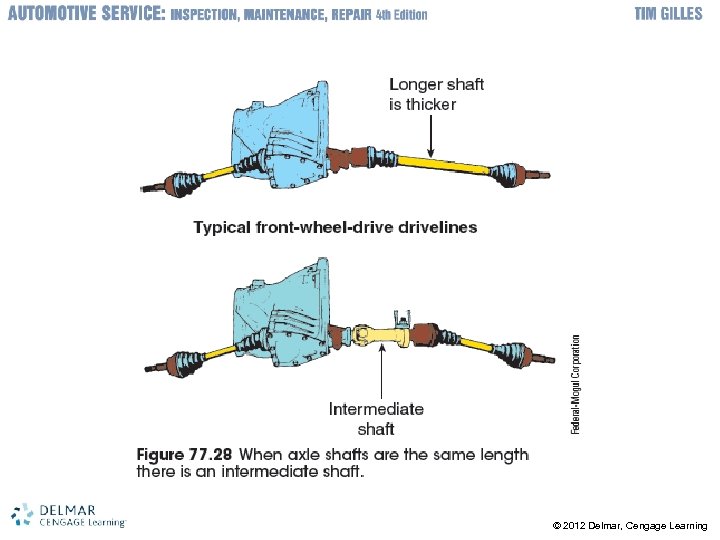
 Axle Shafts • Characteristics – May be solid or hollow – May have damper weights to absorb vibration – Turn much slower than rear-wheel drive shaft • Balance not as important – When different lengths: long one twists and lags before puts its torque to the wheel • Torque steer is prevented by longer axle shaft of larger diameter tubing © 2012 Delmar, Cengage Learning
 © 2012 Delmar, Cengage Learning
 © 2012 Delmar, Cengage Learning
 CV Joint Boots • Boots at each end of axle contain grease – Protect joint from the elements • CV joint boot – Attached to axle and stub shafts with plastic or steel bands or straps – Made of natural rubber, neoprene, silicone, or urethane © 2012 Delmar, Cengage Learning