


 Скачать презентацию From victim to citizen Exploring the social role
81276bff61d8acc61e45fef616ac8b4d.ppt
- Количество слайдов: 42
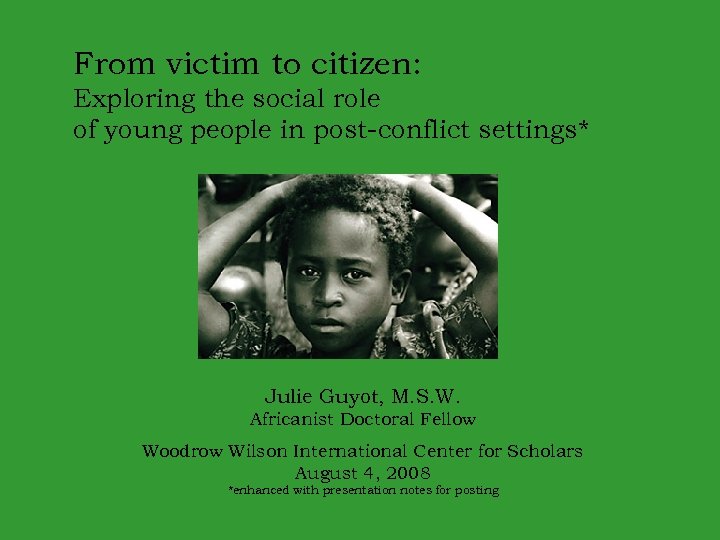 From victim to citizen: Exploring the social role of young people in post-conflict settings* Julie Guyot, M. S. W. Africanist Doctoral Fellow Woodrow Wilson International Center for Scholars August 4, 2008 *enhanced with presentation notes for posting
 Presentation outline • Social transition from conflict to “post-” • The limitations of trauma approaches • Person-in-environment (ecological) perspective • Introduction of social role theory • Political youth, a role? • Country examples • Considerations and further research steps
 Social transition from conflict to “post-” “A key task of reintegration is to help youth achieve a positive, respected role in their communities” (Wessells & Jonah, 2006, p. 39).
 As children and youth “now constitute the majority of the African population, … Their integration into society, in terms of both civic responsibility and membership, has…enormous economic, cultural, political, and social consequences” (Diouf, 2003, p. 2).
 Purpose of this research • Desire to shift from the study of ex-combatants as a segregated youth cohort from a perspective that privileges a “between the ears” (or trauma) approach, to an investigation into how youth fit into the post-conflict social environment • A belief that African youth are political beings and constitute a vital component of civil society • • To reframe the traditional approach that largely views young people as “lost generation” (www. npr. org) or “perennial security threat” (ICG, 7/31/08) To explore civic engagement and political participation as therapeutic processes for post-conflict youth
 DDR as an organizing frame Zegeye (2004) stresses that “both childhood and adulthood are socially constructed and are defined within institutional frameworks” (p. 854, emphasis added). Demobilization, Demilitarization, and Reintegration (DDR) is a useful construct to interrogate youth, transformation, and social role theory the reasons that: • Represents a cluster of programming (accessible) • It operates as a liminal space a site of transition, , as transformation, and decision-making—the space between, where things are named (Ferguson and Gupta, 2002; Foucault, 1991)
 Demobilization, Demilitarization, Rehabilitation (DDR) and roles While DDR programs are set up to ease the reintroduction Of young people to their communities, the challenge young People face in locating a meaningful role can be complicated by notions held by community leaders and program administrators of what it means to be a young person. Along with medical checks, family tracing and resettlement packages, young people are assigned roles.
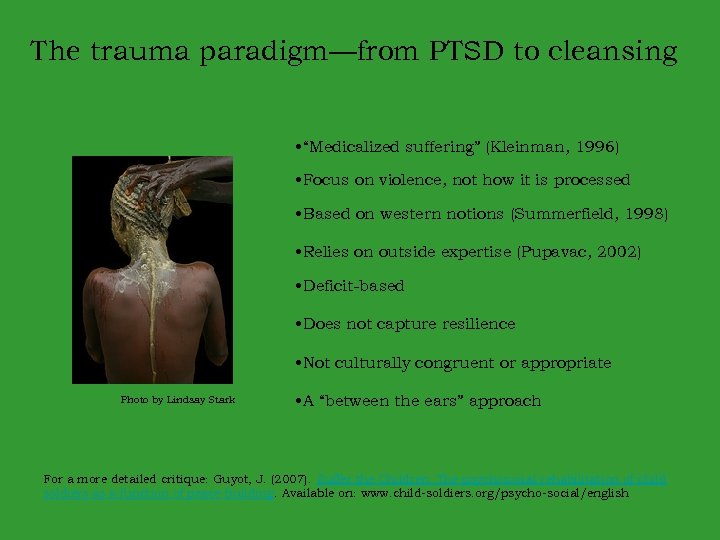 The trauma paradigm—from PTSD to cleansing • “Medicalized suffering” (Kleinman, 1996) • Focus on violence, not how it is processed • Based on western notions (Summerfield, 1998) • Relies on outside expertise (Pupavac, 2002) • Deficit-based • Does not capture resilience • Not culturally congruent or appropriate Photo by Lindsay Stark • A “between the ears” approach For a more detailed critique: Guyot, J. (2007). Suffer the Children: The psychosocial rehabilitation of child soldiers as a function of peace-building. Available on: www. child-soldiers. org/psycho-social/english
 Building an empirical base Too often, ex-combatants are characterized as traumatized victims (UN, 2000), “robbed of childhood” (HRW, 2006), comprising a “lost generation” (St. C, 2006). The Study of War-Affected Youth (SWAY) Project in northern Uganda and the Harvard School of Public Health longitudinal work taking place in Sierra Leone are enriching our understanding of how young people fare by: - incorporating variables related to pro-social behavior, employment, and political activity - moving away from traditional trauma approaches that quantified [western] medical symptoms - expanding beyond exclusive concern with depression and anxiety symptoms
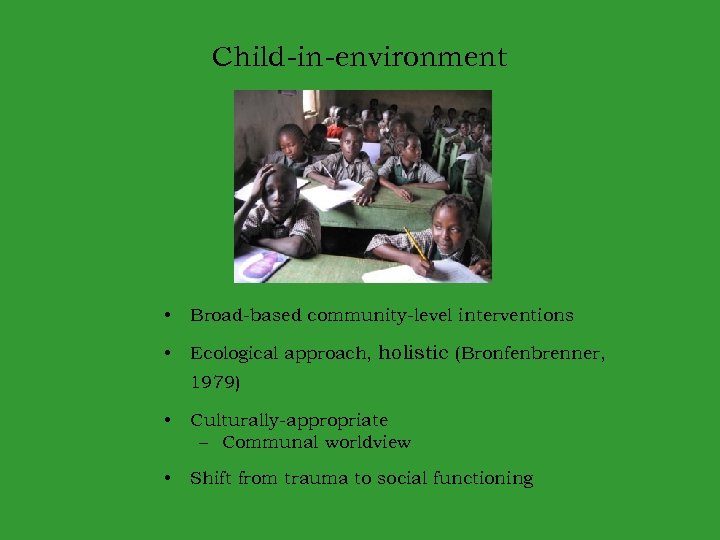 Child-in-environment • Broad-based community-level interventions • Ecological approach, holistic (Bronfenbrenner, 1979) • Culturally-appropriate – Communal worldview • Shift from trauma to social functioning
 RE: Child-in-Environment • Children may become embedded in adult narratives of community development, subsumed by household (as a unit of analysis) and schooling (as a normative, status-appropriate activity) • Rather than focus on the dynamic interaction between young people and the environment, this model may simply assign them the concerns of the broader community • They may serve as no more than a window to the community, rather than for the frame to function so as to enrich understanding of young people’s particular circumstance within it
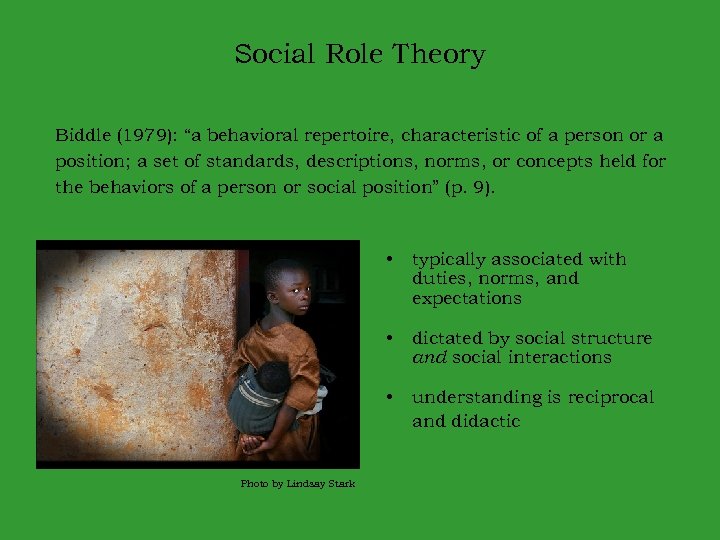 Social Role Theory Biddle (1979): “a behavioral repertoire, characteristic of a person or a position; a set of standards, descriptions, norms, or concepts held for the behaviors of a person or social position” (p. 9). • • dictated by social structure and social interactions • Photo by Lindsay Stark typically associated with duties, norms, and expectations understanding is reciprocal and didactic
 Social Role Theory • One way of understanding the ways in which people are socially positioned, how the self is constructed, and how this informs behaviors and expectations regarding behavior • Alternative, asset-based perspective that focuses on the individual agency that is exercised through role-taking and role-making (Turner, 1962) • Focuses on the interaction between individual behavior and social structure • Unlike the prevailing trauma paradigm it captures coping, capacity, socio-economic condition, and community-level interaction • It addresses issues of power because negotiation is central to the process of role formation • Culture and psychosocial development are not treated as static, but evolutionary
 World Bank DDR report (2002) The soldier has been changed by his/her life and experiences as a soldier. Demobilized soldiers go through the process of leaving the status soldier, leaving the life with which they of have become familiar, and leaving the community of soldiers who have been companions through many experiences. [See Hansen, 1999] Certainly, for the child soldier this important period of forming a social and personal identity been has the capstone of his/her childhood to that date (Verhey, 2002, p. 14).
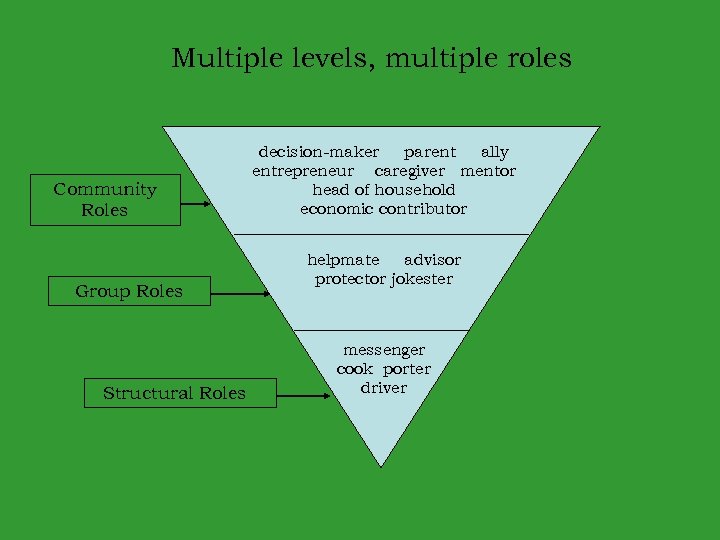 Multiple levels, multiple roles Community Roles Group Roles Structural Roles decision-maker parent ally entrepreneur caregiver mentor head of household economic contributor helpmate advisor protector jokester messenger cook porter driver
 On multiple roles • Marks & Mac. Mermid (1996) found that “people who maintain more balance across their entire systems of roles and activities…score lower on measures of… depression and higher on measures of selfesteem, …and other indicators of well-being” (p. 417) • Research has shown that multiple roles may be good for one’s health (Verbrugge, 1986) and psychological well-being (Baruch & Barnett, 1994) • According to Linton (1987), “people with many self-aspects are buffered against stress from negative events because they have the option of refocusing on which selves have remained unaffected by any particular event” (Marks & Mac. Mermid, 1996, p. 418) • An example from a CHF International study on the Economic Reintegration of Ex-combatants in Lofa County, Liberia (2008): “I’m a mother now, so I wouldn’t fight again” (p. 25)
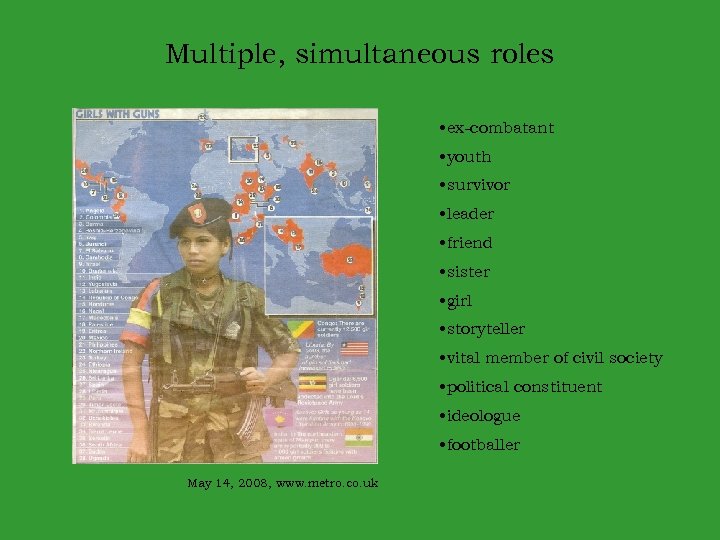 Multiple, simultaneous roles • ex-combatant • youth • survivor • leader • friend • sister • girl • storyteller • vital member of civil society • political constituent • ideologue • footballer May 14, 2008, www. metro. co. uk
 On the subject of female combatants… What’s emerged from a participatory action research with female former combatants taking place now (10 agencies in three African countries) is a strong desire expressed by participants not to be reduced to incidence of sexual assault—not to be viewed as “sex slaves. ” But to be recognized in ways that connect with participants’ personal sense of power and self-identity, which form an alternate role, pulled from within complex selves, with dignity. Self-concept and Definitions that come from outside the self
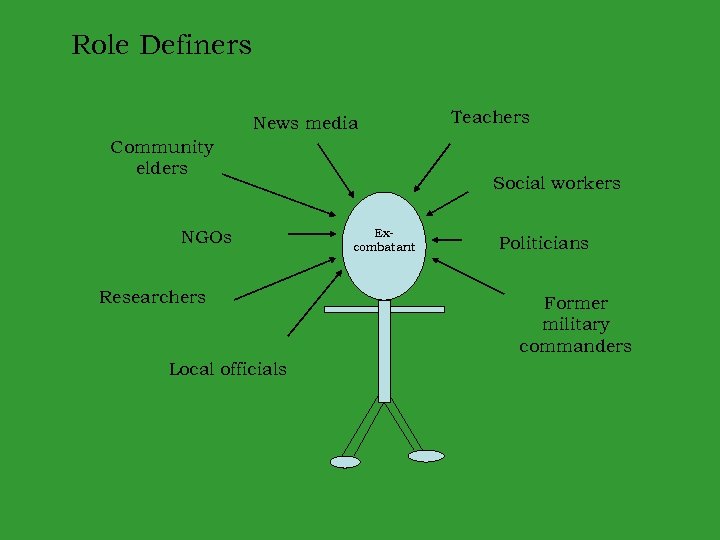 Role Definers News media Community elders NGOs Researchers Local officials Teachers Social workers Excombatant Politicians Former military commanders
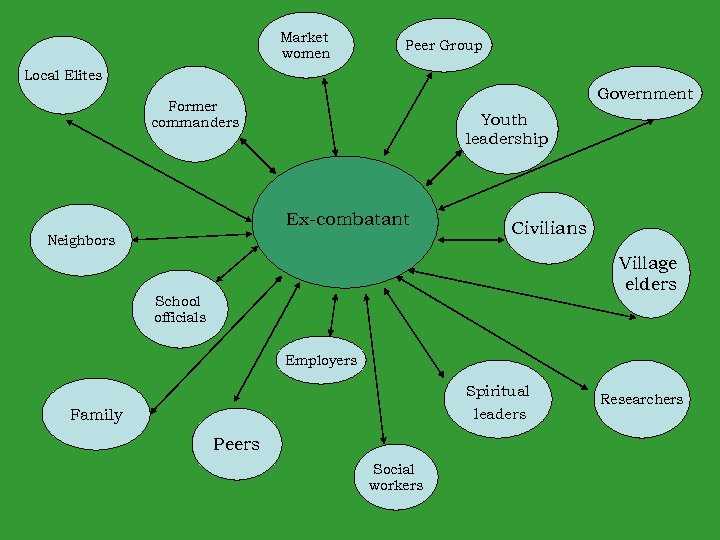 Market women Peer Group Local Elites Government Former commanders Youth leadership Ex-combatant Neighbors Civilians Village elders School officials Employers Spiritual leaders Family Peers Social workers Researchers
 Interaction From a research and intervention perspective this dynamic is particularly useful as role theory highlights the agency of an individual while also providing a sense of environment, as: A. an actor’s self is a reflection of the attitudes that others hold toward her B. elements are shaped by what the actor brings to the encounter C. the quality and type of interaction/engagement is highly relevant (Breese, 1997) Role consensus is the meeting point of role, self-concept, and expectations. It depends on the alignment among these three.
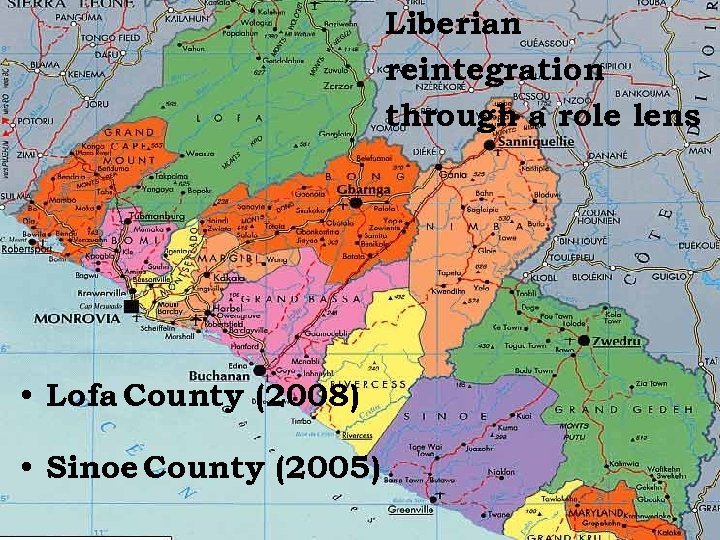 Liberian cases reintegration through a role lens • Lofa County (2008) • Sinoe County (2005)
 Lofa County, Liberia (2008) From a CHF International Study on the Economic Re-integration of Ex-combatants (Taylor, Hill, & Temin, 2008): “Anecdotal evidence suggests that some of the ex-combatants returned expecting to be treated as heroes or at least receive , respect for who they are and what they had done. This often was not the case and many ex-combatants went through a period where they were at odds with community and family. Some continue to have problems. And even though they have (or perhaps had) an image of themselves as heroes took , few advantage of skills gained during warfare to build a life for themselves after the fighting ended. In short, ex-combatants continue to struggle…” (p. 27).
 Sinoe County, Liberia (2005) Opportunities for economic independence + respected social position = More successful process of spontaneous social reintegration. • Utas (2005) noted how men were taking on “adult” roles that had taken place at a later age prior to the period of conflict (e. g. able to farm their own land to marry). • A separate report cites a Senior Reintegration Specialist who noted the presence of a 15 year-old military commander of Sinoe County’s Tubmanburg region Matching role sets: • consistency across time as it relates to the duties, norms, and expectations • autonomy and authority of wartime translated to positive social role for post-conflict period
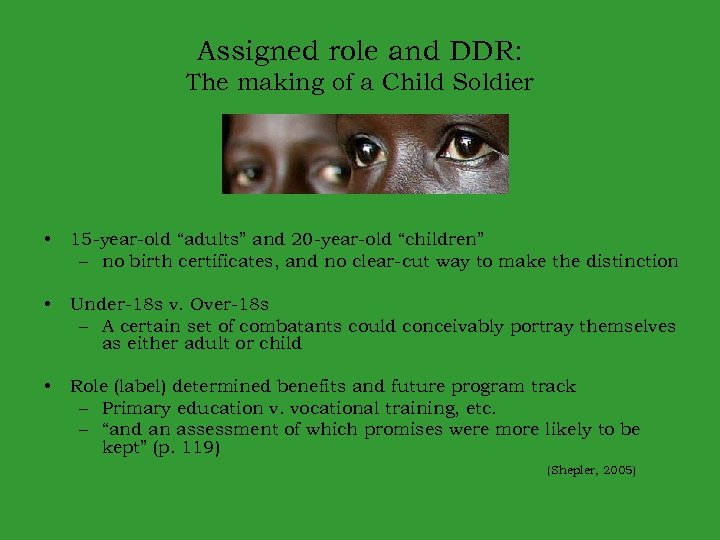 Assigned role and DDR: The making of a Child Soldier • 15 -year-old “adults” and 20 -year-old “children” – no birth certificates, and no clear-cut way to make the distinction • Under-18 s v. Over-18 s – A certain set of combatants could conceivably portray themselves as either adult or child • Role (label) determined benefits and future program track – Primary education v. vocational training, etc. – “and an assessment of which promises were more likely to be kept” (p. 119) (Shepler, 2005)
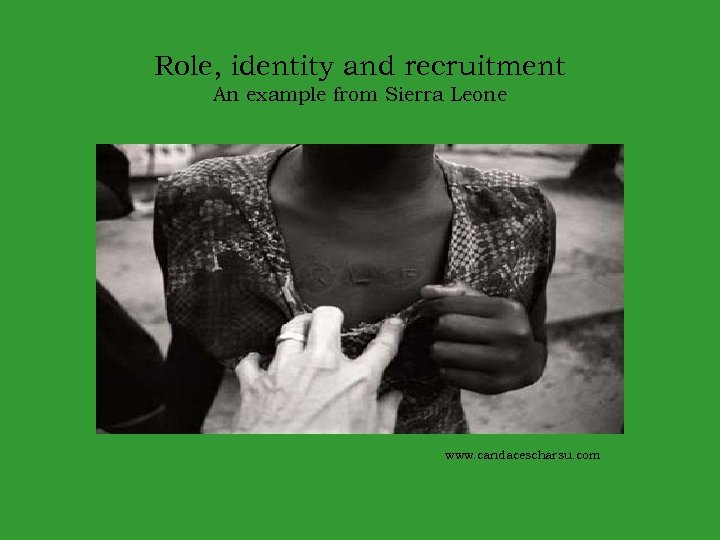 Role, identity and recruitment An example from Sierra Leone www. candacescharsu. com
 Role assignment: Negative representation of youth Nigerian “Area Boys, ” South African Tsotsis, the Breakers and Gang Boys of Senegal; Savis Man and Rarray Boys in Sierra Leone, the Gronah Boys of Liberia. Representation of a troubled and troublesome youth has helped to criminalize youth, and fuelled an underestimation of the capacity for, and possibility of a “positive” youth in Africa (Honwana & De Boek 2005 in Oyewole, 2006, p. 7).
 Emergent themes 1. Characterizations of youth emanating from security concerns and trauma frames are so negative as to preclude a sense of positive youth leadership 2. “Youth” as a category is implicitly somehow deficient developmentally or inappropriate to the social order (e. g. tradition)
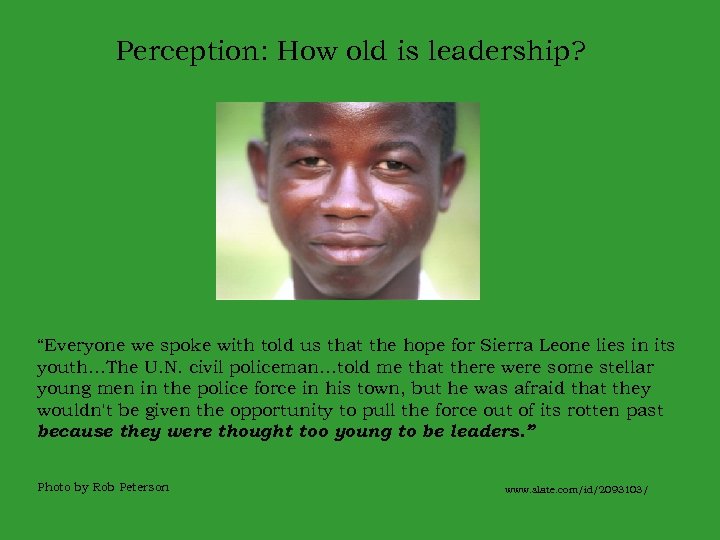 Perception: How old is leadership? “Everyone we spoke with told us that the hope for Sierra Leone lies in its youth…The U. N. civil policeman…told me that there were some stellar young men in the police force in his town, but he was afraid that they wouldn't be given the opportunity to pull the force out of its rotten past because they were thought too young to be leaders. ” Photo by Rob Peterson www. slate. com/id/2093103/
 Resistance to political youth role • Elders rule, young people serve (Carter, 2007) – A strong tradition of youth voice has been documented by Gables (2000). The Culture Development Club: Youth, Neo-Tradition, and the Construction of Society in Guinea-Bissau, and others… – Notion of tradition itself is highly problematic – See: Ranger’s Invention of Tradition in Colonial Africa (1983) • Co-opted by “big men” for hire as spoilers (Abdullah, 1998) – Case studies of youth-led civic education NAYMOTE) (e. g.
 Resistance to political youth role • Token role in local governance structures (Manning, n. d. ) – Somehow not authentic: Imposed. Done to pacify or stimulate interest of NGOs, not reflective of an appreciation for youth voice • Outcome of therapeutic/trauma paradigm (Pupavac, 2006) – The trauma paradigm provides a role that is wholly circumscribed by vulnerability and dependence. Systems are so convinced that youth are broken by trauma that belief in decision-making capacity is thoroughly undermined. Lost generations don’t lead! See: Youth and Politics in Conflict Contexts, May 16, 2007. WWICS publication.
 Youth leadership “Children lead… 14 -year-olds going on 25 are leaders—they lead in the camps, in the transition points, in the reintegration facilities…” Lieutenant-General Romeo Dallaire (UNICEF, 2002)
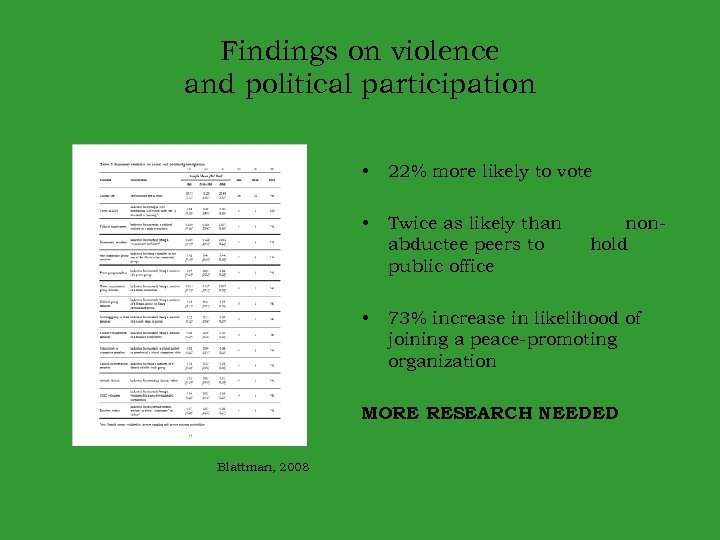 Findings on violence and political participation • 22% more likely to vote • Twice as likely than abductee peers to public office • 73% increase in likelihood of joining a peace-promoting organization nonhold MORE RESEARCH NEEDED Blattman, 2008
 Blattman (2008) and political participation Dominant theories regarding war-trauma and young people assume that it renders them incapable of normal functioning much less participation in the public sphere. And yet, Blattman (2008) articulates a very different vision, based on data from northern Ugandan abductees. But, what is most significant here is that there is a particularly political face to community activity. Interestingly, he found no relationship between abduction, violence, and NON-political forms of participation and volunteering… MORE RESEARCH NEEDED
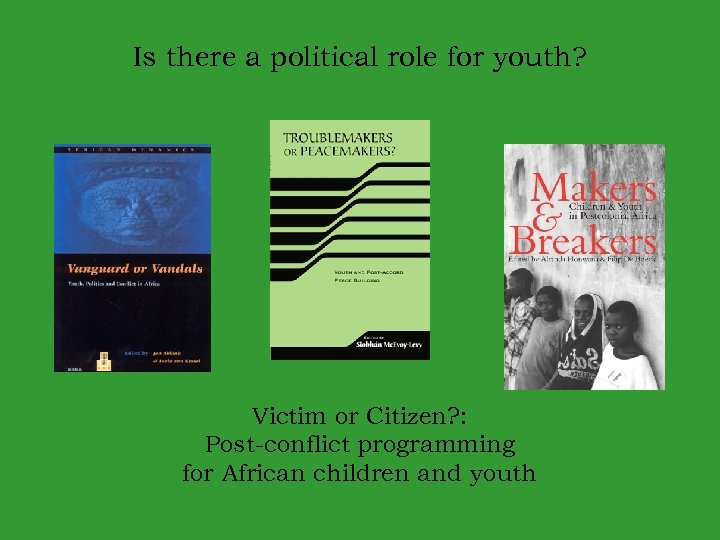 Is there a political role for youth? Victim or Citizen? : Post-conflict programming for African children and youth
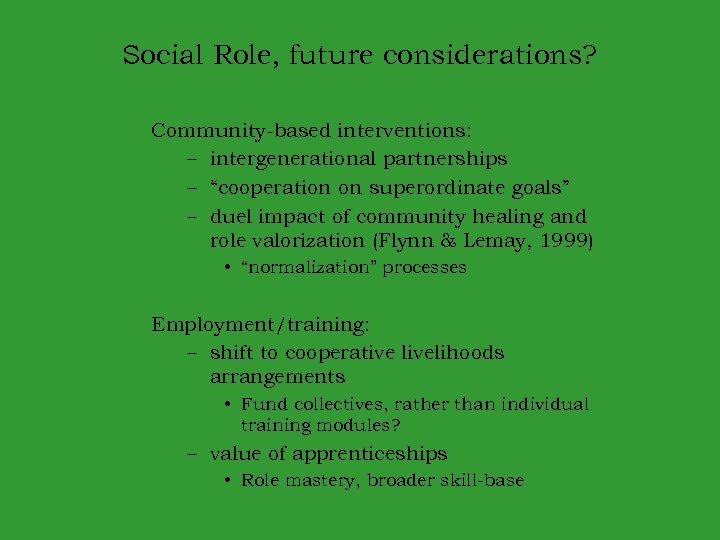 Social Role, future considerations? Community-based interventions: – intergenerational partnerships – “cooperation on superordinate goals” – duel impact of community healing and role valorization (Flynn & Lemay, 1999) • “normalization” processes Employment/training: – shift to cooperative livelihoods arrangements • Fund collectives, rather than individual training modules? – value of apprenticeships • Role mastery, broader skill-base
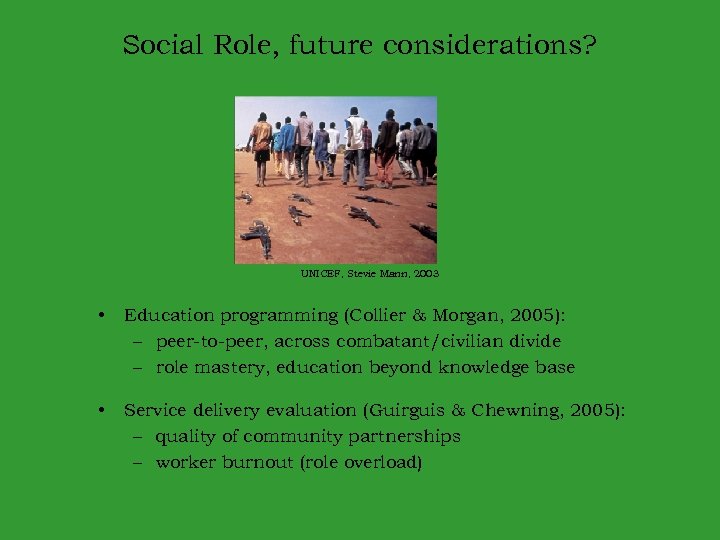 Social Role, future considerations? UNICEF, Stevie Mann, 2003 • Education programming (Collier & Morgan, 2005): – peer-to-peer, across combatant/civilian divide – role mastery, education beyond knowledge base • Service delivery evaluation (Guirguis & Chewning, 2005): – quality of community partnerships – worker burnout (role overload)
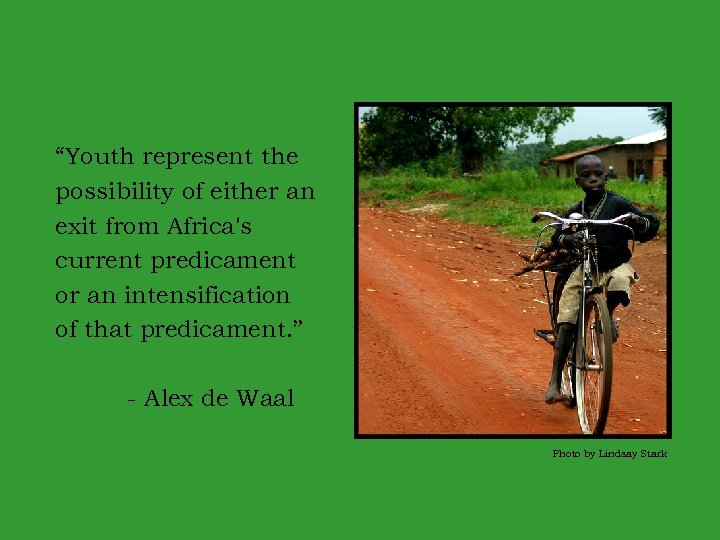 “Youth represent the possibility of either an exit from Africa's current predicament or an intensification of that predicament. ” - Alex de Waal Photo by Lindsay Stark
 Resources: Youth and Politics Blattman, C. (2008). From violence to voting: War and political participation in Uganda. Center for Global Development. Working Paper, No. 138. Boyden, J. (2006). Children, war and world disorder in the 21 st century: A review of theories and the literature on children’s contributions to armed violence. Working Paper 138, Queen Elizabeth House, Univ. of Oxford. Hickey, S. & Mohan, G. (2005). Relocating participation within a radical politics of development. Development and Change, 36 (2), 237 -260. Mc. Evoy-Levy, S. (2001). Youth as social and political agents: Issues in post-settlement peace-building. Kroc Institute Occasional Paper, #21 -OP-2. Newman, J. (2005). Protection through participation: Young people affected by forced migration and political crisis. RSC Working Paper Series. No. 20. Oxford, United Kingdom: Refugee Studies Centre, University of Oxford. Twum-Danso, A. (2004). The political child. In, Mc. Intyre, A. (Ed. ), Invisible stakeholders: The impact of children on war (pp. 7 -30).
 Resources: Social Role Theory Biddle, B. J. (1979). Role theory—expectations, identities and behaviors. New York: John Wiley & Sons. Breese, J. R. (1997). A re-examination of the concept of role and its divergent traditions. Virginia Social Science Journal, 32, 113 – 126. Flynn, R. J. , & Lemay, R. A. (Eds. ) (1999). A quarter-century of normalization and social role valorization: evolution and impact. Ottawa: University of Ottawa Press. Goode, W. J. (1960). A theory of role strain. American Sociological Review, 25, 483 -496. Linton, R. (1945). Social structure and cultural participation, In, The cultural background of personality (pp. 55 -82). New York: Appleton-Century. Mead, G. H. (1934). Mind, self, and society. Chicago: University of Chicago Press. Parsons, T. (1951). The social system. Glencoe, IL: The Free Press. Thomas, E. J. , Feldman, R. A. , & Kamm, J. (1967). Concepts of role theory. In E. J. Thomas (Ed. ), Behavioral science for social workers. New York: Free Press. Turner, R. H. (1956). Role taking, role standpoint, and reference group behavior. American Journal of Sociology, 41, 316 -328.
 Contact info Julie Guyot, M. S. W. julieguyot@hotmail. com