


 Скачать презентацию From the Plantagenets to the Wars of the
038668c90f4d417f67dc89fd75b4d67c.ppt
- Количество слайдов: 20
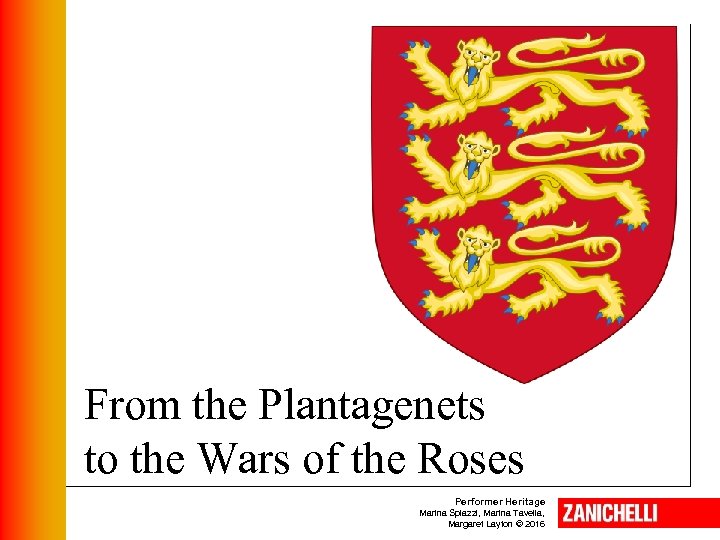 From the Plantagenets to the Wars of the Roses Performer Heritage Marina Spiazzi, Marina Tavella, Margaret Layton © 2016
 From the Plantagenets to the Wars of the Roses 1. Anarchy • • Performer Heritage William I died in 1087. His son William II succeeded him on the throne. Henry I, William II’s brother became king in 1100. Stephen (1135 -54), Henry’s nephew, was the last Norman king. For most of his reign he fought Matilda’s (Henry I’s daughter) attempts to seize throne. A period of civil war called the Anarchy followed. Stephen recognised Matilda’s son, Henry, as his heir.
 From the Plantagenets to the Wars of the Roses 2. The House of Plantagenet • • Henry II (1154 -89), Henry I’s grandson. Richard I (1189 -99), the Lionheart, third son of Henry II. • John (1199 -1216), the Lackland, fifth son of Henry II. • • • Performer Heritage Henry III (1216 -72), John’s son. Edward I (1272 -1307), Henry III’s son. Edward II (1307 -27), Edward I’s son. Edward III (1327 -77), Edward II’s son. Richard II (1377 -99), Edward III’s grandson.
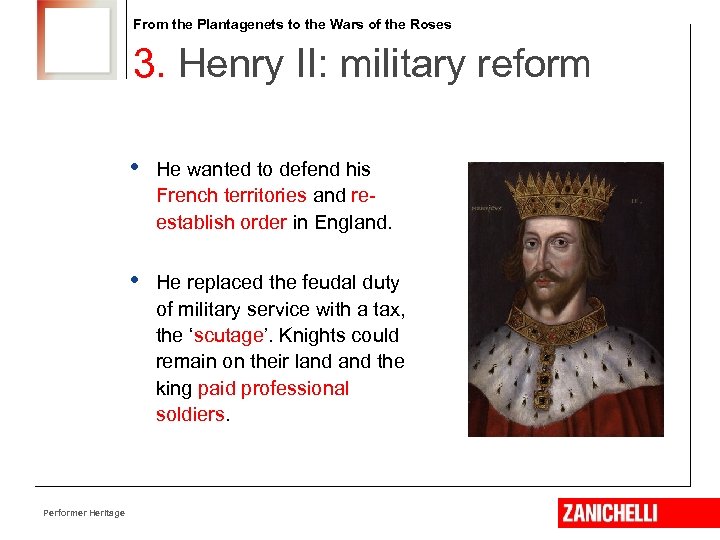 From the Plantagenets to the Wars of the Roses 3. Henry II: military reform • • Performer Heritage He wanted to defend his French territories and reestablish order in England. He replaced the feudal duty of military service with a tax, the ‘scutage’. Knights could remain on their land the king paid professional soldiers.
 From the Plantagenets to the Wars of the Roses 3. Henry II: the reform of justice • The king regained control of the justice system • by creating travelling judges. The law they administered was called common law The common law was used everywhere and based on local customs comparisons and previous cases. Performer Heritage It was different from the law administered in other parts of Europe, linked to the civil law of the Roman Empire and the canon law of the Church.
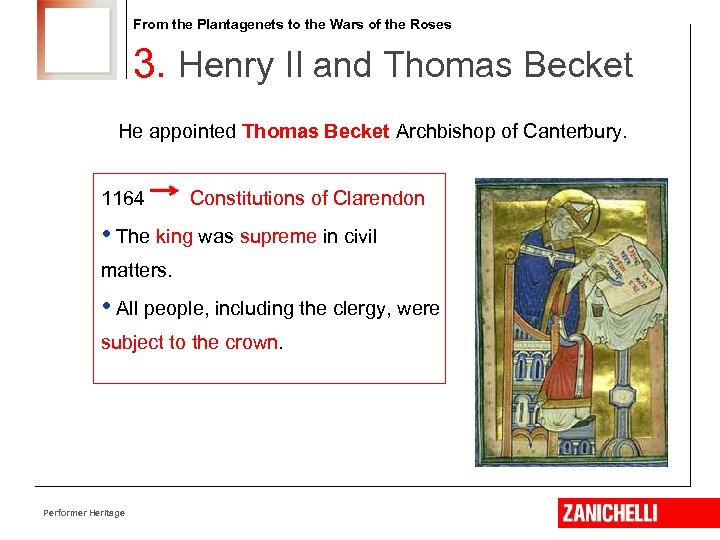 From the Plantagenets to the Wars of the Roses 3. Henry II and Thomas Becket He appointed Thomas Becket Archbishop of Canterbury. 1164 Constitutions of Clarendon • The king was supreme in civil matters. • All people, including the clergy, were subject to the crown. Performer Heritage
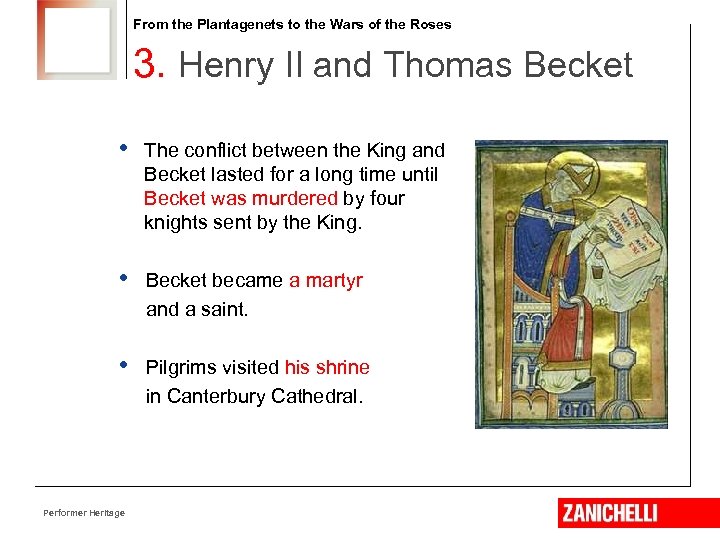 From the Plantagenets to the Wars of the Roses 3. Henry II and Thomas Becket • The conflict between the King and Becket lasted for a long time until Becket was murdered by four knights sent by the King. • Becket became a martyr and a saint. • Pilgrims visited his shrine in Canterbury Cathedral. Performer Heritage
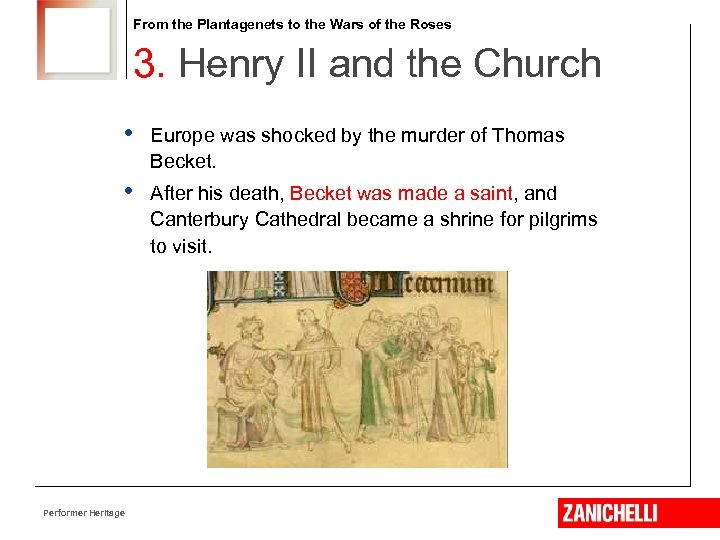 From the Plantagenets to the Wars of the Roses 3. Henry II and the Church • Europe was shocked by the murder of Thomas Becket. • After his death, Becket was made a saint, and Canterbury Cathedral became a shrine for pilgrims to visit. Performer Heritage
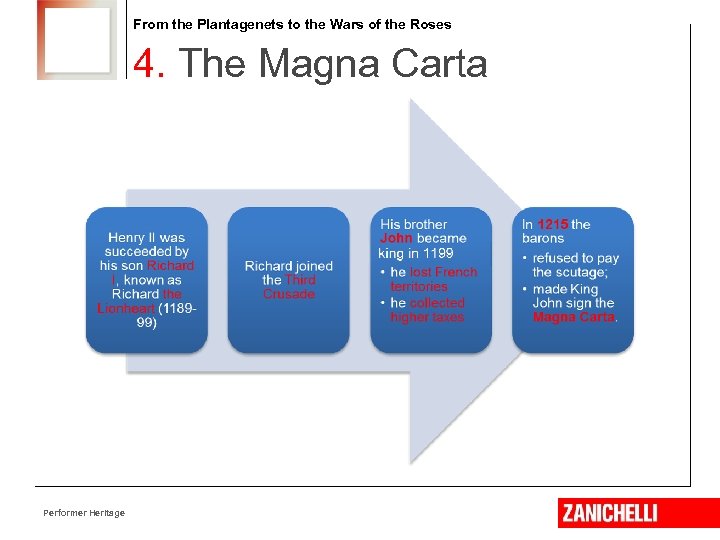
 From the Plantagenets to the Wars of the Roses 4. The Magna Carta • • Henry II was succeeded by his son Richard I, known as Richard the Lionheart (1189 -99). Richard joined the Third Crusade. His brother John became king in 1199 he lost French territories; he collected higher taxes. In 1215 the barons - refused to pay the scutage; - conspired to resist the King; - occupied London; - made King John sign an important document, the Magna Carta. Performer Heritage
 From the Plantagenets to the Wars of the Roses 4. The Magna Carta Performer Heritage
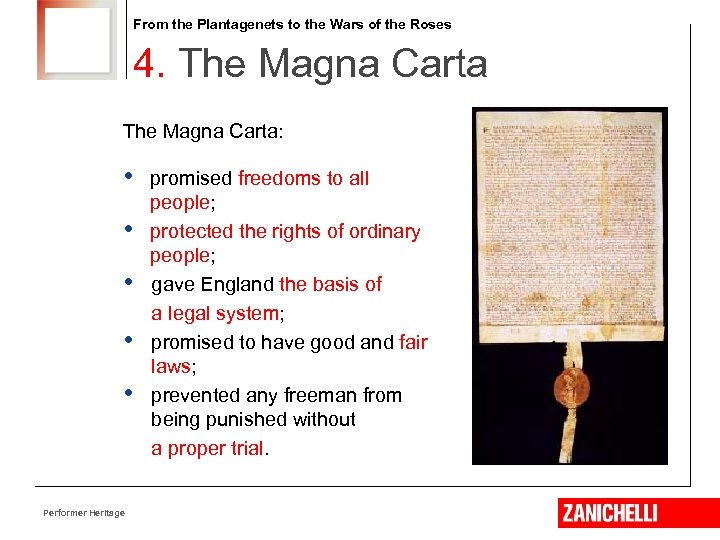 From the Plantagenets to the Wars of the Roses 4. The Magna Carta: • • • Performer Heritage promised freedoms to all people; protected the rights of ordinary people; gave England the basis of a legal system; promised to have good and fair laws; prevented any freeman from being punished without a proper trial.
 From the Plantagenets to the Wars of the Roses 5. The birth of Parliament From the earliest times, the kings of England had assembled nobles and other important subjects in the witan, or council, to advise them. During the reign of Henry III assemblies were summoned. They included: - bishops; - barons; - knights of the shire; - two representatives from the towns. The transition from the king’s council to Parliament was gradual. In 1295 the meeting of the king’s council was known as ‘The Model Parliament’, England’s first Parliament. Performer Heritage
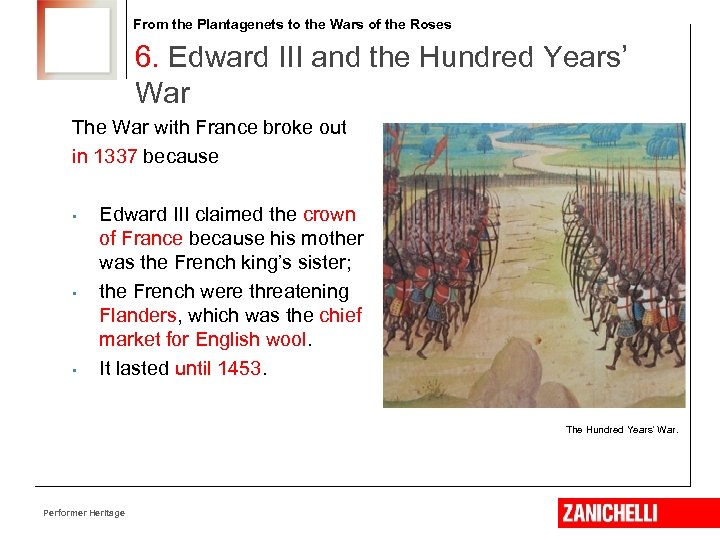 From the Plantagenets to the Wars of the Roses 6. Edward III and the Hundred Years’ War The War with France broke out in 1337 because • • • Edward III claimed the crown of France because his mother was the French king’s sister; the French were threatening Flanders, which was the chief market for English wool. It lasted until 1453. The Hundred Years’ War. Performer Heritage
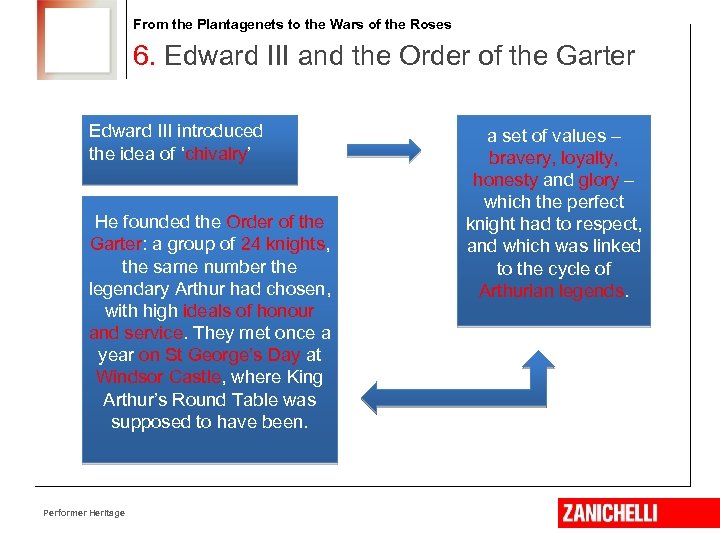 From the Plantagenets to the Wars of the Roses 6. Edward III and the Order of the Garter Edward III introduced the idea of ‘chivalry’ He founded the Order of the Garter: a group of 24 knights, the same number the legendary Arthur had chosen, with high ideals of honour and service. They met once a year on St George’s Day at Windsor Castle, where King Arthur’s Round Table was supposed to have been. Performer Heritage a set of values – bravery, loyalty, honesty and glory – which the perfect knight had to respect, and which was linked to the cycle of Arthurian legends.
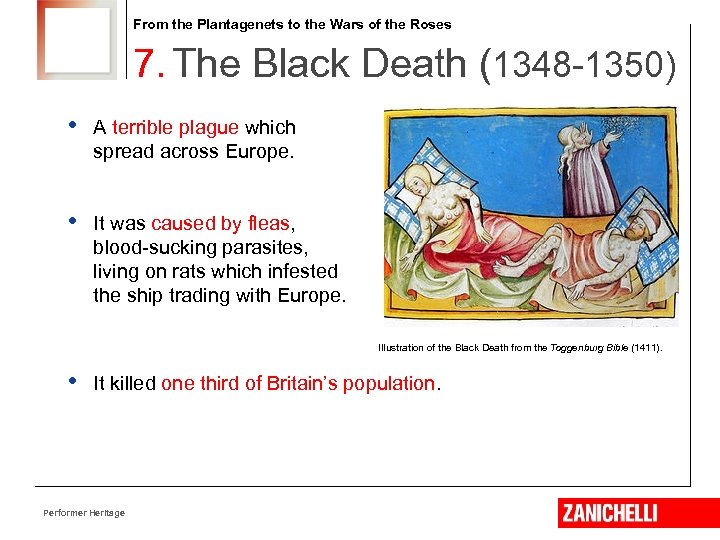 From the Plantagenets to the Wars of the Roses 7. The Black Death (1348 -1350) • A terrible plague which spread across Europe. • It was caused by fleas, blood-sucking parasites, living on rats which infested the ship trading with Europe. Illustration of the Black Death from the Toggenburg Bible (1411). • It killed one third of Britain’s population. Performer Heritage
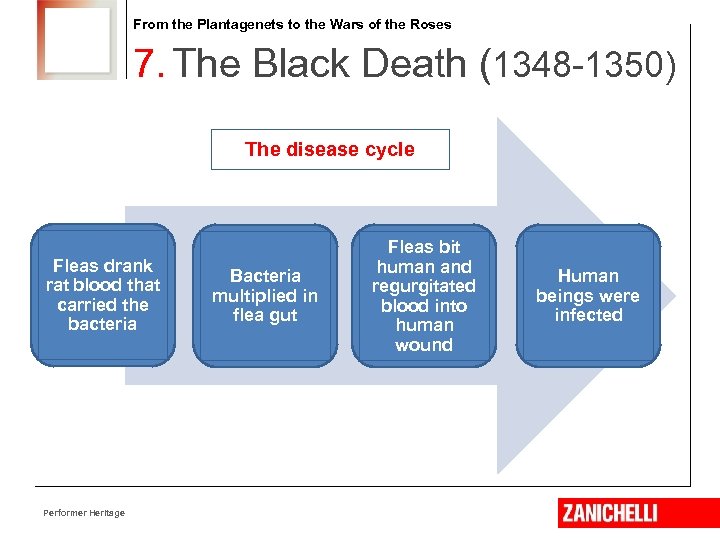 From the Plantagenets to the Wars of the Roses 7. The Black Death (1348 -1350) The disease cycle Fleas drank rat blood that carried the bacteria Performer Heritage Bacteria multiplied in flea gut Fleas bit human and regurgitated blood into human wound Human beings were infected
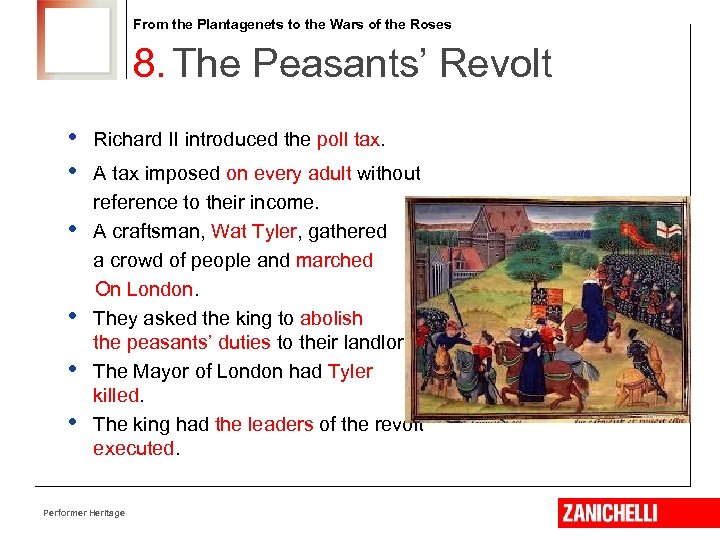 From the Plantagenets to the Wars of the Roses 8. The Peasants’ Revolt • • • Richard II introduced the poll tax. A tax imposed on every adult without reference to their income. A craftsman, Wat Tyler, gathered a crowd of people and marched On London. They asked the king to abolish the peasants’ duties to their landlords. The Mayor of London had Tyler killed. The king had the leaders of the revolt executed. Performer Heritage
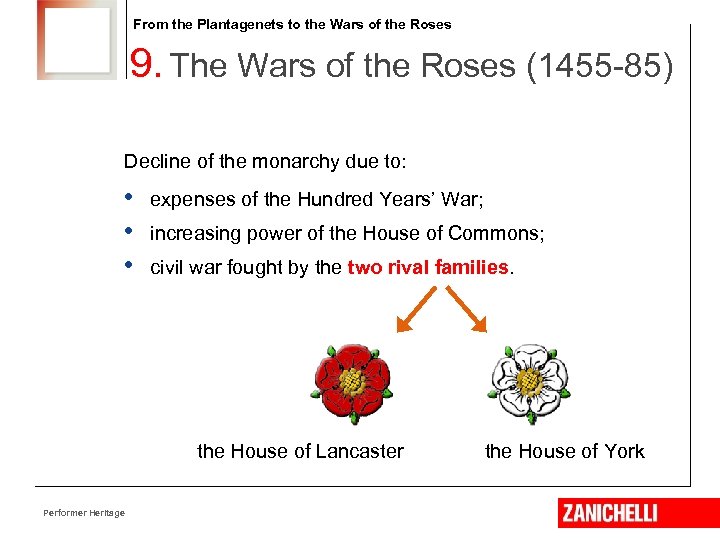 From the Plantagenets to the Wars of the Roses 9. The Wars of the Roses (1455 -85) Decline of the monarchy due to: • • • expenses of the Hundred Years’ War; increasing power of the House of Commons; civil war fought by the two rival families. the House of Lancaster Performer Heritage the House of York
 From the Plantagenets to the Wars of the Roses 9. The Wars of the Roses (1455 -85) Lancaster vs York The House of Lancaster The House of York • Henry IV, Richard II’s • Edward IV, son of the Duke cousin, 1399 -1413 • Henry V, 1413 -1422 • Henry VI, 1422 -1461 Performer Heritage of York, 1461 -1483 • Edward V, Edward IV’s son, 1483 • Richard III, 1483 -1485
 From the Plantagenets to the Wars of the Roses 9. The Wars of the Roses (1455 -85) Main events of the war • • Henry VI was weak and Lancastrians became unpopular. • When Edward died, his young son, Edward V, was murdered by his uncle Richard, Duke of Gloucester, who crowned himself as Richard III. • Richard III was killed by Henry, Earl of Richmond, at the Battle of Bosworth in 1485. • • Henry became Henry VII, the first king of the Tudor dynasty. In 1461 he was confined to the Tower by the son of the Duke of York, who seized the throne as Edward IV. He married Elizabeth of York, daughter of Edward IV. Performer Heritage