 Скачать презентацию From Sounds to Language CS 4706 Julia Hirschberg
032d9af6f6167039943f3ee3ae164d50.ppt
- Количество слайдов: 27



From Sounds to Language CS 4706 Julia Hirschberg
Who studies speech sounds? • Phoneticians: – What distinctive sounds do particular languages have? – How are they produced? • Phonologists: – What is the underlying theory of speech sound? – What explains how particular sounds vary in context? • Acoustic phoneticians, speech engineers, speech pathologists, lexicographers, singers, …
How do we represent speech sounds? • Regular orthography • Special-purpose symbol sets • Abstract sound classes based upon sound similarities – What sounds are shared by languages X and Y? – What sounds are unique to particular languages? Or at least rare? – E. g. for language identification
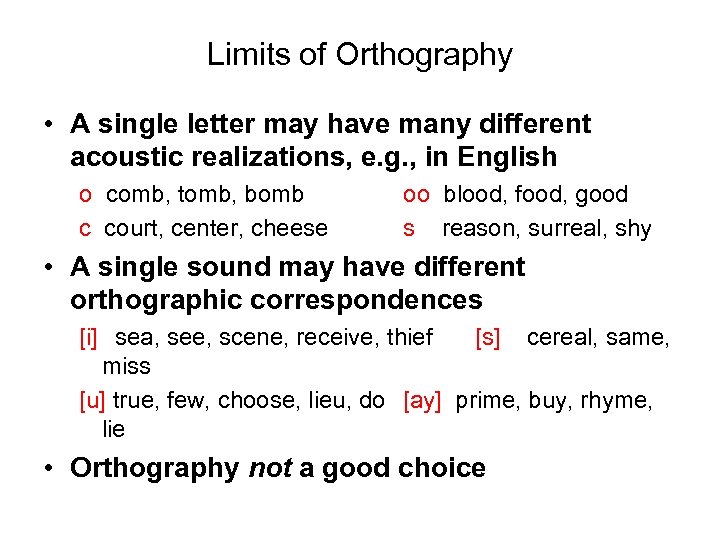
Limits of Orthography • A single letter may have many different acoustic realizations, e. g. , in English o comb, tomb, bomb c court, center, cheese oo blood, food, good s reason, surreal, shy • A single sound may have different orthographic correspondences [i] sea, see, scene, receive, thief [s] cereal, same, miss [u] true, few, choose, lieu, do [ay] prime, buy, rhyme, lie • Orthography not a good choice
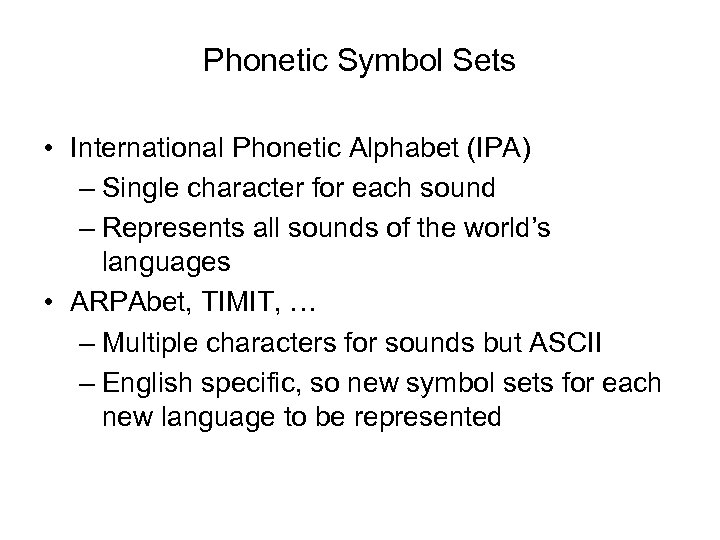
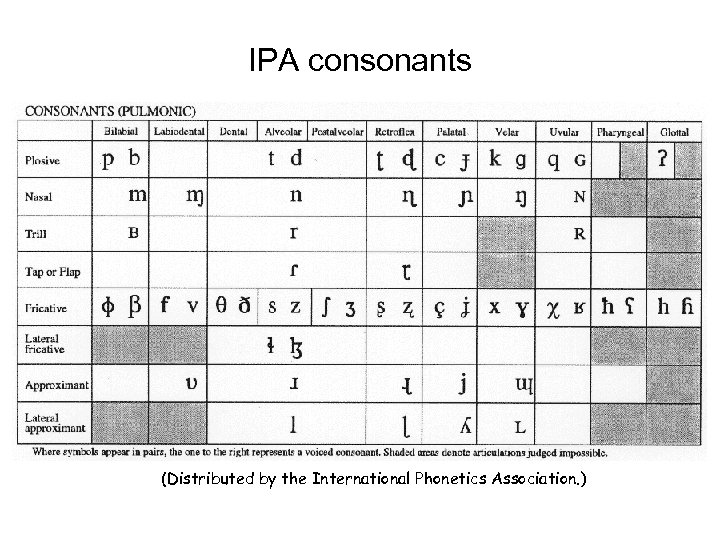
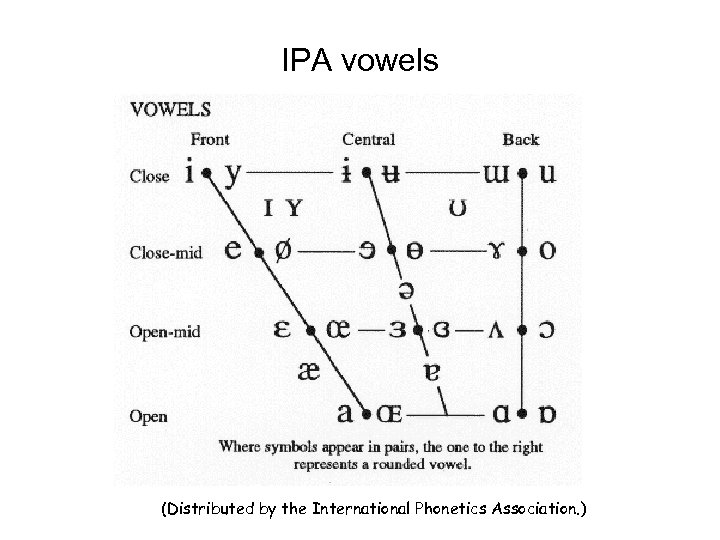
Phonetic Symbol Sets • International Phonetic Alphabet (IPA) – Single character for each sound – Represents all sounds of the world’s languages • ARPAbet, TIMIT, … – Multiple characters for sounds but ASCII – English specific, so new symbol sets for each new language to be represented
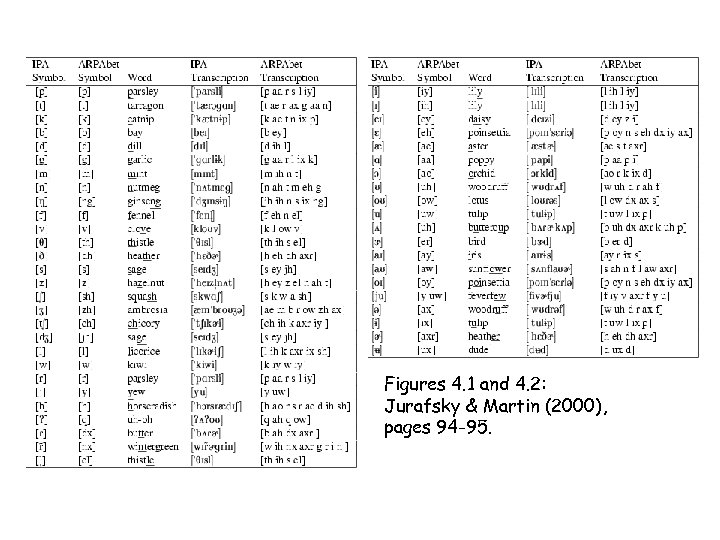
Figures 4. 1 and 4. 2: Jurafsky & Martin (2000), pages 94 -95.
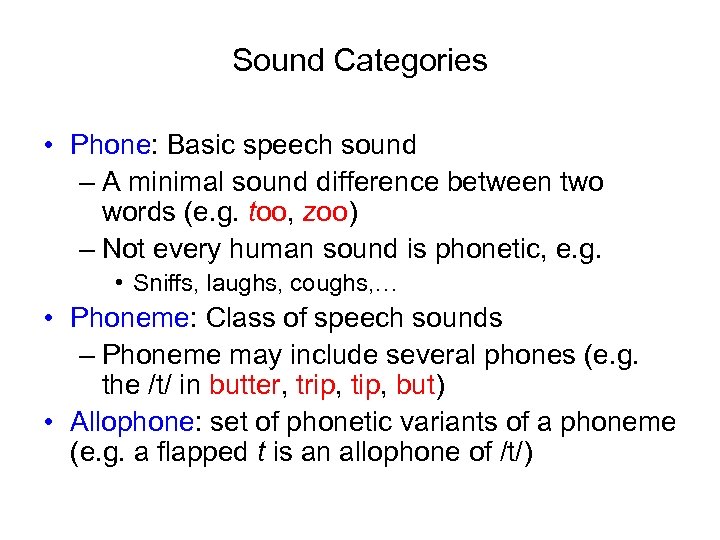
Sound Categories • Phone: Basic speech sound – A minimal sound difference between two words (e. g. too, zoo) – Not every human sound is phonetic, e. g. • Sniffs, laughs, coughs, … • Phoneme: Class of speech sounds – Phoneme may include several phones (e. g. the /t/ in butter, trip, tip, but) • Allophone: set of phonetic variants of a phoneme (e. g. a flapped t is an allophone of /t/)
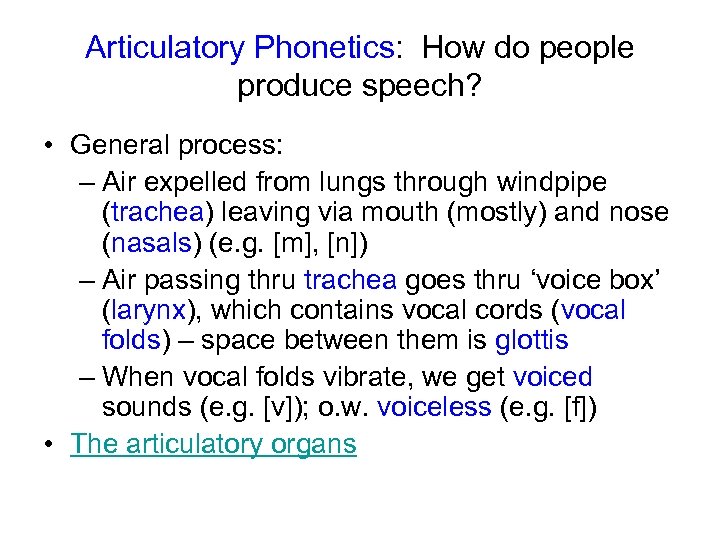
Articulatory Phonetics: How do people produce speech? • General process: – Air expelled from lungs through windpipe (trachea) leaving via mouth (mostly) and nose (nasals) (e. g. [m], [n]) – Air passing thru trachea goes thru ‘voice box’ (larynx), which contains vocal cords (vocal folds) – space between them is glottis – When vocal folds vibrate, we get voiced sounds (e. g. [v]); o. w. voiceless (e. g. [f]) • The articulatory organs
![Vocal fold vibration [UCLA Phonetics Lab demo]](https://present5.com/presentation/032d9af6f6167039943f3ee3ae164d50/image-9.jpg "Vocal fold vibration [UCLA Phonetics Lab demo]")
Vocal fold vibration [UCLA Phonetics Lab demo]
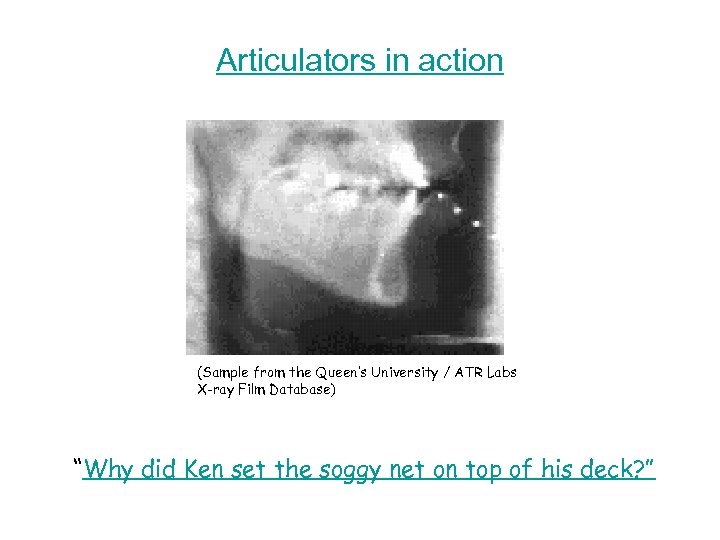
Articulators in action (Sample from the Queen’s University / ATR Labs X-ray Film Database) “Why did Ken set the soggy net on top of his deck? ”
How do we capture articulatory data? • X-ray/pellet film archive • X-Ray Microbeam Database – Sample output • Electroglottography • Electromagnetic articulography (EMMA) – 3 transmitters on helmet produce alternating magnetic fields at different frequencies, forming equilateral triangle – Creates alternating current in 5 -15 sensors to calculate sensor positions via XY coordinates – Sample output
Classes of Sounds • Consonants and vowels: – Consonants: • Restriction/blockage of air flow • Voiced or voiceless – Vowels: • Generally voiced, less restriction – Semivowels: [w], [y]
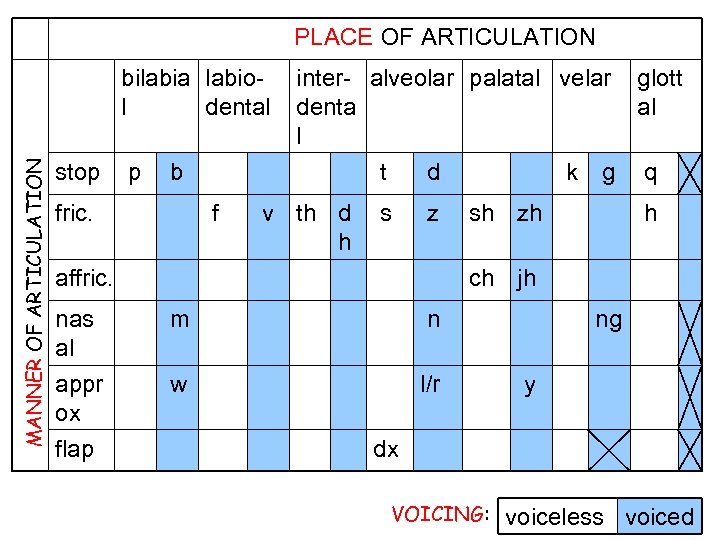
Consonants: Place of Articulation • What is the point of maximum restriction? – Labial: bilabial [b], [p]; labiodental [v], [f] – Dental: [ ], [ ] thief vs. them – Alveolar: [t], [d], [s], [z] – Palatal: [ ], [t ] shrimp vs. chimp – Velar: [k], [g] – Glottal: [? ] glottal stop
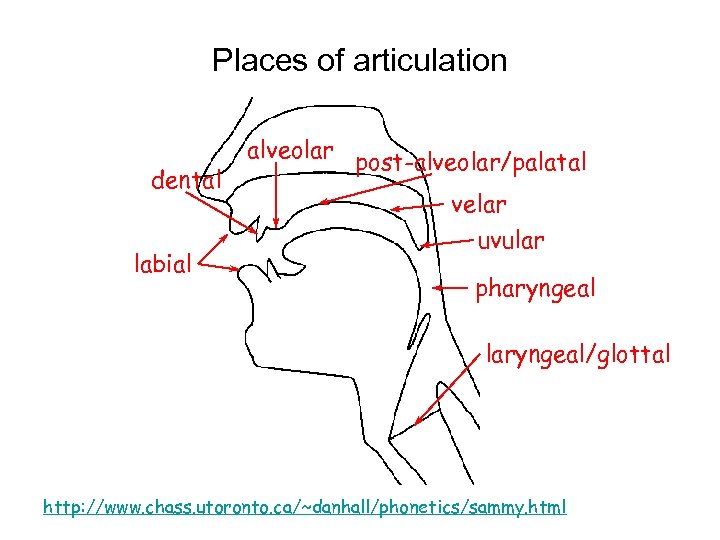
Places of articulation dental labial alveolar post-alveolar/palatal velar uvular pharyngeal laryngeal/glottal http: //www. chass. utoronto. ca/~danhall/phonetics/sammy. html
![Consonants: Manner of Articulation • How is the airflow restricted? – Stop: [p], [t],](https://present5.com/presentation/032d9af6f6167039943f3ee3ae164d50/image-15.jpg "Consonants: Manner of Articulation • How is the airflow restricted? – Stop: [p], [t],")
Consonants: Manner of Articulation • How is the airflow restricted? – Stop: [p], [t], [g], … • Airflow completely blocked (closure), then released (release) • Aka plosive – Nasal: air is released thru nose [m], [ng], … – Fricative: [s], [z], [f] air forced thru narrow channel – Affricates [t ] begin as stops and end as fricatives
![– Approximant: [w], [y] • 2 articulators come close but don’t restrict much •](https://present5.com/presentation/032d9af6f6167039943f3ee3ae164d50/image-16.jpg "– Approximant: [w], [y] • 2 articulators come close but don’t restrict much •")
– Approximant: [w], [y] • 2 articulators come close but don’t restrict much • Between vowels and consonants • Lateral: [l] – Tap or flap: [ ]
PLACE OF ARTICULATION MANNER OF ARTICULATION bilabia labiol dental stop p inter- alveolar palatal velar denta l b fric. t f v th d s z affric. nas al appr ox flap k g sh zh glott al q h ch jh m n w l/r ng y dx VOICING: voiceless voiced
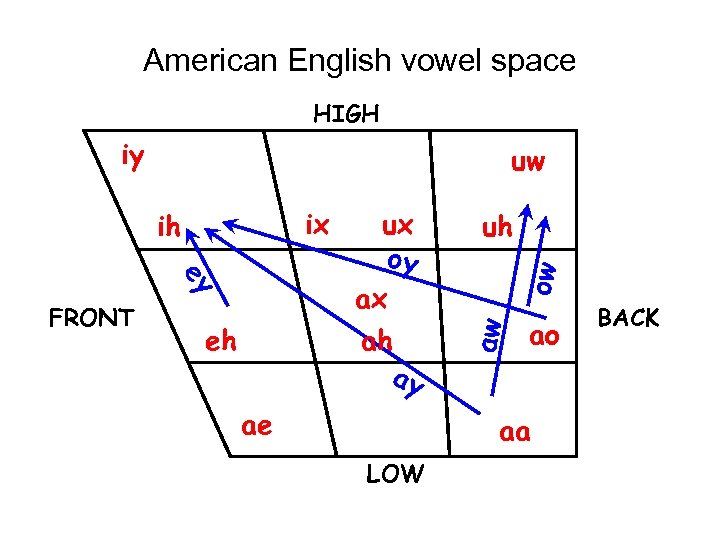
Vowels • Vowel height – How high is the tongue? high or low vowel – Where is its highest point? front or back vowel • How rounded are the lips? • Mono vs. diphthong, e. g. [ei] – 1 vowel sound or 2?
American English vowel space HIGH iy uw eh ae uh ow ey FRONT ux oy ax ah ay aw ix ih ao aa LOW BACK
![[iy] vs. [uw] (From a lecture given by Rochelle Newman)](https://present5.com/presentation/032d9af6f6167039943f3ee3ae164d50/image-20.jpg "[iy] vs. [uw] (From a lecture given by Rochelle Newman)")
[iy] vs. [uw] (From a lecture given by Rochelle Newman)
![[ae] vs. [aa] (From a lecture given by Rochelle Newman)](https://present5.com/presentation/032d9af6f6167039943f3ee3ae164d50/image-21.jpg "[ae] vs. [aa] (From a lecture given by Rochelle Newman)")
[ae] vs. [aa] (From a lecture given by Rochelle Newman)
![Acoustic landmarks [p] [t] [ih] [ix] [sh] [ax] [p] [ae] [t] [iy][n] [s] [ae]](https://present5.com/presentation/032d9af6f6167039943f3ee3ae164d50/image-22.jpg "Acoustic landmarks [p] [t] [ih] [ix] [sh] [ax] [p] [ae] [t] [iy][n] [s] [ae]")
Acoustic landmarks [p] [t] [ih] [ix] [sh] [ax] [p] [ae] [t] [iy][n] [s] [ae] [l] [n] [s] [iy] “Patricia and Patsy and Sally” [p] [ix] [t] [ih]
A Problem: Coarticulation • Same phone produced differently depending on phonetic context • Occurs when articulations overlap as articulators are moving in different timing patterns to produce different adjacent sounds – Eight vs. Eighth • Place of articulation moves forward as /t/ is dentalized – Met vs. Men • Vowel is nasalized
IPA consonants (Distributed by the International Phonetics Association. )
IPA vowels (Distributed by the International Phonetics Association. )
Representations for Sounds • Now we have ways to represent the sounds of a language (IPA, Arpabet…) and to classify similar sounds – Automatic speech recognition – Speech synthesis – Speech pathology, language id, speaker id • But…how can we recognize different sounds automatically? – Acoustic analysis and tools
Next Class • Acoustics of speech production (J&M 7. 4, *Johnson 1 -2)
Скачать презентацию From Sounds to Language CS 4706 Julia Hirschberg
032d9af6f6167039943f3ee3ae164d50.ppt