


 Скачать презентацию From Puritanism to the Enlightenment 1640 -1780
2_Puritanism_Enlight.ppt
- Количество слайдов: 22
 From Puritanism to the Enlightenment 1640 -1780
 The Divine Right of Kings • When James I (1603 -1625) succeeded to the English throne, he firmly believed that the regent derives power directly from God. • James was not interested in reforming the Church of England. • Catholics were forbidden to celebrate Mass (service of worship), and Puritans could not gather for religious meetings. • Many religious dissidents left England. • Catholics tended to emigrate to the European continent, particularly France and Italy. • The Puritans first found a home in Holland, and later voyaged to North America, where they established the Plymouth Colony in 1620 in present-day Massachusetts.
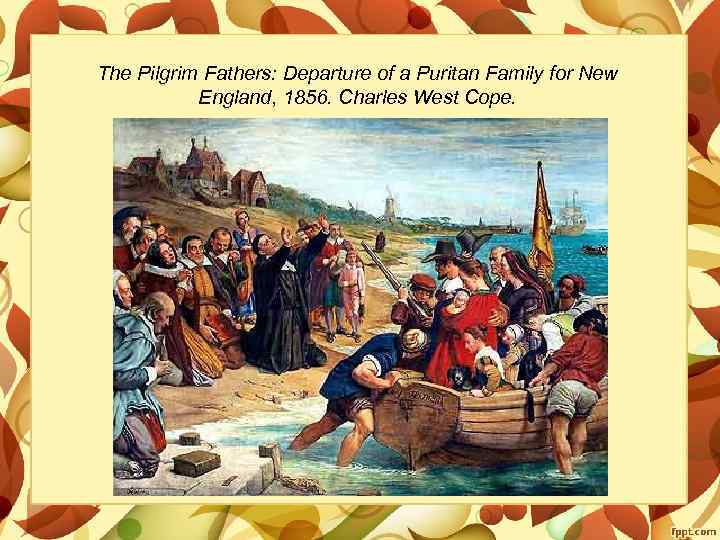 The Pilgrim Fathers: Departure of a Puritan Family for New England, 1856. Charles West Cope.
 Growing conflict • When James’s son Charles I came to the throne in 1625 (16251649), people who hoped for a more tolerant ruler were disappointed. • The new king had taken to heart his father’s example of ruling by divine right. • Because of his belief that he would be committing a grave sin in surrendering part of his authority, Charles disregarded Parliament’s opinions on economic spending and commanded his subjects to observe a form of Anglican ritual that was offensive to Puritans and other dissidents. • By 1629, with Parliament and the king unable to agree on religious and economic matters. • Charles dissolved Parliament and did not call it back for eleven years.
 Growing conflict • During the “eleven years’ tyranny, ” grievances (sérelmek) on both sides mounted. • By the time Charles recalled Parliament in 1640, it was too late for any permanent compromise. • Parliament called for a new constitution that included their demands to control all church and military matters and appoint ministers and judges. • The king moved his court from London to the northern city of York. • The ideological battle lines were drawn; by August 1642, war had begun.
 Civil War • The English civil war was fought between Royalist Cavaliers loyal to the king and the Puritan Roundheads (so called because their hair was cut short, unlike the long-haired courtiers). • Over time, Parliament proved victorious, due largely to the New Model Army of Oliver Cromwell, a military genius and Puritan extremist. • In April 1646, Charles surrendered himself to the Scots, who turned him over to Parliament in exchange for a large ransom.
 Civil War • By this time, the Parliamentary forces wanted to do away with the monarchy. • The court that tried Charles accused him of being a “Tyrant, Traitor and Murderer; and a public enemy to the good people of this nation. ” • The trial was controversial; many people who had fought against Charles were reluctant to resort to execution. • Nonetheless, the death sentence was passed, and the king was publicly beheaded. • A week after his death, Parliament abolished the monarchy.
 The Commonwealth • Cromwell became the Lord Protector of the country. • Until his death in 1658, Cromwell imposed strict Puritanical rules on public behavior and religious worship. • He closed theaters, banned dancing and music, caused all religious icons to be destroyed as “graven images, ” and forbade the celebration of Christmas.
 The Puritan Rule • Cromwell was a complex leader, leaving a legacy to be both admired and deplored. • He preached and practiced religious toleration—except for Catholics. • Any “graven images, ” which Cromwell associated with Catholicism, were destroyed. Throughout England, baptismal fonts, statues of saints, ceiling and altar decorations—the devotional art of centuries—were smashed. • With the stability that Cromwell’s government provided, the economy prospered, but there was little pleasure or entertainment in a country where public music was banned and theaters were closed. • What had begun as a noble experiment in liberty ended in a military dictatorship.
 After Cromwell • After Cromwell’s death in 1658, his son Richard briefly attempted to rule as Lord Protector, but he was ousted by the military, which disbanded Parliament and ruled incompetently. • When order was restored by some of the king’s old enemies, there seemed only one solution. • In May 1660, Charles II returned triumphant, riding through London accompanied by a supportive army as he made his way to the palace of Whitehall, the scene of his father’s execution twelve years before.
 The Restoration • In 1660 the English Parliament that had ordered the execution of Charles I invited his son Charles II to return from exile and reclaim the throne. (From France – Louis XIV. ) • With the restoration of the monarchy, many old entertainments were restored. • The theaters were reopened, public festivals were celebrated, and new fashions in clothes, food, and ideas flooded in from the European continent. • Intellectual life began to flourish once more and set the stage for the burgeoning Enlightenment that took hold in England during the following century.
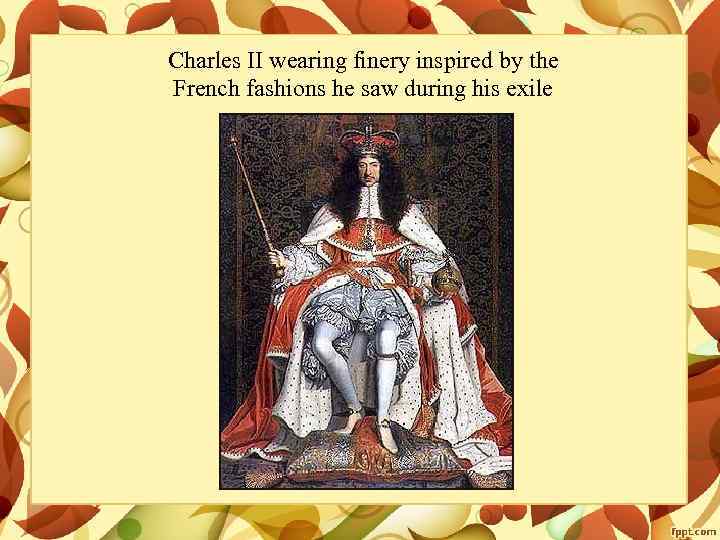 Charles II wearing finery inspired by the French fashions he saw during his exile
 The Restoration • Charles was a far cry from both his father and Oliver Cromwell. • Known as the merry monarch, the goodnatured Charles enjoyed pleasures of all kinds, from courtly entertainments to his royal mistresses. • Trying to break the cycle of retribution which had plagued England for so long, Charles forgave many of his father’s old enemies. • His mercy did not extend, however, to most of the judges at his father’s trial and signers of the order of execution. • Cromwell’s body, which had been buried in the Tower of London, was dug up, beheaded, and reburied in a common pit.
 Public Pleasures • Charles II’s taste for pleasure was shared by many people, whose lives had been dreary under Puritan rule. • Holidays such as Christmas were celebrated once more, • horse races—and betting—started up again, • and music and evening masquerade parties filled public pleasure gardens such as Vauxhall. • Charles also reopened theaters. • Audiences had an insatiable appetite for comedies about the fashionable manners of the age. • Bawdy, witty, and amoral, these Restoration dramas by such playwrights as William Congreve, William Wycherley, and George Farquhar reflect a cynical frivolity in matters of love and money.
 Public Pleasures • The plays seemed all the more scandalous because the new theaters allowed women to appear on the stage for the first time. • One of the most popular playwrights of the day was Aphra Behn, the first woman in England to make her living as a professional writer. • Behn was often accused of lewdness (bujaság), but there is no doubt that her vivacious comedies reflected the pleasure-loving attitude and carpe diem spirit of the Restoration.
 Coffee and Tea • Drinking tea became popular in England during the Restoration. • At that time, it was a very costly drink: a pound of tea cost 10 pounds. • By 1700 the price was reduced to one pound, but this was still a big expense for ordinary British families, whose annual income ranged between 15 and 50 pounds a year. • The first coffeehouse opened in London in 1652. • By 1663 London had 82 coffeehouses; • by 1700 the number had grown to somewhere between 500 and 2000.
 The Enlightenment and Neoclassicism • The Enlightenment was a European philosophical and literary movement that in England is often called “The Age of Reason. ” • It is characterized by a profound faith in the power of human reason and a devotion to clarity of thought. • With the Restoration came a return to Anglicanism as England's state religion and a realization that future monarchs would have to share their authority with Parliament, whose influence had increased substantially.
 The Enlightenment and Neoclassicism • A related literary movement was Neoclassicism, which reached its pinnacle in the poetry, prose, and criticism of Samuel Johnson. • Its major tenet was the conviction that the classical authors of ancient Greece and Rome had perfected the rules and norms that should govern the writing of literature for all time.
 Plague and Fire • Perhaps the Puritans viewed the twin disasters of plague and fire as a punishment from God for what they perceived to be the immorality and corruption of the age. • But the outbreak of the bubonic plague in 1665 disproportionately affected the poor. • The College of Physicians ordered houses in which plague appeared to be nailed shut, leaving all the inhabitants to their fate. • Wealthy people could engineer their escape and pay to leave London.
 Plague • So many victims died that bodies were buried in communal pits rather than in individual plots. • The official number of the dead was more than 68, 000; • with the addition of people not usually included on official lists, such as Quakers and Jews, the actual number was probably, more than 100, 000.
 Fire • Unlike the plague, the Great Fire of London equally affected both the rich and the poor. • The fire raged for four days and continued to smolder for almost two months. • An area about one and one-half miles long by a half mile wide was completely destroyed, including most of old London within its medieval walls. • The king, who had shown great personal courage and intelligence in fighting the fire, took a vigorous interest in rebuilding the city—in fire-resistant stone—on an elegant and systematic scale. • He placed his plan in the hands of Sir Christopher Wren, an astronomer by training, who proved to be the greatest civil architect England has ever produced.
 The Great Fire of London • On September 2, 1666, fire broke out in a London bakery. • During the next four days it spread, destroying much of the city. • Fortunately, the flames spread slowly, which enabled Londoners to escape. • As a result, few people were killed; contemporary records indicate only five deaths from the fire. • Damage to buildings and property, however, was • considerable; • 100, 000 Londoners were homeless.