 Скачать презентацию From picoseconds to galaxies Building electronics for Relativistic
4963ee932a32a9842255529cb865b715.ppt
- Количество слайдов: 42



From picoseconds to galaxies Building electronics for Relativistic Heavy Ion Collider and for Dark Matter Search Wojtek Skulski Department of Physics and Astronomy University of Rochester W. Skulski Laboratory for Laser Energetics, Rochester, 22 September 2004
Outline • Introduction. • Electronics for PHOBOS at RHIC. • Time Equalizer electronics. • Universal Trigger Module for on-line trigger. • Research and student projects at Uof. R. • Electronics for Dark Matter Search. • Tiled Diffraction Gratings at LLE. • Summary and acknowledgements. W. Skulski Laboratory for Laser Energetics, Rochester, 22 September 2004
Electronics and software help achieve scientific goals • My electronics and software developments are driven by science. Tools to help achieve scientific goals rather than goals in themselves. • The tools are meant to be used in mission-critical applications. • Therefore, no compromises are allowed concerning their quality. • Electronics development required all of the following: • Schematic design, board layout and board assembly. • Hardware testing and debugging. • Software for embedded microcontroller. • Firmware for on-board FPGA. • GUI design and programming. • The “one-man show” brings coherence to my designs. W. Skulski Laboratory for Laser Energetics, Rochester, 22 September 2004
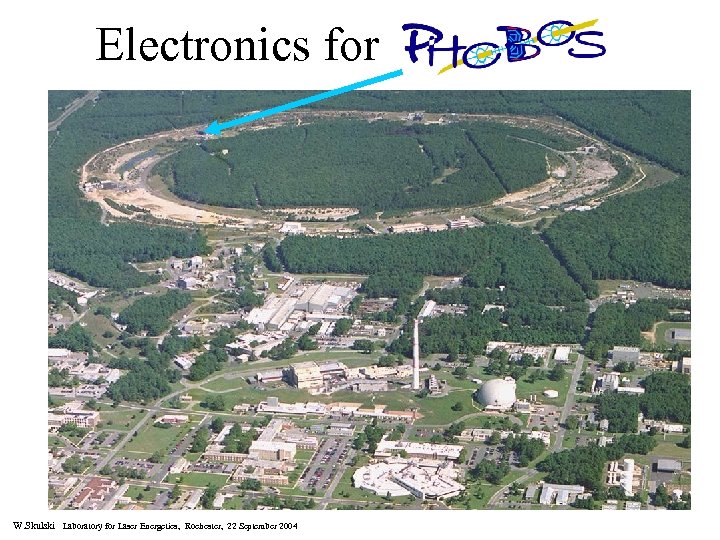
Electronics for W. Skulski Laboratory for Laser Energetics, Rochester, 22 September 2004
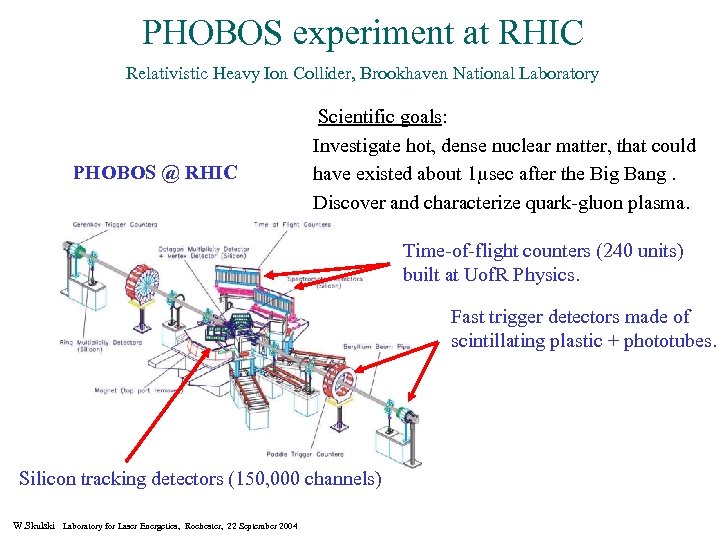
PHOBOS experiment at RHIC Relativistic Heavy Ion Collider, Brookhaven National Laboratory PHOBOS @ RHIC Scientific goals: Investigate hot, dense nuclear matter, that could have existed about 1 msec after the Big Bang. Discover and characterize quark-gluon plasma. Time-of-flight counters (240 units) built at Uof. R Physics. Fast trigger detectors made of scintillating plastic + phototubes. Silicon tracking detectors (150, 000 channels) W. Skulski Laboratory for Laser Energetics, Rochester, 22 September 2004
Time Equalizer for W. Skulski Laboratory for Laser Energetics, Rochester, 22 September 2004
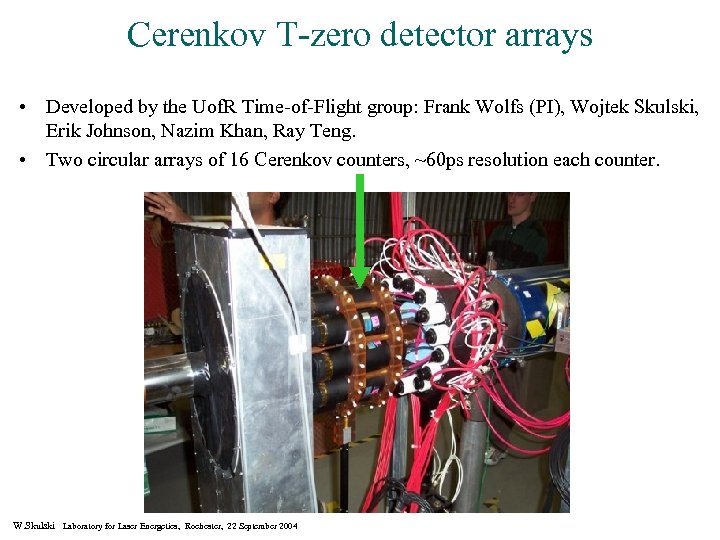
Cerenkov T-zero detector arrays • Developed by the Uof. R Time-of-Flight group: Frank Wolfs (PI), Wojtek Skulski, Erik Johnson, Nazim Khan, Ray Teng. • Two circular arrays of 16 Cerenkov counters, ~60 ps resolution each counter. W. Skulski Laboratory for Laser Energetics, Rochester, 22 September 2004
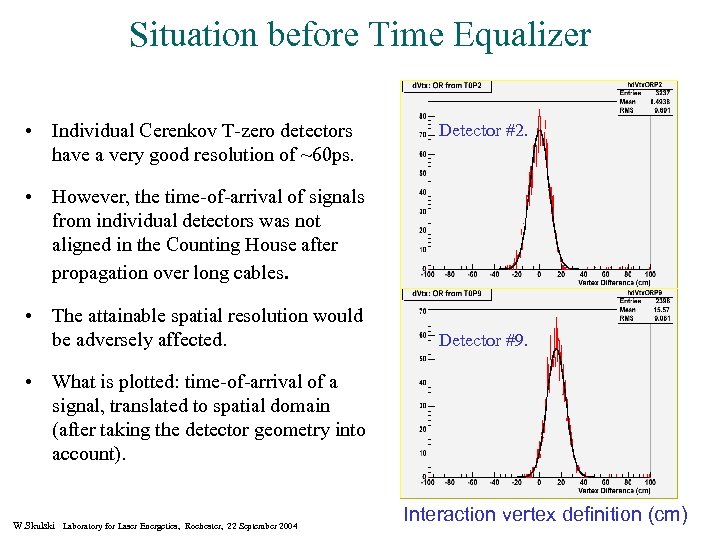
Situation before Time Equalizer • Individual Cerenkov T-zero detectors have a very good resolution of ~60 ps. Detector #2. • However, the time-of-arrival of signals from individual detectors was not aligned in the Counting House after propagation over long cables. • The attainable spatial resolution would be adversely affected. Detector #9. • What is plotted: time-of-arrival of a signal, translated to spatial domain (after taking the detector geometry into account). W. Skulski Laboratory for Laser Energetics, Rochester, 22 September 2004 Interaction vertex definition (cm)
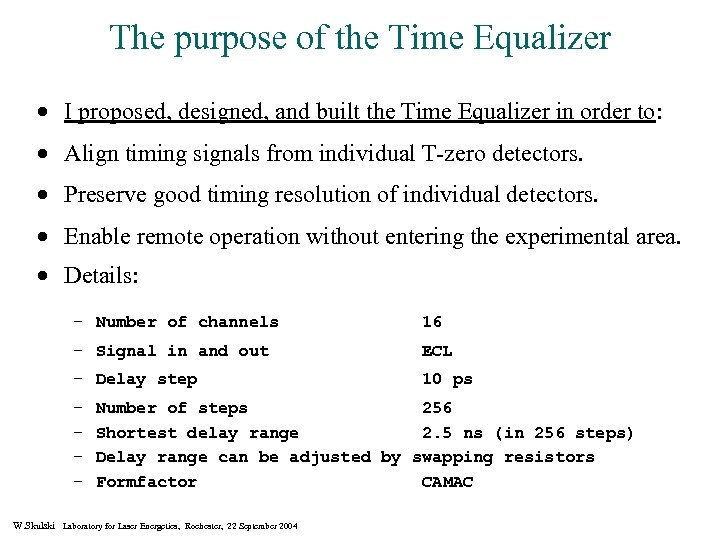
The purpose of the Time Equalizer · I proposed, designed, and built the Time Equalizer in order to: · Align timing signals from individual T-zero detectors. · Preserve good timing resolution of individual detectors. · Enable remote operation without entering the experimental area. · Details: – Number of channels 16 – Signal in and out ECL – Delay step 10 ps – – Number of steps 256 Shortest delay range 2. 5 ns (in 256 steps) Delay range can be adjusted by swapping resistors Formfactor CAMAC W. Skulski Laboratory for Laser Energetics, Rochester, 22 September 2004
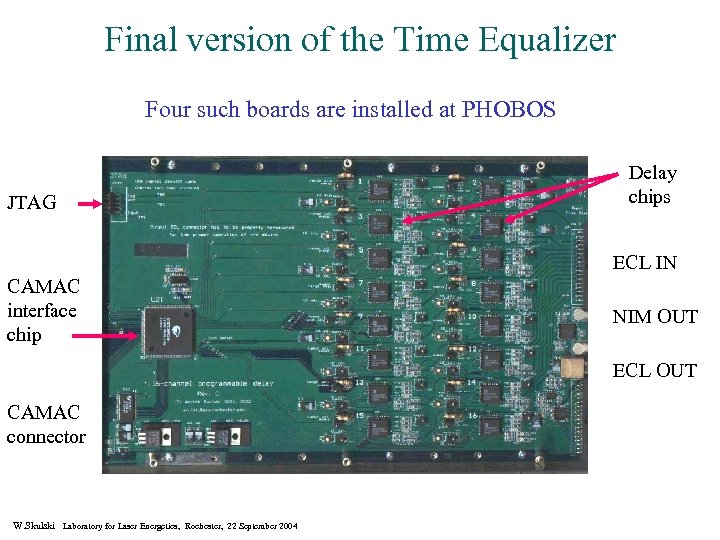
Final version of the Time Equalizer Four such boards are installed at PHOBOS JTAG Delay chips ECL IN CAMAC interface chip NIM OUT ECL OUT CAMAC connector W. Skulski Laboratory for Laser Energetics, Rochester, 22 September 2004
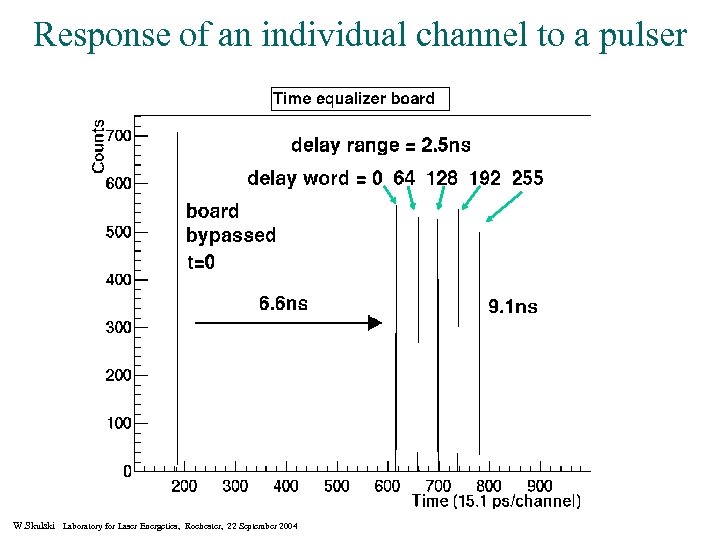
Response of an individual channel to a pulser W. Skulski Laboratory for Laser Energetics, Rochester, 22 September 2004
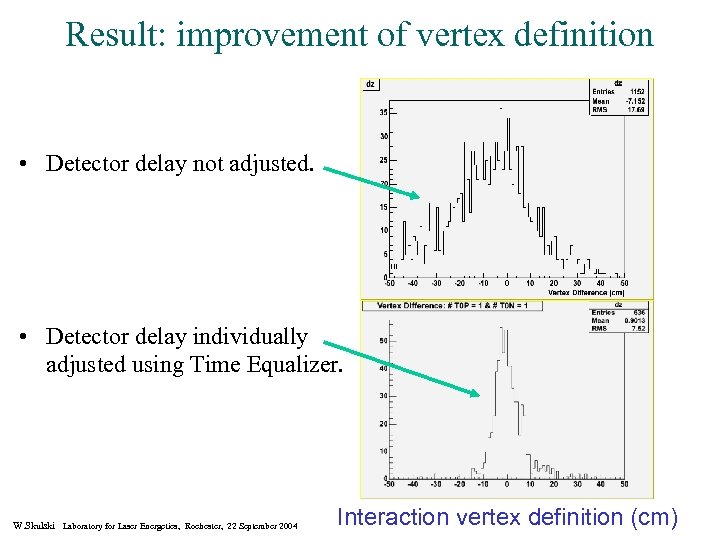
Result: improvement of vertex definition • Detector delay not adjusted. • Detector delay individually adjusted using Time Equalizer. W. Skulski Laboratory for Laser Energetics, Rochester, 22 September 2004 Interaction vertex definition (cm)
Universal Trigger Module for W. Skulski Laboratory for Laser Energetics, Rochester, 22 September 2004
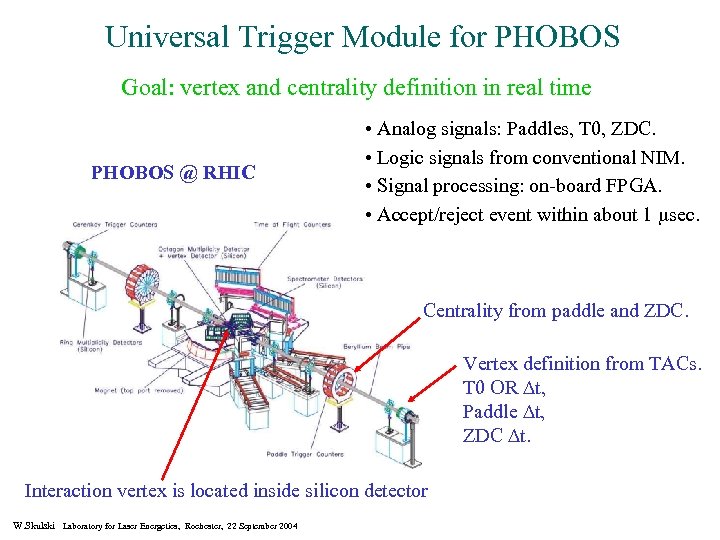
Universal Trigger Module for PHOBOS Goal: vertex and centrality definition in real time PHOBOS @ RHIC • Analog signals: Paddles, T 0, ZDC. • Logic signals from conventional NIM. • Signal processing: on-board FPGA. • Accept/reject event within about 1 msec. Centrality from paddle and ZDC. Vertex definition from TACs. T 0 OR Dt, Paddle Dt, ZDC Dt. Interaction vertex is located inside silicon detector W. Skulski Laboratory for Laser Energetics, Rochester, 22 September 2004
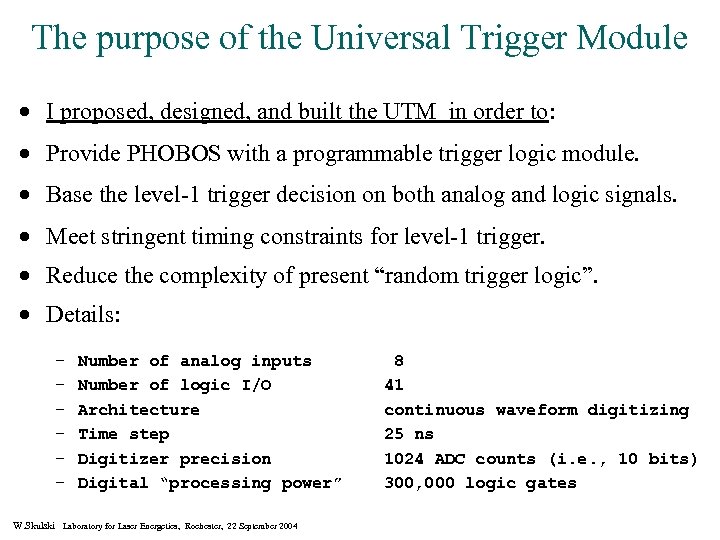
The purpose of the Universal Trigger Module · I proposed, designed, and built the UTM in order to: · Provide PHOBOS with a programmable trigger logic module. · Base the level-1 trigger decision on both analog and logic signals. · Meet stringent timing constraints for level-1 trigger. · Reduce the complexity of present “random trigger logic”. · Details: – – – Number of analog inputs 8 Number of logic I/O 41 Architecture continuous waveform digitizing Time step 25 ns Digitizer precision 1024 ADC counts (i. e. , 10 bits) Digital “processing power” 300, 000 logic gates W. Skulski Laboratory for Laser Energetics, Rochester, 22 September 2004
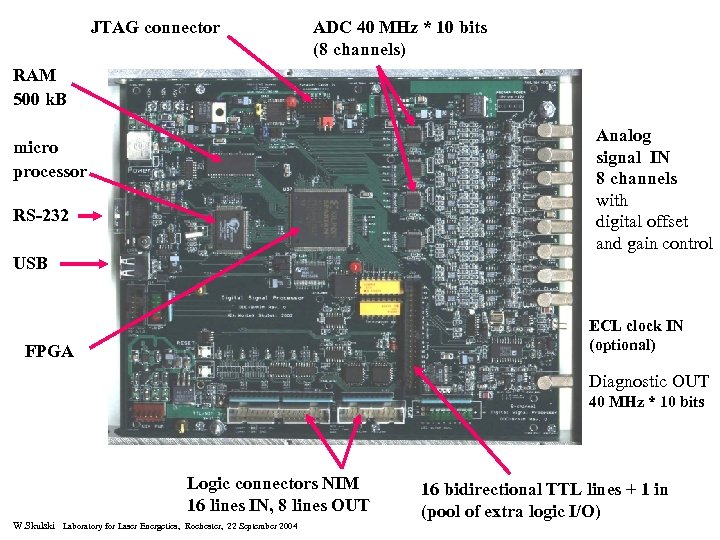
JTAG connector ADC 40 MHz * 10 bits (8 channels) RAM 500 k. B Analog signal IN 8 channels with digital offset and gain control micro processor RS-232 USB ECL clock IN (optional) FPGA Diagnostic OUT 40 MHz * 10 bits Logic connectors NIM 16 lines IN, 8 lines OUT W. Skulski Laboratory for Laser Energetics, Rochester, 22 September 2004 16 bidirectional TTL lines + 1 in (pool of extra logic I/O)
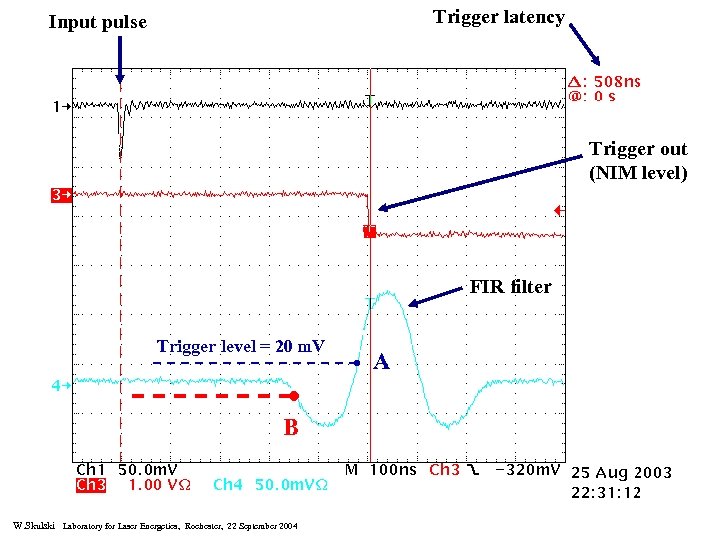
Trigger latency Input pulse Trigger out (NIM level) FIR filter Trigger level = 20 m. V B W. Skulski Laboratory for Laser Energetics, Rochester, 22 September 2004 A
Status of the Universal Trigger Module for PHOBOS · Technical requirements were met. · Hardware, firmware, and software working and tested. · One board loaned to University of Illinois at Chicago (UIC). · Firmware will be customized at UIC for PHOBOS trigger. · Master Thesis for Ian Harnarine, UIC. W. Skulski Laboratory for Laser Energetics, Rochester, 22 September 2004
R&D and student projects at Physics and Astronomy W. Skulski Laboratory for Laser Energetics, Rochester, 22 September 2004
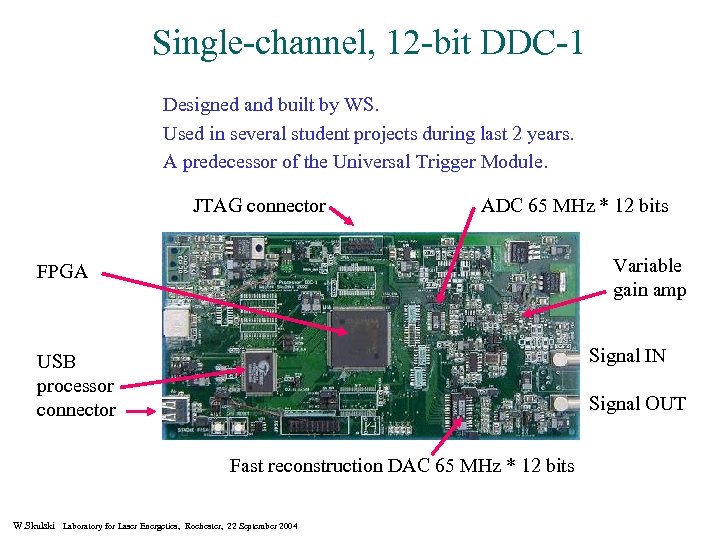
Single-channel, 12 -bit DDC-1 Designed and built by WS. Used in several student projects during last 2 years. A predecessor of the Universal Trigger Module. JTAG connector ADC 65 MHz * 12 bits Variable gain amp FPGA Signal IN USB processor connector Signal OUT Fast reconstruction DAC 65 MHz * 12 bits W. Skulski Laboratory for Laser Energetics, Rochester, 22 September 2004
Education and R&D projects at Physics and Astronomy • S. Zuberi, Digital Signal Processing of Scintillator Pulses in Nuclear Physics Techniques, Senior Thesis, Department of Physics and Astronomy, University of Rochester. Presented at Spring APS meeting, April 2003, Philadelphia, PA. • Awarded the Stoddard prize for the best Senior Thesis in the Department. • D. Miner, W. Skulski, F. Wolfs, Detection and Analysis of Stopping Muons Using a Compact Digital Pulse Processor, Summer Research Experience for Undergraduates, Department of Physics and Astronomy, University of Rochester 2003 (unpublished). • P. Bharadwaj, Digital and analog signal processing techniques for low-background measurements, summer project 2004. • F. Wolfs, W. Skulski, (Uof. R), Ian Harnarine, E. Garcia, D. Hofman (UIC), Developing an efficient triggering system for PHOBOS at RHIC, ongoing. W. Skulski Laboratory for Laser Energetics, Rochester, 22 September 2004
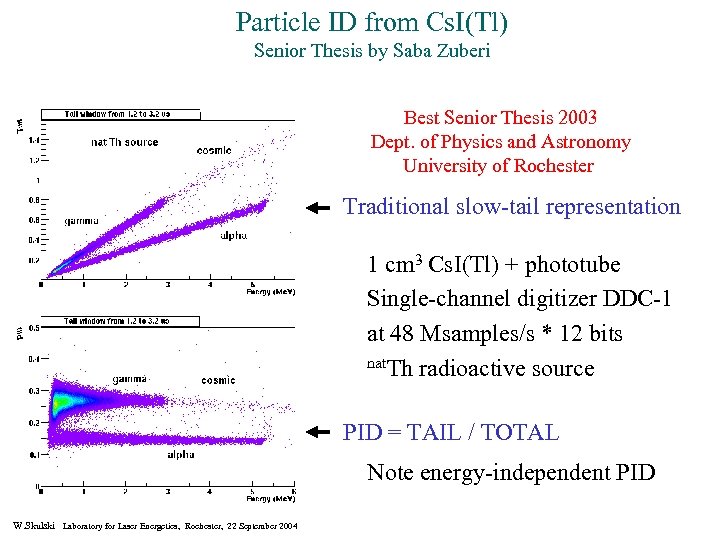
Particle ID from Cs. I(Tl) Senior Thesis by Saba Zuberi Best Senior Thesis 2003 Dept. of Physics and Astronomy University of Rochester Traditional slow-tail representation 1 cm 3 Cs. I(Tl) + phototube Single-channel digitizer DDC-1 at 48 Msamples/s * 12 bits nat. Th radioactive source PID = TAIL / TOTAL Note energy-independent PID W. Skulski Laboratory for Laser Energetics, Rochester, 22 September 2004
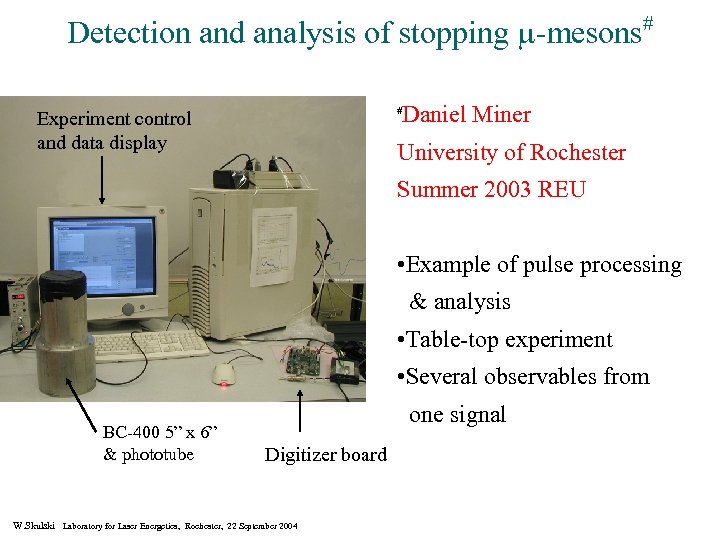
Detection and analysis of stopping m-mesons# Daniel Miner # Experiment control and data display University of Rochester Summer 2003 REU • Example of pulse processing & analysis • Table-top experiment • Several observables from BC-400 5” x 6” & phototube one signal Digitizer board W. Skulski Laboratory for Laser Energetics, Rochester, 22 September 2004
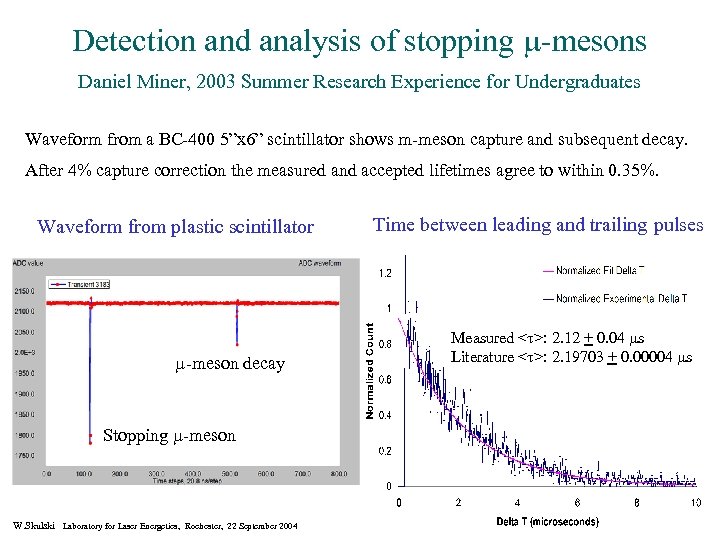
Detection and analysis of stopping m-mesons Daniel Miner, 2003 Summer Research Experience for Undergraduates Waveform from a BC-400 5”x 6” scintillator shows m-meson capture and subsequent decay. After 4% capture correction the measured and accepted lifetimes agree to within 0. 35%. Waveform from plastic scintillator m-meson decay Stopping m-meson W. Skulski Laboratory for Laser Energetics, Rochester, 22 September 2004 Time between leading and trailing pulses Measured <t>: 2. 12 + 0. 04 ms Literature <t>: 2. 19703 + 0. 00004 ms
Electronics for Dark Matter Search W. Skulski Laboratory for Laser Energetics, Rochester, 22 September 2004
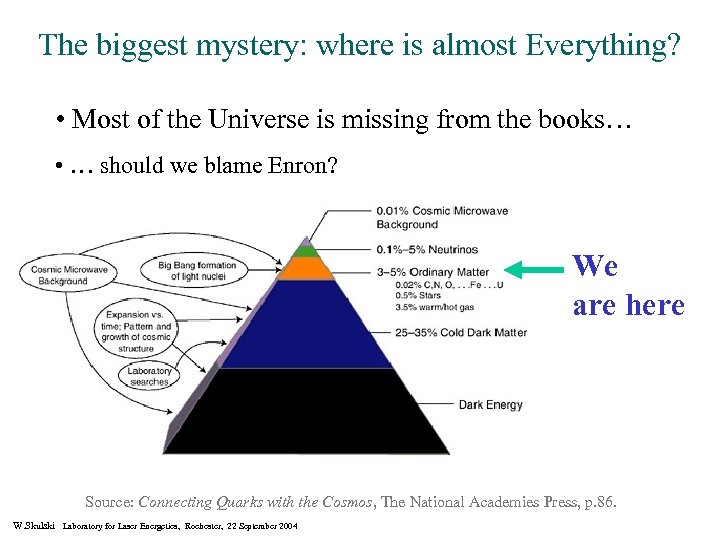
The biggest mystery: where is almost Everything? • Most of the Universe is missing from the books… • … should we blame Enron? We are here Source: Connecting Quarks with the Cosmos, The National Academies Press, p. 86. W. Skulski Laboratory for Laser Energetics, Rochester, 22 September 2004
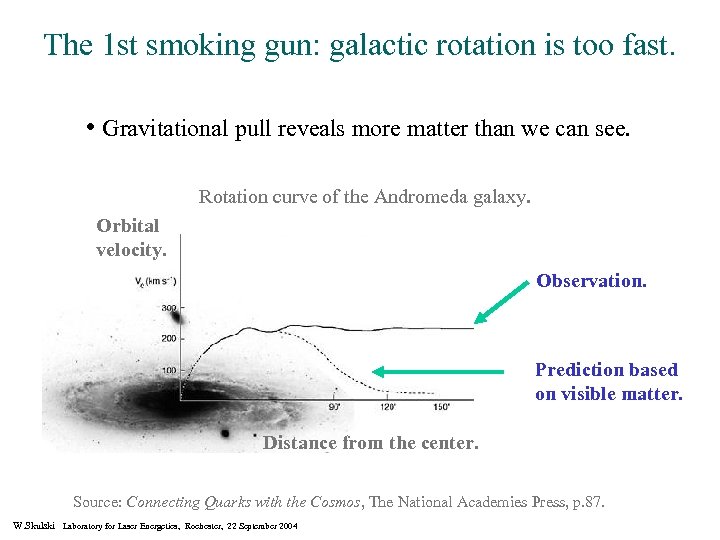
The 1 st smoking gun: galactic rotation is too fast. • Gravitational pull reveals more matter than we can see. Rotation curve of the Andromeda galaxy. Orbital velocity. Observation. Prediction based on visible matter. Distance from the center. Source: Connecting Quarks with the Cosmos, The National Academies Press, p. 87. W. Skulski Laboratory for Laser Energetics, Rochester, 22 September 2004
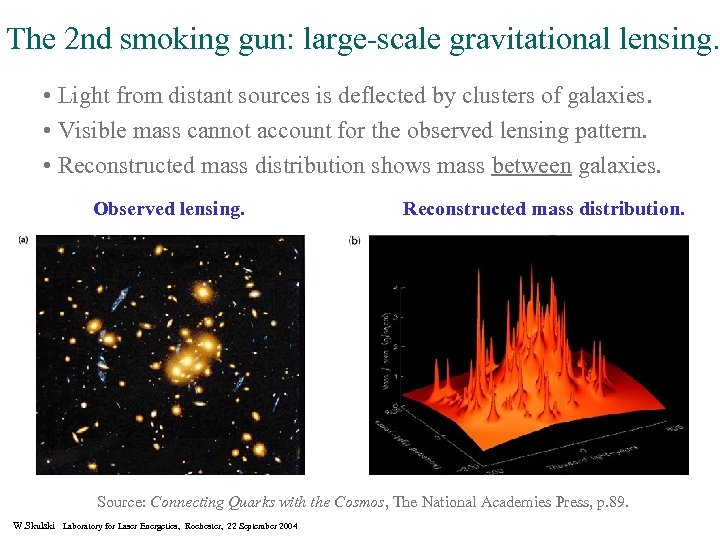
The 2 nd smoking gun: large-scale gravitational lensing. • Light from distant sources is deflected by clusters of galaxies. • Visible mass cannot account for the observed lensing pattern. • Reconstructed mass distribution shows mass between galaxies. Observed lensing. Reconstructed mass distribution. Source: Connecting Quarks with the Cosmos, The National Academies Press, p. 89. W. Skulski Laboratory for Laser Energetics, Rochester, 22 September 2004
Who are the suspects? How to find them? • Nobody knows, but there are candidates predicted by theory … • Axions: light particles that may explain CP violation. • Neutralinos: heavy particles predicted by SUSY. • We focus on the latter. • The neutralino is neutral, weakly interacting, and as massive as an atom of gold. • Occasionally it will bounce off an ordinary nucleus and produce some ionization. • We will wait for the occasion at Boulby mine in the UK. • We will use a two-phase liquid xenon detector named Zeplin. W. Skulski Laboratory for Laser Energetics, Rochester, 22 September 2004
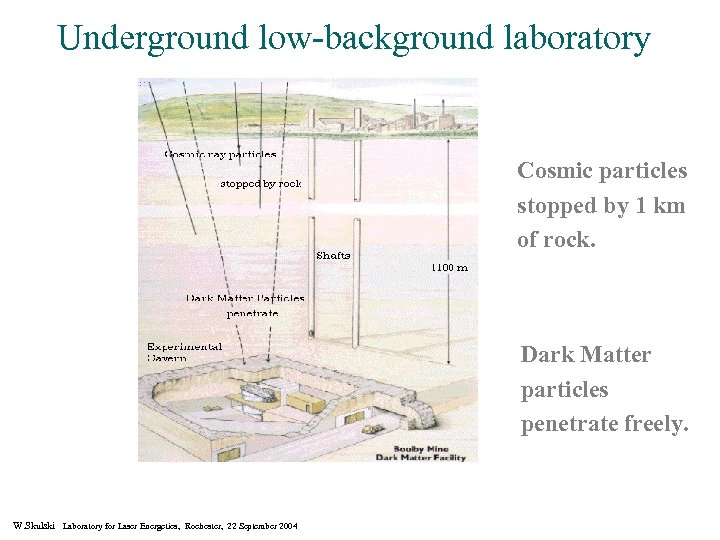
Underground low-background laboratory Cosmic particles stopped by 1 km of rock. Dark Matter particles penetrate freely. W. Skulski Laboratory for Laser Energetics, Rochester, 22 September 2004
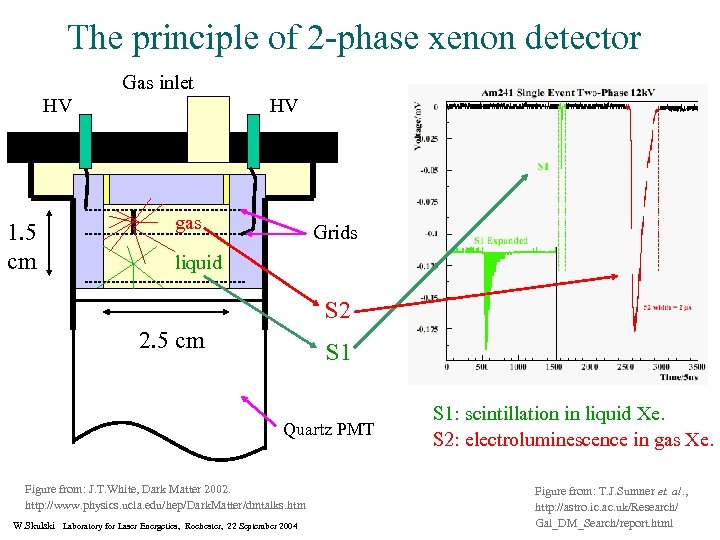
The principle of 2 -phase xenon detector Gas inlet HV 1. 5 cm HV gas Grids liquid S 2 2. 5 cm S 1 Quartz PMT Figure from: J. T. White, Dark Matter 2002. http: //www. physics. ucla. edu/hep/Dark. Matter/dmtalks. htm W. Skulski Laboratory for Laser Energetics, Rochester, 22 September 2004 S 1: scintillation in liquid Xe. S 2: electroluminescence in gas Xe. Figure from: T. J. Sumner et. al. , http: //astro. ic. ac. uk/Research/ Gal_DM_Search/report. html
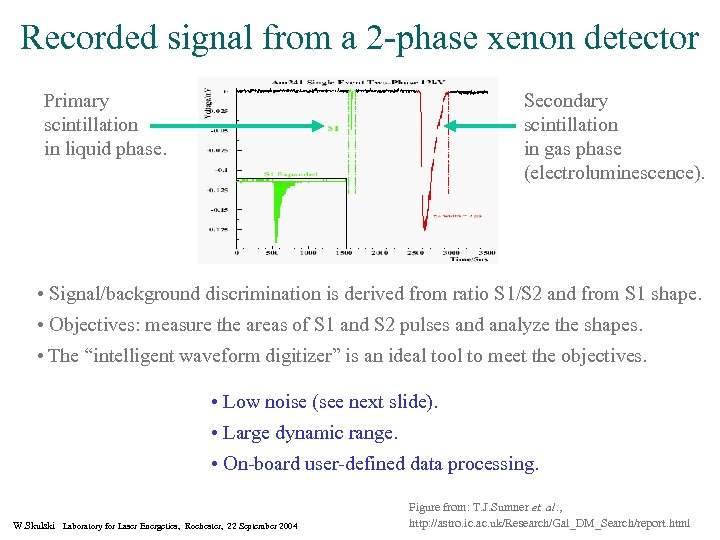
Recorded signal from a 2 -phase xenon detector Primary scintillation in liquid phase. Secondary scintillation in gas phase (electroluminescence). • Signal/background discrimination is derived from ratio S 1/S 2 and from S 1 shape. • Objectives: measure the areas of S 1 and S 2 pulses and analyze the shapes. • The “intelligent waveform digitizer” is an ideal tool to meet the objectives. • Low noise (see next slide). • Large dynamic range. • On-board user-defined data processing. W. Skulski Laboratory for Laser Energetics, Rochester, 22 September 2004 Figure from: T. J. Sumner et. al. , http: //astro. ic. ac. uk/Research/Gal_DM_Search/report. html
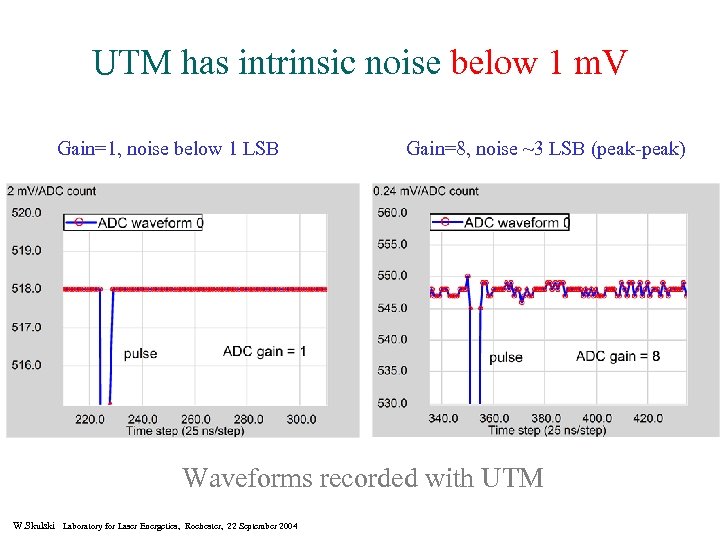
UTM has intrinsic noise below 1 m. V Gain=1, noise below 1 LSB Gain=8, noise ~3 LSB (peak-peak) Waveforms recorded with UTM W. Skulski Laboratory for Laser Energetics, Rochester, 22 September 2004
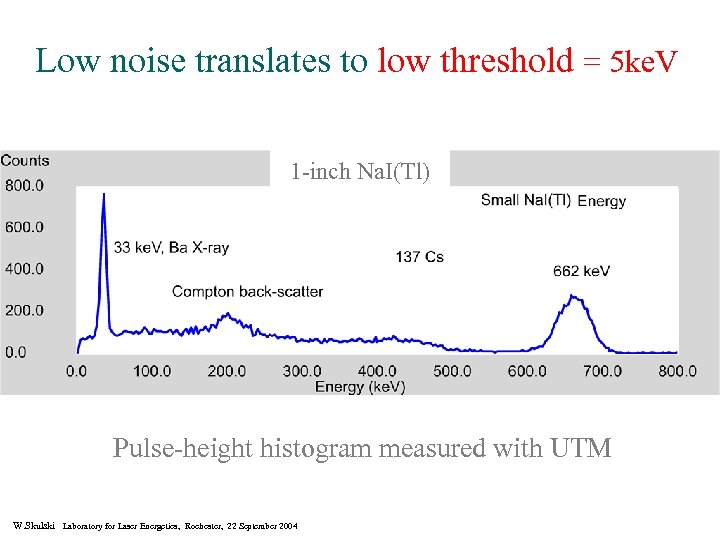
Low noise translates to low threshold = 5 ke. V 1 -inch Na. I(Tl) Pulse-height histogram measured with UTM W. Skulski Laboratory for Laser Energetics, Rochester, 22 September 2004
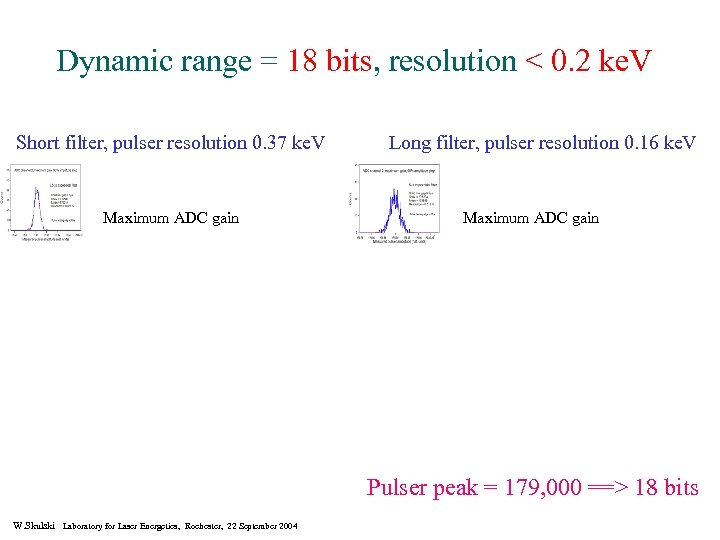
Dynamic range = 18 bits, resolution < 0. 2 ke. V Short filter, pulser resolution 0. 37 ke. V Maximum ADC gain Long filter, pulser resolution 0. 16 ke. V Maximum ADC gain Pulser peak = 179, 000 ==> 18 bits W. Skulski Laboratory for Laser Energetics, Rochester, 22 September 2004
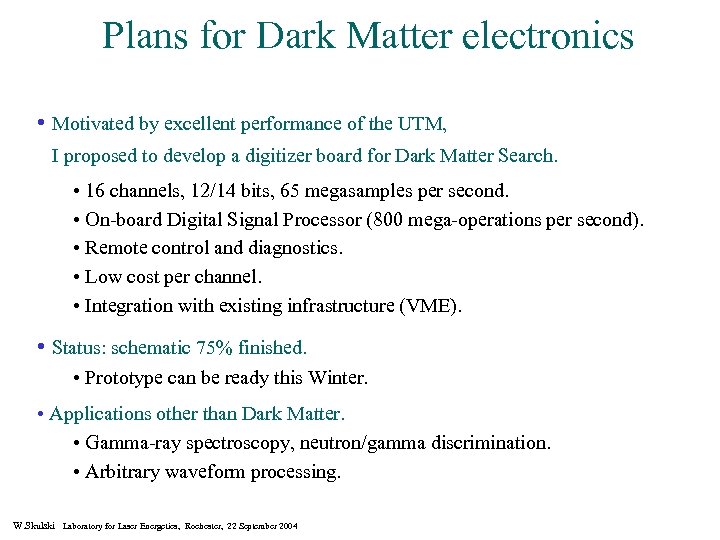
Plans for Dark Matter electronics • Motivated by excellent performance of the UTM, I proposed to develop a digitizer board for Dark Matter Search. • 16 channels, 12/14 bits, 65 megasamples per second. • On-board Digital Signal Processor (800 mega-operations per second). • Remote control and diagnostics. • Low cost per channel. • Integration with existing infrastructure (VME). • Status: schematic 75% finished. • Prototype can be ready this Winter. • Applications other than Dark Matter. • Gamma-ray spectroscopy, neutron/gamma discrimination. • Arbitrary waveform processing. W. Skulski Laboratory for Laser Energetics, Rochester, 22 September 2004
Tiled Grating Assembly at LLE W. Skulski Laboratory for Laser Energetics, Rochester, 22 September 2004
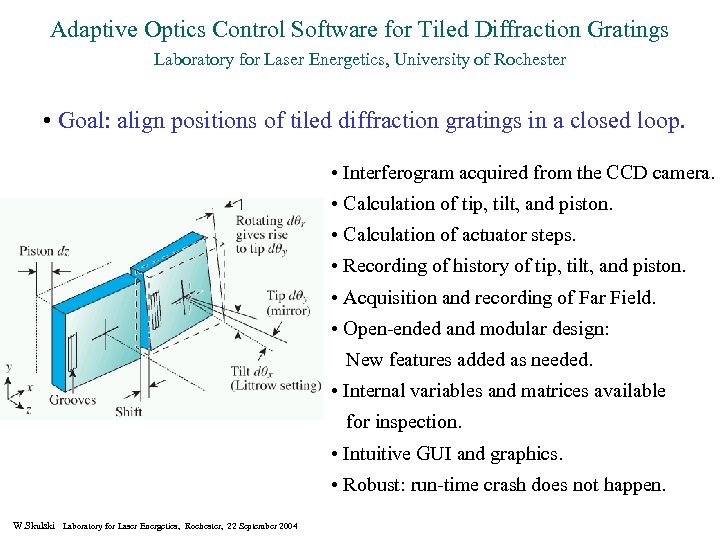
Adaptive Optics Control Software for Tiled Diffraction Gratings Laboratory for Laser Energetics, University of Rochester • Goal: align positions of tiled diffraction gratings in a closed loop. • Interferogram acquired from the CCD camera. • Calculation of tip, tilt, and piston. • Calculation of actuator steps. • Recording of history of tip, tilt, and piston. • Acquisition and recording of Far Field. • Open-ended and modular design: New features added as needed. • Internal variables and matrices available for inspection. • Intuitive GUI and graphics. • Robust: run-time crash does not happen. W. Skulski Laboratory for Laser Energetics, Rochester, 22 September 2004
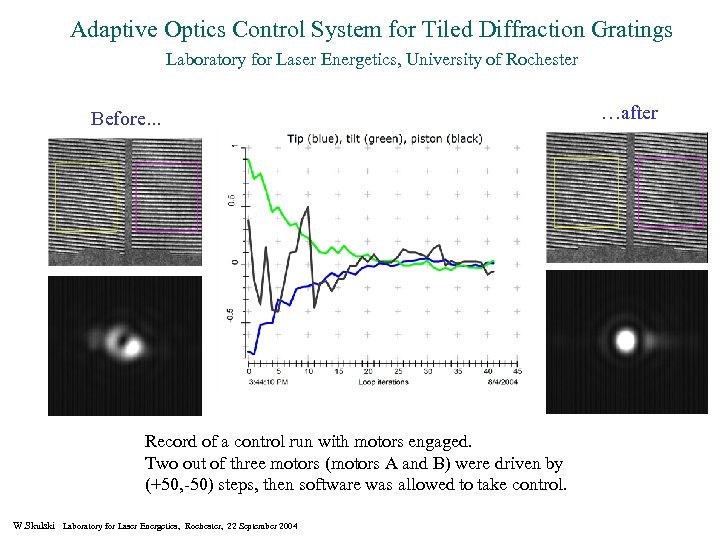
Adaptive Optics Control System for Tiled Diffraction Gratings Laboratory for Laser Energetics, University of Rochester Before. . . Record of a control run with motors engaged. Two out of three motors (motors A and B) were driven by (+50, -50) steps, then software was allowed to take control. W. Skulski Laboratory for Laser Energetics, Rochester, 22 September 2004 …after
Summary • Development of TGA software at LLE has been a success. Software is intuitive, open-ended, and robust. • Electronics development required all of the following: • Schematic design, board layout and board assembly. • Hardware testing and debugging. • Software for embedded microcontroller. • Firmware for on-board FPGA. • GUI design and programming. • Time Equalizers are being used in a mission-critical application. • Waveform digitizers are under development for PHOBOS, Dark Matter Search, in-beam spectroscopy, and other demanding applications. • Several student projects and table-top experiments were completed. W. Skulski Laboratory for Laser Energetics, Rochester, 22 September 2004
Possible applications at LLE • Software: control and data processing systems that are robust, open-ended, and graphically rich. • Time Equalizer: accurate alignment of fast timing pulses. • Waveform digitizers and digital signal processors. Their function is defined by embedded firmware and software (FPGA and DSP). • Pulse-height spectroscopy. • Pulse shape analysis. • Particle discrimination (e. g. , gamma/neutron). • Real-time processing of arbitrary waveforms. • User-defined data acquisition and processing. W. Skulski Laboratory for Laser Energetics, Rochester, 22 September 2004
Acknowledgements • Sku. Tek Instrumentation. • Joanna Klima, WS (Principal Investigator for electronics). • University of Rochester. • Frank Wolfs, Ray Teng, Tom Ferbel (Physics), Jan Toke (Chemistry). • Joachim Bunkenburg, Larry Iwan, Terry Kessler, Charles Kellogg, Conor Kelly, Matthew Swain (LLE). • Robert Campbell (BAE Systems). • Wolfgang Weck and Cuno Pfister (Oberon Microsystems). • PHOBOS Collaboration. • Students. • Erik Johnson, Nazim Khan, Suzanne Levine, Daniel Miner, Len Zheleznyak, Saba Zuberi, Palash Bharadwaj. • My work was supported by grants from NSF and DOE. W. Skulski Laboratory for Laser Energetics, Rochester, 22 September 2004
Скачать презентацию From picoseconds to galaxies Building electronics for Relativistic
4963ee932a32a9842255529cb865b715.ppt