 Скачать презентацию From Physics to Optoelectronics Technology Alexey Belyanin TAMU-Physics
d874410120277698f61ff249814af2de.ppt
- Количество слайдов: 49



From Physics to Optoelectronics Technology Alexey Belyanin TAMU-Physics
Physics in the Information Age Transistor Laser Computer World Wide Web … Are all invented by physicists
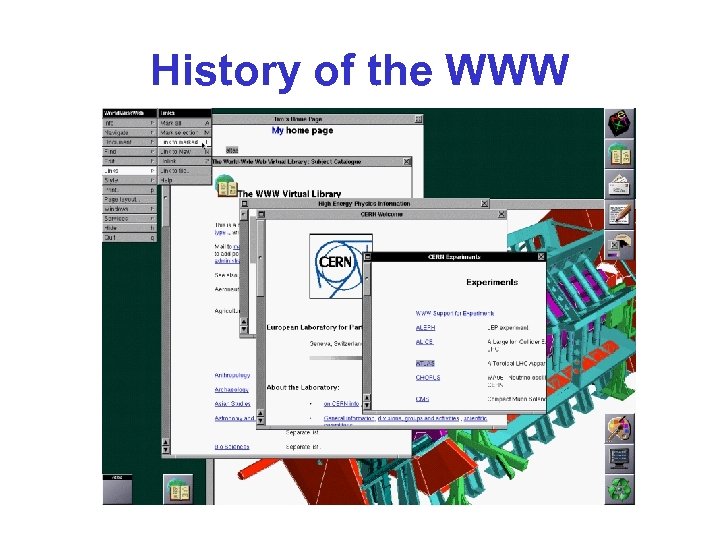
History of the WWW
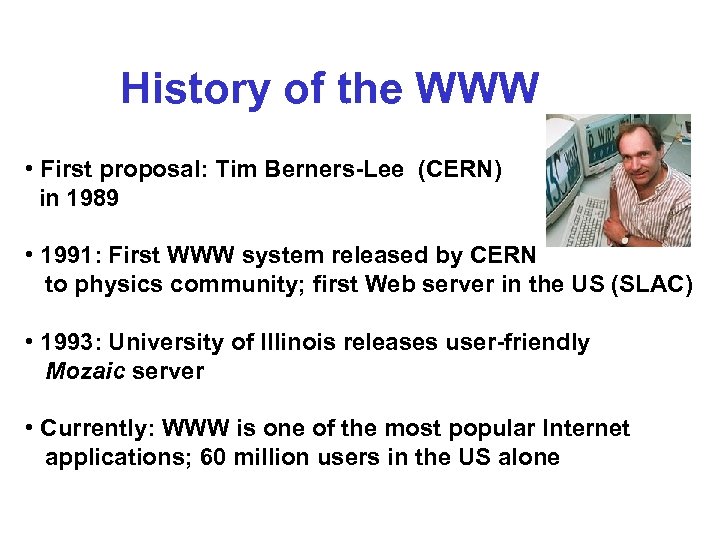
History of the WWW • First proposal: Tim Berners-Lee (CERN) in 1989 • 1991: First WWW system released by CERN to physics community; first Web server in the US (SLAC) • 1993: University of Illinois releases user-friendly Mozaic server • Currently: WWW is one of the most popular Internet applications; 60 million users in the US alone
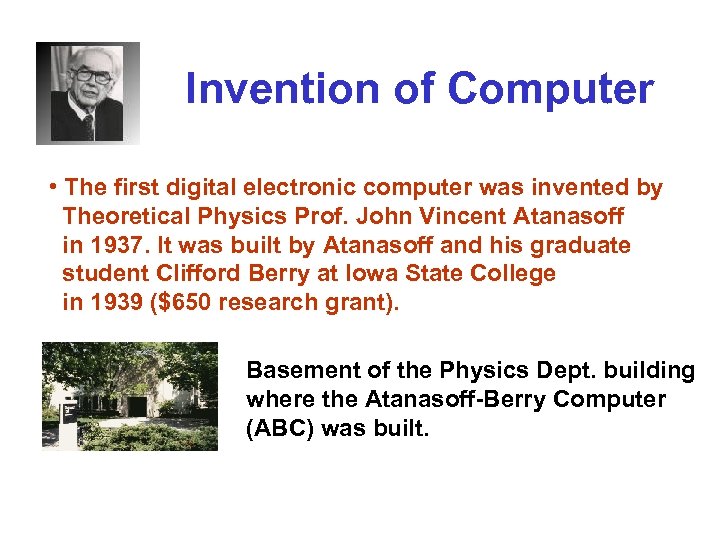
Invention of Computer • The first digital electronic computer was invented by Theoretical Physics Prof. John Vincent Atanasoff in 1937. It was built by Atanasoff and his graduate student Clifford Berry at Iowa State College in 1939 ($650 research grant). Basement of the Physics Dept. building where the Atanasoff-Berry Computer (ABC) was built.
ABC • Used base-two numbers (the binary system) - all other experimental systems at the time used base-ten • Used electricity and electronics as it's principal media • Used condensers for memory and used a regenerative process to avoid lapses that could occur from leakage of power • Computed by direct logical action rather than by the enumeration methods used in analog calculators Implemented principles of modern computers Only material base has been changed.
From ABC to ENIAC • 1940 s: J. Mauchly and J. Eckert build ENIAC (Electronic Numerical Integrator And Computer). All basic concepts and principles of ENIAC are “borrowed” from Atanasoff’s papers. • 1972: U. S. Court voids the Honeywell’s patent on the computing principles and ENIAC, saying that it had been “derived” from Atanasoff’s invention. • 1990: Atanasoff receives the U. S. National Medal of Technology. He dies in 1995 at the age of 91.
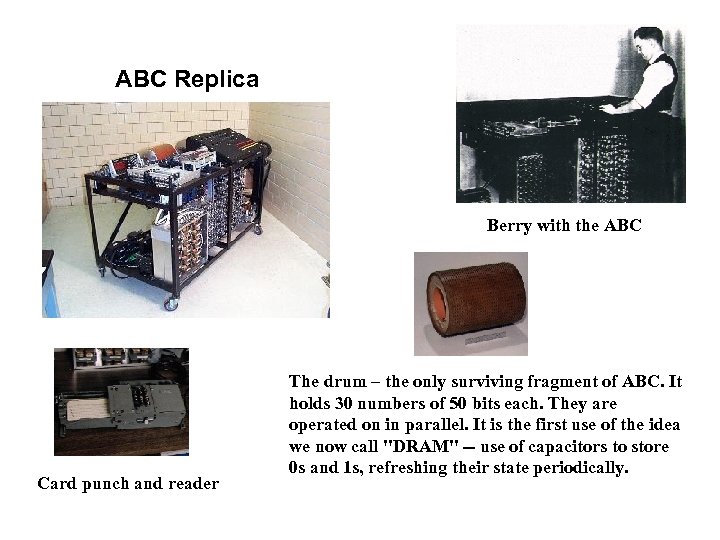
ABC Replica Berry with the ABC Card punch and reader The drum – the only surviving fragment of ABC. It holds 30 numbers of 50 bits each. They are operated on in parallel. It is the first use of the idea we now call "DRAM" -- use of capacitors to store 0 s and 1 s, refreshing their state periodically.
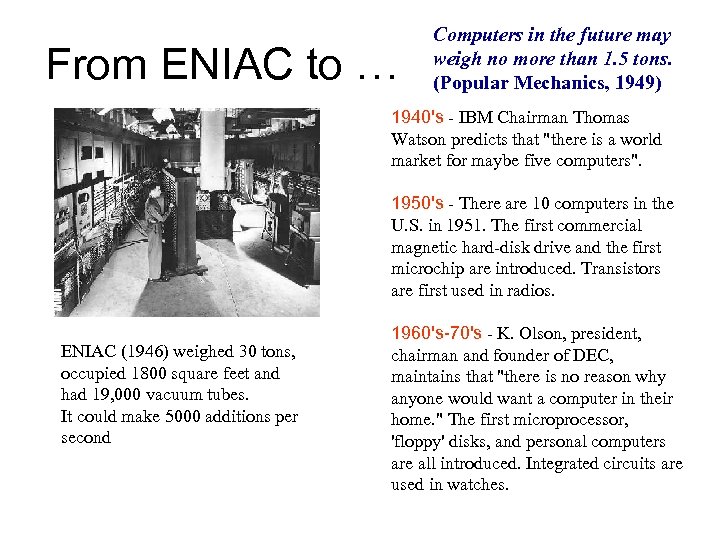
From ENIAC to … Computers in the future may weigh no more than 1. 5 tons. (Popular Mechanics, 1949) 1940's - IBM Chairman Thomas Watson predicts that "there is a world market for maybe five computers". 1950's - There are 10 computers in the U. S. in 1951. The first commercial magnetic hard-disk drive and the first microchip are introduced. Transistors are first used in radios. ENIAC (1946) weighed 30 tons, occupied 1800 square feet and had 19, 000 vacuum tubes. It could make 5000 additions per second 1960's-70's - K. Olson, president, chairman and founder of DEC, maintains that "there is no reason why anyone would want a computer in their home. " The first microprocessor, 'floppy' disks, and personal computers are all introduced. Integrated circuits are used in watches.
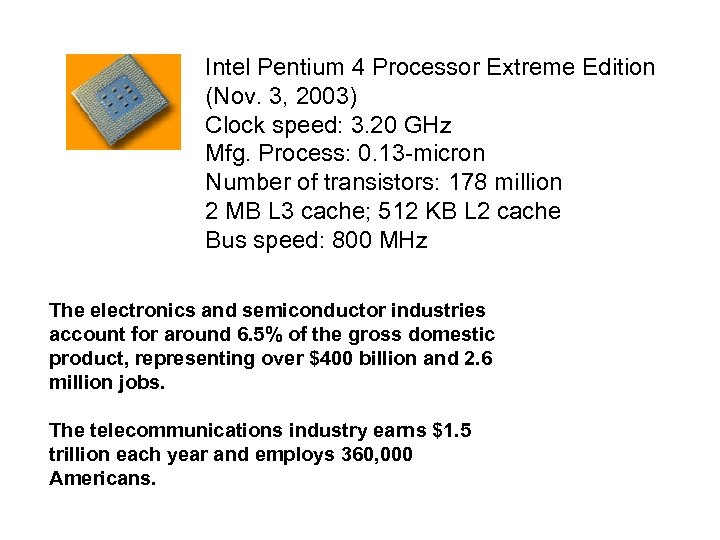
Intel Pentium 4 Processor Extreme Edition (Nov. 3, 2003) Clock speed: 3. 20 GHz Mfg. Process: 0. 13 -micron Number of transistors: 178 million 2 MB L 3 cache; 512 KB L 2 cache Bus speed: 800 MHz The electronics and semiconductor industries account for around 6. 5% of the gross domestic product, representing over $400 billion and 2. 6 million jobs. The telecommunications industry earns $1. 5 trillion each year and employs 360, 000 Americans.
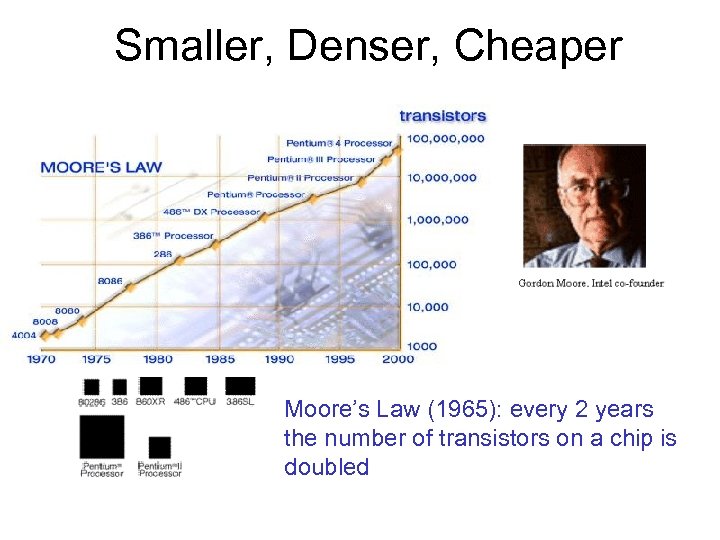
Smaller, Denser, Cheaper Moore’s Law (1965): every 2 years the number of transistors on a chip is doubled
Pushing Fundamental Limits: Challenges and Bottlenecks § Semiconductors: how small the transistor can be? § Memory and data storage: limits on writing density? § Communications: limits on data rate?
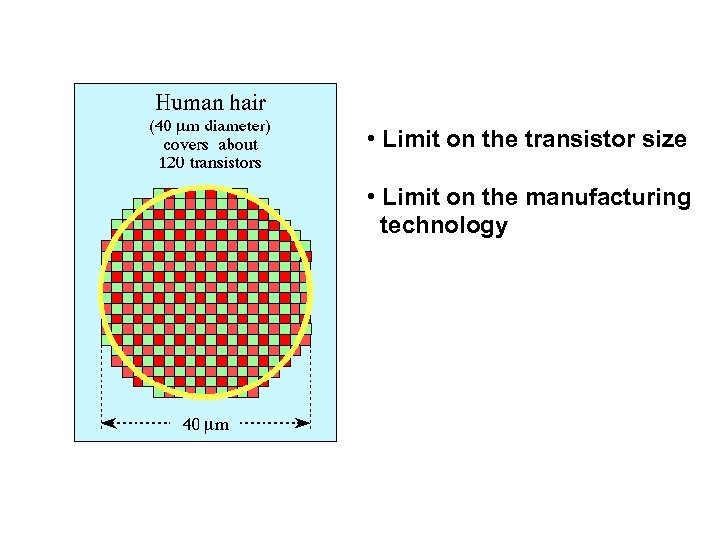
• Limit on the transistor size • Limit on the manufacturing technology
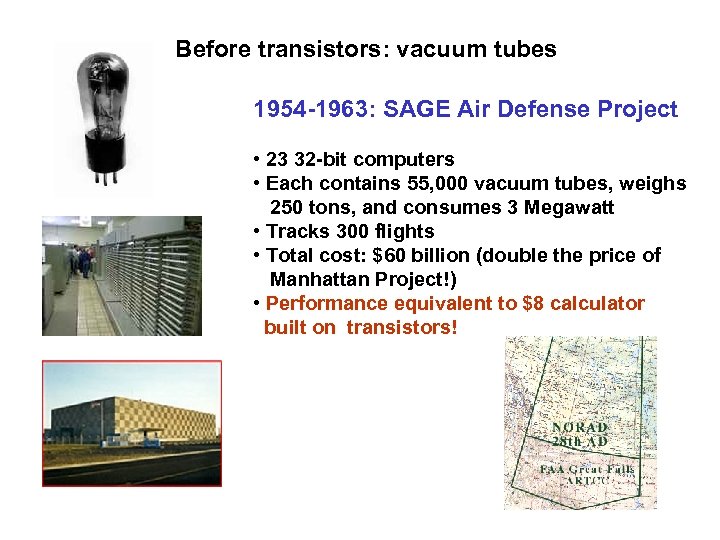
Before transistors: vacuum tubes 1954 -1963: SAGE Air Defense Project • 23 32 -bit computers • Each contains 55, 000 vacuum tubes, weighs 250 tons, and consumes 3 Megawatt • Tracks 300 flights • Total cost: $60 billion (double the price of Manhattan Project!) • Performance equivalent to $8 calculator built on transistors!
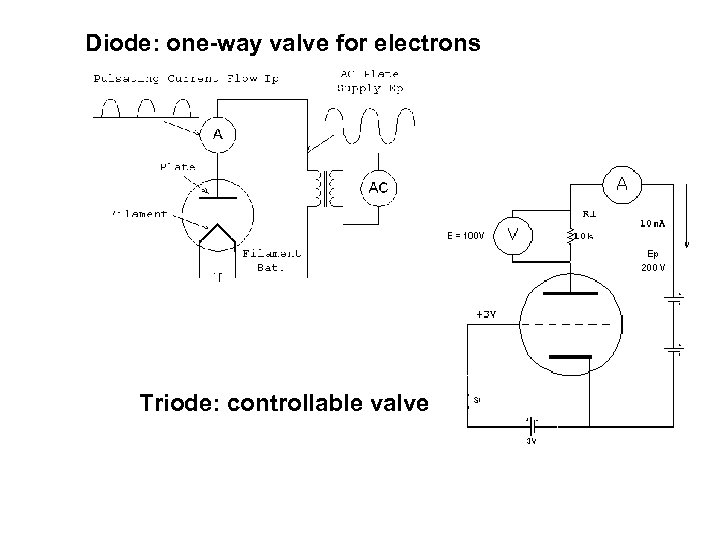
Diode: one-way valve for electrons Triode: controllable valve
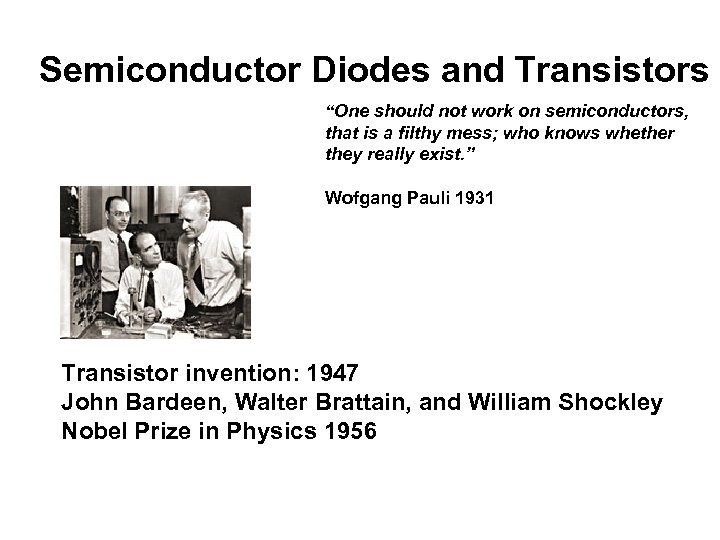
Semiconductor Diodes and Transistors “One should not work on semiconductors, that is a filthy mess; who knows whether they really exist. ” Wofgang Pauli 1931 Transistor invention: 1947 John Bardeen, Walter Brattain, and William Shockley Nobel Prize in Physics 1956
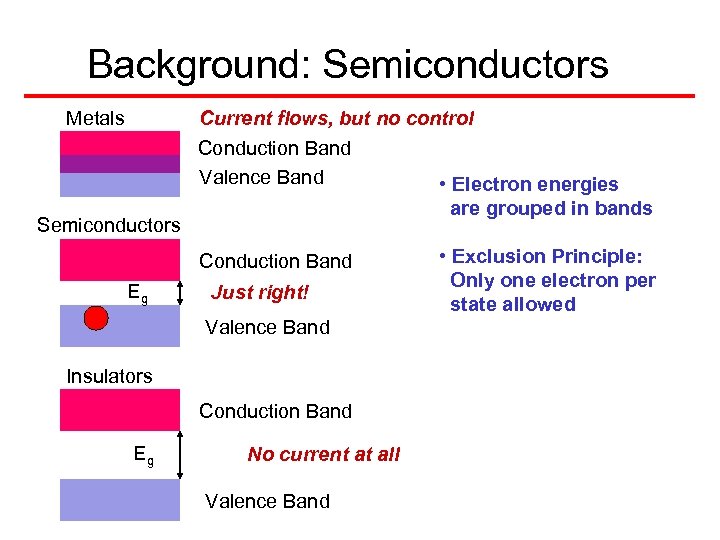
Background: Semiconductors Current flows, but no control Metals Conduction Band Valence Band Semiconductors Conduction Band Eg Just right! Valence Band Insulators Conduction Band Eg No current at all Valence Band • Electron energies are grouped in bands • Exclusion Principle: Only one electron per state allowed
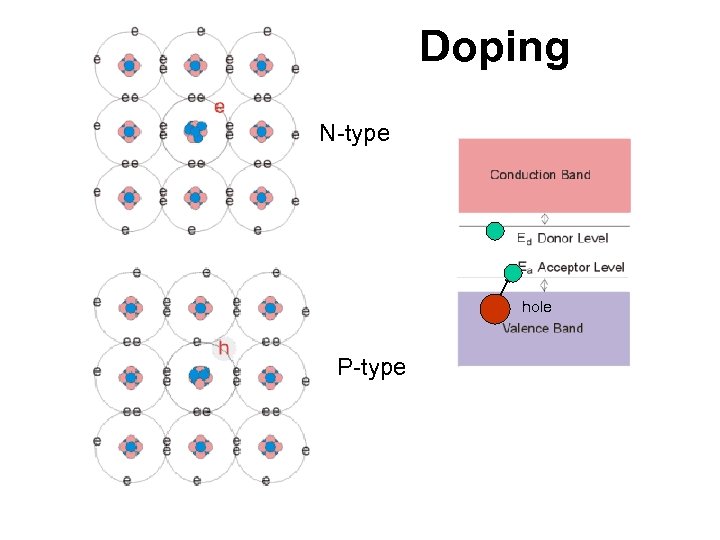
Doping N-type hole P-type
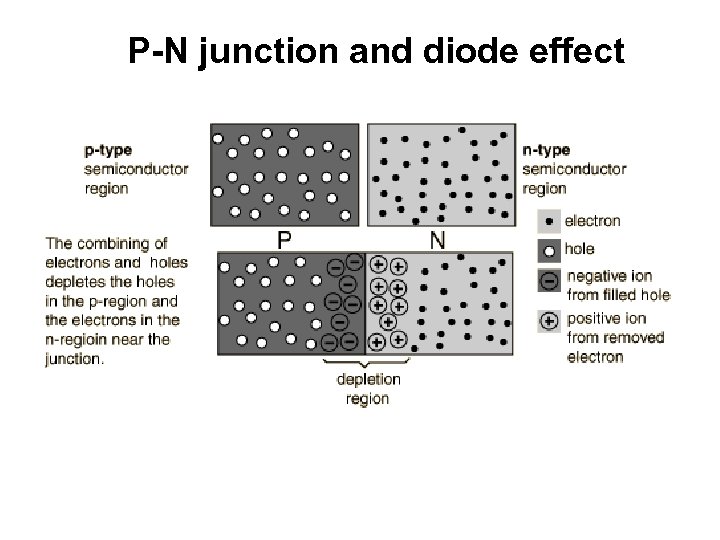
P-N junction and diode effect
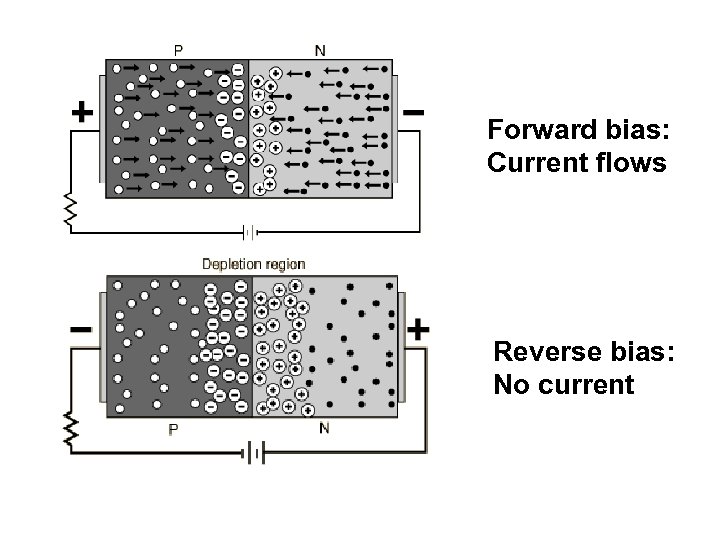
Forward bias: Current flows Reverse bias: No current
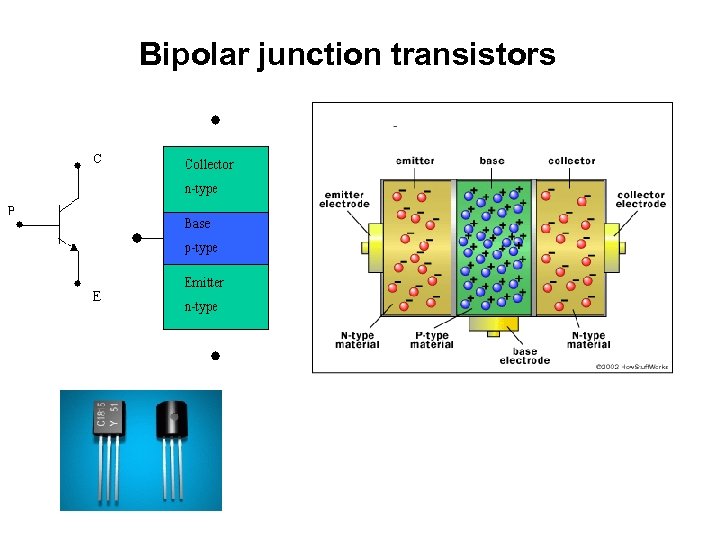
Bipolar junction transistors
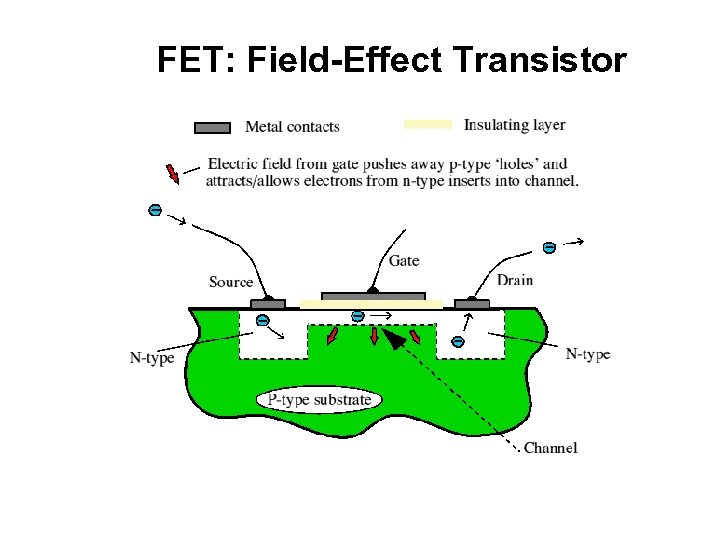
FET: Field-Effect Transistor
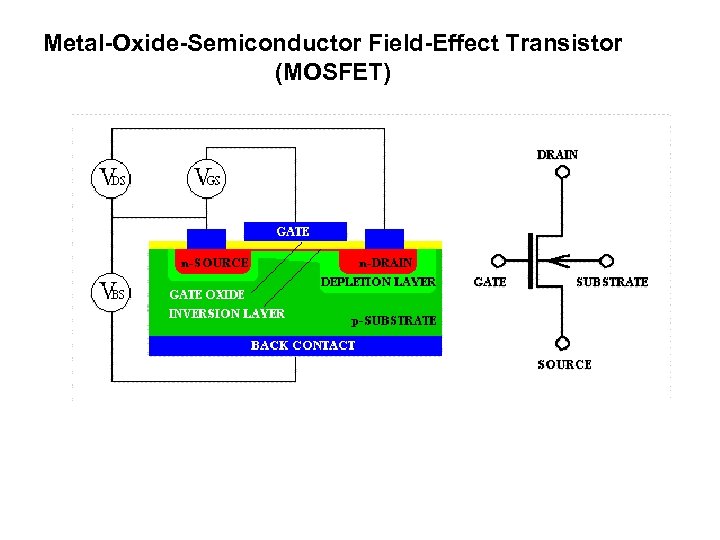
Metal-Oxide-Semiconductor Field-Effect Transistor (MOSFET)
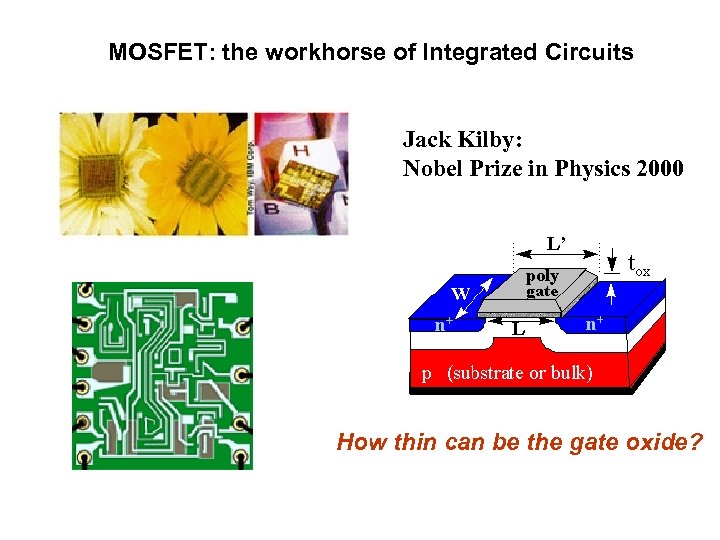
MOSFET: the workhorse of Integrated Circuits Jack Kilby: Nobel Prize in Physics 2000 How thin can be the gate oxide?
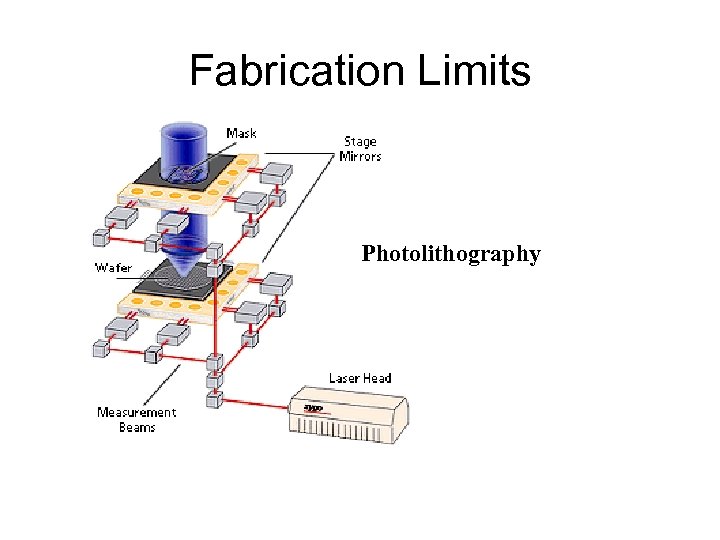
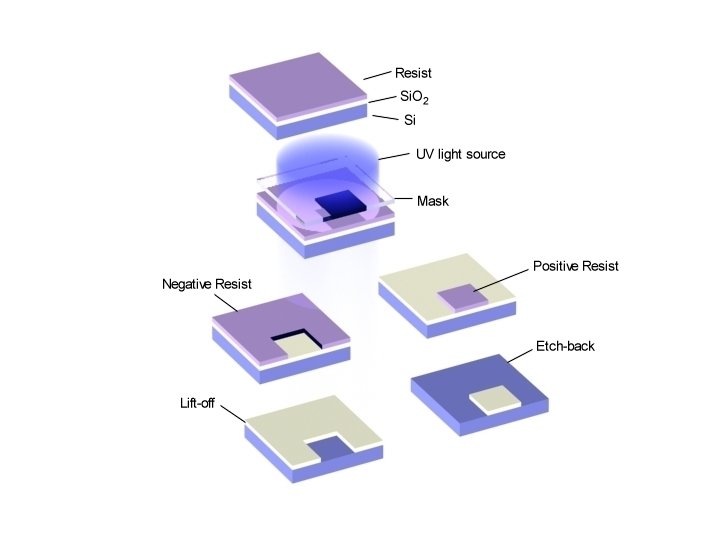
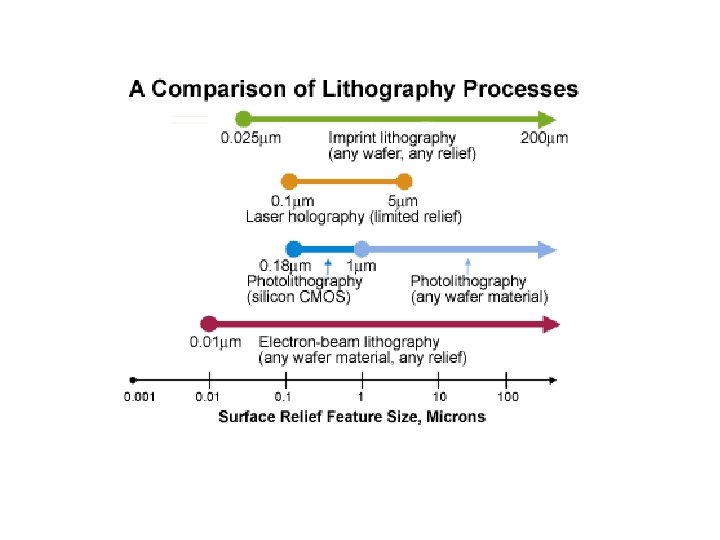
Fabrication Limits Photolithography
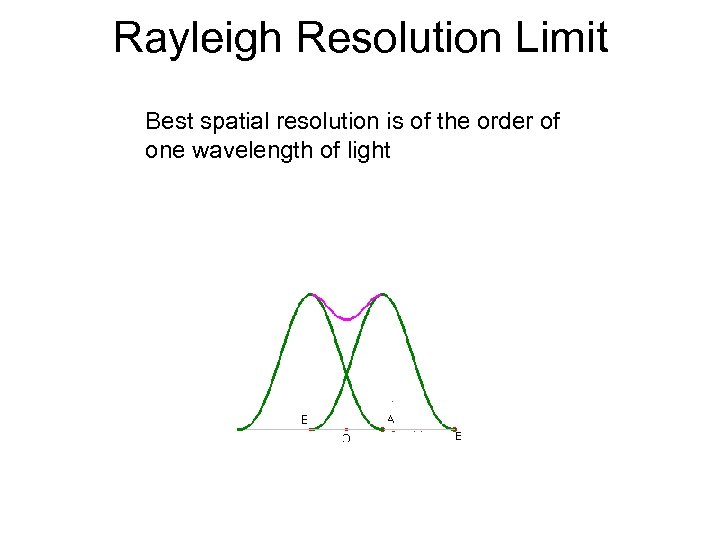
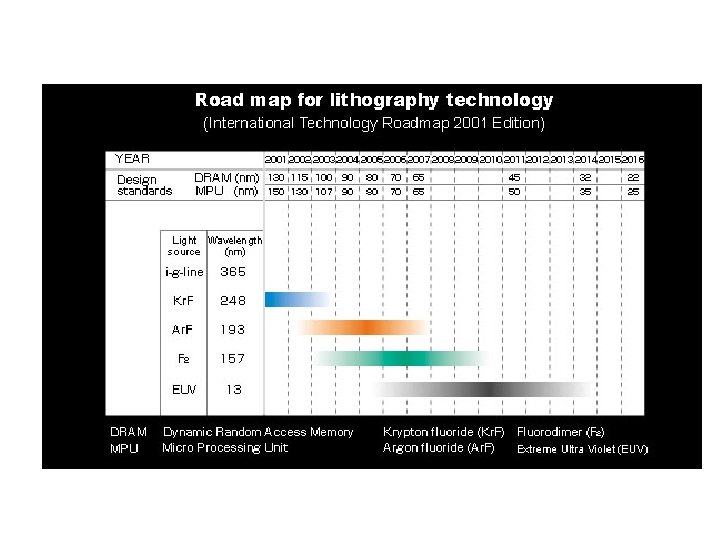
Rayleigh Resolution Limit Best spatial resolution is of the order of one wavelength of light
Telecommunications
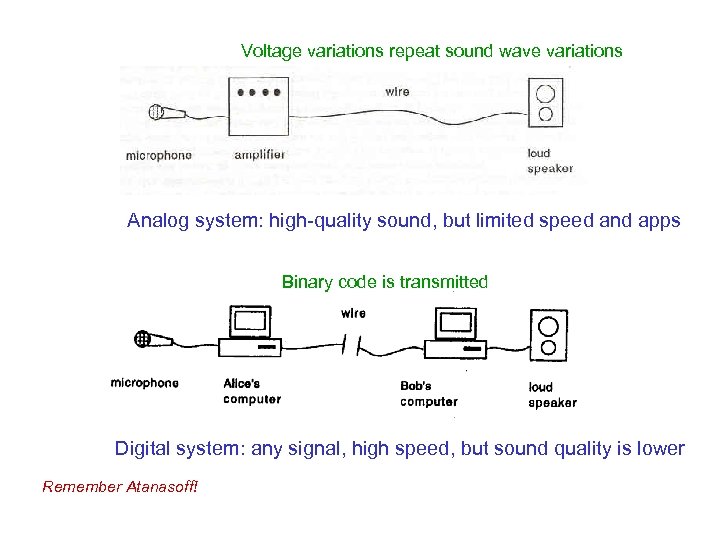
Voltage variations repeat sound wave variations Analog system: high-quality sound, but limited speed and apps Binary code is transmitted Digital system: any signal, high speed, but sound quality is lower Remember Atanasoff!
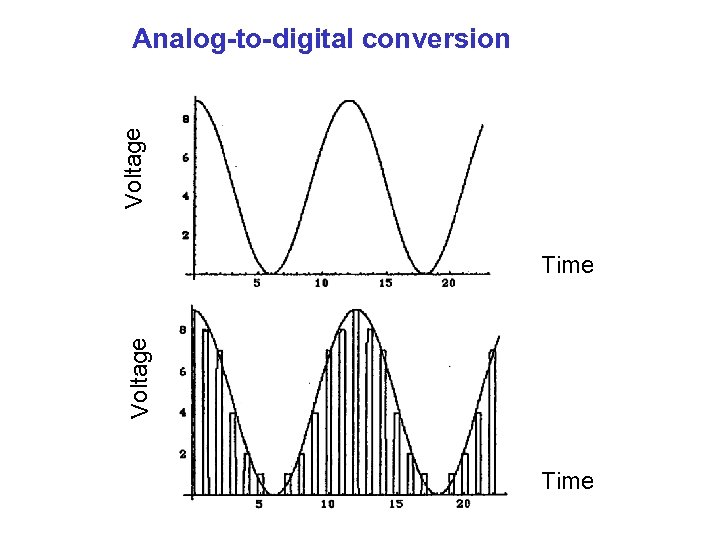
Voltage Analog-to-digital conversion Voltage Time
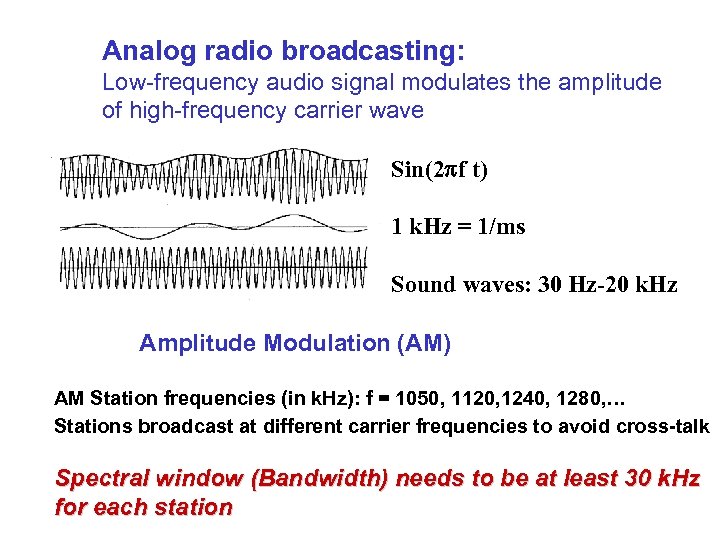
Analog radio broadcasting: Low-frequency audio signal modulates the amplitude of high-frequency carrier wave Sin(2 f t) 1 k. Hz = 1/ms Sound waves: 30 Hz-20 k. Hz Amplitude Modulation (AM) AM Station frequencies (in k. Hz): f = 1050, 1120, 1240, 1280, … Stations broadcast at different carrier frequencies to avoid cross-talk Spectral window (Bandwidth) needs to be at least 30 k. Hz for each station
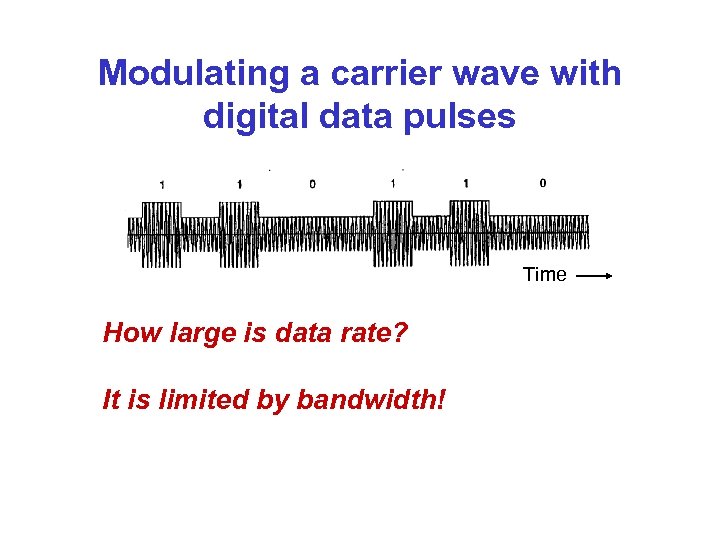
Modulating a carrier wave with digital data pulses Time How large is data rate? It is limited by bandwidth!
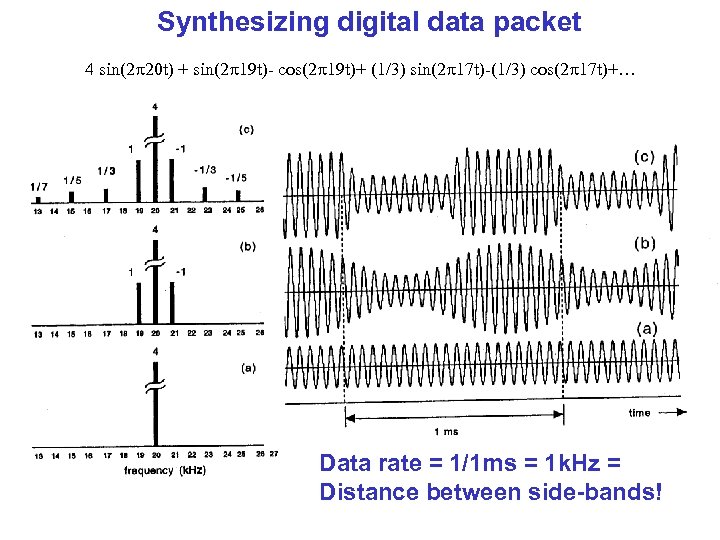
Synthesizing digital data packet 4 sin(2 20 t) + sin(2 19 t)- cos(2 19 t)+ (1/3) sin(2 17 t)-(1/3) cos(2 17 t)+… Data rate = 1/1 ms = 1 k. Hz = Distance between side-bands!
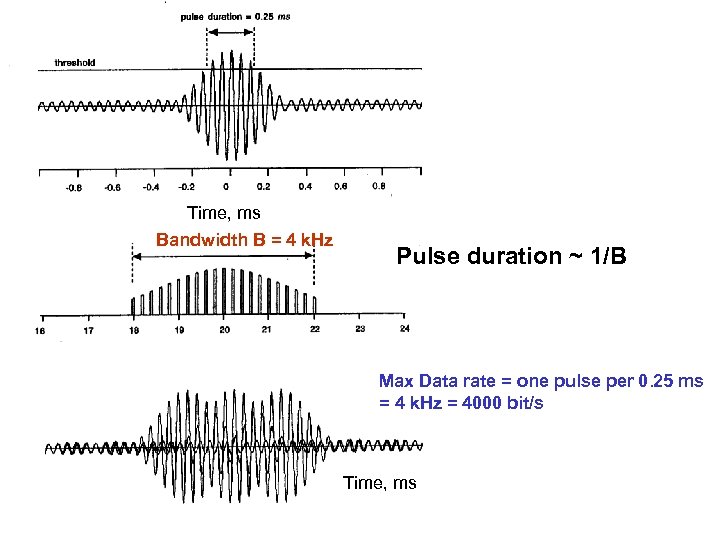
Time, ms Bandwidth B = 4 k. Hz Pulse duration ~ 1/B Frequency, k. Hz Max Data rate = one pulse per 0. 25 ms = 4 k. Hz = 4000 bit/s Time, ms
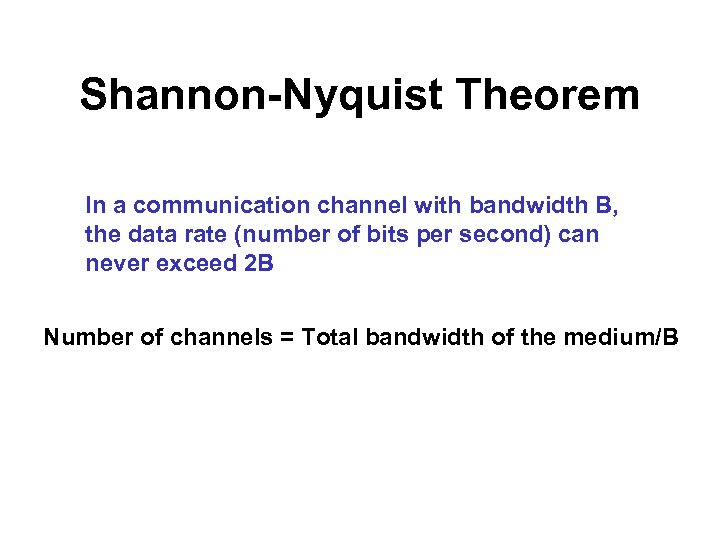
Shannon-Nyquist Theorem In a communication channel with bandwidth B, the data rate (number of bits per second) can never exceed 2 B Number of channels = Total bandwidth of the medium/B
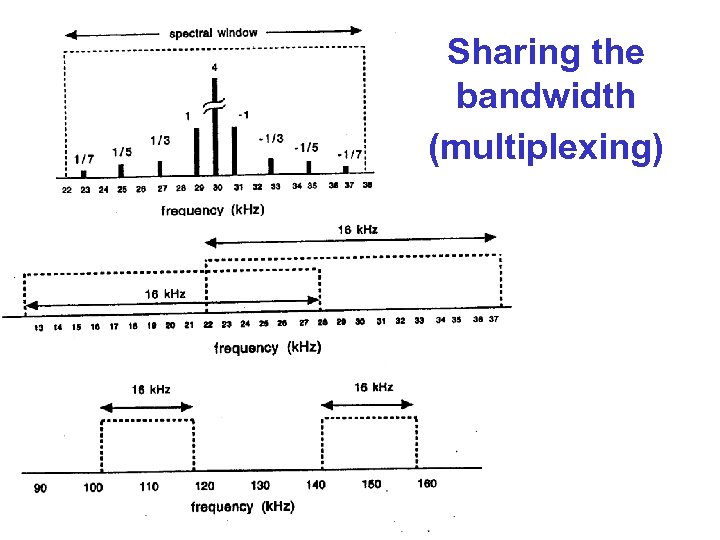
Sharing the bandwidth (multiplexing)
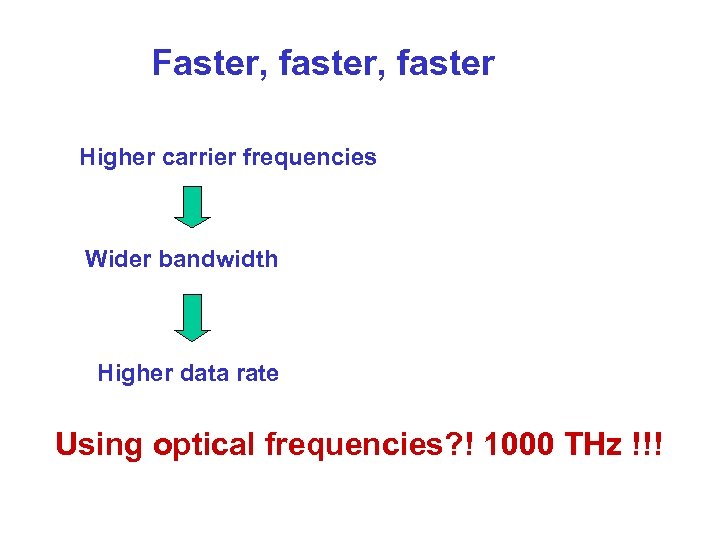
Faster, faster Higher carrier frequencies Wider bandwidth Higher data rate Using optical frequencies? ! 1000 THz !!!
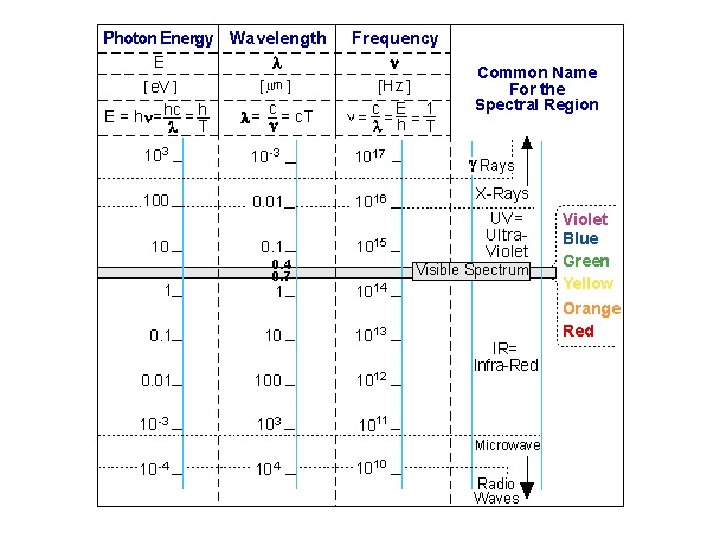
What kind of medium can carry optical frequencies? Air? Only within line of sight; High absorption and scattering Optical waveguides are necessary! Copper coaxial cable? High absorption, narrow bandwidth 300 MHz Glass? Window glass absorbs 90% of light after 1 m. Only 1% transmission after 2 meters. Extra-purity silica glass? !
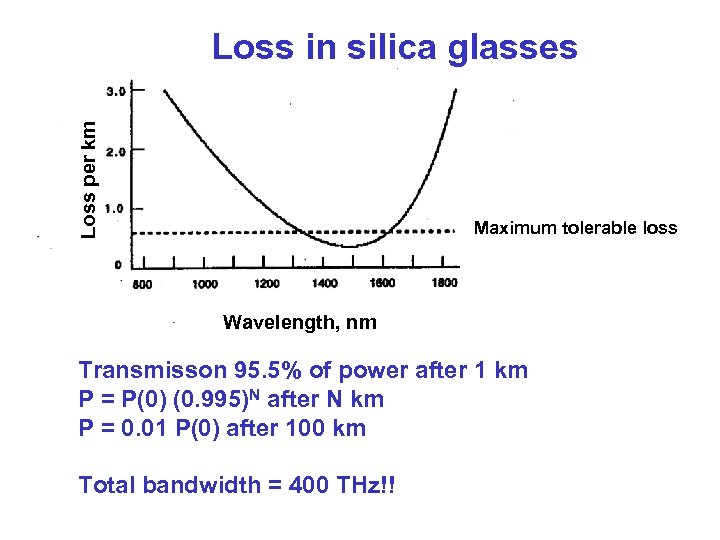
Loss per km Loss in silica glasses Maximum tolerable loss Wavelength, nm Transmisson 95. 5% of power after 1 km P = P(0) (0. 995)N after N km P = 0. 01 P(0) after 100 km Total bandwidth = 400 THz!!
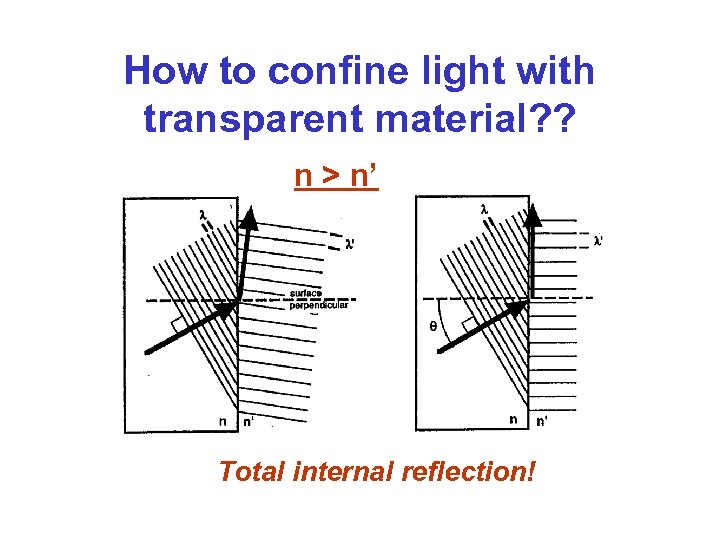
How to confine light with transparent material? ? n > n’ Total internal reflection!
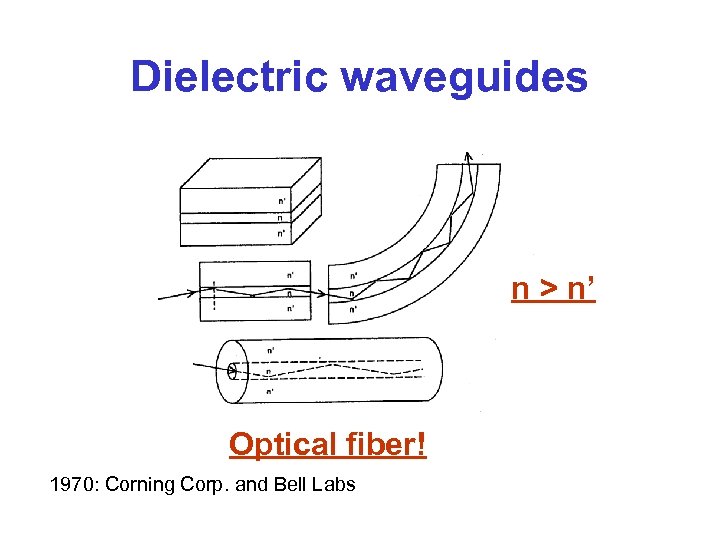
Dielectric waveguides n > n’ Optical fiber! 1970: Corning Corp. and Bell Labs
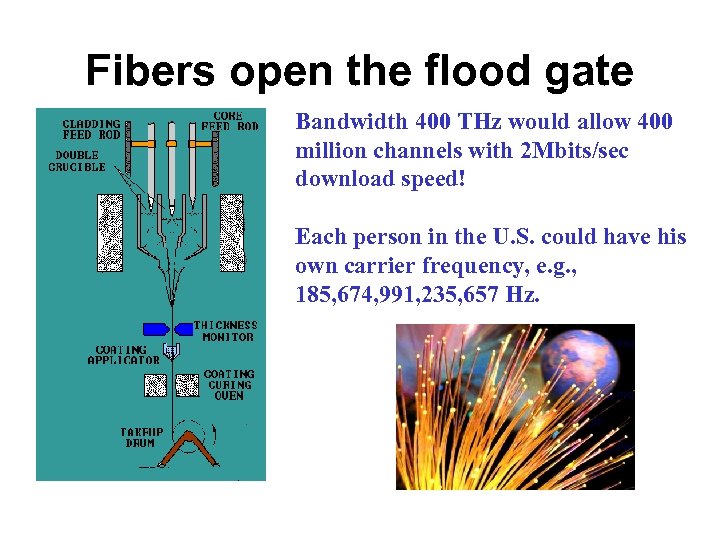
Fibers open the flood gate Bandwidth 400 THz would allow 400 million channels with 2 Mbits/sec download speed! Each person in the U. S. could have his own carrier frequency, e. g. , 185, 674, 991, 235, 657 Hz.
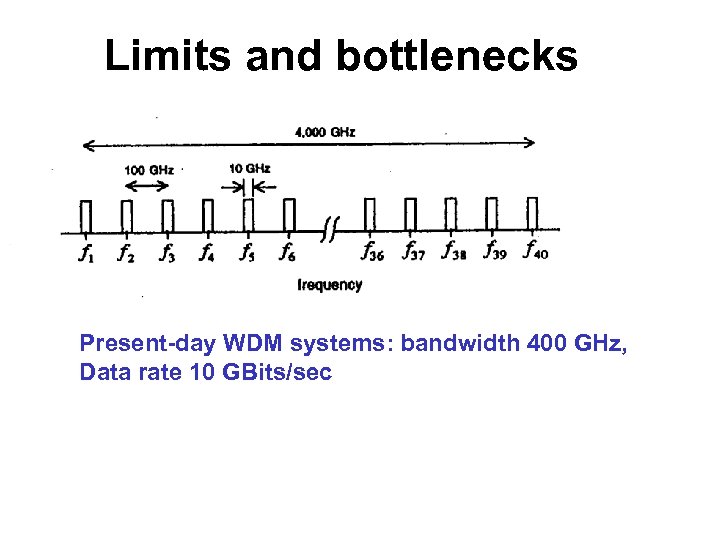
Limits and bottlenecks Present-day WDM systems: bandwidth 400 GHz, Data rate 10 GBits/sec
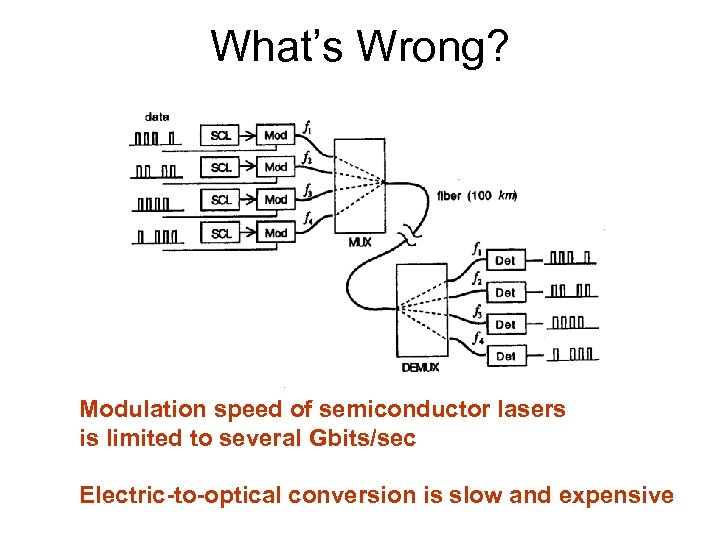
What’s Wrong? Modulation speed of semiconductor lasers is limited to several Gbits/sec Electric-to-optical conversion is slow and expensive
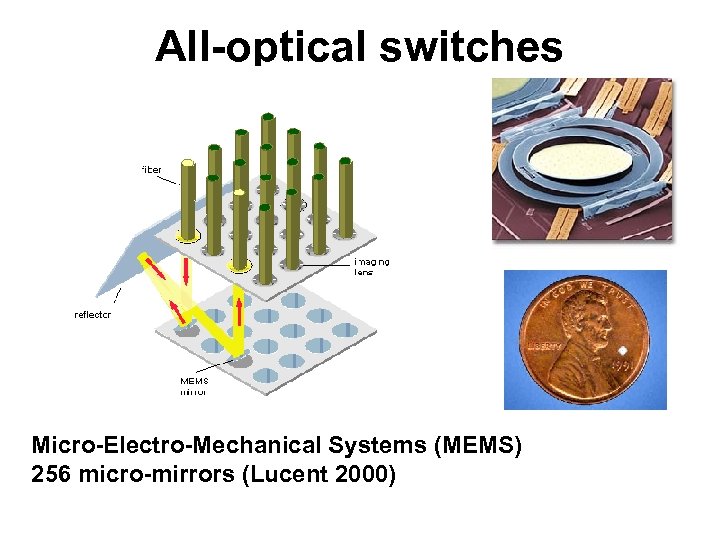
All-optical switches Micro-Electro-Mechanical Systems (MEMS) 256 micro-mirrors (Lucent 2000)
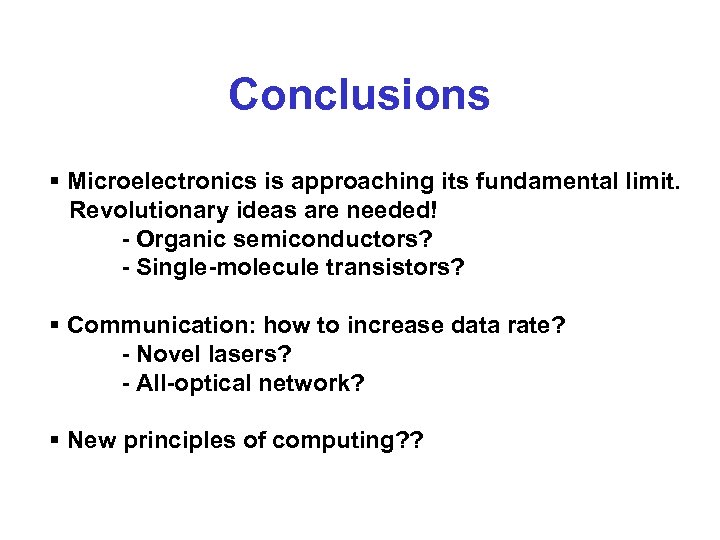
Conclusions § Microelectronics is approaching its fundamental limit. Revolutionary ideas are needed! - Organic semiconductors? - Single-molecule transistors? § Communication: how to increase data rate? - Novel lasers? - All-optical network? § New principles of computing? ?
Скачать презентацию From Physics to Optoelectronics Technology Alexey Belyanin TAMU-Physics
d874410120277698f61ff249814af2de.ppt