 Скачать презентацию From microarrays to biological networks to graphs in
57f35b6ade33bf9c37bc3160d6841ffc.ppt
- Количество слайдов: 90



From microarrays to biological networks to graphs in R and Bioconductor Wolfgang Huber, EBI / EMBL
recap "generalized" or "regularized" log-ratios (on popular request)
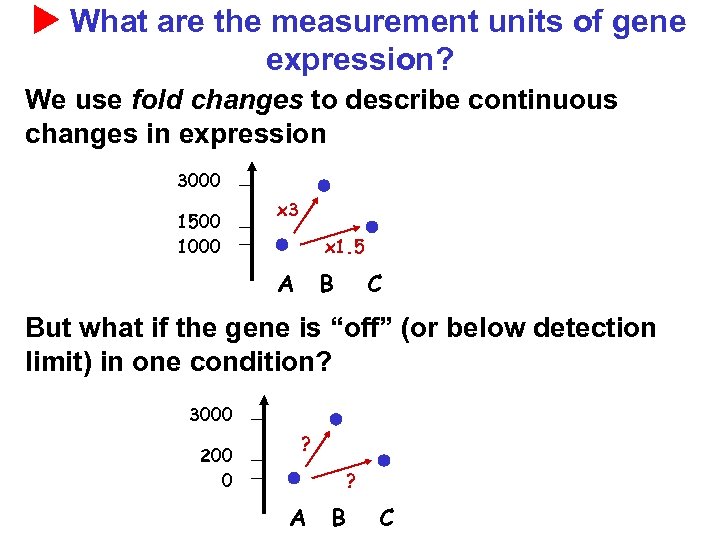
What are the measurement units of gene expression? We use fold changes to describe continuous changes in expression 3000 1500 1000 x 3 x 1. 5 A B C But what if the gene is “off” (or below detection limit) in one condition? 3000 200 0 ? ? A B C
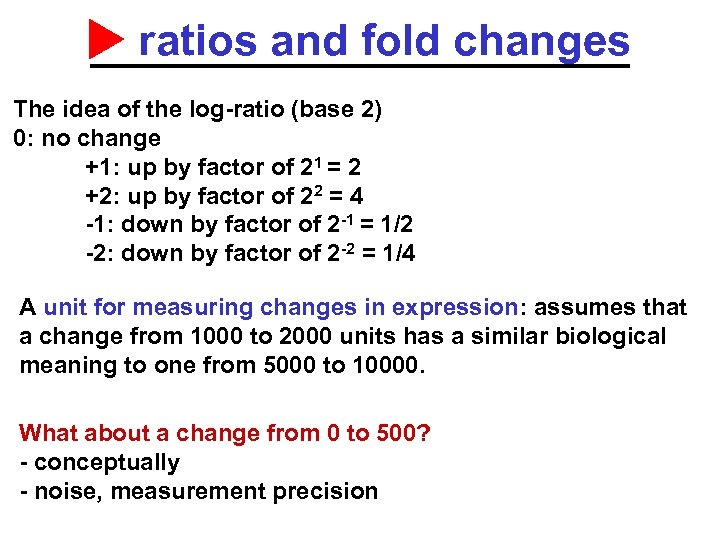
ratios and fold changes The idea of the log-ratio (base 2) 0: no change +1: up by factor of 21 = 2 +2: up by factor of 22 = 4 -1: down by factor of 2 -1 = 1/2 -2: down by factor of 2 -2 = 1/4 A unit for measuring changes in expression: assumes that a change from 1000 to 2000 units has a similar biological meaning to one from 5000 to 10000. What about a change from 0 to 500? - conceptually - noise, measurement precision
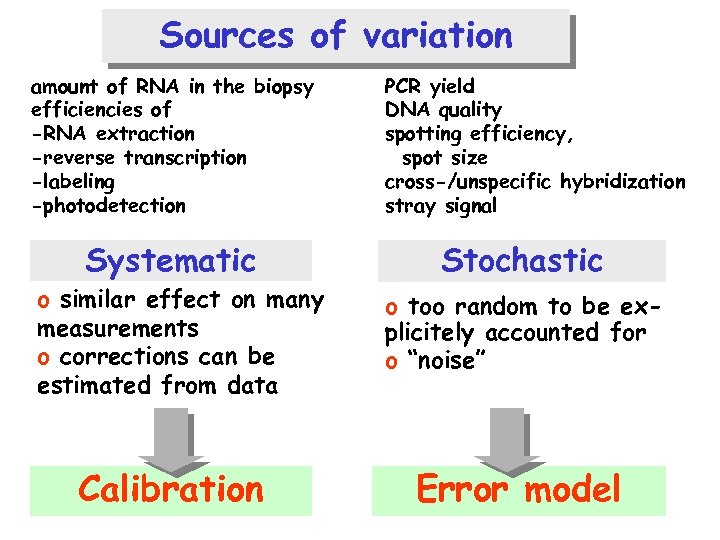
Sources of variation amount of RNA in the biopsy efficiencies of -RNA extraction -reverse transcription -labeling -photodetection Systematic o similar effect on many measurements o corrections can be estimated from data Calibration PCR yield DNA quality spotting efficiency, spot size cross-/unspecific hybridization stray signal Stochastic o too random to be explicitely accounted for o “noise” Error model
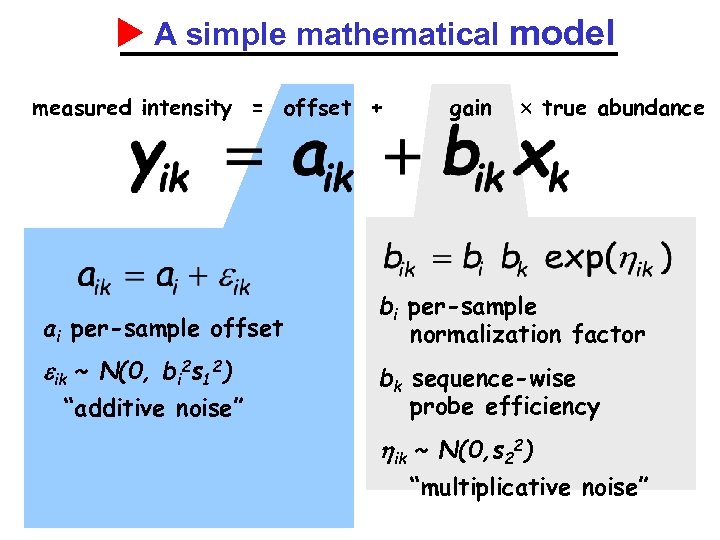
A simple mathematical model measured intensity = offset + ai per-sample offset ik ~ N(0, bi 2 s 12) “additive noise” gain true abundance bi per-sample normalization factor bk sequence-wise probe efficiency ik ~ N(0, s 22) “multiplicative noise”
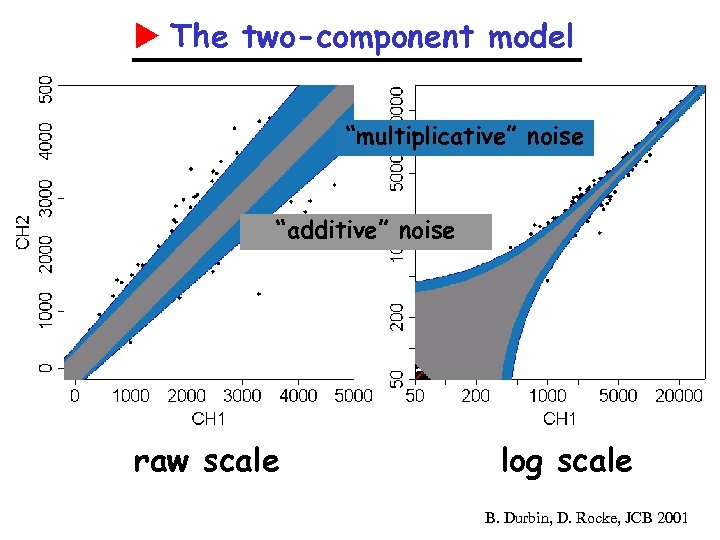
The two-component model “multiplicative” noise “additive” noise raw scale log scale B. Durbin, D. Rocke, JCB 2001
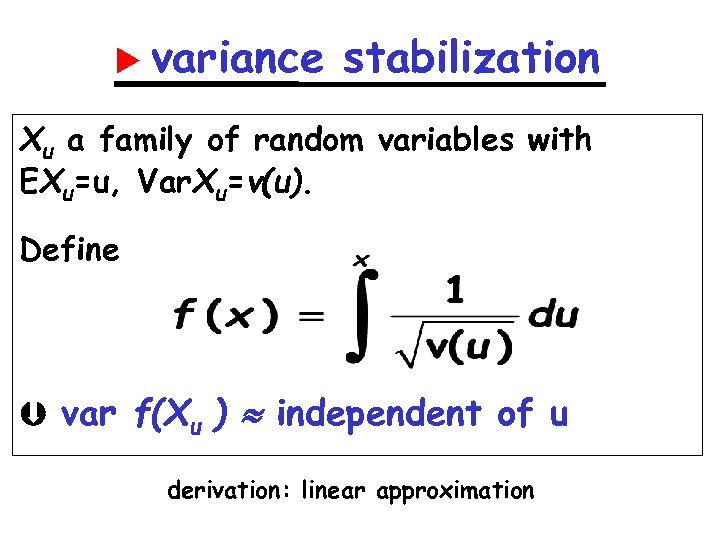
variance stabilization Xu a family of random variables with EXu=u, Var. Xu=v(u). Define var f(Xu ) independent of u derivation: linear approximation
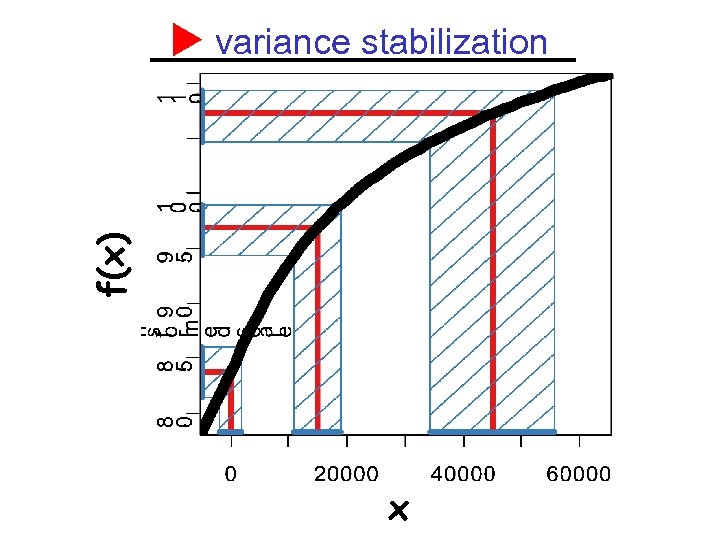
f(x) variance stabilization x
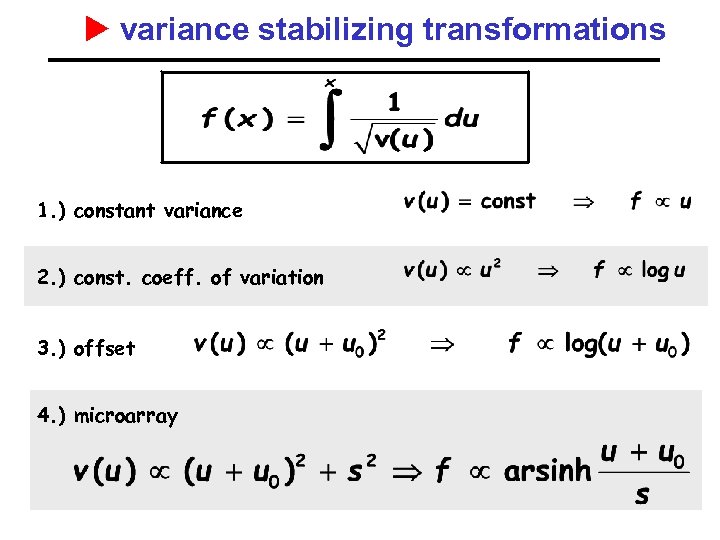
variance stabilizing transformations 1. ) constant variance 2. ) const. coeff. of variation 3. ) offset 4. ) microarray
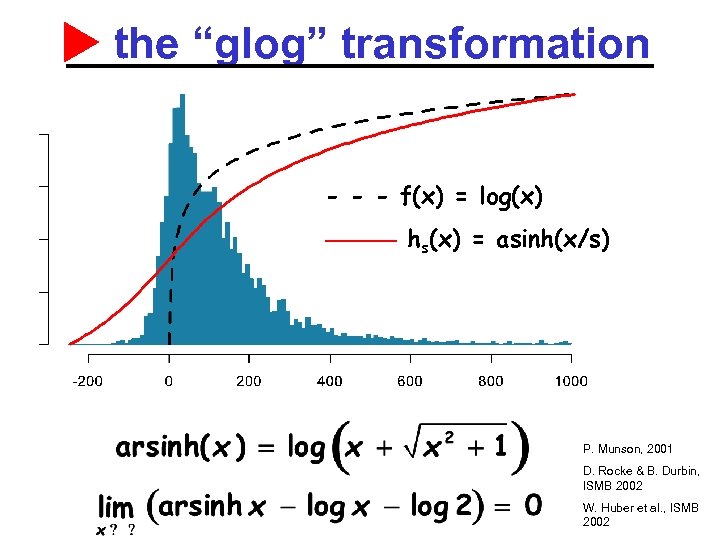
the “glog” transformation - - - f(x) = log(x) ——— hs(x) = asinh(x/s) P. Munson, 2001 D. Rocke & B. Durbin, ISMB 2002 W. Huber et al. , ISMB 2002
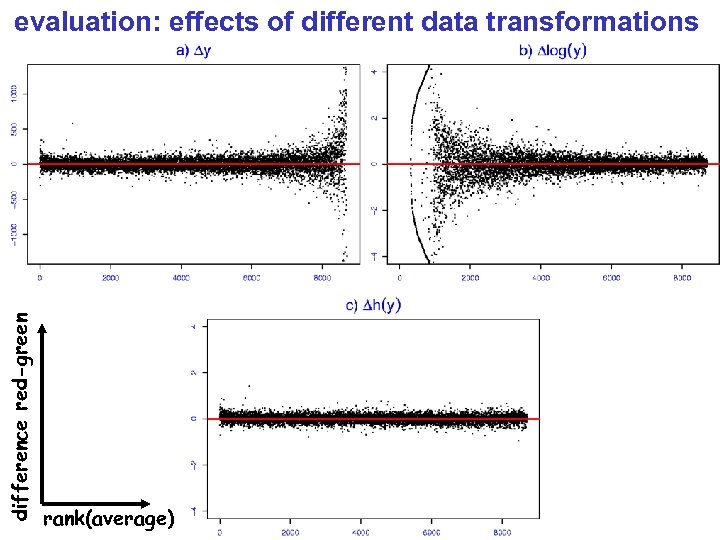
difference red-green evaluation: effects of different data transformations rank(average)
What is the bottomline? Detecting differentially transcribed genes from c. DNA array data o Data: paired tumor/normal tissue from 19 kidney cancers, in color flip duplicates on 38 c. DNA slides à 4000 genes. o 6 different strategies for normalization and quantification of differential abundance o Calculate for each gene & each method: -statistics, permutation-p o For threshold , compare the number of genes the different methods find, #{pi | pi } t
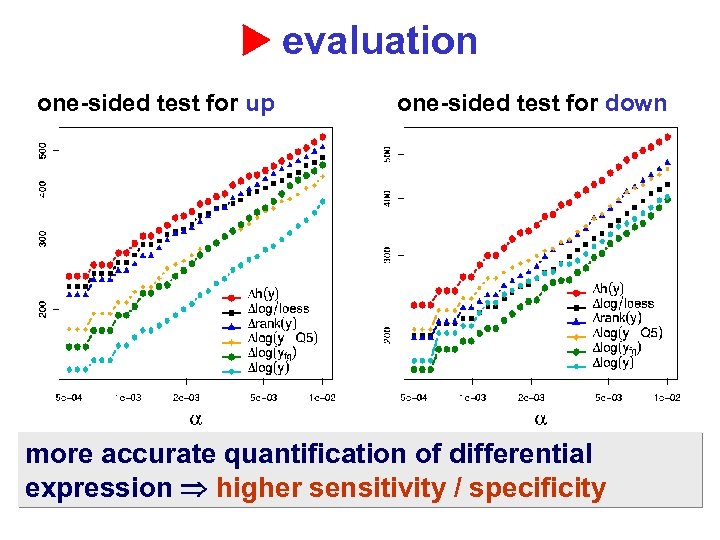
evaluation one-sided test for up one-sided test for down more accurate quantification of differential expression higher sensitivity / specificity
Another evaluation: affycomp, a benchmark for Affymetrix genechip expression measures o Data: Spike-in series: from Affymetrix 59 x HGU 95 A, 16 genes, 14 concentrations, complex background Dilution series: from Gene. Logic 60 x HGU 95 Av 2, liver & CNS c. RNA in different proportions and amounts o Benchmark: 15 quality measures regarding -reproducibility -sensitivity -specificity Put together by Rafael Irizarry (Johns Hopkins) http: //affycomp. biostat. jhsph. edu
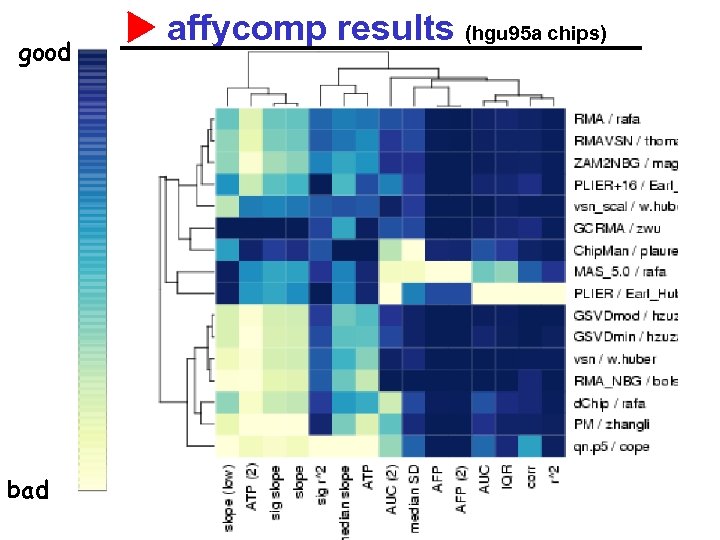
good bad affycomp results (hgu 95 a chips)
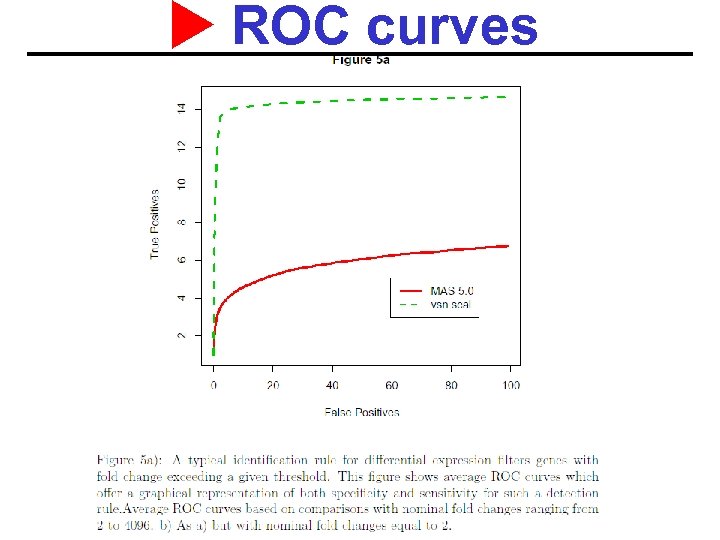
ROC curves
Availability Package vsn in Bioconductor: Preprocessing of two-color, Agilent, and Affymetrix arrays
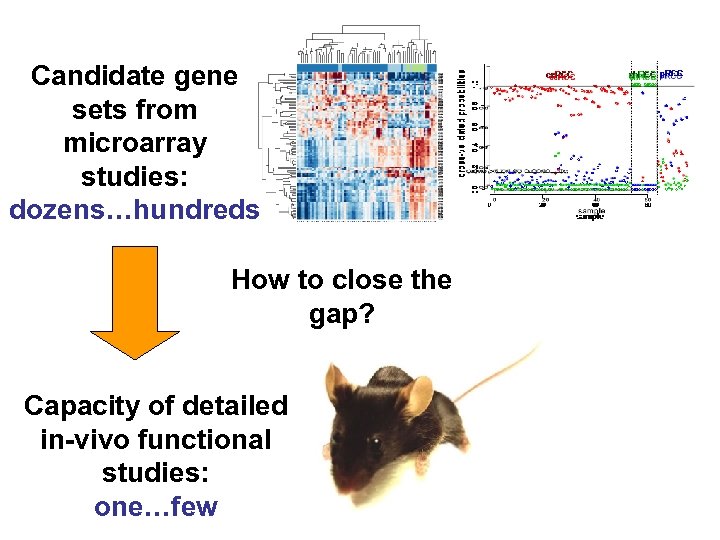
Candidate gene sets from microarray studies: dozens…hundreds How to close the gap? Capacity of detailed in-vivo functional studies: one…few
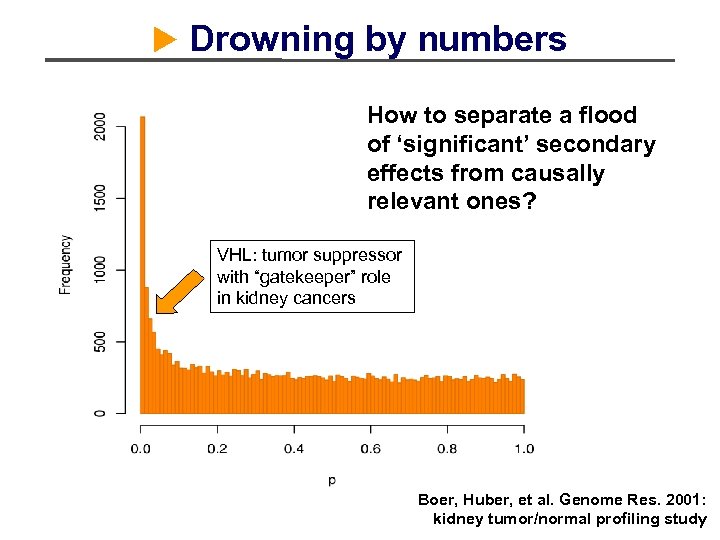
Drowning by numbers How to separate a flood of ‘significant’ secondary effects from causally relevant ones? VHL: tumor suppressor with “gatekeeper” role in kidney cancers Boer, Huber, et al. Genome Res. 2001: kidney tumor/normal profiling study
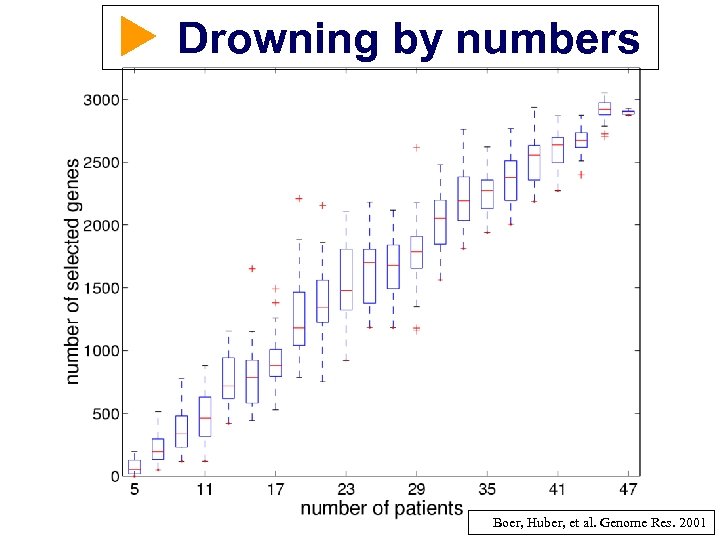
Drowning by numbers Boer, Huber, et al. Genome Res. 2001
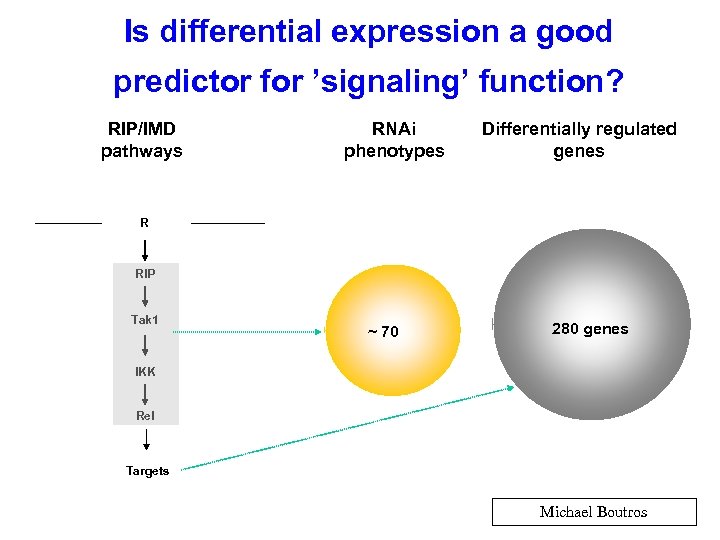
Is differential expression a good predictor for ’signaling’ function? RIP/IMD pathways RNAi phenotypes Differentially regulated genes R RIP Tak 1 ~ 70 280 genes IKK Rel Targets Michael Boutros
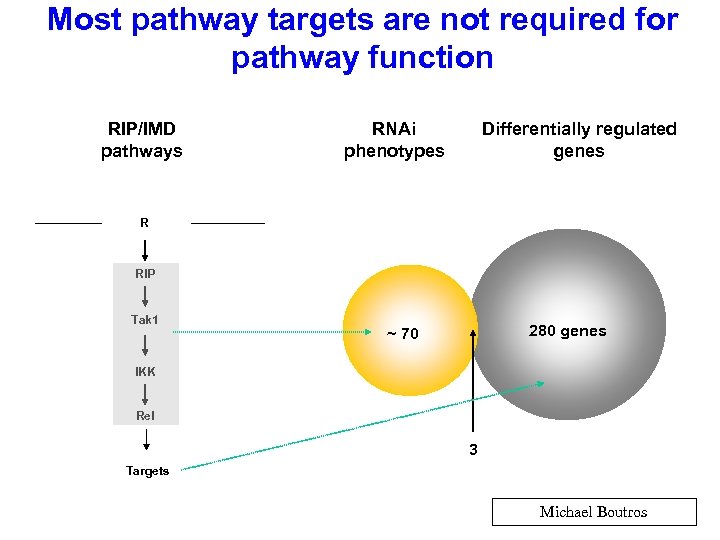
Most pathway targets are not required for pathway function RIP/IMD pathways RNAi phenotypes Differentially regulated genes R RIP Tak 1 280 genes ~ 70 IKK Rel 3 Targets Michael Boutros
Buffering in yeast, ~73% of gene deletions are "non-essential" (Glaever et al. Nature 418 (2002)) in Drosophila cell lines, only 5% show viability phenotype (Boutros et al. Science 303 (2004)) association studies for most human genetic diseases have failed to produce single loci with high penetrance evolutionary pressure for robustness What are the implications for functional studies? Need to: use combinatorial perturbations observe multiple phenotypes with high sensitivity understand gene-gene and gene-phenotype interactions in terms of graph-like models ("networks")
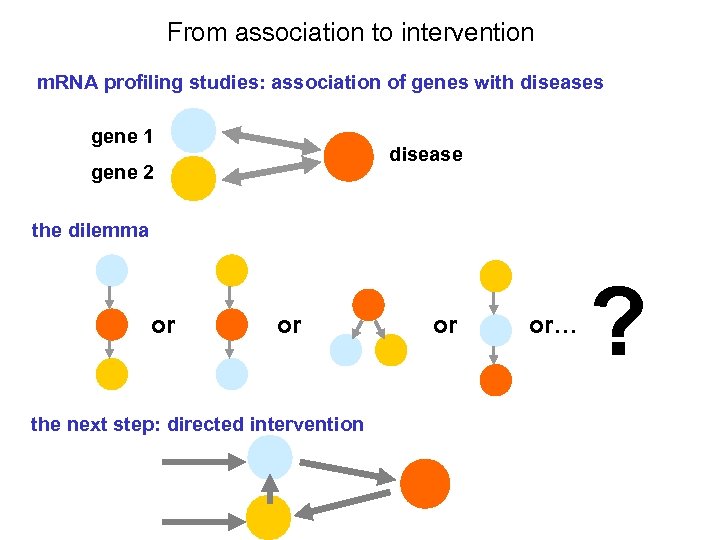
From association to intervention m. RNA profiling studies: association of genes with diseases gene 1 disease gene 2 the dilemma or or the next step: directed intervention or or… ?
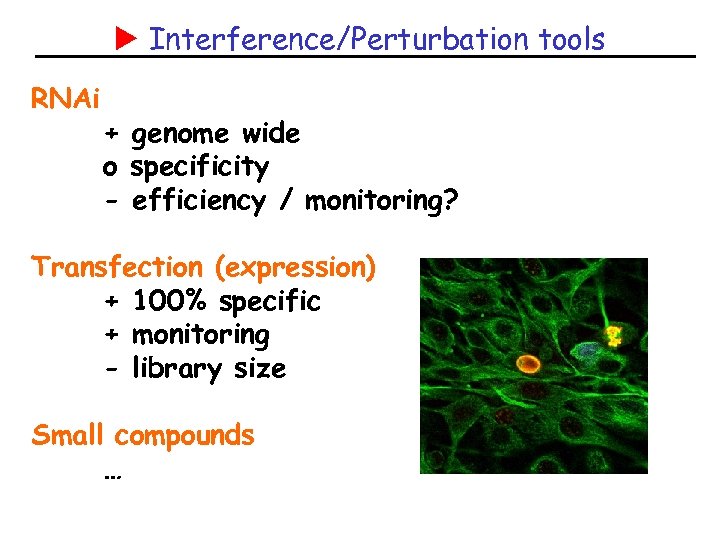
Interference/Perturbation tools RNAi + genome wide o specificity - efficiency / monitoring? Transfection (expression) + 100% specific + monitoring - library size Small compounds …
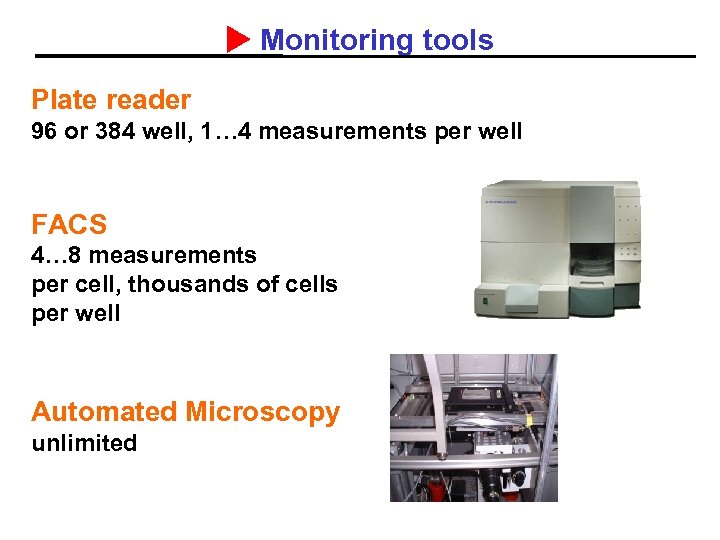
Monitoring tools Plate reader 96 or 384 well, 1… 4 measurements per well FACS 4… 8 measurements per cell, thousands of cells per well Automated Microscopy unlimited
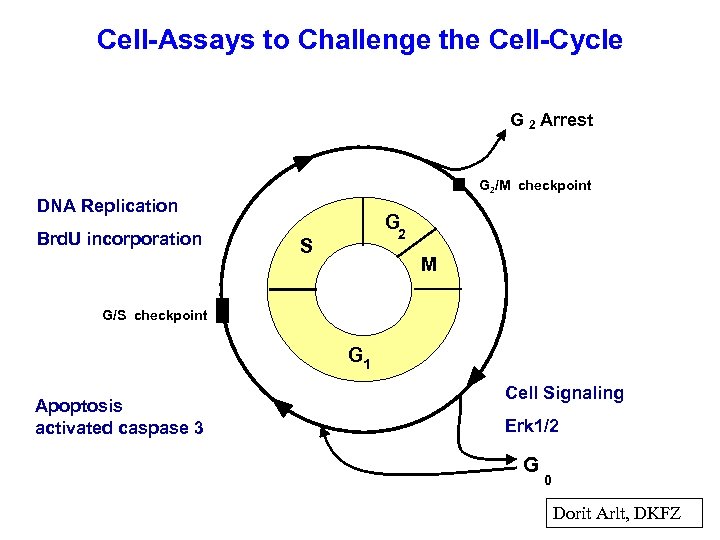
Cell-Assays to Challenge the Cell-Cycle G 2 Arrest G 2/M checkpoint DNA Replication Brd. U incorporation G 2 S M G/S checkpoint G 1 Apoptosis activated caspase 3 Cell Signaling Erk 1/2 G 0 Dorit Arlt, DKFZ
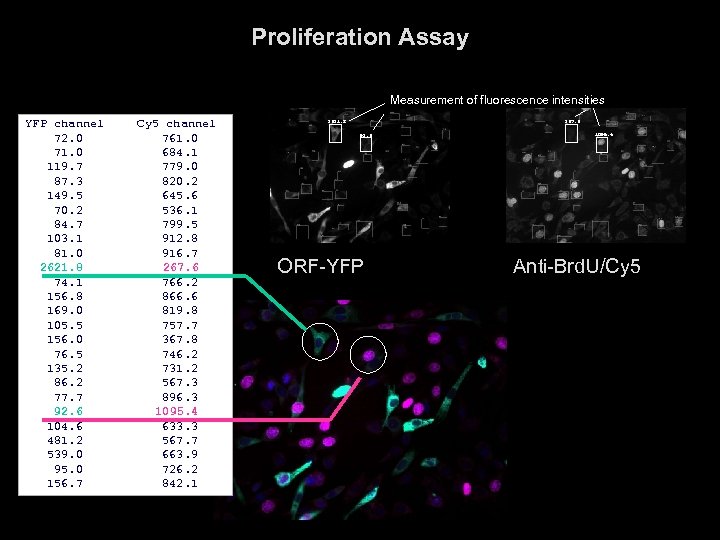
Proliferation Assay Measurement of fluorescence intensities YFP channel 72. 0 71. 0 119. 7 87. 3 149. 5 70. 2 84. 7 103. 1 81. 0 2621. 8 74. 1 156. 8 169. 0 105. 5 156. 0 76. 5 135. 2 86. 2 77. 7 92. 6 104. 6 481. 2 539. 0 95. 0 156. 7 Cy 5 channel 761. 0 684. 1 779. 0 820. 2 645. 6 536. 1 799. 5 912. 8 916. 7 267. 6 766. 2 866. 6 819. 8 757. 7 367. 8 746. 2 731. 2 567. 3 896. 3 1095. 4 633. 3 567. 7 663. 9 726. 2 842. 1 2621. 8, 267. 6 92. 6, ORF-YFP 1095. 4 Anti-Brd. U/Cy 5
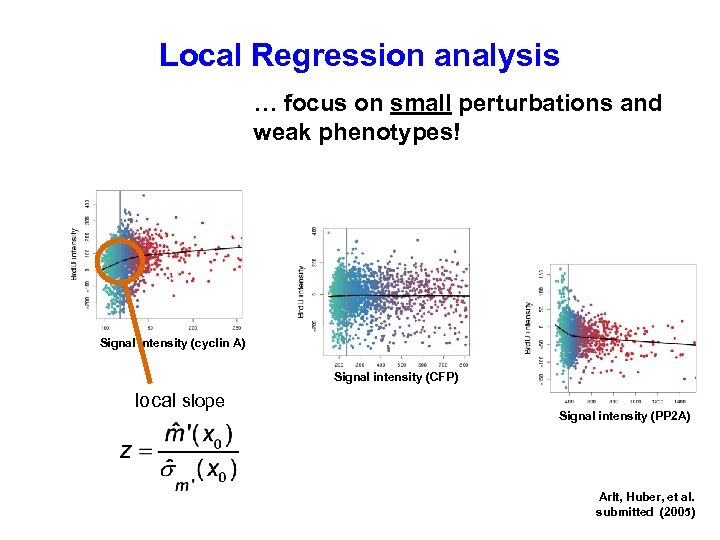
Local Regression analysis … focus on small perturbations and weak phenotypes! Signal intensity (cyclin A) Signal intensity (CFP) local slope Signal intensity (PP 2 A) Arlt, Huber, et al. submitted (2005)
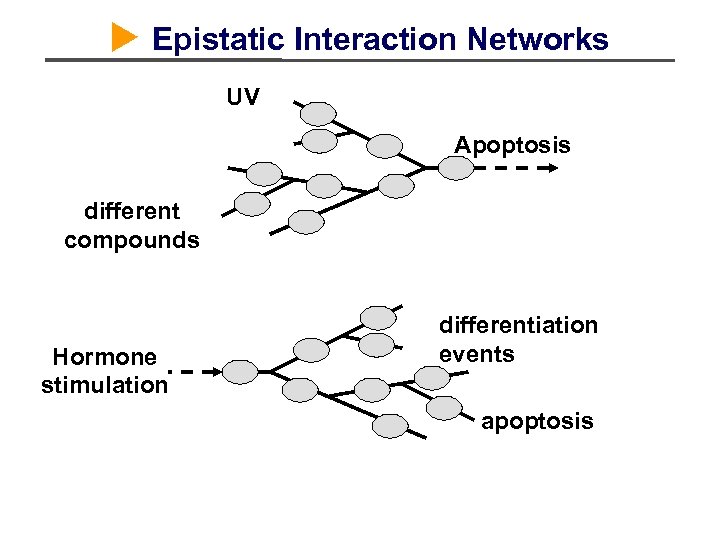
Epistatic Interaction Networks UV Apoptosis different compounds Hormone stimulation differentiation events apoptosis
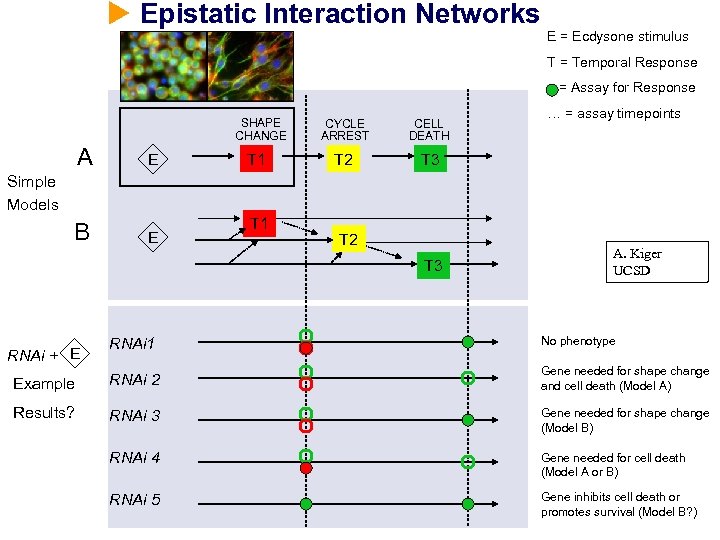
Epistatic Interaction Networks E = Ecdysone stimulus T = Temporal Response = Assay for Response SHAPE CHANGE A E B E T 1 CYCLE ARREST CELL DEATH T 2 … = assay timepoints T 3 Simple Models T 1 T 2 T 3 A. Kiger UCSD RNAi 1 No phenotype Example RNAi 2 Gene needed for shape change and cell death (Model A) Results? RNAi 3 Gene needed for shape change (Model B) RNAi 4 Gene needed for cell death (Model A or B) RNAi 5 Gene inhibits cell death or promotes survival (Model B? ) RNAi + E
Basic formal concepts, software, and case studies Wolfgang Huber, EBI / EMBL
Definitions Graph : = set of nodes + set of edges Edge : = pair of nodes Edges can be - directed - undirected - weighted, typed special cases: cycles, acyclic graphs, trees
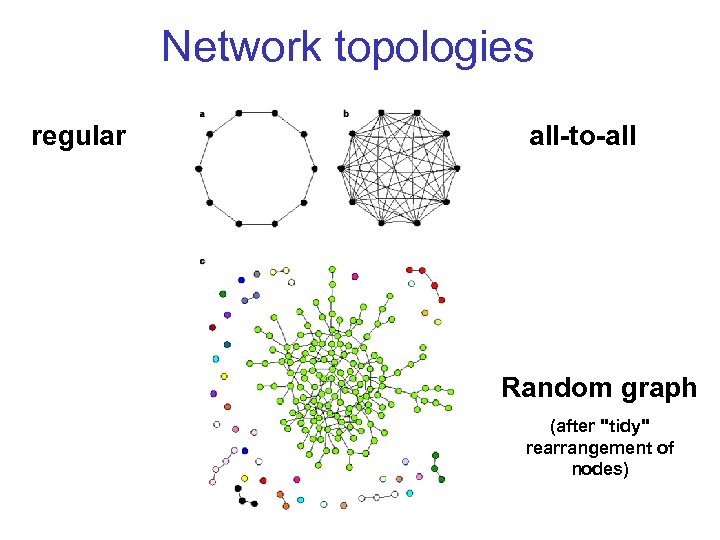
Network topologies regular all-to-all Random graph (after "tidy" rearrangement of nodes)
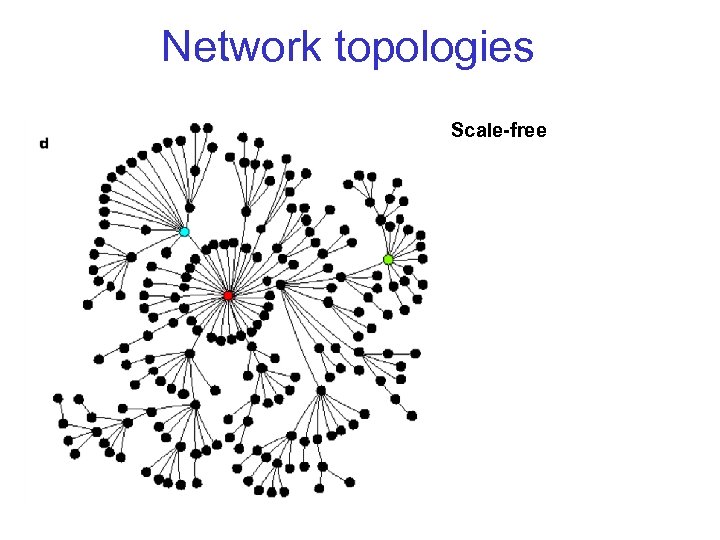
Network topologies Scale-free
Random Edge Graphs n nodes, m edges p(i, j) = 1/m with high probability: m < n/2: many disconnected components m > n/2: one giant connected component: size ~ n. (next biggest: size ~ log(n)). degrees of separation: log(n). Erdös and Rényi 1960
Some popular concepts: Small worlds Clustering Degree distribution Motifs
Small world networks Typical path length („degrees of separation“) is short many examples: - communications - epidemiology / infectious diseases - metabolic networks - scientific collaboration networks - WWW - company ownership in Germany - „ 6 degrees of Kevin Bacon“ But not in - regular networks, random edge graphs
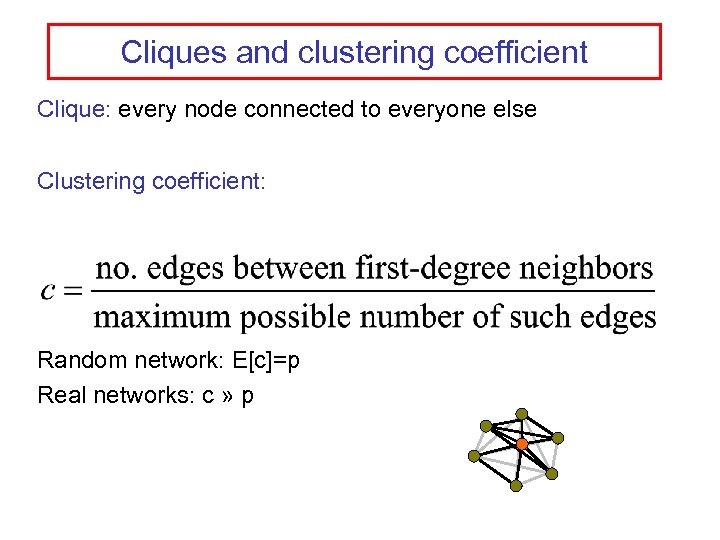
Cliques and clustering coefficient Clique: every node connected to everyone else Clustering coefficient: Random network: E[c]=p Real networks: c » p
Degree distributions p(k) = proportion of nodes that have k edges Random graph: p(k) = Poisson distribution with some parameter („scale“) Many real networks: p(k) = power law, p(k) ~ k „scale-free“ In principle, there could be many other distributions: exponential, normal, …
Growth models for scale free networks Start out with one node and continously add nodes, with preferential attachment to existing nodes, with probability ~ degree of target node. p(k)~k-3 (Simon 1955; Barabási, Albert, Jeong 1999) "The rich get richer" Modifications to obtain 3: Through different rules for adding or rewiring of edges, can tune to obtain any kind of degree distribution
Real networks - tend to have power-law scaling (truncated) - are ‚small worlds‘ (like random networks) - have a high clustering coefficient independent of network size (like lattices and unlike random networks)
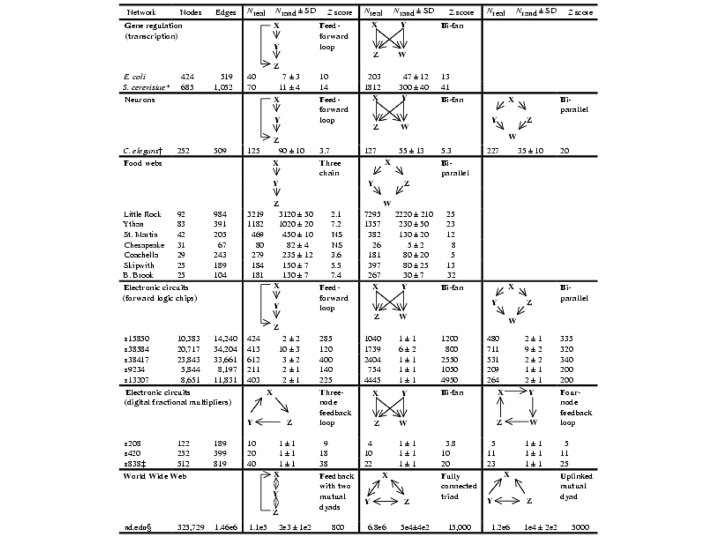
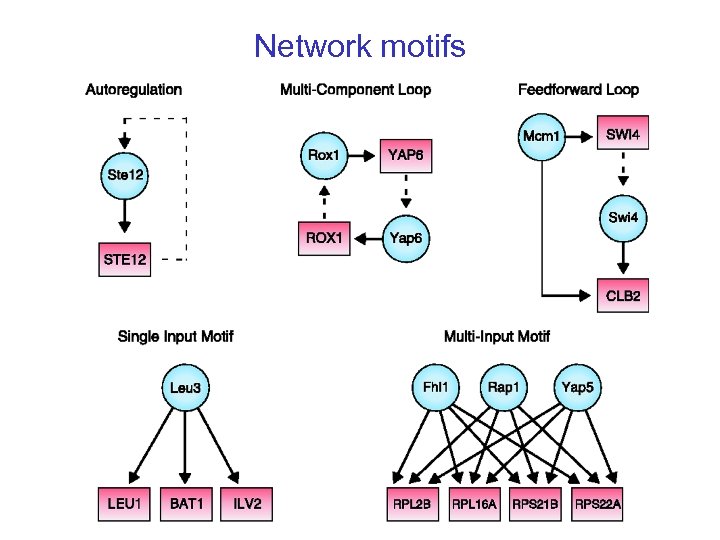
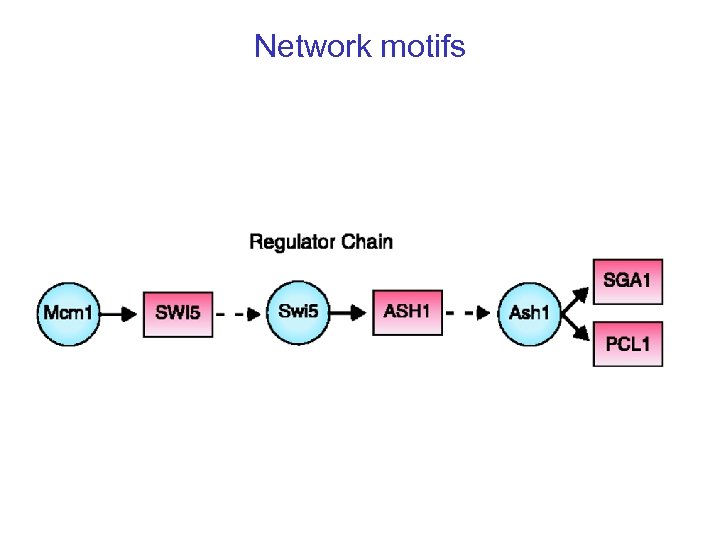
Network motifs : = pattern that occurs more often than in randomized networks Intended implications duplication: useful building blocks are reused by nature there may be evolutionary pressure for convergence of network architectures
Network motifs Starting point: graph with directed edges Scan for n-node subgraphs (n=3, 4) and count number of occurence Compare to randomized networks (randomization preserves in-, out- and in+out- degree of each node, and the frequencies of all (n-1)-subgraphs)
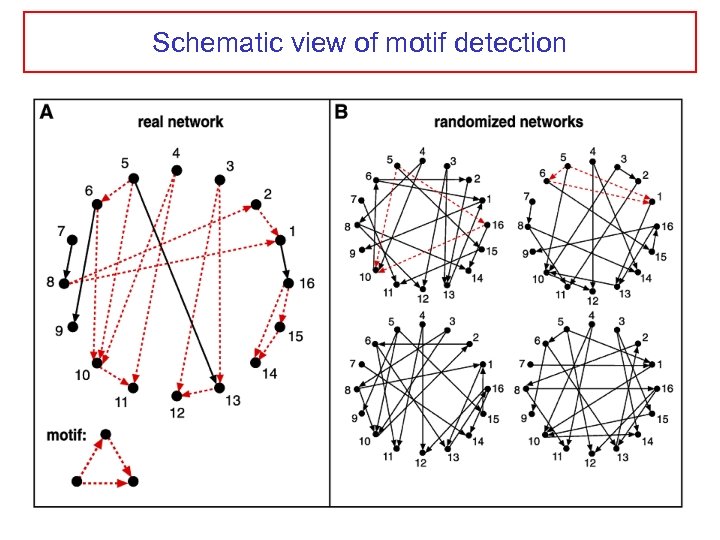
Schematic view of motif detection
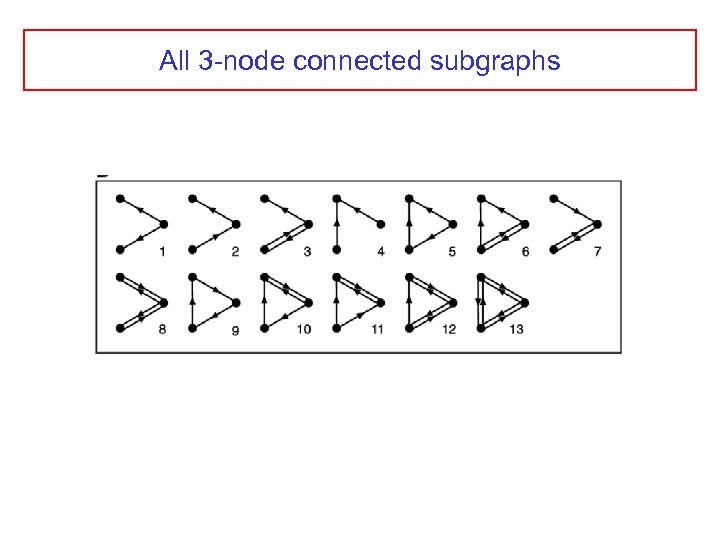
All 3 -node connected subgraphs
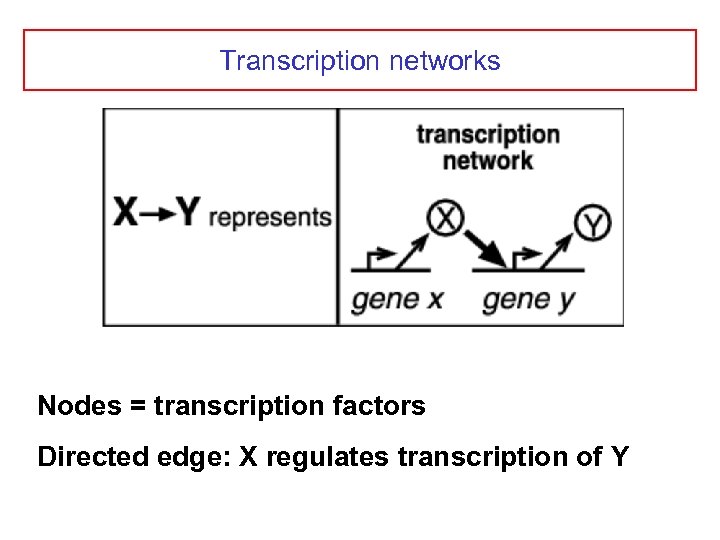
Transcription networks Nodes = transcription factors Directed edge: X regulates transcription of Y
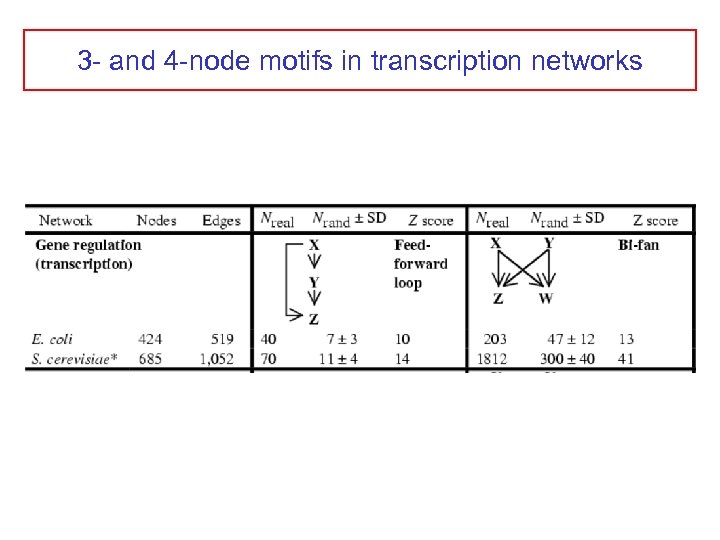
3 - and 4 -node motifs in transcription networks
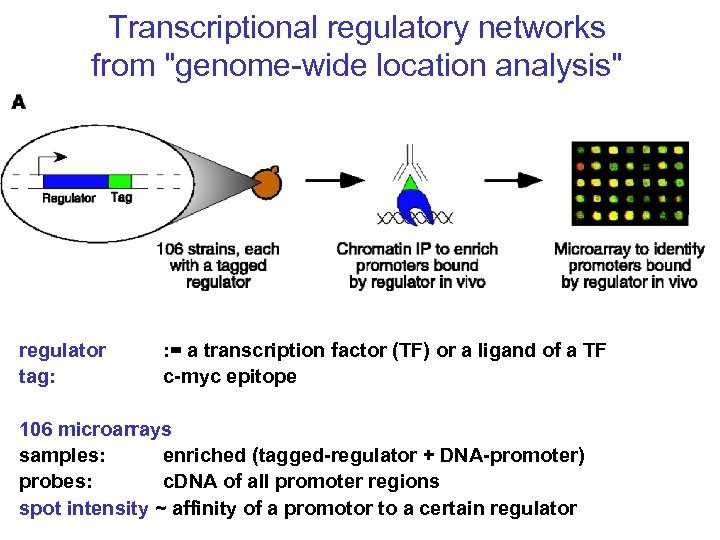
Transcriptional regulatory networks from "genome-wide location analysis" regulator tag: : = a transcription factor (TF) or a ligand of a TF c-myc epitope 106 microarrays samples: enriched (tagged-regulator + DNA-promoter) probes: c. DNA of all promoter regions spot intensity ~ affinity of a promotor to a certain regulator
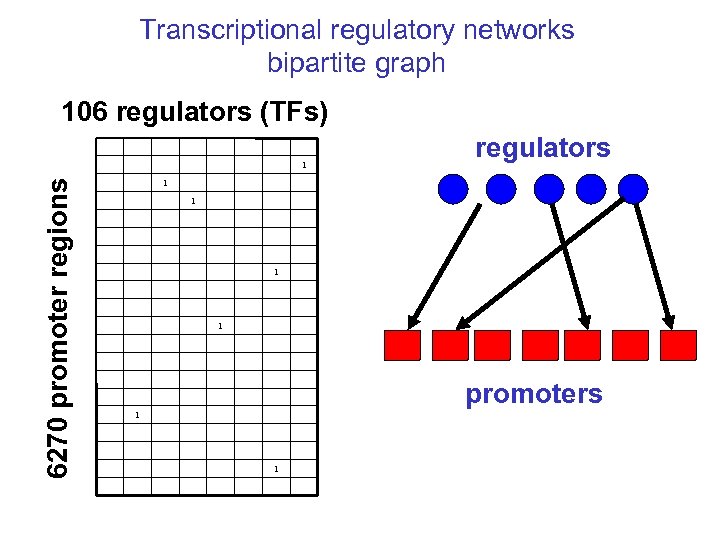
Transcriptional regulatory networks bipartite graph 106 regulators (TFs) 6270 promoter regions 1 regulators 1 1 promoters 1 1
Network motifs
Network motifs
Graphs with R and Bioconductor
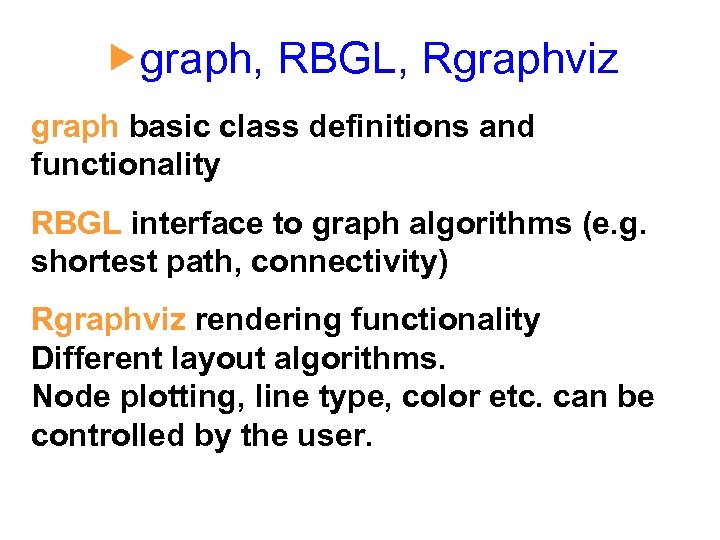
graph, RBGL, Rgraphviz graph basic class definitions and functionality RBGL interface to graph algorithms (e. g. shortest path, connectivity) Rgraphviz rendering functionality Different layout algorithms. Node plotting, line type, color etc. can be controlled by the user.
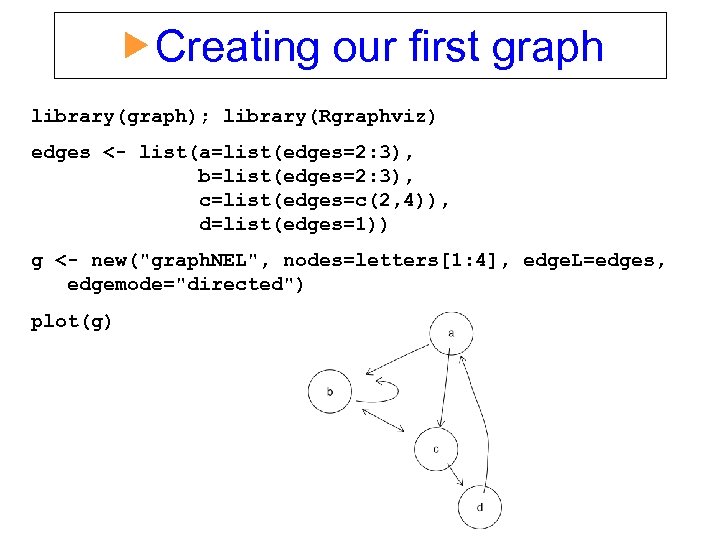
Creating our first graph library(graph); library(Rgraphviz) edges <- list(a=list(edges=2: 3), b=list(edges=2: 3), c=list(edges=c(2, 4)), d=list(edges=1)) g <- new("graph. NEL", nodes=letters[1: 4], edge. L=edges, edgemode="directed") plot(g)
![Querying nodes, edges, degree > nodes(g) [1] "a" "b" "c" "d" > edges(g)](https://present5.com/presentation/57f35b6ade33bf9c37bc3160d6841ffc/image-58.jpg "Querying nodes, edges, degree > nodes(g) [1] \"a\" \"b\" \"c\" \"d\" > edges(g)")
Querying nodes, edges, degree > nodes(g) [1] "a" "b" "c" "d" > edges(g) $a [1] "b" "c" $b [1] "b" "c" $c [1] "b" "d" $d [1] "a" > degree(g) $in. Degree a b c d 1 3 2 1 $out. Degree a b c d 2 2 2 1
![Adjacent and accessible nodes > adj(g, c("b", "c")) $b [1] "b" "c" $c](https://present5.com/presentation/57f35b6ade33bf9c37bc3160d6841ffc/image-59.jpg "Adjacent and accessible nodes > adj(g, c(\"b\", \"c\")) $b [1] \"b\" \"c\" $c")
Adjacent and accessible nodes > adj(g, c("b", "c")) $b [1] "b" "c" $c [1] "b" "d" > acc(g, c("b", "c")) $b a c d 3 1 2 $c a b d 2 1 1
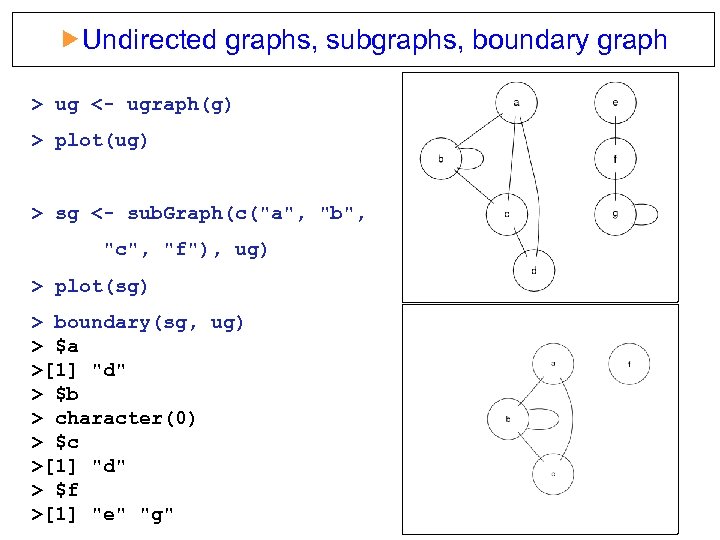
Undirected graphs, subgraphs, boundary graph > ug <- ugraph(g) > plot(ug) > sg <- sub. Graph(c("a", "b", "c", "f"), ug) > plot(sg) > boundary(sg, ug) > $a >[1] "d" > $b > character(0) > $c >[1] "d" > $f >[1] "e" "g"
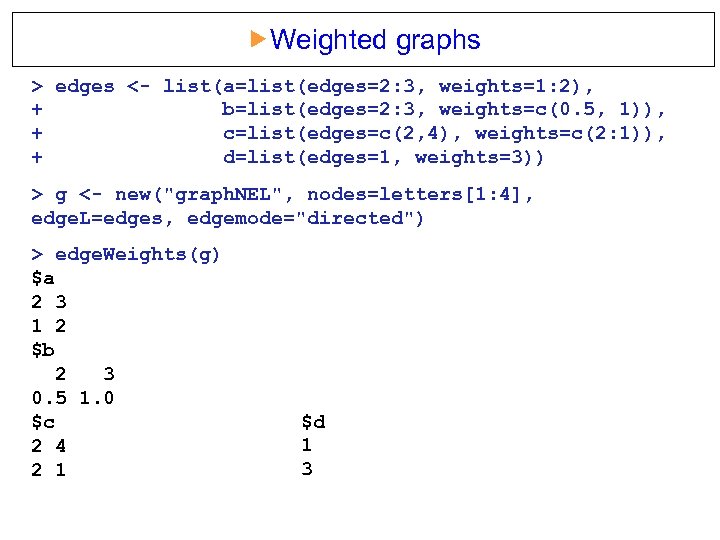
Weighted graphs > edges <- list(a=list(edges=2: 3, weights=1: 2), + b=list(edges=2: 3, weights=c(0. 5, 1)), + c=list(edges=c(2, 4), weights=c(2: 1)), + d=list(edges=1, weights=3)) > g <- new("graph. NEL", nodes=letters[1: 4], edge. L=edges, edgemode="directed") > edge. Weights(g) $a 2 3 1 2 $b 2 3 0. 5 1. 0 $c 2 4 2 1 $d 1 3
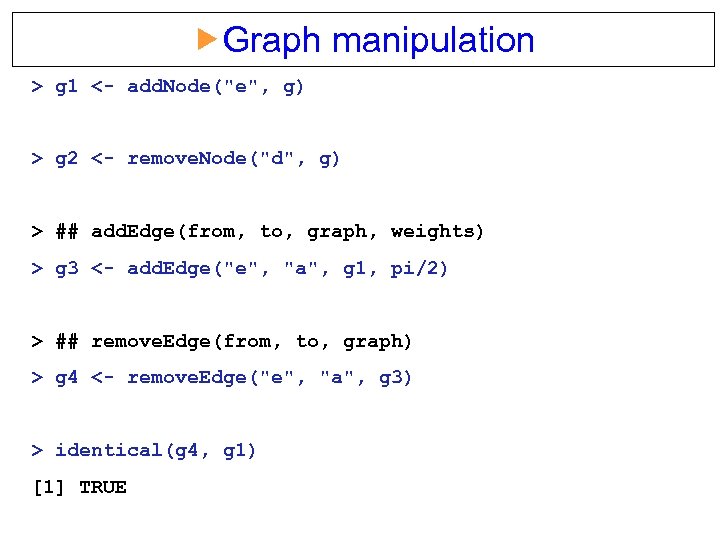
Graph manipulation > g 1 <- add. Node("e", g) > g 2 <- remove. Node("d", g) > ## add. Edge(from, to, graph, weights) > g 3 <- add. Edge("e", "a", g 1, pi/2) > ## remove. Edge(from, to, graph) > g 4 <- remove. Edge("e", "a", g 3) > identical(g 4, g 1) [1] TRUE
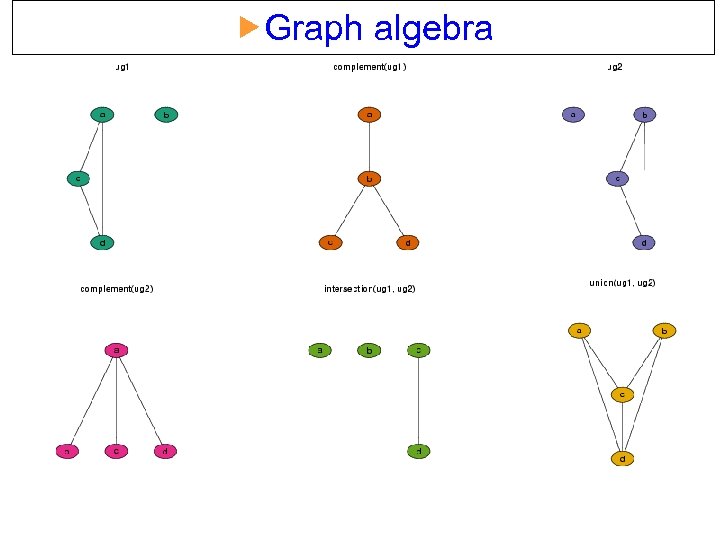
Graph algebra
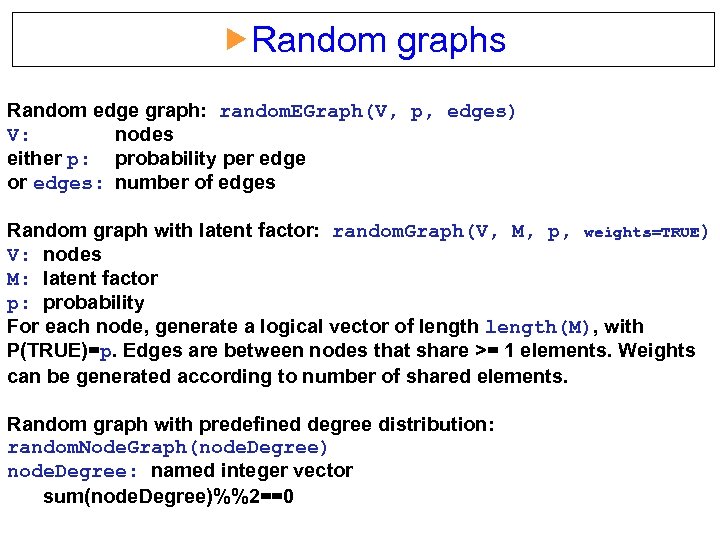
Random graphs Random edge graph: random. EGraph(V, p, edges) V: nodes either p: probability per edge or edges: number of edges Random graph with latent factor: random. Graph(V, M, p, weights=TRUE) V: nodes M: latent factor p: probability For each node, generate a logical vector of length(M), with P(TRUE)=p. Edges are between nodes that share >= 1 elements. Weights can be generated according to number of shared elements. Random graph with predefined degree distribution: random. Node. Graph(node. Degree) node. Degree: named integer vector sum(node. Degree)%%2==0
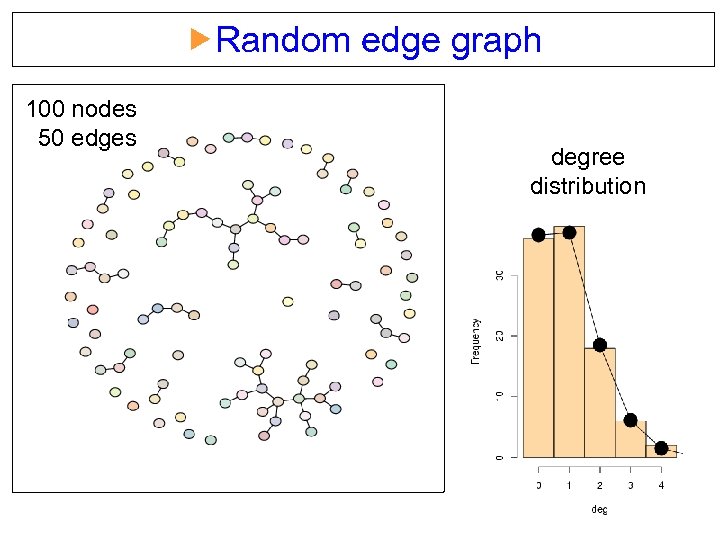
Random edge graph 100 nodes 50 edges degree distribution
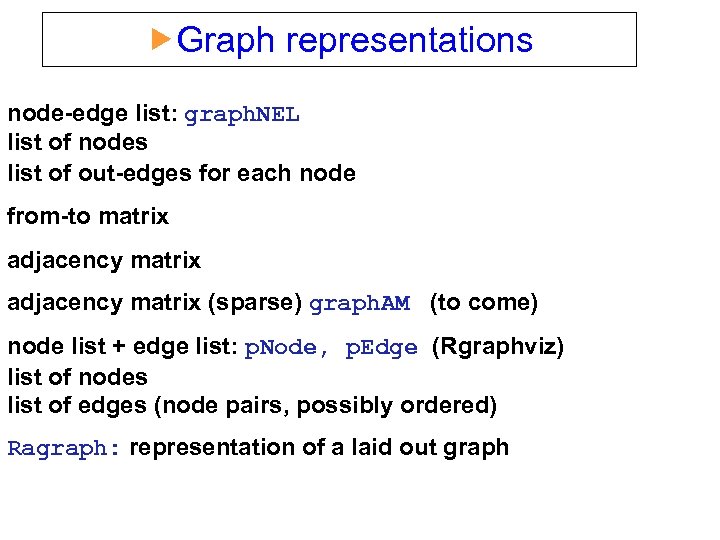
Graph representations node-edge list: graph. NEL list of nodes list of out-edges for each node from-to matrix adjacency matrix (sparse) graph. AM (to come) node list + edge list: p. Node, p. Edge (Rgraphviz) list of nodes list of edges (node pairs, possibly ordered) Ragraph: representation of a laid out graph
![Graph representations: from-to-matrix > ft [1, ] [2, ] [3, ] [4, ]](https://present5.com/presentation/57f35b6ade33bf9c37bc3160d6841ffc/image-67.jpg "Graph representations: from-to-matrix > ft [1, ] [2, ] [3, ] [4, ]")
Graph representations: from-to-matrix > ft [1, ] [2, ] [3, ] [4, ] [, 1] [, 2] 1 2 2 3 3 1 4 4 > ft. M 2 adj. M(ft) 1 2 3 4 1 0 0 2 0 0 1 0 3 1 0 0 0 4 0 0 0 1
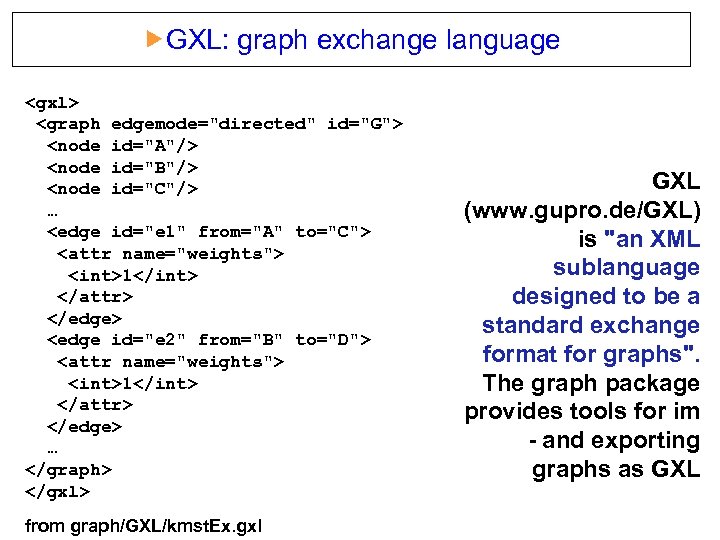
GXL: graph exchange language <gxl> <graph edgemode="directed" id="G"> <node id="A"/> <node id="B"/> <node id="C"/> … <edge id="e 1" from="A" to="C"> <attr name="weights"> <int>1</int> </attr> </edge> <edge id="e 2" from="B" to="D"> <attr name="weights"> <int>1</int> </attr> </edge> … </graph> </gxl> from graph/GXL/kmst. Ex. gxl GXL (www. gupro. de/GXL) is "an XML sublanguage designed to be a standard exchange format for graphs". The graph package provides tools for im - and exporting graphs as GXL
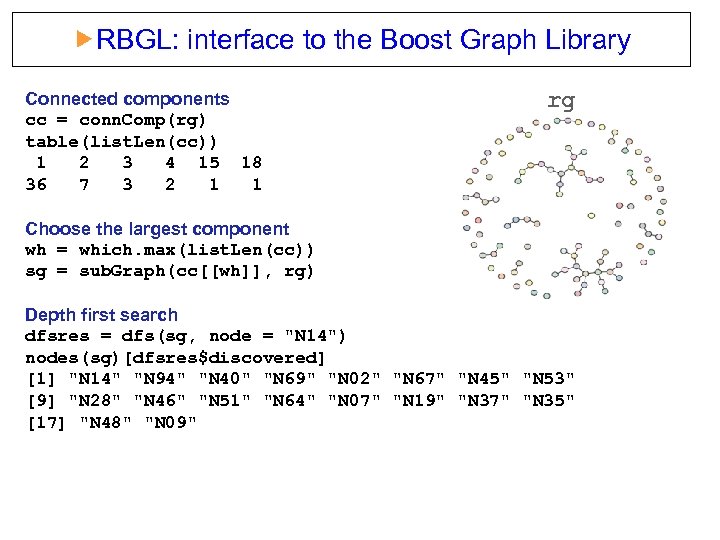
RBGL: interface to the Boost Graph Library Connected components cc = conn. Comp(rg) table(list. Len(cc)) 1 2 3 4 15 18 36 7 3 2 1 1 rg Choose the largest component wh = which. max(list. Len(cc)) sg = sub. Graph(cc[[wh]], rg) Depth first search dfsres = dfs(sg, node = "N 14") nodes(sg)[dfsres$discovered] [1] "N 14" "N 94" "N 40" "N 69" "N 02" "N 67" "N 45" "N 53" [9] "N 28" "N 46" "N 51" "N 64" "N 07" "N 19" "N 37" "N 35" [17] "N 48" "N 09"
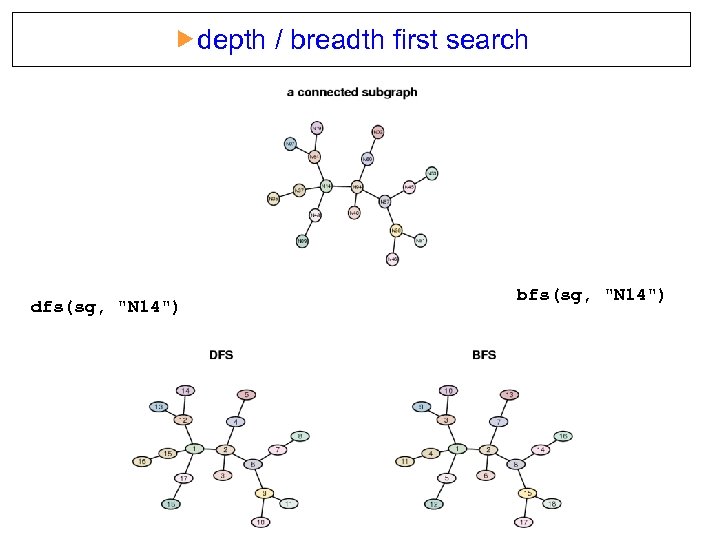
depth / breadth first search dfs(sg, "N 14") bfs(sg, "N 14")
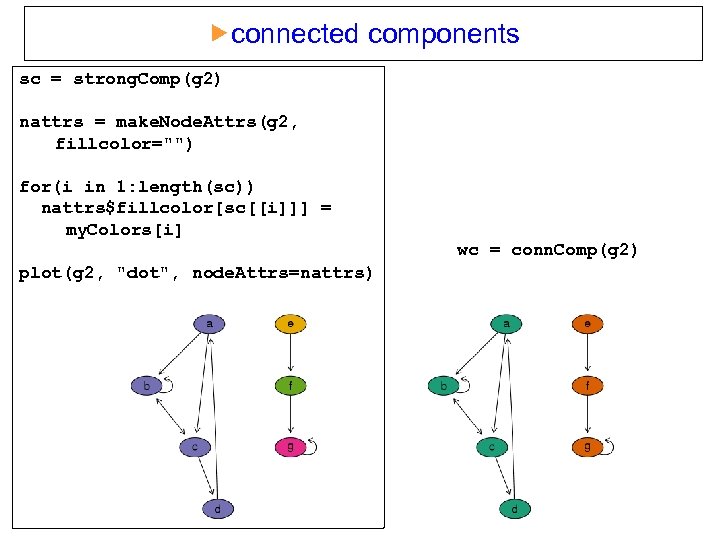
connected components sc = strong. Comp(g 2) nattrs = make. Node. Attrs(g 2, fillcolor="") for(i in 1: length(sc)) nattrs$fillcolor[sc[[i]]] = my. Colors[i] wc = conn. Comp(g 2) plot(g 2, "dot", node. Attrs=nattrs)
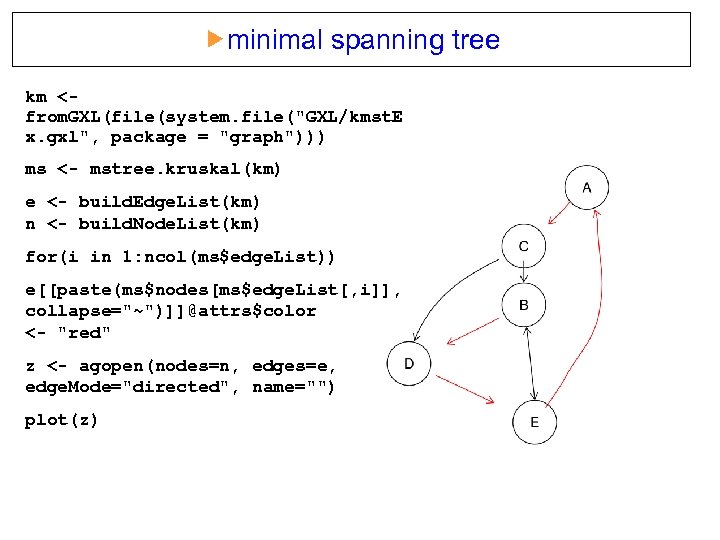
minimal spanning tree km <from. GXL(file(system. file("GXL/kmst. E x. gxl", package = "graph"))) ms <- mstree. kruskal(km) e <- build. Edge. List(km) n <- build. Node. List(km) for(i in 1: ncol(ms$edge. List)) e[[paste(ms$nodes[ms$edge. List[, i]], collapse="~")]]@attrs$color <- "red" z <- agopen(nodes=n, edges=e, edge. Mode="directed", name="") plot(z)
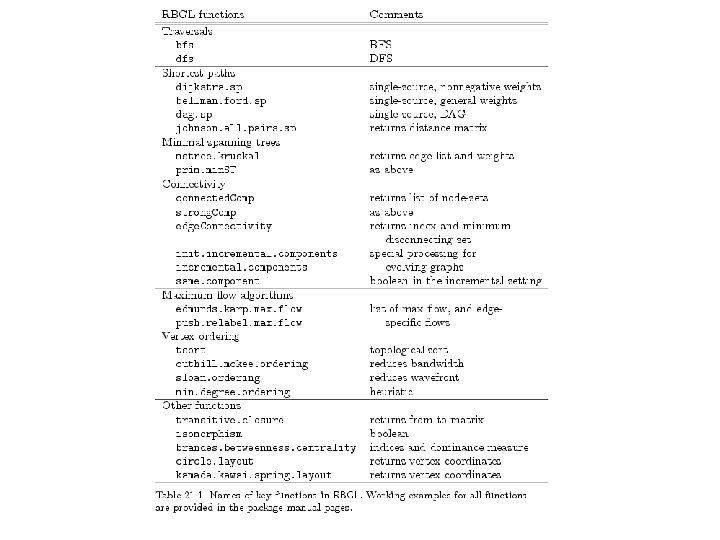
shortest path algorithms Different algorithms for different types of graphs o all edge weights the same o positive edge weights o real numbers …and different settings of the problem o single pair o single source o single destination o all pairs Functions bfs dijkstra. sp sp. between johnson. all. pairs. sp
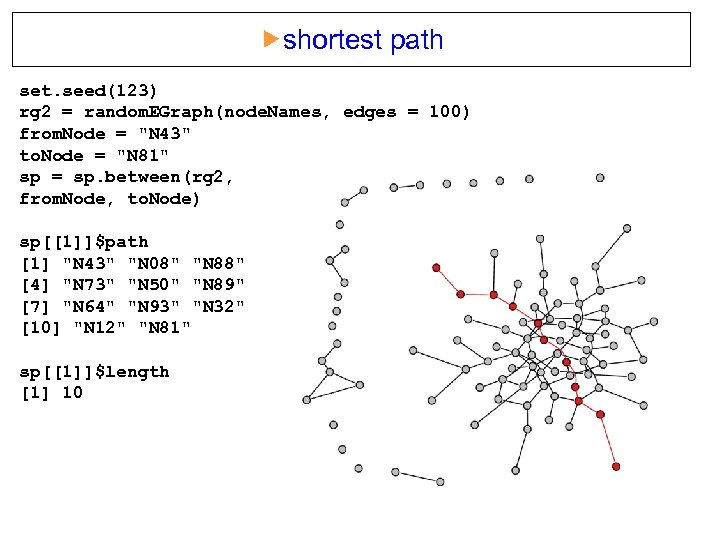
shortest path set. seed(123) rg 2 = random. EGraph(node. Names, edges = 100) from. Node = "N 43" to. Node = "N 81" sp = sp. between(rg 2, from. Node, to. Node) sp[[1]]$path [1] "N 43" "N 08" "N 88" [4] "N 73" "N 50" "N 89" [7] "N 64" "N 93" "N 32" [10] "N 12" "N 81" sp[[1]]$length [1] 10 1
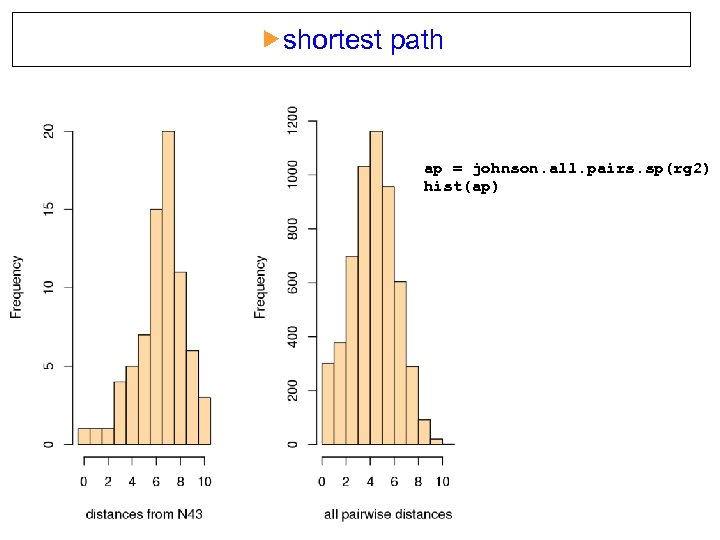
shortest path ap = johnson. all. pairs. sp(rg 2) hist(ap)
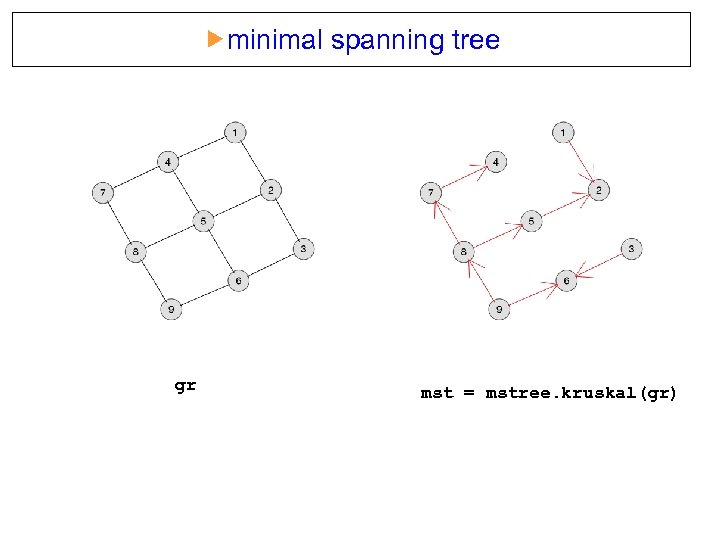
minimal spanning tree gr mst = mstree. kruskal(gr)
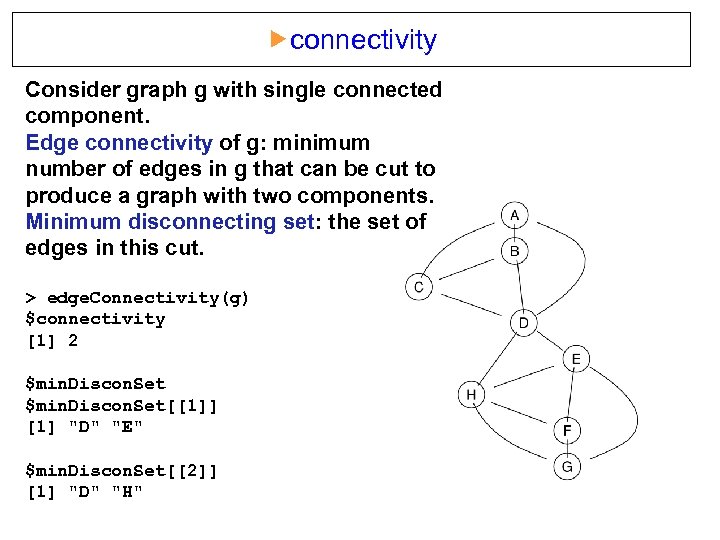
connectivity Consider graph g with single connected component. Edge connectivity of g: minimum number of edges in g that can be cut to produce a graph with two components. Minimum disconnecting set: the set of edges in this cut. > edge. Connectivity(g) $connectivity [1] 2 $min. Discon. Set[[1]] [1] "D" "E" $min. Discon. Set[[2]] [1] "D" "H"
Rgraphviz: the different layout engines dot: directed graphs. Works best on DAGs and other graphs that can be drawn as hierarchies. neato: undirected graphs using ’spring’ models twopi: radial layout. One node (‘root’) chosen as the center. Remaining nodes on a sequence of concentric circles about the origin, with radial distance proportional to graph distance. Root can be specified or chosen heuristically.
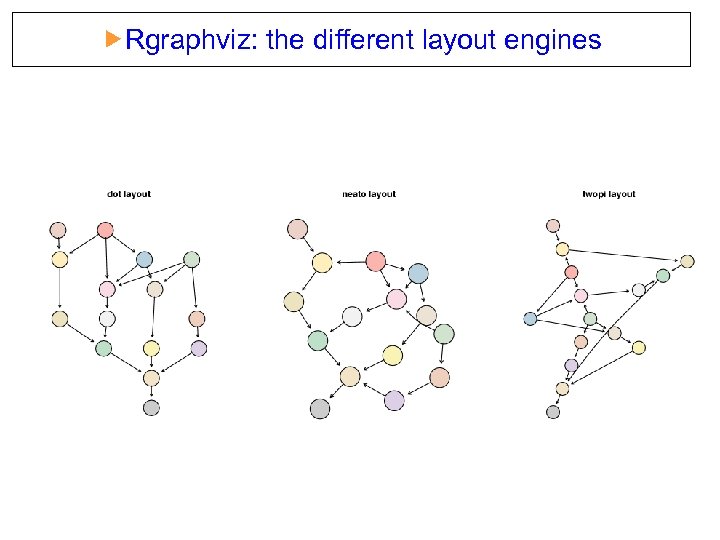
Rgraphviz: the different layout engines
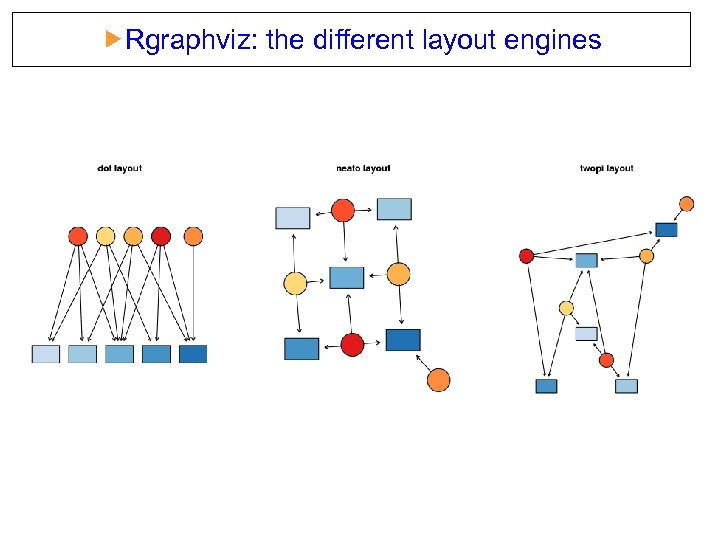
Rgraphviz: the different layout engines
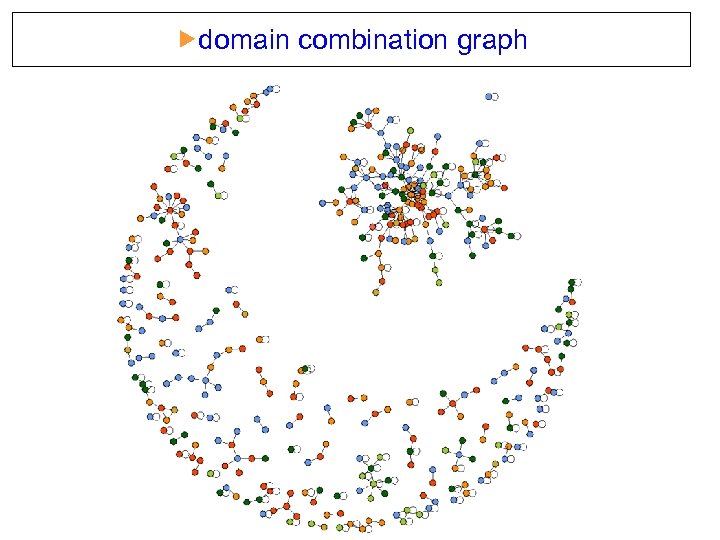
domain combination graph
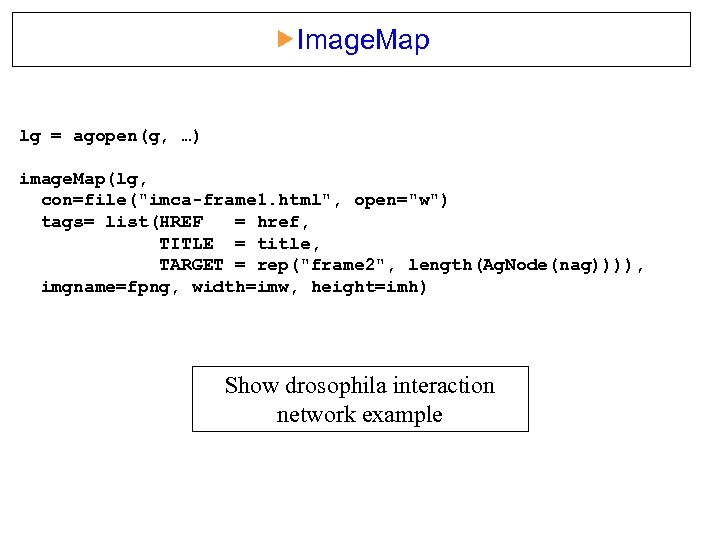
Image. Map lg = agopen(g, …) image. Map(lg, con=file("imca-frame 1. html", open="w") tags= list(HREF = href, TITLE = title, TARGET = rep("frame 2", length(Ag. Node(nag)))), imgname=fpng, width=imw, height=imh) Show drosophila interaction network example
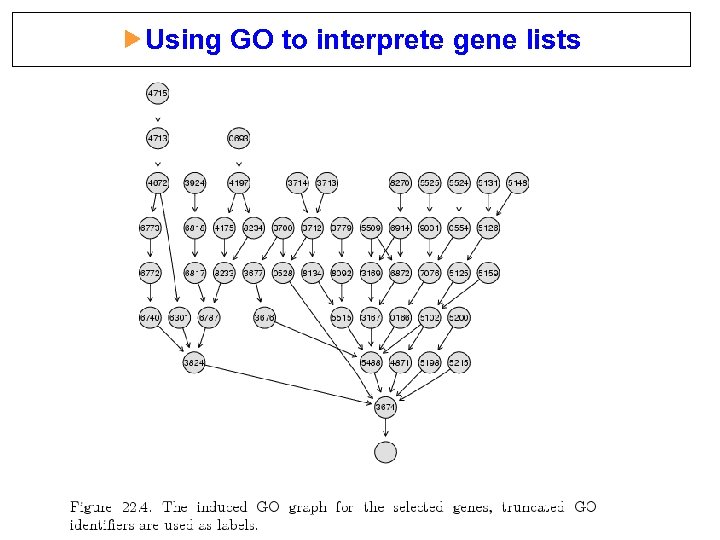
Using GO to interprete gene lists
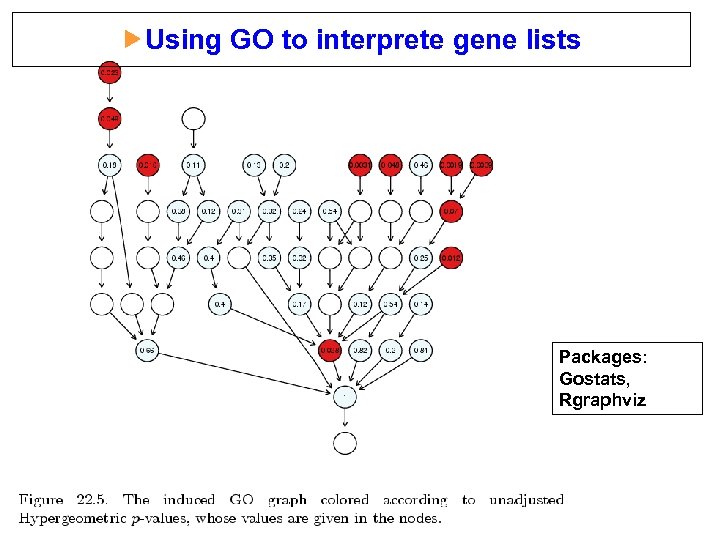
Using GO to interprete gene lists Packages: Gostats, Rgraphviz
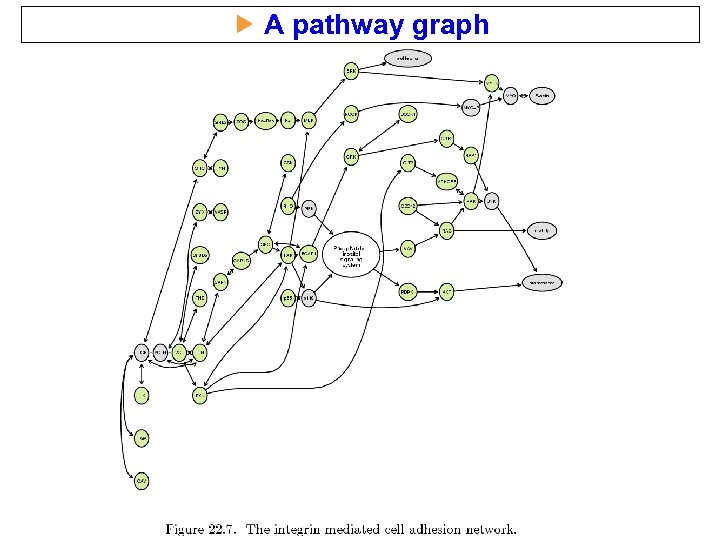
A pathway graph
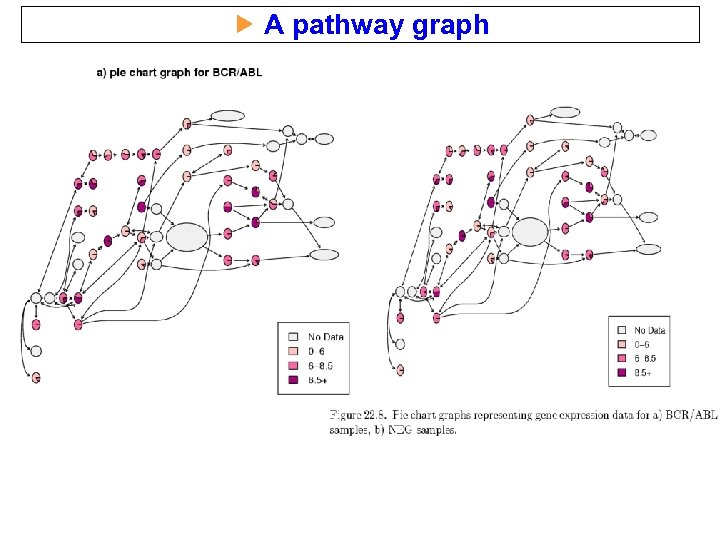
A pathway graph
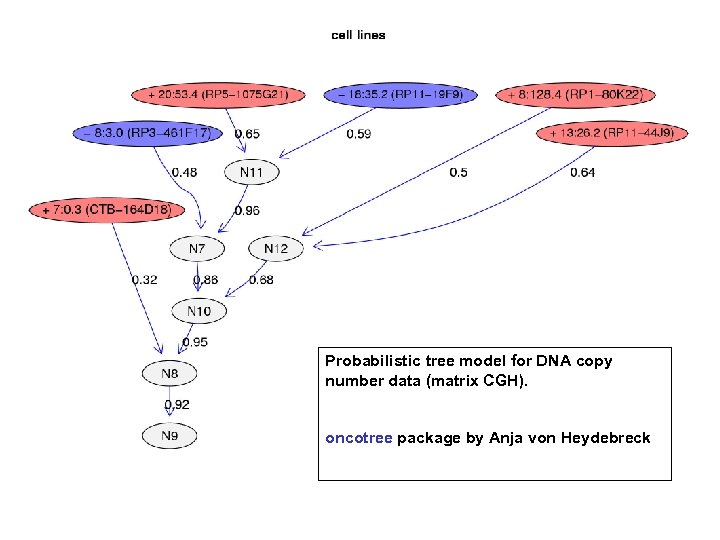
Probabilistic tree model for DNA copy number data (matrix CGH). oncotree package by Anja von Heydebreck
Acknowledgements R project: R-core team www. r-project. org Bioconductor project: Robert Gentleman, Vince Carey, Jeff Gentry, and many others www. bioconductor. org graphviz project: Emden Gansner, Stephen North, Yehuda Koren (AT&T Research) www. graphviz. org Boost graph library: Jeremy Siek, Lie-Quan Lee, Andrew Lumsdaine, Indiana University www. boost. org/libs/graph/doc
References Can a biologist fix a radio? Y. Lazebnik, Cancer Cell 2: 179 (2002) Social Network Analysis, Methods and Applications. S. Wasserman and K. Faust, Cambridge University Press (1994) Bioinformatics and Computational Biology Solutions using R and Bioconductor. R. Gentleman, V. Carey, W. Huber, R. Irizarry, S. Dudoit. Springer, available in summer 2005.
Скачать презентацию From microarrays to biological networks to graphs in
57f35b6ade33bf9c37bc3160d6841ffc.ppt