


 Скачать презентацию From Institutional Policy to Individual Practice Using Learning
2a93b5a04c2d013f05a79baea785be5b.ppt
- Количество слайдов: 25
 “From Institutional Policy to Individual Practice: Using Learning Technologies to Develop and Assess Essential Learning Skills” Sarra Saffron Powell University of Liverpool sarrasaf@liv. ac. uk
 Definitions Rationale and drivers – Sound pedagogical principles? Functionality i. Learn Grade. Mark i. Learn/Skills Diagnostic Evaluation Challenges Discussion
 Learning technologies: ‘Learning technology is the broad range of communication, information and related technologies that can be used to support learning, teaching, and assessment’ (ALT, 2011) Digital Literacies ‘a blend of ICT, media and information skills and knowledge situated within academic practice contexts while influenced by a wide range of techno-social practices involving communication, collaboration and participation in networks’ (JISC Design Studio, 2011) image from Greg. Falken. com
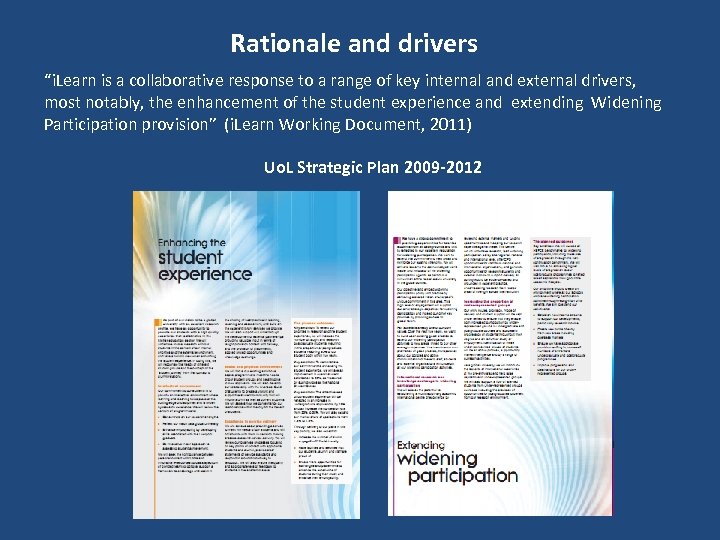 Rationale and drivers “i. Learn is a collaborative response to a range of key internal and external drivers, most notably, the enhancement of the student experience and extending Widening Participation provision” (i. Learn Working Document, 2011) Uo. L Strategic Plan 2009 -2012
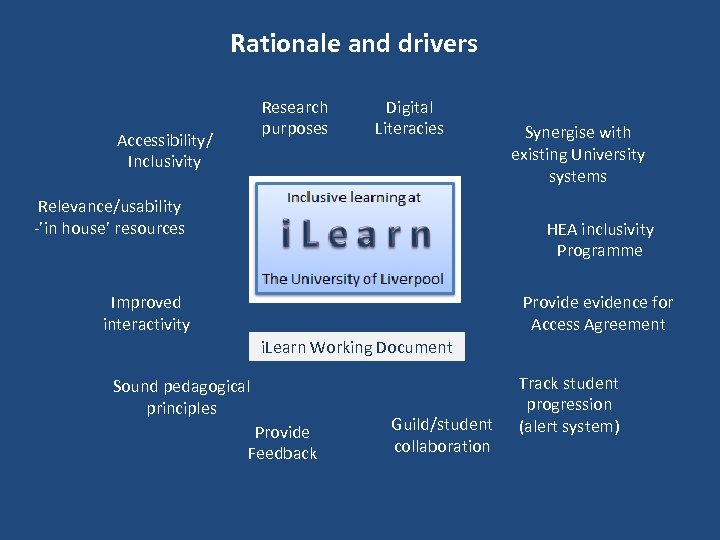 Rationale and drivers Research purposes Accessibility/ Inclusivity Digital Literacies Relevance/usability -’in house’ resources Synergise with existing University systems HEA inclusivity Programme Improved interactivity Provide evidence for Access Agreement i. Learn Working Document Sound pedagogical principles Provide Feedback Guild/student collaboration Track student progression (alert system)
 Rationale and drivers- Sound pedagogical principles? Enhancing the student experience: (Yorke and Longdon 2008) • Range of institutional activities that improve student success: Commitment to student learning and hence student engagement; Placing emphasis on the first year experience (including provision of resources); Systematically monitoring student achievement and acting on the evidence thereby collated • Tracks student progression • Extended induction (Uo. L Strategy Review)
 Rationale and drivers Accessibility/Inclusivity: • Uo. L: a top Russell Group WP provision evidence for Access Agreement increased external governance (Cable and Willetts, 2011); • HEA Inclusive Cultures Programme – institutional commitment; Relevance/usability of resources ‘in-house’: • Subject specific activities improve confidence, criticality and self-reflection in learner (Allen and Clarke 2007, Wingate 2006) • Improved interactivity; • Clarity and relevance for learner (Reeves et al, 2002) Feedback provision: Guild/student collaboration: Responding to the student voice Quality, timely, detailed and relevant (Gibbs and Simpson 2004) significantly enhances the student learning experience (Sadler 1983, Biggs 2003) if it is articulated in a way matches the students’ level of sophistication and understanding (Glover and Brown, 2006)
 Rationale and drivers Synergise with existing University systems: Development of Online Planner; i. Teach; Grade. Mark; Student Learning Journey, (Curricula/co-curricula and extra-curricula developments); Curriculum Review; HEAR ; PDP; e. Learning Strategy; Skills and Learning Strategy (“promoting flexibility and personalisation of learning to support progression”); Careers and Employability (shared repository); Informed by the Graduate Skills Agenda; CDS mobile learning – support learners’ use of personal technologies (Beetham et al 2009) Developing Digital Literacies Programme. . .
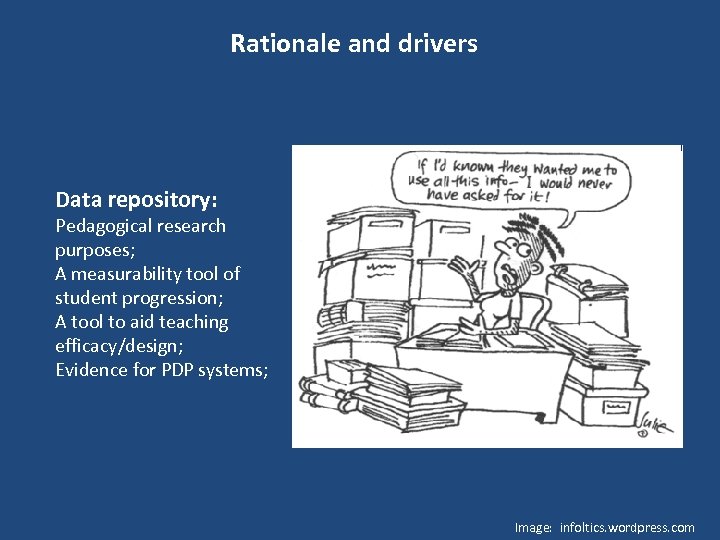 Rationale and drivers Data repository: Pedagogical research purposes; A measurability tool of student progression; A tool to aid teaching efficacy/design; Evidence for PDP systems; Image: infoltics. wordpress. com
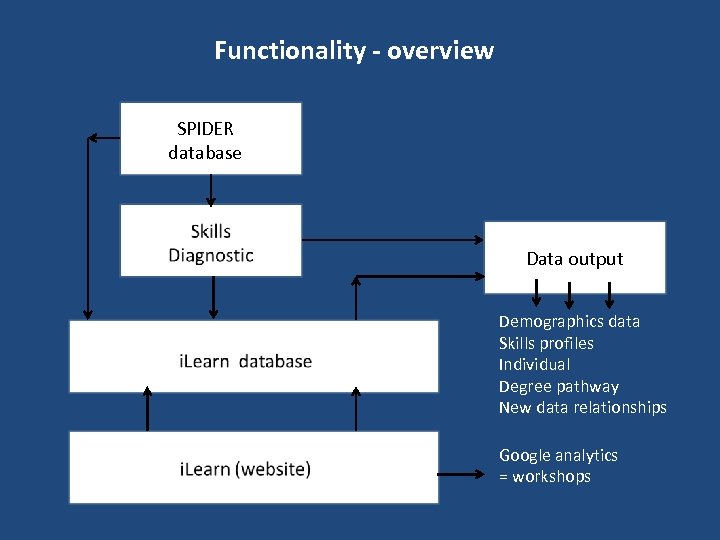 Functionality - overview SPIDER database Data output Demographics data Skills profiles Individual Degree pathway New data relationships Google analytics = workshops
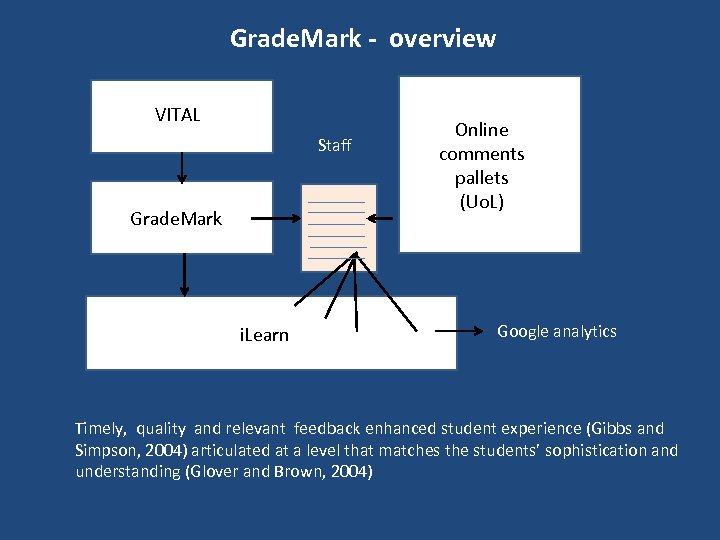 Grade. Mark - overview VITAL Staff Grade. Mark i. Learn Online comments pallets (Uo. L) Google analytics Timely, quality and relevant feedback enhanced student experience (Gibbs and Simpson, 2004) articulated at a level that matches the students’ sophistication and understanding (Glover and Brown, 2004)
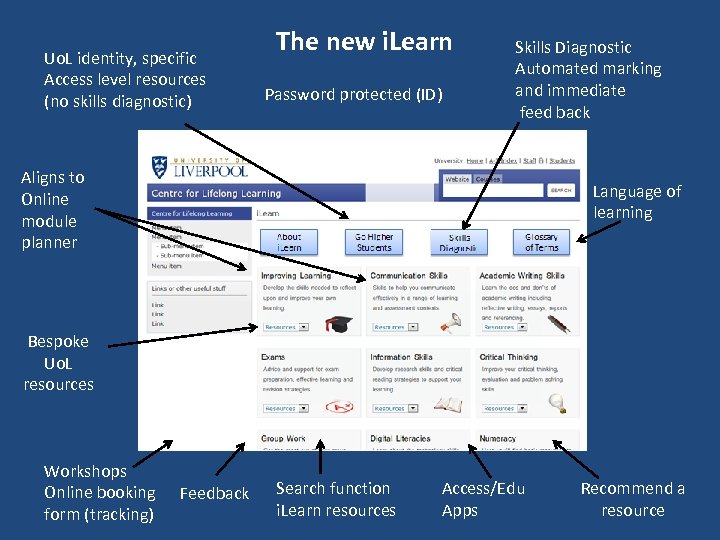 Uo. L identity, specific Access level resources (no skills diagnostic) The new i. Learn Password protected (ID) Skills Diagnostic Automated marking and immediate feed back Aligns to Online module planner Language of learning Bespoke Uo. L resources Workshops Online booking form (tracking) Feedback Search function i. Learn resources Access/Edu Apps Recommend a resource
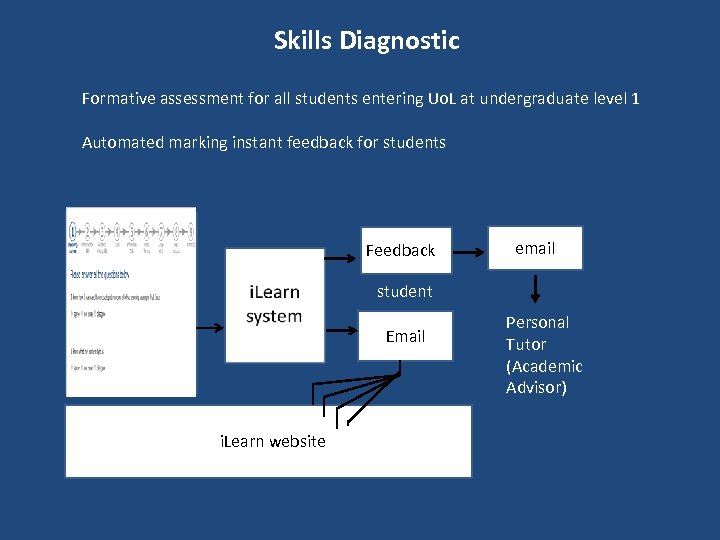 Skills Diagnostic Formative assessment for all students entering Uo. L at undergraduate level 1 Automated marking instant feedback for students Feedback email student Email i. Learn website Personal Tutor (Academic Advisor)
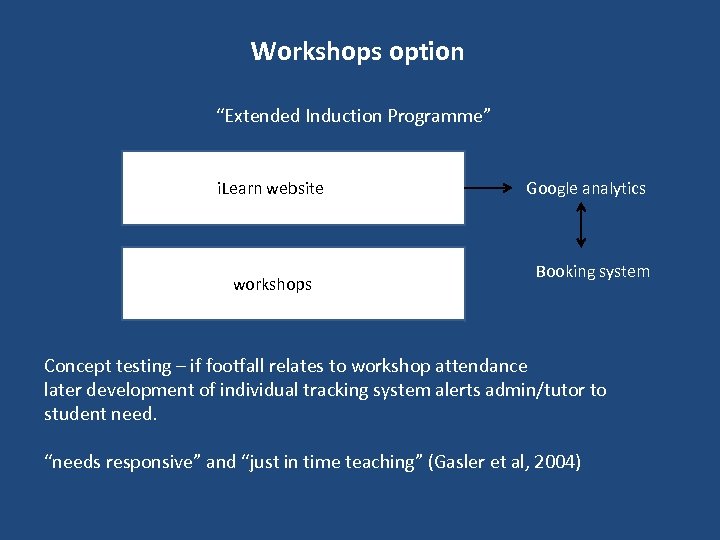 Workshops option “Extended Induction Programme” i. Learn website workshops Google analytics Booking system Concept testing – if footfall relates to workshop attendance later development of individual tracking system alerts admin/tutor to student need. “needs responsive” and “just in time teaching” (Gasler et al, 2004)
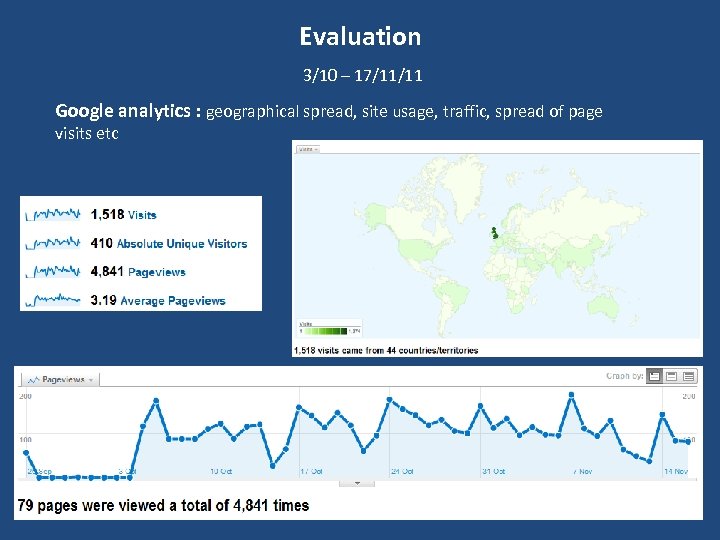 Evaluation 3/10 – 17/11/11 Google analytics : geographical spread, site usage, traffic, spread of page visits etc
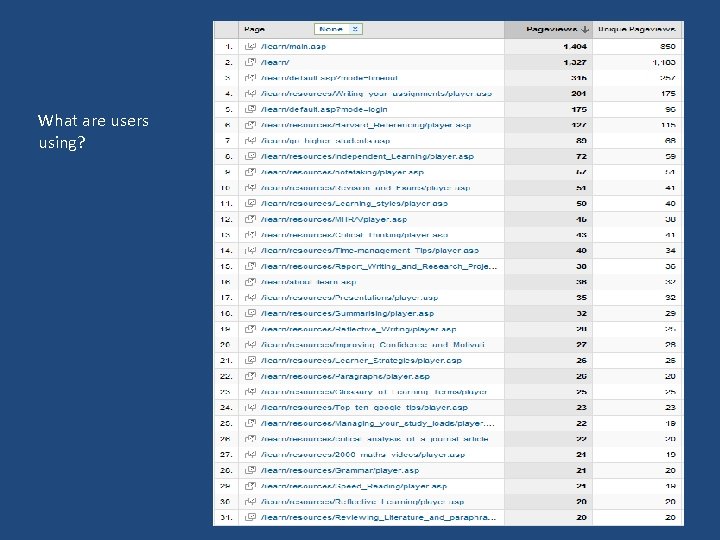 Evaluation What are users using?
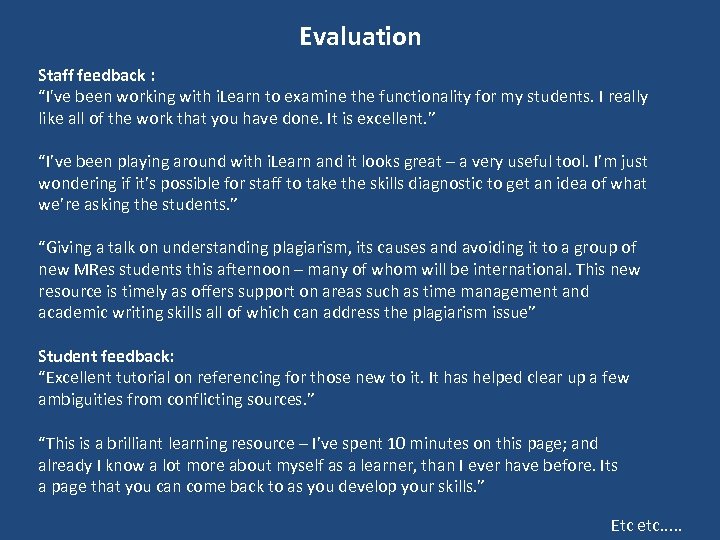 Evaluation Staff feedback : “I've been working with i. Learn to examine the functionality for my students. I really like all of the work that you have done. It is excellent. ” “I’ve been playing around with i. Learn and it looks great – a very useful tool. I’m just wondering if it’s possible for staff to take the skills diagnostic to get an idea of what we’re asking the students. ” “Giving a talk on understanding plagiarism, its causes and avoiding it to a group of new MRes students this afternoon – many of whom will be international. This new resource is timely as offers support on areas such as time management and academic writing skills all of which can address the plagiarism issue” Student feedback: “Excellent tutorial on referencing for those new to it. It has helped clear up a few ambiguities from conflicting sources. ” “This is a brilliant learning resource – I’ve spent 10 minutes on this page; and already I know a lot more about myself as a learner, than I ever have before. Its a page that you can come back to as you develop your skills. ” Etc etc. . .
 Future Evaluation • Focus groups: to explore relevance usability; • Further rounds of student consultation with Guild Reps; • Questionnaires; • Mapping Entry profiles to exit points; • JISC evaluation toolkit.
 Challenges Image: j. king
 Challenges • Articulate package can be troublesome. . . • Problems with functionality in networked computer systems; • Personal incompetence: overwriting files • Problems of identifying where data is held • Accessing Uo. L databases • Data protection and confidentiality issues • Volume of resources required • Maintenance/updating • Copy write and permissions take time • Compatibility Articulate and mac systems (flash issues)
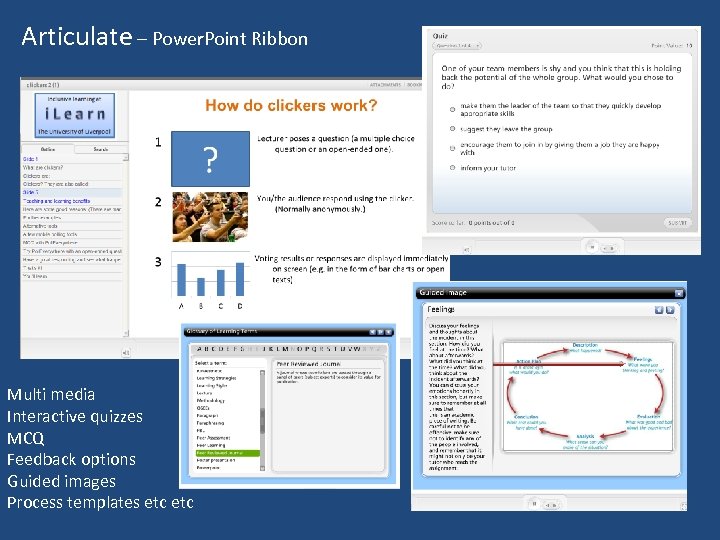 Articulate – Power. Point Ribbon Multi media Interactive quizzes MCQ Feedback options Guided images Process templates etc
 SEDA 2 011 SEDA Delegate pack 2011 Thank you for listening. Fiddled Image: off themark
 Discussion points • Questions? • In what ways might your institution’s strategies and policies be used to support collaboration in the use of technologies? • What are meaningful ways of evaluating the efficacy of online coaching and skills development tools?
![Reference List ALT (2011), http: //www. alt. ac. uk/ [accessed 11/11/11] Allen J and](https://present5.com/presentation/2a93b5a04c2d013f05a79baea785be5b/image-24.jpg "Reference List ALT (2011), http: //www. alt. ac. uk/ [accessed 11/11/11] Allen J and") Reference List ALT (2011), http: //www. alt. ac. uk/ [accessed 11/11/11] Allen J and Clarke K, (2007) Nurturing supportive learning environments in Higher Education through the teaching of study skills: to embed or not to embed? International Journal of Teaching and Learning in Higher Education, 19 (1), pp. 64 -67, http: //www. isetl. org/ijtlhe [accessed 21/01/2011] Beetham H, Mc. Gill L, and Little. John A, (2009) Thriving in the 21 st Century: Learning Literacies and the Digital Age (LLi. DA project), The Caledonian Academy, Glasgow Caledonian University, http: //www. jisc. ac. uk/media/documents/projects/llidareportjune 2009. pdf [accessed 10/02/2011] Biggs J, (2006) Teaching for Quality Learning at University, OUP, Berkshire Cable V, and Willetts D, (2011) Guidance to the Director of Fair Access, Issued by Secretary of State for Business, Innovation and Skills and Minister for Universities and Science http: //www. bis. gov. uk/assets/biscore/higher-education/docs/g/11 -728 -guidance-to-directorfair-access [accessed 4/03/2011] Glover C, and Brown E, (2006) Written Feedback for Students: too much, too detailed or too incomprehensible to be effective? http: //www. bioscience. heacademy. ac. uk/journal/vol 7/beej -7 -3. pdf [accessed 23/02/2011] Gassler G, Hug T, and Glahn T (2004) Integrated Micro Learning - An outline of the basic method and first results, http: //www. ro. feri. uni-mb. si/razno/icl 2004/pdf/gassler. pdf [accessed 21/02/2011]
Reference List ALT (2011), http: //www. alt. ac. uk/ [accessed 11/11/11] Allen J and Clarke K, (2007) Nurturing supportive learning environments in Higher Education through the teaching of study skills: to embed or not to embed? International Journal of Teaching and Learning in Higher Education, 19 (1), pp. 64 -67, http: //www. isetl. org/ijtlhe [accessed 21/01/2011] Beetham H, Mc. Gill L, and Little. John A, (2009) Thriving in the 21 st Century: Learning Literacies and the Digital Age (LLi. DA project), The Caledonian Academy, Glasgow Caledonian University, http: //www. jisc. ac. uk/media/documents/projects/llidareportjune 2009. pdf [accessed 10/02/2011] Biggs J, (2006) Teaching for Quality Learning at University, OUP, Berkshire Cable V, and Willetts D, (2011) Guidance to the Director of Fair Access, Issued by Secretary of State for Business, Innovation and Skills and Minister for Universities and Science http: //www. bis. gov. uk/assets/biscore/higher-education/docs/g/11 -728 -guidance-to-directorfair-access [accessed 4/03/2011] Glover C, and Brown E, (2006) Written Feedback for Students: too much, too detailed or too incomprehensible to be effective? http: //www. bioscience. heacademy. ac. uk/journal/vol 7/beej -7 -3. pdf [accessed 23/02/2011] Gassler G, Hug T, and Glahn T (2004) Integrated Micro Learning - An outline of the basic method and first results, http: //www. ro. feri. uni-mb. si/razno/icl 2004/pdf/gassler. pdf [accessed 21/02/2011]
 Hughes S, (2011) Simon Hughes MP, Advocate for Access to Education and Liberal Democrat Deputy Leader, http: //www. simonhughes. org. uk/en/article/2011/455211/simon-hughes-oxfordcambridge-must-widen-access-to-charge-higher-fees [accessed 23/02/2011] JISC Design Studio (2011) Digital Literacies Anatomy http: //jiscdesignstudio. pbworks. com/w/file/40474828/Digital%20 literacies%20 anatomy. pdf [accessed 28/09/11] Reeves T. C, Herrington J, and Oliver R, (2002) Authentic activities and online learning, http: //elrond. scam. ecu. edu. au/oliver/2002/Reeves. pdf [accessed 25/02/2011] Wingate U, (2006) Doing away with Study Skills, Teaching in Higher Education, Vol 11 (4) pp. 417469 http: //basicskills. edublogs. org/files/2008/06/doing-20 away-20 with-20 -27 study-20 skills 27. pdf [accessed 23/02/2011] Yorke M, and Longden B, (2008) The first year experience of Higher Education in the UK: Final Report, Higher Education Academy