


 Скачать презентацию From Hazard Control to Risk Control — A
1233ddc1f47154304b444d920d491ef9.ppt
- Количество слайдов: 11
 From Hazard Control to Risk Control - A Paradigm Shift in the National OHS Policy Shuh Woei Yu Graduate Institute of Environmental Engineering National Central University 1
 Presentation Outline • Realignment of the National OSH Policy • The Management System-based National Policy • The Risk Assessment Process • Challenges of OH&S Risk Assessment • Conclusion 2
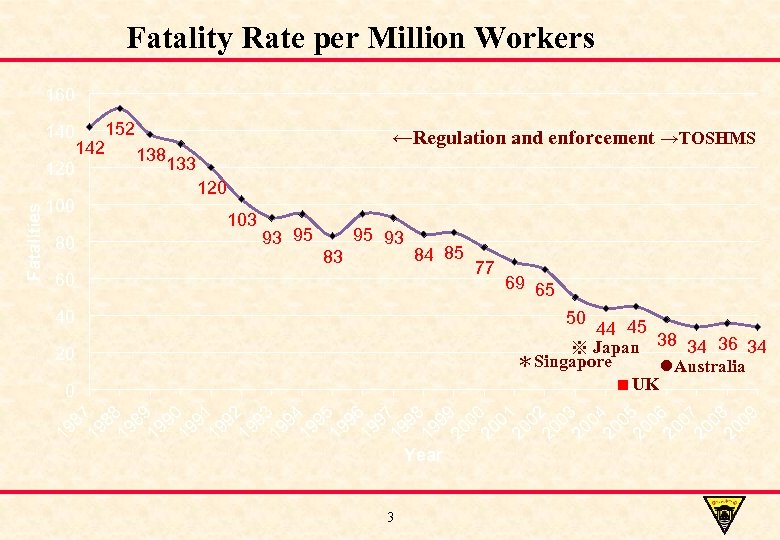 Fatality Rate per Million Workers 160 100 80 ←Regulation and enforcement →TOSHMS 120 103 93 95 83 95 93 84 85 60 40 77 69 65 50 44 45 ※ Japan 38 34 36 34 *Singapore l. Australia UK 20 0 19 87 19 88 19 89 19 90 19 91 19 92 19 93 19 94 19 95 19 96 19 97 19 98 19 99 20 00 20 01 20 02 20 03 20 04 20 05 20 06 20 07 20 08 20 09 Fatalities 152 140 142 138 133 120 Year 3
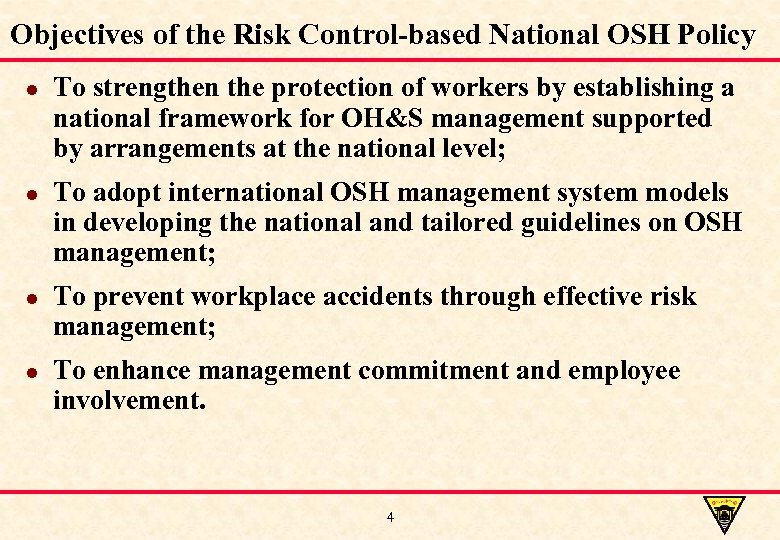 Objectives of the Risk Control-based National OSH Policy l l To strengthen the protection of workers by establishing a national framework for OH&S management supported by arrangements at the national level; To adopt international OSH management system models in developing the national and tailored guidelines on OSH management; To prevent workplace accidents through effective risk management; To enhance management commitment and employee involvement. 4
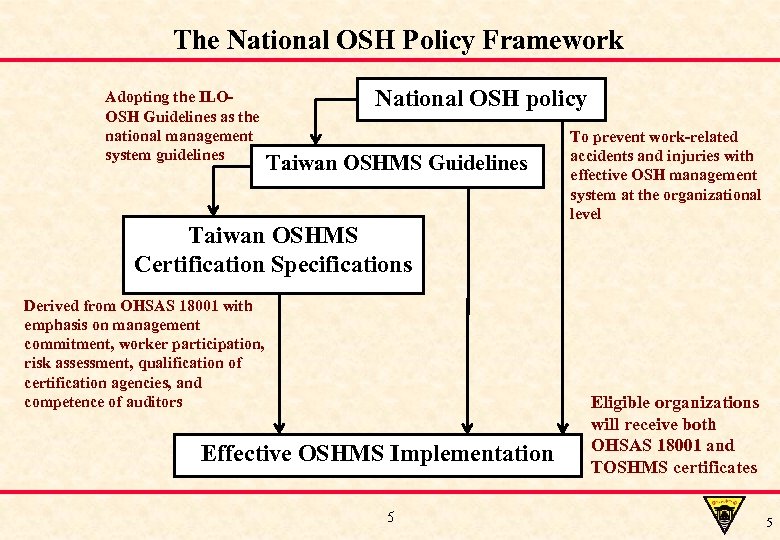 The National OSH Policy Framework Adopting the ILOOSH Guidelines as the national management system guidelines National OSH policy Taiwan OSHMS Guidelines Taiwan OSHMS Certification Specifications Derived from OHSAS 18001 with emphasis on management commitment, worker participation, risk assessment, qualification of certification agencies, and competence of auditors Effective OSHMS Implementation 5 To prevent work-related accidents and injuries with effective OSH management system at the organizational level Eligible organizations will receive both OHSAS 18001 and TOSHMS certificates 5
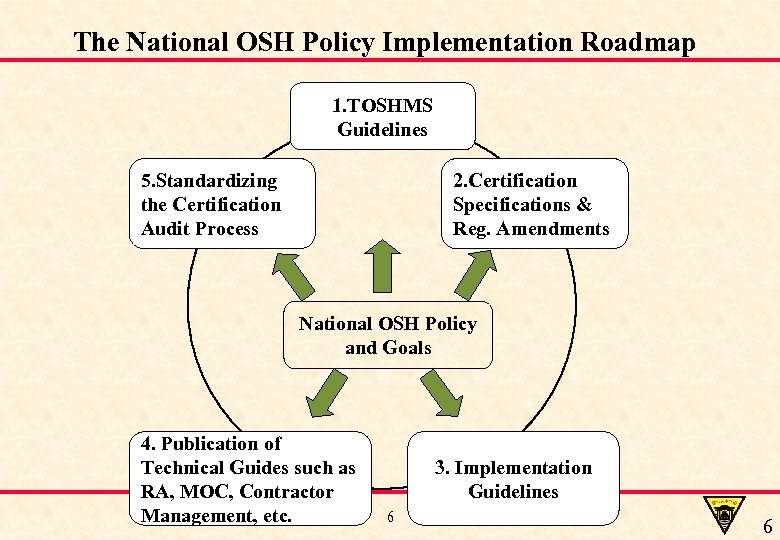 The National OSH Policy Implementation Roadmap 1. TOSHMS Guidelines 5. Standardizing the Certification Audit Process 2. Certification Specifications & Reg. Amendments National OSH Policy and Goals 4. Publication of Technical Guides such as RA, MOC, Contractor Management, etc. 3. Implementation Guidelines 6 6
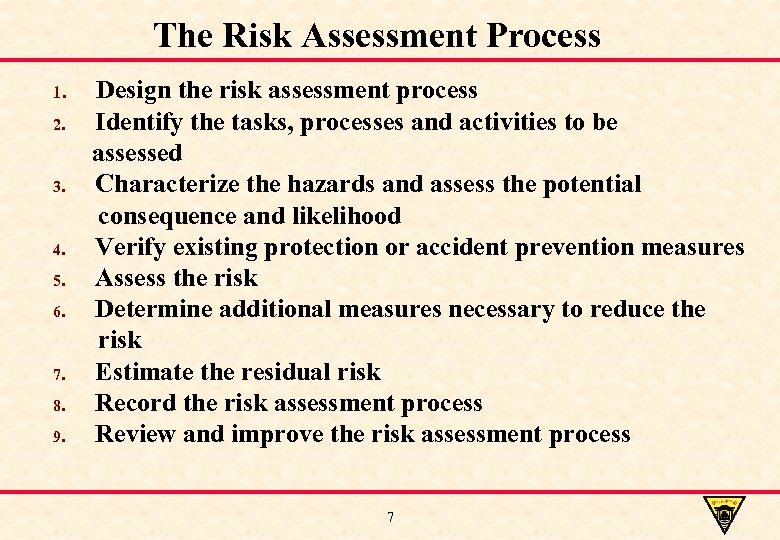 The Risk Assessment Process 1. 2. 3. 4. 5. 6. 7. 8. 9. Design the risk assessment process Identify the tasks, processes and activities to be assessed Characterize the hazards and assess the potential consequence and likelihood Verify existing protection or accident prevention measures Assess the risk Determine additional measures necessary to reduce the risk Estimate the residual risk Record the risk assessment process Review and improve the risk assessment process 7
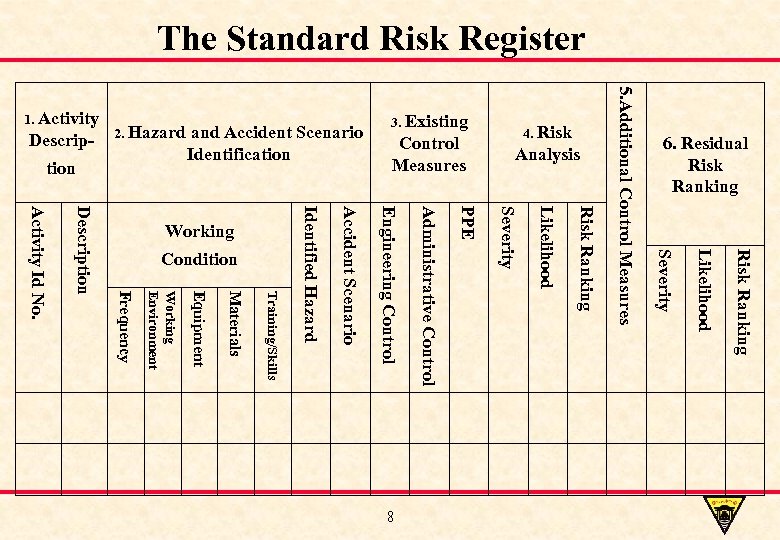 The Standard Risk Register tion Risk Ranking Likelihood Severity Condition Training/Skills Materials Equipment Working Environment Frequency Activity Id No. Description Working Identified Hazard Accident Scenario Engineering Control Administrative Control PPE Severity Likelihood Risk Ranking 5. Additional Control Measures Descrip- 8 6. Residual Risk Ranking Analysis Control Measures 4. Risk 3. Existing and Accident Scenario Identification 2. Hazard 1. Activity
 Challenges of OH&S Risk Management l Lack of proper use of risk criteria Ø the overuse of risk matrix Ø risk criteria not defined prior to risk assessment Ø not fully understanding the ALARP principle l Lack of well-defined procedures for hazard identification Ø mostly conducted based on assessor’s experiences Ø Ø failure to integrate Job Safety Analysis principles with hazard identification no well documented methodologies 9
 Challenges of OH&S Risk Management (cont’d) l Insufficient in-house expertise and past accident history Ø over reliance on generic methodologies Ø lack of past incident and accident database Ø subjectivity of risk assessors Ø lack of consideration of human factors l Inappropriate risk scenario identification Ø limited experience in incident investigation Ø improper handling or not fully understanding the effect of uncertainty 10
 Conclusion l l Recognition of the fact that regulations alone cannot prevent accidents by the Council of Labor Affairs is certainly a critical step toward upgrading Taiwan’s OH&S management standard to the international level. The risk management process is a core element of and is critical to the success of TOSHMS. Therefore, capacity building for risk assessment and risk control is a priority task to most Taiwanese organizations. 11