


 Скачать презентацию From financial options to real options 4 Financing
eba769d648fcb920d1672218bcad9759.ppt
- Количество слайдов: 20
 From financial options to real options 4. Financing real options Prof. André Farber Solvay Business School ESCP March 10, 2000 Financing real options 1
 Financing new ventures: • For new ventures, financing needs are greater than initial capital available. • Outside financing required? How? – Debt ? principal source of outside financing for companies. – Equity ? – Convertible bonds (or bonds with warrants)? • An example: • Current value of company : 80, no debt, 100 shares • Financing needed: 70 Financing real options 2
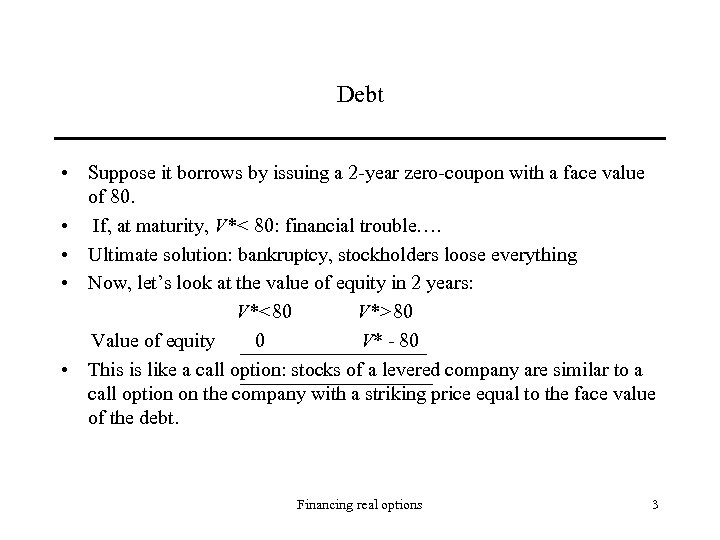 Debt • Suppose it borrows by issuing a 2 -year zero-coupon with a face value of 80. • If, at maturity, V*< 80: financial trouble…. • Ultimate solution: bankruptcy, stockholders loose everything • Now, let’s look at the value of equity in 2 years: V*<80 V*>80 Value of equity 0 V* - 80 • This is like a call option: stocks of a levered company are similar to a call option on the company with a striking price equal to the face value of the debt. Financing real options 3
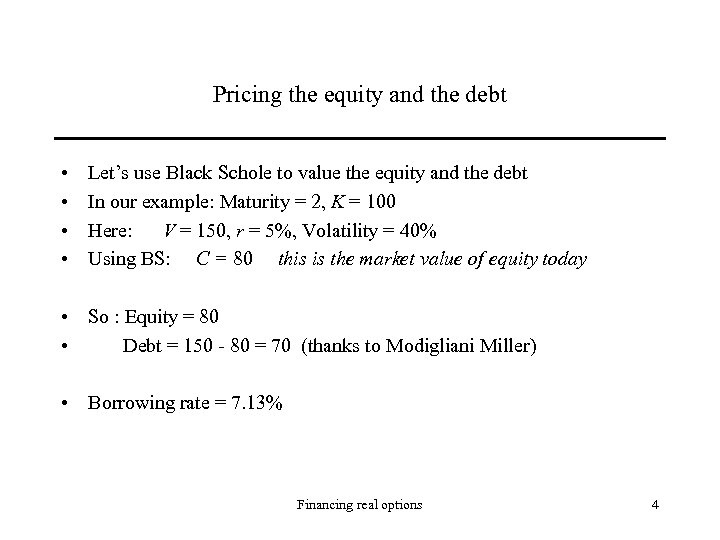 Pricing the equity and the debt • • Let’s use Black Schole to value the equity and the debt In our example: Maturity = 2, K = 100 Here: V = 150, r = 5%, Volatility = 40% Using BS: C = 80 this is the market value of equity today • So : Equity = 80 • Debt = 150 - 80 = 70 (thanks to Modigliani Miller) • Borrowing rate = 7. 13% Financing real options 4
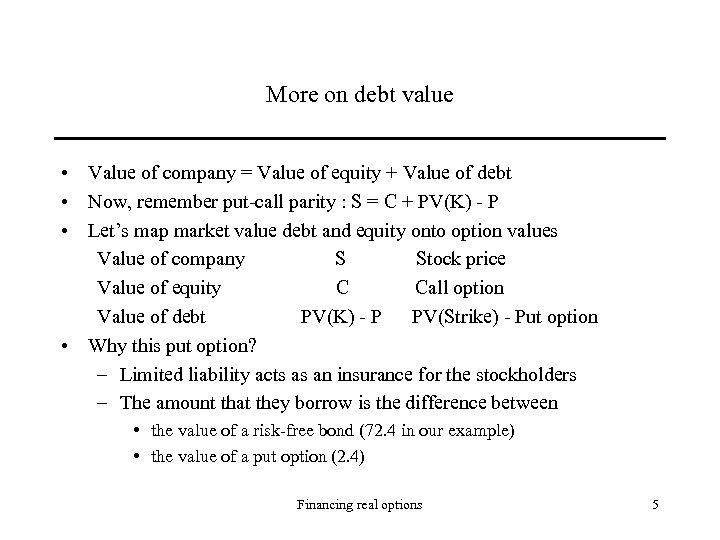 More on debt value • Value of company = Value of equity + Value of debt • Now, remember put-call parity : S = C + PV(K) - P • Let’s map market value debt and equity onto option values Value of company S Stock price Value of equity C Call option Value of debt PV(K) - P PV(Strike) - Put option • Why this put option? – Limited liability acts as an insurance for the stockholders – The amount that they borrow is the difference between • the value of a risk-free bond (72. 4 in our example) • the value of a put option (2. 4) Financing real options 5
 Agency problems related to debt • We are now in a position to better understand conflicts of interests between stockholders and bonds holders: – incentive to take large risks – incentive toward underinvestment – milking the property – increasing debt Financing real options 6
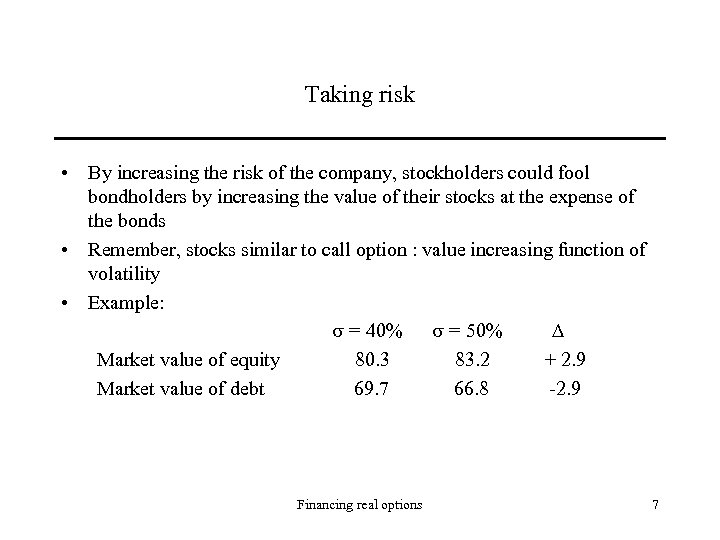 Taking risk • By increasing the risk of the company, stockholders could fool bondholders by increasing the value of their stocks at the expense of the bonds • Remember, stocks similar to call option : value increasing function of volatility • Example: = 40% = 50% Market value of equity 80. 3 83. 2 + 2. 9 Market value of debt 69. 7 66. 8 -2. 9 Financing real options 7
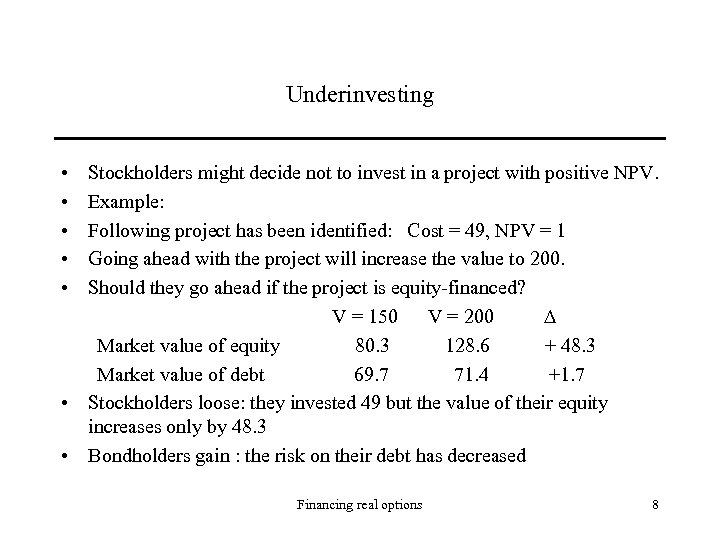 Underinvesting • • • Stockholders might decide not to invest in a project with positive NPV. Example: Following project has been identified: Cost = 49, NPV = 1 Going ahead with the project will increase the value to 200. Should they go ahead if the project is equity-financed? V = 150 V = 200 Market value of equity 80. 3 128. 6 + 48. 3 Market value of debt 69. 7 71. 4 +1. 7 • Stockholders loose: they invested 49 but the value of their equity increases only by 48. 3 • Bondholders gain : the risk on their debt has decreased Financing real options 8
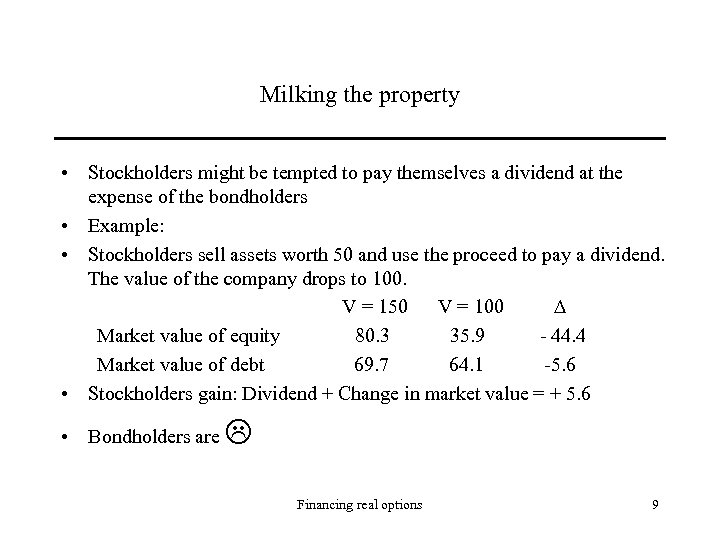 Milking the property • Stockholders might be tempted to pay themselves a dividend at the expense of the bondholders • Example: • Stockholders sell assets worth 50 and use the proceed to pay a dividend. The value of the company drops to 100. V = 150 V = 100 Market value of equity 80. 3 35. 9 - 44. 4 Market value of debt 69. 7 64. 1 -5. 6 • Stockholders gain: Dividend + Change in market value = + 5. 6 • Bondholders are Financing real options 9
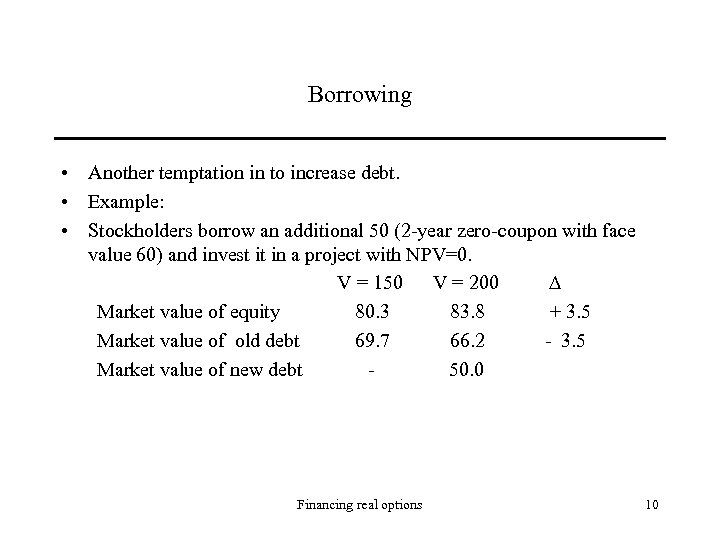 Borrowing • Another temptation in to increase debt. • Example: • Stockholders borrow an additional 50 (2 -year zero-coupon with face value 60) and invest it in a project with NPV=0. V = 150 V = 200 Market value of equity 80. 3 83. 8 + 3. 5 Market value of old debt 69. 7 66. 2 - 3. 5 Market value of new debt 50. 0 Financing real options 10
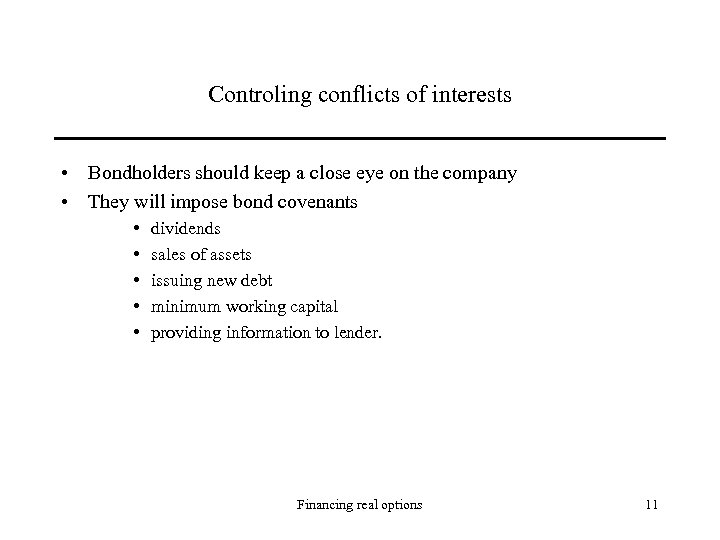 Controling conflicts of interests • Bondholders should keep a close eye on the company • They will impose bond covenants • • • dividends sales of assets issuing new debt minimum working capital providing information to lender. Financing real options 11
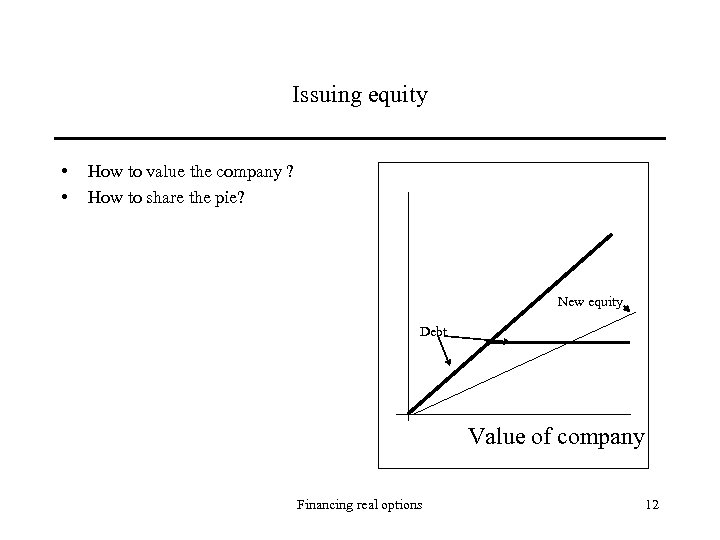 Issuing equity • • How to value the company ? How to share the pie? New equity Debt Value of company Financing real options 12
 Bonds with Warrants • Give the right to its owner to buy a number of shares issued by a firm at a price set in advance. • Issued most frequently with bonds: – Price set for the "package" : Bond + Warrants – Traded separately after issue • Similar to call option but two main differences: – 1. Warrants are issued by the company: • If exercised, new stocks. are issued – 2. Proceeds of the sale of warrant goes to company Financing real options 13
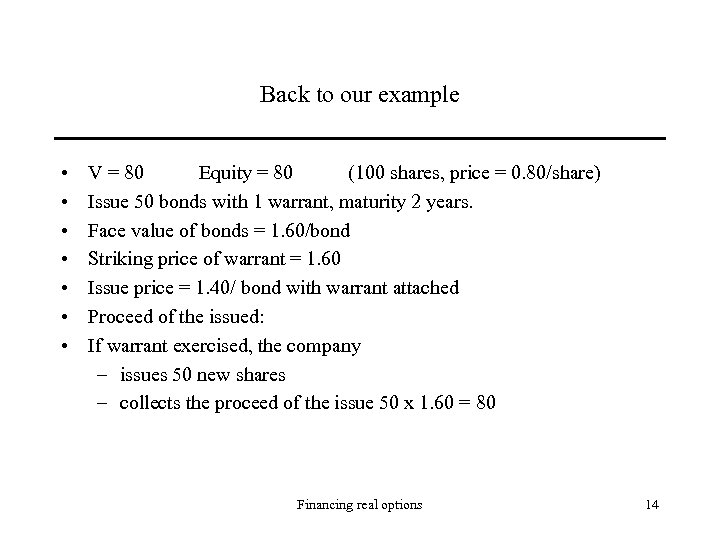 Back to our example • • V = 80 Equity = 80 (100 shares, price = 0. 80/share) Issue 50 bonds with 1 warrant, maturity 2 years. Face value of bonds = 1. 60/bond Striking price of warrant = 1. 60 Issue price = 1. 40/ bond with warrant attached Proceed of the issued: If warrant exercised, the company – issues 50 new shares – collects the proceed of the issue 50 x 1. 60 = 80 Financing real options 14
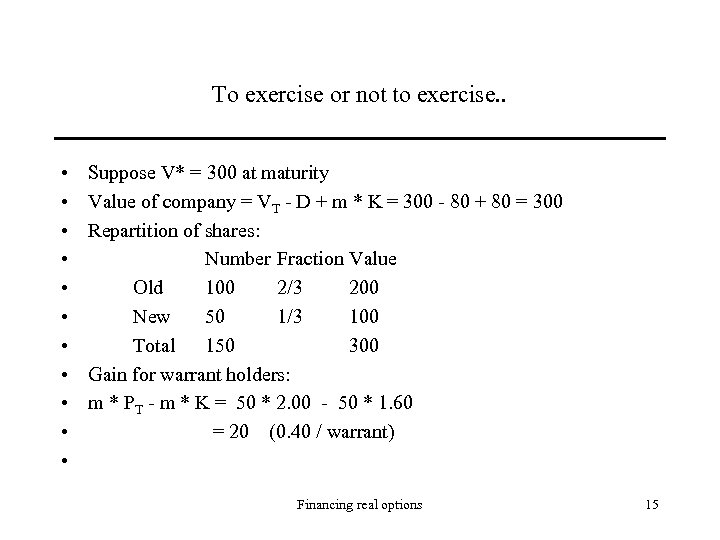 To exercise or not to exercise. . • • • Suppose V* = 300 at maturity Value of company = VT - D + m * K = 300 - 80 + 80 = 300 Repartition of shares: Number Fraction Value Old 100 2/3 200 New 50 1/3 100 Total 150 300 Gain for warrant holders: m * PT - m * K = 50 * 2. 00 - 50 * 1. 60 = 20 (0. 40 / warrant) Financing real options 15
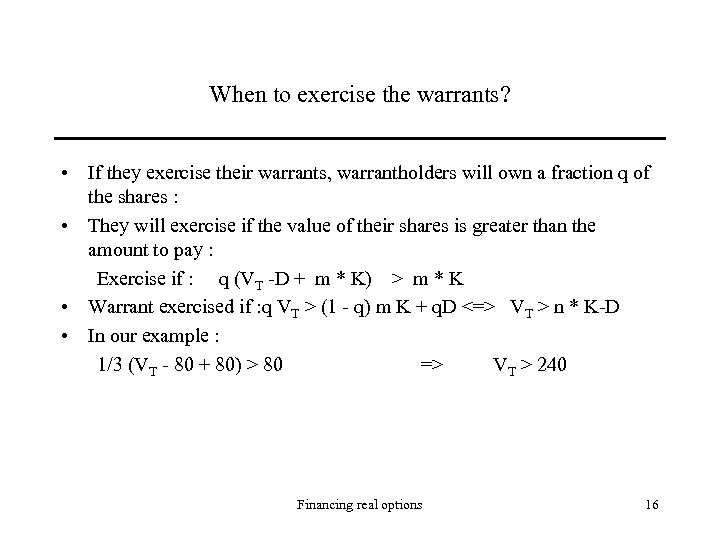 When to exercise the warrants? • If they exercise their warrants, warrantholders will own a fraction q of the shares : • They will exercise if the value of their shares is greater than the amount to pay : Exercise if : q (VT -D + m * K) > m * K • Warrant exercised if : q VT > (1 - q) m K + q. D <=> VT > n * K-D • In our example : 1/3 (VT - 80 + 80) > 80 => VT > 240 Financing real options 16
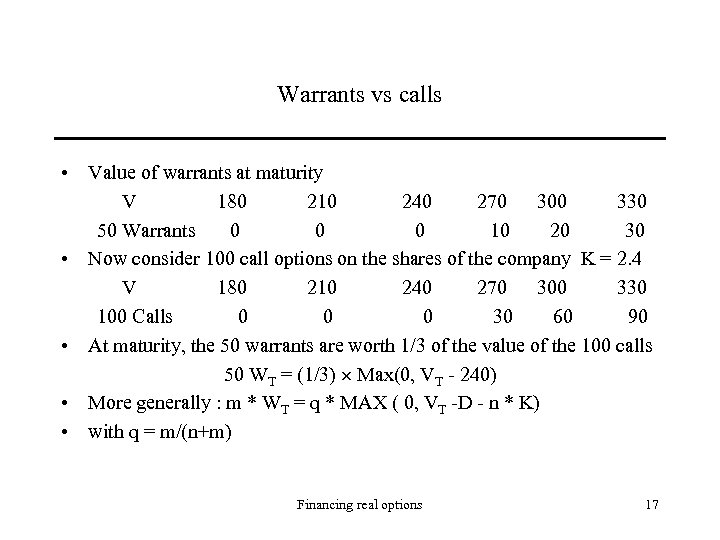 Warrants vs calls • Value of warrants at maturity V 180 210 240 270 300 330 50 Warrants 0 0 0 10 20 30 • Now consider 100 call options on the shares of the company K = 2. 4 V 180 210 240 270 300 330 100 Calls 0 0 0 30 60 90 • At maturity, the 50 warrants are worth 1/3 of the value of the 100 calls 50 WT = (1/3) Max(0, VT - 240) • More generally : m * WT = q * MAX ( 0, VT -D - n * K) • with q = m/(n+m) Financing real options 17
 Valuing a warrant • Step 1: Value n calls on the company using BS – (in our example: S=150, K=240, Maturity = 2, r = 5%, = 40%) – Value of 100 calls = 15. 41 • Step 2: Calculate value of 1 warrant by dividing by m – Value of 50 warrant = 1/3 x 15. 41 = 5. 13 – Value of 1 warrant = 5. 13/50 = 0. 10 Financing real options 18
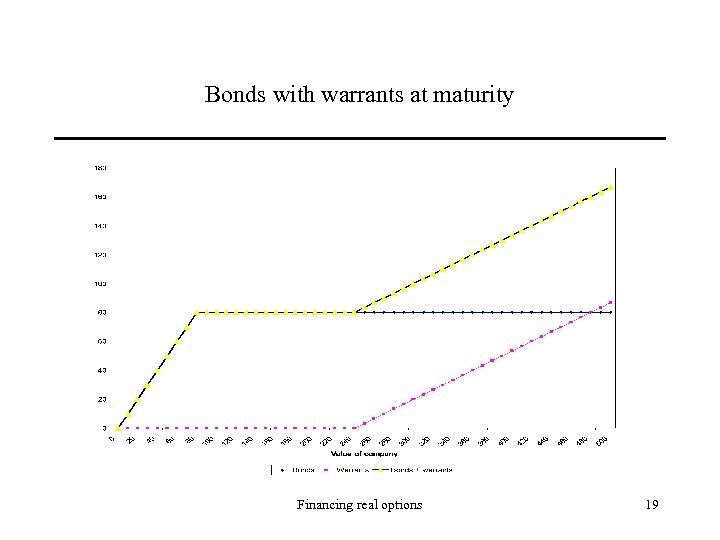 Bonds with warrants at maturity Financing real options 19
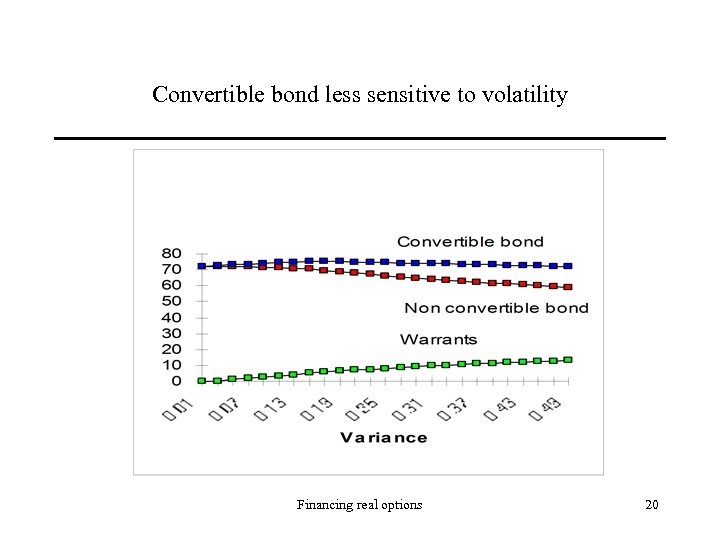 Convertible bond less sensitive to volatility Financing real options 20