


 Скачать презентацию From Classroom to Courtroom Avoiding litigation if you
80509c05afd39c6966f0622d192161d5.ppt
- Количество слайдов: 140
 From Classroom to Courtroom Avoiding litigation if you can; Protecting yourself if you can’t Candyce Pardee Udall Shumway ~ Yuma Office
 This presentation will cover n n Compliance with the law Compliance with policies, rules and regulations
 “Law? What law? I didn’t know about any law!” Not knowing the law is not a defense if you violate the law! Stay informed! n Attend training or classes; n Read informational bulletins put out by the school; n Read informational bulletins put out by the National Educational Association and the Arizona Educational Association
 Laws Affecting Schools … Federal and State laws: n n United States Constitution Arizona Constitution Family Educational Rights and Privacy Act (FERPA), 20 U. S. C. S. § 1232 g Individuals with Disabilities Education Act as Amended (IDEA; IDEAA), 20 U. S. C. S. § 1400 et. Seq. INCLUDING…
 Anti-Discrimination Laws n n n 20 U. S. C. 1401, Individuals with Disabilities Education Act 20 U. S. C. 1681, Title IX 20 U. S. C. 1703, Equal Employment Opportunity Act 29 U. S. C. 794, Rehabilitation Act 42 U. S. C. 2000, Civil Rights Act 42 U. S. C. 12101 et. Seq. Americans With Disabilities Act
 Parts of the Arizona criminal code n n n Duty to Report, A. R. S. 13 -3620 Misconduct Involving Weapons, A. R. S. 133102 (A) (12) Drug free school zone, A. R. S. 13 -3411 Interference with an Educational Institution, A. R. S. 13 -2911 Aggravated Assault, A. R. S. 13 -1204 Justification for physical force, A. R. S. 13403, 404, 406, and 408.
 And just about all of Title 15 of the Arizona legislative code… Including reporting: n Bullying n Hazing n Weapons and dangerous instruments n Drugs n Conduct that poses a threat of death or serious physical injury to students, employees and others on school property
 Violation of laws… Violation of federal laws can subject the school to liability under a “ 1983 action” And you to personal liability for depriving a person of his or her constitutional rights. Violation of either federal or state criminal statutes can subject you to: n Criminal penalties n Civil penalties n Discipline, up to and including termination n And potential loss of teaching certification
 Easy Mistakes to Make FERPA violations… n n n Discussing your students with family members or friends Discussing students in the grocery store or other place where others can overhear Posting grades with students’ names or allowing students to check their grades in your grade book where they can see other student’s names and grades
 School is like VEGAS… What happens in school, STAYS in school n *GOOD NEWS—you can still have peers grade each other’s papers Owasso Indep. Sch. Dist. No. I-011 v. Falvo, 534 US 426 (2002)
 Easy Mistakes on Duty to Report n n “It was just little kids fighting, I didn’t think it was a big deal!” “I thought the (nurse, principal, counselor, someone else) was going to report it. ” “I thought that since the kid was special ed, that the duty to report didn’t count. ” “I didn’t know FOR SURE that it really happened—I mean, I didn’t actually see it happen and this kid could be lying. ”
 Attorney General Opinion I 07 -006 (R 06 -012) n n What is meant by “physical injury”? Does duty to report include non-accidental injuries that are just a bruise, cut or scratch? Must a teacher report a non-accidental injury caused during a fight or horseplay between students? If a child with disabilities who lacks the cognitive ability to control his behavior or understand right from wrong causes the injury, must it be reported?
 n n If an employee forms a reasonable belief that the child has suffered abuse early in the school day, may the duty to “immediately” report be satisfied by a report before the end of the school day? Does the duty to report end if the employee has a reasonable belief or knows that another employee has previously reported the event?
 And the answers are…
 What is meant by “physical injury”? Impairment of physical condition and includes: n Skin bruising n Pressure sores n Bleeding n Failure to thrive n Malnutrition n Dehydration
 Burns n Fracture of any bone n Subdural hematoma n Soft tissue swelling n Injury to any internal organ n Or any physical condition that imperils health or welfare The injury need not be serious or life threatening. n
 Does duty to report include nonaccidental injuries that are just a bruise, cut or scratch? n n Yes, for bruising. Yes, for cuts and scratches, if they are accompanied by any bleeding.
 Do you have to report injuries from student fights or horseplay? n Yes. “Labels such as ‘horseplay’ or school yard ‘fights’ are imprecise and cannot be used as a litmus test to dismiss the reporting obligation where the conduct fairly falls within the statute. ”
 If a child with disabilities who lacks the cognitive ability to control his behavior or understand right from wrong causes the injury, must it be reported? n Yes. “From the injured child’s point of view, it makes little difference whether a perpetrator has the cognitive ability to control or appreciate his conduct. Indeed, such lack of control or understanding may make the situation more likely to reoccur. ”
 What does “immediate” mean? ? n n Time is of the essence…if a school employee forms a reasonable belief of abuse early in the school day, the statute “would require the teacher to make a report, or cause the report to be made, as soon as possible. ” “In short, to comply with the reporting statute, a covered person should make the required report immediately and without delay as soon as the person forms a reasonable belief that a child has been abused. ”
 Does the duty to report end if the employee has a reasonable belief or knows that another employee has previously reported the event? n n “Specific knowledge that the incident has been reported by another caregiver satisfies this obligation. Mere belief without verification is insufficient. ” So, the question is…do ya’ feel lucky? Or, more to the point, are you willing to bet your license on it?
 REPORT!
 Why? ? n n n Failure to report child abuse, physical injury or neglect can result in a school employee being charged with a class 1 misdemeanor. Failure to report a sexual offense can result in a school employee being charged with a class 6 felony. Teachers and administrators can also lose certification, EVEN IF NO CRIMINAL CHARGES ARE BROUGHT!!
 REPORT!!! DON’T BE THAT GUY!
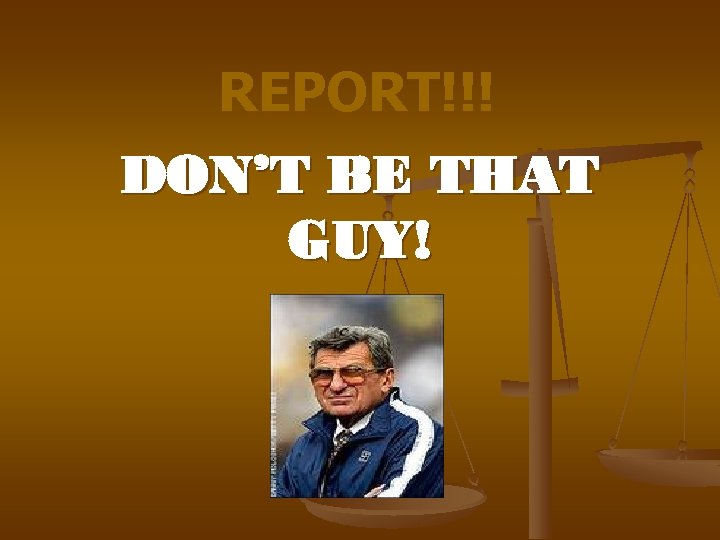
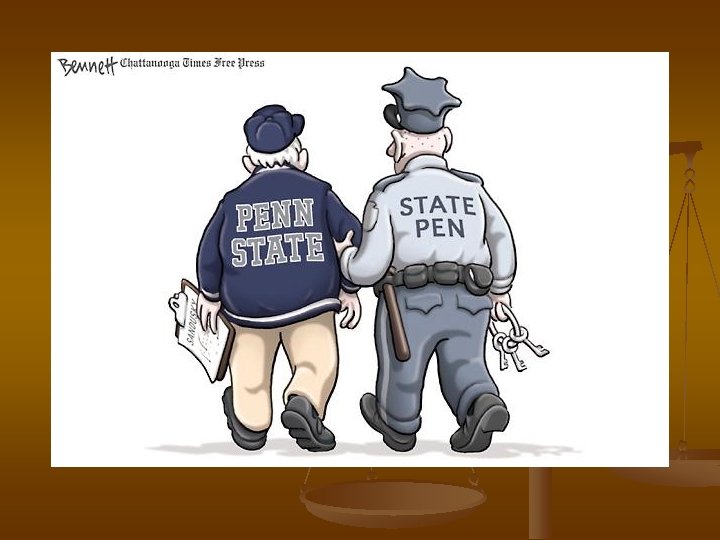
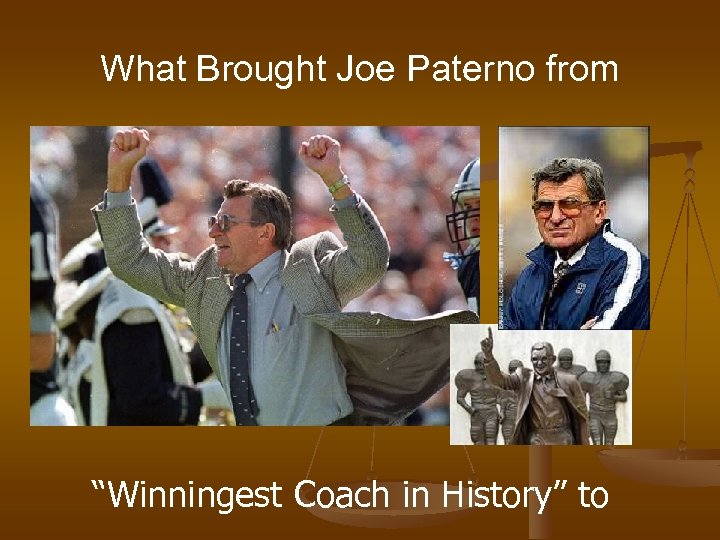 What Brought Joe Paterno from “Winningest Coach in History” to
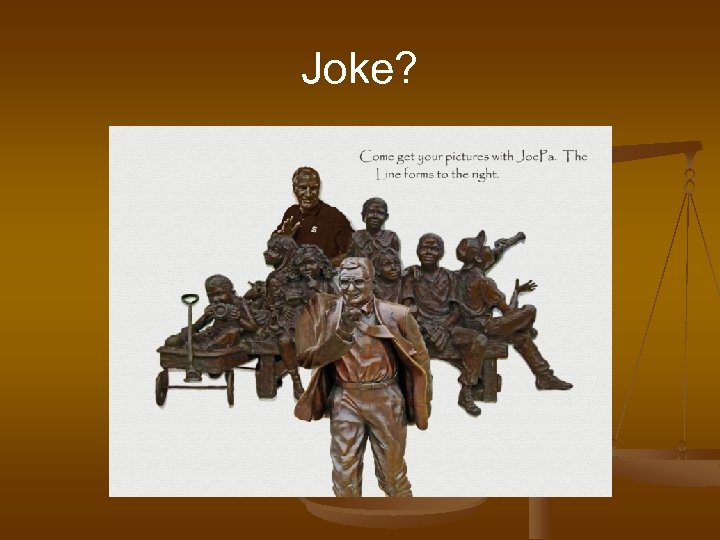 Joke?
Joke?
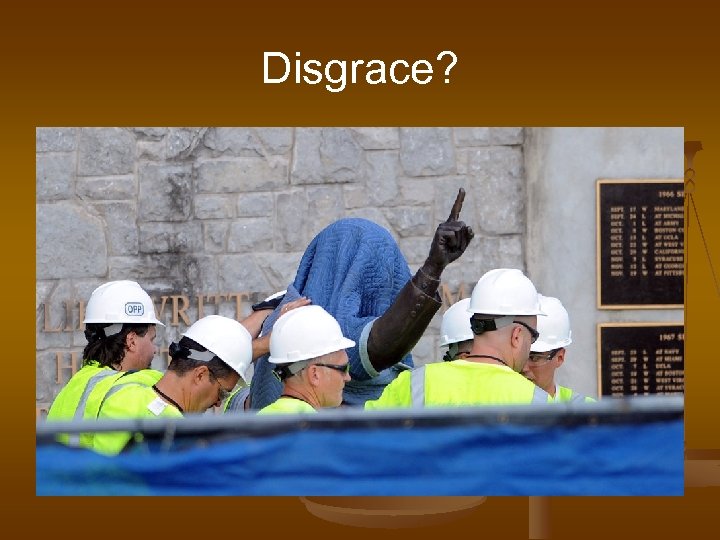 Disgrace?
 NCAA ANNOUNCES PENALTY n n n $60, 000. 00 FINE to be paid over 5 years, money paid into an endowment for programs preventing child abuse. Four year post-season ban in football Four year reduction in aid (scholarships for football) a limit of 65 total grants in aid (from 85). Five years of probation Vacating all Penn State football wins from 1998 to 2011, removing these wins from Joe Paterno’s career record.
 It Wasn’t Just Jerry…
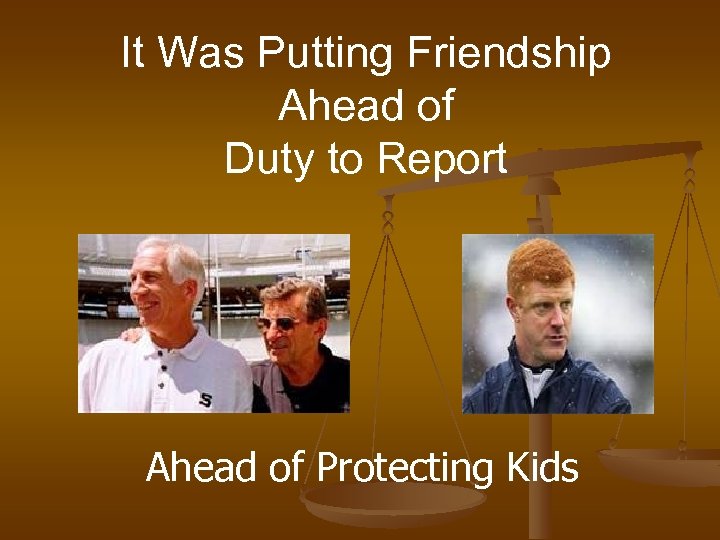 It Was Putting Friendship Ahead of Duty to Report Ahead of Protecting Kids
 AND REMEMBER…. n n n If the non-accidental injury, abuse, child abuse, reportable offense or neglect fits into the “duty to report” list, it still must be reported under duty to report EVEN IF it is ALSO being reported as A violation of school behavioral policies A violation of the anti-bullying policies A violation of the anti-hazing policies
 Easy mistakes leading to IDEAA violations… n n n Failing to follow the I. E. P. in the classroom Failing to follow the I. E. P. protocol when testing/evaluating/grading Failing to provide appropriate accommodations that were called for under the I. E. P. on the playground or in extracurricular activities
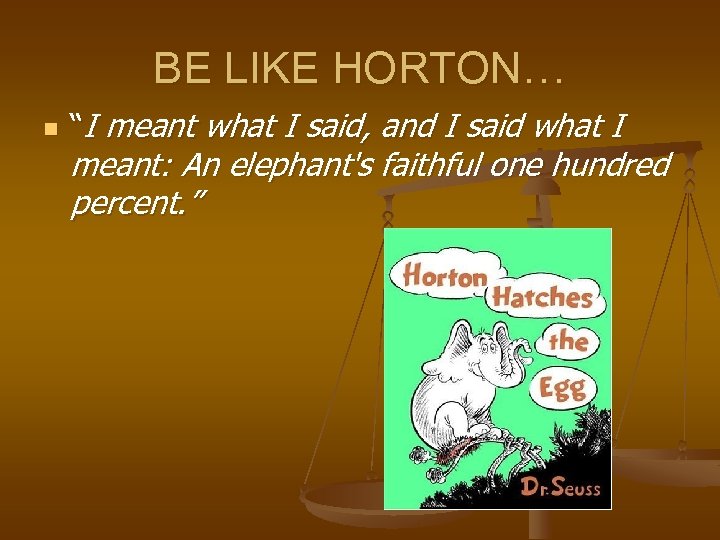 BE LIKE HORTON… n “I meant what I said, and I said what I meant: An elephant's faithful one hundred percent. ”
 n n n The I. E. P. TEAM, including you, created the plan, so you need to conform to the team’s decision, not do what YOU choose. Failure to comply with the I. E. P. can result in a claim against the school This will, in turn, lead to discipline against you!
 Easy Mistakes With Discrimination, Harassment n n Being lazy with your thinking…times change, people change, shake up your preconceptions. Forgetting you are a professional—and working at a job. Forgetting other people have different backgrounds, different preconceptions, different attitudes towards personal space Jokes about others aren’t as funny as you think
 Easy Mistakes to Make with Conflict of Interest n n Getting involved with recommending, hiring a person within 3 degrees of relation to you or your dependent. Supervising a close family member or dependent. Failing to fill out a conflict of interest statement; purchasing from a dependent. Accepting gifts from a provider that have more than a minimal value.
 Easy Mistakes to Make on Interaction with Students Supervision Discipline Interpersonal Relationships Attendance and Grades
 Supervision
 “Here are my keys—run this over to my house. ” n n Employees are expected to exercise general supervision over the conduct of students, not only while in the schoolroom, but also before and after school and during recess. Policy GBEBB Teachers will be responsible for their classes at all times. At no time are students to be left unsupervised. Students are not to be sent on errands from the school premises. Policy JLI
 In addition, Policy JLIA states n When students are in school, engaging in school-sponsored activities, or traveling to and from school on school buses, they are responsible to the school and the school is responsible for them. n n So, staff supervision of the students shall include being within the physical presence of the students and, Whenever possible, being within a line of vision of the students
 When? ? n n n Teachers shall exercise supervision as appropriate from the commencement of the school day, before classes begin, during class sessions, during lunch periods, between classes, and at any other time when performing teaching or related duties on behalf of the school.
 Emergency? n n If it should be necessary in an emergency situation for a teacher to leave the physical presence of the students… The teacher shall make a reasonable effort to obtain a school employee to supervise the students during the teacher's absence. In no case shall the teacher leave students unsupervised if there is a reasonable possibility that harm to students or property will result from the students being left unattended.
 I’m in the room, I’m teaching, some kid suddenly just DOES something stupid and someone gets hurt… n n Morris v. Ortiz, 103 Ariz. 119; 437 P. 2 d 652 (1968). “To hold that Ortiz had to anticipate Gillmor's act and somehow circumvent it is to say that it is the responsibility of a school teacher to anticipate the myriad of unexpected acts which occur daily in and about schools and school premises, the penalty for failure of which would be financial responsibility in negligence. ”
 n “We do not think that either the teacher or the district should be subject to such harassment nor is there an invocable legal doctrine or principle which can lead to such an absurd result. ” YAY for COMMON SENSE!!
 Discipline
 Maintain Discipline, GBEBB n n n Students shall not have the right to interfere with the efforts of instructional staff members to coordinate or assist in learning, to disseminate information for purposes of learning, or to otherwise implement a learning program. Nor shall a student have the right to interfere with the motivation to learn or the learning activities and efforts of other students. No student shall have the right to interfere with or disrupt any employee's work activities.
 Teachers must n n Hold students to strict account for disorderly conduct. Policy GCMF Exercise supervision over students on the playgrounds and during recess if assigned to such duty. Policy GCMF
 15 -341 (A)(37) The Board shall prescribe/enforce policies to prohibit pupils from harassing, intimidating and bullying n On school grounds, school property, school buses, school bus stops, school sponsored events and n Through the use of electronic technology or electronic communication on school computers, networks, forums and mailing lists.
 JICK-Definitions: Bullying may occur when a student or group of students n engages in any form of behavior that includes such acts as intimidation and/or harassment that n has the effect of physically harming a student, n damaging a student's property, or n placing a student in reasonable fear of harm or damage to property
 Bullying definition con’t n n n is sufficiently severe, persistent or pervasive that the action, behavior, or threat creates an intimidating, threatening, or abusive environment in the form of physical or emotional harm occurs when there is a real or perceived imbalance of power or strength, or may constitute a violation of law.
 Bullying of a student or group of students can be manifested through n written, n verbal, n physical, or n emotional means Bullying may occur in a variety of forms including, but not limited to n verbal, written/printed or graphic exposure to n derogatory comments, n extortion,
 n n n exploitation, name calling, or rumor spreading n either directly n though another person or group or n through cyberbullying, exposure to social exclusion or ostracism, physical contact including pushing, hitting, kicking, shoving, or spitting, damage to or theft of personal property.
 Definition of Cyberbullying is n any act of bullying committed by use of electronic technology or n electronic communication devices, n including telephonic devices, n social networking and other internet communications, n on school computers, networks, forums and mailing lists, or other District-owned property, and n by means of an individual’s personal electronic media and equipment.
 Definition of Harassment is intentional behavior by n a student or group of students that is n disturbing or threatening to another student or group of students. Behaviors include, but are not limited to, n stalking, n hazing, n social exclusion, n name calling, n unwanted physical contact and n unwelcome verbal or written comments, photographs and graphics.
 Harassment may be related, but not limited to: n race, n religious orientation, n sexual preference, n cultural background, n economic status, n size or personal appearance. Harassing behaviors can be direct or indirect and by use of social media.
 Definition of Intimidation is intentional behavior n by a student or group of students that n places another student or group of students n in fear of harm of person or property. Intimidation can be manifested n emotionally or n physically, n either directly or indirectly, and n by use of social media.
 Disciplinary action may result for bullying which occurs outside of the school and the school day when n bullying results in a substantial n physical, n mental, or n emotional n negative effect on the victim while on school grounds, school property, school buses, at school bus stops, or at school sponsored events and activities, or n when such act(s) interfere with the authority of the school system to maintain order.
 Employee Reporting A school employee who n becomes aware of or n suspects a student is being bullied shall n immediately notify the school administrator. n The initial notification of an alleged incident may be provided verbally. n A detailed written description of the incident and any other relevant information must be provided n on form(s) made available by the school and n submitted to the principal within one (1) school day of the verbal report.
 Failure to Report Bullying n Failure by an employee to report a suspected case of bullying may result in disciplinary action up to suspension without pay or dismissal pursuant to Board Policies GCQF and GDQF.
 Additional Requirements n n n Reprisals against employee or student reporting shall result in discipline of the individual carrying out the reprisals. Student reporting bullying must be given copies of policies. Principal must investigate all claims of bullying. Principal must notify child’s parents or guardians of report made by their child alleging bullying. Whether or not bullying is determined to have occurred, Principal must meet with all involved students to review the findings.
 n n Within FERPA requirements, parents and students must be informed of the outcome of the investigation. Employees must maintain confidentiality. Reports to police agencies shall be made under A. R. S. § 13 -3620 if non-accidental injury, abuse, or a reportable offense has occurred. Reports to police agencies shall be made of other crimes committed as part of the bullying behavior.
 n n Bullying reports and investigations must be kept for six years. Disclosure of reports outside of education or law enforcement will require redaction pursuant to FERPA. Knowingly submitting a false report under this policy shall subject the student to discipline up to and including suspension or expulsion. District policies shall be followed for any discipline resulting from bullying, false reporting, or from reprisals.
 The Superintendent shall: Establish procedures for the dissemination of information to students, parents and guardians. n The information will include: n Governing Board policies, n incident reporting, n support services (proactive and reactive) and n student's rights. n be summarized in the student handbook and on the District website
 The dissemination of this information shall n Occur during the first (1 st) week of each school year, n Be provided to each incoming student during the school year at registration, n Be posted in each classroom and in common areas of the school, and n Shall be provided to a student during the school year when the student reports being bullied, harassed, intimidated.
 n n Establish procedures for the dissemination of information to District employees including, n Governing Board policy, n Preventive measures, n Incident reporting procedures, n Available support services for students (both proactive and reactive), and n Student rights. Information will be provided to staff members at the beginning of each instructional year and on the first day of employment for new employees.
 Student’s Report of Bullying n n n May be verbal or in writing If verbal, Employee taking the report must document it in writing Employee may make own report verbally, but must follow up in writing. Written report must be made within one day of receipt of student’s report or of observation of incident. Principal must investigate report within two days of receiving initial report. Investigation must be documented by Principal.
 n n n COMPLAINT FORM (To be filed with any School District employee who will forward this document to the principal or the principal’s designee) Please print: Name _____________ Date ______ Address ____________________ Telephone _____ Another phone where you can be reached _____ During the hours of _____ E-mail address _________________ I wish to complain against: Name of person(s) ________________________ _ Specify your complaint by stating the problem as you see it. Describe the incident, the participants, the background to the incident, and any attempts you have made to solve the problem. Be sure to include all relevant dates, times, and places. Additional pages may be attached if necessary.
 n n n n If there is anyone who could provide more information regarding this complaint, please list name(s), address(es), and telephone number(s). Name Address Telephone Number The projected solution: Indicate what you think can and should be done to solve the problem. Be as specific as possible. I certify this information is correct to the best of my knowledge. Signature of Complainant _____________ Date ______ Document received by ______________ Date ______ Investigating official _______________ Date ______
 If bullying is reported to you n n Report it to administration on or before the next school day. Assist the student in making the report by asking who did the bullying, when did it happen (must have happened within 30 days of the report), how long has the bullying been going on, what kind of bullying (physical, emotional, cyber, etc. ) Help the student feel safe by advising your colleagues of the conflict if it appears to be one heading toward physical violence or reprisals. Maintain confidentiality if a safety based concern does not exist.
 HAZING, 15 -2301(C)(2) n n n "Hazing" means any intentional, knowing or reckless act committed by a student, whether individually or in concert with other persons, against another student, and in which both of the following apply:
 (a) The act was committed in connection with n an initiation into, n an affiliation with or n the maintenance of n membership in any organization that is affiliated with an educational institution. AND (b) The act contributes to a substantial risk of potential physical injury, mental harm or degradation or causes physical injury, mental harm or personal degradation.
 Hazing, 15 -2301(C)(3) "Organization" means n an athletic team, n association, order, society, corps, cooperative, club n or other similar group n that is affiliated with an educational institution and whose membership consists primarily of students enrolled at that educational institution.
 Policy JICFA, Reporting Hazing n n Professional staff members must report the incident to the school administrator or next higher administrative supervisor, in writing, with such details as may have been provided. Any instance of reported or observed hazing which includes possible child abuse or violations of statutes known to the staff member shall be reported to a law enforcement agency.
 n n The staff member shall preserve the confidentiality of those involved, disclosing the incident only to the appropriate school administrator or next higher administrative supervisor or as otherwise required by law. A failure by a staff member to timely inform the school administrator or next higher administrative supervisor of a hazing allegation or their observation of an incident of hazing may subject the staff member to disciplinary action in accord with District policies.
 15 -2301 (A)(10) Any teacher or staff who knowingly n Permitted n Authorized, or n Condoned The hazing activity is subject to disciplinary action by the educational institution. Not to mention being sued by some attorney!!
 PREVENTION! On bus trips n Coaches, sponsors, and chaperones should not stay in one place on the bus n The adults should walk back and forth at random times and pay attention to what’s going on between the kids n If more than one adult is on the bus, have one sit in back and one in the middle of the bus n Do not fall asleep or become engrossed in a movie, lap top, game, or book
 Don’t encourage students by n n n Giving artificial privileges to one group over another (varsity over junior varsity) that the students may feel the need to enforce unless YOU do the enforcing! Telling about initiations or hazings you participated in when you were in school or on a team “Who will rid me of this troublesome priest”— making students feel like you have given them the go-ahead by things you say or by actions that aren’t in harmony with what you say
 “Can I ever use physical force? ” Policy GBEB provides: Any administrator, teacher, or other school employee entrusted with the care and supervision of a minor may use n reasonable and appropriate physical force upon the minor n to the extent reasonably necessary and appropriate n to maintain order.
 You can also use physical force n n n To the extent reasonably necessary and appropriate in self-defense, In the defense of other students and school personnel, and To prevent or terminate the commission of theft or criminal damage to the property of the District or the property of persons lawfully on the premises of the District
 BUT… n n n The threat or use of physical force is not justified as a response to verbal provocation alone, Nor when the degree of physical force used is disproportionate to the circumstances or Exceeds that necessary to avoid injury to oneself or to others or to preserve property at risk. Justification for physical force, A. R. S. §§ 13 -403, 404, 406, and 408.
 “I think sarcasm directed at students is a useful weapon in my personal arsenal of teaching techniques. ” This is NOT an acceptable technique under policy… n At all times teachers and other staff members will accord students the dignity and respect that they deserve, and n Avoid embarrassing any student unnecessarily. Policy GBEBB
 “Ditto for a well-timed expletive-non -deleted. ” Again, this is not acceptable n Staff is prohibited from the use of profane or abusive language, symbols, or conduct. Policy GBEB-R And finally, remember that in your arsenal of teaching and discipline techniques…
 Duct tape is like “The Force” n n n It has a light side and a dark side It holds together the universe BUT IT IS NEVER, EVER an appropriate form of discipline!
 Interpersonal Relationships
 “So, how about dating? ” NO!!
 n n All personnel employed by the District are expected to relate to students of the District in a manner that maintains social and moral patterns of behavior consistent with community standards and acceptable professional conduct. Even if YOUR community standards might approve of dating a 14 year old student… Warren Jeffs
 It is STILL a violation of policy… n n Relationships between staff members and students that include "dating, " "courtship, " or "romantic involvement" are prohibited. These behaviors deviate from ethical or professional standards and shall be deemed unacceptable and contrary to the expectations of District governance.
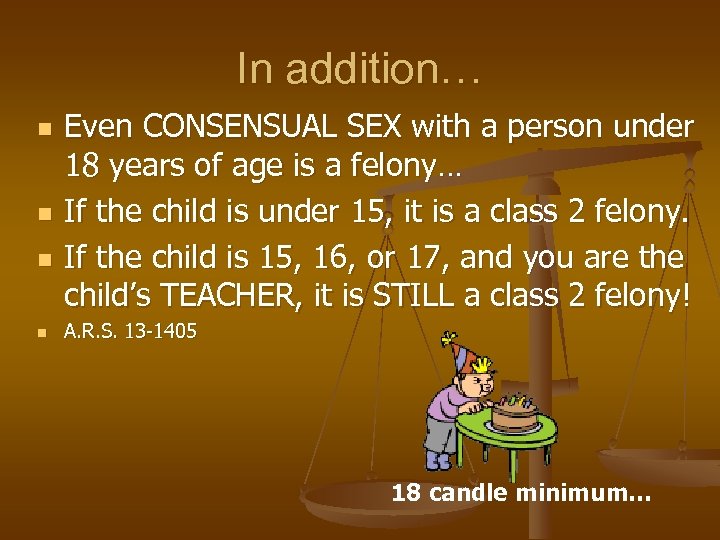 In addition… n n Even CONSENSUAL SEX with a person under 18 years of age is a felony… If the child is under 15, it is a class 2 felony. If the child is 15, 16, or 17, and you are the child’s TEACHER, it is STILL a class 2 felony! A. R. S. 13 -1405 18 candle minimum…
 You are the ADULT n n n Maintain boundaries Do not show inappropriate movies in class Do not allow students to use your car to run errands Do not allow students to run personal errands for you Do not get into inappropriate discussions with students—you are there to teach to standards, not preach about religion, menopause, sexual positions and preferences, personal drug use, alcohol abuse, dating….
 And remember setting those boundaries? ? n n E-mailing and text messaging students can blur the role between teacher and student MAY lead to students to assume a more casual relationship with the teacher; fall into a “friend” or “more than a friend” role. SO, IF you use this tool, keep the e-mail or text message professional in tone Sign with title and surname, not with first name or a nickname
 Parents, administrators, and other students can read these messages n n Make sure nothing you write can be misinterpreted by a parent or, worse yet, Misinterpreted by a lawyer looking at it later KEEP it SHORT, to the point, and impersonal in tone! Remember, e-mail messages can be typed over, so keep a copy of what you sent out and a copy of any replies.
 Social Media… n n n Best practice is to NOT “friend” students! If you think social media may be a good way to extend school discussions, Set up a “school only” account or have IT set you up with a “wiki” account Only allow students, administration, parents to have access (NO FRIENDS). Monitor it continually to take down inappropriate comments (bullying, discriminatory, profane/obscene/general cursing…)
 OTHERWISE … n n n Your “oh-so-mature” friends may post inappropriate materials on your social media page that your students will see and share. You may post pictures and messages that will be inappropriate and will get you in trouble because of student viewing and sharing. Your students may post inappropriate pictures and messages…
 Attendance and Grades
 Attendance n n Taking attendance MATTERS! Policy GCMF states teachers shall keep a school register, which the Governing Board shall carefully preserve as one of the records of the school. 15 -807 requires for K-8, “the school in which the pupil is enrolled, within two hours after the first class in which the pupil is absent, shall make a reasonable effort to promptly telephone and notify the parent … of the pupil's absence from school. ”
 And whether Kindergarten or High School… n DON’T be the teacher who didn’t report a child missing from class when the child ends up dead somewhere away from the school—whether kidnapped or joy-riding.
 Your grading decision COUNTS, so make sure you can support it! n n Make the decision to promote or retain a student in grade in a common school or to pass or fail a student in a course in high school. Such decisions may be overturned only as provided in A. R. S. 15 -342 (11): Review the decision of a teacher to promote a pupil to a grade or retain a pupil in a grade in a common school or to pass or fail a pupil in a course in high school.
 Burden of Proof The pupil has the burden of proof to overturn the decision of a teacher to promote, retain, pass or fail the pupil. n In order to sustain the burden of proof, the pupil shall demonstrate to the governing board that the pupil has mastered the academic standards adopted by the state board of education pursuant to sections 15 -701 and 15 -701. n
 Board Must Have Teacher Input n n n If the governing board overturns the decision of a teacher pursuant to this paragraph, the governing board shall adopt a written finding that the pupil has mastered the academic standards. If the review is conducted in executive session, the board shall notify the teacher of the date, time and place of the review and shall allow the teacher to be present at the review. If the teacher is not present at the review, the board shall consult with the teacher before making its decision.
 And basically-The challenge cannot be to make a “B” an “A”—it is only to reverse a failing grade or a decision not to promote. But how did we get here? Communication is KEY—let people KNOW when their kids are slipping—even if—or especially if(!)—it happens after “progress” reports are sent out! Otherwise parents are blindsided and react in anger toward you!
 And FINALLY, on the issue of Grades… n n n A. R. S. § 15 -516 A full time teacher who is employed by a school district or a charter school is immune from personal liability for all acts done and actions taken in good faith in evaluating or grading any student. So, as long as you made your decision in good faith, you are immune from being sued!!
 Technology is our Friend Or is it?
 Use of Technology n n Policy IJND, Technology Resources (movies and videos) Policy IJND-R (regulations for use of movies and videos) Policy IJNDB, Use of Technology Resources in Education Policy IJNDB-R (regulations for use of technology)
 Policy IJND, Technology Resources n n Parents or guardians of students enrolled in the District shall have access in advance to instructional materials, learning materials and activities currently in use, or being considered for use, in the District shall obtain signed, written consent from a student's parent or guardian before using video, audio or electronic materials that may be inappropriate for the age of the student.
 Policy IJND-R Movies, videos and electronic materials with ratings other than for general audiences of all ages are not to be shown in classrooms or at any District facility (this includes buses and motels where students are present) except when n It has been previewed by teacher n It does not contain material that is objectionable or inappropriate for the age group to which it is intended to be shown
 n n The appropriate school administrator has approved it Advanced notification has been provided to each student's parent(s) of the title of the movie, video or electronic material, the date, it will be shown and the rating.
 And remember… Under the parent bill of rights, n Parents have the right to request that their child view/not view a rated movie/video. n Teachers must provide an appropriate alternative educational experience that will replace the movie/video experience for students not viewing a movie/video.
 “Didn’t get my lesson prepared— gotta movie I can show? ” Policy IJND n There is educational value in utilizing movies and videos in classrooms only when such movies and videos extend and/or reinforce the concepts being taught and have been planned for in advance. n Fair use under copyright requires that the movie or video is closely tied to the educational standards being taught.
 Policy IJNDB n n The District may provide electronic information services (EIS) to qualified students, teachers, and other personnel who attend or who are employed by the District. Electronic information services include networks (e. g. , LAN, WAN, Internet), databases, and any computer-accessible source of information, whether from hard drives, tapes, compact disks (CDs), floppy disks, or other electronic sources.
 n The use of the services shall be in support of education, research, and the educational goals of the District. NOTICE! IT DOES NOT SAY “THE USE OF THE SERVICES SHALL BE IN SUPPORT OF PORNOGRAPHY!!”
 Filters on the Internet n n n The District shall provide for technology protection measures that protect against Internet access by both adults and minors to visual depictions that are obscene, child pornography, or, with respect to use of the computers by students, harmful to students. IN ADDITION… The protective measures shall also include monitoring the online activities of students.
 n n Since kids and adults are smart and determined, the ability to by-pass the filter is NOT a defense to viewing pornography, downloading pornography, UP-loading pornography, visiting inappropriate websites…
 Policy IJNDB-R, requires users to n n n Support personal educational objectives consistent with the educational goals and objectives of the School District Agree not to submit, publish, display, or retrieve any defamatory, inaccurate, abusive, obscene, profane, sexually oriented, threatening, racially offensive, or illegal material. Abide by all copyright and trademark laws and regulations.
 n n n Follow the District's code of conduct. Not attempt to harm, modify, add, or destroy software or hardware nor interfere with system security. Understand that inappropriate use may result in cancellation of permission to use the educational information services (EIS) and appropriate disciplinary action up to and including expulsion for students.
 IJNDB-E, User Agreement n n All users of the District electronic information system MUST sign the user agreement. The agreement specifies that the system will NOT be used to “submit, publish, display, or retrieve any defamatory, inaccurate, abusive, obscene, profane, sexually oriented, threatening, racially offensive, or illegal material. ”
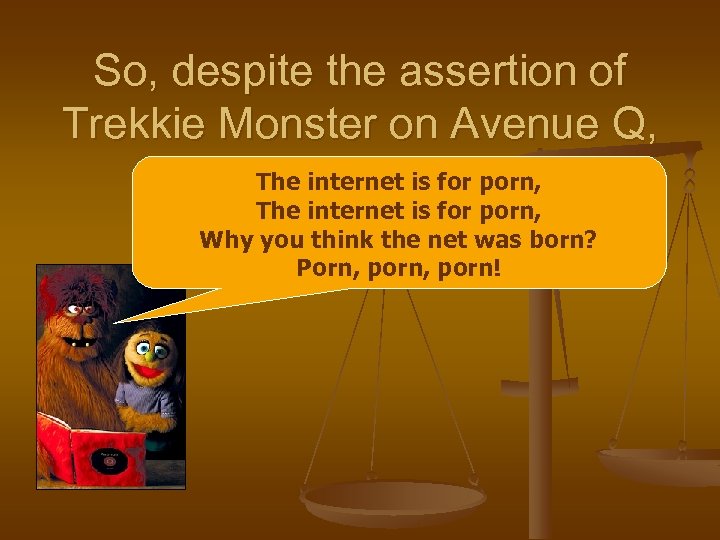 So, despite the assertion of Trekkie Monster on Avenue Q, The internet is for porn, Why you think the net was born? Porn, porn!
 The Internet, at least at SCHOOL, is NOT for PORN!
 How to Avoid Liability?
 Comply with Policies! n n School District policies can be found on line at http: //lp. ctspublish. com/asba/ Personnel policies begin with Section G Other teacher and staff responsibilities are included in Section J, Students Instruction policies are under Section I
 GBEA, Staff Ethics n n n All employees of the District are expected to maintain high standards in their school relationships. This responsibility requires the employee to maintain standards of exemplary conduct. It must be recognized that the employee's actions will be viewed and appraised by the community, associates, and students.
 You like to complain about other teachers and administrators…heck, about the Board, too, while you are at it! But see GBEA—Employees are to: n Direct any criticism of other staff members or of any department of the school system or constructive criticism made toward improving the District directly to the school administrator who has the responsibility for improving the situation n Implement the Governing Board's policies and administrative rules and regulations.
 You like to gossip about other teachers, staff members, students, parents… GBEA says the ethical school employee: n Maintains just, courteous, and proper relationships with students, parents, staff members, and others. n In the performance of duties, employees shall keep in confidence such information as they may secure unless disclosure serves District purposes or is required by law
 “Don’t I have Freedom of Speech? ” n n n Wellll, not really… For one thing, it is clear that at the K-12 levels you must abide by school district policies regarding classroom materials, movies, instructional techniques. In addition, Garcetti v. Ceballos gives the public employer the ability to monitor and restrict official speech or work related speech saying this simply reflects the exercise of employer control over speech the employer itself has commissioned or created.
 n n n Pickering v. Board of Education held that a teacher’s comments to a local newspaper were matters of public concern and articulated a four part test: 1. Whether the speech would interfere with the employee’s performance. 2. Whether the speech would create disharmony among co-workers. 3. Whether the speech would undercut an immediate supervisor’s authority over the employee. 4. Whether the speech would destroy the relationship of loyalty and trust required of confidential employees. [i] 391 U. S. 563, 88 S. Ct. 1731 (1968)
 “Hey, I’ve been here for years, I can coast until I retire!” But those GBEA ethics state you are to: n Make the well-being of students the fundamental value of all decision making and actions. n Strive for the maintenance of efficiency and knowledge of developments in the employee's field of work.
 Fulfill job responsibilities with honesty and integrity. n Maintain the standards and seeks to improve the effectiveness of the profession through research and continuing professional development. n
 So, we’ve covered a number of laws, policies, rules and regulations Why?
 So why is it so IMPORTANT to follow policies, rules and regulations? n n IF you are in compliance with the policies when something goes wrong, THEN you are PERSONALLY protected! If you violate policies, you can be subjected to discipline, up to and including termination. WHY? Failure to do so may make the District liable for failing to uphold policies.
 Kohl v. City of Phoenix 160 P. 3 d 170 (2007) n n Reaffirms that there is immunity to both the governmental agency and its employees IF there is an exercise of a legislative or the administrative function of a fundamental governmental policy AND As long as the governmental agency and its employees are acting in compliance with the policy.
 A. R. S. § 12 -820. 05 (B) n n n A public entity is not liable for losses that arise out of and are directly attributable to An act or omission Determined by a court to be a criminal felony Committed by an employee of the public entity UNLESS the public entity knew of the employee’s propensity for the action.
 And in the same way. . Employee violations of policy create the “propensity” for committing the acts that brought about the lawsuit n Ignored and unaddressed violations of policy destroy any immunity if the “policy” is a sham n
 So follow policies! And may the FORCE be with you!
 A. R. S. § 15 -977 Changes with “Prop 301” performance pay n Reeves v. Barlow, a court of appeals case, went into effect with this year’s contracts: v School District employees who do not hold a teaching certificate may not participate in the classroom site fund compensation system under A. R. S. § 15 -977. n
 v v Overrules Attorney General Opinion, I 01014, defining “teacher” as one who teaches children; not just certificated teachers. Retains District’s right to exercise discretion to determine whether those who possess a teaching certificate are eligible to participate.
 2012 Legislative Changes 15 -977(B) PRESENTLY READS: B. A school district governing board must adopt a performance based compensation system at a public hearing to allocate funding from the classroom site fund pursuant to subsection A of this section. Subsection B is amended to add that beginning in school year 2014 -2015, individual teacher performance component, measured by the teacher’s performance classification under A. R. S. 15 -203 (A) (38) shall be a component of the school district’s portion of the 40% allocation for teacher compensation based on performance and employment related expenses.
 n n n Former Subsection C. 11. , now Subsection C. 12. , is amended to read: Regular evaluation for effectiveness, which shall comply by fiscal year 2014 -2015 with A. R. S. 15 -203 (A) (38) The balance of the statute, including other fund designations, remains unchanged.
 15 -977 (C) presently reads: C. A school district governing board shall vote on a performance based compensation system that includes the following elements: 1. School district performance and school performance. 2. Measures of academic progress toward the academic standards adopted by the state board of education. 3. Other measures of academic progress. 4. Dropout or graduation rates. n
 5. Attendance rates. 6. Ratings of school quality by parents. 7. Ratings of school quality by students. 8. The input of teachers and administrators. 9. Approval of the performance based compensation system based on an affirmative vote of at least seventy per cent of the teachers eligible to participate in the performance based compensation system. 10. An appeals process for teachers who have been denied performance based compensation.
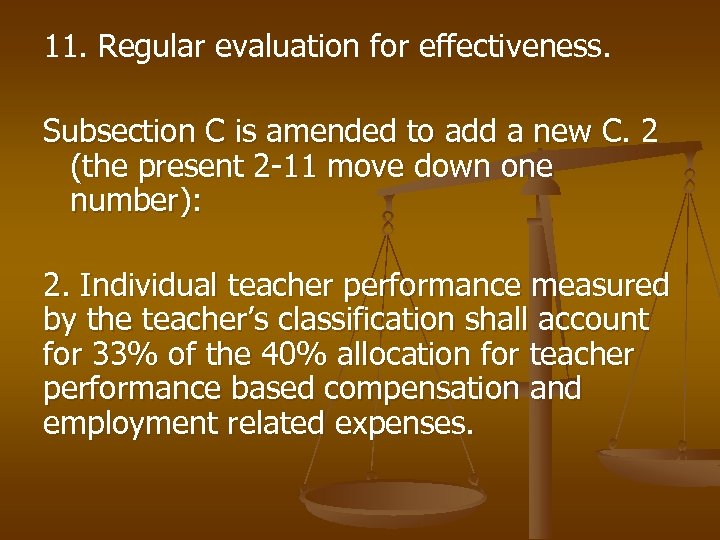 11. Regular evaluation for effectiveness. Subsection C is amended to add a new C. 2 (the present 2 -11 move down one number): 2. Individual teacher performance measured by the teacher’s classification shall account for 33% of the 40% allocation for teacher performance based compensation and employment related expenses.