 Скачать презентацию From Barriers to Bridges Improving Chronic Disease and
a32e54085c8eefa1f95eae112cad23a0.ppt
- Количество слайдов: 71



From Barriers to Bridges: Improving Chronic Disease and Preventive Care Richard C. Wender, MD Alumni Professor and Chair Department of Family and Community Medicine Thomas Jefferson University Philadelphia, Pennsylvania November 10, 2006
Or… Delivering High Quality Care…
…In Our Low Quality Health Care System

Or… What Can You Do To Deliver Comprehensive Quality Care…

…When No One Is Paying You To Do It

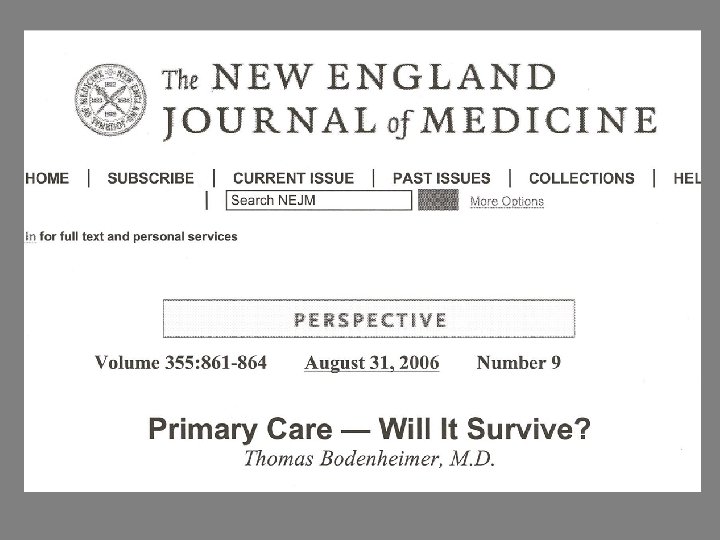
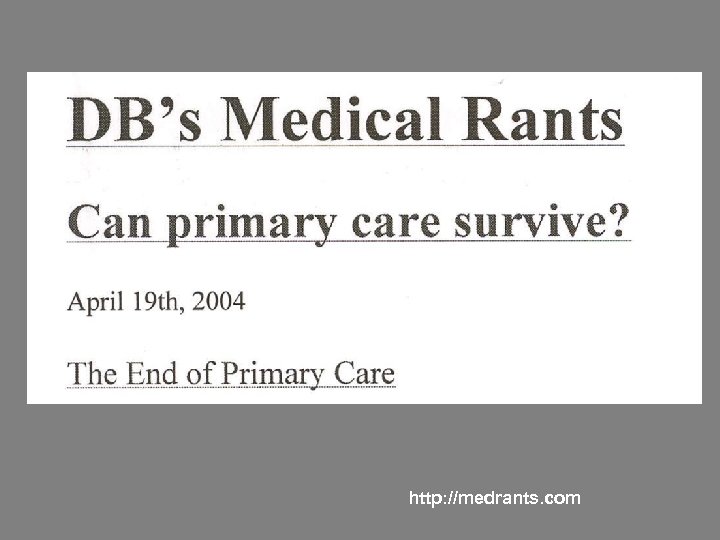
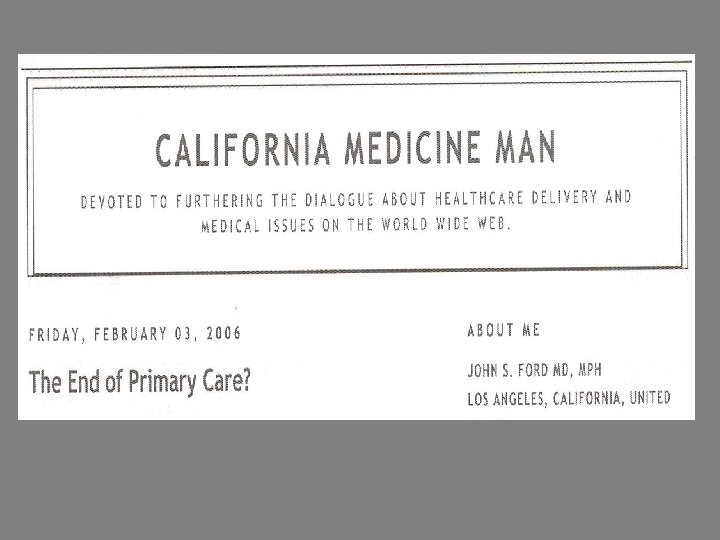
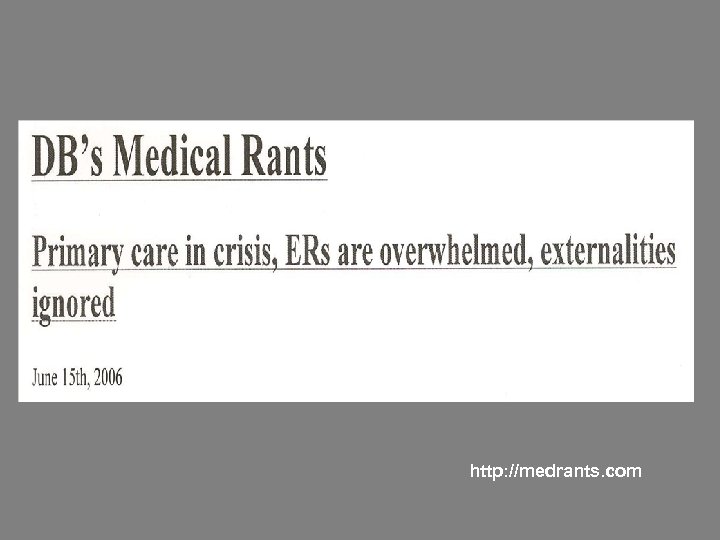
Good News Everybody’s Talking About Us!!!
http: //medrants. com

MGMA: Physician Compensation and Production Survey: 2006 Report Based on 2005 Data
http: //medrants. com

Everybody’s Talking About Us… It’s Just What They’re Saying That Makes Us Nervous. . .
The Family Medicine Response Reports of our premature death have been greatly exaggerated
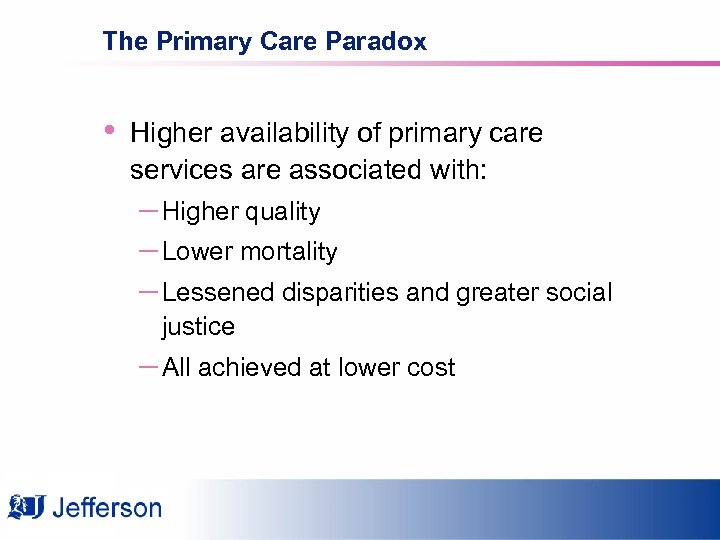
The Primary Care Paradox • Higher availability of primary care services are associated with: – Higher quality – Lower mortality – Lessened disparities and greater social justice – All achieved at lower cost
Why Is Primary Care Important? Better health outcomes Lower costs Greater equity in health Starfield 09/04 PC 2945 04 -134
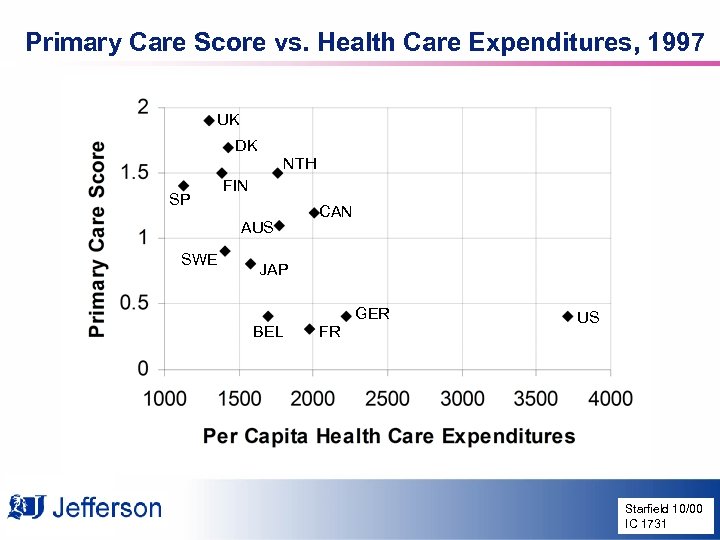
Primary Care Score vs. Health Care Expenditures, 1997 UK DK NTH SP FIN AUS SWE CAN JAP GER BEL FR US Starfield 10/00 IC 1731 00 -133
An orientation to primary care reduces sociodemographic and socioeconomic disparities (inequities) • in access to health services • in population health Starfield 03/06 IC 3383
Why Is Our Future Threatened? U. S. reimbursement mechanisms systematically and consistently discourage primary care practice
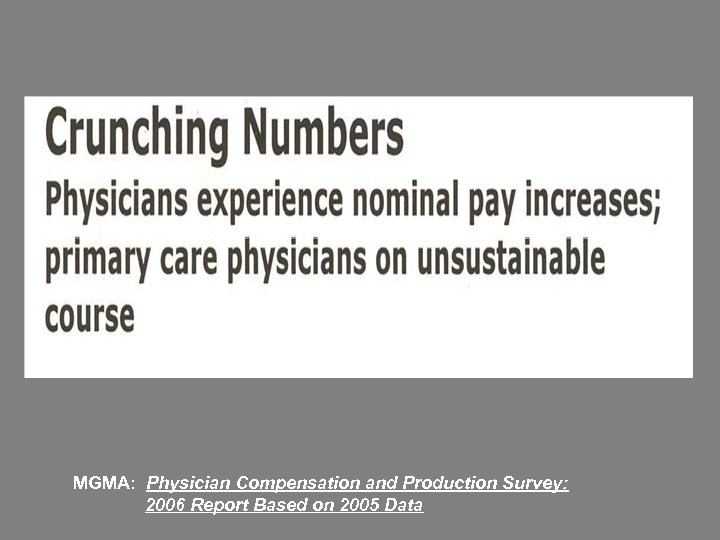
The Reimbursement Disparity Continues To Grow • MGMA 2006 Report: – Primary care MD total earnings rose 3. 9% in 2005 – Specialty total earnings rose an average of 6. 61% – Despite slightly greater increase in primary care work productivity
Downstream Effect of Inequitable Payment For Services • Fewer U. S. Medical School graduates choosing primary careers – The decline in general medicine is being overlooked • Greater pressure to generate a high volume of care – a threat to quality and satisfaction
Volume Vs. Quality • Volume ITSELF does not preclude provision of quality • But paying ONLY for volume does threaten quality
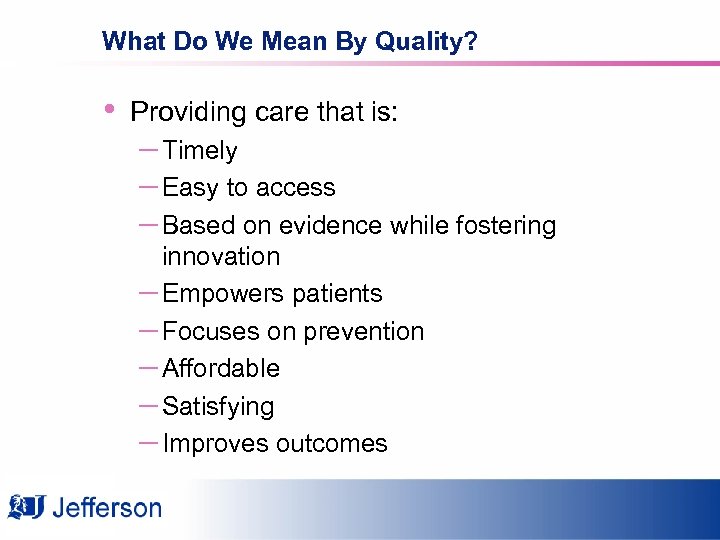
What Do We Mean By Quality? • Providing care that is: – Timely – Easy to access – Based on evidence while fostering innovation – Empowers patients – Focuses on prevention – Affordable – Satisfying – Improves outcomes

How is the U. S. Doing? The Commonwealth Fund Report
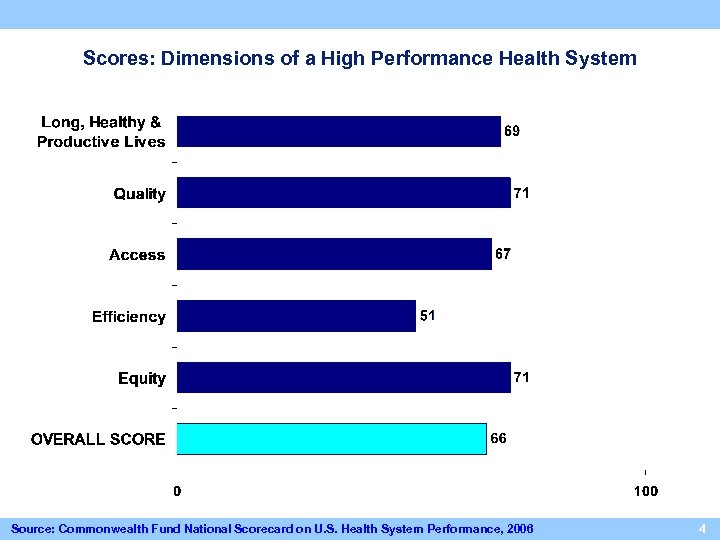
Scores: Dimensions of a High Performance Health System Source: Commonwealth Fund National Scorecard on U. S. Health System Performance, 2006 4
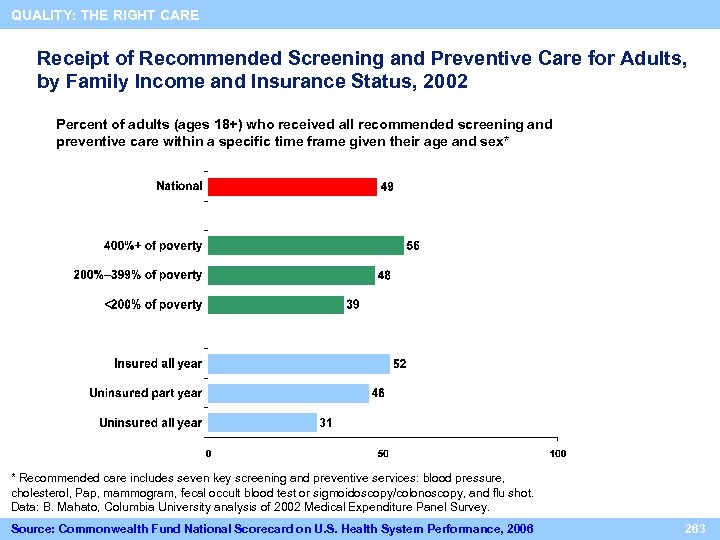
QUALITY: THE RIGHT CARE Receipt of Recommended Screening and Preventive Care for Adults, by Family Income and Insurance Status, 2002 Percent of adults (ages 18+) who received all recommended screening and preventive care within a specific time frame given their age and sex* * Recommended care includes seven key screening and preventive services: blood pressure, cholesterol, Pap, mammogram, fecal occult blood test or sigmoidoscopy/colonoscopy, and flu shot. Data: B. Mahato, Columbia University analysis of 2002 Medical Expenditure Panel Survey. Source: Commonwealth Fund National Scorecard on U. S. Health System Performance, 2006 263
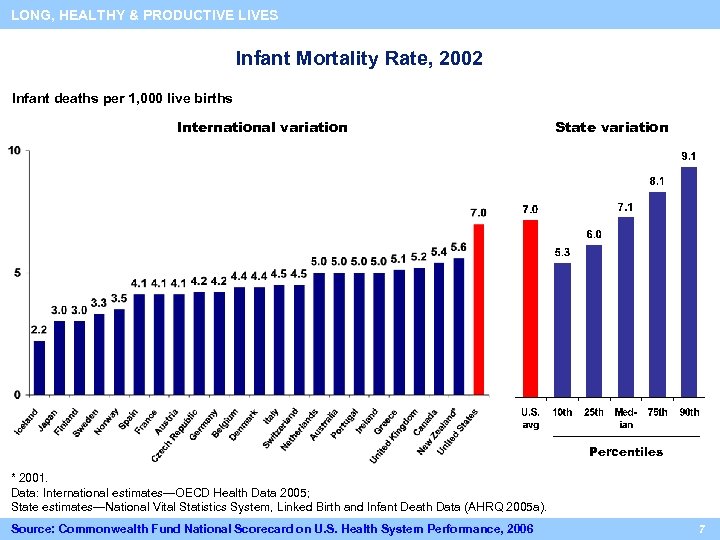
LONG, HEALTHY & PRODUCTIVE LIVES Infant Mortality Rate, 2002 Infant deaths per 1, 000 live births International variation State variation Percentiles * 2001. Data: International estimates—OECD Health Data 2005; State estimates—National Vital Statistics System, Linked Birth and Infant Death Data (AHRQ 2005 a). Source: Commonwealth Fund National Scorecard on U. S. Health System Performance, 2006 7
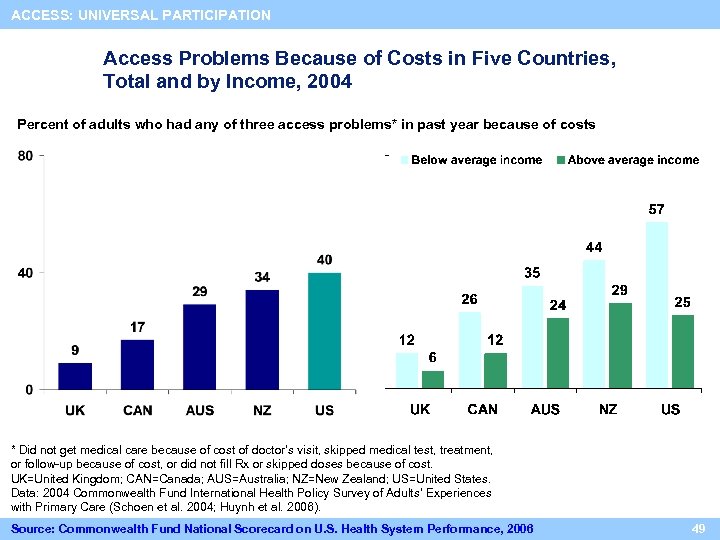
ACCESS: UNIVERSAL PARTICIPATION Access Problems Because of Costs in Five Countries, Total and by Income, 2004 Percent of adults who had any of three access problems* in past year because of costs * Did not get medical care because of cost of doctor’s visit, skipped medical test, treatment, or follow-up because of cost, or did not fill Rx or skipped doses because of cost. UK=United Kingdom; CAN=Canada; AUS=Australia; NZ=New Zealand; US=United States. Data: 2004 Commonwealth Fund International Health Policy Survey of Adults’ Experiences with Primary Care (Schoen et al. 2004; Huynh et al. 2006). Source: Commonwealth Fund National Scorecard on U. S. Health System Performance, 2006 49
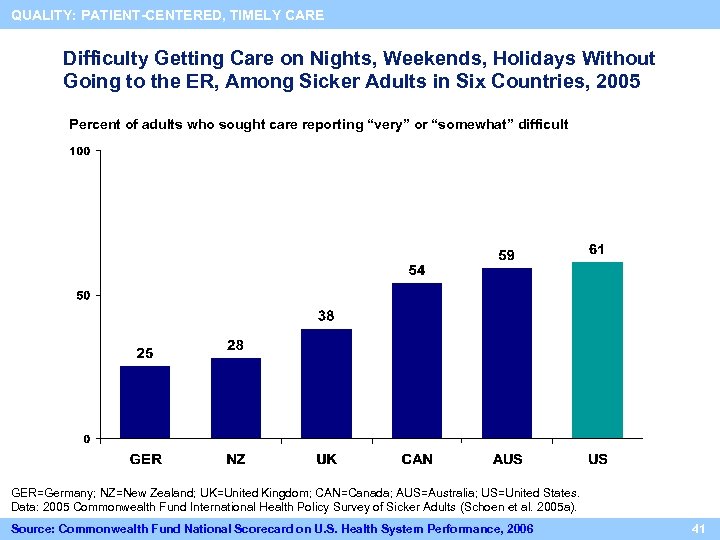
QUALITY: PATIENT-CENTERED, TIMELY CARE Difficulty Getting Care on Nights, Weekends, Holidays Without Going to the ER, Among Sicker Adults in Six Countries, 2005 Percent of adults who sought care reporting “very” or “somewhat” difficult GER=Germany; NZ=New Zealand; UK=United Kingdom; CAN=Canada; AUS=Australia; US=United States. Data: 2005 Commonwealth Fund International Health Policy Survey of Sicker Adults (Schoen et al. 2005 a). Source: Commonwealth Fund National Scorecard on U. S. Health System Performance, 2006 41
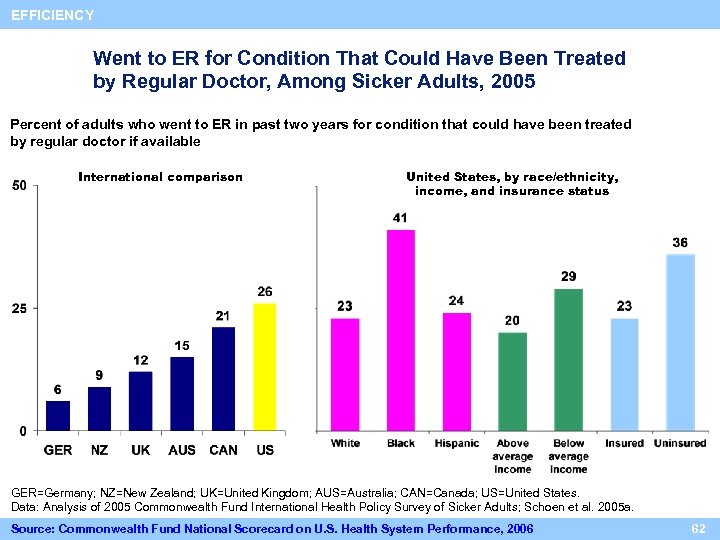
EFFICIENCY Went to ER for Condition That Could Have Been Treated by Regular Doctor, Among Sicker Adults, 2005 Percent of adults who went to ER in past two years for condition that could have been treated by regular doctor if available International comparison United States, by race/ethnicity, income, and insurance status GER=Germany; NZ=New Zealand; UK=United Kingdom; AUS=Australia; CAN=Canada; US=United States. Data: Analysis of 2005 Commonwealth Fund International Health Policy Survey of Sicker Adults; Schoen et al. 2005 a. Source: Commonwealth Fund National Scorecard on U. S. Health System Performance, 2006 62
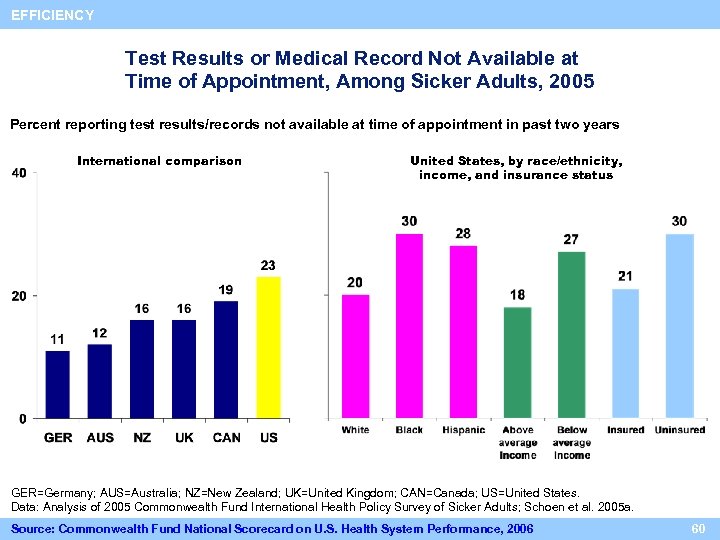
EFFICIENCY Test Results or Medical Record Not Available at Time of Appointment, Among Sicker Adults, 2005 Percent reporting test results/records not available at time of appointment in past two years International comparison United States, by race/ethnicity, income, and insurance status GER=Germany; AUS=Australia; NZ=New Zealand; UK=United Kingdom; CAN=Canada; US=United States. Data: Analysis of 2005 Commonwealth Fund International Health Policy Survey of Sicker Adults; Schoen et al. 2005 a. Source: Commonwealth Fund National Scorecard on U. S. Health System Performance, 2006 60
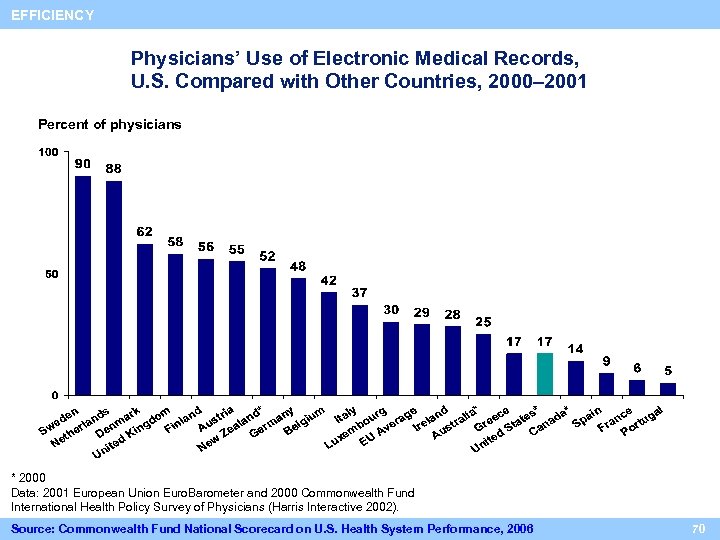
EFFICIENCY Physicians’ Use of Electronic Medical Records, U. S. Compared with Other Countries, 2000– 2001 Percent of physicians * 2000 Data: 2001 European Union Euro. Barometer and 2000 Commonwealth Fund International Health Policy Survey of Physicians (Harris Interactive 2002). Source: Commonwealth Fund National Scorecard on U. S. Health System Performance, 2006 70
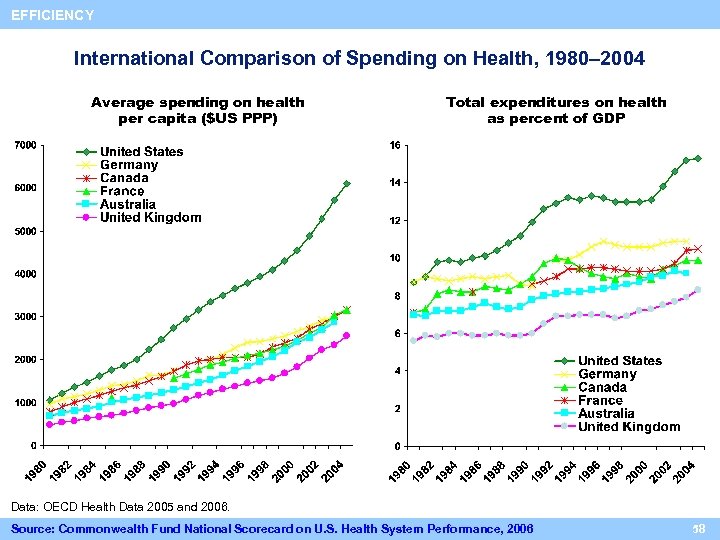
EFFICIENCY International Comparison of Spending on Health, 1980– 2004 Average spending on health per capita ($US PPP) Total expenditures on health as percent of GDP Data: OECD Health Data 2005 and 2006. Source: Commonwealth Fund National Scorecard on U. S. Health System Performance, 2006 58
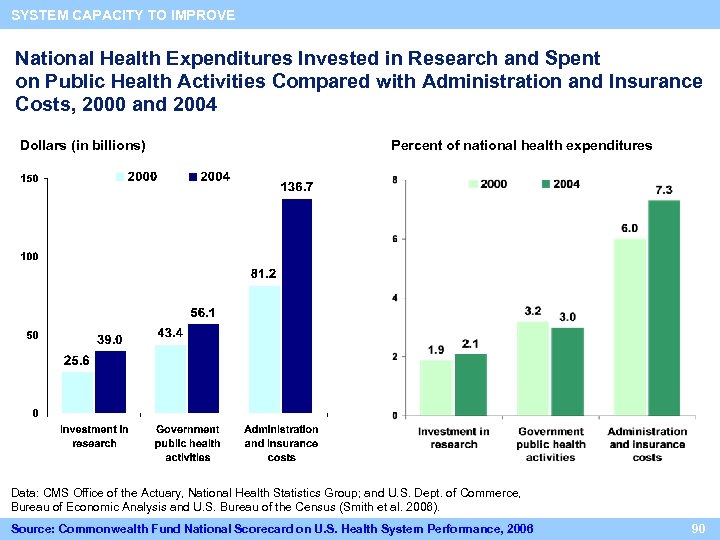
SYSTEM CAPACITY TO IMPROVE National Health Expenditures Invested in Research and Spent on Public Health Activities Compared with Administration and Insurance Costs, 2000 and 2004 Dollars (in billions) Percent of national health expenditures Data: CMS Office of the Actuary, National Health Statistics Group; and U. S. Dept. of Commerce, Bureau of Economic Analysis and U. S. Bureau of the Census (Smith et al. 2006). Source: Commonwealth Fund National Scorecard on U. S. Health System Performance, 2006 90
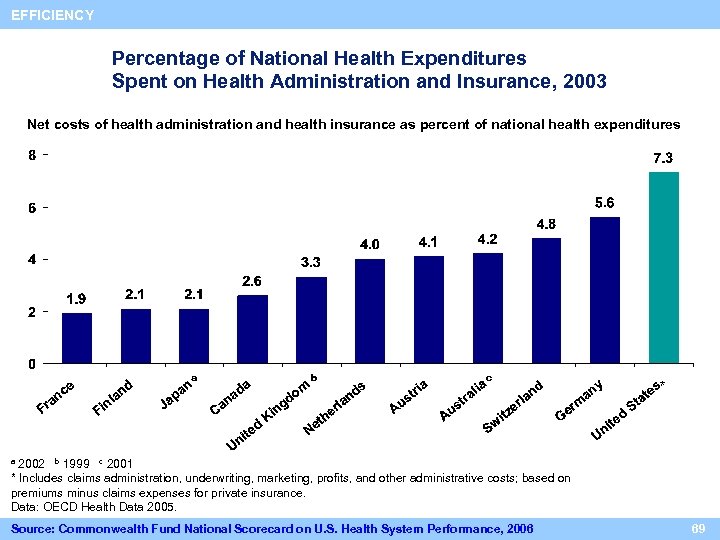
EFFICIENCY Percentage of National Health Expenditures Spent on Health Administration and Insurance, 2003 Net costs of health administration and health insurance as percent of national health expenditures a b c * 2002 b 1999 c 2001 * Includes claims administration, underwriting, marketing, profits, and other administrative costs; based on premiums minus claims expenses for private insurance. Data: OECD Health Data 2005. a Source: Commonwealth Fund National Scorecard on U. S. Health System Performance, 2006 69
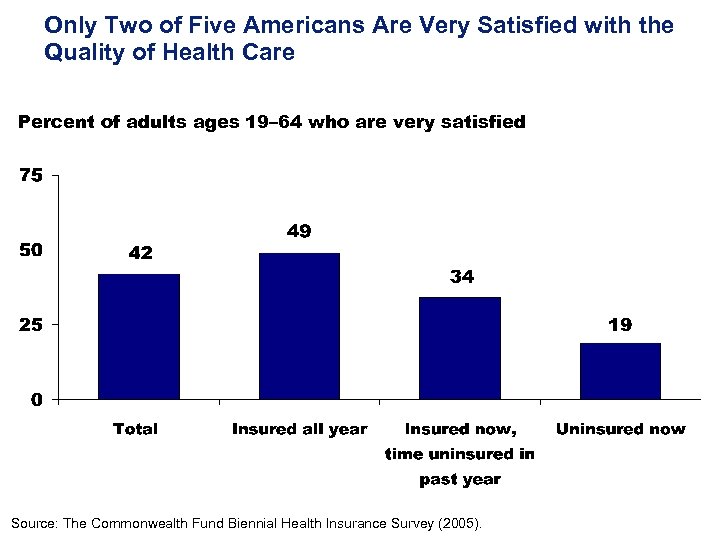
Only Two of Five Americans Are Very Satisfied with the Quality of Health Care Percent of adults ages 19– 64 who are very satisfied Source: The Commonwealth Fund Biennial Health Insurance Survey (2005).
Our Health Care System Is Perfectly Organized To Deliver The Results It Achieves
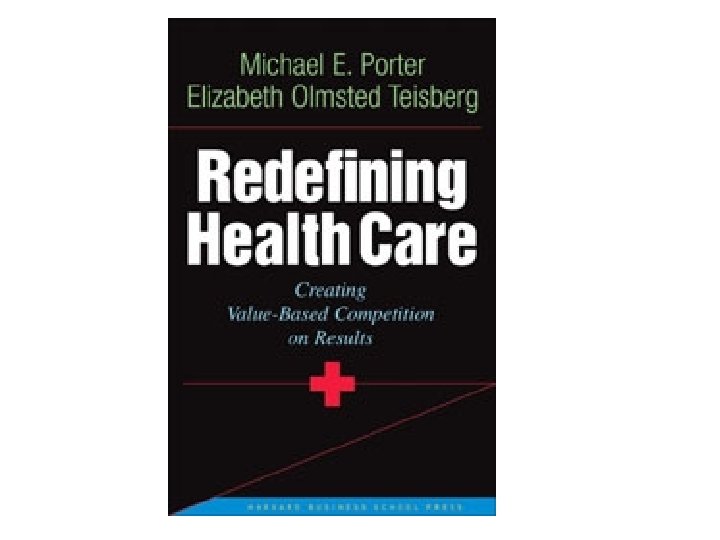
Why Does Our System Fail To Promote Quality? “Competition has taken place at the wrong levels and on the wrong things. It has gravitated to a zero-sum competition, in which the gains of one system participant come at the expense of others” Porter ME; Tershery EO, Redefining Health Care, Harvard Business School Press, 2006.
The Wrong Type of Competition “This kind of competition does not create value for patients, but erodes quality, fosters inefficiency, creates excess capacity, and drives up administrative costs, among other nefarious effects ” Porter ME; Tershery EO, Redefining Health Care, Harvard Business School Press, 2006.
Pay For Performance “Recent quality and pay-forperformance initiatives address process compliance rather than the quality of results achieved”
Competition on Results – Beyond Evidence-Based Medicine “What is needed is competition on results, not standardized care. What is needed is competition on results, not just evidence-based medicine”
Measurement is Vital “Mandatory measurement and reporting of results is perhaps the single most important step in reforming the health care system”
Quality Is Cost-Effective “Better providers can often earn higher margins at the same or lower prices, so quality improvement does not require ever-escalating costs”
Not Everyone Is Up To The Task “…many providers lack the capabilities to achieve true excellence”
What Will It Take To Improve Quality? • • • Elimination of uninsurance A system that provides and pays for preventive care A renewed emphasis on primary care Systems of care must replace the “sole clinician” concept of care delivery Reimbursement for systems of care and achievement of outcomes as opposed to volume or process of care
Innovation – Elimination of Uninsurance
• Massachusetts – Mandates health insurance for all – Tax implications for being uninsured – Coverage for those unable to pay • Other states are pursuing similar solutions • Federal solutions demand committed Presidential leadership
Innovation – Setting Priorities In Preventive Care
Partnership for Prevention Used evidence to rank health impact and cost effectiveness of 25 clinical preventive services
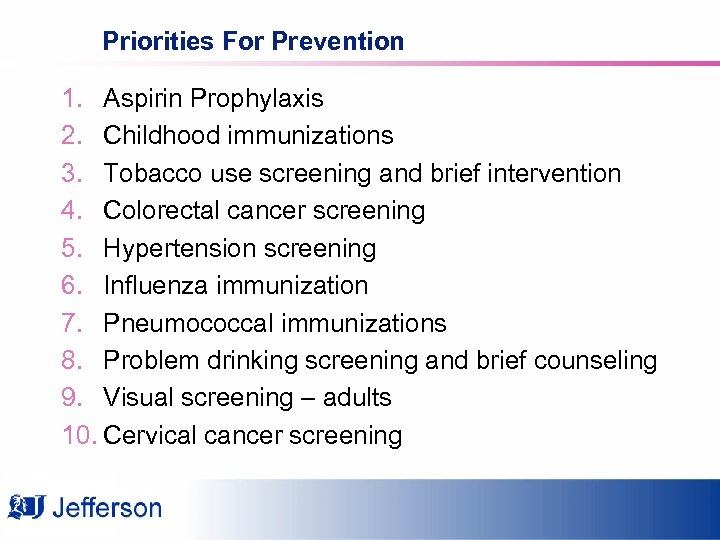
Priorities For Prevention 1. Aspirin Prophylaxis 2. Childhood immunizations 3. Tobacco use screening and brief intervention 4. Colorectal cancer screening 5. Hypertension screening 6. Influenza immunization 7. Pneumococcal immunizations 8. Problem drinking screening and brief counseling 9. Visual screening – adults 10. Cervical cancer screening
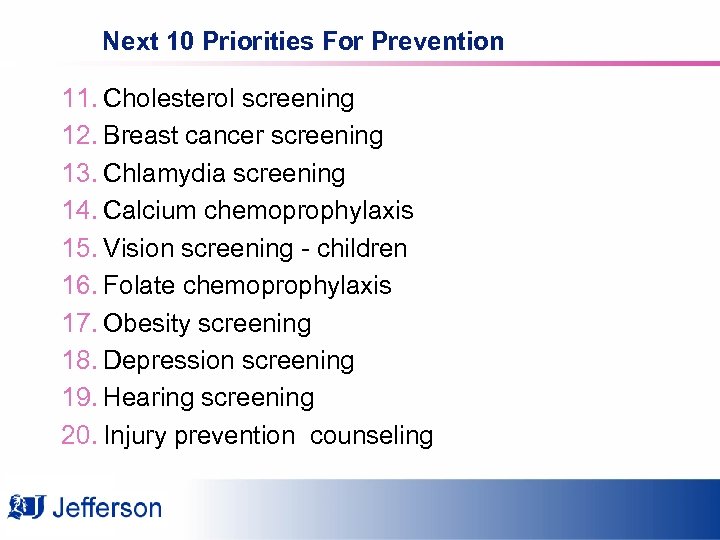
Next 10 Priorities For Prevention 11. Cholesterol screening 12. Breast cancer screening 13. Chlamydia screening 14. Calcium chemoprophylaxis 15. Vision screening - children 16. Folate chemoprophylaxis 17. Obesity screening 18. Depression screening 19. Hearing screening 20. Injury prevention counseling
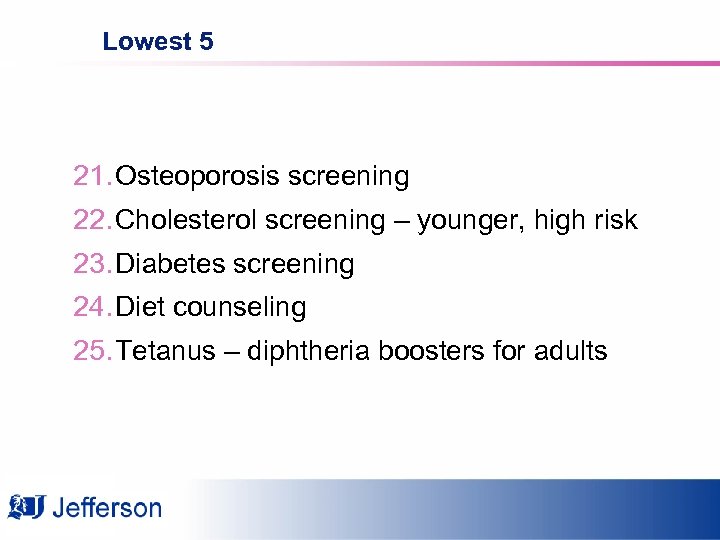
Lowest 5 21. Osteoporosis screening 22. Cholesterol screening – younger, high risk 23. Diabetes screening 24. Diet counseling 25. Tetanus – diphtheria boosters for adults
Innovation – Systems of Care
How Would Quality in Primary Care Look? • Teams of care focusing on specific conditions • • • Open Access scheduling Dedicated prevention visits Outreach to patients who don’t come in Partnership with community outreach Measurement, reporting and accountability – M. A. ’s navigating access to tests – Pharm D. ’s prescribing medications – Electronic monitoring of quality outcomes
Models of Practice: Option 1: “Boutique” Care • Advantages – More time per patient permits improved attention to prevention and chronic disease management – Facilitates use of health maintenance visits – Has the potential to maintain physician income, or even increase it – Does not require a large support staff
Option 1: “Boutique” Care (cont’d) • Disadvantages – Limits provision of care to individuals with reasonable financial means – Creates obstacles to utilizing insurance – Reduces the number of enrolled patients per clinician in an era of primary care shortage – Carries financial risk
Option 2: Maintain Traditional Practice Model But Earn Less • Advantages – Allows the clinician to see fewer patients per session thus permitting: • Greater time per patient • Use of health maintenance visits – Maintenance of a small support staff – Less need to actually learn a new style of practice – AND

Money doesn’t buy happiness anyway
Option 3: Creating a System of Care and Seeing More Patients • Advantages – Leverages the skill levels of staff and clinicians – Creates more “caretakers” for patients – Offers the satisfaction of functioning as a team – Allows for progressive innovation and more ideas – Makes maintenance of income possible
Creating a High Quality Practice: • • Demands leadership • May require a larger staff Demands investment – both spiritual and financial – Almost always does initially • DOES require a staff that functions as professionals • Demands disruptive change

Improving Outcomes: Wender’s Words of Wisdom
First Words of Wisdom: Make Up Your Mind To Improve • Create a value-driven practice • Put outcomes first • Be willing to invest
Second Words of Wisdom: Be Relentless! • Improving quality is HARD • Nothing is perfect • Keep your eye on the prize – Particularly first time out
Third Words of Wisdom: Measure The Right Things • A 1 c achieved…not just how many were done • Percent of eligible individuals successfully screened • Percent of smokers who quit
Fourth Words of Wisdom: Measure and Report Results • Cystic fibrosis center had the nerve to report their results to the families they care for • At LEAST, report to each other
The Corollary To The Fourth Word Of Wisdom • • No EMR? Just measure a few outcomes • Some results are better than no results Audit 5 diabetics; 5 women over 50; 5 men over 50
Fifth Words Of Wisdom: Try Anything • • We used resident moonlighters to reach diabetic patients to get eyes and labs checked Group visits Medical assistants to navigate Quality prevention coordinator Pharm D’s Open Access scheduling Whatever works!
Sixth Words Of Wisdom: Don’t Do It Alone • • Value your whole team • Find ways to partner with hospital or group practice Solo practice? – compare results to someone else’s practice
Characteristics of the Quality Practice • • Leadership that demands performance • • Willingness to try new things A culture of quality and pride in the service provided A commitment to measuring what you do Appropriate use of technology Investment in necessary change
We CAN Do This • Leadership • Investment • Teamwork • Measurement
Скачать презентацию From Barriers to Bridges Improving Chronic Disease and
a32e54085c8eefa1f95eae112cad23a0.ppt