Скачать презентацию from applications or customers 1988 1994
1ee9f8250397b98d1174d65c413fcff1.ppt
- Количество слайдов: 55




 from applications or customers







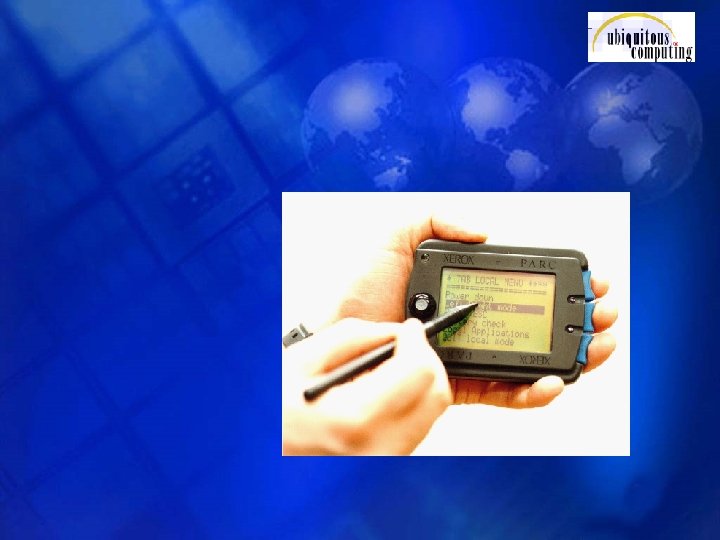
 1988 – 1994 at PARC Xerox


 The trend toward miniaturization of computer components down to an atomic scale is known as nanotechnology
 • Mobile data technology – GSM, GPRS, UMTS, CDMA, WAP, Imode • Wireless data technology – Bluetooth, 802. 11 b • Internet data technology – IP over optical, Broadband • Content services – Web & WAP • Applications – Multimedia, Internet messaging
 a combination of several factors, including the current location, the current user or if there any other Ubicomp devices present in the near surroundings
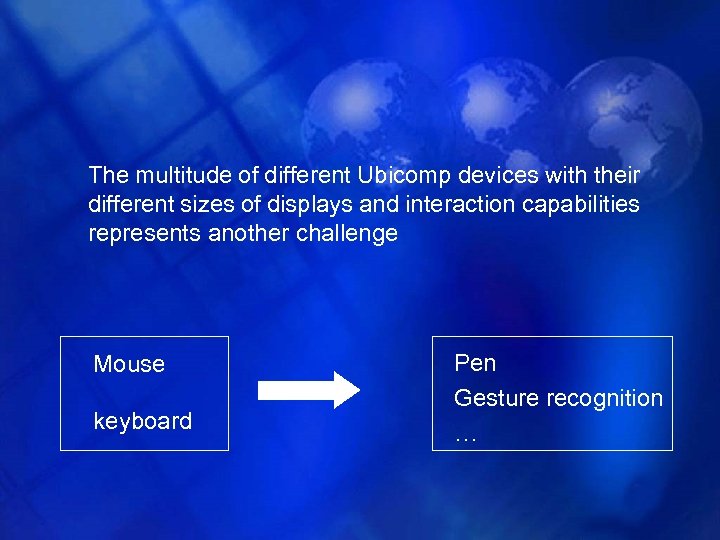 The multitude of different Ubicomp devices with their different sizes of displays and interaction capabilities represents another challenge Mouse keyboard Pen Gesture recognition …
 Another key driver for the final transition will be the use of short-range wireless as well as traditional wired technologies Wireless computing refers to the use of wireless technology to connect computers to a network
 Mobility is made possible communication technologies through wireless Problem of disconnectivity!!! This behaviour is an inherent property of the ubicomp concept and it should not be treated as a failure
 In a ubiquitous computing environment where possibly thousands and thousands of devices are part of scalability of the whole system is a key requirement All the devices are autonomous and must be able to operate independently a decentralized management will most likely be most suitable
 Thus the reliability of ubiquitous services and devices is a crucial requirement In order to construct reliable systems self-monitoring, self-regulating and self-healing features like they are found in biology might be a solution
 This will probably be one of the major factors for the success or failure of the Ubicomp vision Use of technology just existed: JINI, CORBA, ecc… This diversity will make it impossible that there is only one agreed standard
 The ability of devices to describe their behaviour to the network is a key requirement. On the other hand, it can not be assumed that devices in a ubiquitous environment have prior knowledge of the capabilites of other occupants.












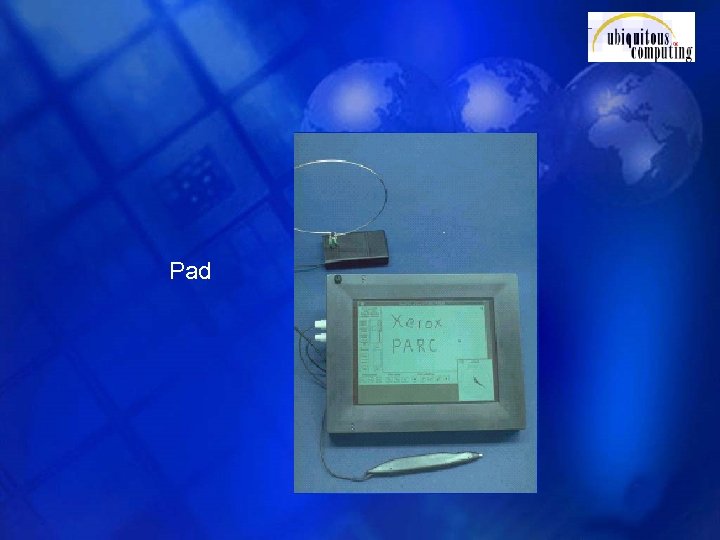 Pad
Pad
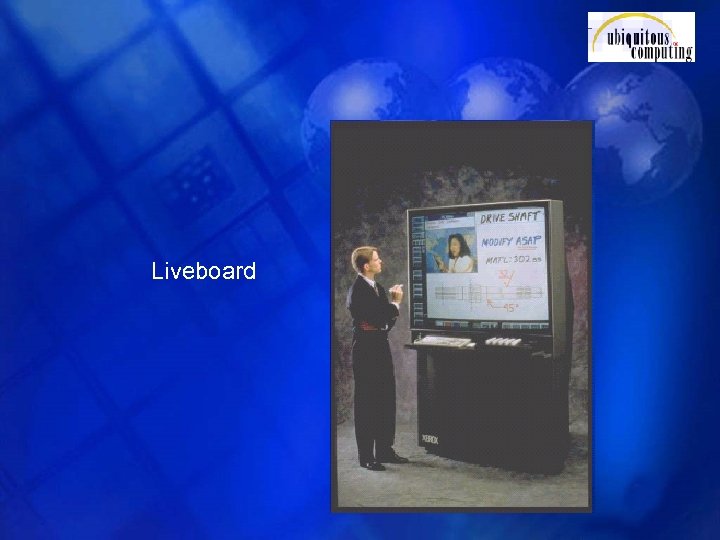 Liveboard

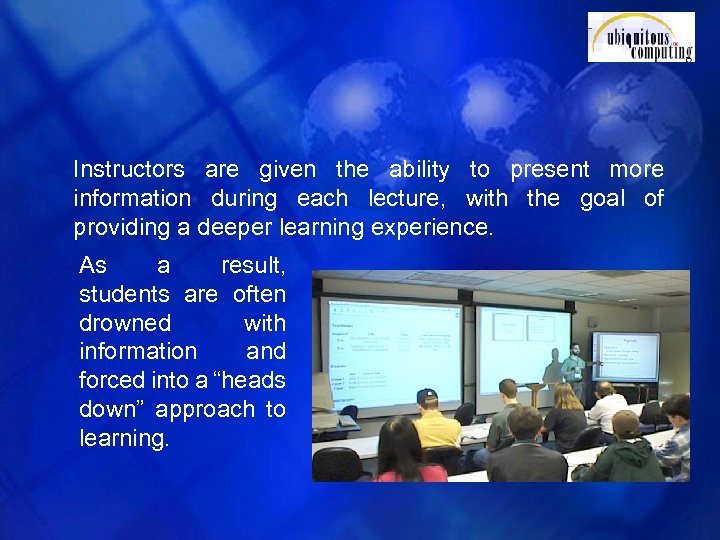 Instructors are given the ability to present more information during each lecture, with the goal of providing a deeper learning experience. As a result, students are often drowned with information and forced into a “heads down” approach to learning.

 • Technology Advancement – Wide adoption of wireless technology: 67 million mobile professionals by 2002 – Cost for wireless access: comparable to wired networks • What does the new Internet provide? – Mobility – Ubiquitous access
 • What is mobile Internet? – Extension of Internet – Extension of Wireless Services
 • Mobile data technology – GSM, GPRS, UMTS, CDMA, WAP, Imode • Wireless data technology – Bluetooth, 802. 11 b • Internet data technology – IP over optical, Broadband • Content services – Web & WAP • Applications – Multimedia, Internet messaging
 The infrastructure of the ubiquitous computing environment may be organized and structured as a cyber equivalent of an ecosystem, a very complex, dynamic infrastructure. A ubiquitous computing system is a integrated system of computing resources, devices, services, and the ubiquitous computing environment (UCE) that provides a communication framework to connect all of the components.


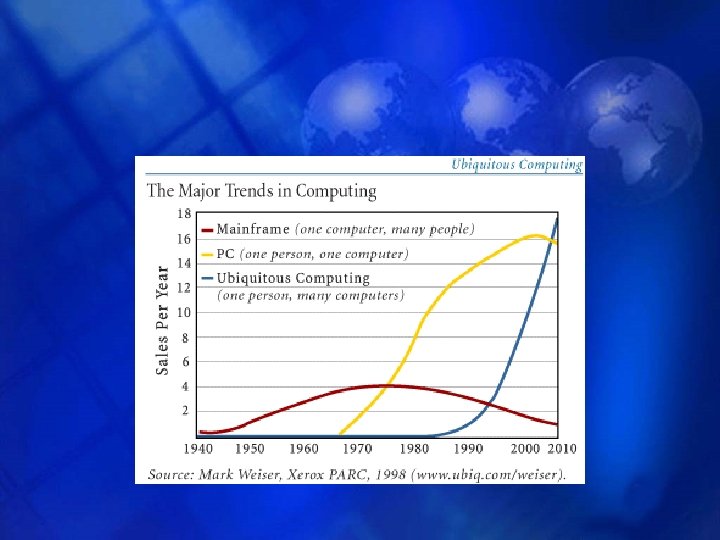
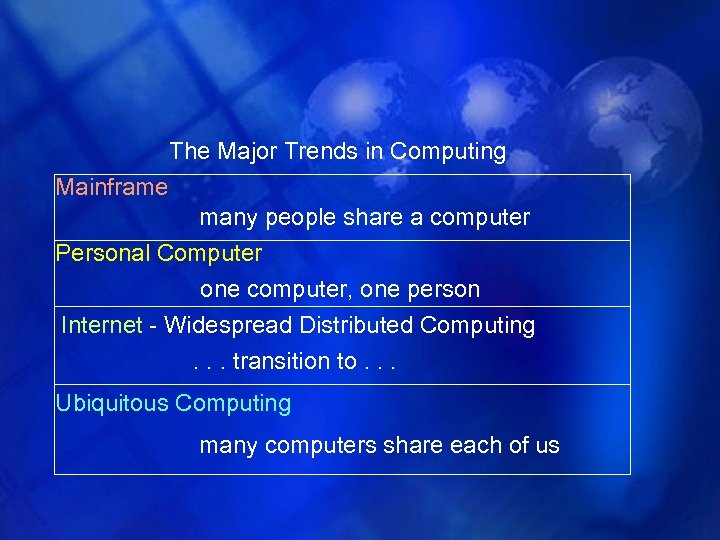 The Major Trends in Computing Mainframe many people share a computer Personal Computer one computer, one person Internet - Widespread Distributed Computing. . . transition to. . . Ubiquitous Computing many computers share each of us