 Скачать презентацию From 1 m to the planet mapping global
dee9ad37438620bd4ba570ccce8715f2.ppt
- Количество слайдов: 18



From 1 m to the planet: mapping global population using Earth Observation: An Overview Jan-Peter Muller Professor of Image Understanding and Remote Sensing MODIS & MISR Science Team Member (NASA EOS Project) POLDER (ADEOSI/II), VEGETATION (SPOT 4), GLI (ADEOSII) Workshop on Gridding Population Data Columbia University, New York Tuesday 2 nd May 2000 DEPARTMENT OF GEOMATIC ENGINEERING
Overview How can we use remote sensing to measure what is of relevance to global population mapping? Current Space Earth Observation platforms of relevance Exemplar 1: MODIS & VEGETATION for land surface BRDF/albedo for mapping large-scale urban structures Exemplar 2: ERS SAR interferometry for mapping urban land use and land use change at the sub-hectare scale Exemplar 3: IRS-1 C for mapping urban land use for European cities (EU MURBANDY) Exemplar 4: IKONOS-2 for automated building detection and extraction (including height) Exemplar 5: POLDER & MISR for mapping aerosol sources Exemplar 6: MOPITT for mapping CO CEOS-IGOS Project proposal: Global mapping of urban population DEPARTMENT OF GEOMATIC ENGINEERING
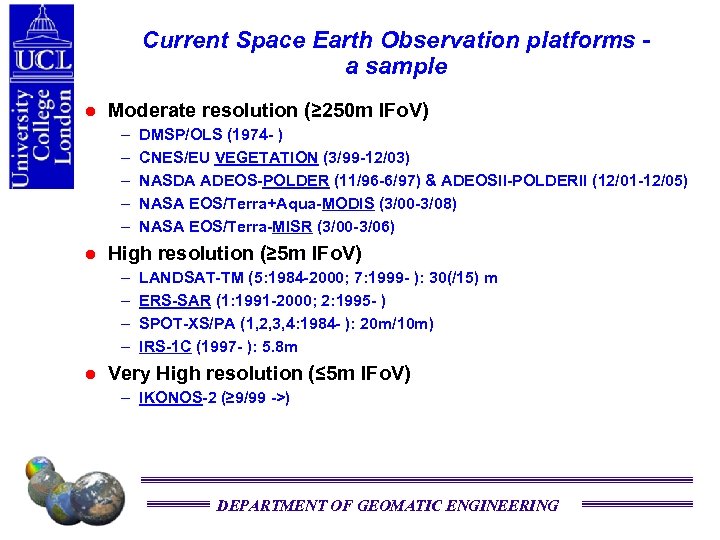
Current Space Earth Observation platforms a sample Moderate resolution (≥ 250 m IFo. V) – – – High resolution (≥ 5 m IFo. V) – – DMSP/OLS (1974 - ) CNES/EU VEGETATION (3/99 -12/03) NASDA ADEOS-POLDER (11/96 -6/97) & ADEOSII-POLDERII (12/01 -12/05) NASA EOS/Terra+Aqua-MODIS (3/00 -3/08) NASA EOS/Terra-MISR (3/00 -3/06) LANDSAT-TM (5: 1984 -2000; 7: 1999 - ): 30(/15) m ERS-SAR (1: 1991 -2000; 2: 1995 - ) SPOT-XS/PA (1, 2, 3, 4: 1984 - ): 20 m/10 m) IRS-1 C (1997 - ): 5. 8 m Very High resolution (≤ 5 m IFo. V) – IKONOS-2 (≥ 9/99 ->) DEPARTMENT OF GEOMATIC ENGINEERING
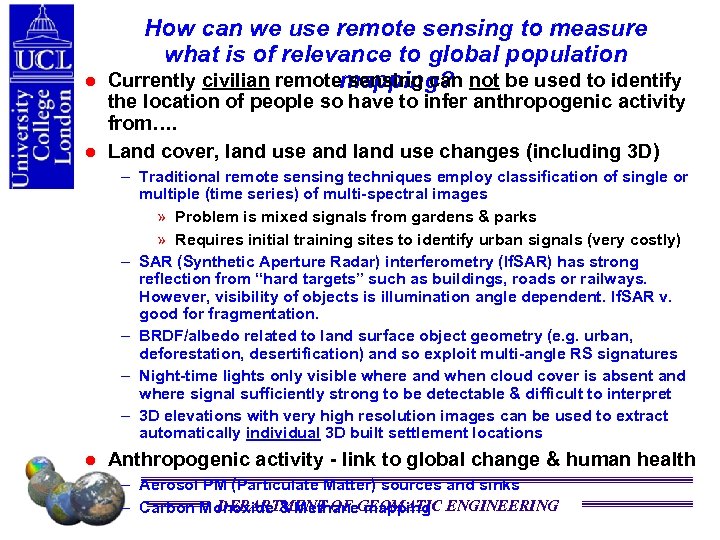
How can we use remote sensing to measure what is of relevance to global population Currently civilian remotemapping? not be used to identify sensing can the location of people so have to infer anthropogenic activity from…. Land cover, land use and land use changes (including 3 D) – Traditional remote sensing techniques employ classification of single or multiple (time series) of multi-spectral images » Problem is mixed signals from gardens & parks » Requires initial training sites to identify urban signals (very costly) – SAR (Synthetic Aperture Radar) interferometry (If. SAR) has strong reflection from “hard targets” such as buildings, roads or railways. However, visibility of objects is illumination angle dependent. If. SAR v. good for fragmentation. – BRDF/albedo related to land surface object geometry (e. g. urban, deforestation, desertification) and so exploit multi-angle RS signatures – Night-time lights only visible where and when cloud cover is absent and where signal sufficiently strong to be detectable & difficult to interpret – 3 D elevations with very high resolution images can be used to extract automatically individual 3 D built settlement locations Anthropogenic activity - link to global change & human health – Aerosol PM (Particulate Matter) sources and sinks DEPARTMENT OF mapping – Carbon Monoxide & Methane. GEOMATIC ENGINEERING
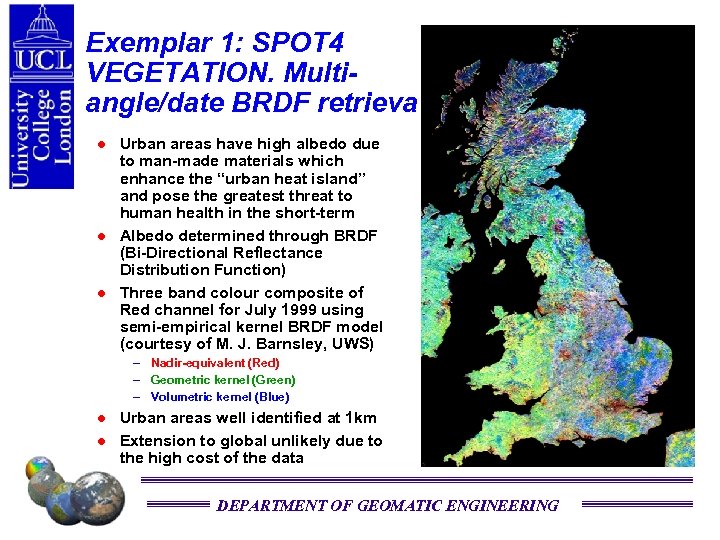
Exemplar 1: SPOT 4 VEGETATION. Multiangle/date BRDF retrieval Urban areas have high albedo due to man-made materials which enhance the “urban heat island” and pose the greatest threat to human health in the short-term Albedo determined through BRDF (Bi-Directional Reflectance Distribution Function) Three band colour composite of Red channel for July 1999 using semi-empirical kernel BRDF model (courtesy of M. J. Barnsley, UWS) – Nadir-equivalent (Red) – Geometric kernel (Green) – Volumetric kernel (Blue) Urban areas well identified at 1 km Extension to global unlikely due to the high cost of the data DEPARTMENT OF GEOMATIC ENGINEERING
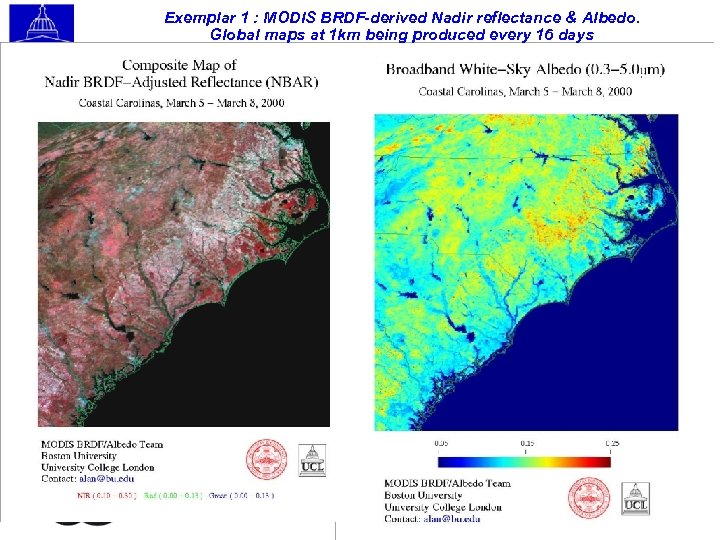
Exemplar 1 : MODIS BRDF-derived Nadir reflectance & Albedo. Global maps at 1 km being produced every 16 days DEPARTMENT OF GEOMATIC ENGINEERING
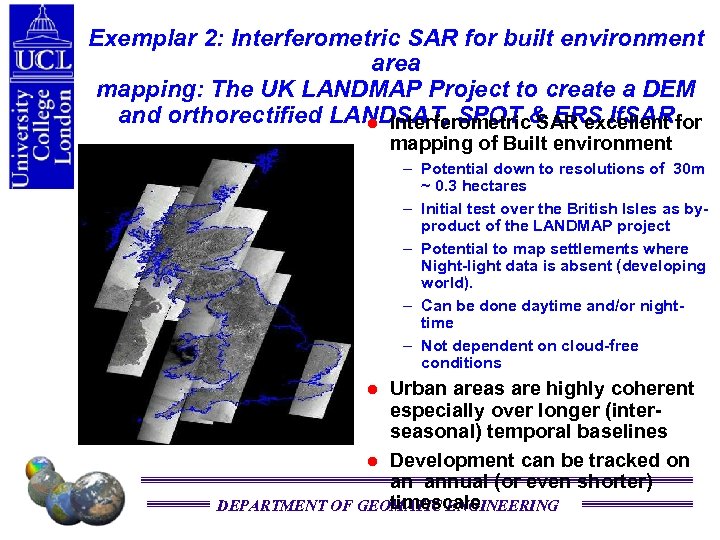
Exemplar 2: Interferometric SAR for built environment area mapping: The UK LANDMAP Project to create a DEM and orthorectified LANDSAT, SPOT & ERS If. SAR for Interferometric SAR excellent mapping of Built environment – Potential down to resolutions of 30 m ~ 0. 3 hectares – Initial test over the British Isles as byproduct of the LANDMAP project – Potential to map settlements where Night-light data is absent (developing world). – Can be done daytime and/or nighttime – Not dependent on cloud-free conditions Urban areas are highly coherent especially over longer (interseasonal) temporal baselines Development can be tracked on an annual (or even shorter) timescale DEPARTMENT OF GEOMATIC ENGINEERING
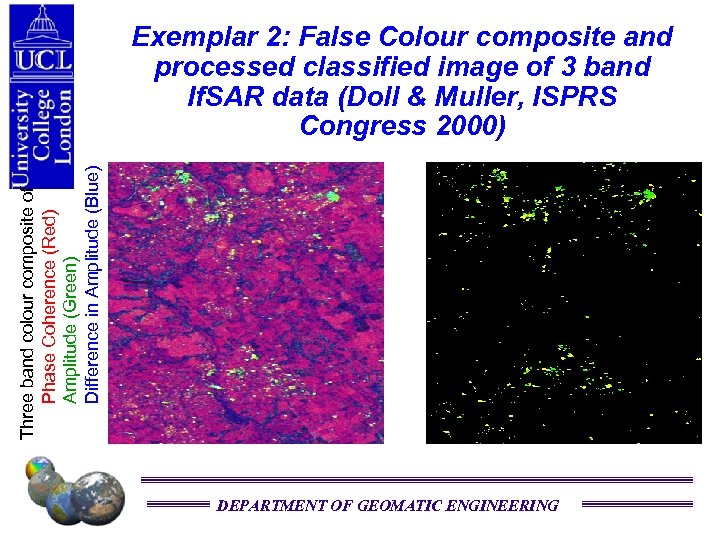
Three band colour composite of Phase Coherence (Red) Amplitude (Green) Difference in Amplitude (Blue) Exemplar 2: False Colour composite and processed classified image of 3 band If. SAR data (Doll & Muller, ISPRS Congress 2000) DEPARTMENT OF GEOMATIC ENGINEERING
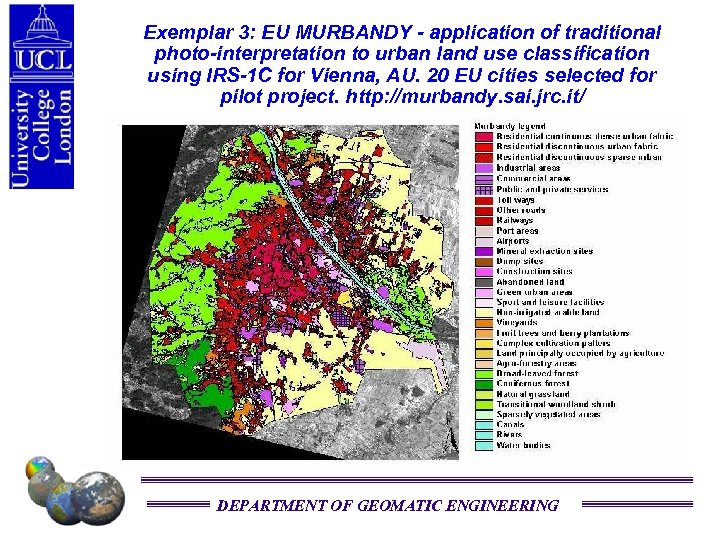
Exemplar 3: EU MURBANDY - application of traditional photo-interpretation to urban land use classification using IRS-1 C for Vienna, AU. 20 EU cities selected for pilot project. http: //murbandy. sai. jrc. it/ DEPARTMENT OF GEOMATIC ENGINEERING
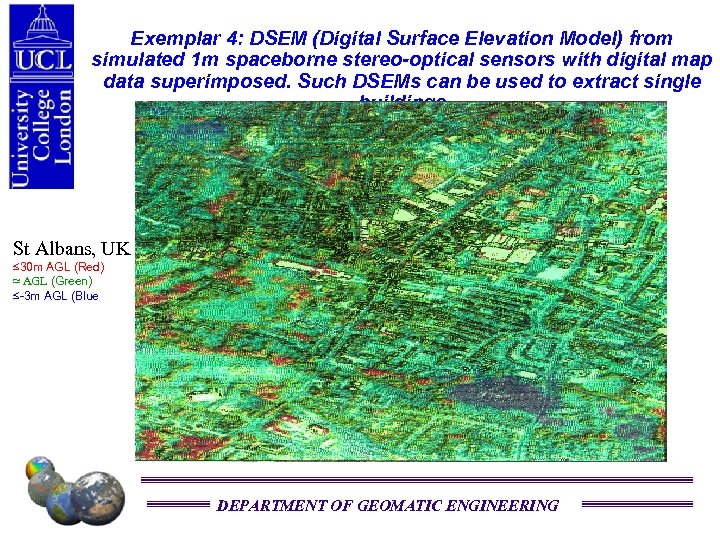
Exemplar 4: DSEM (Digital Surface Elevation Model) from simulated 1 m spaceborne stereo-optical sensors with digital map data superimposed. Such DSEMs can be used to extract single buildings St Albans, UK ≤ 30 m AGL (Red) ≈ AGL (Green) ≤-3 m AGL (Blue DEPARTMENT OF GEOMATIC ENGINEERING
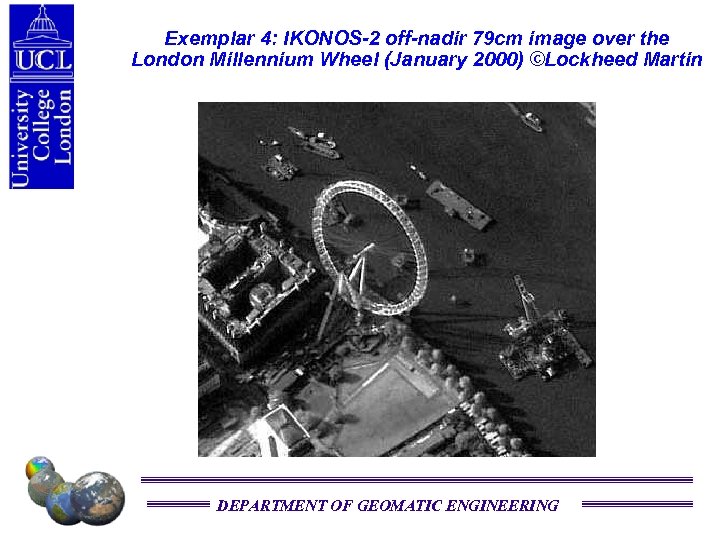
Exemplar 4: IKONOS-2 off-nadir 79 cm image over the London Millennium Wheel (January 2000) ©Lockheed Martin DEPARTMENT OF GEOMATIC ENGINEERING
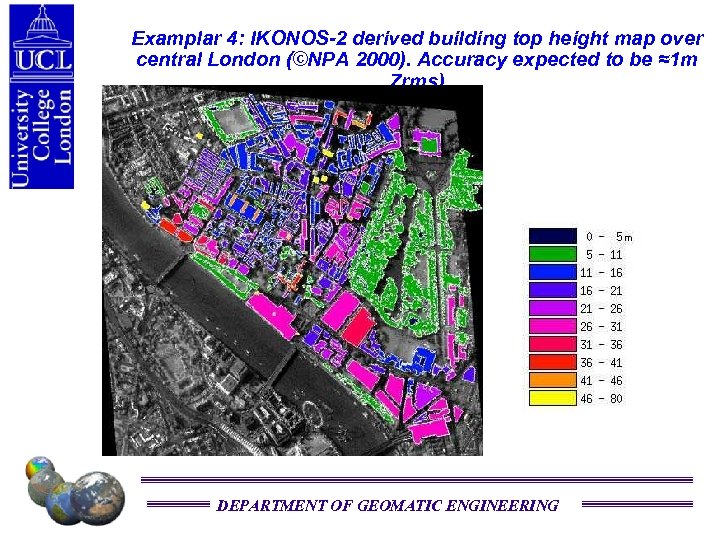
Examplar 4: IKONOS-2 derived building top height map over central London (©NPA 2000). Accuracy expected to be ≈1 m Zrms) DEPARTMENT OF GEOMATIC ENGINEERING
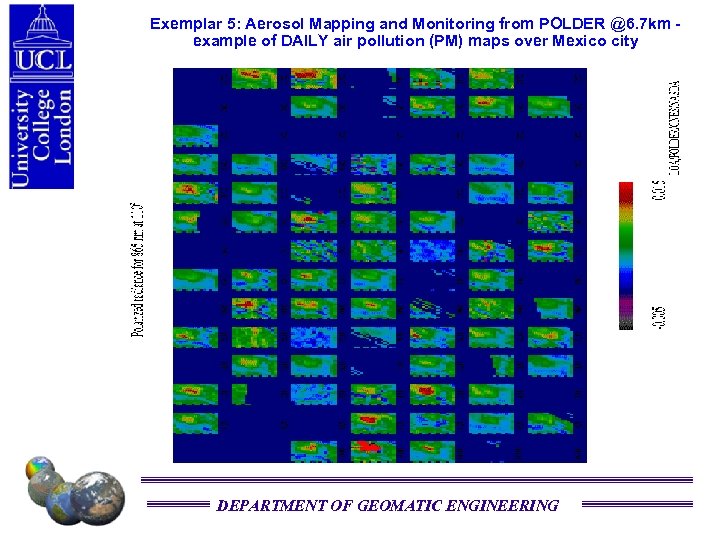
Exemplar 5: Aerosol Mapping and Monitoring from POLDER @6. 7 km example of DAILY air pollution (PM) maps over Mexico city DEPARTMENT OF GEOMATIC ENGINEERING
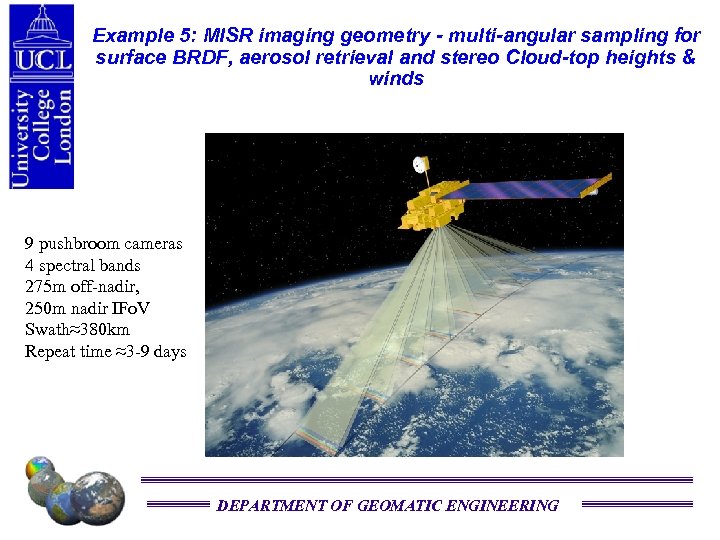
Example 5: MISR imaging geometry - multi-angular sampling for surface BRDF, aerosol retrieval and stereo Cloud-top heights & winds 9 pushbroom cameras 4 spectral bands 275 m off-nadir, 250 m nadir IFo. V Swath≈380 km Repeat time ≈3 -9 days DEPARTMENT OF GEOMATIC ENGINEERING
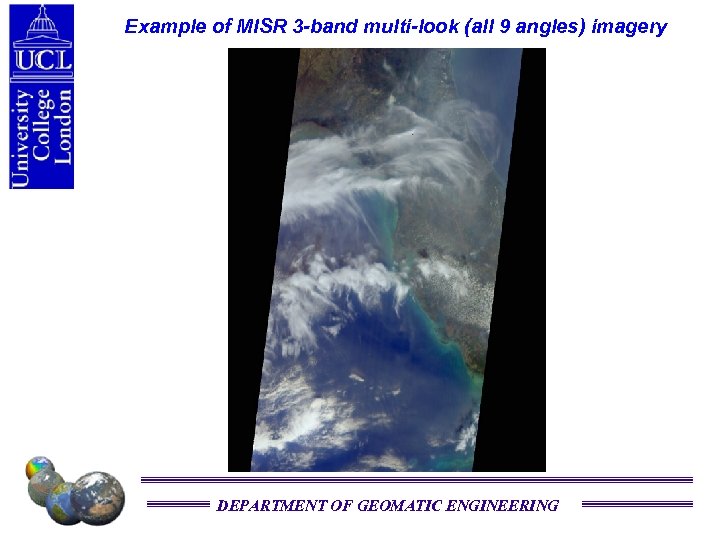
Example of MISR 3 -band multi-look (all 9 angles) imagery DEPARTMENT OF GEOMATIC ENGINEERING
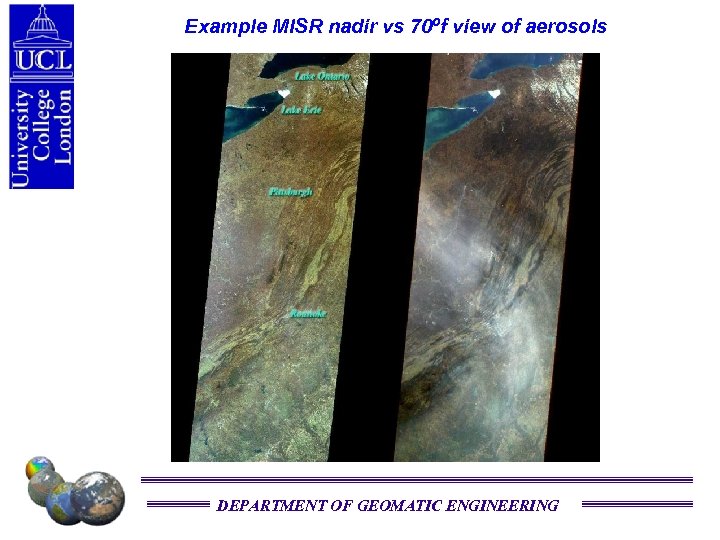
Example MISR nadir vs 70ºf view of aerosols DEPARTMENT OF GEOMATIC ENGINEERING
Examplar 6: Examples of anthropogenic and natural urbanatmosphere interactions from MODIS, CERES & MOPITT DEPARTMENT OF GEOMATIC ENGINEERING
CEOS-IGOS Project proposal: Global mapping of urban population At a recent CEOS (Committee on Earth Observing Systems) WGISS (Working Group on Information Systems) meeting held at UCL, UK it was suggested that a new IGOS (International Global Observing System) project should be initiated along the lines of either the global Carbon Inventory or the global Forest Map project. This idea is currently being debated by email. IGOS are prototype very large-scale projects with active support from the space agencies who provide not only data but often funding for the generation of value-added products. It is not restricted to the academic community but includes government and the private sector Given the results of this workshop (and especially this session), should we push within CEOS to establish this project? Is there sufficient scientific justification even given the uncertainties? DEPARTMENT OF GEOMATIC ENGINEERING
Скачать презентацию From 1 m to the planet mapping global
dee9ad37438620bd4ba570ccce8715f2.ppt