Скачать презентацию Freedom of speech and its influence on the
Freedom of speech and its influence on the economic climate.pptx
- Количество слайдов: 10
 Freedom of speech and its influence on the economic climate Turkey and Baltic countries
 Presentation structure 1. The relationship between freedom of speech and economic development 2. World recognized researches on Freedom of Speech 3. Media Freedom in Turkey 4. Media Freedom in Baltics 5. Global tendencies on Freedom of Speech
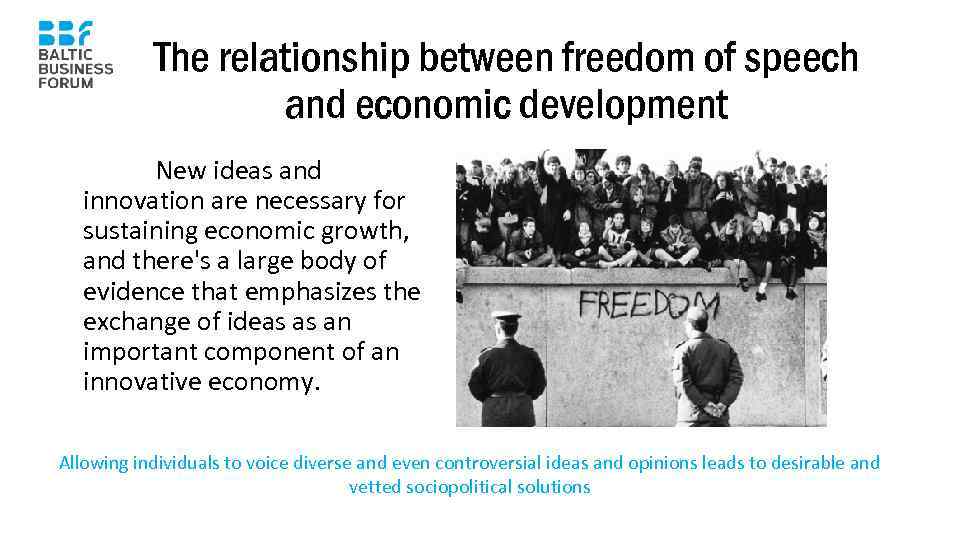 The relationship between freedom of speech and economic development New ideas and innovation are necessary for sustaining economic growth, and there's a large body of evidence that emphasizes the exchange of ideas as an important component of an innovative economy. Allowing individuals to voice diverse and even controversial ideas and opinions leads to desirable and vetted sociopolitical solutions
 World recognized researches on Freedom of Speech • In a 2014 World Bank research project, Sanjukta Roy found that in Sub-Sahara Africa, developed media systems that maintained higher levels of press freedoms linked to lower levels of political risk. In other words, countries that have freer media are less likely to experience violent political uprisings and transitions. • In a 2008 UNESCO special report found that press freedoms were more restricted in countries that spent more on military (the US an obvious outlier here). They also found that in countries that experienced more violence, journalists were more likely to be in danger, which influenced the media environment. “Generally speaking, in a State where public discussion exists and the media can deal freely with the problems of society, large-scale violence is not tolerated. ” • Researchers Abdullah Alam and Syed Zulfiqar Ali Shah, found that press freedoms contributed to economic growth in a country, and that economically developing countries increasingly implement press freedoms. “This bidirectional relationship indicates that freedom of press plays a vital role in the development of the economy and the reverse relationship points out that an economically growing country implements additional press freedoms, ” stated Alam & Shah.
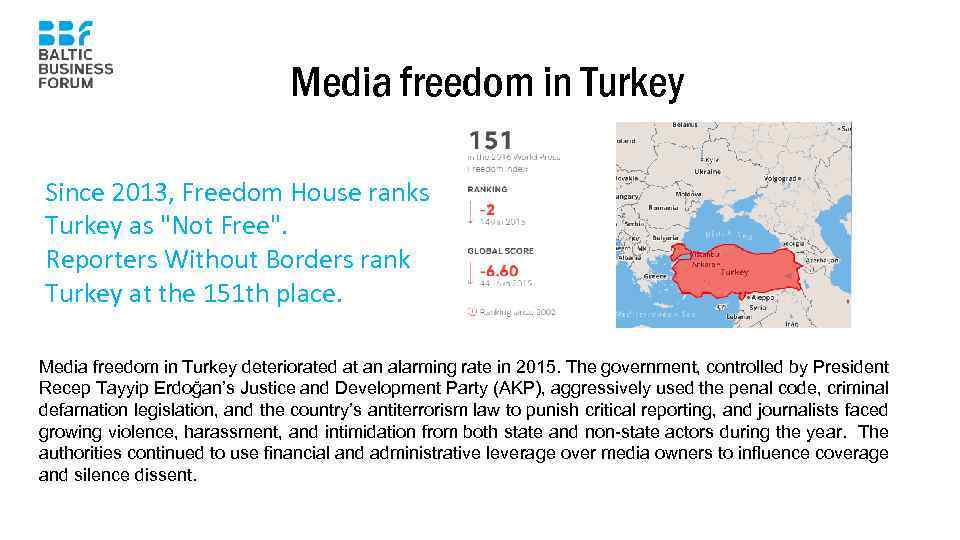 Media freedom in Turkey Since 2013, Freedom House ranks Turkey as "Not Free". Reporters Without Borders rank Turkey at the 151 th place. Media freedom in Turkey deteriorated at an alarming rate in 2015. The government, controlled by President Recep Tayyip Erdoğan’s Justice and Development Party (AKP), aggressively used the penal code, criminal defamation legislation, and the country’s antiterrorism law to punish critical reporting, and journalists faced growing violence, harassment, and intimidation from both state and non-state actors during the year. The authorities continued to use financial and administrative leverage over media owners to influence coverage and silence dissent.
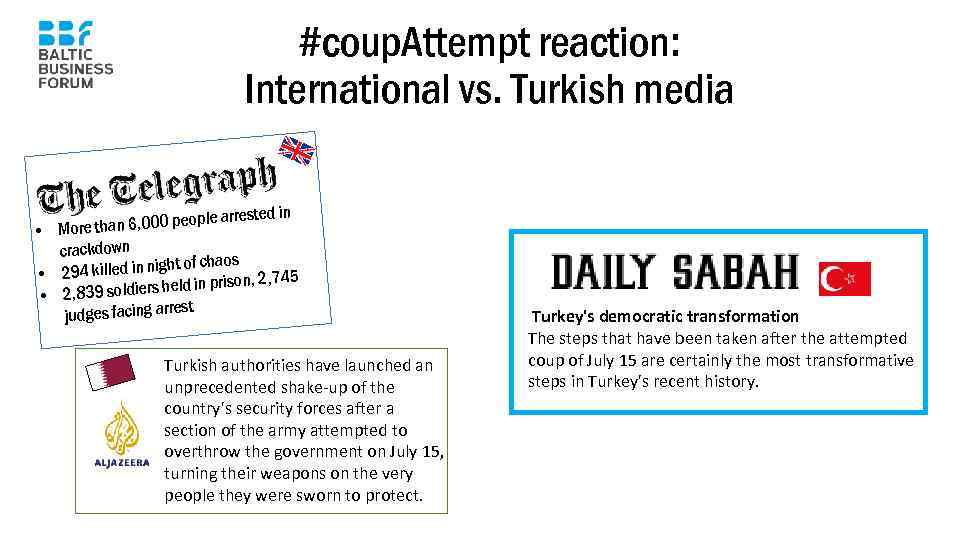 #coup. Attempt reaction: International vs. Turkish media arrested in an 6, 000 people • More th crackdown t of chaos 294 killed in nigh • son, 2, 745 oldiers held in pri • 2, 839 s st judges facing arre Turkish authorities have launched an unprecedented shake-up of the country's security forces after a section of the army attempted to overthrow the government on July 15, turning their weapons on the very people they were sworn to protect. Turkey's democratic transformation The steps that have been taken after the attempted coup of July 15 are certainly the most transformative steps in Turkey's recent history.
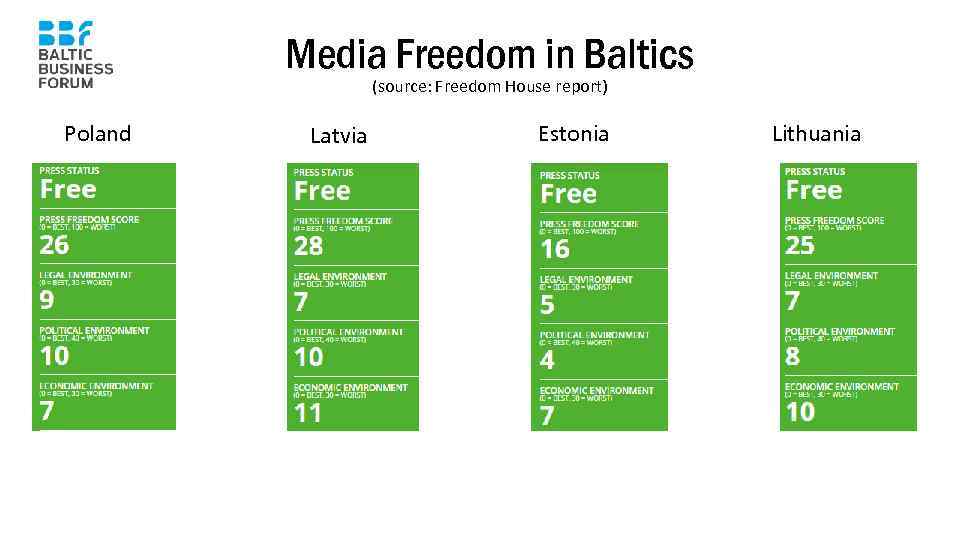 Media Freedom in Baltics (source: Freedom House report) Poland Latvia Estonia Lithuania
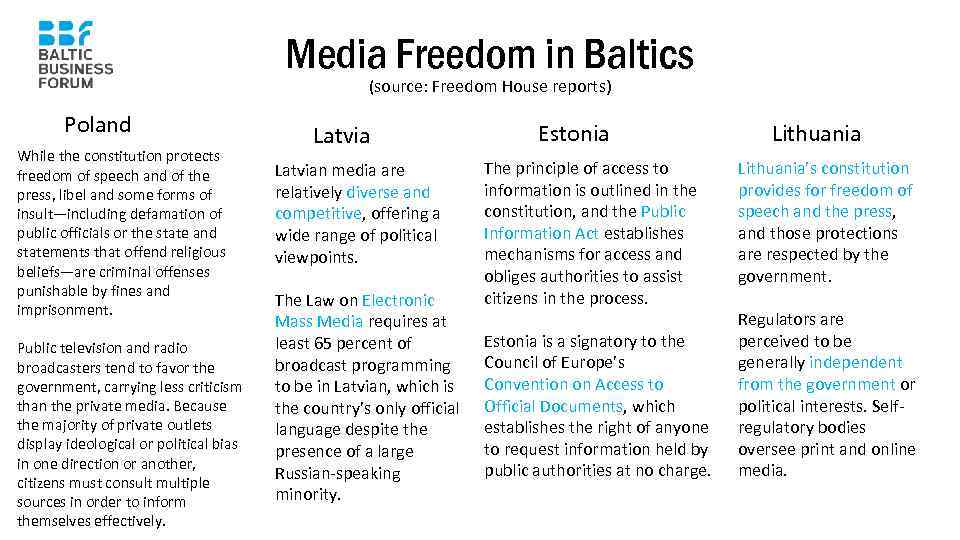 Media Freedom in Baltics (source: Freedom House reports) Poland While the constitution protects freedom of speech and of the press, libel and some forms of insult—including defamation of public officials or the state and statements that offend religious beliefs—are criminal offenses punishable by fines and imprisonment. Public television and radio broadcasters tend to favor the government, carrying less criticism than the private media. Because the majority of private outlets display ideological or political bias in one direction or another, citizens must consult multiple sources in order to inform themselves effectively. Latvian media are relatively diverse and competitive, offering a wide range of political viewpoints. The Law on Electronic Mass Media requires at least 65 percent of broadcast programming to be in Latvian, which is the country’s only official language despite the presence of a large Russian-speaking minority. Estonia The principle of access to information is outlined in the constitution, and the Public Information Act establishes mechanisms for access and obliges authorities to assist citizens in the process. Estonia is a signatory to the Council of Europe’s Convention on Access to Official Documents, which establishes the right of anyone to request information held by public authorities at no charge. Lithuania’s constitution provides for freedom of speech and the press, and those protections are respected by the government. Regulators are perceived to be generally independent from the government or political interests. Selfregulatory bodies oversee print and online media.
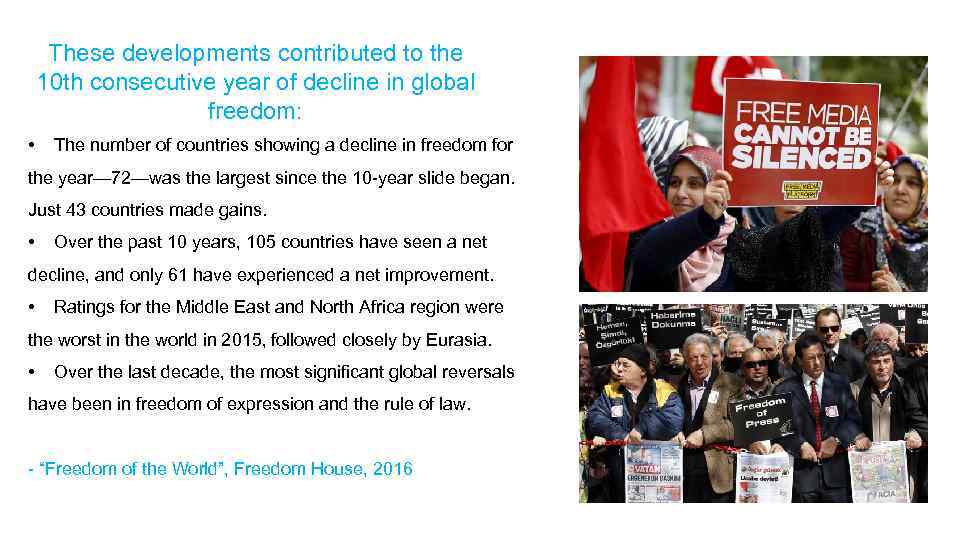 These developments contributed to the 10 th consecutive year of decline in global freedom: • The number of countries showing a decline in freedom for the year— 72—was the largest since the 10 -year slide began. Just 43 countries made gains. • Over the past 10 years, 105 countries have seen a net decline, and only 61 have experienced a net improvement. • Ratings for the Middle East and North Africa region were the worst in the world in 2015, followed closely by Eurasia. • Over the last decade, the most significant global reversals have been in freedom of expression and the rule of law. - “Freedom of the World”, Freedom House, 2016